SHORT STORIES
The Bare Bones of a Plot
1. Exposition, or basic situation – the opening
of the story, when the characters and their
conflict are introduced
2. Rising action, or complication – the main
character takes some action to resolve the
conflict
3. Climax – the key scene in the story, a tense
or exciting or terrifying moment
4. Resolution – the end of the story when all
of the struggles are over
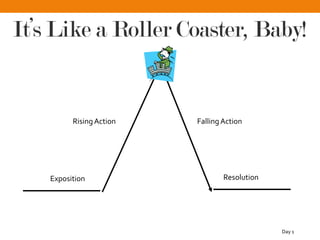
It’s Like a Roller Coaster, Baby!
Climax
RisingAction
Exposition
FallingAction
Resolution
Day 1
Sequencing of Events
• Timing:
• Chronological order – events unfold in real time
• Pacing – the speed that an author chooses to let a
story’s events unfold
• Playing with Time:
• Flashback – an episode from the past is presented
and interrupts the flow of events
• Flash-forward – a jumping ahead into the future
• Foreshadowing – hints or clues that suggest what
is to come
The Fuel of the Narrative: Conflict
• Internal Conflict – the struggle that takes
place in a character’s mind or heart
• human vs. him/herself
• External Conflict – the struggle that takes
place “outside” the character
• human vs. human
• human vs. society
• human vs. nature
Sensory Details
• Setting – the time and place the story is set,
along with any pertinent background
information
• Details – facts, observations, and incidents
used to develop a story
• Imagery – language that appeals to one or
more of the five senses
Context Clue Competition
1. He could see the ship going away from him,
receding in the distance.
2. “Don’t be alarmed,” said Rainsford, with a smile
he hoped was disarming.
3. Zaroff’s whole life was one prolonged hunt.
4. The general smiled the quiet smile of one who
has faced an obstacle and surmounted it with
success.
5. Zaroff appeared unruffled, even when Rainsford
called him a murderer.
6. The protruding cliffs blocked Rainsford’s sight
of the ocean.
Reading Quiz
Answer the following questions in
complete sentences:
1. What is the most dangerous game?
2. Explain the significance of the last
sentence of the story: “He had
never slept in a better bed,
Rainsford decided.”
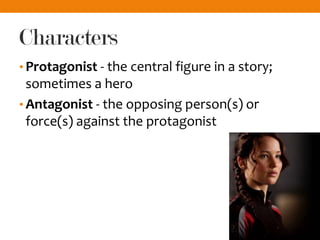
Characters
• Protagonist - the central figure in a story;
sometimes a hero
• Antagonist - the opposing person(s) or
force(s) against the protagonist
Characters
• Flat Character - a literary character whose
personality can be defined by one or two
traits and does not change in the course of
the story
• Round Character - a character in fiction
whose personality, background, motives, and
other features are fully described by the
author
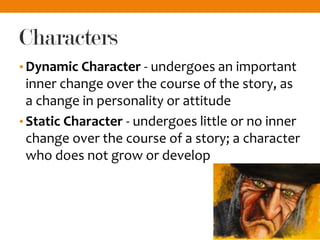
Characters
• Dynamic Character - undergoes an important
inner change over the course of the story, as
a change in personality or attitude
• Static Character - undergoes little or no inner
change over the course of a story; a character
who does not grow or develop
THINK-PAIR-SHARE
1. Is Rainsford the protagonist or antagonist?
2. Is Rainsford flat or round?
3. Is Rainsford dynamic or static?
DON’T FORGET: BACK UP YOUR
ANSWER WITH EVIDENCE!
“HELEN ON EIGHTY-
SIXTH STREET”
Reading Quiz
Answer the following questions in
complete sentences:
1. What is Vita’s family situation?
2. Tell me one of Vita’s three wishes.
THINK-PAIR-SHARE
1. What is the primary conflict in “Helen on
Eighty-Sixth Street?”
2. Is it an internal or external conflict?
DON’T FORGET: BACK UP YOUR
ANSWER WITH EVIDENCE!
Characterization
How does an author tell us about a character?
1. Speech
• dialogue – conversation between characters
2. Appearance
3. Private Thoughts
4. How Other Characters Feel
5. Actions
• motivation – the reason a character thinks, feels,
or acts the way he/she does
Characterization
• Direct – a writer tells us directly what a
character is like or what a person’s motives
are
• Indirect – a writer shows us a character but
allows us to interpret for ourselves the kind
of person we are meeting
Points of View
• Omniscient – the narrator is not in the story
and almost never refers to himself or herself
directly
• First person – the narrator is a character in
the story who talks to the readers using the
pronoun I
• Third person limited – the narrator zooms in
on one character but talks about that
character in third-person
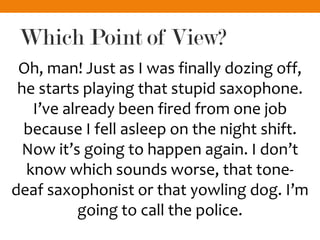
Which Point of View?
Oh, man! Just as I was finally dozing off,
he starts playing that stupid saxophone.
I’ve already been fired from one job
because I fell asleep on the night shift.
Now it’s going to happen again. I don’t
know which sounds worse, that tone-
deaf saxophonist or that yowling dog. I’m
going to call the police.
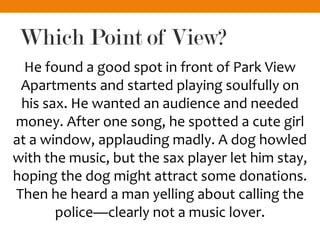
Which Point of View?
He found a good spot in front of Park View
Apartments and started playing soulfully on
his sax. He wanted an audience and needed
money. After one song, he spotted a cute girl
at a window, applauding madly. A dog howled
with the music, but the sax player let him stay,
hoping the dog might attract some donations.
Then he heard a man yelling about calling the
police—clearly not a music lover.
Which Point of View?
One day a young woman looked out her
apartment window and saw a man playing a
saxophone. “Cool,” she thought as she swayed
to his tune. A big brown dog joined the man and
howled along with the music.
Then a man in pajamas yelled from another
window, complaining that the noise woke him
up and he was going to call the police. This man,
who worked the night shift and had to sleep all
day, liked cats better than dogs anyway.
Unreliable Narrator
• An unreliable narrator may not always know
the whole truth or many purpose choose to
deceive readers.
• In other words, the narrator’s credibility is
seriously compromised, perhaps by:
1. mental illness
2. immaturity
3. arrogance
4. lying
Context Clue Competition
1. Fortunato’s drunkenness precluded his total
understanding of his fate.
2. The secret catacombs ensured Montresor’s
impunity from his crime.
3. Montresor viewed Fortunato’s death as
suitable retribution for Fortunato’s crimes.
4. “I don’t wish to impose on your time!” lied
Montresor.
5. Recoiling, as if in horror, Montresor then
walked away.
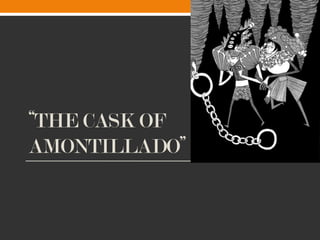
“THE CASK OF
AMONTILLADO”
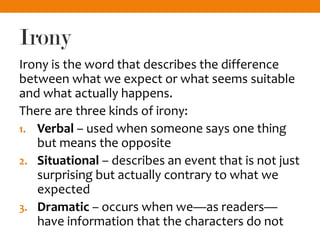
Irony
Irony is the word that describes the difference
between what we expect or what seems suitable
and what actually happens.
There are three kinds of irony:
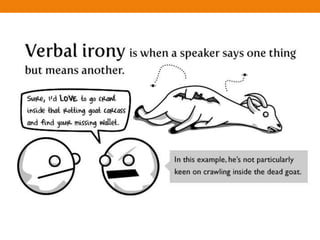
1. Verbal – used when someone says one thing
but means the opposite
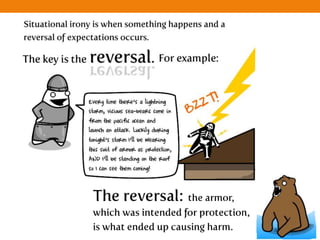
2. Situational – describes an event that is not just
surprising but actually contrary to what we
expected
3. Dramatic – occurs when we—as readers—
have information that the characters do not
Examples of Verbal Irony
• “My, you’ve certainly made a mess of your life!”
said the father to his daughter, who just
graduated with honors.
• “You’re my favorite son-in-law,” the father said to
the man he wished his daughter hadn’t married.
• “Isn’t this lovely weather we’re having?” Tracy
said, looking at the storm through the classroom
window.
• “Come,” [Zaroff] said, “we shouldn’t be chatting
here. We can talk later. Now you want clothes,
food, rest. You shall have them. This is a most
restful spot.”
Examples of Situational Irony
• A man lights a stress-relief candle to relieve his anxiety,
but the candles ends up burning his house down.
• Sue wanted to attend the city council meeting on
traffic jams, but she missed it. She was stuck in traffic!
• Dorothy travels far to see a wizard who will help her to
go home, only to find out that she had the ability to get
home by herself the entire time.
• A killer on the loose raises his gun to shoot another
victim. A loud gunshot is heard, and the killer collapses
at the feet of the policewoman who caught him.
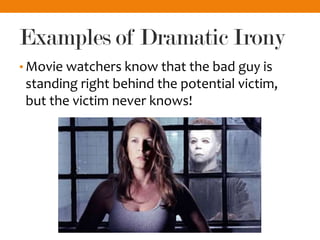
Examples of Dramatic Irony
• Movie watchers know that the bad guy is
standing right behind the potential victim,
but the victim never knows!
“THE SNIPER”
Reading Quiz
Answer the following questions in
complete sentences:
1. What does the sniper do to trick
his enemy?
2. What discovery does the sniper
make at the end of the story?
Review: Imagery
•Imagery is language
that appeals to one or
more of the five senses.
THE MESSAGE
•A theme is a central message or main
idea in a literary work.
1. It’s what the author wants you to
learn or know.
2. It’s a broad idea about life, usually
stated in a single sentence.
3. The author usually doesn’t come
right out and say it. Readers must
infer it.
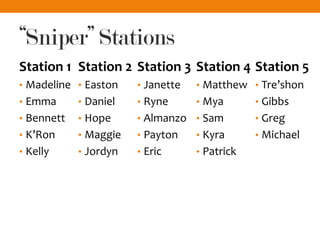
“Sniper” Stations
Station 1
• Madeline
• Emma
• Bennett
• K’Ron
• Kelly
Station 2
• Easton
• Daniel
• Hope
• Maggie
• Jordyn
Station 3
• Janette
• Ryne
• Almanzo
• Payton
• Eric
Station 4
• Matthew
• Mya
• Sam
• Kyra
• Patrick
Station 5
• Tre’shon
• Gibbs
• Greg
• Michael
“LIBERTY”
Reading Quiz
Answer the following questions in
complete sentences:
1. Why does Papi name the dog
Liberty?
2. Why does the narrator let her dog
run free at the end of the story?
THE MESSAGE
•A theme is a central message in a literary
work.
1. It’s what the author wants you to
learn or know.
2. It’s a broad statement about life.
3. The author usually doesn’t come
right out and say it. Readers must
infer it. This requires abstract
thinking!
How to Find the Theme
1. What happens to the main character? Does the
character change over the course of the book?
• If in a good way, maybe the theme is to follow his/her
lead…
• If in a negative way, maybe the theme is to avoid doing
what they did…
2. Often, authors put hints in the title that will
point you toward a main theme.
3. Look at the main conflict. What forces are pitted
against each other? Who wins and why?
4. Sometimes the author outright states the theme
(or has a character do this).
“Liberty” Groups
Group 1
• Hope
• Emma
• Bennett
• K’Ron
• Kelly
Group 2
• Easton
• Daniel
• Madeline
• Jordyn
• Gibbs
Group 3
• Janette
• Ryne
• Almanzo
• Payton
• Sam
Group 4
• Matthew
• Eric
• Kyra
• Patrick
Group 5
• Tre’shon
• Greg
• Michael
• Maggie
• Mya
THINK-GROUP-SHARE
What is the theme of “Liberty”?
Find three examples from the
story that support your theme.
Be ready to share with the
class.
Remember: “Freedom” is not a
theme. That’s a subject.
Tone
•A story’s tone can be described in a
single word: joyous, somber,
humorous, serious, angry, tender,
ironic, etc.
•Tone is the attitude a speaker or
writer takes toward a subject,
character, or audience.
“Exile” (p. 256)
• Let’s read the background together on p. 255.
• Now, in your groups, go around in a circle to read
the poem out loud, one stanza per person.
• In what ways are “Liberty” and “Exile” different?
• Group 1: Compare/contrast the difference in tone (the
attitude toward the subject, going to America).
• Group 2: Compare/contrast what each narrator
knows/does not know.
• Group 3: Compare/contrast the two settings.
• Group 4: Compare/contrast the two genres: short story
and poem.
• Group 5: Compare/contrast the two titles.
“THE GIFT OF THE MAGI”
Context Clue Competition
1. One very upset shopper instigates a
storewide search for her missing diamond
earring.
2. The girl dreamed that the many birthday gifts
she coveted would shower over her like a
cascade of riches.
3. The agile shopper used nimble steps to
maneuver through the crowded aisles.
4. The thieves left after ransacking the jewelry
display.
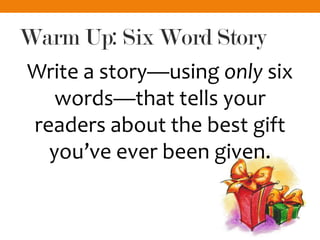
Warm Up: Six Word Story
Write a story—using only six
words—that tells your
readers about the best gift
you’ve ever been given.
Allusion
• An allusion a brief reference to a person,
place, or event or another piece of literature.
The author assumes you’ll get the reference.
• What is the allusion in the title? Let’s read the
background information on p. 286.

Short Stories PowerPoint

  • 1.
  • 2.
    The Bare Bonesof a Plot 1. Exposition, or basic situation – the opening of the story, when the characters and their conflict are introduced 2. Rising action, or complication – the main character takes some action to resolve the conflict 3. Climax – the key scene in the story, a tense or exciting or terrifying moment 4. Resolution – the end of the story when all of the struggles are over
  • 3.
    It’s Like aRoller Coaster, Baby! Climax RisingAction Exposition FallingAction Resolution Day 1
  • 4.
    Sequencing of Events •Timing: • Chronological order – events unfold in real time • Pacing – the speed that an author chooses to let a story’s events unfold • Playing with Time: • Flashback – an episode from the past is presented and interrupts the flow of events • Flash-forward – a jumping ahead into the future • Foreshadowing – hints or clues that suggest what is to come
  • 5.
    The Fuel ofthe Narrative: Conflict • Internal Conflict – the struggle that takes place in a character’s mind or heart • human vs. him/herself • External Conflict – the struggle that takes place “outside” the character • human vs. human • human vs. society • human vs. nature
  • 6.
    Sensory Details • Setting– the time and place the story is set, along with any pertinent background information • Details – facts, observations, and incidents used to develop a story • Imagery – language that appeals to one or more of the five senses
  • 8.
    Context Clue Competition 1.He could see the ship going away from him, receding in the distance. 2. “Don’t be alarmed,” said Rainsford, with a smile he hoped was disarming. 3. Zaroff’s whole life was one prolonged hunt. 4. The general smiled the quiet smile of one who has faced an obstacle and surmounted it with success. 5. Zaroff appeared unruffled, even when Rainsford called him a murderer. 6. The protruding cliffs blocked Rainsford’s sight of the ocean.
  • 9.
    Reading Quiz Answer thefollowing questions in complete sentences: 1. What is the most dangerous game? 2. Explain the significance of the last sentence of the story: “He had never slept in a better bed, Rainsford decided.”
  • 10.
    Characters • Protagonist -the central figure in a story; sometimes a hero • Antagonist - the opposing person(s) or force(s) against the protagonist
  • 11.
    Characters • Flat Character- a literary character whose personality can be defined by one or two traits and does not change in the course of the story • Round Character - a character in fiction whose personality, background, motives, and other features are fully described by the author
  • 12.
    Characters • Dynamic Character- undergoes an important inner change over the course of the story, as a change in personality or attitude • Static Character - undergoes little or no inner change over the course of a story; a character who does not grow or develop
  • 13.
    THINK-PAIR-SHARE 1. Is Rainsfordthe protagonist or antagonist? 2. Is Rainsford flat or round? 3. Is Rainsford dynamic or static? DON’T FORGET: BACK UP YOUR ANSWER WITH EVIDENCE!
  • 14.
  • 15.
    Reading Quiz Answer thefollowing questions in complete sentences: 1. What is Vita’s family situation? 2. Tell me one of Vita’s three wishes.
  • 16.
    THINK-PAIR-SHARE 1. What isthe primary conflict in “Helen on Eighty-Sixth Street?” 2. Is it an internal or external conflict? DON’T FORGET: BACK UP YOUR ANSWER WITH EVIDENCE!
  • 17.
    Characterization How does anauthor tell us about a character? 1. Speech • dialogue – conversation between characters 2. Appearance 3. Private Thoughts 4. How Other Characters Feel 5. Actions • motivation – the reason a character thinks, feels, or acts the way he/she does
  • 18.
    Characterization • Direct –a writer tells us directly what a character is like or what a person’s motives are • Indirect – a writer shows us a character but allows us to interpret for ourselves the kind of person we are meeting
  • 19.
    Points of View •Omniscient – the narrator is not in the story and almost never refers to himself or herself directly • First person – the narrator is a character in the story who talks to the readers using the pronoun I • Third person limited – the narrator zooms in on one character but talks about that character in third-person
  • 20.
    Which Point ofView? Oh, man! Just as I was finally dozing off, he starts playing that stupid saxophone. I’ve already been fired from one job because I fell asleep on the night shift. Now it’s going to happen again. I don’t know which sounds worse, that tone- deaf saxophonist or that yowling dog. I’m going to call the police.
  • 21.
    Which Point ofView? He found a good spot in front of Park View Apartments and started playing soulfully on his sax. He wanted an audience and needed money. After one song, he spotted a cute girl at a window, applauding madly. A dog howled with the music, but the sax player let him stay, hoping the dog might attract some donations. Then he heard a man yelling about calling the police—clearly not a music lover.
  • 22.
    Which Point ofView? One day a young woman looked out her apartment window and saw a man playing a saxophone. “Cool,” she thought as she swayed to his tune. A big brown dog joined the man and howled along with the music. Then a man in pajamas yelled from another window, complaining that the noise woke him up and he was going to call the police. This man, who worked the night shift and had to sleep all day, liked cats better than dogs anyway.
  • 23.
    Unreliable Narrator • Anunreliable narrator may not always know the whole truth or many purpose choose to deceive readers. • In other words, the narrator’s credibility is seriously compromised, perhaps by: 1. mental illness 2. immaturity 3. arrogance 4. lying
  • 24.
    Context Clue Competition 1.Fortunato’s drunkenness precluded his total understanding of his fate. 2. The secret catacombs ensured Montresor’s impunity from his crime. 3. Montresor viewed Fortunato’s death as suitable retribution for Fortunato’s crimes. 4. “I don’t wish to impose on your time!” lied Montresor. 5. Recoiling, as if in horror, Montresor then walked away.
  • 25.
  • 26.
    Irony Irony is theword that describes the difference between what we expect or what seems suitable and what actually happens. There are three kinds of irony: 1. Verbal – used when someone says one thing but means the opposite 2. Situational – describes an event that is not just surprising but actually contrary to what we expected 3. Dramatic – occurs when we—as readers— have information that the characters do not
  • 28.
    Examples of VerbalIrony • “My, you’ve certainly made a mess of your life!” said the father to his daughter, who just graduated with honors. • “You’re my favorite son-in-law,” the father said to the man he wished his daughter hadn’t married. • “Isn’t this lovely weather we’re having?” Tracy said, looking at the storm through the classroom window. • “Come,” [Zaroff] said, “we shouldn’t be chatting here. We can talk later. Now you want clothes, food, rest. You shall have them. This is a most restful spot.”
  • 30.
    Examples of SituationalIrony • A man lights a stress-relief candle to relieve his anxiety, but the candles ends up burning his house down. • Sue wanted to attend the city council meeting on traffic jams, but she missed it. She was stuck in traffic! • Dorothy travels far to see a wizard who will help her to go home, only to find out that she had the ability to get home by herself the entire time. • A killer on the loose raises his gun to shoot another victim. A loud gunshot is heard, and the killer collapses at the feet of the policewoman who caught him.
  • 32.
    Examples of DramaticIrony • Movie watchers know that the bad guy is standing right behind the potential victim, but the victim never knows!
  • 33.
  • 34.
    Reading Quiz Answer thefollowing questions in complete sentences: 1. What does the sniper do to trick his enemy? 2. What discovery does the sniper make at the end of the story?
  • 35.
    Review: Imagery •Imagery islanguage that appeals to one or more of the five senses.
  • 36.
    THE MESSAGE •A themeis a central message or main idea in a literary work. 1. It’s what the author wants you to learn or know. 2. It’s a broad idea about life, usually stated in a single sentence. 3. The author usually doesn’t come right out and say it. Readers must infer it.
  • 37.
    “Sniper” Stations Station 1 •Madeline • Emma • Bennett • K’Ron • Kelly Station 2 • Easton • Daniel • Hope • Maggie • Jordyn Station 3 • Janette • Ryne • Almanzo • Payton • Eric Station 4 • Matthew • Mya • Sam • Kyra • Patrick Station 5 • Tre’shon • Gibbs • Greg • Michael
  • 38.
  • 39.
    Reading Quiz Answer thefollowing questions in complete sentences: 1. Why does Papi name the dog Liberty? 2. Why does the narrator let her dog run free at the end of the story?
  • 40.
    THE MESSAGE •A themeis a central message in a literary work. 1. It’s what the author wants you to learn or know. 2. It’s a broad statement about life. 3. The author usually doesn’t come right out and say it. Readers must infer it. This requires abstract thinking!
  • 41.
    How to Findthe Theme 1. What happens to the main character? Does the character change over the course of the book? • If in a good way, maybe the theme is to follow his/her lead… • If in a negative way, maybe the theme is to avoid doing what they did… 2. Often, authors put hints in the title that will point you toward a main theme. 3. Look at the main conflict. What forces are pitted against each other? Who wins and why? 4. Sometimes the author outright states the theme (or has a character do this).
  • 42.
    “Liberty” Groups Group 1 •Hope • Emma • Bennett • K’Ron • Kelly Group 2 • Easton • Daniel • Madeline • Jordyn • Gibbs Group 3 • Janette • Ryne • Almanzo • Payton • Sam Group 4 • Matthew • Eric • Kyra • Patrick Group 5 • Tre’shon • Greg • Michael • Maggie • Mya
  • 43.
    THINK-GROUP-SHARE What is thetheme of “Liberty”? Find three examples from the story that support your theme. Be ready to share with the class. Remember: “Freedom” is not a theme. That’s a subject.
  • 44.
    Tone •A story’s tonecan be described in a single word: joyous, somber, humorous, serious, angry, tender, ironic, etc. •Tone is the attitude a speaker or writer takes toward a subject, character, or audience.
  • 45.
    “Exile” (p. 256) •Let’s read the background together on p. 255. • Now, in your groups, go around in a circle to read the poem out loud, one stanza per person. • In what ways are “Liberty” and “Exile” different? • Group 1: Compare/contrast the difference in tone (the attitude toward the subject, going to America). • Group 2: Compare/contrast what each narrator knows/does not know. • Group 3: Compare/contrast the two settings. • Group 4: Compare/contrast the two genres: short story and poem. • Group 5: Compare/contrast the two titles.
  • 46.
    “THE GIFT OFTHE MAGI”
  • 47.
    Context Clue Competition 1.One very upset shopper instigates a storewide search for her missing diamond earring. 2. The girl dreamed that the many birthday gifts she coveted would shower over her like a cascade of riches. 3. The agile shopper used nimble steps to maneuver through the crowded aisles. 4. The thieves left after ransacking the jewelry display.
  • 48.
    Warm Up: SixWord Story Write a story—using only six words—that tells your readers about the best gift you’ve ever been given.
  • 49.
    Allusion • An allusiona brief reference to a person, place, or event or another piece of literature. The author assumes you’ll get the reference. • What is the allusion in the title? Let’s read the background information on p. 286.