Short Story Terms
What is a Short Story?
           • A short story is : a
             brief work of fiction
             where, usually, the
             main character faces a
             conflict that is worked
             out in the plot of the
             story
Character
• Character – a person in a story, poem or
  play.
• Types of Characters:
  – Round- fully developed, has many different
    character traits
  – Flat- stereotyped, one-dimensional, few traits
  – Static – Does not change
  – Dynamic – Changes as a result of the story's
    events
Characterization
• How the author develops the characters,
  especially the main character.
• This is done through:
  – what the character does or says
  – what others say of and to the character
  – author’s word choice in descriptive passages
Characterization
• Direct characterization
  – The author directly states what the character’s
    personality is like. Example: cruel, kind

• Indirect characterization
  – Showing a character’s personality through his/
    her actions, thoughts, feelings, words,
    appearance or other character’s observations
    or reactions
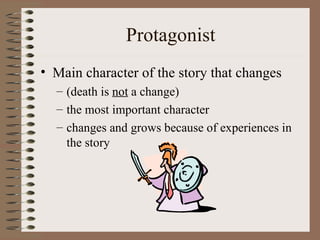
Protagonist
• Main character of the story that changes
  – (death is not a change)
  – the most important character
  – changes and grows because of experiences in
    the story
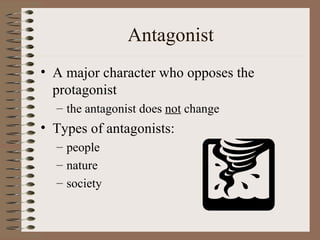
Antagonist
• A major character who opposes the
  protagonist
  – the antagonist does not change
• Types of antagonists:
  – people
  – nature
  – society
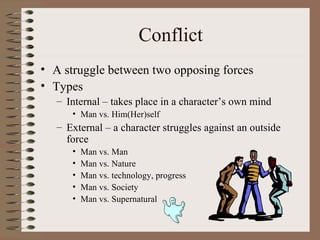
Conflict
• A struggle between two opposing forces
• Types
   – Internal – takes place in a character’s own mind
      • Man vs. Him(Her)self
   – External – a character struggles against an outside
     force
      •   Man vs. Man
      •   Man vs. Nature
      •   Man vs. technology, progress
      •   Man vs. Society
      •   Man vs. Supernatural
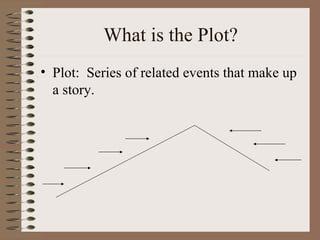
What is the Plot?
• Plot: Series of related events that make up
  a story.
Exposition
• Section that introduces characters, the
  setting, and conflicts.
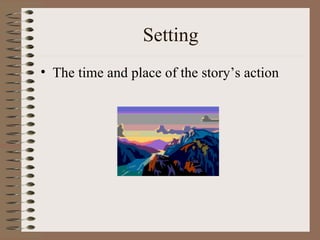
Setting
• The time and place of the story’s action
Rising Action
• Consists of a series of complications.
• These occur when the main characters take
  action to resolve their problems and are
  met with further problems:
  – Fear
  – Hostility
  – Threatening situation
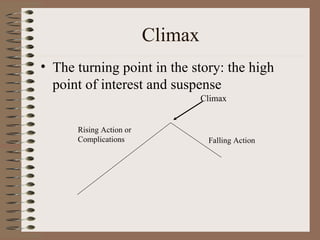
Climax
• The turning point in the story: the high
  point of interest and suspense
                                  Climax


      Rising Action or
      Complications                Falling Action
Falling Action
• All events following the climax or turning
  point in the story. These events are a result
  of the action taken at the climax.
Resolution
• (Denoument)
• The end of the central conflict: it shows
  how the situation turns out and ties up
  loose ends
Point of View

• Vantage point from which the writer tells
  the story.
  – First person- One of the characters is actually
    telling the story using the pronoun “I”
  – Third person- Centers on one character’s
    thoughts and actions.
  – Omniscient- All knowing narrator. Can center
    on the thoughts any actions of any and all
    characters.
Theme
• The central message or insight into life
  revealed through a literary work.
       • The “main idea” of the story
Flashback
• The present scene in the story is
  interrupted to flash backward and tell what
  happened in an earlier time.
Foreshadowing
• Clues the writer puts in the story to give
  the reader a hint of what is to come.
Symbol
• An object, person, or event that functions
  as itself, but also stands for something
  more than itself.
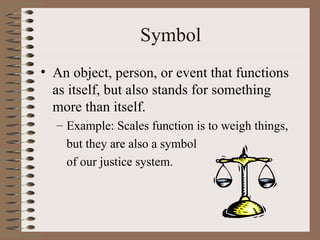
  – Example: Scales function is to weigh things,
    but they are also a symbol
    of our justice system.
Figurative Language
• Involves some imaginative comparison
  between two unlike things.
  – Simile – comparing two unlike things using
    like or as.
     • “I wandered lonely as a cloud”
  – Metaphor – comparing two unlike things (not
    using like or as)
     • Life is a roller coaster, it has lots of ups and
       downs.
Figurative Language
• Personification – Giving human qualities
  to non-human things.
  – “The wind howled”
Irony
• A contrast between expectation and reality
Irony
• Verbal Irony – saying one thing but meaning
  something completely different.
   – Calling a clumsy basketball player “Michael Jordan”
• Situational Irony – A contradiction between what
  we expect to happen and what really does happen
• Dramatic Irony – occurs when the reader knows
  something important that the characters in the
  story do not know.
Allusion
• Reference to a statement, person, a place,
  or events from:
  –   Literature
  –   History
  –   Religion
  –   Mythology
  –   Politics
  –   Sports
Suspense
• Uncertainty or anxiety the reader feels
  about what is going to happen next in a
  story.
Imagery
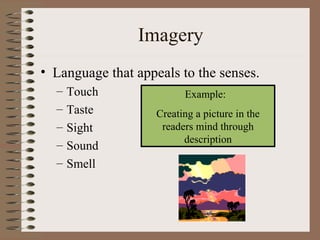
• Language that appeals to the senses.
  –   Touch               Example:
  –   Taste         Creating a picture in the
  –   Sight          readers mind through
                          description
  –   Sound
  –   Smell

Short story terms

  • 1.
  • 2.
    What is aShort Story? • A short story is : a brief work of fiction where, usually, the main character faces a conflict that is worked out in the plot of the story
  • 3.
    Character • Character –a person in a story, poem or play. • Types of Characters: – Round- fully developed, has many different character traits – Flat- stereotyped, one-dimensional, few traits – Static – Does not change – Dynamic – Changes as a result of the story's events
  • 4.
    Characterization • How theauthor develops the characters, especially the main character. • This is done through: – what the character does or says – what others say of and to the character – author’s word choice in descriptive passages
  • 5.
    Characterization • Direct characterization – The author directly states what the character’s personality is like. Example: cruel, kind • Indirect characterization – Showing a character’s personality through his/ her actions, thoughts, feelings, words, appearance or other character’s observations or reactions
  • 6.
    Protagonist • Main characterof the story that changes – (death is not a change) – the most important character – changes and grows because of experiences in the story
  • 7.
    Antagonist • A majorcharacter who opposes the protagonist – the antagonist does not change • Types of antagonists: – people – nature – society
  • 8.
    Conflict • A strugglebetween two opposing forces • Types – Internal – takes place in a character’s own mind • Man vs. Him(Her)self – External – a character struggles against an outside force • Man vs. Man • Man vs. Nature • Man vs. technology, progress • Man vs. Society • Man vs. Supernatural
  • 9.
    What is thePlot? • Plot: Series of related events that make up a story.
  • 10.
    Exposition • Section thatintroduces characters, the setting, and conflicts.
  • 11.
    Setting • The timeand place of the story’s action
  • 12.
    Rising Action • Consistsof a series of complications. • These occur when the main characters take action to resolve their problems and are met with further problems: – Fear – Hostility – Threatening situation
  • 13.
    Climax • The turningpoint in the story: the high point of interest and suspense Climax Rising Action or Complications Falling Action
  • 14.
    Falling Action • Allevents following the climax or turning point in the story. These events are a result of the action taken at the climax.
  • 15.
    Resolution • (Denoument) • Theend of the central conflict: it shows how the situation turns out and ties up loose ends
  • 16.
    Point of View •Vantage point from which the writer tells the story. – First person- One of the characters is actually telling the story using the pronoun “I” – Third person- Centers on one character’s thoughts and actions. – Omniscient- All knowing narrator. Can center on the thoughts any actions of any and all characters.
  • 17.
    Theme • The centralmessage or insight into life revealed through a literary work. • The “main idea” of the story
  • 18.
    Flashback • The presentscene in the story is interrupted to flash backward and tell what happened in an earlier time.
  • 19.
    Foreshadowing • Clues thewriter puts in the story to give the reader a hint of what is to come.
  • 20.
    Symbol • An object,person, or event that functions as itself, but also stands for something more than itself. – Example: Scales function is to weigh things, but they are also a symbol of our justice system.
  • 21.
    Figurative Language • Involvessome imaginative comparison between two unlike things. – Simile – comparing two unlike things using like or as. • “I wandered lonely as a cloud” – Metaphor – comparing two unlike things (not using like or as) • Life is a roller coaster, it has lots of ups and downs.
  • 22.
    Figurative Language • Personification– Giving human qualities to non-human things. – “The wind howled”
  • 23.
    Irony • A contrastbetween expectation and reality
  • 24.
    Irony • Verbal Irony– saying one thing but meaning something completely different. – Calling a clumsy basketball player “Michael Jordan” • Situational Irony – A contradiction between what we expect to happen and what really does happen • Dramatic Irony – occurs when the reader knows something important that the characters in the story do not know.
  • 25.
    Allusion • Reference toa statement, person, a place, or events from: – Literature – History – Religion – Mythology – Politics – Sports
  • 26.
    Suspense • Uncertainty oranxiety the reader feels about what is going to happen next in a story.
  • 27.
    Imagery • Language thatappeals to the senses. – Touch Example: – Taste Creating a picture in the – Sight readers mind through description – Sound – Smell