Literary Elements
Part 1
Conflict, Plot, Antagonist,
and Protagonist,
Conflict
The problem or struggle in a story that
triggers the action.
There are 5 basic types of conflict.
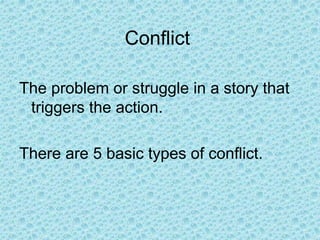
Man v. Man
Man v. Self
Types of Conflict
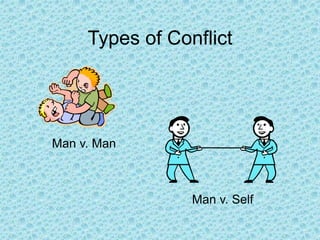
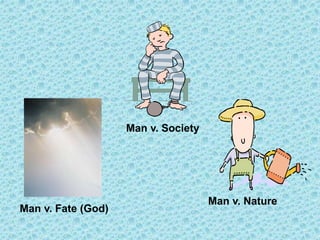
Man v. Nature
Man v. Society
Man v. Fate (God)
Internal Conflict
Any struggle or problem that is going
on within the character.
Man v. Self
External Conflict
Any struggle or problem that involves the
character and any other person, thing
or unknown force.
– Man v. Man
– Man v. Nature
– Man v. Society
– Man v. God (Fate)
Plot
The action or sequence of events in a
story.
It is usually a series of related events
that build up on one another as the
story develops.
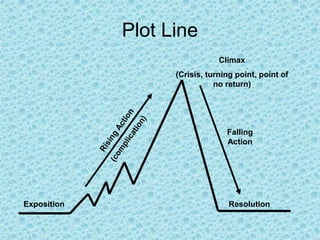
Plot Line
Exposition
Climax
(Crisis, turning point, point of
no return)
Falling
Action
Resolution
Exposition – The background or situation
surrounding the story.
Rising action - the series of struggles that
builds a story toward a climax.
Climax – the most intense point in a
story.
Falling action – part of the story that
works out decisions reached during the
climax.
Resolution – is part of the story in which
the problem is solved.
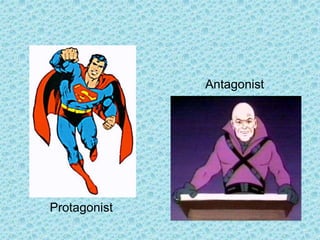
Protagonist - Main character
Antagonist - The person or thing
working against the protagonist
Antagonist and Protagonist
Protagonist
Antagonist
Literary Devices
Part 2
Theme, Irony, Suspense, Allusion
Characterization, etc.
Theme
The statement about life the author is
trying to get across in a story.
–In most cases the theme will be implied
rather than directly told.
In The Most Dangerous Game by Richard
Connell, the theme was “the hunter
becomes the hunted.”
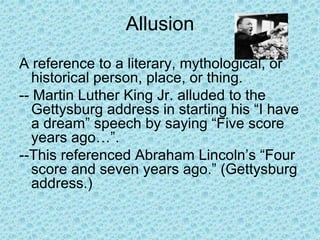
Allusion
A reference to a literary, mythological, or
historical person, place, or thing.
-- Martin Luther King Jr. alluded to the
Gettysburg address in starting his “I have
a dream” speech by saying “Five score
years ago…”.
--This referenced Abraham Lincoln’s “Four
score and seven years ago.” (Gettysburg
address.)
Foreshadowing
• The use in a literary work of clues that
suggest events that will happen later in a
story.
• --In Romeo and Juliet, both main
characters state early on that they would
rather die than live apart.
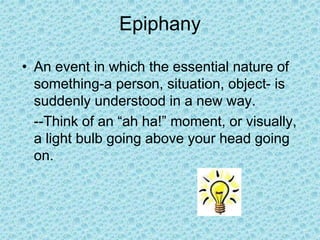
Epiphany
• An event in which the essential nature of
something-a person, situation, object- is
suddenly understood in a new way.
--Think of an “ah ha!” moment, or visually,
a light bulb going above your head going
on.
Detail
• Facts revealed by the author or that
support the attitude or tone of the work.
• --A detail gives more information. For
example, a detail about Killeen is that it is
the location of Fort Hood.
Archetype
• A type of character, action, or situation
that occurs over and over in literature.
• --An archetype can at times be considered
a generalization or stereotype. “The
princess must always be rescued by a
prince.”
Motif
• A main idea in a literary work. A pattern or
strand of imagery or symbolism in
literature.
• --A motif is different from a theme in that it
happens over and over in a story.
Imagery
• The words used to represent persons,
objects, feelings, by appealing to the five
senses.
• --Ex. Her face is a garden.
• --He laughed like a hyena.
Point of view
• The view or perspective from which a story
is told.
• The author is not the one telling the story,
but the narrator. This can be 1st, 2nd, 3rd
person point of view.
Setting
• The time and place of the story.
• --The setting of Batman is Gotham City in
the future.
• --The setting can change throughout the
story.
Irony
Is using a word or phrase to mean the
exact opposite of its literal or normal
meaning.
There are three kinds of irony:
Dramatic irony, in which the reader or the
audience sees a character’s mistakes, but
the character does not.
Verbal irony, in which the writer says one
thing and means another: “The best
substitute for experience is being thirteen”
Situational irony, in which there is a great
difference between the purpose of an action
and the result.
Suspense
The uncertainty or anxiety we feel
about what is going to happen next in
a story.
The Grip of Suspense
When we feel suspense, we feel as if
we are hanging in midair, like those
characters in a movie who cling by
their fingertips to cliffs, their feet
kicking out into space. That’s
suspense – and that’s why stories like
The Interlopers by Saki are called
cliffhangers.
Characterization
Is the method an author uses to reveal
characters and their personalities.
There are two types of characterization
Direct Characterization – In which a writer tells us
directly what a character is like or what their motives
are.
Indirect Characterization – In which a writer shows us
a character but allows us to interpret for ourselves
the kind of person we are meeting.
• Speech
• Appearance
• Private thoughts
• Actions and
• How others in the story feel about them.
Symbolism, Tone, and Mood
Literary Elements
Part 3
Symbolism
Person, place, thing, or event that stands
both for itself and for something beyond
itself.
A form of figurative language that is
identified with something else
Public symbols are symbols that are widely
recognized and accepted
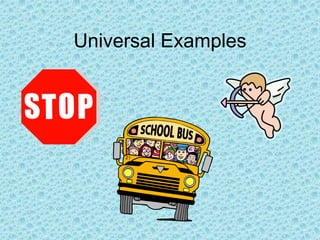
Universal Examples
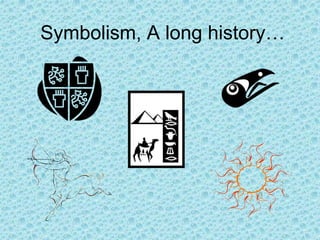
Symbolism, A long history…
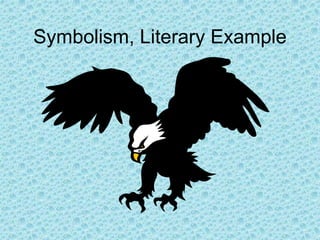
Symbolism, Literary Example
Symbolism
• Why would the eagle be chosen as a
symbol of the United States?
• What metaphors exist within the
symbol of the eagle when comparing
it to a nation?
Symbolism
• Strength of an eagle’s wings…
• Sharp eyes…
• Largeness of the bird…
• Why do you think our forefathers chose the
eagle over Benjamin Franklin’s proposed
turkey?
Tone
Tone is the attitude that an
author takes toward the
audience, the subject, or the
character. Tone is conveyed
through the author's words
and details.
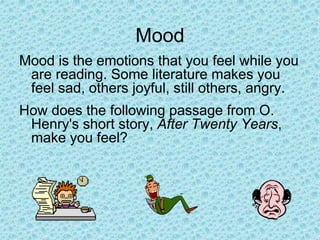
Mood
Mood is the emotions that you feel while you
are reading. Some literature makes you
feel sad, others joyful, still others, angry.
How does the following passage from O.
Henry's short story, After Twenty Years,
make you feel?
Literary Elements
Part 4
Figures of speech
Simile
• A comparison of two different things or
ideas through the use of the words LIKE or
AS.
• --He was as tall as a tree.
• --She was sick like a dog.
Metaphor
• A comparison of two unlike things NOT
using like or as.
• -- This homework is a breeze.
• --He showered her with gifts.
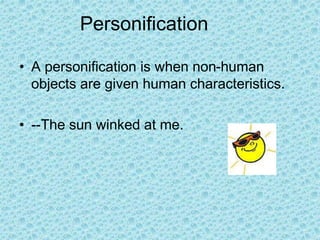
Personification
• A personification is when non-human
objects are given human characteristics.
• --The sun winked at me.
Pun
• A play on words that are identical or similar in
sound but mean two completely different things.
• Shakespeare used puns often in his work.
• Mercutio: “Nay, gentle Romeo, we must have you
dance.”
Romeo: “Not I, believe me. You have dancing
shoes with nimble soles; I have a soul of lead so
stakes me to the ground I cannot move.”
More examples of puns
• Every oven in the restaurant was broken.
The patrons got a raw deal.
• Did you hear about the guy whose whole
left side was cut off? He's all right now.
Paradox
• When two elements of a statement
contradict one another. It seems
impossible, but may show hidden truths.
• A teenager told me, “All teenagers are
liars.”
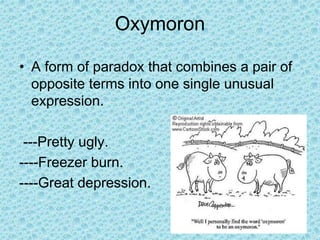
Oxymoron
• A form of paradox that combines a pair of
opposite terms into one single unusual
expression.
---Pretty ugly.
----Freezer burn.
----Great depression.
Idiom
• A phrase or expression that has a different
meaning that its literal meaning.
• -- Call it a day: stop work for the day.
• "It's late and you've accomplished a lot.
Why don't you call it a day?
Hyperbole
• An outrageous exaggeration.
---This is the best day ever!!!
---My sister wears so much makeup, she
weighs 50 pounds more after she puts it on.
--- My teacher is so old, she taught cave men
how to start a fire.
The End

Literary_Elements.ppt

  • 1.
    Literary Elements Part 1 Conflict,Plot, Antagonist, and Protagonist,
  • 2.
    Conflict The problem orstruggle in a story that triggers the action. There are 5 basic types of conflict.
  • 3.
    Man v. Man Manv. Self Types of Conflict
  • 4.
    Man v. Nature Manv. Society Man v. Fate (God)
  • 5.
    Internal Conflict Any struggleor problem that is going on within the character. Man v. Self
  • 6.
    External Conflict Any struggleor problem that involves the character and any other person, thing or unknown force. – Man v. Man – Man v. Nature – Man v. Society – Man v. God (Fate)
  • 7.
    Plot The action orsequence of events in a story. It is usually a series of related events that build up on one another as the story develops.
  • 8.
    Plot Line Exposition Climax (Crisis, turningpoint, point of no return) Falling Action Resolution
  • 9.
    Exposition – Thebackground or situation surrounding the story. Rising action - the series of struggles that builds a story toward a climax. Climax – the most intense point in a story. Falling action – part of the story that works out decisions reached during the climax. Resolution – is part of the story in which the problem is solved.
  • 10.
    Protagonist - Maincharacter Antagonist - The person or thing working against the protagonist Antagonist and Protagonist
  • 11.
  • 12.
    Literary Devices Part 2 Theme,Irony, Suspense, Allusion Characterization, etc.
  • 13.
    Theme The statement aboutlife the author is trying to get across in a story. –In most cases the theme will be implied rather than directly told. In The Most Dangerous Game by Richard Connell, the theme was “the hunter becomes the hunted.”
  • 14.
    Allusion A reference toa literary, mythological, or historical person, place, or thing. -- Martin Luther King Jr. alluded to the Gettysburg address in starting his “I have a dream” speech by saying “Five score years ago…”. --This referenced Abraham Lincoln’s “Four score and seven years ago.” (Gettysburg address.)
  • 15.
    Foreshadowing • The usein a literary work of clues that suggest events that will happen later in a story. • --In Romeo and Juliet, both main characters state early on that they would rather die than live apart.
  • 16.
    Epiphany • An eventin which the essential nature of something-a person, situation, object- is suddenly understood in a new way. --Think of an “ah ha!” moment, or visually, a light bulb going above your head going on.
  • 17.
    Detail • Facts revealedby the author or that support the attitude or tone of the work. • --A detail gives more information. For example, a detail about Killeen is that it is the location of Fort Hood.
  • 18.
    Archetype • A typeof character, action, or situation that occurs over and over in literature. • --An archetype can at times be considered a generalization or stereotype. “The princess must always be rescued by a prince.”
  • 19.
    Motif • A mainidea in a literary work. A pattern or strand of imagery or symbolism in literature. • --A motif is different from a theme in that it happens over and over in a story.
  • 20.
    Imagery • The wordsused to represent persons, objects, feelings, by appealing to the five senses. • --Ex. Her face is a garden. • --He laughed like a hyena.
  • 21.
    Point of view •The view or perspective from which a story is told. • The author is not the one telling the story, but the narrator. This can be 1st, 2nd, 3rd person point of view.
  • 22.
    Setting • The timeand place of the story. • --The setting of Batman is Gotham City in the future. • --The setting can change throughout the story.
  • 23.
    Irony Is using aword or phrase to mean the exact opposite of its literal or normal meaning. There are three kinds of irony:
  • 24.
    Dramatic irony, inwhich the reader or the audience sees a character’s mistakes, but the character does not. Verbal irony, in which the writer says one thing and means another: “The best substitute for experience is being thirteen” Situational irony, in which there is a great difference between the purpose of an action and the result.
  • 25.
    Suspense The uncertainty oranxiety we feel about what is going to happen next in a story.
  • 26.
    The Grip ofSuspense When we feel suspense, we feel as if we are hanging in midair, like those characters in a movie who cling by their fingertips to cliffs, their feet kicking out into space. That’s suspense – and that’s why stories like The Interlopers by Saki are called cliffhangers.
  • 27.
    Characterization Is the methodan author uses to reveal characters and their personalities. There are two types of characterization
  • 28.
    Direct Characterization –In which a writer tells us directly what a character is like or what their motives are. Indirect Characterization – In which a writer shows us a character but allows us to interpret for ourselves the kind of person we are meeting. • Speech • Appearance • Private thoughts • Actions and • How others in the story feel about them.
  • 29.
    Symbolism, Tone, andMood Literary Elements Part 3
  • 30.
    Symbolism Person, place, thing,or event that stands both for itself and for something beyond itself. A form of figurative language that is identified with something else Public symbols are symbols that are widely recognized and accepted
  • 31.
  • 32.
  • 33.
  • 34.
    Symbolism • Why wouldthe eagle be chosen as a symbol of the United States? • What metaphors exist within the symbol of the eagle when comparing it to a nation?
  • 35.
    Symbolism • Strength ofan eagle’s wings… • Sharp eyes… • Largeness of the bird… • Why do you think our forefathers chose the eagle over Benjamin Franklin’s proposed turkey?
  • 36.
    Tone Tone is theattitude that an author takes toward the audience, the subject, or the character. Tone is conveyed through the author's words and details.
  • 37.
    Mood Mood is theemotions that you feel while you are reading. Some literature makes you feel sad, others joyful, still others, angry. How does the following passage from O. Henry's short story, After Twenty Years, make you feel?
  • 38.
  • 39.
    Simile • A comparisonof two different things or ideas through the use of the words LIKE or AS. • --He was as tall as a tree. • --She was sick like a dog.
  • 40.
    Metaphor • A comparisonof two unlike things NOT using like or as. • -- This homework is a breeze. • --He showered her with gifts.
  • 41.
    Personification • A personificationis when non-human objects are given human characteristics. • --The sun winked at me.
  • 42.
    Pun • A playon words that are identical or similar in sound but mean two completely different things. • Shakespeare used puns often in his work. • Mercutio: “Nay, gentle Romeo, we must have you dance.” Romeo: “Not I, believe me. You have dancing shoes with nimble soles; I have a soul of lead so stakes me to the ground I cannot move.”
  • 43.
    More examples ofpuns • Every oven in the restaurant was broken. The patrons got a raw deal. • Did you hear about the guy whose whole left side was cut off? He's all right now.
  • 44.
    Paradox • When twoelements of a statement contradict one another. It seems impossible, but may show hidden truths. • A teenager told me, “All teenagers are liars.”
  • 45.
    Oxymoron • A formof paradox that combines a pair of opposite terms into one single unusual expression. ---Pretty ugly. ----Freezer burn. ----Great depression.
  • 46.
    Idiom • A phraseor expression that has a different meaning that its literal meaning. • -- Call it a day: stop work for the day. • "It's late and you've accomplished a lot. Why don't you call it a day?
  • 47.
    Hyperbole • An outrageousexaggeration. ---This is the best day ever!!! ---My sister wears so much makeup, she weighs 50 pounds more after she puts it on. --- My teacher is so old, she taught cave men how to start a fire.
  • 48.