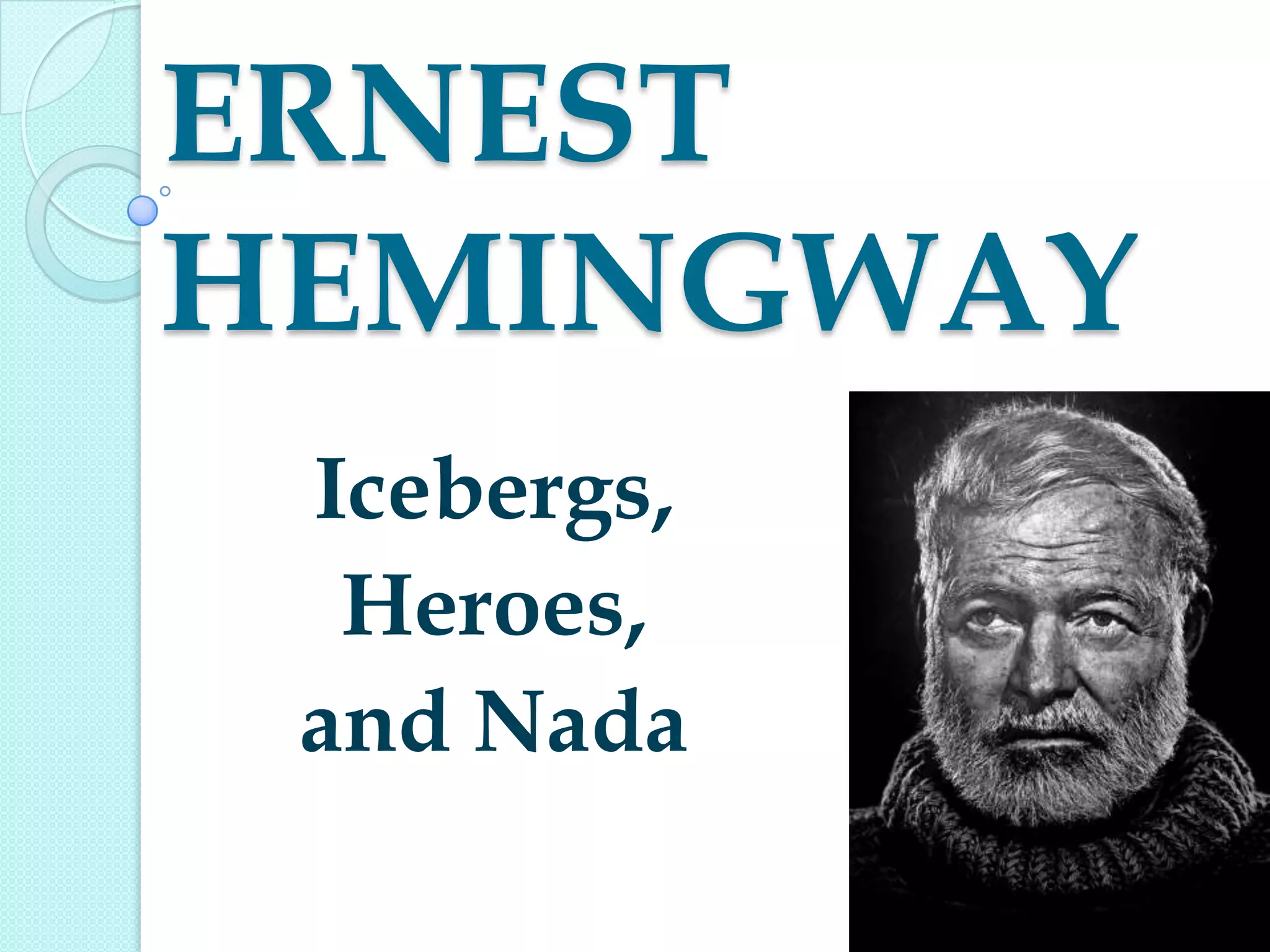
ERNEST
HEMINGWAY
Icebergs,
Heroes,
and Nada
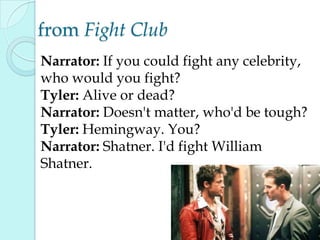
from Fight Club
Narrator: If you could fight any celebrity,
who would you fight?
Tyler: Alive or dead?
Narrator: Doesn't matter, who'd be tough?
Tyler: Hemingway. You?
Narrator: Shatner. I'd fight William
Shatner.
POSTMODERNISM
1940s - TODAY
Puritanism
1472 - 1750
Rationalism
1750 - 1800
Romanticism
1820 - 1860

Transcendentalism
1830 - 1860
Realism

Naturalism

Regionalism
1860 - 1920
Imagism
1912 - 1927
The Harlem
Renaissance
1920 - 1935
The Lost
Generation
1920 - 1930
MODERNISM
1900-1940s
American Literary Movements
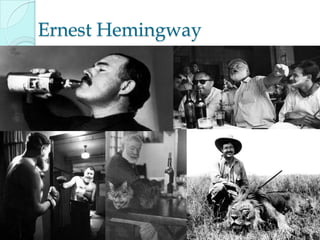
Ernest Hemingway (1899-1961)
 Hemingway was born in Oak Park, Illinois.
 He was a journalist (1917), then a volunteer
ambulance driver and active duty soldier
(1918) during WWI.
 In 1921, he married the first of his four
wives and left the U.S. to join the growing
band of artists and writers who were
gathering in Paris.
 Loves: African safaris, heavy drinking, cock
fighting, deep sea fishing, other macho stuff
 He won the Noble Prize for Literature in
1954.
 He committed suicide in 1961.
Ernest Hemingway
The Lost Generation
 This name was given to a group of
authors and artists who came of age
during WWI.
 The phrase was coined by writer Gertrude
Stein. She told Ernest Hemingway, “That is
what you are. That is what you all are. You
are a lost generation.”
 This group included The Great Gatsby
author F. Scott Fitzgerald and T.S. Eliot,
the author of “The Love Song of J. Alfred
Prufrock.
The Iceberg Principle
“I always try to write
on the principle of the
iceberg. There is seven-
eighths of it under
water for every part
that shows. Anything
you know you can
eliminate and it only
strengthens your
iceberg. It is the part
that doesn‟t show.”
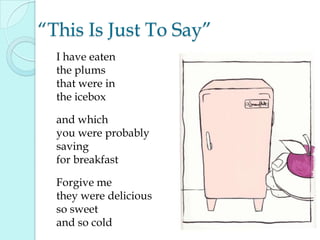
“This Is Just To Say”
I have eaten
the plums
that were in
the icebox
and which
you were probably
saving
for breakfast
Forgive me
they were delicious
so sweet
and so cold
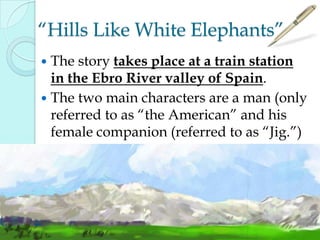
“Hills Like White Elephants”
 The story takes place at a train station
in the Ebro River valley of Spain.
 The two main characters are a man (only
referred to as “the American” and his
female companion (referred to as “Jig.”)
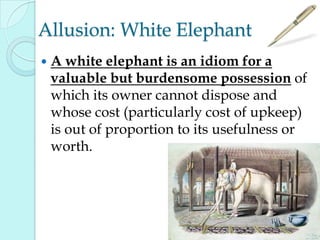
Allusion: White Elephant
 A white elephant is an idiom for a
valuable but burdensome possession of
which its owner cannot dispose and
whose cost (particularly cost of upkeep)
is out of proportion to its usefulness or
worth.
“Hills” Close Reading
1. Put yourself into a partnership, preferably a
boy-girl pair. Each person should grab a marker.
2. Highlight/underline the second-to-last sentence
in the first paragraph: “It was very hot and the
express from Barcelona would come in forty
minutes” (Hemingway 211).
3. Highlight/underline: “„That the train is coming
in five minutes‟” on p. 214.
4. Do now: Assign parts. Boys are the American;
girls are Jig. Read this story out loud, as if it
were a play. Think carefully about how each
character would say his/her lines; consider
tone.
5. THINK-PAIR-SHARE: What have these two
been doing for thirty-five minutes???
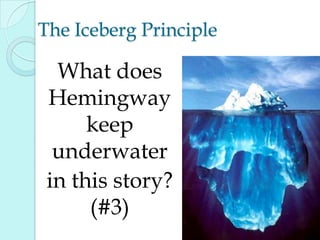
The Iceberg Principle
What does
Hemingway
keep
underwater
in this story?
(#3)
Symbolism of the Setting
Hemingway‟s Code Hero
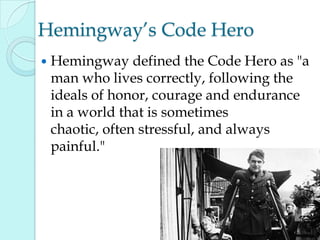
 Hemingway defined the Code Hero as "a
man who lives correctly, following the
ideals of honor, courage and endurance
in a world that is sometimes
chaotic, often stressful, and always
painful."
Code Hero Attributes
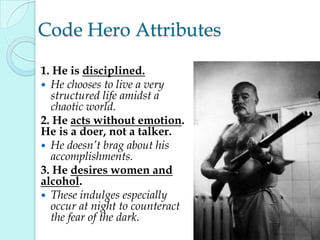
1. He is disciplined.
 He chooses to live a very
structured life amidst a
chaotic world.
2. He acts without emotion.
He is a doer, not a talker.
 He doesn’t brag about his
accomplishments.
3. He desires women and
alcohol.
 These indulges especially
occur at night to counteract
the fear of the dark.
Code Hero Attributes
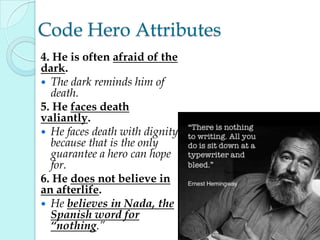
4. He is often afraid of the
dark.
 The dark reminds him of
death.
5. He faces death
valiantly.
 He faces death with dignity
because that is the only
guarantee a hero can hope
for.
6. He does not believe in
an afterlife.
 He believes in Nada, the
Spanish word for
“nothing.”
Apprentice Heroes
 In Hemingway stories, code heroes are
those characters who have recognized
and accepted the reality of nada and
who live in compliance with the code.
 Apprentice heroes are those characters
who are either struggling with the
fear, anxiety, and loss of control which
the recognition of nada brings, or who
are in the process of learning the
requirements of the code.
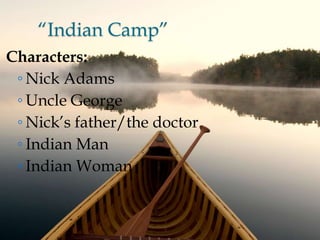
“Indian Camp”
Characters:
◦ Nick Adams
◦ Uncle George
◦ Nick‟s father/the doctor
◦ Indian Man
◦ Indian Woman
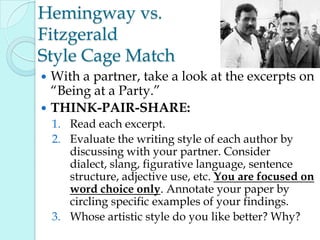
Hemingway vs.
Fitzgerald
Style Cage Match
 With a partner, take a look at the excerpts on
“Being at a Party.”
 THINK-PAIR-SHARE:
1. Read each excerpt.
2. Evaluate the writing style of each author by
discussing with your partner. Consider
dialect, slang, figurative language, sentence
structure, adjective use, etc. You are focused on
word choice only. Annotate your paper by
circling specific examples of your findings.
3. Whose artistic style do you like better? Why?
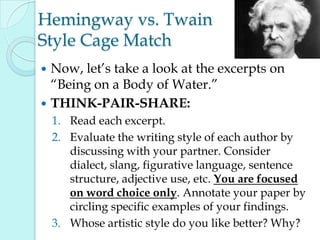
Hemingway vs. Twain
Style Cage Match
 Now, let‟s take a look at the excerpts on
“Being on a Body of Water.”
 THINK-PAIR-SHARE:
1. Read each excerpt.
2. Evaluate the writing style of each author by
discussing with your partner. Consider
dialect, slang, figurative language, sentence
structure, adjective use, etc. You are focused
on word choice only. Annotate your paper by
circling specific examples of your findings.
3. Whose artistic style do you like better? Why?
Hemingway‟s Style
Hemingway’s style consists of:
1. simplicity – His sentences and vocabulary are
short and sparse, even though they deal with
important issues.
2. reporting – He presents sensory details to the
reader as facts, just as a newspaper reports the
facts in a story.
3. understating – He employs the “iceberg
principle” by revealing only 1/8 of the story
and leaving readers to uncover what‟s
underwater.
4. stream of consciousness - He presents the
thoughts and feelings of a character right as
they occur.
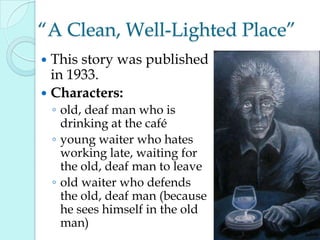
“A Clean, Well-Lighted Place”
 This story was published
in 1933.
 Characters:
◦ old, deaf man who is
drinking at the café
◦ young waiter who hates
working late, waiting for
the old, deaf man to leave
◦ old waiter who defends
the old, deaf man (because
he sees himself in the old
man)
“A Clean, Well-Lighted Place”
 Your task:
1. Read this short story independently.
2. While you read, annotate (mark and
label) your story for the following items:
a) The 6 Attributes of Hemingway‟s
Code Hero
b) The 4 Attributes of Hemingway‟s
Writing Style
3. Turn in your packet of stories when you
are finished with your name on it.

American heroes

  • 1.
  • 2.
    from Fight Club Narrator:If you could fight any celebrity, who would you fight? Tyler: Alive or dead? Narrator: Doesn't matter, who'd be tough? Tyler: Hemingway. You? Narrator: Shatner. I'd fight William Shatner.
  • 3.
    POSTMODERNISM 1940s - TODAY Puritanism 1472- 1750 Rationalism 1750 - 1800 Romanticism 1820 - 1860  Transcendentalism 1830 - 1860 Realism  Naturalism  Regionalism 1860 - 1920 Imagism 1912 - 1927 The Harlem Renaissance 1920 - 1935 The Lost Generation 1920 - 1930 MODERNISM 1900-1940s American Literary Movements
  • 4.
    Ernest Hemingway (1899-1961) Hemingway was born in Oak Park, Illinois.  He was a journalist (1917), then a volunteer ambulance driver and active duty soldier (1918) during WWI.  In 1921, he married the first of his four wives and left the U.S. to join the growing band of artists and writers who were gathering in Paris.  Loves: African safaris, heavy drinking, cock fighting, deep sea fishing, other macho stuff  He won the Noble Prize for Literature in 1954.  He committed suicide in 1961.

  • 5.
  • 6.
    The Lost Generation This name was given to a group of authors and artists who came of age during WWI.  The phrase was coined by writer Gertrude Stein. She told Ernest Hemingway, “That is what you are. That is what you all are. You are a lost generation.”  This group included The Great Gatsby author F. Scott Fitzgerald and T.S. Eliot, the author of “The Love Song of J. Alfred Prufrock.
  • 7.
    The Iceberg Principle “Ialways try to write on the principle of the iceberg. There is seven- eighths of it under water for every part that shows. Anything you know you can eliminate and it only strengthens your iceberg. It is the part that doesn‟t show.”
  • 8.
    “This Is JustTo Say” I have eaten the plums that were in the icebox and which you were probably saving for breakfast Forgive me they were delicious so sweet and so cold
  • 9.
    “Hills Like WhiteElephants”  The story takes place at a train station in the Ebro River valley of Spain.  The two main characters are a man (only referred to as “the American” and his female companion (referred to as “Jig.”)
  • 10.
    Allusion: White Elephant A white elephant is an idiom for a valuable but burdensome possession of which its owner cannot dispose and whose cost (particularly cost of upkeep) is out of proportion to its usefulness or worth.
  • 11.
    “Hills” Close Reading 1.Put yourself into a partnership, preferably a boy-girl pair. Each person should grab a marker. 2. Highlight/underline the second-to-last sentence in the first paragraph: “It was very hot and the express from Barcelona would come in forty minutes” (Hemingway 211). 3. Highlight/underline: “„That the train is coming in five minutes‟” on p. 214. 4. Do now: Assign parts. Boys are the American; girls are Jig. Read this story out loud, as if it were a play. Think carefully about how each character would say his/her lines; consider tone. 5. THINK-PAIR-SHARE: What have these two been doing for thirty-five minutes???
  • 12.
    The Iceberg Principle Whatdoes Hemingway keep underwater in this story? (#3)
  • 13.
  • 14.
    Hemingway‟s Code Hero Hemingway defined the Code Hero as "a man who lives correctly, following the ideals of honor, courage and endurance in a world that is sometimes chaotic, often stressful, and always painful."
  • 15.
    Code Hero Attributes 1.He is disciplined.  He chooses to live a very structured life amidst a chaotic world. 2. He acts without emotion. He is a doer, not a talker.  He doesn’t brag about his accomplishments. 3. He desires women and alcohol.  These indulges especially occur at night to counteract the fear of the dark.
  • 16.
    Code Hero Attributes 4.He is often afraid of the dark.  The dark reminds him of death. 5. He faces death valiantly.  He faces death with dignity because that is the only guarantee a hero can hope for. 6. He does not believe in an afterlife.  He believes in Nada, the Spanish word for “nothing.”
  • 17.
    Apprentice Heroes  InHemingway stories, code heroes are those characters who have recognized and accepted the reality of nada and who live in compliance with the code.  Apprentice heroes are those characters who are either struggling with the fear, anxiety, and loss of control which the recognition of nada brings, or who are in the process of learning the requirements of the code.
  • 18.
    “Indian Camp” Characters: ◦ NickAdams ◦ Uncle George ◦ Nick‟s father/the doctor ◦ Indian Man ◦ Indian Woman
  • 19.
    Hemingway vs. Fitzgerald Style CageMatch  With a partner, take a look at the excerpts on “Being at a Party.”  THINK-PAIR-SHARE: 1. Read each excerpt. 2. Evaluate the writing style of each author by discussing with your partner. Consider dialect, slang, figurative language, sentence structure, adjective use, etc. You are focused on word choice only. Annotate your paper by circling specific examples of your findings. 3. Whose artistic style do you like better? Why?
  • 20.
    Hemingway vs. Twain StyleCage Match  Now, let‟s take a look at the excerpts on “Being on a Body of Water.”  THINK-PAIR-SHARE: 1. Read each excerpt. 2. Evaluate the writing style of each author by discussing with your partner. Consider dialect, slang, figurative language, sentence structure, adjective use, etc. You are focused on word choice only. Annotate your paper by circling specific examples of your findings. 3. Whose artistic style do you like better? Why?
  • 21.
    Hemingway‟s Style Hemingway’s styleconsists of: 1. simplicity – His sentences and vocabulary are short and sparse, even though they deal with important issues. 2. reporting – He presents sensory details to the reader as facts, just as a newspaper reports the facts in a story. 3. understating – He employs the “iceberg principle” by revealing only 1/8 of the story and leaving readers to uncover what‟s underwater. 4. stream of consciousness - He presents the thoughts and feelings of a character right as they occur.
  • 22.
    “A Clean, Well-LightedPlace”  This story was published in 1933.  Characters: ◦ old, deaf man who is drinking at the café ◦ young waiter who hates working late, waiting for the old, deaf man to leave ◦ old waiter who defends the old, deaf man (because he sees himself in the old man)
  • 23.
    “A Clean, Well-LightedPlace”  Your task: 1. Read this short story independently. 2. While you read, annotate (mark and label) your story for the following items: a) The 6 Attributes of Hemingway‟s Code Hero b) The 4 Attributes of Hemingway‟s Writing Style 3. Turn in your packet of stories when you are finished with your name on it.