
An introduction to small ruminant enterprise$SUSAN SCHOENIANSheep & Goat SpecialistWestern Maryland Research & Education Centersschoen@umd.edu – www.sheepandgoat.com
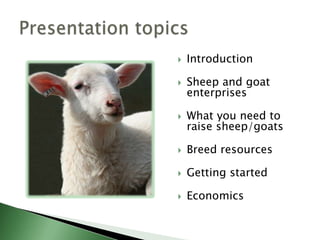
IntroductionSheep and goat enterprisesWhat you need to raise sheep/goatsBreed resourcesGetting startedEconomicsPresentation topics
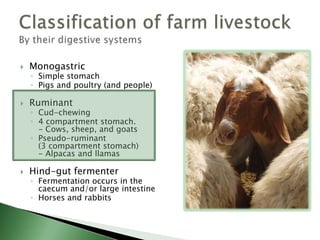
MonogastricSimple stomachPigs and poultry (and people)RuminantCud-chewing 4 compartment stomach.- Cows, sheep, and goatsPseudo-ruminant (3 compartment stomach)- Alpacas and llamasHind-gut fermenterFermentation occurs in the caecum and/or large intestineHorses and rabbitsClassification of farm livestockBy their digestive systems
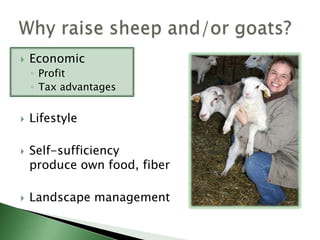
EconomicProfitTax advantagesLifestyleSelf-sufficiency produce own food, fiberLandscape managementWhy raise sheep and/or goats?
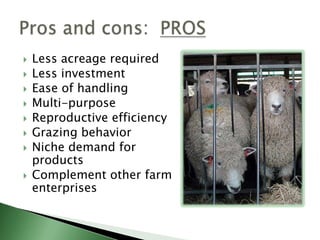
Less acreage requiredLess investmentEase of handlingMulti-purposeReproductive efficiencyGrazing behaviorNiche demand for productsComplement other farm enterprisesPros and cons:  PROS
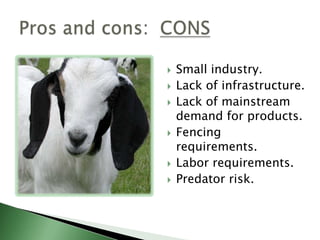
Small industry.Lack of infrastructure.Lack of mainstream demand for products.Fencing requirements.Labor requirements.Predator risk.Pros and cons:  CONS
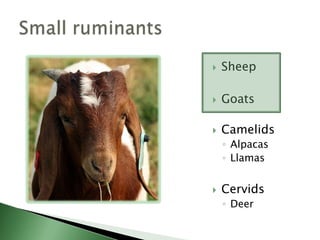
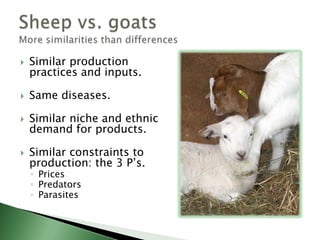
Similar production practices and inputs.Same diseases.Similar niche and ethnic demand for products.Similar constraints to production: the 3 P’s.PricesPredatorsParasitesSheep vs. goatsMore similarities than differences
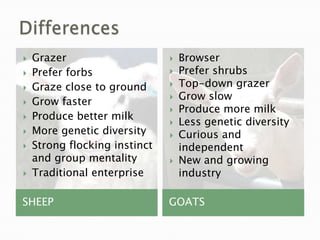
DifferencesSHEEPGOATSGrazerPrefer forbsGraze close to groundGrow fasterProduce better milkMore genetic diversityStrong flocking instinct and group mentalityTraditional enterpriseBrowserPrefer shrubsTop-down grazerGrow slowProduce more milkLess genetic diversityCurious and independentNew and growing industry
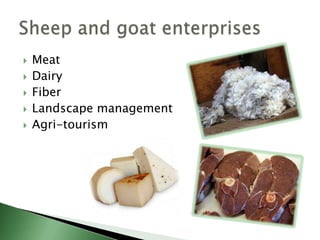
MeatDairyFiberLandscape managementAgri-tourismSheep and goat enterprises
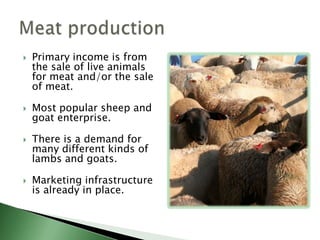
Primary income is from the sale of live animals for meat and/or the sale of meat.Most popular sheep and goat enterprise.There is a demand for many different kinds of lambs and goats.Marketing infrastructure is already in place.Meat production
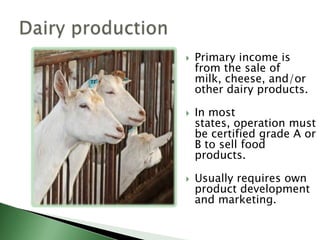
Dairy productionPrimary income is from the sale of milk, cheese, and/or other dairy products.In most states, operation must be certified grade A or B to sell food products.Usually requires own product development and marketing.
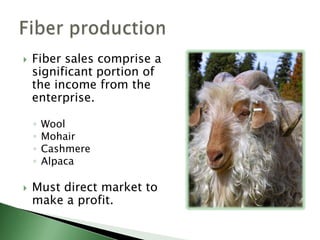
Fiber sales comprise a significant portion of the income from the enterprise.WoolMohair CashmereAlpacaMust direct market to make a profit.Fiber production
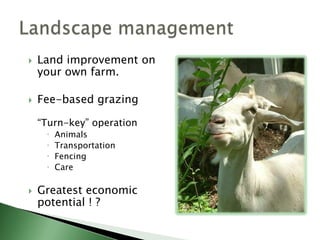
Land improvement on your own farm.Fee-based grazing“Turn-key” operationAnimalsTransportationFencingCareGreatest economic potential ! ? Landscape management
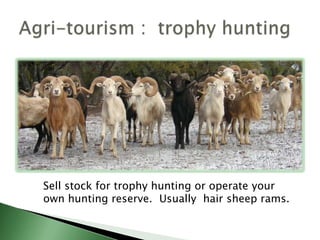
Agri-tourism :  trophy huntingSell stock for trophy hunting or operate your own hunting reserve.  Usually  hair sheep rams.
Agri-entertainment
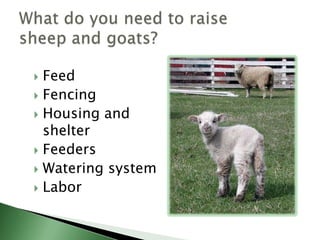
FeedFencingHousing and shelterFeedersWatering systemLaborWhat do you need to raise sheep and goats?
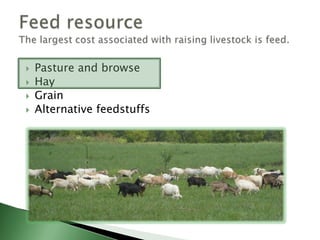
Pasture and browseHayGrainAlternative feedstuffsFeed resourceThe largest cost associated with raising livestock is feed.
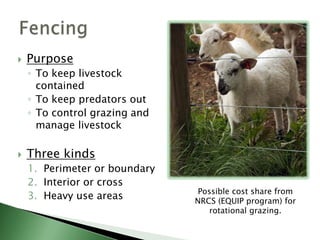
PurposeTo keep livestock containedTo keep predators outTo control grazing and manage livestockThree kindsPerimeter or boundaryInterior or crossHeavy use areasFencingPossible cost share from NRCS (EQUIP program) for rotational grazing.
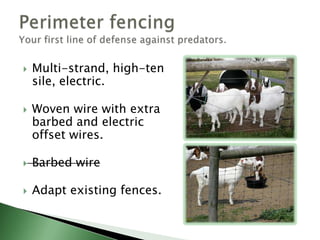
Multi-strand, high-tensile, electric.Woven wire with extra barbed and electric offset wires.Barbed wireAdapt existing fences.Perimeter fencingYour first line of defense against predators.
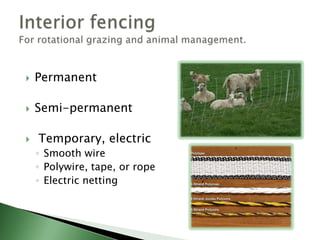
PermanentSemi-permanent Temporary, electricSmooth wirePolywire, tape, or ropeElectric nettingInterior fencingFor rotational grazing and animal management.
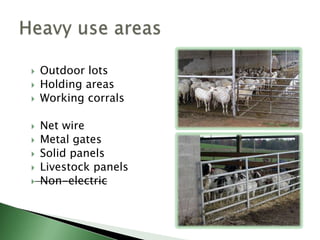
Outdoor lotsHolding areasWorking corralsNet wireMetal gatesSolid panelsLivestock panelsNon-electricHeavy use areas
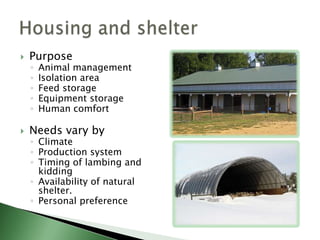
PurposeAnimal managementIsolation areaFeed storageEquipment storageHuman comfortNeeds vary byClimate Production systemTiming of lambing and kiddingAvailability of natural shelter.Personal preferenceHousing and shelter
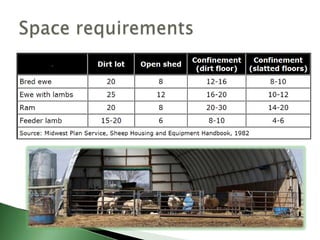
Space requirements
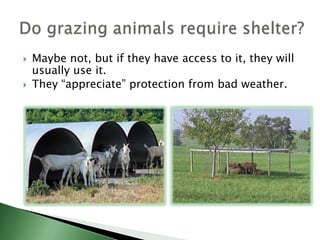
Do grazing animals require shelter?Maybe not, but if they have access to it, they will usually use it. They “appreciate” protection from bad weather.
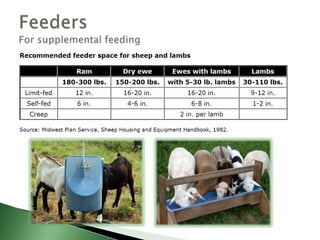
FeedersFor supplemental feeding
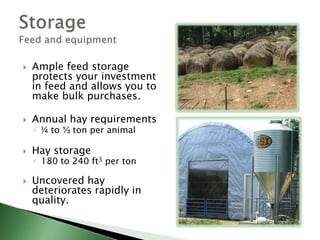
Ample feed storage protects your investment in feed and allows you to make bulk purchases.Annual hay requirements¼ to ⅓ ton per animalHay storage	180 to 240 ft3 per tonUncovered hay deteriorates rapidly in quality.StorageFeed and equipment
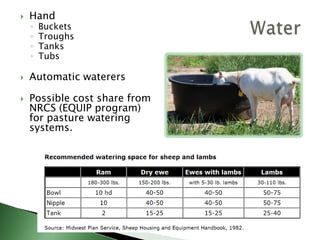
WaterHandBucketsTroughsTanksTubsAutomatic waterersPossible cost share from NRCS (EQUIP program) for pasture watering systems.
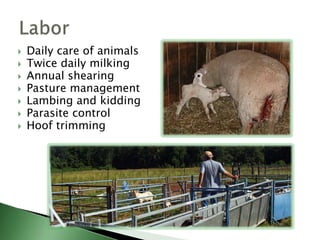
Daily care of animalsTwice daily milkingAnnual shearingPasture managementLambing and kiddingParasite controlHoof trimmingLabor
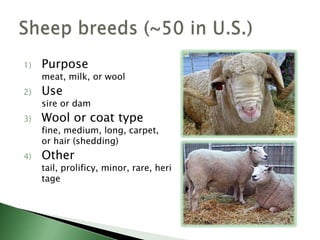
Purposemeat, milk, or woolUsesire or damWool or coat typefine, medium, long, carpet, or hair (shedding)Othertail, prolificy, minor, rare, heritageSheep breeds (~50 in U.S.)
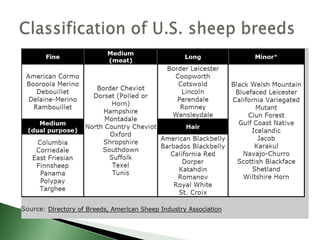
Classification of U.S. sheep breeds
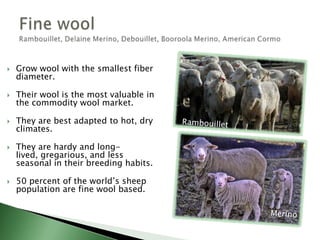
Grow wool with the smallest fiber diameter.Their wool is the most valuable in the commodity wool market.They are best adapted to hot, dry climates.They are hardy and long-lived, gregarious, and less seasonal in their breeding habits.50 percent of the world’s sheep population are fine wool based.Fine wool Rambouillet, Delaine Merino, Debouillet, Booroola Merino, American CormoRambouilletMerino
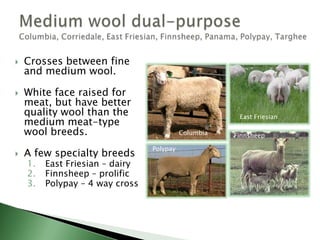
Medium wool dual-purposeColumbia, Corriedale, East Friesian, Finnsheep, Panama, Polypay, TargheeCrosses between fine and medium wool.Whiteface sheep raised for meat, but have better quality wool than the medium meat-type wool breeds.A few specialty breedsEast Friesian – dairyFinnsheep – prolificPolypay – 4 way crossEast FriesianColumbiaFinnsheepPolypay
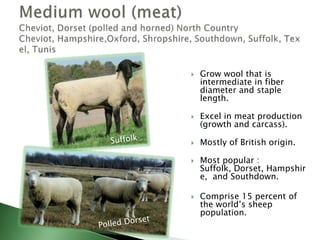
Grow wool that is intermediate in fiber diameter and staple length.Excel in meat production (growth and carcass).Mostly of British origin.Most popular :  Suffolk, Dorset, Hampshire,  and Southdown.Comprise 15 percent of the world’s sheep population.Medium wool (meat)Cheviot, Dorset (polled and horned) North Country Cheviot, Hampshire,Oxford, Shropshire, Southdown, Suffolk, Texel, TunisSuffolkPolled Dorset
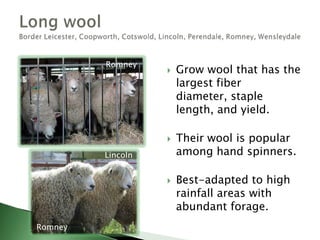
Long woolBorder Leicester, Coopworth, Cotswold, Lincoln, Perendale, Romney, WensleydaleRomneyGrow wool that has the largest fiber diameter, staple length, and yield.Their wool is popular among hand spinners.Best-adapted to high rainfall areas with abundant forage.LincolnRomney
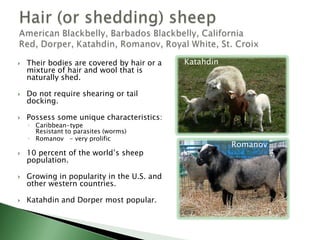
Their bodies are covered by hair or a mixture of hair and wool that is naturally shed.Do not require shearing or tail docking.Possess some unique characteristics:Caribbean-typeResistant to parasites (worms)Romanov   - very prolific10 percent of the world’s sheep population.Growing in popularity in the U.S. and other western countries.Katahdin and Dorper most popular.Hair (or shedding) sheepAmerican Blackbelly, Barbados Blackbelly, California Red, Dorper, Katahdin, Romanov, Royal White, St. CroixKatahdinRomanov
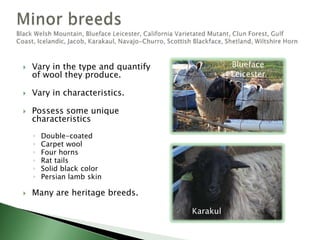
Minor breedsBlack Welsh Mountain, Blueface Leicester, California Varietated Mutant, Clun Forest, Gulf Coast, Icelandic, Jacob, Karakaul, Navajo-Churro, Scottish Blackface, Shetland, Wiltshire HornBlueface LeicesterVary in the type and quantify of wool they produce.Vary in characteristics.Possess some unique characteristics Double-coatedCarpet woolFour hornsRat tailsSolid black colorPersian lamb skinMany are heritage breeds.Karakul
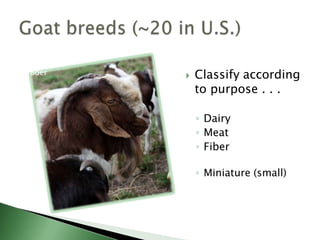
Classify according to purpose . . .DairyMeatFiberMiniature (small)Goat breeds (~20 in U.S.)Boer
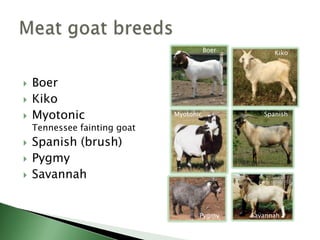
Meat goat breedsBoerKikoBoerKikoMyotonicTennessee fainting goatSpanish (brush)PygmySavannahSpanishMyotonicSavannahPygmy
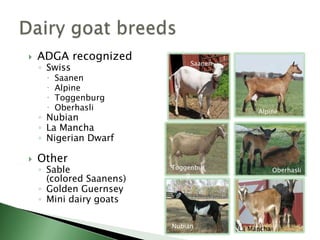
ADGA recognizedSwissSaanenAlpineToggenburgOberhasliNubianLa ManchaNigerian DwarfOtherSable (colored Saanens)Golden GuernseyMini dairy goatsDairy goat breedsSaanenAlpineToggenburgOberhasliNubianLa Mancha
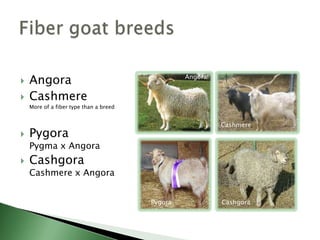
AngoraCashmereMore of a fiber type than a breedPygoraPygma x AngoraCashgoraCashmere x AngoraFiber goat breedsAngoraCashmereCashgoraPygora
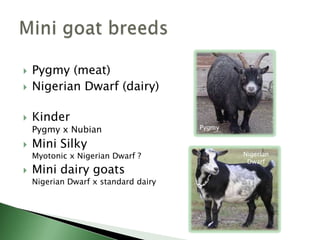
Pygmy (meat)Nigerian Dwarf (dairy)KinderPygmy x NubianMini SilkyMyotonic x Nigerian Dwarf ?Mini dairy goats Nigerian Dwarf x standard dairyMini goat breedsPygmyNigerian Dwarf
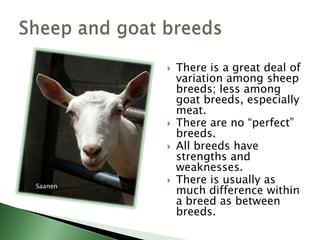
There is a great deal of variation among sheep breeds; less among goat breeds, especially meat.There are no “perfect” breeds.All breeds have strengths and weaknesses.There is usually as much difference within a breed as between breeds.Sheep and goat breedsSaanen
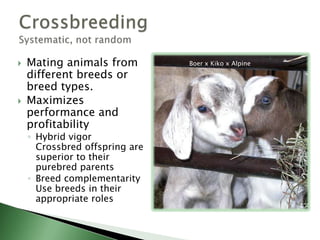
Mating animals from different breeds or breed types.Maximizes performance and profitabilityHybrid vigorCrossbred offspring are superior to their purebred parentsBreed complementarityUse breeds in their appropriate rolesCrossbreeding Systematic, not randomBoer x Kiko x Alpine
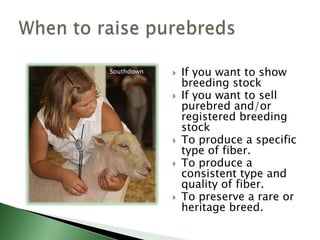
If you want to show breeding stockIf you want to sell purebred and/or registered breeding stockTo produce a specific type of fiber.To produce a consistent type and quality of fiber.To preserve a rare or heritage breed.When to raise purebredsSouthdown
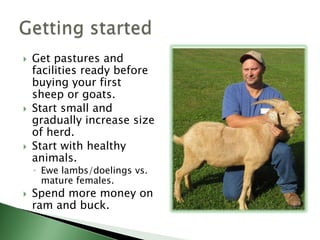
Get pastures and facilities ready before buying your first sheep or goats.Start small and gradually increase size of herd.Start with healthy animals.Ewe lambs/doelings vs. mature females.Spend more money on ram and buck.Getting started
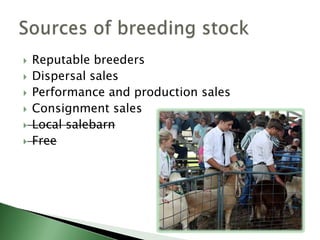
Reputable breedersDispersal salesPerformance and production salesConsignment salesLocal salebarnFreeSources of breeding stock
Web-based directorieswww.sheepgoatmarketing.infoBreed associationshttp://www.sheepandgoat.com/goatbreedassoc.htmlhttp://www.sheepandgoat.com/sheepbreedassoc.htmlWest Virginia Shepherd’s Federation http://www.sheepwv.org/ MPWV Meat Goat Producers Associationhttp://www.meatgoat.bizWest Virginia Market Bulletinhttp://www.wvagriculture.org/market_bulletin/market_bulletin.htmlVirginia sheep and goat clearinghouse listshttp://www.vdacs.virginia.gov/livestock/Lancaster Farminghttp://lancasterfarming.comWhere to find breeding stock
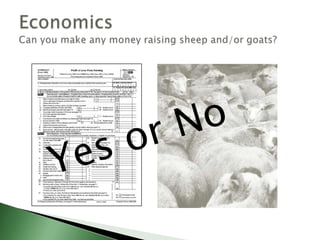
EconomicsCan you make any money raising sheep and/or goats?Yes or No
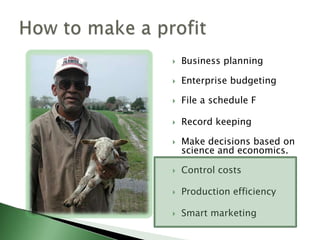
Business planningEnterprise budgetingFile a schedule FRecord keepingMake decisions based on science and economics.Control costsProduction efficiencySmart marketingHow to make a profit
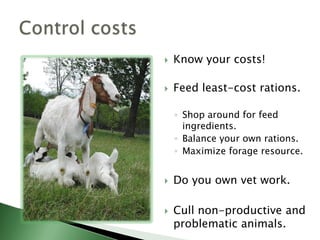
Know your costs!Feed least-cost rations.Shop around for feed ingredients.Balance your own rations.Maximize forage resource.Do you own vet work.Cull non-productive and problematic animals.Control costs
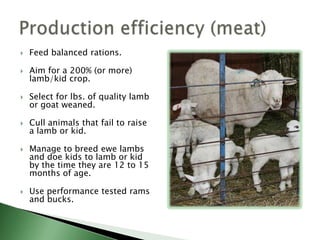
Feed balanced rations.Aim for a 200% (or more) lamb/kid crop.Select for lbs. of quality lamb or goat weaned.Cull animals that fail to raise a lamb or kid.Manage to breed ewe lambs and doe kids to lamb or kid by the time they are 12 to 15 months of age.Use performance tested rams and bucks.Production efficiency (meat)
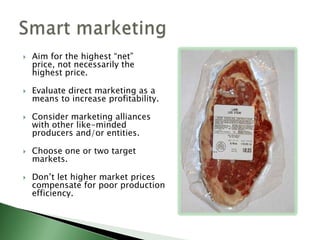
Aim for the highest “net” price, not necessarily the highest price.Evaluate direct marketing as a means to increase profitability.Consider marketing alliances with other like-minded producers and/or entities.Choose one or two target markets.Don’t let higher market prices compensate for poor production efficiency.Smart marketing
Thank you for your attention.  Any questions?