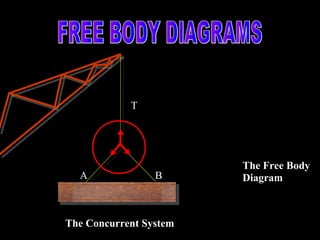
T
A B
The Concurrent System
The Free Body
Diagram
Concept of Free Body
Diagrams
Particle System
Rigid Body
Systems
Concept of
Equilibrant
Graphical
Determination of
Equilibrant
Applied and
Reaction Forces in
Beams
Types of
Beam
Supports
Free Body diagram
of Rigid Bodies
Free Body Diagrams
• Essential step in solving Equilibrium problems
•Complex Structural systems reduced into concise
FORCE systems
WHAT IS A FREE BODY DIAGRAM?
A FBD is a simplified representation of a PARTICLE
or RIGID BODY that is isolated from its surroundings
and on which all applied forces and reactions are
shown.
All forces acting on a particle original body must be
considered, and equally important any force not directly
applied on the body must be excluded.
W
A
B
C
W
BC
BA
Free Body Diagram
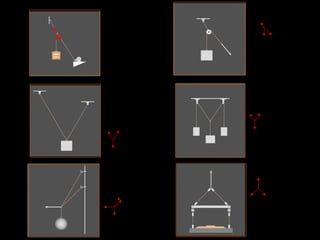
Draw the Free Body Diagrams
REAL LIFE CONCURRENT
SYSTEMS
Equilibrium of a Particle
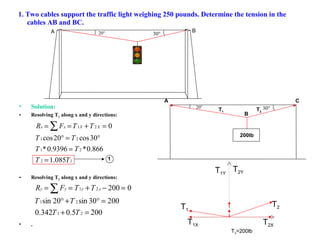
1. Two cables support the traffic light weighing 250 pounds. Determine the tension in the
cables AB and BC.
• Solution:
• Resolving T1 along x and y directions:
• Resolving T2 along x and y directions:
• .
°20 °30A B
°20 °30
200lb
A C
B
T1 T2
T1
T2
T1Y
T2Y
T1X T2X
T3=200lb
12
21
21
21
085.1
866.0*9396.0*
30cos20cos
0
TT
TT
TT
TTFR XXxx
=
=
°=°
=+== ∑
2005.0342.0
20030sin20sin
0200
21
21
21
=+
=°+°
=−+== ∑
TT
TT
TTFR yyyy
1
• Substituting equation 1 in the above equation, we get
.342T1+.5425T2=200
.8845T1=200
T1=226lb
• From equation 1 we get
T2=1.085*226
T2= 245.56lb
Answers:
Tension in cable AB = 226lb
Tension in cable BC = 245.56lb
W=100#
A
C D
E
B 
30=θ
4
3
BA=?
BC=?
CD=?
CE=?
Problem
Change
400#
F1
F2
300N
450N
F1
X
Y
X
X
X
Y
Y Y

30=θ

60=θ
F
3 kN
7 kN
4.5 kN
7.5 kN
2.25 kN
F

60=θ

30=θ
P P
PP
1
2
3
4
θ
θ
θ

20=θ
4
3
12
5
3
CONCEPT OF THE EQUIBILIRIANT
Resultant
1F
2F
R
E
Equilibrant
ASimple Supported Beam
A Cantilever Beam
RIGID BODY SYSTEMS
A Propped Cantilever with Three
Concentrated Load
A Simply Supported Beam with
Three concentrated Loads
APPLIED AND REACTION FORCES IN BEAMS
In the Chapter on Force Systems, we discussed the concept
of APPLIED FORCES, REACTION FORCES and
INTERNAL FORCES
Here we well discuss the relevance and importance of
APPLIED FORCES and REACTION FORCES in the
case of Beams.
Before we proceed further please study the animated
visuals on the next slide
APPLIED FORCES AND REACTION FORCES ON
RIGID BODY SYSTEMS
A Foundation resting on Soil, with
APPLIED FORCES and REACTION
FORCES
A Simple Supported Beams with APPLIED
FORCES and REACTION FORCES
A Cantilever Beam with APPLIED
FORCES and REACTION
FORCES
A Beam is an example of Rigid Body. Generally loads are
applied on the beams. And the beams develop reactions. We
named the loads hat are applied on the beams like Dead
Load, Live Load, Wind Load. Earthquake Loads as
APPLIED FORCES, and the consequent reactions that are
simultaneously developed as REACTION FORCES. These
REACTION FORCES generally develop at the supports. We
use the same color code as described earlier for clarity.
The reactions develop as a direct consequence of Newton’s
Third Law,. Which states that for every action there is an
equal and opposite reaction. In the three examples
presented, if we separate the rigid body for its supports we
can see equal and opposite forces acting at the supports..
From the above we can describe the concept of the
FREE BODY DIAGRAM of a Rigid Body as folows. It
is representing the rigid body with all the Forces- the
APPLIED FORCES and REACTION FORCES acting
on it
It is axiomatic that the Rigid Body must be in
equilibrium under the action of the APPLIED
FORCES and the REACTION FORCES. Hence the
FREE BODY DIAGRAMS can also be called as
EQUILIBRIUM DIAGRAMS, even though the former
name is more popular.
Finding the REACTION of beams for various types of
APPLIED LOADS is a basic requirement in STATICS
The above diagrams, which show the complete system
of applied and reactive forces acting on a body, are
called free body diagrams.
The whole system of applied and reactive forces acting
on a body must be in a state of equilibrium. Free-body
diagrams are, consequently ,often called equilibrium
diagrams.
Drawing equilibrium diagrams and finding
reactions for loaded structural members is a
common first step in a complete structural
analysis
Roller, Hinge and Fixed Supports
Hinge
supports
Roller Supports
Fixed Supports
ROLLER SUPPORT
Applied Force
Reactive Forces
The Reactive Force must
always be perpendicular to
the surface for a ROLLER
Roller Support
Roller Support allows horizontal movement
It allows the beam to bend
Rocker Support
A Rocker Support is similar to the Roller Support
A variation of Roller Support
PIN or HINGE SUPPORT
Applied Force
Reactive Force
The Reactive Force can be in
any direction
Pin or Hinge Support
Pin support does no allow any movement
It allows the beam to bend
FIXED SUPPORT
No movement
No Rotation
Half the strength of the Bridge is lost by not
allowing the Bridge to expand due to the
Temperature Rise
Why Roller Support is Important?
500 ft. 2.34”
T= 100 degT= 40 deg
Why Hinge Support is Important ?
Why Fixed Support is Important?
A Cantilever has to be fixed to support a load
Hinge
REAL LIFE HINGES
A Steel Hinge A Concrete Hinge A Neoprene Pad Hinge
The shear deformation of
the Neoprene pad mimics
the horizontal movement of
a Roller
The close confinement of the
steel rods will not allow moment
transfer, but only Vertical &
Horizontal Forces
Top part
Bottom
part
Pin
The rotation of
the top part
about the pin
allows a Hinge
action
Question 1. What is the difference between a
Rigid Body and a Particle
Question 2: Explain the Difference between a
Roller Support, Hinge Support and Fixed
Support
FREE BODY DIAGRAMS OF RIGID SYSTEMS
Free Body Diagrams
1. Try to draw the free body diagram for a axle of a bicycle wheel as shown
below:
2. Draw the free body diagram for a propped cantilever shown below:
3. Does a Neoprene pad bearing function like a Hinge or a Roller.
4. Attempt to draw the Free body diagram for the circled part of the building
P
Axle
5. Draw the Free Body Diagram for the following Dam:
Water

Freebodydigram

  • 1.
    T A B The ConcurrentSystem The Free Body Diagram
  • 2.
    Concept of FreeBody Diagrams Particle System Rigid Body Systems Concept of Equilibrant Graphical Determination of Equilibrant Applied and Reaction Forces in Beams Types of Beam Supports Free Body diagram of Rigid Bodies
  • 3.
    Free Body Diagrams •Essential step in solving Equilibrium problems •Complex Structural systems reduced into concise FORCE systems WHAT IS A FREE BODY DIAGRAM? A FBD is a simplified representation of a PARTICLE or RIGID BODY that is isolated from its surroundings and on which all applied forces and reactions are shown. All forces acting on a particle original body must be considered, and equally important any force not directly applied on the body must be excluded.
  • 4.
  • 5.
    Draw the FreeBody Diagrams
  • 6.
  • 9.
    1. Two cablessupport the traffic light weighing 250 pounds. Determine the tension in the cables AB and BC. • Solution: • Resolving T1 along x and y directions: • Resolving T2 along x and y directions: • . °20 °30A B °20 °30 200lb A C B T1 T2 T1 T2 T1Y T2Y T1X T2X T3=200lb 12 21 21 21 085.1 866.0*9396.0* 30cos20cos 0 TT TT TT TTFR XXxx = = °=° =+== ∑ 2005.0342.0 20030sin20sin 0200 21 21 21 =+ =°+° =−+== ∑ TT TT TTFR yyyy 1
  • 10.
    • Substituting equation1 in the above equation, we get .342T1+.5425T2=200 .8845T1=200 T1=226lb • From equation 1 we get T2=1.085*226 T2= 245.56lb Answers: Tension in cable AB = 226lb Tension in cable BC = 245.56lb
  • 11.
  • 12.
    400# F1 F2 300N 450N F1 X Y X X X Y Y Y  30=θ  60=θ F 3 kN 7kN 4.5 kN 7.5 kN 2.25 kN F  60=θ  30=θ P P PP 1 2 3 4 θ θ θ  20=θ 4 3 12 5 3
  • 13.
    CONCEPT OF THEEQUIBILIRIANT Resultant 1F 2F R E Equilibrant
  • 14.
    ASimple Supported Beam ACantilever Beam RIGID BODY SYSTEMS
  • 15.
    A Propped Cantileverwith Three Concentrated Load A Simply Supported Beam with Three concentrated Loads
  • 16.
    APPLIED AND REACTIONFORCES IN BEAMS In the Chapter on Force Systems, we discussed the concept of APPLIED FORCES, REACTION FORCES and INTERNAL FORCES Here we well discuss the relevance and importance of APPLIED FORCES and REACTION FORCES in the case of Beams. Before we proceed further please study the animated visuals on the next slide
  • 17.
    APPLIED FORCES ANDREACTION FORCES ON RIGID BODY SYSTEMS A Foundation resting on Soil, with APPLIED FORCES and REACTION FORCES A Simple Supported Beams with APPLIED FORCES and REACTION FORCES A Cantilever Beam with APPLIED FORCES and REACTION FORCES
  • 18.
    A Beam isan example of Rigid Body. Generally loads are applied on the beams. And the beams develop reactions. We named the loads hat are applied on the beams like Dead Load, Live Load, Wind Load. Earthquake Loads as APPLIED FORCES, and the consequent reactions that are simultaneously developed as REACTION FORCES. These REACTION FORCES generally develop at the supports. We use the same color code as described earlier for clarity. The reactions develop as a direct consequence of Newton’s Third Law,. Which states that for every action there is an equal and opposite reaction. In the three examples presented, if we separate the rigid body for its supports we can see equal and opposite forces acting at the supports..
  • 19.
    From the abovewe can describe the concept of the FREE BODY DIAGRAM of a Rigid Body as folows. It is representing the rigid body with all the Forces- the APPLIED FORCES and REACTION FORCES acting on it It is axiomatic that the Rigid Body must be in equilibrium under the action of the APPLIED FORCES and the REACTION FORCES. Hence the FREE BODY DIAGRAMS can also be called as EQUILIBRIUM DIAGRAMS, even though the former name is more popular. Finding the REACTION of beams for various types of APPLIED LOADS is a basic requirement in STATICS
  • 20.
    The above diagrams,which show the complete system of applied and reactive forces acting on a body, are called free body diagrams. The whole system of applied and reactive forces acting on a body must be in a state of equilibrium. Free-body diagrams are, consequently ,often called equilibrium diagrams. Drawing equilibrium diagrams and finding reactions for loaded structural members is a common first step in a complete structural analysis
  • 21.
    Roller, Hinge andFixed Supports Hinge supports Roller Supports Fixed Supports
  • 22.
    ROLLER SUPPORT Applied Force ReactiveForces The Reactive Force must always be perpendicular to the surface for a ROLLER
  • 23.
    Roller Support Roller Supportallows horizontal movement It allows the beam to bend
  • 24.
    Rocker Support A RockerSupport is similar to the Roller Support
  • 25.
    A variation ofRoller Support
  • 26.
    PIN or HINGESUPPORT Applied Force Reactive Force The Reactive Force can be in any direction
  • 27.
    Pin or HingeSupport Pin support does no allow any movement It allows the beam to bend
  • 28.
  • 29.
    Half the strengthof the Bridge is lost by not allowing the Bridge to expand due to the Temperature Rise Why Roller Support is Important? 500 ft. 2.34” T= 100 degT= 40 deg
  • 30.
    Why Hinge Supportis Important ?
  • 31.
    Why Fixed Supportis Important? A Cantilever has to be fixed to support a load Hinge
  • 32.
    REAL LIFE HINGES ASteel Hinge A Concrete Hinge A Neoprene Pad Hinge The shear deformation of the Neoprene pad mimics the horizontal movement of a Roller The close confinement of the steel rods will not allow moment transfer, but only Vertical & Horizontal Forces Top part Bottom part Pin The rotation of the top part about the pin allows a Hinge action
  • 33.
    Question 1. Whatis the difference between a Rigid Body and a Particle Question 2: Explain the Difference between a Roller Support, Hinge Support and Fixed Support
  • 34.
    FREE BODY DIAGRAMSOF RIGID SYSTEMS
  • 37.
    Free Body Diagrams 1.Try to draw the free body diagram for a axle of a bicycle wheel as shown below: 2. Draw the free body diagram for a propped cantilever shown below: 3. Does a Neoprene pad bearing function like a Hinge or a Roller. 4. Attempt to draw the Free body diagram for the circled part of the building P Axle
  • 38.
    5. Draw theFree Body Diagram for the following Dam: Water