
Welcome
To
Our
Presentation
MD MAJHARUL ISLAM
BTE00505254
Sewing problem
(Fabric Damage )
Introduction
Sewing Problems consist of :
Problem of stitch Formation
Seam pucker
Fabric damage in the seam line
Fabric Damage
• A garment product can be rejected due to
damage of fabrics or yarn of fabrics in
the seam line. This is mainly happening due
to wrong needle selection or needle damaging
problem. Fabric may be also damaged in case
of new and fine needles due to wrong
selection of needle size and needle point.
Types of Fabric Damage
1.Mechanical Damage
2.Needle heating Damage
Mechanical Damage
Mechanical damage is the common in apparel
industry. This damaging of fibers or yarns in
the fabrics by needle is the entire faults of
mechanical damage. Mechanical problem is
the main reason for producing defective
fabric.
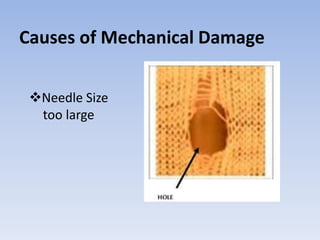
Causes of Mechanical Damage
Needle Size
too large
CONTINUE
Inappropriate needle point
Causes of Mechanical Damage
Inadequate fabric finishing
Damage needle point or throat plate
Mismatch between needle size & throat plate
Remedies of Mechanical Damage
Application
of lubricant
along the
stitch line
before
sewing
Continue
• The speed of sewing machine should be
reduced.
• Needle size and point should be properly
selected and needle should be free from fault.
• To test the Sew ability before sewing of fabrics
Needle Heating Damage
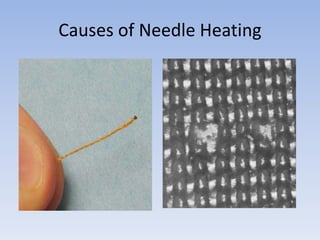
The temperature in needle due to friction
between needle and fabric is up to 300 ºC –
350 ºC. Needle and fabric both may be
damaged in this temperature.
Causes of Needle Heating
Continue
Needle heat is the result of the friction between the
needle and the fabric during
sewing. The following factors can impact the
amount of heat that is generated:
* Thicker fabrics
* Fabrics with harsher finishes or greater density
* Fabric color or density
* Higher sewing machine speeds
Continued
* Needle contact surface
− Larger Needle Sizes have more contact area
− Longer Needle Types have more contact area
− Single grooved needle has more contact area
than double
grooved needles.
− Some needle surfaces generate more friction
than others.
Remedies of Needle Heating Damage
• 1. Speed: By reducing
sewing speed so that
there is less generating
of heat to the needle.
But, for large
production this is not
granted.
Continue
2 . Special type of
needle:
Teflon coated needle
which has extra
smoothness than
galvanized nickel coated
needle may be used to
reduce temperature.
Continue
3. Needle Size and Shape: By changing needle
size, shape and use finer needle so that there
is less generation of heat to the needle.
4. Short Length of sewing: The temperature
generation in needle can be reduced by
sewing of short length instead of long length.
CONTINUE
5. Cool Air: By
flowing cool air on
the needle during
sewing so that the
temperature can
be controlled
between 70ºC
Continue
6. Lubrication:
If lubrication is
done along the
seam line on fabric,
or needle or both,
then heat
generation due to
friction is reduced.
Conclusion
The identification of fabric damage fault with
image would be clear. It is one of the major
problem during sewing . Most of the defects
occur due to improper needle size, pressure
foot adjustment, throat plate replace etc. If
sewing process can be improved, the quality
of the products will be better.
Thank you

Sewing problem

  • 1.
  • 2.
  • 3.
  • 4.
    Introduction Sewing Problems consistof : Problem of stitch Formation Seam pucker Fabric damage in the seam line
  • 5.
    Fabric Damage • Agarment product can be rejected due to damage of fabrics or yarn of fabrics in the seam line. This is mainly happening due to wrong needle selection or needle damaging problem. Fabric may be also damaged in case of new and fine needles due to wrong selection of needle size and needle point.
  • 6.
    Types of FabricDamage 1.Mechanical Damage 2.Needle heating Damage
  • 7.
    Mechanical Damage Mechanical damageis the common in apparel industry. This damaging of fibers or yarns in the fabrics by needle is the entire faults of mechanical damage. Mechanical problem is the main reason for producing defective fabric.
  • 8.
    Causes of MechanicalDamage Needle Size too large
  • 9.
  • 10.
    Causes of MechanicalDamage Inadequate fabric finishing Damage needle point or throat plate Mismatch between needle size & throat plate
  • 11.
    Remedies of MechanicalDamage Application of lubricant along the stitch line before sewing
  • 12.
    Continue • The speedof sewing machine should be reduced. • Needle size and point should be properly selected and needle should be free from fault. • To test the Sew ability before sewing of fabrics
  • 13.
    Needle Heating Damage Thetemperature in needle due to friction between needle and fabric is up to 300 ºC – 350 ºC. Needle and fabric both may be damaged in this temperature.
  • 14.
  • 15.
    Continue Needle heat isthe result of the friction between the needle and the fabric during sewing. The following factors can impact the amount of heat that is generated: * Thicker fabrics * Fabrics with harsher finishes or greater density * Fabric color or density * Higher sewing machine speeds
  • 16.
    Continued * Needle contactsurface − Larger Needle Sizes have more contact area − Longer Needle Types have more contact area − Single grooved needle has more contact area than double grooved needles. − Some needle surfaces generate more friction than others.
  • 17.
    Remedies of NeedleHeating Damage • 1. Speed: By reducing sewing speed so that there is less generating of heat to the needle. But, for large production this is not granted.
  • 18.
    Continue 2 . Specialtype of needle: Teflon coated needle which has extra smoothness than galvanized nickel coated needle may be used to reduce temperature.
  • 19.
    Continue 3. Needle Sizeand Shape: By changing needle size, shape and use finer needle so that there is less generation of heat to the needle. 4. Short Length of sewing: The temperature generation in needle can be reduced by sewing of short length instead of long length.
  • 20.
    CONTINUE 5. Cool Air:By flowing cool air on the needle during sewing so that the temperature can be controlled between 70ºC
  • 21.
    Continue 6. Lubrication: If lubricationis done along the seam line on fabric, or needle or both, then heat generation due to friction is reduced.
  • 22.
    Conclusion The identification offabric damage fault with image would be clear. It is one of the major problem during sewing . Most of the defects occur due to improper needle size, pressure foot adjustment, throat plate replace etc. If sewing process can be improved, the quality of the products will be better.
  • 23.