ASSQC
Assignment-II
By-
Ali Sher Waris, 02
Atul Prabhakar, 05
Suman Singh, 22
Introduction
For every industry or business, to get increased sales and better name amongst consumers and fellow companies it is
important to maintain a level of quality. In the garment industry quality control is practiced right from the initial stage
of sourcing raw materials to the stage of final finished garment. For textile and apparel industry product quality is
calculated in terms of quality and standard of fibres, yarns, fabric construction, color fastness, surface designs and the
final finished garment products. However quality expectations for export are related to the type of customer segments
and the retail outlets. There are a number of factors on which quality fitness of garment industry is based such as –
performance, reliability, durability, visual and perceived quality of the garment. Quality needs to be defined in terms of
a particular framework of cost.
The national regulatory quality certification and international quality Programs like ISO 9000 series lay down the broad
quality parameters based on which companies maintain the export quality in the garment and apparel industry. Here
some of main fabric properties that are taken into consideration for garment manufacturing for export basis:
•Overall look of the garment.
•Right formation of the garment.
•Feel and fall of the garment.
•Physical properties.
•Color fastness of the garment.
•Finishing properties.
•Presentation of the final produced garment.
There are certain quality related problems in garment manufacturing that should not be over looked:
•Sewing defects - Like open seams, wrong stitching techniques used, same color garment, but usage of different color
threads on the garment, miss out of stitches in between, creasing of the garment, erroneous thread tension and raw
edges are some sewing defects that could occur so should be taken care of.
•Color effects - Color defects that could occur are – difference of the color of final produced garment to the sample
shown, accessories used are of wrong color combination and mismatching of dye amongst the pieces.
•Sizing defects - Wrong gradation of sizes, difference in measurement of a garment part from other, for example-
sleeves of ‘XL’ size but body of ‘L’ size. Such defects do not occur has to be seen too.
Garment defects - During manufacturing process defects could occur like faulty zippers, irregular hemming, loose
buttons, raw edges, improper button holes, uneven parts, inappropriate trimming, and difference in fabric colors.
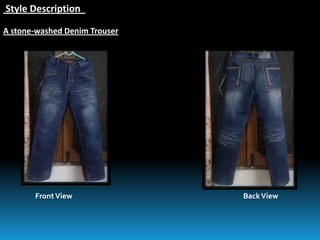
Style Description
A stone-washed Denim Trouser
FrontView BackView
Stone Washed Denim:
Stonewashed jeans are jeans that have been treated to produce a faded, worn appearance. This is usually accomplished
either by washing the jeans with pumice in a rotating drum, or also by using chemicals to create the appearance without
the use of a rotating drum. Stonewashed jeans were a popular fashion trend in the 1970s.In the 2000s
stonewashed jeans were heavily distressed, with pre-made holes, frayed edges and extensive fading caused
by sandblasting.
Front Panel
•Waist Band
•Front Panel
•Zipper fly Panel
•Front Leg parts
Back Panel
•Waist Band
•Back Panel
•Back Leg Parts
Defect Analysis
Various Probable Defects (including trim defects):
•Broken buttons
•Broken snaps
•Broken stitching
•Defective snaps
•Different shades within the same garment
•Dropped stitches
•Exposed notches
•Exposed raw edges
•Holes
•Inoperative zipper
•Loose / hanging sewing threads
•Misaligned buttons and holes
•Missing buttons
•Needle cuts / chews
•Open seams
•Pulled / loose yarn
•Stain
•Unfinished buttonhole
•Zipper too short
Pre production Defects
Pattern defects in garment:
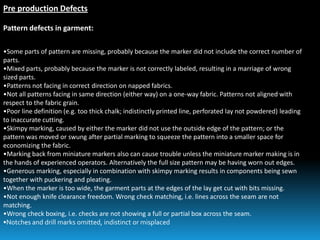
•Some parts of pattern are missing, probably because the marker did not include the correct number of
parts.
•Mixed parts, probably because the marker is not correctly labeled, resulting in a marriage of wrong
sized parts.
•Patterns not facing in correct direction on napped fabrics.
•Not all patterns facing in same direction (either way) on a one-way fabric. Patterns not aligned with
respect to the fabric grain.
•Poor line definition (e.g. too thick chalk; indistinctly printed line, perforated lay not powdered) leading
to inaccurate cutting.
•Skimpy marking, caused by either the marker did not use the outside edge of the pattern; or the
pattern was moved or swung after partial marking to squeeze the pattern into a smaller space for
economizing the fabric.
•Marking back from miniature markers also can cause trouble unless the miniature marker making is in
the hands of experienced operators. Alternatively the full size pattern may be having worn out edges.
•Generous marking, especially in combination with skimpy marking results in components being sewn
together with puckering and pleating.
•When the marker is too wide, the garment parts at the edges of the lay get cut with bits missing.
•Not enough knife clearance freedom. Wrong check matching, i.e. lines across the seam are not
matching.
•Wrong check boxing, i.e. checks are not showing a full or partial box across the seam.
•Notches and drill marks omitted, indistinct or misplaced
Spreading defects in garment:
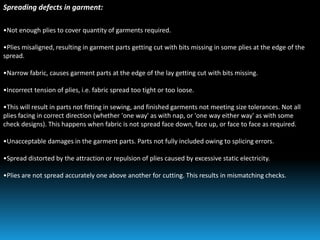
•Not enough plies to cover quantity of garments required.
•Plies misaligned, resulting in garment parts getting cut with bits missing in some plies at the edge of the
spread.
•Narrow fabric, causes garment parts at the edge of the lay getting cut with bits missing.
•Incorrect tension of plies, i.e. fabric spread too tight or too loose.
•This will result in parts not fitting in sewing, and finished garments not meeting size tolerances. Not all
plies facing in correct direction (whether 'one way' as with nap, or 'one way either way' as with some
check designs). This happens when fabric is not spread face down, face up, or face to face as required.
•Unacceptable damages in the garment parts. Parts not fully included owing to splicing errors.
•Spread distorted by the attraction or repulsion of plies caused by excessive static electricity.
•Plies are not spread accurately one above another for cutting. This results in mismatching checks.
Cutting defects in garment:
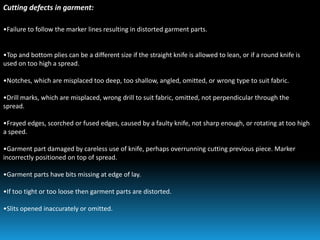
•Failure to follow the marker lines resulting in distorted garment parts.
•Top and bottom plies can be a different size if the straight knife is allowed to lean, or if a round knife is
used on too high a spread.
•Notches, which are misplaced too deep, too shallow, angled, omitted, or wrong type to suit fabric.
•Drill marks, which are misplaced, wrong drill to suit fabric, omitted, not perpendicular through the
spread.
•Frayed edges, scorched or fused edges, caused by a faulty knife, not sharp enough, or rotating at too high
a speed.
•Garment part damaged by careless use of knife, perhaps overrunning cutting previous piece. Marker
incorrectly positioned on top of spread.
•Garment parts have bits missing at edge of lay.
•If too tight or too loose then garment parts are distorted.
•Slits opened inaccurately or omitted.
Name of the
defect
Description Defect Picture Cause Remedy
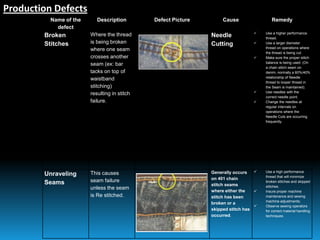
Broken
Stitches
Where the thread
is being broken
where one seam
crosses another
seam (ex: bar
tacks on top of
waistband
stitching)
resulting in stitch
failure.
Needle
Cutting
 Use a higher performance
thread.
 Use a larger diameter
thread on operations where
the thread is being cut.
 Make sure the proper stitch
balance is being used. (On
a chain stitch seam on
denim, normally a 60%/40%
relationship of Needle
thread to looper thread in
the Seam is maintained).
 Use needles with the
correct needle point.
 Change the needles at
regular intervals on
operations where the
Needle Cuts are occurring
frequently.
Unraveling
Seams
This causes
seam failure
unless the seam
is Re stitched.
Generally occurs
on 401 chain
stitch seams
where either the
stitch has been
broken or a
skipped stitch has
occurred.
 Use a high performance
thread that will minimize
broken stitches and skipped
stitches;
 Insure proper machine
maintenance and sewing
machine adjustments;
 Observe sewing operators
for correct material handling
techniques.
Production Defects
Re Stitched
Seams
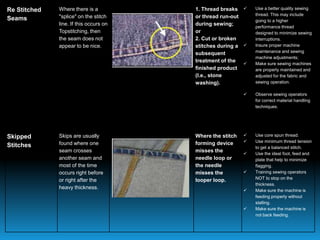
Where there is a
"splice" on the stitch
line. If this occurs on
Topstitching, then
the seam does not
appear to be nice.
1. Thread breaks
or thread run-out
during sewing;
or
2. Cut or broken
stitches during a
subsequent
treatment of the
finished product
(I.e., stone
washing).
 Use a better quality sewing
thread. This may include
going to a higher
performance thread
designed to minimize sewing
interruptions.
 Insure proper machine
maintenance and sewing
machine adjustments;
 Make sure sewing machines
are properly maintained and
adjusted for the fabric and
sewing operation.
 Observe sewing operators
for correct material handling
techniques.
Skipped
Stitches
Skips are usually
found where one
seam crosses
another seam and
most of the time
occurs right before
or right after the
heavy thickness.
Where the stitch
forming device
misses the
needle loop or
the needle
misses the
looper loop.
 Use core spun thread.
 Use minimum thread tension
to get a balanced stitch.
 Use the ideal foot, feed and
plate that help to minimize
flagging.
 Training sewing operators
NOT to stop on the
thickness.
 Make sure the machine is
feeding properly without
stalling.
 Make sure the machine is
not back feeding.
Ragged /
Inconsistent Edge
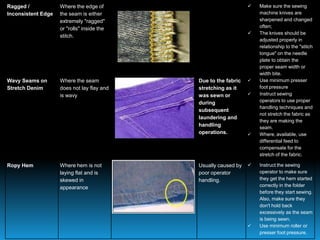
Where the edge of
the seam is either
extremely "ragged"
or "rolls" inside the
stitch.
 Make sure the sewing
machine knives are
sharpened and changed
often;
 The knives should be
adjusted properly in
relationship to the "stitch
tongue" on the needle
plate to obtain the
proper seam width or
width bite.
Wavy Seams on
Stretch Denim
Where the seam
does not lay flay and
is wavy
Due to the fabric
stretching as it
was sewn or
during
subsequent
laundering and
handling
operations.
 Use minimum presser
foot pressure
 Instruct sewing
operators to use proper
handling techniques and
not stretch the fabric as
they are making the
seam.
 Where, available, use
differential feed to
compensate for the
stretch of the fabric.
Ropy Hem Where hem is not
laying flat and is
skewed in
appearance
Usually caused by
poor operator
handling.
 Instruct the sewing
operator to make sure
they get the hem started
correctly in the folder
before they start sewing.
Also, make sure they
don't hold back
excessively as the seam
is being sewn.
 Use minimum roller or
presser foot pressure.
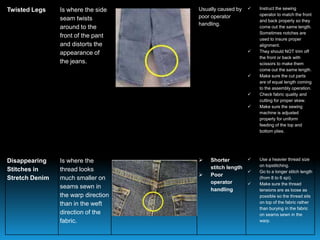
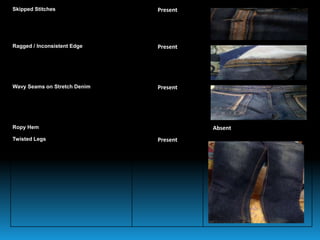
Twisted Legs Is where the side
seam twists
around to the
front of the pant
and distorts the
appearance of
the jeans.
Usually caused by
poor operator
handling.
 Instruct the sewing
operator to match the front
and back properly so they
come out the same length.
Sometimes notches are
used to insure proper
alignment.
 They should NOT trim off
the front or back with
scissors to make them
come out the same length.
 Make sure the cut parts
are of equal length coming
to the assembly operation.
 Check fabric quality and
cutting for proper skew.
 Make sure the sewing
machine is adjusted
properly for uniform
feeding of the top and
bottom plies.
Disappearing
Stitches in
Stretch Denim
Is where the
thread looks
much smaller on
seams sewn in
the warp direction
than in the weft
direction of the
fabric.
 Shorter
stitch length
 Poor
operator
handling
 Use a heavier thread size
on topstitching.
 Go to a longer stitch length
(from 8 to 6 spi).
 Make sure the thread
tensions are as loose as
possible so the thread sits
on top of the fabric rather
than burying in the fabric
on seams sewn in the
warp.
Name of the
defect
Description Defect Picture Cause Remedy
Thread
discoloration
after Laundry
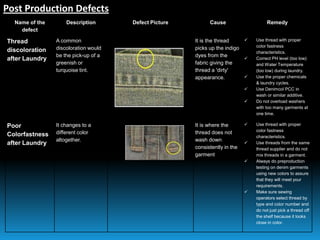
A common
discoloration would
be the pick-up of a
greenish or
turquoise tint.
It is the thread
picks up the indigo
dyes from the
fabric giving the
thread a 'dirty'
appearance.
 Use thread with proper
color fastness
characteristics.
 Correct PH level (too low)
and Water Temperature
(too low) during laundry.
 Use the proper chemicals
& laundry cycles.
 Use Denimcol PCC in
wash or similar additive.
 Do not overload washers
with too many garments at
one time.
Poor
Colorfastness
after Laundry
It changes to a
different color
altogether.
It is where the
thread does not
wash down
consistently in the
garment
 Use thread with proper
color fastness
characteristics.
 Use threads from the same
thread supplier and do not
mix threads in a garment.
 Always do preproduction
testing on denim garments
using new colors to assure
that they will meet your
requirements.
 Make sure sewing
operators select thread by
type and color number and
do not just pick a thread off
the shelf because it looks
close in color.
Post Production Defects
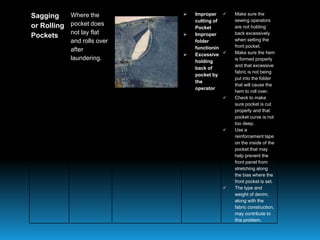
Sagging
or Rolling
Pockets
Where the
pocket does
not lay flat
and rolls over
after
laundering.
 Improper
cutting of
Pocket
 Improper
folder
functionin
 Excessive
holding
back of
pocket by
the
operator
 Make sure the
sewing operators
are not holding
back excessively
when setting the
front pocket.
 Make sure the hem
is formed properly
and that excessive
fabric is not being
put into the folder
that will cause the
hem to roll over.
 Check to make
sure pocket is cut
properly and that
pocket curve is not
too deep.
 Use a
reinforcement tape
on the inside of the
pocket that may
help prevent the
front panel from
stretching along
the bias where the
front pocket is set.
 The type and
weight of denim,
along with the
fabric construction,
may contribute to
this problem.
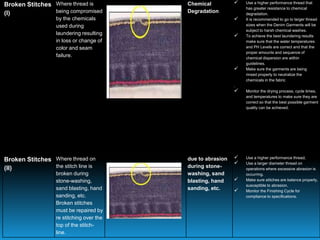
Broken Stitches
(I)
Where thread is
being compromised
by the chemicals
used during
laundering resulting
in loss or change of
color and seam
failure.
Chemical
Degradation
 Use a higher performance thread that
has greater resistance to chemical
degradation.
 It is recommended to go to larger thread
sizes when the Denim Garments will be
subject to harsh chemical washes.
 To achieve the best laundering results
make sure that the water temperatures
and PH Levels are correct and that the
proper amounts and sequence of
chemical dispersion are within
guidelines.
 Make sure the garments are being
rinsed properly to neutralize the
chemicals in the fabric
.
 Monitor the drying process, cycle times,
and temperatures to make sure they are
correct so that the best possible garment
quality can be achieved.
Broken Stitches
(II)
Where thread on
the stitch line is
broken during
stone-washing,
sand blasting, hand
sanding, etc.
Broken stitches
must be repaired by
re stitching over the
top of the stitch-
line.
due to abrasion
during stone-
washing, sand
blasting, hand
sanding, etc.
 Use a higher performance thread;
 Use a larger diameter thread on
operations where excessive abrasion is
occurring.
 Make sure stitches are balance properly,
susceptible to abrasion.
 Monitor the Finishing Cycle for
compliance to specifications.
Name of the defects Present/Absent
Broken Stitches Absent
Unraveling Seams Absent
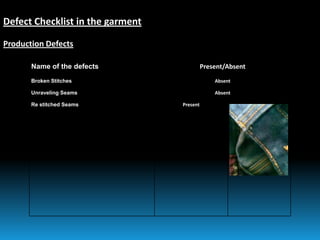
Re stitched Seams Present
Defect Checklist in the garment
Production Defects
Skipped Stitches Present
Ragged / Inconsistent Edge Present
Wavy Seams on Stretch Denim Present
Ropy Hem Absent
Twisted Legs Present
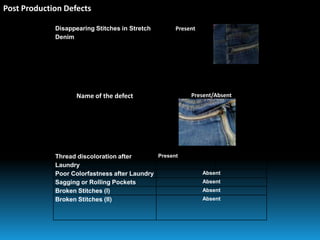
Disappearing Stitches in Stretch
Denim
Present
Name of the defect Present/Absent
Thread discoloration after
Laundry
Present
Poor Colorfastness after Laundry Absent
Sagging or Rolling Pockets Absent
Broken Stitches (I) Absent
Broken Stitches (II) Absent
Post Production Defects
Thank you
Submitted by-
Ali sher waris (02)
Atul Prabhakar(05)
Suman Singh (22)
B.F.Tech.(AP)
Semester-04

Assqc2

  • 1.
    ASSQC Assignment-II By- Ali Sher Waris,02 Atul Prabhakar, 05 Suman Singh, 22
  • 2.
    Introduction For every industryor business, to get increased sales and better name amongst consumers and fellow companies it is important to maintain a level of quality. In the garment industry quality control is practiced right from the initial stage of sourcing raw materials to the stage of final finished garment. For textile and apparel industry product quality is calculated in terms of quality and standard of fibres, yarns, fabric construction, color fastness, surface designs and the final finished garment products. However quality expectations for export are related to the type of customer segments and the retail outlets. There are a number of factors on which quality fitness of garment industry is based such as – performance, reliability, durability, visual and perceived quality of the garment. Quality needs to be defined in terms of a particular framework of cost. The national regulatory quality certification and international quality Programs like ISO 9000 series lay down the broad quality parameters based on which companies maintain the export quality in the garment and apparel industry. Here some of main fabric properties that are taken into consideration for garment manufacturing for export basis: •Overall look of the garment. •Right formation of the garment. •Feel and fall of the garment. •Physical properties. •Color fastness of the garment. •Finishing properties. •Presentation of the final produced garment. There are certain quality related problems in garment manufacturing that should not be over looked: •Sewing defects - Like open seams, wrong stitching techniques used, same color garment, but usage of different color threads on the garment, miss out of stitches in between, creasing of the garment, erroneous thread tension and raw edges are some sewing defects that could occur so should be taken care of. •Color effects - Color defects that could occur are – difference of the color of final produced garment to the sample shown, accessories used are of wrong color combination and mismatching of dye amongst the pieces. •Sizing defects - Wrong gradation of sizes, difference in measurement of a garment part from other, for example- sleeves of ‘XL’ size but body of ‘L’ size. Such defects do not occur has to be seen too. Garment defects - During manufacturing process defects could occur like faulty zippers, irregular hemming, loose buttons, raw edges, improper button holes, uneven parts, inappropriate trimming, and difference in fabric colors.
  • 3.
    Style Description A stone-washedDenim Trouser FrontView BackView
  • 4.
    Stone Washed Denim: Stonewashedjeans are jeans that have been treated to produce a faded, worn appearance. This is usually accomplished either by washing the jeans with pumice in a rotating drum, or also by using chemicals to create the appearance without the use of a rotating drum. Stonewashed jeans were a popular fashion trend in the 1970s.In the 2000s stonewashed jeans were heavily distressed, with pre-made holes, frayed edges and extensive fading caused by sandblasting. Front Panel •Waist Band •Front Panel •Zipper fly Panel •Front Leg parts Back Panel •Waist Band •Back Panel •Back Leg Parts
  • 5.
    Defect Analysis Various ProbableDefects (including trim defects): •Broken buttons •Broken snaps •Broken stitching •Defective snaps •Different shades within the same garment •Dropped stitches •Exposed notches •Exposed raw edges •Holes •Inoperative zipper •Loose / hanging sewing threads •Misaligned buttons and holes •Missing buttons •Needle cuts / chews •Open seams •Pulled / loose yarn •Stain •Unfinished buttonhole •Zipper too short
  • 6.
    Pre production Defects Patterndefects in garment: •Some parts of pattern are missing, probably because the marker did not include the correct number of parts. •Mixed parts, probably because the marker is not correctly labeled, resulting in a marriage of wrong sized parts. •Patterns not facing in correct direction on napped fabrics. •Not all patterns facing in same direction (either way) on a one-way fabric. Patterns not aligned with respect to the fabric grain. •Poor line definition (e.g. too thick chalk; indistinctly printed line, perforated lay not powdered) leading to inaccurate cutting. •Skimpy marking, caused by either the marker did not use the outside edge of the pattern; or the pattern was moved or swung after partial marking to squeeze the pattern into a smaller space for economizing the fabric. •Marking back from miniature markers also can cause trouble unless the miniature marker making is in the hands of experienced operators. Alternatively the full size pattern may be having worn out edges. •Generous marking, especially in combination with skimpy marking results in components being sewn together with puckering and pleating. •When the marker is too wide, the garment parts at the edges of the lay get cut with bits missing. •Not enough knife clearance freedom. Wrong check matching, i.e. lines across the seam are not matching. •Wrong check boxing, i.e. checks are not showing a full or partial box across the seam. •Notches and drill marks omitted, indistinct or misplaced
  • 7.
    Spreading defects ingarment: •Not enough plies to cover quantity of garments required. •Plies misaligned, resulting in garment parts getting cut with bits missing in some plies at the edge of the spread. •Narrow fabric, causes garment parts at the edge of the lay getting cut with bits missing. •Incorrect tension of plies, i.e. fabric spread too tight or too loose. •This will result in parts not fitting in sewing, and finished garments not meeting size tolerances. Not all plies facing in correct direction (whether 'one way' as with nap, or 'one way either way' as with some check designs). This happens when fabric is not spread face down, face up, or face to face as required. •Unacceptable damages in the garment parts. Parts not fully included owing to splicing errors. •Spread distorted by the attraction or repulsion of plies caused by excessive static electricity. •Plies are not spread accurately one above another for cutting. This results in mismatching checks.
  • 8.
    Cutting defects ingarment: •Failure to follow the marker lines resulting in distorted garment parts. •Top and bottom plies can be a different size if the straight knife is allowed to lean, or if a round knife is used on too high a spread. •Notches, which are misplaced too deep, too shallow, angled, omitted, or wrong type to suit fabric. •Drill marks, which are misplaced, wrong drill to suit fabric, omitted, not perpendicular through the spread. •Frayed edges, scorched or fused edges, caused by a faulty knife, not sharp enough, or rotating at too high a speed. •Garment part damaged by careless use of knife, perhaps overrunning cutting previous piece. Marker incorrectly positioned on top of spread. •Garment parts have bits missing at edge of lay. •If too tight or too loose then garment parts are distorted. •Slits opened inaccurately or omitted.
  • 9.
    Name of the defect DescriptionDefect Picture Cause Remedy Broken Stitches Where the thread is being broken where one seam crosses another seam (ex: bar tacks on top of waistband stitching) resulting in stitch failure. Needle Cutting  Use a higher performance thread.  Use a larger diameter thread on operations where the thread is being cut.  Make sure the proper stitch balance is being used. (On a chain stitch seam on denim, normally a 60%/40% relationship of Needle thread to looper thread in the Seam is maintained).  Use needles with the correct needle point.  Change the needles at regular intervals on operations where the Needle Cuts are occurring frequently. Unraveling Seams This causes seam failure unless the seam is Re stitched. Generally occurs on 401 chain stitch seams where either the stitch has been broken or a skipped stitch has occurred.  Use a high performance thread that will minimize broken stitches and skipped stitches;  Insure proper machine maintenance and sewing machine adjustments;  Observe sewing operators for correct material handling techniques. Production Defects
  • 10.
    Re Stitched Seams Where thereis a "splice" on the stitch line. If this occurs on Topstitching, then the seam does not appear to be nice. 1. Thread breaks or thread run-out during sewing; or 2. Cut or broken stitches during a subsequent treatment of the finished product (I.e., stone washing).  Use a better quality sewing thread. This may include going to a higher performance thread designed to minimize sewing interruptions.  Insure proper machine maintenance and sewing machine adjustments;  Make sure sewing machines are properly maintained and adjusted for the fabric and sewing operation.  Observe sewing operators for correct material handling techniques. Skipped Stitches Skips are usually found where one seam crosses another seam and most of the time occurs right before or right after the heavy thickness. Where the stitch forming device misses the needle loop or the needle misses the looper loop.  Use core spun thread.  Use minimum thread tension to get a balanced stitch.  Use the ideal foot, feed and plate that help to minimize flagging.  Training sewing operators NOT to stop on the thickness.  Make sure the machine is feeding properly without stalling.  Make sure the machine is not back feeding.
  • 11.
    Ragged / Inconsistent Edge Wherethe edge of the seam is either extremely "ragged" or "rolls" inside the stitch.  Make sure the sewing machine knives are sharpened and changed often;  The knives should be adjusted properly in relationship to the "stitch tongue" on the needle plate to obtain the proper seam width or width bite. Wavy Seams on Stretch Denim Where the seam does not lay flay and is wavy Due to the fabric stretching as it was sewn or during subsequent laundering and handling operations.  Use minimum presser foot pressure  Instruct sewing operators to use proper handling techniques and not stretch the fabric as they are making the seam.  Where, available, use differential feed to compensate for the stretch of the fabric. Ropy Hem Where hem is not laying flat and is skewed in appearance Usually caused by poor operator handling.  Instruct the sewing operator to make sure they get the hem started correctly in the folder before they start sewing. Also, make sure they don't hold back excessively as the seam is being sewn.  Use minimum roller or presser foot pressure.
  • 12.
    Twisted Legs Iswhere the side seam twists around to the front of the pant and distorts the appearance of the jeans. Usually caused by poor operator handling.  Instruct the sewing operator to match the front and back properly so they come out the same length. Sometimes notches are used to insure proper alignment.  They should NOT trim off the front or back with scissors to make them come out the same length.  Make sure the cut parts are of equal length coming to the assembly operation.  Check fabric quality and cutting for proper skew.  Make sure the sewing machine is adjusted properly for uniform feeding of the top and bottom plies. Disappearing Stitches in Stretch Denim Is where the thread looks much smaller on seams sewn in the warp direction than in the weft direction of the fabric.  Shorter stitch length  Poor operator handling  Use a heavier thread size on topstitching.  Go to a longer stitch length (from 8 to 6 spi).  Make sure the thread tensions are as loose as possible so the thread sits on top of the fabric rather than burying in the fabric on seams sewn in the warp.
  • 13.
    Name of the defect DescriptionDefect Picture Cause Remedy Thread discoloration after Laundry A common discoloration would be the pick-up of a greenish or turquoise tint. It is the thread picks up the indigo dyes from the fabric giving the thread a 'dirty' appearance.  Use thread with proper color fastness characteristics.  Correct PH level (too low) and Water Temperature (too low) during laundry.  Use the proper chemicals & laundry cycles.  Use Denimcol PCC in wash or similar additive.  Do not overload washers with too many garments at one time. Poor Colorfastness after Laundry It changes to a different color altogether. It is where the thread does not wash down consistently in the garment  Use thread with proper color fastness characteristics.  Use threads from the same thread supplier and do not mix threads in a garment.  Always do preproduction testing on denim garments using new colors to assure that they will meet your requirements.  Make sure sewing operators select thread by type and color number and do not just pick a thread off the shelf because it looks close in color. Post Production Defects
  • 14.
    Sagging or Rolling Pockets Where the pocketdoes not lay flat and rolls over after laundering.  Improper cutting of Pocket  Improper folder functionin  Excessive holding back of pocket by the operator  Make sure the sewing operators are not holding back excessively when setting the front pocket.  Make sure the hem is formed properly and that excessive fabric is not being put into the folder that will cause the hem to roll over.  Check to make sure pocket is cut properly and that pocket curve is not too deep.  Use a reinforcement tape on the inside of the pocket that may help prevent the front panel from stretching along the bias where the front pocket is set.  The type and weight of denim, along with the fabric construction, may contribute to this problem.
  • 15.
    Broken Stitches (I) Where threadis being compromised by the chemicals used during laundering resulting in loss or change of color and seam failure. Chemical Degradation  Use a higher performance thread that has greater resistance to chemical degradation.  It is recommended to go to larger thread sizes when the Denim Garments will be subject to harsh chemical washes.  To achieve the best laundering results make sure that the water temperatures and PH Levels are correct and that the proper amounts and sequence of chemical dispersion are within guidelines.  Make sure the garments are being rinsed properly to neutralize the chemicals in the fabric .  Monitor the drying process, cycle times, and temperatures to make sure they are correct so that the best possible garment quality can be achieved. Broken Stitches (II) Where thread on the stitch line is broken during stone-washing, sand blasting, hand sanding, etc. Broken stitches must be repaired by re stitching over the top of the stitch- line. due to abrasion during stone- washing, sand blasting, hand sanding, etc.  Use a higher performance thread;  Use a larger diameter thread on operations where excessive abrasion is occurring.  Make sure stitches are balance properly, susceptible to abrasion.  Monitor the Finishing Cycle for compliance to specifications.
  • 16.
    Name of thedefects Present/Absent Broken Stitches Absent Unraveling Seams Absent Re stitched Seams Present Defect Checklist in the garment Production Defects
  • 17.
    Skipped Stitches Present Ragged/ Inconsistent Edge Present Wavy Seams on Stretch Denim Present Ropy Hem Absent Twisted Legs Present
  • 18.
    Disappearing Stitches inStretch Denim Present Name of the defect Present/Absent Thread discoloration after Laundry Present Poor Colorfastness after Laundry Absent Sagging or Rolling Pockets Absent Broken Stitches (I) Absent Broken Stitches (II) Absent Post Production Defects
  • 19.
    Thank you Submitted by- Alisher waris (02) Atul Prabhakar(05) Suman Singh (22) B.F.Tech.(AP) Semester-04