Harm Reduction in HousingH.O.M.E. ConferenceSeptember 16, 2010Christy Respress, MSWPathways to Housing DC1
Pathways to Housing DC: Who we ServePersons experiencing serious mental illnesses such as schizophrenia, bipolar disorder, and major depressionExperiencing chronic/long term homelessnessCo-occurring substance use disorders- at least 80%Serious medical issuesHistories of trauma and violenceLack of hopeVarious stages of readiness to make change, with the majority entering in precontemplation or ambivalence2
Pathways DC Program and Housing Services4 Assertive Community Treatment (ACT) teams with the capacity to serve 300 individuals. Each participant on the ACT team receives their own scattered site apartment.PSH program serving 135 people w/ intensive case management and scattered site apartmentsOutreach TeamCommunity Support- 40 servedSupported Employment Program3
Housing First Program PracticeImmediate access to permanent, independent housing No requirement for sobriety or treatmentHarm reduction approach to servicesProgram participant sets service priorities (e.g., job, family connection, addictions Tx, psychiatric Tx, etc.)Follow standard lease obligationsNeed to visit in home at least 1x per month4
Practitioner anxiety around allowing people to make choices in PSHHealth issuesAlcohol/Drug usePsychiatric medications
Recovery is a ProcessRecovery doesn’t magically happen once someone moves into an apartment!  Well….maybe sometimes.
Recovery is a process and looks different for each person
People still need support while they’re using!
Need a framework for delivering services while person engaging in harmful activities/behaviors, actively using drugs/alcohol, or disengaged from psychiatric/medical treatment- harm reduction6
Recovery: Implications for PSH StaffDeegan: The Dignity of Risk, The Right to Failure“Chronically normal people’ are allowed to make dumb, uninsightful decisions all the time in their lives…. We must be careful to distinguish between a person making (from our perspective) a dumb or self-defeating choice, and a person who is truly at risk.Just as Elizabeth Taylor has failed her 8th marriage and not a single case manager has jumped in to control her "marriage impulse", so too do people with psychiatric disabilities claim the right to make mistakes, to learn through failures and to take risks. The reclaiming of these rights is referred to as the dignity of risk and the right to failure.”
Abstinence as a requirement for permanent housingMost programs mandate abstinence from drugs and alcohol to obtain/maintain housing.Most also mandate psychiatric treatment.Some people can achieve this, but many others (especially those who are dually diagnosed) remain homeless.
Problems with Abstinence Model:The Abstinence Violation EffectEach failure of the addict to achieve the goal of abstinence leads to a negative adjustment of self-opinion in tune with the failure just experienced. This negative readjustment of self opinion may feed on itself, lowering self-esteem and diminishing the belief and hope in the possibility of making changes on one’s own.
Harm Reduction Practice and the Abstinence Violation Effect (AVE)Harm reduction avoids the downward spiral of AVE, by focusing on helping clients take small steps forward and maintain a positive attitude and direction, while rewarding each small step along the way. “Even though some people can stop just like that,” opined one person who was a heavy drinker, snapping his fingers. “I couldn’t stop like that. I thought it was good when I went from a 40-ouncer to a 12-ouncer.”
Harm Reduction: What is it?Harm reduction is a progressive alternative to the prohibition of some potentially dangerous lifestyle choices, e.g., smoking, drug use, alcohol use, casual sex.The central idea is to recognize that some people have, and will, engage in risky behaviors.The main objective of harm reduction is to mitigate the potential dangers and health risks associated with the risky behaviors themselves.
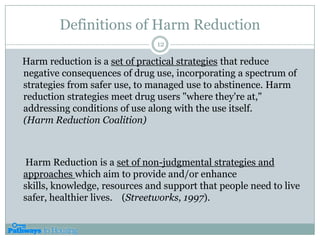
Definitions of Harm Reduction12Harm reduction is a set of practical strategies that reduce negative consequences of drug use, incorporating a spectrum of strategies from safer use, to managed use to abstinence. Harm reduction strategies meet drug users "where they're at," addressing conditions of use along with the use itself.          (Harm Reduction Coalition)     Harm Reduction is a set of non-judgmental strategies and approaches which aim to provide and/or enhance skills, knowledge, resources and support that people need to live safer, healthier lives.    (Streetworks, 1997).
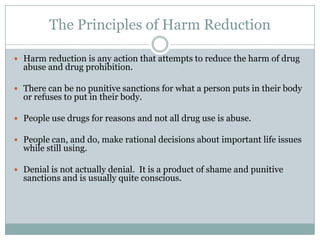
The Principles of Harm ReductionHarm reduction is any action that attempts to reduce the harm of drug abuse and drug prohibition.There can be no punitive sanctions for what a person puts in their body or refuses to put in their body.People use drugs for reasons and not all drug use is abuse.People can, and do, make rational decisions about important life issues while still using.Denial is not actually denial.  It is a product of shame and punitive sanctions and is usually quite conscious.
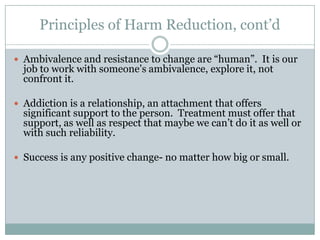
Principles of Harm Reduction, cont’dAmbivalence and resistance to change are “human”.  It is our job to work with someone’s ambivalence, explore it, not confront it.Addiction is a relationship, an attachment that offers significant support to the person.  Treatment must offer that support, as well as respect that maybe we can’t do it as well or with such reliability.Success is any positive change- no matter how big or small.
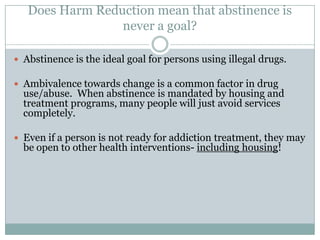
Does Harm Reduction mean that abstinence is never a goal?Abstinence is the ideal goal for persons using illegal drugs.Ambivalence towards change is a common factor in drug use/abuse.  When abstinence is mandated by housing and treatment programs, many people will just avoid services completely.Even if a person is not ready for addiction treatment, they may be open to other health interventions- including housing!
Harm Reduction in housing16Most people entering Pathways are not actively working on ending their addictions or obtaining psychiatric treatment.
Principles of harm reduction support Stages of Change- Prochaska  & DiClemente
Most needed in early stages of precontemplation and contemplation
Harm reduction doesn’t mean we encourage people in their use- still want folks to stop using!Housing First andHarm ReductionThe housing first model allows for alternative paths to complete sobriety and serves to contain or reduce the many harms associated with drug use  while homeless and after being housed.
Housing First andHarm ReductionRisk reduction: Housing first programs decrease the likelihood of drug overdose, dealing, incarceration, impoverishment, malnourishment, unending homelessness, ill health, spending on drugs and alcohol and other conditions that would otherwise befall a person who must achieve abstinence in order to be housed.
Housing First and Harm Reduction PracticeSupport:  Once housed, the program staff offer services and support that include an acceptance and tolerance of symptoms, use, and relapse while the individual remains housed.
Housing First and Harm Reduction Practice Relapse: Clients typically move from stage to stage at their own pace, but when they stop moving or move backwards they are still accepted and supported. is an expected and natural step in the long course of recovery, and clients are able, indeed encouraged, to discuss their psychoses and addictions with staff in an open and accepting manner.
Harm Reduction PracticeCandid conversation: Once a client is engaged in a therapeutic relationship and there is a candid discussion concerning the symptoms of mental illness or drug and alcohol use, the stressors leading to these conditions are addressed. With this, the process of recovery begins.
What Does Harm Reduction look like at PTHDC?22AddictionsPsychiatricMedical
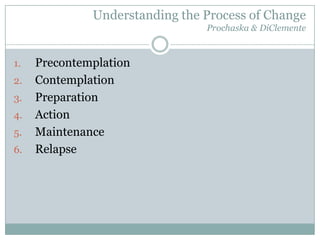
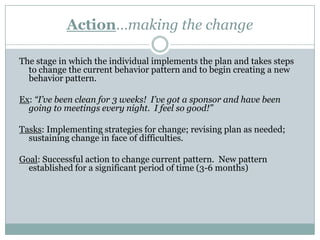
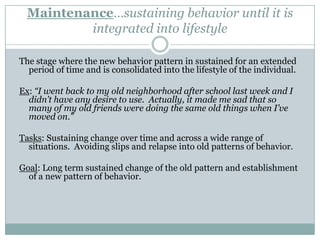
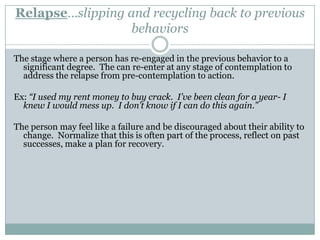
Understanding the Process of ChangeProchaska & DiClementePrecontemplationContemplationPreparationActionMaintenanceRelapse
Precontemplation…notseriouslyconsidering changeThere is little or no consideration of change in the foreseeable future.Ex: “I don’t have a problem- you’re my problem!”Tasks: Increase awareness of need for change and concern about the current pattern of behavior; envision possibility of change. Goal: Serious consideration of change for this behavior.
Engaging the “Unmotivated” PersonP. Deegan: Action Steps to Use With People in the 	 	Precontemplation StageGetting the person to move into action is not the goal at this stage. During this stage  develop your relationship with the client.Join with the client. Begin to understand what they are motivated toward and what they are motivated against.Don't nag, but don't ignore the problem as you see it.  Remember, for the client in this stage there is no problem.Focus on consciousness raising, i.e., help the person see the problem, the relationship between their behavior and its consequences, see how others are affected by the problem, and see how others have dealt with the problem.Directly and frequently offer alternative activities/options.Sometimes people move out of this stage spontaneously due to life events & developmental milestones such as one's 40th birthday, siblings have all married, high school reunion, death of a loved one, Create opportunities for getting more information about the problem.
Engagementand MotivationDeegan:  Reframing the Question of Motivation Less Helpful Questions:How can I motivate Jim?How do I get Jim to do what I want him to do? (this sets up a power struggle)Question of Motivation Reframed:What is going on with Jim such that he is not more involved in improving the quality of his life?
Contemplation…thinking about changeThe stage where the person examines their patterns of behavior and the potential for change in a risk-reward analysis.Ex: “I know that smoking crack only gets me into trouble and makes me do bad things, but I’ve tried to stop before and I always start using again.  I don’t think I can do it”.Tasks: Analysis of the pros and cons of the current behavior and the costs and benefits of change.Goal:  A considered evaluation that leads to a decision to change.
Decisional Balance exercise(see handout)
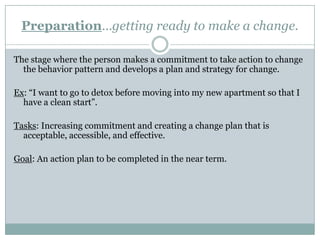
Preparation…getting ready to make a change.The stage where the person makes a commitment to take action to change the behavior pattern and develops a plan and strategy for change.Ex: “I want to go to detox before moving into my new apartment so that I have a clean start”.Tasks: Increasing commitment and creating a change plan that is acceptable, accessible, and effective.Goal: An action plan to be completed in the near term.

2010 HOME Conference - Harm reduction

  • 1.
    Harm Reduction inHousingH.O.M.E. ConferenceSeptember 16, 2010Christy Respress, MSWPathways to Housing DC1
  • 2.
    Pathways to HousingDC: Who we ServePersons experiencing serious mental illnesses such as schizophrenia, bipolar disorder, and major depressionExperiencing chronic/long term homelessnessCo-occurring substance use disorders- at least 80%Serious medical issuesHistories of trauma and violenceLack of hopeVarious stages of readiness to make change, with the majority entering in precontemplation or ambivalence2
  • 3.
    Pathways DC Programand Housing Services4 Assertive Community Treatment (ACT) teams with the capacity to serve 300 individuals. Each participant on the ACT team receives their own scattered site apartment.PSH program serving 135 people w/ intensive case management and scattered site apartmentsOutreach TeamCommunity Support- 40 servedSupported Employment Program3
  • 4.
    Housing First ProgramPracticeImmediate access to permanent, independent housing No requirement for sobriety or treatmentHarm reduction approach to servicesProgram participant sets service priorities (e.g., job, family connection, addictions Tx, psychiatric Tx, etc.)Follow standard lease obligationsNeed to visit in home at least 1x per month4
  • 5.
    Practitioner anxiety aroundallowing people to make choices in PSHHealth issuesAlcohol/Drug usePsychiatric medications
  • 6.
    Recovery is aProcessRecovery doesn’t magically happen once someone moves into an apartment! Well….maybe sometimes.
  • 7.
    Recovery is aprocess and looks different for each person
  • 8.
    People still needsupport while they’re using!
  • 9.
    Need a frameworkfor delivering services while person engaging in harmful activities/behaviors, actively using drugs/alcohol, or disengaged from psychiatric/medical treatment- harm reduction6
  • 10.
    Recovery: Implications forPSH StaffDeegan: The Dignity of Risk, The Right to Failure“Chronically normal people’ are allowed to make dumb, uninsightful decisions all the time in their lives…. We must be careful to distinguish between a person making (from our perspective) a dumb or self-defeating choice, and a person who is truly at risk.Just as Elizabeth Taylor has failed her 8th marriage and not a single case manager has jumped in to control her "marriage impulse", so too do people with psychiatric disabilities claim the right to make mistakes, to learn through failures and to take risks. The reclaiming of these rights is referred to as the dignity of risk and the right to failure.”
  • 11.
    Abstinence as arequirement for permanent housingMost programs mandate abstinence from drugs and alcohol to obtain/maintain housing.Most also mandate psychiatric treatment.Some people can achieve this, but many others (especially those who are dually diagnosed) remain homeless.
  • 12.
    Problems with AbstinenceModel:The Abstinence Violation EffectEach failure of the addict to achieve the goal of abstinence leads to a negative adjustment of self-opinion in tune with the failure just experienced. This negative readjustment of self opinion may feed on itself, lowering self-esteem and diminishing the belief and hope in the possibility of making changes on one’s own.
  • 13.
    Harm Reduction Practiceand the Abstinence Violation Effect (AVE)Harm reduction avoids the downward spiral of AVE, by focusing on helping clients take small steps forward and maintain a positive attitude and direction, while rewarding each small step along the way. “Even though some people can stop just like that,” opined one person who was a heavy drinker, snapping his fingers. “I couldn’t stop like that. I thought it was good when I went from a 40-ouncer to a 12-ouncer.”
  • 14.
    Harm Reduction: Whatis it?Harm reduction is a progressive alternative to the prohibition of some potentially dangerous lifestyle choices, e.g., smoking, drug use, alcohol use, casual sex.The central idea is to recognize that some people have, and will, engage in risky behaviors.The main objective of harm reduction is to mitigate the potential dangers and health risks associated with the risky behaviors themselves.
  • 15.
    Definitions of HarmReduction12Harm reduction is a set of practical strategies that reduce negative consequences of drug use, incorporating a spectrum of strategies from safer use, to managed use to abstinence. Harm reduction strategies meet drug users "where they're at," addressing conditions of use along with the use itself. (Harm Reduction Coalition) Harm Reduction is a set of non-judgmental strategies and approaches which aim to provide and/or enhance skills, knowledge, resources and support that people need to live safer, healthier lives. (Streetworks, 1997).
  • 16.
    The Principles ofHarm ReductionHarm reduction is any action that attempts to reduce the harm of drug abuse and drug prohibition.There can be no punitive sanctions for what a person puts in their body or refuses to put in their body.People use drugs for reasons and not all drug use is abuse.People can, and do, make rational decisions about important life issues while still using.Denial is not actually denial. It is a product of shame and punitive sanctions and is usually quite conscious.
  • 17.
    Principles of HarmReduction, cont’dAmbivalence and resistance to change are “human”. It is our job to work with someone’s ambivalence, explore it, not confront it.Addiction is a relationship, an attachment that offers significant support to the person. Treatment must offer that support, as well as respect that maybe we can’t do it as well or with such reliability.Success is any positive change- no matter how big or small.
  • 18.
    Does Harm Reductionmean that abstinence is never a goal?Abstinence is the ideal goal for persons using illegal drugs.Ambivalence towards change is a common factor in drug use/abuse. When abstinence is mandated by housing and treatment programs, many people will just avoid services completely.Even if a person is not ready for addiction treatment, they may be open to other health interventions- including housing!
  • 19.
    Harm Reduction inhousing16Most people entering Pathways are not actively working on ending their addictions or obtaining psychiatric treatment.
  • 20.
    Principles of harmreduction support Stages of Change- Prochaska & DiClemente
  • 21.
    Most needed inearly stages of precontemplation and contemplation
  • 22.
    Harm reduction doesn’tmean we encourage people in their use- still want folks to stop using!Housing First andHarm ReductionThe housing first model allows for alternative paths to complete sobriety and serves to contain or reduce the many harms associated with drug use while homeless and after being housed.
  • 23.
    Housing First andHarmReductionRisk reduction: Housing first programs decrease the likelihood of drug overdose, dealing, incarceration, impoverishment, malnourishment, unending homelessness, ill health, spending on drugs and alcohol and other conditions that would otherwise befall a person who must achieve abstinence in order to be housed.
  • 24.
    Housing First andHarm Reduction PracticeSupport: Once housed, the program staff offer services and support that include an acceptance and tolerance of symptoms, use, and relapse while the individual remains housed.
  • 25.
    Housing First andHarm Reduction Practice Relapse: Clients typically move from stage to stage at their own pace, but when they stop moving or move backwards they are still accepted and supported. is an expected and natural step in the long course of recovery, and clients are able, indeed encouraged, to discuss their psychoses and addictions with staff in an open and accepting manner.
  • 26.
    Harm Reduction PracticeCandidconversation: Once a client is engaged in a therapeutic relationship and there is a candid discussion concerning the symptoms of mental illness or drug and alcohol use, the stressors leading to these conditions are addressed. With this, the process of recovery begins.
  • 27.
    What Does HarmReduction look like at PTHDC?22AddictionsPsychiatricMedical
  • 28.
    Understanding the Processof ChangeProchaska & DiClementePrecontemplationContemplationPreparationActionMaintenanceRelapse
  • 29.
    Precontemplation…notseriouslyconsidering changeThere islittle or no consideration of change in the foreseeable future.Ex: “I don’t have a problem- you’re my problem!”Tasks: Increase awareness of need for change and concern about the current pattern of behavior; envision possibility of change. Goal: Serious consideration of change for this behavior.
  • 30.
    Engaging the “Unmotivated”PersonP. Deegan: Action Steps to Use With People in the Precontemplation StageGetting the person to move into action is not the goal at this stage. During this stage develop your relationship with the client.Join with the client. Begin to understand what they are motivated toward and what they are motivated against.Don't nag, but don't ignore the problem as you see it. Remember, for the client in this stage there is no problem.Focus on consciousness raising, i.e., help the person see the problem, the relationship between their behavior and its consequences, see how others are affected by the problem, and see how others have dealt with the problem.Directly and frequently offer alternative activities/options.Sometimes people move out of this stage spontaneously due to life events & developmental milestones such as one's 40th birthday, siblings have all married, high school reunion, death of a loved one, Create opportunities for getting more information about the problem.
  • 31.
    Engagementand MotivationDeegan: Reframing the Question of Motivation Less Helpful Questions:How can I motivate Jim?How do I get Jim to do what I want him to do? (this sets up a power struggle)Question of Motivation Reframed:What is going on with Jim such that he is not more involved in improving the quality of his life?
  • 32.
    Contemplation…thinking about changeThestage where the person examines their patterns of behavior and the potential for change in a risk-reward analysis.Ex: “I know that smoking crack only gets me into trouble and makes me do bad things, but I’ve tried to stop before and I always start using again. I don’t think I can do it”.Tasks: Analysis of the pros and cons of the current behavior and the costs and benefits of change.Goal: A considered evaluation that leads to a decision to change.
  • 33.
  • 34.
    Preparation…getting ready tomake a change.The stage where the person makes a commitment to take action to change the behavior pattern and develops a plan and strategy for change.Ex: “I want to go to detox before moving into my new apartment so that I have a clean start”.Tasks: Increasing commitment and creating a change plan that is acceptable, accessible, and effective.Goal: An action plan to be completed in the near term.

Editor's Notes

  • #5 t/a choice being at the center of program design and decision making.
  • #7 My conversion to HF. Original fear was that we would throw people into housing w/ no services. If we are going to engage/treat this group of individuals, we need to structure our services to make them attractive/inviting
  • #13 Common examples of harm reduction: seat belt laws, condom distribution (in our office everywhere), needle exchange, methadone
  • #17 Some people think that by practicing harm reduction we’re encouraging more use. Ex. Of HUD folks and reduced $ on ETOH once inside.James- nobody wanted to put him in their housing program. Mumbling, feces, drinking heavily. Would have died on street. First apt. a mess in two days. Tried it again. Different services in place. Still drinking- not much! Smiling, well dressed, engaged in groups, looking for a girlfriend, etc.Edward: nobody wanted him in housing, and he didn’t want to go! If we required insight- still on street. Apt. signs on door, food cans, suspicions, now health issues. Wouldn’t have been able to treat any of this if didn’t allow to come into program in first place.
  • #23 Addiction- Keith- budgeting for drinking, smoking, letting people in. make sure eating, in group, monitor $, involve family, intense medical servicesPsychiatric- Anthony- young, Dx w/ schizophrenia. Hates how meds make him feel. Negotiate w/ doctor. Taking apart apt. Walking in traffic.Medical- Agnes. 70 y.o Drinking, open wounds on legs, heart problems, daily wound care. Buying ETOH while shoppingStaff struggles w/ these decisions daily. Teamwork is essential- decisions not made independently
  • #34 Need to understand in the hiring process. Ex. Of Liz as the Addictions Specialist. Open to new idea, but uncomfortable at first. Now she loves it b/c it allows her to do what was instinctual all along, and to continue to work w/ those most in need of her services.