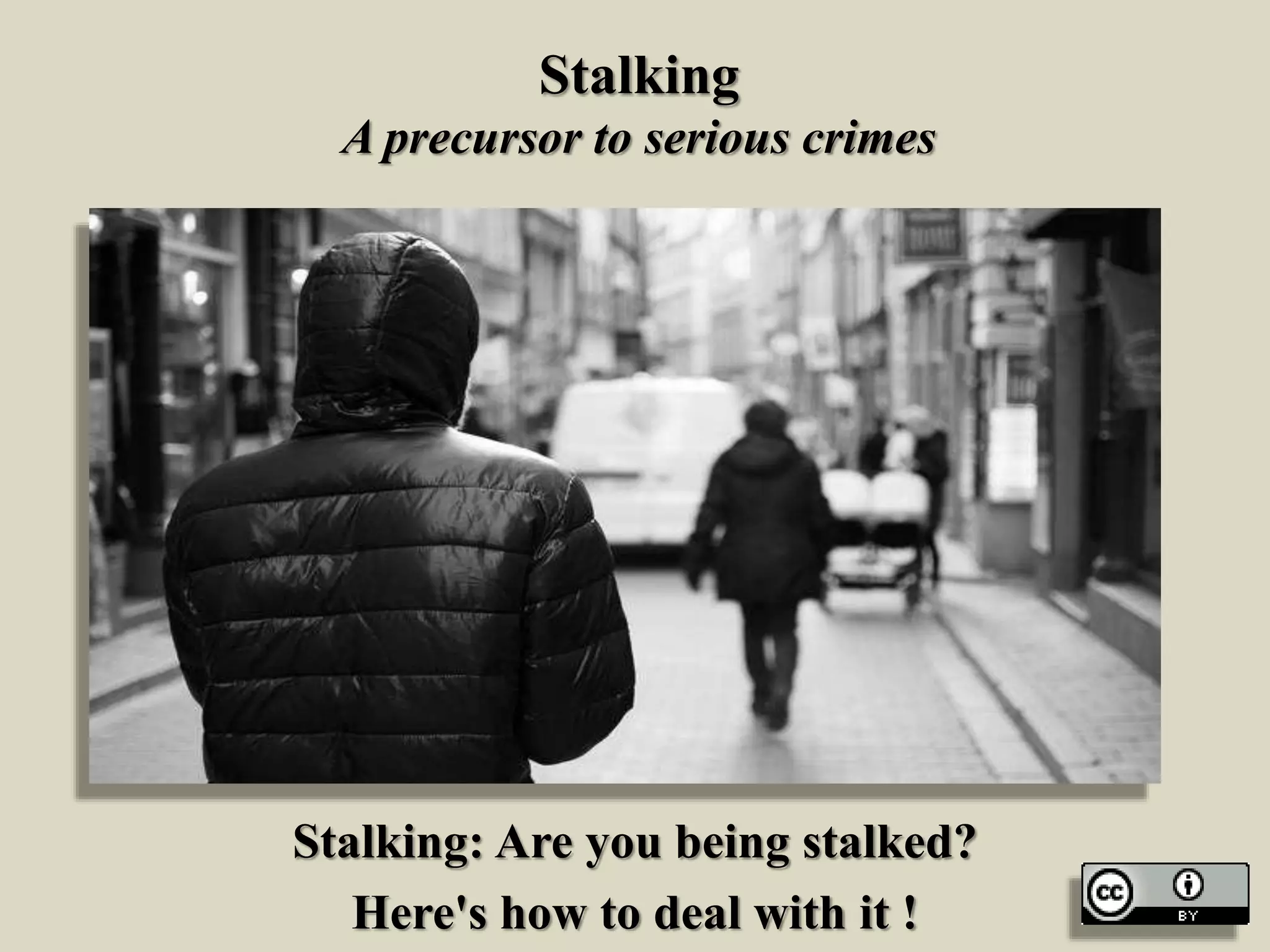












Stalking
A precursor to serious crimes
Stalking: Are you being stalked?
Here's how to deal with it !
Introduction
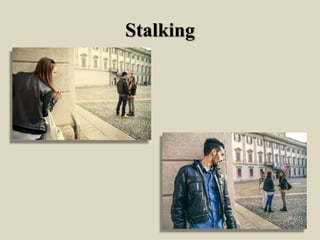
• Stalking is unwanted or repeated surveillance
by an individual or group towards another
person.
• Stalking behaviors are interrelated to
harassment and intimidation and may include
following the victim in person or monitoring
them.
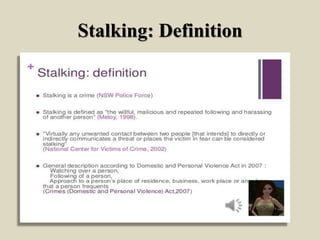
Stalking: Definition
Introduction
• The term stalking is used with some differing
definitions in psychiatry and psychology, as
well as in some legal jurisdictions as a term for a
criminal offense.
• According to a 2002 report by the U.S. National
Center for Victims of Crime, "virtually any
unwanted contact between two people that
directly or indirectly communicates a threat or
places the victim in fear can be considered
stalking.
Stalking
Definitions
• Although stalking is illegal in most areas of the world,
some of the actions that contribute to stalking may be
legal, such as gathering information, calling someone on
the phone, texting, sending gifts, emailing, or instant
messaging.
• They become illegal when they breach the legal
definition of harassment (e.g., an action such as sending a
text is not usually illegal, but is illegal when frequently
repeated to an unwilling recipient).
• In fact, United Kingdom law states the incident only has to
happen twice when the harasser should be aware their
behavior is unacceptable (e.g., two phone calls to a stranger,
two gifts, following the victim then phoning them, etc)
Stalking
Psychology and behaviors
• Stalkers may use overt and covert intimidation,
threats and violence to frighten their victims.
• They may engage in vandalism and property
damage or make physical attacks that are meant
to frighten. Less common are sexual assaults
Psychology and behaviors
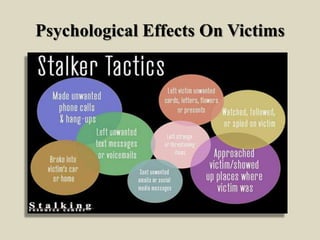
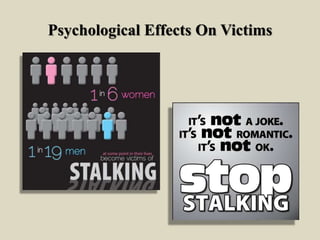
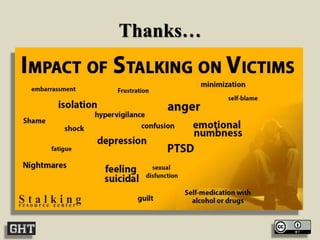
Psychological Effects On Victims
• Disruptions in daily life necessary to escape
the stalker, including changes in
employment, residence and phone numbers,
take a toll on the victim's well-being and may
lead to a sense of isolation.
Psychological Effects On Victims
Stalking
Psychological Effects On Victims
• Stalking is a form of mental assault, in
which the perpetrator repeatedly,
unwantedly, and disruptively breaks into
the life-world of the victim, with whom they
have no relationship (or no longer have).
• Moreover, the separated acts that make up
the intrusion cannot by themselves cause the
mental abuse, but do taken together
(cumulative effect).
Psychological Effects On Victims
Types Of Victims
• Based on work with stalking victims for
eight years in Australia, Mullen and Pathé
identified different types of stalking victims
dependent on their previous relationship to the
stalker. These are
Types Of Victims
Types Of Victims
• Prior Intimates: Victims who had been in a
previous intimate relationship with their
stalker.
• In the article, Mullen and Pathé describe this
as being "the largest category, the most
common victim profile being a woman who
has previously shared an intimate relationship
with her (usually) male stalker.
Prior Intimates
Types Of Victims
• Casual acquaintances and friends: Amongst
male stalking victims, most are part of this
category. This category of victims also includes
neighbor stalking. This may result in the
victims' change of residence.
• Professional contacts: These are victims who
have been stalked by patients, clients, or students
whom they have had a professional relationship
with. Certain professions such as health care
providers, teachers, and lawyers are at a
higher risk for stalking.
Types Of Victims
Types Of Victims
• Workplace Contacts: The stalkers of these
victims tend to visit them in their workplace
which means that they are either an employer,
employee, or a customer.
• When victims have stalkers coming to their
workplace, this poses a threat not only to
the victims' safety but to the safety of other
individuals as well.
Workplace Contacts
Types Of Victims
• Strangers: These victims are typically
unaware of how their stalkers began
stalking because typically these stalkers
form a sense of admiration for their victims
from a distance.
• The famous: Most of these victims are
individuals who are portrayed heavily on
media outlets but can also include individuals
such as politicians and athletes
Types Of Victims
Gender
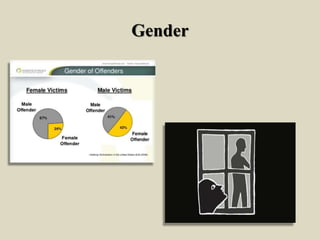
• According to one study, women often target other
women, whereas men primarily stalk women. A report
from the United States Department of Justice reports
that "Males were as likely to report being stalked by
a male as a female offender.
• 43% of male stalking victims stated that the
offender was female, while 41% of male victims
stated that the offender was another male.
• Female victims of stalking were significantly more
likely to be stalked by a male (67%) rather than a
female (24%) offender.
Gender
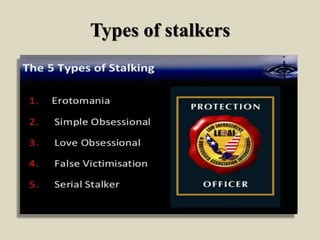
Types of stalkers
• Psychologists often group individuals who stalk into
two categories:
• psychotic and non-psychotic. Some stalkers may have
pre-existing psychotic disorders such as delusional
disorder, schizoaffective disorder, or schizophrenia.
• However, most stalkers are non-psychotic and may
exhibit disorders or neuroses such as major
depression, adjustment disorder, or substance
dependence, as well as a variety of personality
disorders (such as antisocial, borderline, or
narcissistic).
Types of stalkers
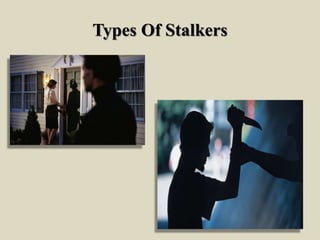
Types Of Stalkers
• Rejected stalkers follow their victims in order
to reverse, correct, or avenge a rejection (e.g.
divorce, separation, termination).
• Resentful stalkers make a vendetta because of
a sense of grievance against the victims –
motivated mainly by the desire to frighten and
distress the victim
Types Of Stalkers
Types Of Stalkers
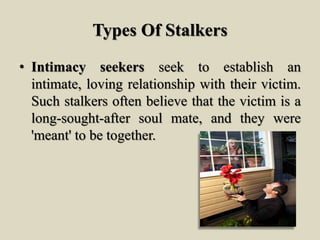
• Intimacy seekers seek to establish an
intimate, loving relationship with their victim.
Such stalkers often believe that the victim is a
long-sought-after soul mate, and they were
'meant' to be together.
Types Of Stalkers
• Incompetent suitors, despite poor social or
courting skills, have a fixation, or in some
cases, a sense of entitlement to an intimate
relationship with those who have attracted
their amorous interest.
• Their victims are most often already in a
dating relationship with someone else.
Types Of Stalkers
Types Of Stalkers
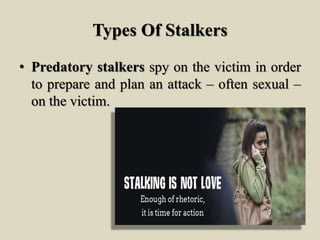
• Predatory stalkers spy on the victim in order
to prepare and plan an attack – often sexual –
on the victim.
Cyber-stalking
• Cyberstalking is the use of computers or
other electronic technology to facilitate
stalking.
• In Davis (2001), Lucks identified a separate
category of stalkers who instead of a terrestrial
means, prefer to perpetrate crimes against
their targeted victims through electronic
and online mean.
Cyber-stalking
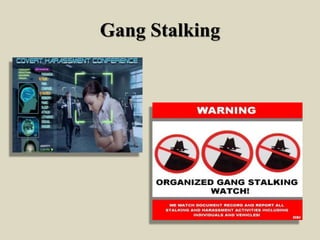
Gang Stalking
• According to a U.S. Department of Justice
special report a significant number of
people reporting stalking incidents claim
that they had been stalked by more than one
person, with 18.2% reporting that they were
stalked by two people, 13.1% reporting that
they had been stalked by three or more.
Gang Stalking
Gang Stalking
• According to a United Kingdom study by
Sheridan and Boon, in 5% of the cases they
studied there was more than one stalker, and
40% of the victims said that friends or family
of their stalker had also been involved.
• In 15% of cases, the victim was unaware of
any reason for the harassment.
Gang Stalking
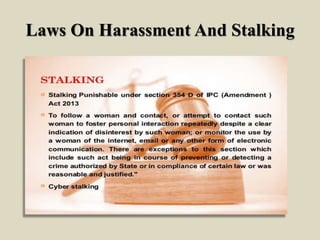
Laws On Harassment And Stalking
• India
• In 2013, Indian Parliament made amendments to the Indian
Penal Code, introducing stalking as a criminal offence.
• Stalking has been defined as a man following or
contacting a woman, despite clear indication of
disinterest by the woman, or monitoring her use of the
Internet or electronic communication.
• A man committing the offence of stalking would be
liable for imprisonment up to three years for the first
offence, and shall also be liable to fine and for any
subsequent conviction would be liable for imprisonment
up to five years and with fine.
Laws On Harassment And Stalking
Section 354D Indian Penal Code 1860
(IPC) Stalking
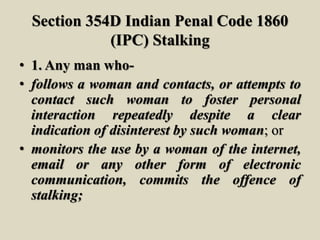
• 1. Any man who-
• follows a woman and contacts, or attempts to
contact such woman to foster personal
interaction repeatedly despite a clear
indication of disinterest by such woman; or
• monitors the use by a woman of the internet,
email or any other form of electronic
communication, commits the offence of
stalking;
Section 354D Indian Penal Code 1860
(IPC) Stalking
Section 354D Indian Penal Code 1860
(IPC) Stalking
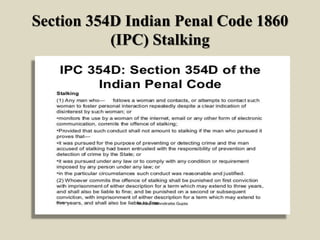
• Provided that such conduct shall not amount to
stalking if the man who pursued it proves that—
• it was pursued for the purpose of preventing or
detecting crime and the man accused of stalking had
been entrusted with the responsibility of prevention and
detection of crime by the State; or
• it was pursued under any law or to comply with any
condition or requirement imposed by any person under
any law; or
• in the particular circumstances such conduct was
reasonable and justified.
Section 354D Indian Penal Code 1860
(IPC) Stalking
• 2. Any man who-
• commits the offence of stalking shall be
punished on first conviction with
imprisonment of either description for a term
which may extend to three years, and shall also
be liable to fine; and be punished on a second or
subsequent conviction, with imprisonment of
either description for a term which may extend to
five years, and shall also be liable to fine.
Stalking Safety Planning
• Several murders of stalking victims have highlighted the
fact that people who stalk can be very dangerous.
Stalkers can threaten, attack, sexually assault and even kill
their victims.
• Victims of stalking can not predict what stalkers will do
but can determine their own responses to the stalking
behavior.
• Personal safety and harm prevention is of the utmost
importance for victims. While victims cannot control the
stalking behavior, they can be empowered to take steps to
keep themselves, family and loved ones safe. The creation
of a safety plan can assist victims in doing this.
Stalking Safety Planning
Stalking Safety Plan - What is it?
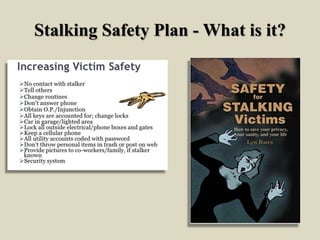
• A safety plan is a combination of suggestions,
plans, and responses created to help victims
reduce their risk of harm.
• While victims can make safety plans on their
own, it is often helpful to enlist the assistance of
trained professionals. These professionals,
including advocates and law enforcement
officers, can help a victim determine which
options will best enhance their safety and will
work to devise a safety plan to address each
unique situation and circumstance.
Stalking Safety Plan - What is it?
Stalking Safety Plans - What to Include
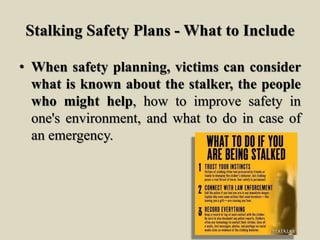
• When safety planning, victims can consider
what is known about the stalker, the people
who might help, how to improve safety in
one's environment, and what to do in case of
an emergency.
Documentation of Stalking and
Reporting to Police
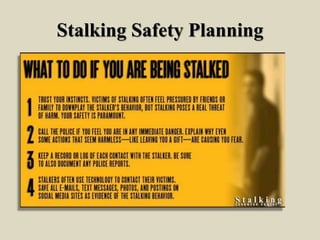
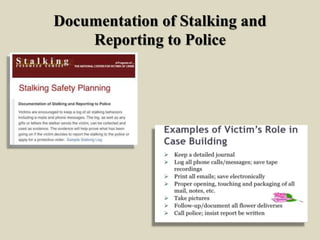
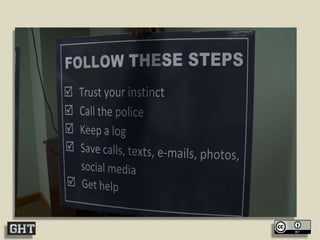
• Victims are encouraged to keep a log of all
stalking behaviors including e-mails and
phone messages.
• The log, as well as any gifts or letters the
stalker sends the victim, can be collected and
used as evidence. The evidence will help prove
what has been going on if the victim decides to
report the stalking to the police or apply for a
protective order
Documentation of Stalking and
Reporting to Police
Rely on Trusted People
• Many victims have found simple ways to
make the stalking affect them less.
• They may ask someone else to pick up and sort
their mail, get a second phone number given
only to trusted people, or have people at work
or school screen phone calls or inform the
police if the stalker shows up.
Technology Safety Planning
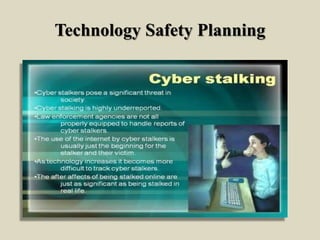
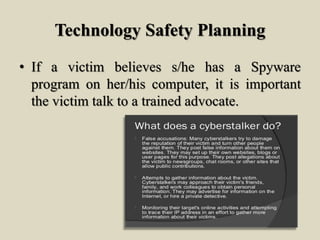
• Stalkers use technology to assist them in stalking their
victims in various ways. It is important to consider how
victims may be harmed by stalkers' use of technology.
Stalkers use the Internet to contact or post things about
the victim on message board or discussion forums.
• Often stalkers will e-mail the victim, or fill their in-
box with spam and have been known to send viruses
or other harmful programs to victims' computers.
These threatening messages should be saved,
especially if the victim is considering contacting the
police with the case.
Technology Safety Planning
• If stalkers have access to a victim's computer,
they can track them by looking at the history
or websites visited on the computer.
• Also, stalkers have been known to install
Spyware software on computers (sometimes
sent through e-mail) that sends them a copy
of every keystroke made, including
passwords, websites visited, and e-mails sent
Technology Safety Planning
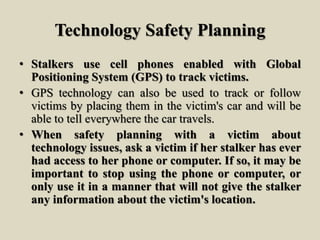
• If a victim believes s/he has a Spyware
program on her/his computer, it is important
the victim talk to a trained advocate.
Technology Safety Planning
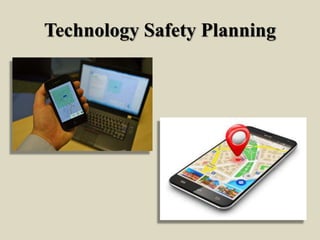
• Stalkers use cell phones enabled with Global
Positioning System (GPS) to track victims.
• GPS technology can also be used to track or follow
victims by placing them in the victim's car and will be
able to tell everywhere the car travels.
• When safety planning with a victim about
technology issues, ask a victim if her stalker has ever
had access to her phone or computer. If so, it may be
important to stop using the phone or computer, or
only use it in a manner that will not give the stalker
any information about the victim's location.
Technology Safety Planning
• It is also important for victims of stalking to
remain diligent about protecting their personal
information that could be saved in databases.
Businesses, for example, collect personal
information about people, including
addresses, phone numbers, last names, etc.
• This information can sometimes be accessed
and exploited by stalkers.
Technology Safety Planning
• Although no safety plan guarantees safety,
such plans are valuable and important tools
to keep victims safer, document incidents
that happen with the perpetrator, make
surroundings more secure, and identify
people who can help.
Technology Safety Planning
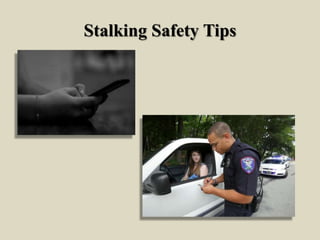
Stalking Safety Tips
• Safety Anytime:
• If possible, have a phone nearby at all times,
preferably one to which the stalker has never had
access. Memorize emergency numbers, and make sure
that 911 and helpful family or friends are on speed dial.
• Treat all threats, direct and indirect, as legitimate
and inform law enforcement immediately.
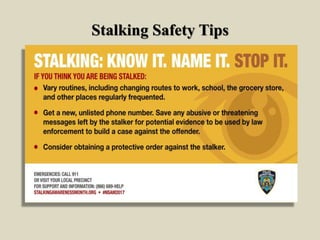
• Vary routines, including changing routes to work,
school, the grocery store, and other places regularly
frequented. Limit time spent alone and try to shop at
different stores and visit different bank branches.
Stalking Safety Tips
• When out of the house or work environment, try not to travel alone and
try to stay in public areas.
• Get a new, unlisted phone number. Leave the old number active and
connected to an answering machine or voicemail. Have a friend, advocate,
or law enforcement screen the calls, and save any messages from the
stalker. These messages, particularly those that are explicitly abusive or
threatening, can be critical evidence for law enforcement to build a stalking
case against the offender.
• Do not interact with the person stalking or harassing you. Responding
to stalker's actions may reinforce their behavior.
• Consider obtaining a protective order against the stalker. Some states
offer stalking protective orders and other victims may be eligible for
protective orders under their state's domestic violence statutes.
• Trust your instincts. If you're somewhere that doesn't feel safe, either
find ways to make it safer, or leave.
Stalking Safety Tips
If in imminent danger, locate a safe
place. Consider going to:
• Police Station
• Residences of family or friends (locations
unknown to the perpetrators)
• Domestic violence shelters
• Place of worship
• Public areas (some stalkers may be less
inclined toward violence or creating a
disturbance in public places).
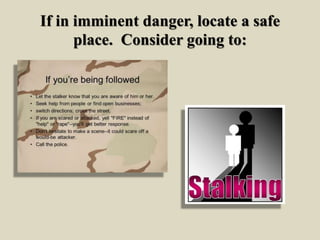
If in imminent danger, locate a safe
place. Consider going to:
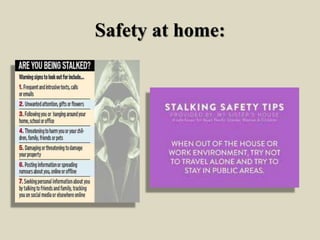
Safety at home:
• Identify escape routes out of your house. Teach them to your children.
• Install solid core doors with dead bolts. If all keys cannot be accounted
for, change the locks and secure the spare keys. Fix any broken windows or
doors.
• Have a code word you use with your children that tells them when they
need to leave.
• Inform neighbors and, if residing in an apartment, any on-site
managers about the situation, providing them with a photo or
description of the stalker and any vehicles they may drive if known. Ask
your neighbors to call the police if they see the stalker at your
house. Agree on a signal you will use when you need them to call the
police.
• Pack a bag with important items you'd need if you had to leave
quickly. Put the bag in a safe place, or give it to a friend or relative you
trust.
• Consider putting together a "stalking sack" that includes the stalking
log, a camera, information about the offender, etc.
Safety at home:
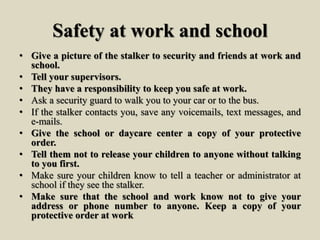
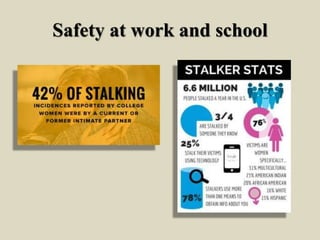
Safety at work and school
• Give a picture of the stalker to security and friends at work and
school.
• Tell your supervisors.
• They have a responsibility to keep you safe at work.
• Ask a security guard to walk you to your car or to the bus.
• If the stalker contacts you, save any voicemails, text messages, and
e-mails.
• Give the school or daycare center a copy of your protective
order.
• Tell them not to release your children to anyone without talking
to you first.
• Make sure your children know to tell a teacher or administrator at
school if they see the stalker.
• Make sure that the school and work know not to give your
address or phone number to anyone. Keep a copy of your
protective order at work
Safety at work and school
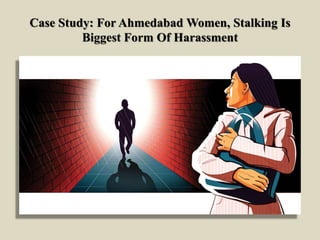
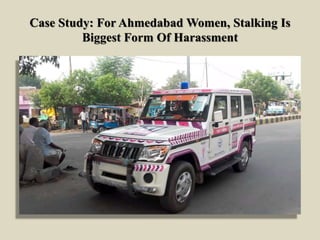
Case Study: For Ahmedabad Women, Stalking Is
Biggest Form Of Harassment
• Guess what is the biggest form of harassment
that women in city faces?
• Stalking! Analysis of calls made to the women
helpline number 181 show that most women
from the city who call the helpline complain of
stalking. What is interesting is that the trend is
true for Ahmedabad and not for the state.
• Across Gujarat, it is physical assault on women
(domestic violence) that tops the list, with
stalking coming a distant second.
Case Study: For Ahmedabad Women, Stalking Is
Biggest Form Of Harassment
Case Study: For Ahmedabad Women,
Stalking Is Biggest Form Of Harassment
• All forms of stalking (physical. telephonic, cyber
and social media) together accounted for the
highest number of distress calls to the helpline from
Ahmedabad. Physical violence came second.
• It should be noted that if each type of stalking were to
be considered separately, telephonic stalking (1489)
would still top the list followed by physical assault
(1104) in the second spot.
Case Study: For Ahmedabad Women, Stalking Is
Biggest Form Of Harassment
Case Study: For Ahmedabad Women,
Stalking Is Biggest Form Of Harassment
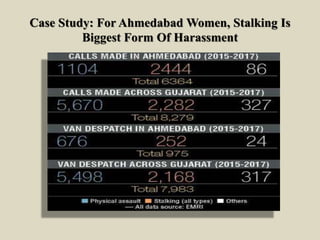
• The data shared by Emergency
Management and Research Institute
(EMRI) about calls and van despatch in
response to distress calls shows that for the
three years of 2015, 2016 and 2017, the
helpline received 3634 calls in the city. Of
this, nearly 67% of the complaints (2444
cases) are of one or the other type of
stalking.
Case Study: For Ahmedabad Women,
Stalking Is Biggest Form Of Harassment
Case Study: For Ahmedabad Women, Stalking Is
Biggest Form Of Harassment
• EMRI that handles the 181 helpline has a
very interesting explanation for why
stalking calls are on the rise.
• "The helpline offers help with complete
anonymity to the victim. This encourages more
women to call us up and report cases,"
Case Study: For Ahmedabad Women,
Stalking Is Biggest Form Of Harassment
Case Study: For Ahmedabad Women,
Stalking Is Biggest Form Of Harassment
• But with the helpline, resolution is done
without actually putting the women in
inconvenience or compromising her
anonymity.
• follow up with the victims to ensure that the
stalking has ceased after our intervention.
Case Study: For Ahmedabad Women, Stalking Is
Biggest Form Of Harassment
Case Study: For Ahmedabad Women,
Stalking Is Biggest Form Of Harassment
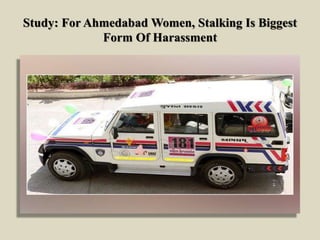
• However, it was physical violence calls that
required the highest number of van
despatch in the city.
• Van despatch takes place when the
counsellors at the helpline feels that there is
a need to physically visit the victim/caller. A
van that is despatched for helping the victims
has a counsellor, a women police constable
and a driver in it.
Case Study: For Ahmedabad Women, Stalking Is
Biggest Form Of Harassment
Case Study: For Ahmedabad Women,
Stalking Is Biggest Form Of Harassment
• The data for the three years (2015-2017) for
van dispatch in Ahmedabad city shows that in
all in 975 cases required one.
• Of this, in 69% of the cases, it was a
physical assault on women (676 cases) that
necessitated a van despatch.
Study: For Ahmedabad Women, Stalking Is Biggest
Form Of Harassment
Study: For Ahmedabad Women, Stalking Is
Biggest Form Of Harassment
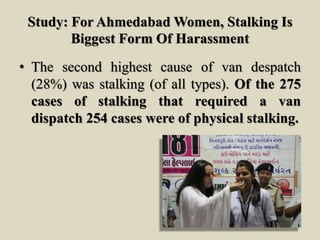
• The second highest cause of van despatch
(28%) was stalking (of all types). Of the 275
cases of stalking that required a van
dispatch 254 cases were of physical stalking.
Study: For Ahmedabad Women, Stalking Is
Biggest Form Of Harassment
• Interestingly, the data for the entire states shows a
different picture. In it physical violence topped
the list as the primary reason why women
called the helpline followed by stalking.
• Overall for the three years (2015-16) the helpline
received 8279 calls of which a whopping 5670
(68%) were complaints of physical assault on
women. The second highest number of calls
were for stalking (of all types). In all 2282 calls
about stalking went to the helpling from across
the state, accounting for 27% of the calls.
Study: For Ahmedabad Women, Stalking Is
Biggest Form Of Harassment
Why You Must Call 181
• 181 helpline first counsels a victim of stalking (and
others too) and then get details of the stalker. In case
of stalking, the service has a women police constable
on duty 24X7.
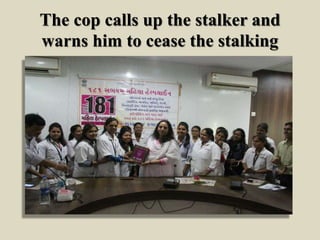
• The cop calls up the stalker and warns him to cease
the stalking. A week after the call is made by the
victim, the service follows up to know if she is still
being stalked.
• The follow-up stops only when the victim says she
feels safe now. In case of stubborn stalkers, the
helpline also involves the CID crime and cops visit
the home of stalkers to warn them too.
The cop calls up the stalker and
warns him to cease the stalking
Terminology
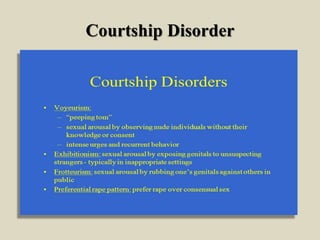
• Courtship Disorder
• Courtship disorder is a theoretical construct
in sexology in which a certain set of sexual
perversion and sexual deviation are seen as
specific instances of anomalous courtship
instincts in men
Courtship Disorder
Terminology
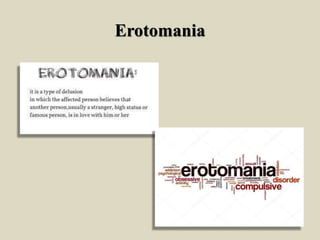
• Erotomania
• Erotomania is listed in the DSM 5 as a
subtype of a delusional disorder.
• It is a relatively uncommon paranoid condition
that is characterized by an individual's
delusions of another person being infatuated
with him or her.
Erotomania
Poison Pen Letter
• Poison pen letter
• A poison pen letter is a letter or note
containing unpleasant, abusive or malicious
statements or accusations about the recipient or
a third party. It is usually sent anonymously.
In the term "poison pen", the word poison
is used figuratively, rather than literally.
Poison pen letters are usually composed and
sent to upset the recipient.
Poison Pen Letter
Querulant
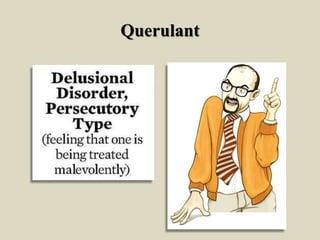
• Querulant
• In the legal profession and courts, a querulant
(from the Latin querulus - "complaining") is a
person who obsessively feels wronged,
particularly about minor causes of action. In
particular the term is used for those who
repeatedly petition authorities or pursue legal
actions based on manifestly unfounded
grounds.
Querulant
Secret Admirer
• Secret Admirer
• A secret admirer is an individual who feels
adoration, fondness or love for another person
without disclosing his or her identity to that
person, and who may send gifts or love letters
to his or her crush.
Secret Admirer
Voyeurism
• Voyeurism
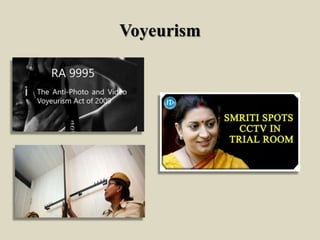
• Voyeurism is the sexual interest in or practice
of spying on people engaged in intimate
behaviors, such as undressing, sexual
activity, or other actions usually considered
to be of a private nature.
Voyeurism
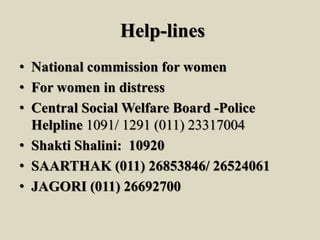
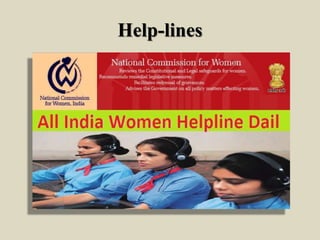
Help-lines
• National commission for women
• For women in distress
• Central Social Welfare Board -Police
Helpline 1091/ 1291 (011) 23317004
• Shakti Shalini: 10920
• SAARTHAK (011) 26853846/ 26524061
• JAGORI (011) 26692700
Help-lines
Help-lines
• Sakshi - Violence Intervention Center (0124)
2562336/ 5018873
• Saheli - A Womens Organization
(011) 24616485 (Saturdays)
• RAHI Recovering and Healing from Incest.
• A support centre for women survivors of child
sexual abuse (011) 26238466/ 26224042
26227647
Help-lines
Help-lines
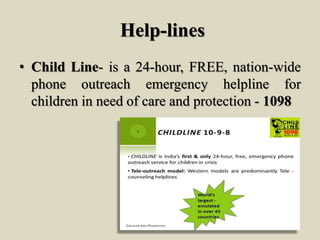
• Child Line- is a 24-hour, FREE, nation-wide
phone outreach emergency helpline for
children in need of care and protection - 1098
Help-lines
• Obscene Calls :Call and/or report on the Delhi
Police Anti-Obscene Call Helpline 1096 &
27894455 and also at e-mail: acp-sit-
dl@nic.in You can also forward objectionable
SMS/MMS on 9911135446.
Help-lines
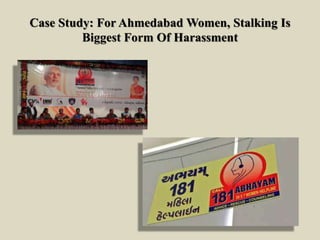
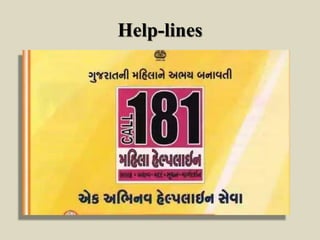
• “Abhayam” – Women Helpline 181 in the State of
Gujarat
• The helpline will be synchronized with the existing
"1091 - Gujarat Police Helpline" and other women-
oriented services.
• The free 24x7 helpline, 181, is a toll-free number to
support women in distress and is accessible through
any mobile or landline. Any women can access 181
“Abhayam” helpline for the purpose of counseling,
guidance, information and also for the rescue in
various threatening situations including domestic
violence.
Help-lines
Stalking Sacks
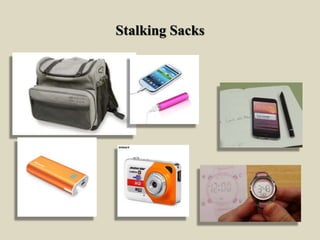
• Stalking sacks, are actual bags of resources, given to stalking victims with tools to
help them increase their safety, document the crime.
• Standard Contents
• Safety
Safety plan
• Cell phone (with charger)
• Flashlight (with batteries)
• Documentation
Stalking log
• Disposable camera (with time/date recorder if available)
• Wrist watch (to specify time and date)
• Notebook and pen
• Stalking Information
Business cards of a local investigator officer, prosecutor, and advocate
• Books on stalking (e.g., Stalking: A Handbook for Victims by Emily Spence-Diehl)
• List of books, Web sites, and other resources on stalking
Stalking Sacks
Stalking Sacks
• Possible Contents
Safety
•
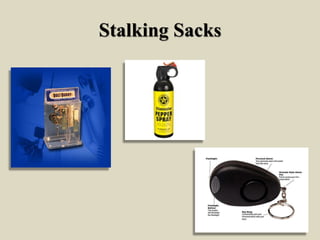
Dead bolt buddy: The dead bolt buddy is a device that attaches to
any dead bolt knob and prevents the lock from opening even if the
intruder has a key.
• Pepper spray: Pepper spray may help a victim escape an attack but
may not be legal in some jurisdictions. Victims are strongly urged to
obtain proper training on the use of pepper spray and other self-
defense instruments.
• Personal alarm: This small, portable alarm can be attached to
windows or doors and will produce a loud noise if the window or
door is opened. It also can be attached to a belt or scarf and will
sound if the strap is pulled. (Note: if the personal alarm is too
expensive, a whistle can be included in the sack.)
Stalking Sacks
Stalking Sacks
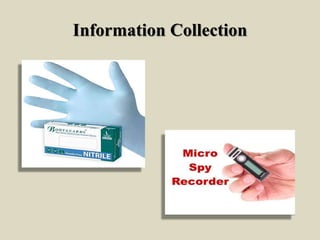
• Plastic zip-lock bag and powder-free latex
gloves: Victims can use these items to collect evidence,
but only as a last resort, if it is clear that police will not
come to the scene or that the evidence will be moved,
damaged, or altered before the police arrive.
Remember that collecting evidence is the job of law
enforcement, and under most circumstances, victims
should wait for the police to perform this task.
• Audio recorder : If tape-recording without permission
is legal in their state, victims can use tape recorders to
tape any conversation with the stalker.
Information Collection
Thanks…
Stalking-A precursor to serious crimes

Stalking-A precursor to serious crimes

  • 1.
    Stalking A precursor toserious crimes Stalking: Are you being stalked? Here's how to deal with it !
  • 2.
    Introduction • Stalking isunwanted or repeated surveillance by an individual or group towards another person. • Stalking behaviors are interrelated to harassment and intimidation and may include following the victim in person or monitoring them.
  • 3.
  • 4.
    Introduction • The termstalking is used with some differing definitions in psychiatry and psychology, as well as in some legal jurisdictions as a term for a criminal offense. • According to a 2002 report by the U.S. National Center for Victims of Crime, "virtually any unwanted contact between two people that directly or indirectly communicates a threat or places the victim in fear can be considered stalking.
  • 5.
  • 6.
    Definitions • Although stalkingis illegal in most areas of the world, some of the actions that contribute to stalking may be legal, such as gathering information, calling someone on the phone, texting, sending gifts, emailing, or instant messaging. • They become illegal when they breach the legal definition of harassment (e.g., an action such as sending a text is not usually illegal, but is illegal when frequently repeated to an unwilling recipient). • In fact, United Kingdom law states the incident only has to happen twice when the harasser should be aware their behavior is unacceptable (e.g., two phone calls to a stranger, two gifts, following the victim then phoning them, etc)
  • 7.
  • 8.
    Psychology and behaviors •Stalkers may use overt and covert intimidation, threats and violence to frighten their victims. • They may engage in vandalism and property damage or make physical attacks that are meant to frighten. Less common are sexual assaults
  • 9.
  • 10.
    Psychological Effects OnVictims • Disruptions in daily life necessary to escape the stalker, including changes in employment, residence and phone numbers, take a toll on the victim's well-being and may lead to a sense of isolation.
  • 11.
  • 12.
  • 13.
    Psychological Effects OnVictims • Stalking is a form of mental assault, in which the perpetrator repeatedly, unwantedly, and disruptively breaks into the life-world of the victim, with whom they have no relationship (or no longer have). • Moreover, the separated acts that make up the intrusion cannot by themselves cause the mental abuse, but do taken together (cumulative effect).
  • 14.
  • 15.
    Types Of Victims •Based on work with stalking victims for eight years in Australia, Mullen and Pathé identified different types of stalking victims dependent on their previous relationship to the stalker. These are
  • 16.
  • 17.
    Types Of Victims •Prior Intimates: Victims who had been in a previous intimate relationship with their stalker. • In the article, Mullen and Pathé describe this as being "the largest category, the most common victim profile being a woman who has previously shared an intimate relationship with her (usually) male stalker.
  • 18.
  • 19.
    Types Of Victims •Casual acquaintances and friends: Amongst male stalking victims, most are part of this category. This category of victims also includes neighbor stalking. This may result in the victims' change of residence. • Professional contacts: These are victims who have been stalked by patients, clients, or students whom they have had a professional relationship with. Certain professions such as health care providers, teachers, and lawyers are at a higher risk for stalking.
  • 20.
  • 21.
    Types Of Victims •Workplace Contacts: The stalkers of these victims tend to visit them in their workplace which means that they are either an employer, employee, or a customer. • When victims have stalkers coming to their workplace, this poses a threat not only to the victims' safety but to the safety of other individuals as well.
  • 22.
  • 23.
    Types Of Victims •Strangers: These victims are typically unaware of how their stalkers began stalking because typically these stalkers form a sense of admiration for their victims from a distance. • The famous: Most of these victims are individuals who are portrayed heavily on media outlets but can also include individuals such as politicians and athletes
  • 24.
  • 25.
    Gender • According toone study, women often target other women, whereas men primarily stalk women. A report from the United States Department of Justice reports that "Males were as likely to report being stalked by a male as a female offender. • 43% of male stalking victims stated that the offender was female, while 41% of male victims stated that the offender was another male. • Female victims of stalking were significantly more likely to be stalked by a male (67%) rather than a female (24%) offender.
  • 26.
  • 27.
    Types of stalkers •Psychologists often group individuals who stalk into two categories: • psychotic and non-psychotic. Some stalkers may have pre-existing psychotic disorders such as delusional disorder, schizoaffective disorder, or schizophrenia. • However, most stalkers are non-psychotic and may exhibit disorders or neuroses such as major depression, adjustment disorder, or substance dependence, as well as a variety of personality disorders (such as antisocial, borderline, or narcissistic).
  • 28.
  • 29.
    Types Of Stalkers •Rejected stalkers follow their victims in order to reverse, correct, or avenge a rejection (e.g. divorce, separation, termination). • Resentful stalkers make a vendetta because of a sense of grievance against the victims – motivated mainly by the desire to frighten and distress the victim
  • 30.
  • 31.
    Types Of Stalkers •Intimacy seekers seek to establish an intimate, loving relationship with their victim. Such stalkers often believe that the victim is a long-sought-after soul mate, and they were 'meant' to be together.
  • 32.
    Types Of Stalkers •Incompetent suitors, despite poor social or courting skills, have a fixation, or in some cases, a sense of entitlement to an intimate relationship with those who have attracted their amorous interest. • Their victims are most often already in a dating relationship with someone else.
  • 33.
  • 34.
    Types Of Stalkers •Predatory stalkers spy on the victim in order to prepare and plan an attack – often sexual – on the victim.
  • 35.
    Cyber-stalking • Cyberstalking isthe use of computers or other electronic technology to facilitate stalking. • In Davis (2001), Lucks identified a separate category of stalkers who instead of a terrestrial means, prefer to perpetrate crimes against their targeted victims through electronic and online mean.
  • 36.
  • 37.
    Gang Stalking • Accordingto a U.S. Department of Justice special report a significant number of people reporting stalking incidents claim that they had been stalked by more than one person, with 18.2% reporting that they were stalked by two people, 13.1% reporting that they had been stalked by three or more.
  • 38.
  • 39.
    Gang Stalking • Accordingto a United Kingdom study by Sheridan and Boon, in 5% of the cases they studied there was more than one stalker, and 40% of the victims said that friends or family of their stalker had also been involved. • In 15% of cases, the victim was unaware of any reason for the harassment.
  • 40.
  • 41.
    Laws On HarassmentAnd Stalking • India • In 2013, Indian Parliament made amendments to the Indian Penal Code, introducing stalking as a criminal offence. • Stalking has been defined as a man following or contacting a woman, despite clear indication of disinterest by the woman, or monitoring her use of the Internet or electronic communication. • A man committing the offence of stalking would be liable for imprisonment up to three years for the first offence, and shall also be liable to fine and for any subsequent conviction would be liable for imprisonment up to five years and with fine.
  • 42.
    Laws On HarassmentAnd Stalking
  • 43.
    Laws On HarassmentAnd Stalking
  • 44.
    Section 354D IndianPenal Code 1860 (IPC) Stalking • 1. Any man who- • follows a woman and contacts, or attempts to contact such woman to foster personal interaction repeatedly despite a clear indication of disinterest by such woman; or • monitors the use by a woman of the internet, email or any other form of electronic communication, commits the offence of stalking;
  • 45.
    Section 354D IndianPenal Code 1860 (IPC) Stalking
  • 46.
    Section 354D IndianPenal Code 1860 (IPC) Stalking • Provided that such conduct shall not amount to stalking if the man who pursued it proves that— • it was pursued for the purpose of preventing or detecting crime and the man accused of stalking had been entrusted with the responsibility of prevention and detection of crime by the State; or • it was pursued under any law or to comply with any condition or requirement imposed by any person under any law; or • in the particular circumstances such conduct was reasonable and justified.
  • 47.
    Section 354D IndianPenal Code 1860 (IPC) Stalking • 2. Any man who- • commits the offence of stalking shall be punished on first conviction with imprisonment of either description for a term which may extend to three years, and shall also be liable to fine; and be punished on a second or subsequent conviction, with imprisonment of either description for a term which may extend to five years, and shall also be liable to fine.
  • 48.
    Stalking Safety Planning •Several murders of stalking victims have highlighted the fact that people who stalk can be very dangerous. Stalkers can threaten, attack, sexually assault and even kill their victims. • Victims of stalking can not predict what stalkers will do but can determine their own responses to the stalking behavior. • Personal safety and harm prevention is of the utmost importance for victims. While victims cannot control the stalking behavior, they can be empowered to take steps to keep themselves, family and loved ones safe. The creation of a safety plan can assist victims in doing this.
  • 49.
  • 50.
    Stalking Safety Plan- What is it? • A safety plan is a combination of suggestions, plans, and responses created to help victims reduce their risk of harm. • While victims can make safety plans on their own, it is often helpful to enlist the assistance of trained professionals. These professionals, including advocates and law enforcement officers, can help a victim determine which options will best enhance their safety and will work to devise a safety plan to address each unique situation and circumstance.
  • 51.
    Stalking Safety Plan- What is it?
  • 52.
    Stalking Safety Plans- What to Include • When safety planning, victims can consider what is known about the stalker, the people who might help, how to improve safety in one's environment, and what to do in case of an emergency.
  • 53.
    Documentation of Stalkingand Reporting to Police • Victims are encouraged to keep a log of all stalking behaviors including e-mails and phone messages. • The log, as well as any gifts or letters the stalker sends the victim, can be collected and used as evidence. The evidence will help prove what has been going on if the victim decides to report the stalking to the police or apply for a protective order
  • 54.
    Documentation of Stalkingand Reporting to Police
  • 55.
    Rely on TrustedPeople • Many victims have found simple ways to make the stalking affect them less. • They may ask someone else to pick up and sort their mail, get a second phone number given only to trusted people, or have people at work or school screen phone calls or inform the police if the stalker shows up.
  • 56.
    Technology Safety Planning •Stalkers use technology to assist them in stalking their victims in various ways. It is important to consider how victims may be harmed by stalkers' use of technology. Stalkers use the Internet to contact or post things about the victim on message board or discussion forums. • Often stalkers will e-mail the victim, or fill their in- box with spam and have been known to send viruses or other harmful programs to victims' computers. These threatening messages should be saved, especially if the victim is considering contacting the police with the case.
  • 57.
  • 58.
    Technology Safety Planning •If stalkers have access to a victim's computer, they can track them by looking at the history or websites visited on the computer. • Also, stalkers have been known to install Spyware software on computers (sometimes sent through e-mail) that sends them a copy of every keystroke made, including passwords, websites visited, and e-mails sent
  • 59.
  • 60.
    Technology Safety Planning •If a victim believes s/he has a Spyware program on her/his computer, it is important the victim talk to a trained advocate.
  • 61.
    Technology Safety Planning •Stalkers use cell phones enabled with Global Positioning System (GPS) to track victims. • GPS technology can also be used to track or follow victims by placing them in the victim's car and will be able to tell everywhere the car travels. • When safety planning with a victim about technology issues, ask a victim if her stalker has ever had access to her phone or computer. If so, it may be important to stop using the phone or computer, or only use it in a manner that will not give the stalker any information about the victim's location.
  • 62.
  • 63.
    Technology Safety Planning •It is also important for victims of stalking to remain diligent about protecting their personal information that could be saved in databases. Businesses, for example, collect personal information about people, including addresses, phone numbers, last names, etc. • This information can sometimes be accessed and exploited by stalkers.
  • 64.
    Technology Safety Planning •Although no safety plan guarantees safety, such plans are valuable and important tools to keep victims safer, document incidents that happen with the perpetrator, make surroundings more secure, and identify people who can help.
  • 65.
  • 66.
    Stalking Safety Tips •Safety Anytime: • If possible, have a phone nearby at all times, preferably one to which the stalker has never had access. Memorize emergency numbers, and make sure that 911 and helpful family or friends are on speed dial. • Treat all threats, direct and indirect, as legitimate and inform law enforcement immediately. • Vary routines, including changing routes to work, school, the grocery store, and other places regularly frequented. Limit time spent alone and try to shop at different stores and visit different bank branches.
  • 67.
  • 68.
    Stalking Safety Tips •When out of the house or work environment, try not to travel alone and try to stay in public areas. • Get a new, unlisted phone number. Leave the old number active and connected to an answering machine or voicemail. Have a friend, advocate, or law enforcement screen the calls, and save any messages from the stalker. These messages, particularly those that are explicitly abusive or threatening, can be critical evidence for law enforcement to build a stalking case against the offender. • Do not interact with the person stalking or harassing you. Responding to stalker's actions may reinforce their behavior. • Consider obtaining a protective order against the stalker. Some states offer stalking protective orders and other victims may be eligible for protective orders under their state's domestic violence statutes. • Trust your instincts. If you're somewhere that doesn't feel safe, either find ways to make it safer, or leave.
  • 69.
  • 70.
    If in imminentdanger, locate a safe place. Consider going to: • Police Station • Residences of family or friends (locations unknown to the perpetrators) • Domestic violence shelters • Place of worship • Public areas (some stalkers may be less inclined toward violence or creating a disturbance in public places).
  • 71.
    If in imminentdanger, locate a safe place. Consider going to:
  • 72.
    Safety at home: •Identify escape routes out of your house. Teach them to your children. • Install solid core doors with dead bolts. If all keys cannot be accounted for, change the locks and secure the spare keys. Fix any broken windows or doors. • Have a code word you use with your children that tells them when they need to leave. • Inform neighbors and, if residing in an apartment, any on-site managers about the situation, providing them with a photo or description of the stalker and any vehicles they may drive if known. Ask your neighbors to call the police if they see the stalker at your house. Agree on a signal you will use when you need them to call the police. • Pack a bag with important items you'd need if you had to leave quickly. Put the bag in a safe place, or give it to a friend or relative you trust. • Consider putting together a "stalking sack" that includes the stalking log, a camera, information about the offender, etc.
  • 73.
  • 74.
    Safety at workand school • Give a picture of the stalker to security and friends at work and school. • Tell your supervisors. • They have a responsibility to keep you safe at work. • Ask a security guard to walk you to your car or to the bus. • If the stalker contacts you, save any voicemails, text messages, and e-mails. • Give the school or daycare center a copy of your protective order. • Tell them not to release your children to anyone without talking to you first. • Make sure your children know to tell a teacher or administrator at school if they see the stalker. • Make sure that the school and work know not to give your address or phone number to anyone. Keep a copy of your protective order at work
  • 75.
    Safety at workand school
  • 76.
    Case Study: ForAhmedabad Women, Stalking Is Biggest Form Of Harassment • Guess what is the biggest form of harassment that women in city faces? • Stalking! Analysis of calls made to the women helpline number 181 show that most women from the city who call the helpline complain of stalking. What is interesting is that the trend is true for Ahmedabad and not for the state. • Across Gujarat, it is physical assault on women (domestic violence) that tops the list, with stalking coming a distant second.
  • 77.
    Case Study: ForAhmedabad Women, Stalking Is Biggest Form Of Harassment
  • 78.
    Case Study: ForAhmedabad Women, Stalking Is Biggest Form Of Harassment • All forms of stalking (physical. telephonic, cyber and social media) together accounted for the highest number of distress calls to the helpline from Ahmedabad. Physical violence came second. • It should be noted that if each type of stalking were to be considered separately, telephonic stalking (1489) would still top the list followed by physical assault (1104) in the second spot.
  • 79.
    Case Study: ForAhmedabad Women, Stalking Is Biggest Form Of Harassment
  • 80.
    Case Study: ForAhmedabad Women, Stalking Is Biggest Form Of Harassment • The data shared by Emergency Management and Research Institute (EMRI) about calls and van despatch in response to distress calls shows that for the three years of 2015, 2016 and 2017, the helpline received 3634 calls in the city. Of this, nearly 67% of the complaints (2444 cases) are of one or the other type of stalking.
  • 81.
    Case Study: ForAhmedabad Women, Stalking Is Biggest Form Of Harassment
  • 82.
    Case Study: ForAhmedabad Women, Stalking Is Biggest Form Of Harassment • EMRI that handles the 181 helpline has a very interesting explanation for why stalking calls are on the rise. • "The helpline offers help with complete anonymity to the victim. This encourages more women to call us up and report cases,"
  • 83.
    Case Study: ForAhmedabad Women, Stalking Is Biggest Form Of Harassment
  • 84.
    Case Study: ForAhmedabad Women, Stalking Is Biggest Form Of Harassment • But with the helpline, resolution is done without actually putting the women in inconvenience or compromising her anonymity. • follow up with the victims to ensure that the stalking has ceased after our intervention.
  • 85.
    Case Study: ForAhmedabad Women, Stalking Is Biggest Form Of Harassment
  • 86.
    Case Study: ForAhmedabad Women, Stalking Is Biggest Form Of Harassment • However, it was physical violence calls that required the highest number of van despatch in the city. • Van despatch takes place when the counsellors at the helpline feels that there is a need to physically visit the victim/caller. A van that is despatched for helping the victims has a counsellor, a women police constable and a driver in it.
  • 87.
    Case Study: ForAhmedabad Women, Stalking Is Biggest Form Of Harassment
  • 88.
    Case Study: ForAhmedabad Women, Stalking Is Biggest Form Of Harassment • The data for the three years (2015-2017) for van dispatch in Ahmedabad city shows that in all in 975 cases required one. • Of this, in 69% of the cases, it was a physical assault on women (676 cases) that necessitated a van despatch.
  • 89.
    Study: For AhmedabadWomen, Stalking Is Biggest Form Of Harassment
  • 90.
    Study: For AhmedabadWomen, Stalking Is Biggest Form Of Harassment • The second highest cause of van despatch (28%) was stalking (of all types). Of the 275 cases of stalking that required a van dispatch 254 cases were of physical stalking.
  • 91.
    Study: For AhmedabadWomen, Stalking Is Biggest Form Of Harassment • Interestingly, the data for the entire states shows a different picture. In it physical violence topped the list as the primary reason why women called the helpline followed by stalking. • Overall for the three years (2015-16) the helpline received 8279 calls of which a whopping 5670 (68%) were complaints of physical assault on women. The second highest number of calls were for stalking (of all types). In all 2282 calls about stalking went to the helpling from across the state, accounting for 27% of the calls.
  • 92.
    Study: For AhmedabadWomen, Stalking Is Biggest Form Of Harassment
  • 93.
    Why You MustCall 181 • 181 helpline first counsels a victim of stalking (and others too) and then get details of the stalker. In case of stalking, the service has a women police constable on duty 24X7. • The cop calls up the stalker and warns him to cease the stalking. A week after the call is made by the victim, the service follows up to know if she is still being stalked. • The follow-up stops only when the victim says she feels safe now. In case of stubborn stalkers, the helpline also involves the CID crime and cops visit the home of stalkers to warn them too.
  • 94.
    The cop callsup the stalker and warns him to cease the stalking
  • 95.
    Terminology • Courtship Disorder •Courtship disorder is a theoretical construct in sexology in which a certain set of sexual perversion and sexual deviation are seen as specific instances of anomalous courtship instincts in men
  • 96.
  • 97.
    Terminology • Erotomania • Erotomaniais listed in the DSM 5 as a subtype of a delusional disorder. • It is a relatively uncommon paranoid condition that is characterized by an individual's delusions of another person being infatuated with him or her.
  • 98.
  • 99.
    Poison Pen Letter •Poison pen letter • A poison pen letter is a letter or note containing unpleasant, abusive or malicious statements or accusations about the recipient or a third party. It is usually sent anonymously. In the term "poison pen", the word poison is used figuratively, rather than literally. Poison pen letters are usually composed and sent to upset the recipient.
  • 100.
  • 101.
    Querulant • Querulant • Inthe legal profession and courts, a querulant (from the Latin querulus - "complaining") is a person who obsessively feels wronged, particularly about minor causes of action. In particular the term is used for those who repeatedly petition authorities or pursue legal actions based on manifestly unfounded grounds.
  • 102.
  • 103.
    Secret Admirer • SecretAdmirer • A secret admirer is an individual who feels adoration, fondness or love for another person without disclosing his or her identity to that person, and who may send gifts or love letters to his or her crush.
  • 104.
  • 105.
    Voyeurism • Voyeurism • Voyeurismis the sexual interest in or practice of spying on people engaged in intimate behaviors, such as undressing, sexual activity, or other actions usually considered to be of a private nature.
  • 106.
  • 107.
    Help-lines • National commissionfor women • For women in distress • Central Social Welfare Board -Police Helpline 1091/ 1291 (011) 23317004 • Shakti Shalini: 10920 • SAARTHAK (011) 26853846/ 26524061 • JAGORI (011) 26692700
  • 108.
  • 109.
    Help-lines • Sakshi -Violence Intervention Center (0124) 2562336/ 5018873 • Saheli - A Womens Organization (011) 24616485 (Saturdays) • RAHI Recovering and Healing from Incest. • A support centre for women survivors of child sexual abuse (011) 26238466/ 26224042 26227647
  • 110.
  • 111.
    Help-lines • Child Line-is a 24-hour, FREE, nation-wide phone outreach emergency helpline for children in need of care and protection - 1098
  • 112.
    Help-lines • Obscene Calls:Call and/or report on the Delhi Police Anti-Obscene Call Helpline 1096 & 27894455 and also at e-mail: acp-sit- dl@nic.in You can also forward objectionable SMS/MMS on 9911135446.
  • 113.
    Help-lines • “Abhayam” –Women Helpline 181 in the State of Gujarat • The helpline will be synchronized with the existing "1091 - Gujarat Police Helpline" and other women- oriented services. • The free 24x7 helpline, 181, is a toll-free number to support women in distress and is accessible through any mobile or landline. Any women can access 181 “Abhayam” helpline for the purpose of counseling, guidance, information and also for the rescue in various threatening situations including domestic violence.
  • 114.
  • 115.
    Stalking Sacks • Stalkingsacks, are actual bags of resources, given to stalking victims with tools to help them increase their safety, document the crime. • Standard Contents • Safety Safety plan • Cell phone (with charger) • Flashlight (with batteries) • Documentation Stalking log • Disposable camera (with time/date recorder if available) • Wrist watch (to specify time and date) • Notebook and pen • Stalking Information Business cards of a local investigator officer, prosecutor, and advocate • Books on stalking (e.g., Stalking: A Handbook for Victims by Emily Spence-Diehl) • List of books, Web sites, and other resources on stalking
  • 116.
  • 117.
    Stalking Sacks • PossibleContents Safety • Dead bolt buddy: The dead bolt buddy is a device that attaches to any dead bolt knob and prevents the lock from opening even if the intruder has a key. • Pepper spray: Pepper spray may help a victim escape an attack but may not be legal in some jurisdictions. Victims are strongly urged to obtain proper training on the use of pepper spray and other self- defense instruments. • Personal alarm: This small, portable alarm can be attached to windows or doors and will produce a loud noise if the window or door is opened. It also can be attached to a belt or scarf and will sound if the strap is pulled. (Note: if the personal alarm is too expensive, a whistle can be included in the sack.)
  • 118.
  • 119.
    Stalking Sacks • Plasticzip-lock bag and powder-free latex gloves: Victims can use these items to collect evidence, but only as a last resort, if it is clear that police will not come to the scene or that the evidence will be moved, damaged, or altered before the police arrive. Remember that collecting evidence is the job of law enforcement, and under most circumstances, victims should wait for the police to perform this task. • Audio recorder : If tape-recording without permission is legal in their state, victims can use tape recorders to tape any conversation with the stalker.
  • 120.
  • 121.