Leadership Theories &Styles
Dr. Kiruba Nagini R
Topics to be covered…
 Theories of Effective Leadership - Introduction - Blake and Mouton’s Managerial
Grid - House’s Path Goal Theory - Great Man Theory - Trait Theory - Leadership-
Member Exchange (LMX) Theory - Transformational Leadership - Transactional
Leadership - Continuum of Leadership Behavior - Likert’s Management System -
Hersey Blanchard Model - Fiedler’s Contingency Model
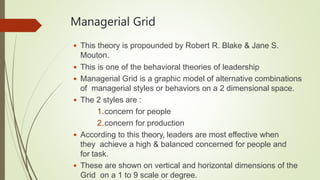
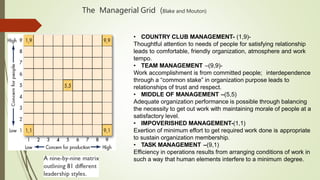
Managerial Grid
 This theory is propounded by Robert R. Blake & Jane S.
Mouton.
 This is one of the behavioral theories of leadership
 Managerial Grid is a graphic model of alternative combinations
of managerial styles or behaviors on a 2 dimensional space.
 The 2 styles are :
1.concern for people
2.concern for production
 According to this theory, leaders are most effective when
they achieve a high & balanced concerned for people and
for task.
 These are shown on vertical and horizontal dimensions of the
Grid on a 1 to 9 scale or degree.
The Managerial Grid (Blake and Mouton)
• COUNTRY CLUB MANAGEMENT- (1,9)-
Thoughtful attention to needs of people for satisfying relationship
leads to comfortable, friendly organization, atmosphere and work
tempo.
• TEAM MANAGEMENT –(9,9)-
Work accomplishment is from committed people; interdependence
through a “common stake” in organization purpose leads to
relationships of trust and respect.
• MIDDLE OF MANAGEMENT –(5,5)
Adequate organization performance is possible through balancing
the necessity to get out work with maintaining morale of people at a
satisfactory level.
• IMPOVERISHED MANAGEMENT-(1,1)
Exertion of minimum effort to get required work done is appropriate
to sustain organization membership.
• TASK MANAGEMENT –(9,1)
Efficiency in operations results from arranging conditions of work in
such a way that human elements interfere to a minimum degree.
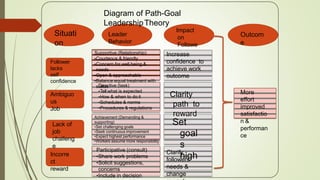
House’s Path-Goal Leadership Theory
 It was developed by Martin Evans &
subsequently refined by Robert House.The
theory extracts key element from the Ohio state
Leadership research & the Expectancy Theory
of Motivation.
 The essence of the theory is that it is the leader’s
job to assist his/her followers in attaining their
goals & to provide necessary directions &
support to ensure that goals are compatible with
the overall objectives of the group or
organization.
 The term Path-Goal is derived from the belief
that effective leaders clarify the path to help
their goals and make the journey along the path
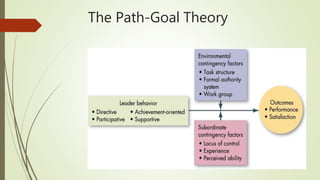
The Path-Goal Theory
Contd
… Following are the four types of leader
behavior predicted on the basis of
path-goal theory:
I. Directive Leadership
II. Supportive Leadership
III. Participative Leadership
IV. Achievement Oriented Leadership
Diagram of Path-Goal
LeadershipTheory
Situati
on
Follower
lacks
self
confidence
Ambiguo
us
Job
Lack of
job
challeng
e
Incorre
ct
reward
Leader
Behavior
Impact
on
Followe
r
Outcom
e
Supportive (Relationship)
•Courteous & friendly
•Concern for well being &
needs
•Open & approachable
•Balance equal treatment with
statusDirective (task)
•Tell what is expected
•How & when to do it
•Schedules & norms
•Procedures & regulations
Achievement (Demanding &
supporting)
•Set challenging goals
•Seek continuous improvement
•Expect highest performance
•Workers assume more responsibility
Participative (consult)
•Share work problems
•Solicit suggestions,
concerns
•Include in decision
Increase
confidence to
achieve work
outcome
Clarity
path to
reward
Set
goal
s
highClarify
followers
needs &
change
More
effort
improved
satisfactio
n &
performan
ce
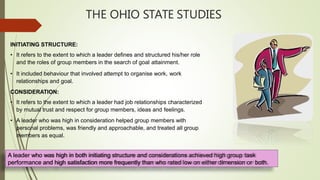
THE OHIO STATE STUDIES
INITIATING STRUCTURE:
• It refers to the extent to which a leader defines and structured his/her role
and the roles of group members in the search of goal attainment.
• It included behaviour that involved attempt to organise work, work
relationships and goal.
CONSIDERATION:
• It refers to the extent to which a leader had job relationships characterized
by mutual trust and respect for group members, ideas and feelings.
• A leader who was high in consideration helped group members with
personal problems, was friendly and approachable, and treated all group
members as equal.
A leader who was high in both initiating structure and considerations achieved high group task
performance and high satisfaction more frequently than who rated low on either dimension or both.
Vroom's expectancy theory of motivation
Vroom's expectancy theory. ... assumes that
behavior results from conscious choices among
alternatives whose purpose it is to maximize pleasure
and minimize pain. ...
Vroom realized that an employee's performance is
based on individuals factors such as personality, skills,
knowledge, experience and abilities.
The Great man theory of leadership states that
some people are born with the necessary
attributes that set them apart from others and
that these traits are responsible for their
assuming positions of power and authority.
A leader is a hero who accomplishes goals
against all odds for his followers
Great Man Theory
Examples
Examples are drawn from such great leaders like
Mahatma Gandhi, Mao Tse Tung, Kamal Ataturk,
Abraham Lincoln, General de Gaulle and others. They
were born natural leaders with built-in qualities
of leadership and attained greatness by divine
design.
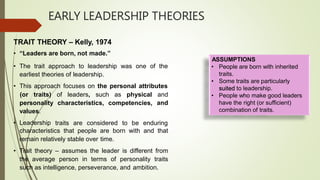
EARLY LEADERSHIP THEORIES
• The trait approach to leadership was one of the
earliest theories of leadership.
• This approach focuses on the personal attributes
characteristics, competencies,
(or traits) of leaders, such as physical and
andpersonality
values.
• Leadership traits are considered to be enduring
characteristics that people are born with and that
remain relatively stable over time.
• Trait theory – assumes the leader is different from
the average person in terms of personality traits
such as intelligence, perseverance, and ambition.
TRAIT THEORY – Kelly, 1974
• “Leaders are born, not made.”
ASSUMPTIONS
• People are born with inherited
traits.
• Some traits are particularly
suited to leadership.
• People who make good leaders
have the right (or sufficient)
combination of traits.
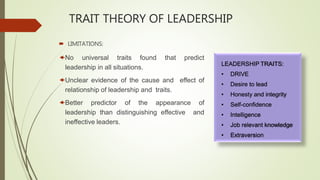
LEADERSHIP TRAITS:
• DRIVE
• Desire to lead
• Honesty and integrity
• Self-confidence
• Intelligence
• Job relevant knowledge
• Extraversion
TRAIT THEORY OF LEADERSHIP
 LIMITATIONS:
No universal traits found that predict
leadership in all situations.
Unclear evidence of the cause and effect of
relationship of leadership and traits.
Better predictor of the appearance of
leadership than distinguishing effective and
ineffective leaders.
BEHAVIOURAL THEORIES
• Leaders can be made, rather than are born.
leadership is based on definable, learnable• Successful
behaviour.
Description
• Behavioural theories do not seek inborn traits – they look at what
leaders actually do.
• Success can be defined in terms of describable actions.
Implication:
• Leadership capability can be learned.
BEHAVIOURAL THEORIES
According to UNIVERSITY OF LOWASTUDIES
• The study was conducted by Kurt Lewin and his
associates
• The three leadership styles which are:-
1. AUTOCRATIC
2. DEMOCRATIC
3. LAISSEZ-FAIRE
Leader–Member Exchange Theory
Leader-Member Exchange (LMX) Theory
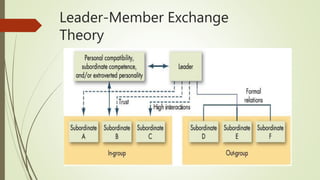
Leaders create in-groups and out-groups,
and subordinates with in-group status will
have higher performance ratings, less
turnover, and greater job satisfaction.
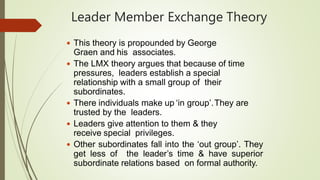
Leader Member Exchange Theory
 This theory is propounded by George
Graen and his associates.
 The LMX theory argues that because of time
pressures, leaders establish a special
relationship with a small group of their
subordinates.
 There individuals make up ‘in group’.They are
trusted by the leaders.
 Leaders give attention to them & they
receive special privileges.
 Other subordinates fall into the ‘out group’. They
get less of the leader’s time & have superior
subordinate relations based on formal authority.
Contd
… Graen & his colleagues emphasizes that LMX
has evolved various stages:
1. The discovery of differentiated dyads.
2. The investigation of characteristics of LMX
relationships & their organizational outcome.
3. The aggregation of differentiated relations to
group.
 The theory and research provide evidence
that leaders do differentiate among sub-
ordinates.
 This is related to the performance of the
employees & their satisfaction.
Leader-Member Exchange
Theory
CONTEMPORARY VIEWS ON
LEADERSHIP
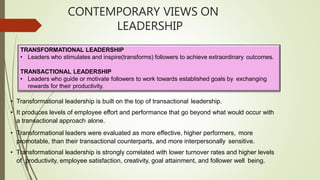
TRANSFORMATIONAL LEADERSHIP
• Leaders who stimulates and inspire(transforms) followers to achieve extraordinary outcomes.
TRANSACTIONAL LEADERSHIP
• Leaders who guide or motivate followers to work towards established goals by exchanging
rewards for their productivity.
• Transformational leadership is built on the top of transactional leadership.
• It produces levels of employee effort and performance that go beyond what would occur with
a transactional approach alone.
• Transformational leaders were evaluated as more effective, higher performers, more
promotable, than their transactional counterparts, and more interpersonally sensitive.
• Transformational leadership is strongly correlated with lower turnover rates and higher levels
of productivity, employee satisfaction, creativity, goal attainment, and follower well being.
MAJOR ISSUES OF LEADERSHIP
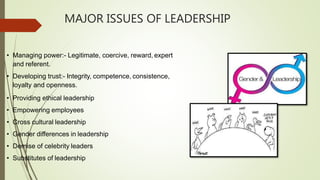
• Managing power:- Legitimate, coercive, reward, expert
and referent.
• Developing trust:- Integrity, competence, consistence,
loyalty and openness.
• Providing ethical leadership
• Empowering employees
• Cross cultural leadership
• Gender differences in leadership
• Demise of celebrity leaders
• Substitutes of leadership
Activity of the Day
 Transformational and Transactional Leadership Questionnaire
 Transactional and Transformational Leadership
Likert’s Management
Systems Rensis Likert of Michigan University USA and his
associates made extensive research on
management and leadership patterns in a large
number of organizations.
 Likert evolved 4 models of management as
systems of management. His system are:
system 1 : Exploitative –
authoritative system 2 :
Benevolent – authoritative
system 3 : Consultative
system 4 : Participative – Democratic
 Likert found that most individual managers and
organization fit into one or the other of his systems
in terms of certain operating characteristics as goal
setting, decision making, motivation, leadership,
communication and control.
Contd
…Likert’s systems of management may be
described in brief as follows:
 System 1 management : Managers and
organizations in the system are highly
autocratic. They believe in determining goals
and the means of achieving them.
Communication is highly formal.
 System 2 management : in this system a
master-servant relationship exists between the
manager and employee. Some times manager
adopt paternalistic attitudes here is & at other
times harsh attitude towards subordinate.
Centralization is there. One way communication.
Organization environment is stress-full.
Contd
… System 3 management : in this system,
management shows some interest in employees and
their contributions.They are consulted and their
views are taken into account by managers. Some
operational decisions are allowed to be made at lower
levels of management.There is a open
communication between superiors and subordinates.
No such control.Trust and confidence between each
other. Rewards for motivation.
 System 4 management : this is an ideal system of
management. The relationship between managers
and subordinates are cordial and frankly.
Subordinates are closely involved in decision-making
process and goal setting process. Superiors are very
Findings of this
theory System 1 oriented organizations scored very
poorly while the performance of System 4
oriented organizations was very creditable.
 He concluded that participative leadership is
only the valid approach to make optimum
utilization of resources.
 For System 2 & 3 he suggested extensive and
intensive leadership training at all levels of
management to move them into system 4.
Hersey & Blanchard’s Situational Theo
 This model is developed by Paul Hersey & Ken
Blanchard.This theory has been used by nearly 500
companies. It has been widely accepted in all the
military services.
 This theory focuses on the followers. Successful
leadership is achieved by selecting the right
leadership style, which is contingent on the level
of followers readiness or maturity.
 Situational leadership uses the same two leadership
dimensions
that Fiedler identified:Task and relationship behavior.
 However Hersey & Balanchard go a step further by
considering each as either high or low and then
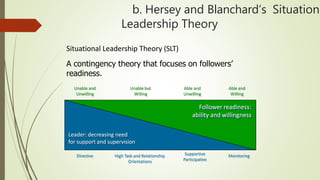
b. Hersey and Blanchard’s Situationa
Leadership Theory
Situational Leadership Theory (SLT)
A contingency theory that focuses on followers’
readiness.
Leader: decreasing need
for support and supervision
Follower readiness:
ability and willingness
Unable and
Unwilling
Unable but
Willing
Able and
Willing
Directive High Task and Relationship
Orientations
Supportive
Participative
Able and
Unwilling
Monitoring
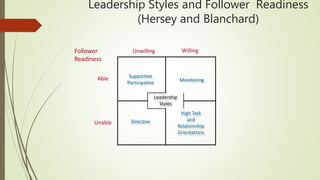
Leadership Styles and Follower Readiness
(Hersey and Blanchard)
WillingUnwilling
Able
Unable
Follower
Readiness
Supportive
Participative Monitoring
Leadership
Styles
Directive
High Task
and
Relationship
Orientations
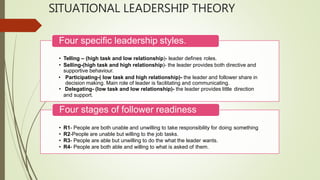
SITUATIONAL LEADERSHIP THEORY
• Telling – (high task and low relationship)- leader defines roles.
• Selling-(high task and high relationship)- the leader provides both directive and
supportive behaviour.
• Participating-( low task and high relationship)- the leader and follower share in
decision making. Main role of leader is facilitating and communicating.
• Delegating- (low task and low relationship)- the leader provides little direction
and support.
Four specific leadership styles.
• R1- People are both unable and unwilling to take responsibility for doing something
• R2-People are unable but willing to the job tasks.
• R3- People are able but unwilling to do the what the leader wants.
• R4- People are both able and willing to what is asked of them.
Four stages of follower readiness
Fiedler’s Contingency Model of Leadership
 After a long and painstaking research Fiedler argued
that effectiveness of leadership depends on the
combination of a leader’s personality and the
situation in which he functions. Situational variables
are described by Fiedler in terms of following three
dimensions:
1. Leader Member Relationship: the extent to which
the leader is accepted, respected and trusted by
members of his work group.
2. Task Structure: the extent to which the jobs of
members of the work group are defined and
known.
3. Position Power: the extent of formal authority
commanded by the leader and also the rewards
and penalties he can dispense to members.
Contd
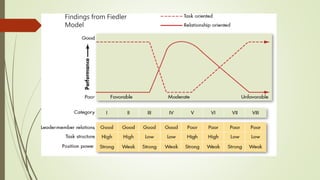
… Leader-member relations may be good or poor, task
structure of work group may be high or low and
position power of the leader may be strong or weak.
Such characteristics of situational variables may
exists in different combinations.
 Situations are favourable to the leader if all 3 of
these dimensions are high and visa versa.
 Fiedler generalized that task oriented leaders are
effective. Good performance by leaders.
 According to Fiedler, the group performance can be
improved in 2 ways. One is leadership training to
modify the personality and values. Second is the
modification or improvement of the situation.
Contd
… Fiedler’s model is considered as a significant
contribution to knowledge on leadership.
 It emphasizes that a leader’s effectiveness is
neither purely a matter of qualities nor that of
situation.
 It is the result of interaction between the two.
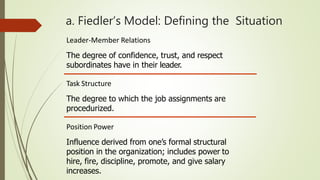
a. Fiedler’s Model: Defining the Situation
Leader-Member Relations
The degree of confidence, trust, and respect
subordinates have in their leader.
Task Structure
The degree to which the job assignments are
procedurized.
Position Power
Influence derived from one’s formal structural
position in the organization; includes power to
hire, fire, discipline, promote, and give salary
increases.
Findings from Fiedler
Model
Meet you in the next session with the
other types and styles …

Session 3 leadership styles

  • 1.
  • 2.
    Topics to becovered…  Theories of Effective Leadership - Introduction - Blake and Mouton’s Managerial Grid - House’s Path Goal Theory - Great Man Theory - Trait Theory - Leadership- Member Exchange (LMX) Theory - Transformational Leadership - Transactional Leadership - Continuum of Leadership Behavior - Likert’s Management System - Hersey Blanchard Model - Fiedler’s Contingency Model
  • 3.
    Managerial Grid  Thistheory is propounded by Robert R. Blake & Jane S. Mouton.  This is one of the behavioral theories of leadership  Managerial Grid is a graphic model of alternative combinations of managerial styles or behaviors on a 2 dimensional space.  The 2 styles are : 1.concern for people 2.concern for production  According to this theory, leaders are most effective when they achieve a high & balanced concerned for people and for task.  These are shown on vertical and horizontal dimensions of the Grid on a 1 to 9 scale or degree.
  • 4.
    The Managerial Grid(Blake and Mouton) • COUNTRY CLUB MANAGEMENT- (1,9)- Thoughtful attention to needs of people for satisfying relationship leads to comfortable, friendly organization, atmosphere and work tempo. • TEAM MANAGEMENT –(9,9)- Work accomplishment is from committed people; interdependence through a “common stake” in organization purpose leads to relationships of trust and respect. • MIDDLE OF MANAGEMENT –(5,5) Adequate organization performance is possible through balancing the necessity to get out work with maintaining morale of people at a satisfactory level. • IMPOVERISHED MANAGEMENT-(1,1) Exertion of minimum effort to get required work done is appropriate to sustain organization membership. • TASK MANAGEMENT –(9,1) Efficiency in operations results from arranging conditions of work in such a way that human elements interfere to a minimum degree.
  • 5.
    House’s Path-Goal LeadershipTheory  It was developed by Martin Evans & subsequently refined by Robert House.The theory extracts key element from the Ohio state Leadership research & the Expectancy Theory of Motivation.  The essence of the theory is that it is the leader’s job to assist his/her followers in attaining their goals & to provide necessary directions & support to ensure that goals are compatible with the overall objectives of the group or organization.  The term Path-Goal is derived from the belief that effective leaders clarify the path to help their goals and make the journey along the path
  • 6.
  • 7.
    Contd … Following arethe four types of leader behavior predicted on the basis of path-goal theory: I. Directive Leadership II. Supportive Leadership III. Participative Leadership IV. Achievement Oriented Leadership
  • 8.
    Diagram of Path-Goal LeadershipTheory Situati on Follower lacks self confidence Ambiguo us Job Lackof job challeng e Incorre ct reward Leader Behavior Impact on Followe r Outcom e Supportive (Relationship) •Courteous & friendly •Concern for well being & needs •Open & approachable •Balance equal treatment with statusDirective (task) •Tell what is expected •How & when to do it •Schedules & norms •Procedures & regulations Achievement (Demanding & supporting) •Set challenging goals •Seek continuous improvement •Expect highest performance •Workers assume more responsibility Participative (consult) •Share work problems •Solicit suggestions, concerns •Include in decision Increase confidence to achieve work outcome Clarity path to reward Set goal s highClarify followers needs & change More effort improved satisfactio n & performan ce
  • 9.
    THE OHIO STATESTUDIES INITIATING STRUCTURE: • It refers to the extent to which a leader defines and structured his/her role and the roles of group members in the search of goal attainment. • It included behaviour that involved attempt to organise work, work relationships and goal. CONSIDERATION: • It refers to the extent to which a leader had job relationships characterized by mutual trust and respect for group members, ideas and feelings. • A leader who was high in consideration helped group members with personal problems, was friendly and approachable, and treated all group members as equal. A leader who was high in both initiating structure and considerations achieved high group task performance and high satisfaction more frequently than who rated low on either dimension or both.
  • 10.
    Vroom's expectancy theoryof motivation Vroom's expectancy theory. ... assumes that behavior results from conscious choices among alternatives whose purpose it is to maximize pleasure and minimize pain. ... Vroom realized that an employee's performance is based on individuals factors such as personality, skills, knowledge, experience and abilities.
  • 11.
    The Great mantheory of leadership states that some people are born with the necessary attributes that set them apart from others and that these traits are responsible for their assuming positions of power and authority. A leader is a hero who accomplishes goals against all odds for his followers Great Man Theory
  • 12.
    Examples Examples are drawnfrom such great leaders like Mahatma Gandhi, Mao Tse Tung, Kamal Ataturk, Abraham Lincoln, General de Gaulle and others. They were born natural leaders with built-in qualities of leadership and attained greatness by divine design.
  • 13.
    EARLY LEADERSHIP THEORIES •The trait approach to leadership was one of the earliest theories of leadership. • This approach focuses on the personal attributes characteristics, competencies, (or traits) of leaders, such as physical and andpersonality values. • Leadership traits are considered to be enduring characteristics that people are born with and that remain relatively stable over time. • Trait theory – assumes the leader is different from the average person in terms of personality traits such as intelligence, perseverance, and ambition. TRAIT THEORY – Kelly, 1974 • “Leaders are born, not made.” ASSUMPTIONS • People are born with inherited traits. • Some traits are particularly suited to leadership. • People who make good leaders have the right (or sufficient) combination of traits.
  • 14.
    LEADERSHIP TRAITS: • DRIVE •Desire to lead • Honesty and integrity • Self-confidence • Intelligence • Job relevant knowledge • Extraversion TRAIT THEORY OF LEADERSHIP  LIMITATIONS: No universal traits found that predict leadership in all situations. Unclear evidence of the cause and effect of relationship of leadership and traits. Better predictor of the appearance of leadership than distinguishing effective and ineffective leaders.
  • 15.
    BEHAVIOURAL THEORIES • Leaderscan be made, rather than are born. leadership is based on definable, learnable• Successful behaviour. Description • Behavioural theories do not seek inborn traits – they look at what leaders actually do. • Success can be defined in terms of describable actions. Implication: • Leadership capability can be learned.
  • 16.
    BEHAVIOURAL THEORIES According toUNIVERSITY OF LOWASTUDIES • The study was conducted by Kurt Lewin and his associates • The three leadership styles which are:- 1. AUTOCRATIC 2. DEMOCRATIC 3. LAISSEZ-FAIRE
  • 17.
    Leader–Member Exchange Theory Leader-MemberExchange (LMX) Theory Leaders create in-groups and out-groups, and subordinates with in-group status will have higher performance ratings, less turnover, and greater job satisfaction.
  • 18.
    Leader Member ExchangeTheory  This theory is propounded by George Graen and his associates.  The LMX theory argues that because of time pressures, leaders establish a special relationship with a small group of their subordinates.  There individuals make up ‘in group’.They are trusted by the leaders.  Leaders give attention to them & they receive special privileges.  Other subordinates fall into the ‘out group’. They get less of the leader’s time & have superior subordinate relations based on formal authority.
  • 19.
    Contd … Graen &his colleagues emphasizes that LMX has evolved various stages: 1. The discovery of differentiated dyads. 2. The investigation of characteristics of LMX relationships & their organizational outcome. 3. The aggregation of differentiated relations to group.  The theory and research provide evidence that leaders do differentiate among sub- ordinates.  This is related to the performance of the employees & their satisfaction.
  • 20.
  • 21.
    CONTEMPORARY VIEWS ON LEADERSHIP TRANSFORMATIONALLEADERSHIP • Leaders who stimulates and inspire(transforms) followers to achieve extraordinary outcomes. TRANSACTIONAL LEADERSHIP • Leaders who guide or motivate followers to work towards established goals by exchanging rewards for their productivity. • Transformational leadership is built on the top of transactional leadership. • It produces levels of employee effort and performance that go beyond what would occur with a transactional approach alone. • Transformational leaders were evaluated as more effective, higher performers, more promotable, than their transactional counterparts, and more interpersonally sensitive. • Transformational leadership is strongly correlated with lower turnover rates and higher levels of productivity, employee satisfaction, creativity, goal attainment, and follower well being.
  • 22.
    MAJOR ISSUES OFLEADERSHIP • Managing power:- Legitimate, coercive, reward, expert and referent. • Developing trust:- Integrity, competence, consistence, loyalty and openness. • Providing ethical leadership • Empowering employees • Cross cultural leadership • Gender differences in leadership • Demise of celebrity leaders • Substitutes of leadership
  • 23.
    Activity of theDay  Transformational and Transactional Leadership Questionnaire  Transactional and Transformational Leadership
  • 24.
    Likert’s Management Systems RensisLikert of Michigan University USA and his associates made extensive research on management and leadership patterns in a large number of organizations.  Likert evolved 4 models of management as systems of management. His system are: system 1 : Exploitative – authoritative system 2 : Benevolent – authoritative system 3 : Consultative system 4 : Participative – Democratic  Likert found that most individual managers and organization fit into one or the other of his systems in terms of certain operating characteristics as goal setting, decision making, motivation, leadership, communication and control.
  • 25.
    Contd …Likert’s systems ofmanagement may be described in brief as follows:  System 1 management : Managers and organizations in the system are highly autocratic. They believe in determining goals and the means of achieving them. Communication is highly formal.  System 2 management : in this system a master-servant relationship exists between the manager and employee. Some times manager adopt paternalistic attitudes here is & at other times harsh attitude towards subordinate. Centralization is there. One way communication. Organization environment is stress-full.
  • 26.
    Contd … System 3management : in this system, management shows some interest in employees and their contributions.They are consulted and their views are taken into account by managers. Some operational decisions are allowed to be made at lower levels of management.There is a open communication between superiors and subordinates. No such control.Trust and confidence between each other. Rewards for motivation.  System 4 management : this is an ideal system of management. The relationship between managers and subordinates are cordial and frankly. Subordinates are closely involved in decision-making process and goal setting process. Superiors are very
  • 27.
    Findings of this theorySystem 1 oriented organizations scored very poorly while the performance of System 4 oriented organizations was very creditable.  He concluded that participative leadership is only the valid approach to make optimum utilization of resources.  For System 2 & 3 he suggested extensive and intensive leadership training at all levels of management to move them into system 4.
  • 28.
    Hersey & Blanchard’sSituational Theo  This model is developed by Paul Hersey & Ken Blanchard.This theory has been used by nearly 500 companies. It has been widely accepted in all the military services.  This theory focuses on the followers. Successful leadership is achieved by selecting the right leadership style, which is contingent on the level of followers readiness or maturity.  Situational leadership uses the same two leadership dimensions that Fiedler identified:Task and relationship behavior.  However Hersey & Balanchard go a step further by considering each as either high or low and then
  • 29.
    b. Hersey andBlanchard’s Situationa Leadership Theory Situational Leadership Theory (SLT) A contingency theory that focuses on followers’ readiness. Leader: decreasing need for support and supervision Follower readiness: ability and willingness Unable and Unwilling Unable but Willing Able and Willing Directive High Task and Relationship Orientations Supportive Participative Able and Unwilling Monitoring
  • 30.
    Leadership Styles andFollower Readiness (Hersey and Blanchard) WillingUnwilling Able Unable Follower Readiness Supportive Participative Monitoring Leadership Styles Directive High Task and Relationship Orientations
  • 31.
    SITUATIONAL LEADERSHIP THEORY •Telling – (high task and low relationship)- leader defines roles. • Selling-(high task and high relationship)- the leader provides both directive and supportive behaviour. • Participating-( low task and high relationship)- the leader and follower share in decision making. Main role of leader is facilitating and communicating. • Delegating- (low task and low relationship)- the leader provides little direction and support. Four specific leadership styles. • R1- People are both unable and unwilling to take responsibility for doing something • R2-People are unable but willing to the job tasks. • R3- People are able but unwilling to do the what the leader wants. • R4- People are both able and willing to what is asked of them. Four stages of follower readiness
  • 32.
    Fiedler’s Contingency Modelof Leadership  After a long and painstaking research Fiedler argued that effectiveness of leadership depends on the combination of a leader’s personality and the situation in which he functions. Situational variables are described by Fiedler in terms of following three dimensions: 1. Leader Member Relationship: the extent to which the leader is accepted, respected and trusted by members of his work group. 2. Task Structure: the extent to which the jobs of members of the work group are defined and known. 3. Position Power: the extent of formal authority commanded by the leader and also the rewards and penalties he can dispense to members.
  • 33.
    Contd … Leader-member relationsmay be good or poor, task structure of work group may be high or low and position power of the leader may be strong or weak. Such characteristics of situational variables may exists in different combinations.  Situations are favourable to the leader if all 3 of these dimensions are high and visa versa.  Fiedler generalized that task oriented leaders are effective. Good performance by leaders.  According to Fiedler, the group performance can be improved in 2 ways. One is leadership training to modify the personality and values. Second is the modification or improvement of the situation.
  • 34.
    Contd … Fiedler’s modelis considered as a significant contribution to knowledge on leadership.  It emphasizes that a leader’s effectiveness is neither purely a matter of qualities nor that of situation.  It is the result of interaction between the two.
  • 35.
    a. Fiedler’s Model:Defining the Situation Leader-Member Relations The degree of confidence, trust, and respect subordinates have in their leader. Task Structure The degree to which the job assignments are procedurized. Position Power Influence derived from one’s formal structural position in the organization; includes power to hire, fire, discipline, promote, and give salary increases.
  • 36.
  • 37.
    Meet you inthe next session with the other types and styles …