Dr. R. Kiruba Nagini, Visiting Faculty - ITM (EEC), Research Scholar, Pondicherry Central University
A Bit of History
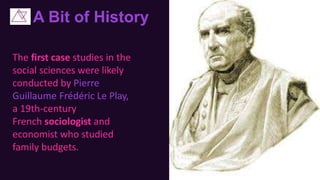
The first case studies in the
social sciences were likely
conducted by Pierre
Guillaume Frédéric Le Play,
a 19th-century
French sociologist and
economist who studied
family budgets.
CASE METHOD
CRACK A CASE
MAKE A CASE
9
CASE METHOD
CRACK A CASE
MAKE A CASE
9
CASE
STUDY
DECISION
CASES
PROBLEM
SOLVING
EXPLORATORY
ANALYSIS
2
ANALYSIS – DECISION CASES
2
Decision cases
Begin by describing a decision
faced by the case protagonist
(e.g. manager
in the case), and often
identifying distinct decision
alternatives.
Students are required to choose
an alternative and to defend
that choice
with arguments and evidence
ANALYSIS – PROBLEM SOLVING CASESANALYSIS – EVALUATION CASES
Assume the role of a case
protagonist and make
recommendations.
Students are required to
invent and justify an action
plan for dealing with the
problem
These cases do not include an
obvious single problem or
decision, but portray
remarkable situations.
Student are required to look at
all that is relevant, good, bad
or in-between, evaluate
outcomes and provide a clear
assessment.
STEPS IN CASE ANALYSIS - 1
3
1. Step-1 Getting oriented
1.1. First pass
1.2. What do I need to
do? Decide OR
Solve OR Evaluate?
1.3. Appropriate focus of
analysis
STEPS IN CASE ANALYSIS
3
2. Identifying problems
2.1. Digging
2.2. Bringing outside
concepts into analysis
2.3. Develop a problem
statement
STEPS IN CASE ANALYSIS - 2
STEPS IN CASE ANALYSIS
3
3. Performing analyses
3.1. Develop a visual
organizer (e.g.
timeline, cause-and-effect
diagram)
3.2. Qualitative information
- Qualitative analysis
3.3. Quantitative data -
Quantitative analysis
3.4. Analyse till
conclusions/evidence emerge
STEPS IN CASE ANALYSIS - 3
STEPS IN CASE ANALYSIS
3
4. Action planning (ultimate objective!!!)
4.1. Generate short, medium and
long term action plans
4.2. Alternatives ???
STEPS IN CASE ANALYSIS - 4
MAKE A CASE
PREPARING THE CASE
DRAFTING THE CASE
FINALIZING THE CASE
MAKE A CASE
PREPARING THE CASE
MAKE A CASE
1.Develop the objective
2. Set a storyline
3. Sketch your characters
4. Form a technical narrative
5. Interweave subject concepts
6. Splash some history
7. Develop the problem knots
8. Bring it to the stage of
a. Decision-making
b. Solution alternatives
c. Evaluation
9. Publish (with permissions, if any)
MAKE A CASE
TH NK
YOU

Ace your cases

  • 1.
    Dr. R. KirubaNagini, Visiting Faculty - ITM (EEC), Research Scholar, Pondicherry Central University
  • 2.
    A Bit ofHistory The first case studies in the social sciences were likely conducted by Pierre Guillaume Frédéric Le Play, a 19th-century French sociologist and economist who studied family budgets.
  • 3.
    CASE METHOD CRACK ACASE MAKE A CASE 9
  • 4.
    CASE METHOD CRACK ACASE MAKE A CASE 9 CASE STUDY
  • 5.
  • 6.
    ANALYSIS – DECISIONCASES 2 Decision cases Begin by describing a decision faced by the case protagonist (e.g. manager in the case), and often identifying distinct decision alternatives. Students are required to choose an alternative and to defend that choice with arguments and evidence ANALYSIS – PROBLEM SOLVING CASESANALYSIS – EVALUATION CASES Assume the role of a case protagonist and make recommendations. Students are required to invent and justify an action plan for dealing with the problem These cases do not include an obvious single problem or decision, but portray remarkable situations. Student are required to look at all that is relevant, good, bad or in-between, evaluate outcomes and provide a clear assessment.
  • 7.
    STEPS IN CASEANALYSIS - 1 3 1. Step-1 Getting oriented 1.1. First pass 1.2. What do I need to do? Decide OR Solve OR Evaluate? 1.3. Appropriate focus of analysis
  • 8.
    STEPS IN CASEANALYSIS 3 2. Identifying problems 2.1. Digging 2.2. Bringing outside concepts into analysis 2.3. Develop a problem statement STEPS IN CASE ANALYSIS - 2
  • 9.
    STEPS IN CASEANALYSIS 3 3. Performing analyses 3.1. Develop a visual organizer (e.g. timeline, cause-and-effect diagram) 3.2. Qualitative information - Qualitative analysis 3.3. Quantitative data - Quantitative analysis 3.4. Analyse till conclusions/evidence emerge STEPS IN CASE ANALYSIS - 3
  • 10.
    STEPS IN CASEANALYSIS 3 4. Action planning (ultimate objective!!!) 4.1. Generate short, medium and long term action plans 4.2. Alternatives ??? STEPS IN CASE ANALYSIS - 4
  • 11.
    MAKE A CASE PREPARINGTHE CASE DRAFTING THE CASE FINALIZING THE CASE
  • 12.
  • 13.
    MAKE A CASE 1.Developthe objective 2. Set a storyline 3. Sketch your characters 4. Form a technical narrative 5. Interweave subject concepts 6. Splash some history 7. Develop the problem knots 8. Bring it to the stage of a. Decision-making b. Solution alternatives c. Evaluation 9. Publish (with permissions, if any)
  • 14.
  • 16.

Editor's Notes

  • #2 Image by Samson Creative.@samsonyyc Collect Download free
  • #4 Image By: Riccardo Annandale@pavement_special
  • #5 Image By: Riccardo Annandale@pavement_special
  • #6 Image by Helloquence@helloquence
  • #7 Image by Helloquence@helloquence
  • #8 Image by Adeolu Eletu@adeolueletu
  • #9 Image by Adeolu Eletu@adeolueletu
  • #10 Image by Adeolu Eletu@adeolueletu
  • #11 Image by Adeolu Eletu@adeolueletu