Higher Order Thinking Skills
(HOTS)
Nurul Hidayah Binti Abdul Halim (D20101037326)
Nur Shafiqah Binti Abdul Rashid (D20121058738)
DEFINITION
• A concept of education reform based on learning
taxonomies (such as Bloom's Taxonomy). The idea is
that some types of learning require more cognitive
processing than others, but also have more
generalized benefits. (Anderson & Krathwohl, 2001)
• Higher order thinking skills include critical, logical,
reflective, metacognitive, and creative thinking
• HOTS moves away from general knowledge type
skills to thinking skills like: synthesizing, analyzing,
reasoning, comprehending, application and
evaluation (Sue Watson, 2003)
• Rather than emphasize the drill and repetition
activities, the focus is on problem solving and
higher level/order thinking skills (Anderson &
Krathwohl, 2001)
• Successful applications of the skills result in
explanations, decisions, performances, and
products that are valid within the context of
available knowledge and experience and that
promote continued growth in these and other
intellectual skills (FJ King & Ludwika Goodson, 2000)
• Higher order thinking is more difficult to learn or
teach but also more valuable because such skills are
more likely to be usable in novel situations
Differences of HOTS and LOTS
LOTS
(LOWER ORDER
THINKING SKILLS)
Remembering
Understanding
Applying
HOTS
(HIGHER ORDER
THINKING SKILLS)
Analizing
Evaluating
Creating
LOTS HOTS
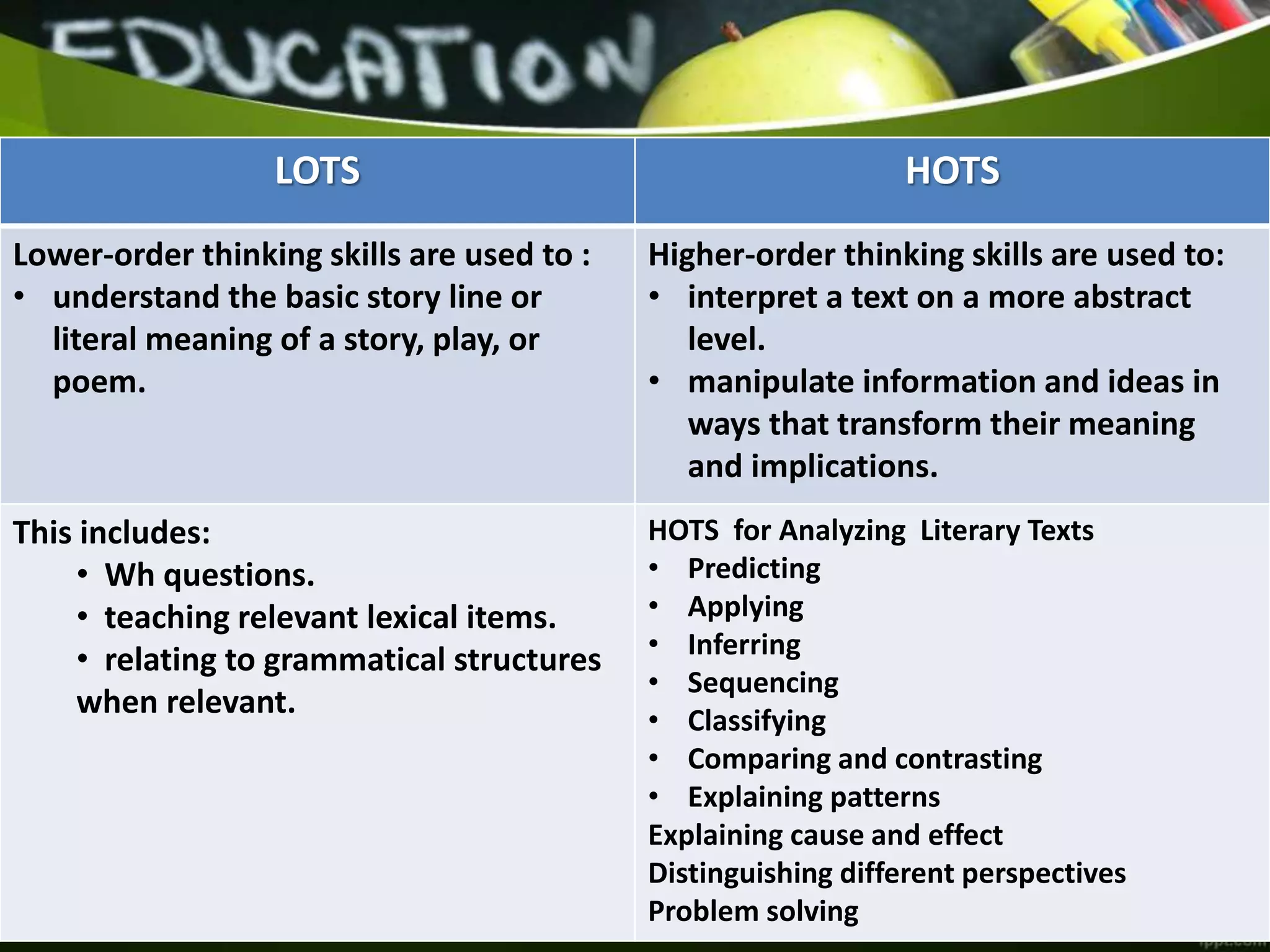
Lower-order thinking skills are used to :
• understand the basic story line or
literal meaning of a story, play, or
poem.
Higher-order thinking skills are used to:
• interpret a text on a more abstract
level.
• manipulate information and ideas in
ways that transform their meaning
and implications.
This includes:
• Wh questions.
• teaching relevant lexical items.
• relating to grammatical structures
when relevant.
HOTS for Analyzing Literary Texts
• Predicting
• Applying
• Inferring
• Sequencing
• Classifying
• Comparing and contrasting
• Explaining patterns
Explaining cause and effect
Distinguishing different perspectives
Problem solving
LOTS HOTS
• Answer given in the reading
• student state or recite answers
• answer not provided
• Student use information from the
reading to figure up answer
Categories in the cognitive domain of Bloom's
Taxonomy
• Based on Blooms Taxonomy ,there are Top four levels of the
cognitive domain: applying, analyzing, evaluating and creating.
• Applying: Carrying out or using a procedure through executing or
implementing
• Analyzing: Breaking material or concepts into parts, determining
how the parts relate or interrelate to one another or to an overall
structure or purpose
• Evaluating: Making judgments based on criteria and standards
through checking and critiquing
• Creating: Putting elements together to form a coherent or
functional whole; reorganizing elements into a new pattern or
structure through generating, planning, or producing
• Bloom’s Question Starter List – There are 6 levels of questions. The first
three levels are considered lower order questions; the final three levels
are considered higher order. Higher order questions are what we use for
Critical Thinking and Creative Problem Solving.
• Level 1: Remember – Recalling Information
List of key words:
Recognize, List, Describe, Retrieve, Name, Find, Match, Recall, Select, Label,
Define, Tell
List of Question Starters:
• What is...?
• Who was it that...?
• Can you name...?
• Describe what happened after...
• What happened after...?
Blooms Question Starter
• Level 2: Understand – Demonstrate an understanding of facts,
concepts and ideas
List of key words: Compare, Contrast, Demonstrate, Describe, Interpret,
Explain, Extend, Illustrate, Infer, Outline, Relate, Rephrase, Translate,
Summarize, Show, Classify
List of Question Starters:
• Can you explain why...?
• Can you write in your own words?
• Write a brief outline of...
• Can you clarify...?
• Who do you think?
• What was the main idea?
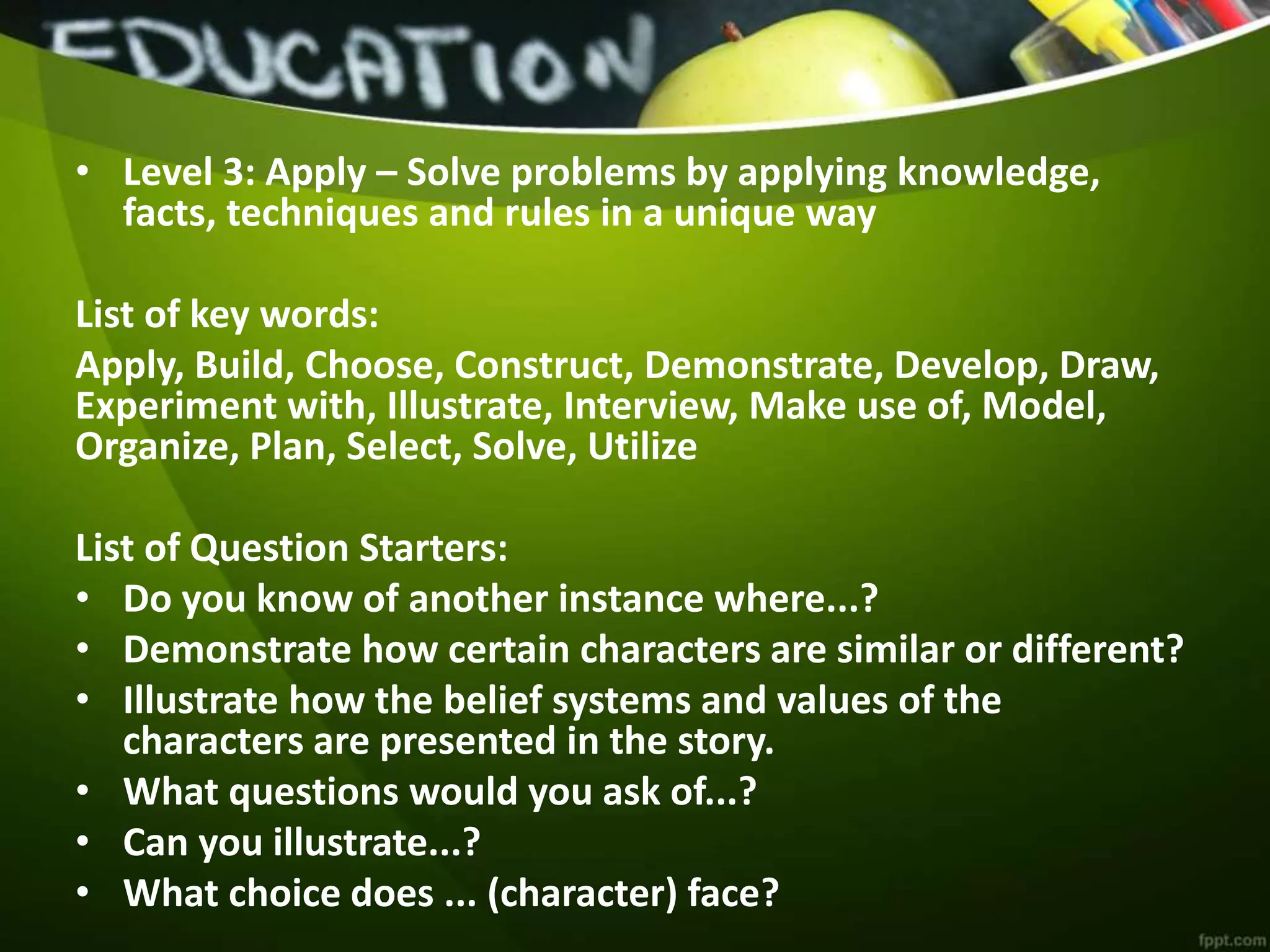
• Level 3: Apply – Solve problems by applying knowledge,
facts, techniques and rules in a unique way
List of key words:
Apply, Build, Choose, Construct, Demonstrate, Develop, Draw,
Experiment with, Illustrate, Interview, Make use of, Model,
Organize, Plan, Select, Solve, Utilize
List of Question Starters:
• Do you know of another instance where...?
• Demonstrate how certain characters are similar or different?
• Illustrate how the belief systems and values of the
characters are presented in the story.
• What questions would you ask of...?
• Can you illustrate...?
• What choice does ... (character) face?
• Level 4: Analyze – Breaking information into parts to explore
connections and relationships
List of key words:
Analyze, Categorize, Classify, Compare, Contrast, Discover, Divide,
Examine, Group, Inspect, Sequence, Simplify, Make Distinctions,
Relationships, Function, Assume, Conclusions
List of Question Starters:
• Which events could not have happened?
• If ... happened, what might the ending have been?
• How is... similar to...?
• Can you distinguish between...?
• What was the turning point?
• What was the problem with...?
• Why did... changes occur?
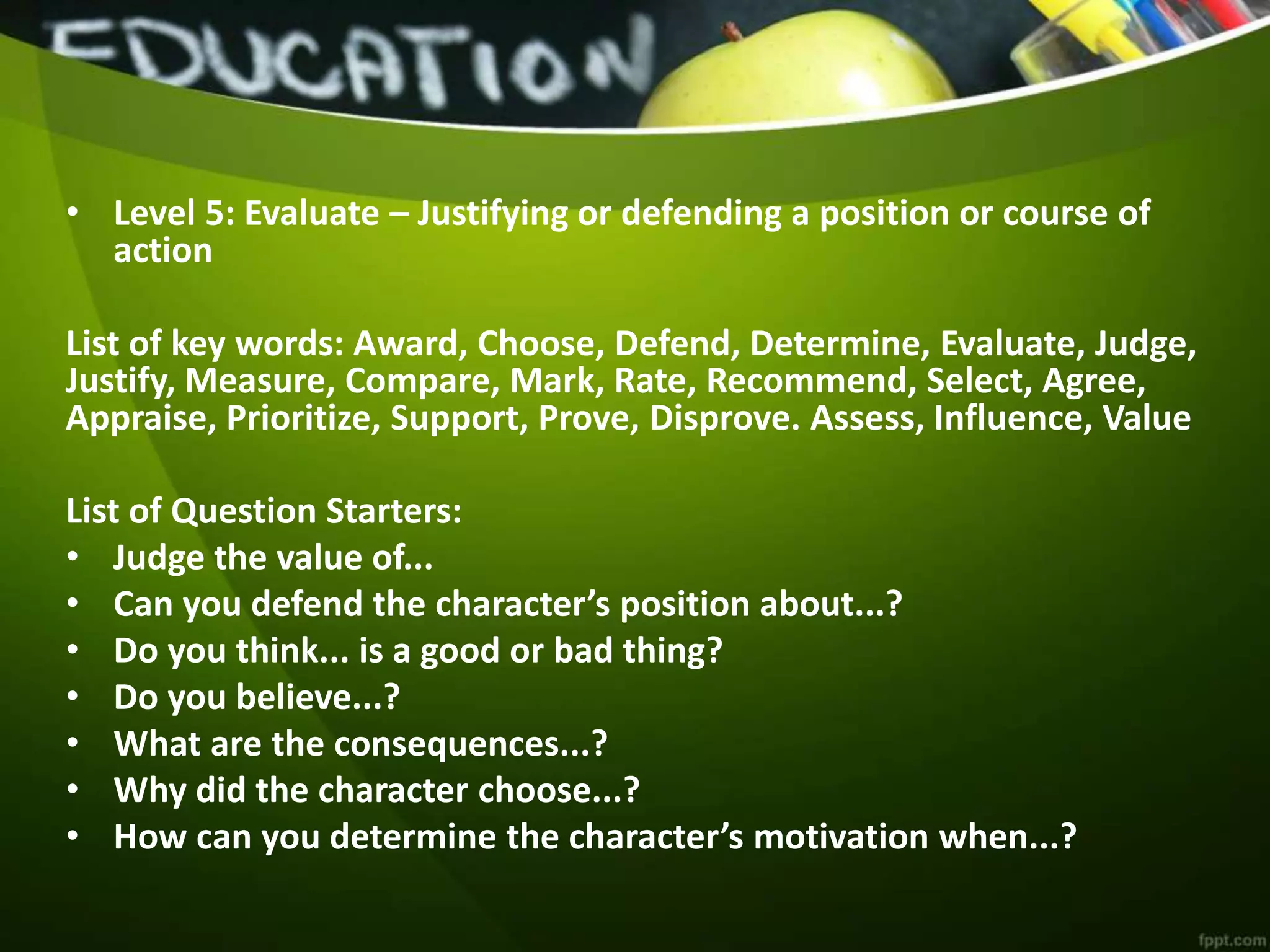
• Level 5: Evaluate – Justifying or defending a position or course of
action
List of key words: Award, Choose, Defend, Determine, Evaluate, Judge,
Justify, Measure, Compare, Mark, Rate, Recommend, Select, Agree,
Appraise, Prioritize, Support, Prove, Disprove. Assess, Influence, Value
List of Question Starters:
• Judge the value of...
• Can you defend the character’s position about...?
• Do you think... is a good or bad thing?
• Do you believe...?
• What are the consequences...?
• Why did the character choose...?
• How can you determine the character’s motivation when...?
• Level 6: Create – Generating new ideas, products or ways of viewing
things
List of key words: Design, Construct, Produce, Invent, Combine, Compile,
Develop, Formulate, Imagine, Modify, Change, Improve, Elaborate, Plan,
Propose, Solve
List of Question Starters:
• What would happen if...?
• Can you see a possible solution to...?
• Do you agree with the actions?...with the outcomes?
• What is your opinion of...?
• What do you imagine would have been the outcome if... had made a
different choice?
• Invent a new ending.
• What would you cite to defend the actions of...?
Bloom’s taxonomy
Why we need HOTS?? (Zaidiaz Man Yaacob, 2013)
• Higher order thinking is imperative to progress. No
explorer ever discovered anything new by following in
the footsteps of those who had been there before
• Exposes further fields of knowledge and know how
which may again, be transferred, reapplied and
collated to create a new and improved version
• If you are committed to learning, growing and have
constant evaluation then it is vital that you commit
yourself to improve your Higher Order Thinking Skills
• Thinking is the heart of all learning. Thinking makes
things that have yet to be perceived possible,
thinking facilities and enhances our ability to
perform and produce and pass on such vital
information to others who would then do the same.
• Learning and knowledge is organic. If we give the
right climate, it will grow and thrive. When given
how many problems our planet faces today, the
need for more people capable of thinking at Higher
Order levels is more important now than ever.

Hots (1)

  • 1.
    Higher Order ThinkingSkills (HOTS) Nurul Hidayah Binti Abdul Halim (D20101037326) Nur Shafiqah Binti Abdul Rashid (D20121058738)
  • 2.
    DEFINITION • A conceptof education reform based on learning taxonomies (such as Bloom's Taxonomy). The idea is that some types of learning require more cognitive processing than others, but also have more generalized benefits. (Anderson & Krathwohl, 2001) • Higher order thinking skills include critical, logical, reflective, metacognitive, and creative thinking • HOTS moves away from general knowledge type skills to thinking skills like: synthesizing, analyzing, reasoning, comprehending, application and evaluation (Sue Watson, 2003)
  • 3.
    • Rather thanemphasize the drill and repetition activities, the focus is on problem solving and higher level/order thinking skills (Anderson & Krathwohl, 2001) • Successful applications of the skills result in explanations, decisions, performances, and products that are valid within the context of available knowledge and experience and that promote continued growth in these and other intellectual skills (FJ King & Ludwika Goodson, 2000) • Higher order thinking is more difficult to learn or teach but also more valuable because such skills are more likely to be usable in novel situations
  • 4.
    Differences of HOTSand LOTS LOTS (LOWER ORDER THINKING SKILLS) Remembering Understanding Applying HOTS (HIGHER ORDER THINKING SKILLS) Analizing Evaluating Creating
  • 5.
    LOTS HOTS Lower-order thinkingskills are used to : • understand the basic story line or literal meaning of a story, play, or poem. Higher-order thinking skills are used to: • interpret a text on a more abstract level. • manipulate information and ideas in ways that transform their meaning and implications. This includes: • Wh questions. • teaching relevant lexical items. • relating to grammatical structures when relevant. HOTS for Analyzing Literary Texts • Predicting • Applying • Inferring • Sequencing • Classifying • Comparing and contrasting • Explaining patterns Explaining cause and effect Distinguishing different perspectives Problem solving
  • 6.
    LOTS HOTS • Answergiven in the reading • student state or recite answers • answer not provided • Student use information from the reading to figure up answer
  • 7.
    Categories in thecognitive domain of Bloom's Taxonomy
  • 8.
    • Based onBlooms Taxonomy ,there are Top four levels of the cognitive domain: applying, analyzing, evaluating and creating. • Applying: Carrying out or using a procedure through executing or implementing • Analyzing: Breaking material or concepts into parts, determining how the parts relate or interrelate to one another or to an overall structure or purpose • Evaluating: Making judgments based on criteria and standards through checking and critiquing • Creating: Putting elements together to form a coherent or functional whole; reorganizing elements into a new pattern or structure through generating, planning, or producing
  • 9.
    • Bloom’s QuestionStarter List – There are 6 levels of questions. The first three levels are considered lower order questions; the final three levels are considered higher order. Higher order questions are what we use for Critical Thinking and Creative Problem Solving. • Level 1: Remember – Recalling Information List of key words: Recognize, List, Describe, Retrieve, Name, Find, Match, Recall, Select, Label, Define, Tell List of Question Starters: • What is...? • Who was it that...? • Can you name...? • Describe what happened after... • What happened after...? Blooms Question Starter
  • 10.
    • Level 2:Understand – Demonstrate an understanding of facts, concepts and ideas List of key words: Compare, Contrast, Demonstrate, Describe, Interpret, Explain, Extend, Illustrate, Infer, Outline, Relate, Rephrase, Translate, Summarize, Show, Classify List of Question Starters: • Can you explain why...? • Can you write in your own words? • Write a brief outline of... • Can you clarify...? • Who do you think? • What was the main idea?
  • 11.
    • Level 3:Apply – Solve problems by applying knowledge, facts, techniques and rules in a unique way List of key words: Apply, Build, Choose, Construct, Demonstrate, Develop, Draw, Experiment with, Illustrate, Interview, Make use of, Model, Organize, Plan, Select, Solve, Utilize List of Question Starters: • Do you know of another instance where...? • Demonstrate how certain characters are similar or different? • Illustrate how the belief systems and values of the characters are presented in the story. • What questions would you ask of...? • Can you illustrate...? • What choice does ... (character) face?
  • 12.
    • Level 4:Analyze – Breaking information into parts to explore connections and relationships List of key words: Analyze, Categorize, Classify, Compare, Contrast, Discover, Divide, Examine, Group, Inspect, Sequence, Simplify, Make Distinctions, Relationships, Function, Assume, Conclusions List of Question Starters: • Which events could not have happened? • If ... happened, what might the ending have been? • How is... similar to...? • Can you distinguish between...? • What was the turning point? • What was the problem with...? • Why did... changes occur?
  • 13.
    • Level 5:Evaluate – Justifying or defending a position or course of action List of key words: Award, Choose, Defend, Determine, Evaluate, Judge, Justify, Measure, Compare, Mark, Rate, Recommend, Select, Agree, Appraise, Prioritize, Support, Prove, Disprove. Assess, Influence, Value List of Question Starters: • Judge the value of... • Can you defend the character’s position about...? • Do you think... is a good or bad thing? • Do you believe...? • What are the consequences...? • Why did the character choose...? • How can you determine the character’s motivation when...?
  • 14.
    • Level 6:Create – Generating new ideas, products or ways of viewing things List of key words: Design, Construct, Produce, Invent, Combine, Compile, Develop, Formulate, Imagine, Modify, Change, Improve, Elaborate, Plan, Propose, Solve List of Question Starters: • What would happen if...? • Can you see a possible solution to...? • Do you agree with the actions?...with the outcomes? • What is your opinion of...? • What do you imagine would have been the outcome if... had made a different choice? • Invent a new ending. • What would you cite to defend the actions of...?
  • 15.
  • 16.
    Why we needHOTS?? (Zaidiaz Man Yaacob, 2013) • Higher order thinking is imperative to progress. No explorer ever discovered anything new by following in the footsteps of those who had been there before • Exposes further fields of knowledge and know how which may again, be transferred, reapplied and collated to create a new and improved version • If you are committed to learning, growing and have constant evaluation then it is vital that you commit yourself to improve your Higher Order Thinking Skills
  • 17.
    • Thinking isthe heart of all learning. Thinking makes things that have yet to be perceived possible, thinking facilities and enhances our ability to perform and produce and pass on such vital information to others who would then do the same. • Learning and knowledge is organic. If we give the right climate, it will grow and thrive. When given how many problems our planet faces today, the need for more people capable of thinking at Higher Order levels is more important now than ever.