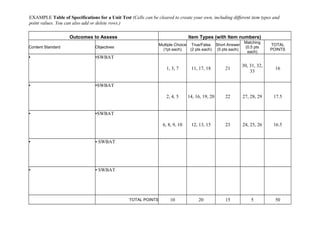
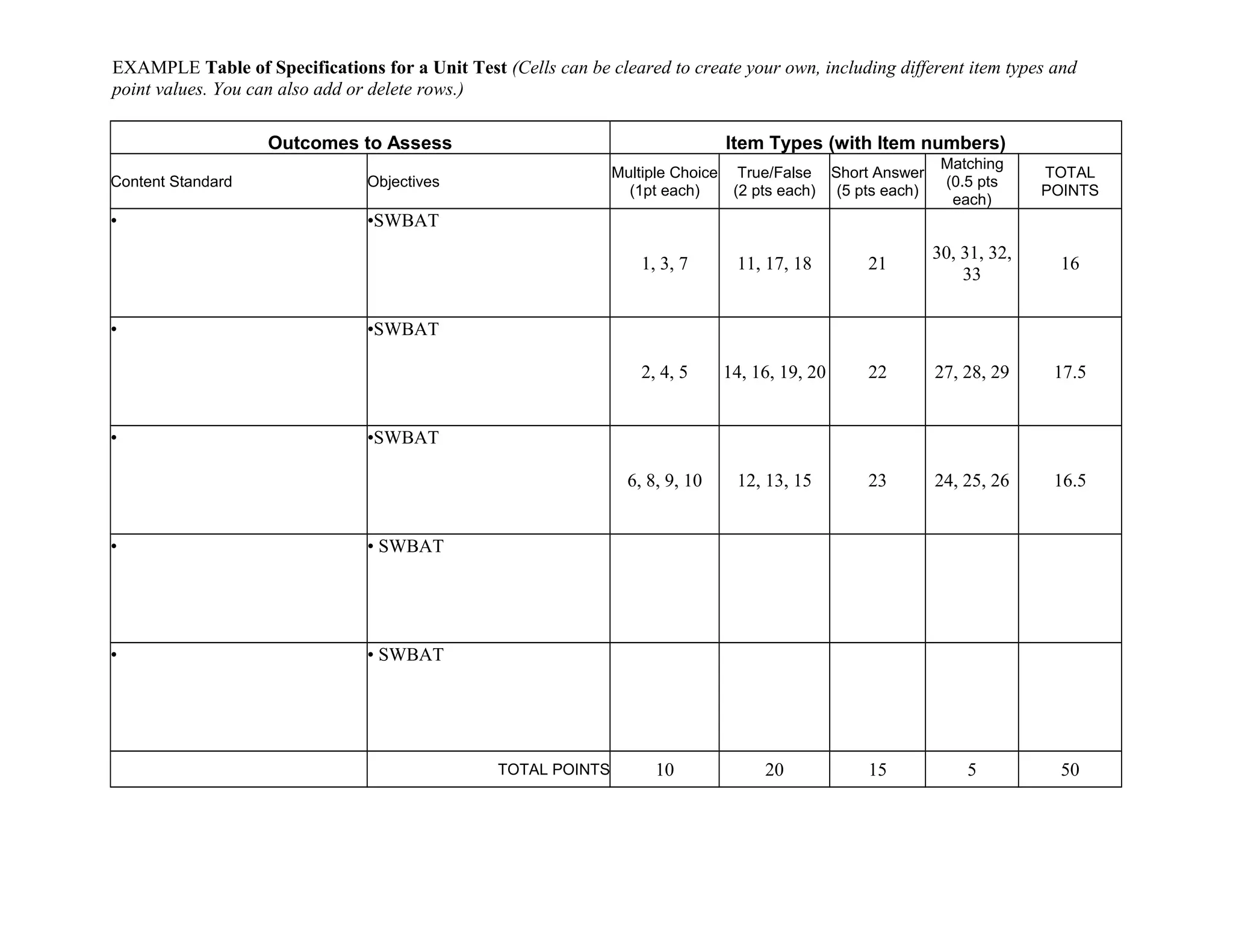
EXAMPLE Table of Specifications for a Unit Test (Cells can be cleared to create your own, including different item types and
point values. You can also add or delete rows.)
Outcomes to Assess Item Types (with Item numbers)
Content Standard Objectives
Multiple Choice
(1pt each)
True/False
(2 pts each)
Short Answer
(5 pts each)
Matching
(0.5 pts
each)
TOTAL
POINTS
• •SWBAT
1, 3, 7 11, 17, 18 21
30, 31, 32,
33
16
• •SWBAT
2, 4, 5 14, 16, 19, 20 22 27, 28, 29 17.5
• •SWBAT
6, 8, 9, 10 12, 13, 15 23 24, 25, 26 16.5
• • SWBAT
• • SWBAT
TOTAL POINTS 10 20 15 5 50
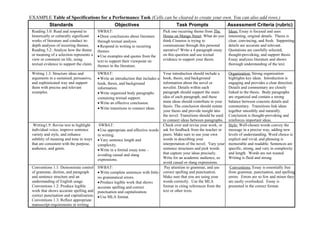
EXAMPLE Table of Specifications for a Performance Task (Cells can be cleared to create your own. You can also add rows.)
Standards Objectives Task Prompts Assessment Criteria (rubric)
Reading 3.0: Read and respond to
historically or culturally significant
works of literature and conduct in-
depth analyses of recurring themes.
Reading 3.2: Analyze how the theme
or meaning of a selection represents a
view or comment on life, using
textual evidence to support the claim.
SWBAT:
• Draw conclusions about literature
through textual analysis.
• Respond in writing to recurring
themes
• Use examples and quotes from the
text to support their viewpoint on
themes in the literature.
Pick one recurring theme from The
House on Mango Street. What do you
think Cisneros is trying to
communicate through this personal
narrative? Write a 4 paragraph essay
on this question and use textual
evidence to support your thesis.
Ideas: Essay is focused and uses
interesting, original details. Thesis is
clear, convincing, and fresh. Supporting
details are accurate and relevant.
Quotations are carefully selected,
thought-provoking, and support thesis.
Essay analyzes literature and shows
thorough understanding of the text.
Writing 1.3: Structure ideas and
arguments in a sustained, persuasive,
and sophisticated way and support
them with precise and relevant
examples.
SWBAT:
• Write an introduction that includes a
hook, thesis, and background
information.
• Write organized body paragraphs
containing textual support.
• Write an effective conclusion.
• Write transitions to connect ideas.
Your introduction should include a
hook, thesis, and background
information about the novel or
novelist. Details within each
paragraph should support the main
idea of each paragraph, and these
main ideas should contribute to your
thesis. The conclusion should restate
your thesis and provide insight into
the novel. Transitions should be used
to connect ideas between paragraphs.
Organization: Strong organization
highlights key ideas. Introduction is
engaging and provides a clear direction.
Details and commentary are closely
linked to the thesis. Body paragraphs
are organized and contain a strong
balance between concrete details and
commentary. Transitions link ideas
together smoothly and naturally.
Conclusion is thought-provoking and
reinforces important ideas.
Writing1.9: Revise text to highlight
individual voice, improve sentence
variety and style, and enhance
subtlety of meaning and tone in ways
that are consistent with the purpose,
audience, and genre.
SWBAT:
• Use appropriate and effective words
in writing.
• Vary sentence length and
complexity.
• Write in a formal essay tone –
avoiding casual and slang
expressions.
Check over and revise your work, or
ask for feedback from the teacher or
peers. Make sure to use your own
words in describing your
interpretation of the novel. Vary your
sentence structures and pick words
that capture your ideas precisely.
Write for an academic audience, so
avoid casual or slang expressions.
Style: Well-chosen words convey the
message in a precise way, adding new
levels of understanding. Word choice is
explicit and vivid, and phrasing is
memorable and readable. Sentences are
specific, strong, and vary in complexity
and length. Words are not wasted.
Writing is fluid and strong.
Conventions 1.1: Demonstrate control
of grammar, diction, and paragraph
and sentence structure and an
understanding of English usage.
Conventions 1.2: Produce legible
work that shows accurate spelling and
correct punctuation and capitalization.
Conventions 1.3: Reflect appropriate
manuscript requirements in writing
SWBAT:
• Write complete sentences with little-
no grammatical errors.
• Produce legible work that shows
accurate spelling and correct
punctuation and capitalization.
• Use MLA format.
Pay attention to grammar, and use
correct spelling and punctuation.
Make sure that you are using your
words correctly. Use the MLA
format in citing references from the
text or other texts.
Conventions: Essay is essentially free
from grammar, punctuation, and spelling
errors. Errors are so few and minor they
are easily overlooked. Essay is
presented in the correct format.

Table of specifications unit test & perf task

  • 1.
    EXAMPLE Table ofSpecifications for a Unit Test (Cells can be cleared to create your own, including different item types and point values. You can also add or delete rows.) Outcomes to Assess Item Types (with Item numbers) Content Standard Objectives Multiple Choice (1pt each) True/False (2 pts each) Short Answer (5 pts each) Matching (0.5 pts each) TOTAL POINTS • •SWBAT 1, 3, 7 11, 17, 18 21 30, 31, 32, 33 16 • •SWBAT 2, 4, 5 14, 16, 19, 20 22 27, 28, 29 17.5 • •SWBAT 6, 8, 9, 10 12, 13, 15 23 24, 25, 26 16.5 • • SWBAT • • SWBAT TOTAL POINTS 10 20 15 5 50
  • 2.
    EXAMPLE Table ofSpecifications for a Performance Task (Cells can be cleared to create your own. You can also add rows.) Standards Objectives Task Prompts Assessment Criteria (rubric) Reading 3.0: Read and respond to historically or culturally significant works of literature and conduct in- depth analyses of recurring themes. Reading 3.2: Analyze how the theme or meaning of a selection represents a view or comment on life, using textual evidence to support the claim. SWBAT: • Draw conclusions about literature through textual analysis. • Respond in writing to recurring themes • Use examples and quotes from the text to support their viewpoint on themes in the literature. Pick one recurring theme from The House on Mango Street. What do you think Cisneros is trying to communicate through this personal narrative? Write a 4 paragraph essay on this question and use textual evidence to support your thesis. Ideas: Essay is focused and uses interesting, original details. Thesis is clear, convincing, and fresh. Supporting details are accurate and relevant. Quotations are carefully selected, thought-provoking, and support thesis. Essay analyzes literature and shows thorough understanding of the text. Writing 1.3: Structure ideas and arguments in a sustained, persuasive, and sophisticated way and support them with precise and relevant examples. SWBAT: • Write an introduction that includes a hook, thesis, and background information. • Write organized body paragraphs containing textual support. • Write an effective conclusion. • Write transitions to connect ideas. Your introduction should include a hook, thesis, and background information about the novel or novelist. Details within each paragraph should support the main idea of each paragraph, and these main ideas should contribute to your thesis. The conclusion should restate your thesis and provide insight into the novel. Transitions should be used to connect ideas between paragraphs. Organization: Strong organization highlights key ideas. Introduction is engaging and provides a clear direction. Details and commentary are closely linked to the thesis. Body paragraphs are organized and contain a strong balance between concrete details and commentary. Transitions link ideas together smoothly and naturally. Conclusion is thought-provoking and reinforces important ideas. Writing1.9: Revise text to highlight individual voice, improve sentence variety and style, and enhance subtlety of meaning and tone in ways that are consistent with the purpose, audience, and genre. SWBAT: • Use appropriate and effective words in writing. • Vary sentence length and complexity. • Write in a formal essay tone – avoiding casual and slang expressions. Check over and revise your work, or ask for feedback from the teacher or peers. Make sure to use your own words in describing your interpretation of the novel. Vary your sentence structures and pick words that capture your ideas precisely. Write for an academic audience, so avoid casual or slang expressions. Style: Well-chosen words convey the message in a precise way, adding new levels of understanding. Word choice is explicit and vivid, and phrasing is memorable and readable. Sentences are specific, strong, and vary in complexity and length. Words are not wasted. Writing is fluid and strong. Conventions 1.1: Demonstrate control of grammar, diction, and paragraph and sentence structure and an understanding of English usage. Conventions 1.2: Produce legible work that shows accurate spelling and correct punctuation and capitalization. Conventions 1.3: Reflect appropriate manuscript requirements in writing SWBAT: • Write complete sentences with little- no grammatical errors. • Produce legible work that shows accurate spelling and correct punctuation and capitalization. • Use MLA format. Pay attention to grammar, and use correct spelling and punctuation. Make sure that you are using your words correctly. Use the MLA format in citing references from the text or other texts. Conventions: Essay is essentially free from grammar, punctuation, and spelling errors. Errors are so few and minor they are easily overlooked. Essay is presented in the correct format.