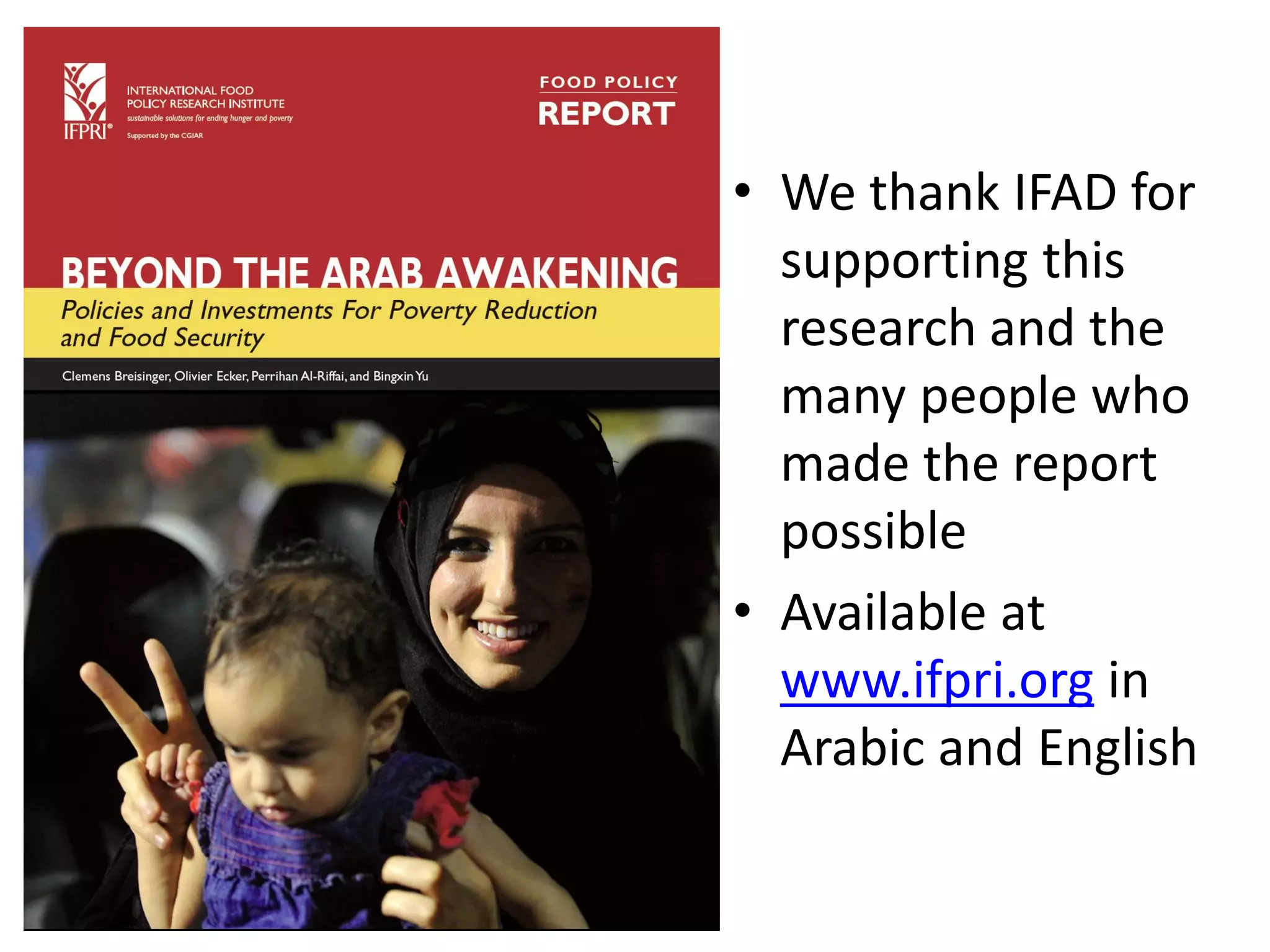
Launch of IFPRI Food Policy Report
Beyond the Arab Awakening: Policies and Investments for
         Food Security and Poverty Reduction


                      Presenter: Clemens Breisinger
       Co-authors: Olivier Ecker, Perrihan Al-Riffai and Bingxin Yu


              IFPRI-UN-ESCWA Conference “Food Secure Arab World”
                           Beirut, February 6-7, 2012
• We thank IFAD for
  supporting this
  research and the
  many people who
  made the report
  possible
• Available at
  www.ifpri.org in
  Arabic and English
In a data-scarce Arab world, the report
suggests answers to three key questions
  based on rigorous economic analysis:
1. Poverty puzzle: did the social indicators really
   improve as suggested by official numbers?
2. Food security question: how can food security be
   measured and what is the state in the Arab World
3. Growth puzzle: which policies and investments are
   key for achieving a food secure Arab World without
   poverty?
This presentation focuses on points 2 and 3 (policies)
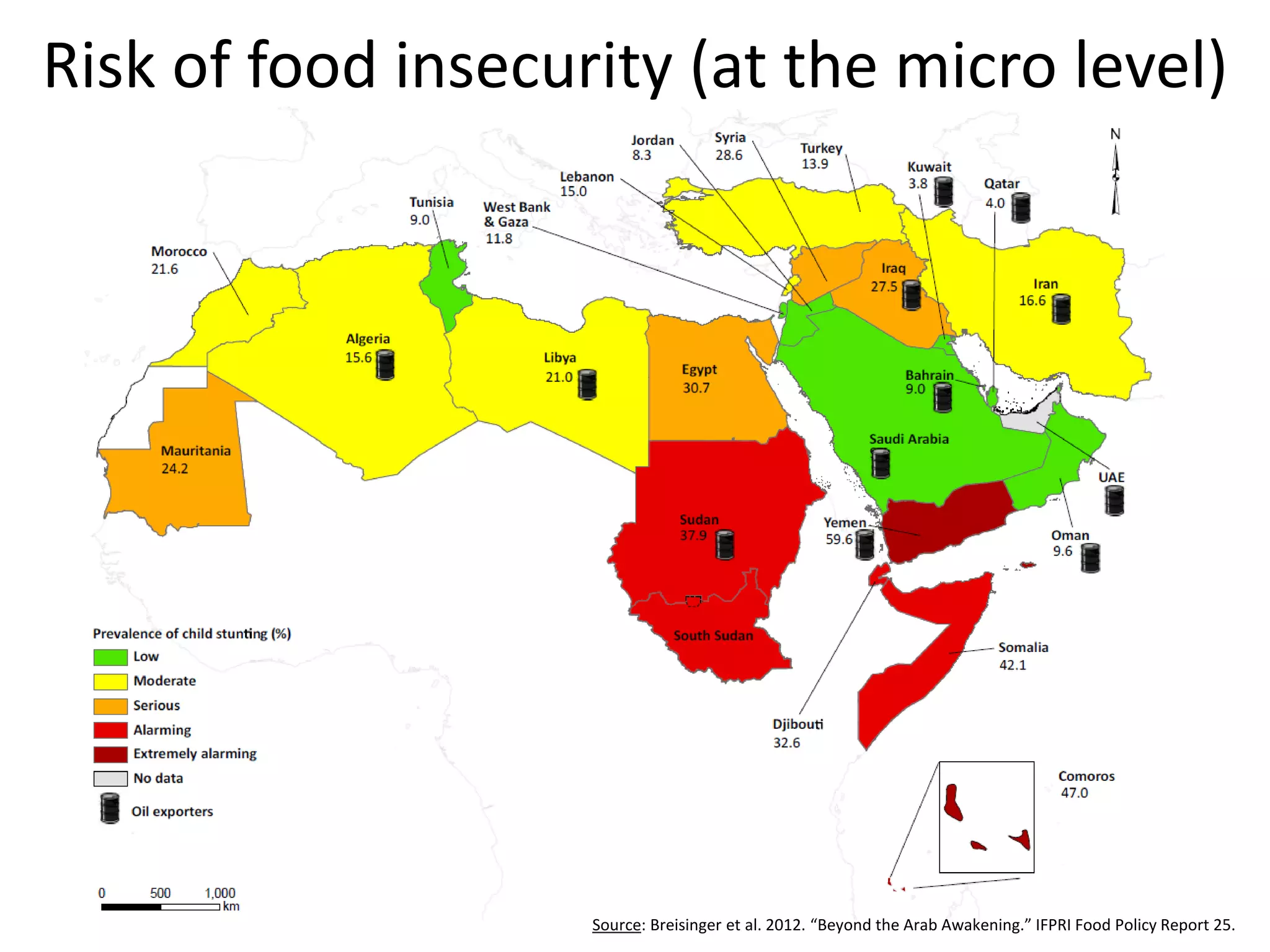
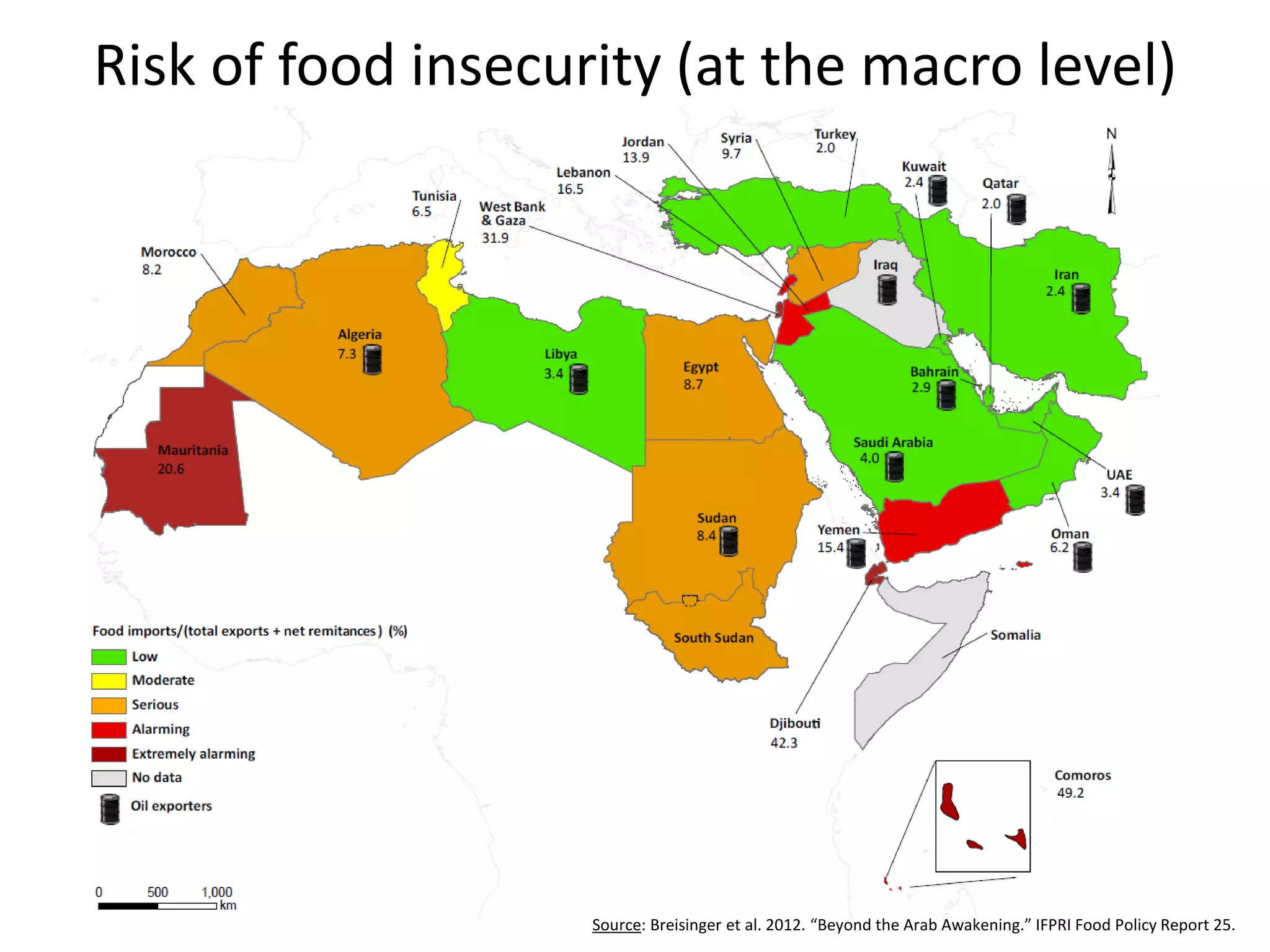
Food security has a macro & micro dimension
Risk of food insecurity (at the micro level)


                    Source: Breisinger et al. 2012. “Beyond the Arab Awakening.” IFPRI Food Policy Report 25.
Risk of food insecurity (at the macro level)


                    Source: Breisinger et al. 2012. “Beyond the Arab Awakening.” IFPRI Food Policy Report 25.
Risk of food insecurity in Arab World
            (plus Iran and Turkey)


                   Source: Breisinger et al. 2012. “Beyond the Arab Awakening.” IFPRI Food Policy Report 25.
Which policies and investments can
           improve food security?
1. ‘Child health production function’:  = ( ,  ,  )
     H = health status, I = health inputs, E = health environment factors, ψ = genetic health
     endowment of child k

2. Reduced-form child nutrition model:  = ( , …)
     N = nutritional status, Y = household income
     => Income elasticity wrt. nutritional status:
                                 
           =                         =                , approx.:  =  
                                     
3. Cross-country nutrition model (in first differences):
       =  
     N = child nutrition situation, Y = national income of country i

4. Decomposition of growth by sectors:  =                              (     )
     η = sector participation component, s = sector share component of sector x (Ag, non-Ag; Ag, Ma,
     In, Se value added)

5. Regression model (based on time series data):
      Δ = 0 + Δ + −1 +  + 
     N = prevalence of child undernutrition, Y = GDP per capita, t = time period, Z = trend effects
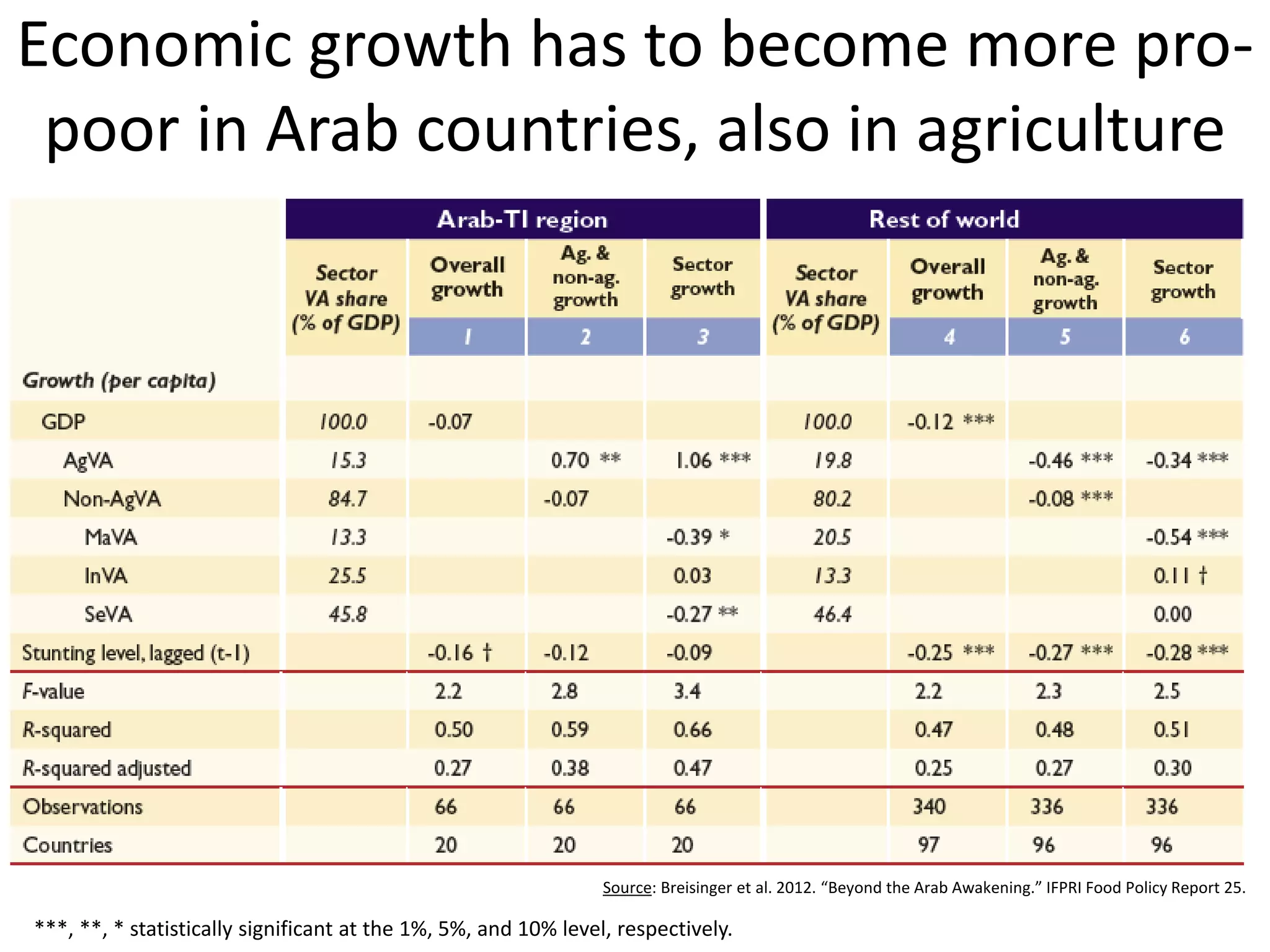
Economic growth has to become more pro-
 poor in Arab countries, also in agriculture


                                                                 Source: Breisinger et al. 2012. “Beyond the Arab Awakening.” IFPRI Food Policy Report 25.

***, **, * statistically significant at the 1%, 5%, and 10% level, respectively.
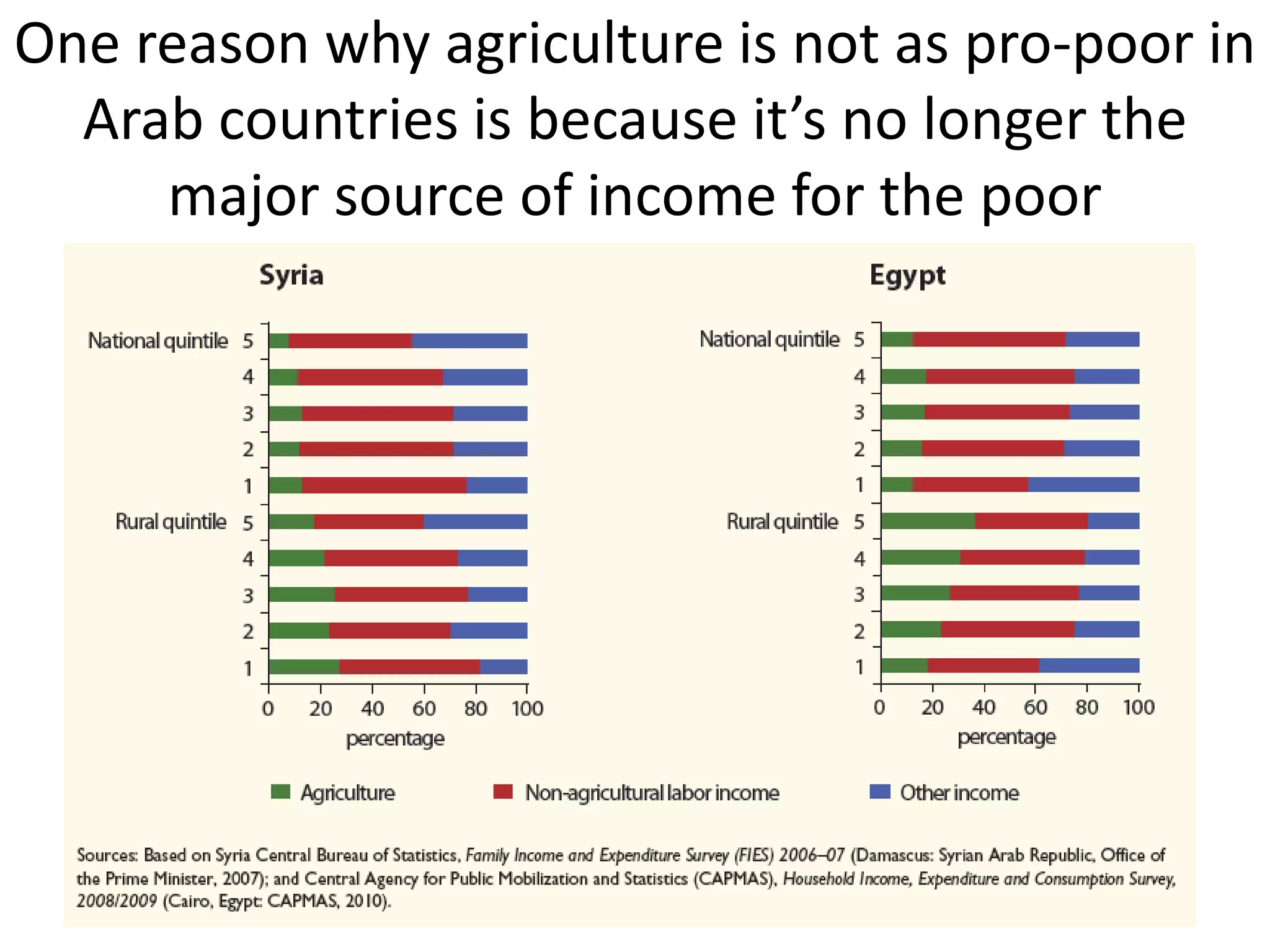
One reason why agriculture is not as pro-poor in
  Arab countries is because it’s no longer the
     major source of income for the poor
Selected messages for a food secure
       Arab world without poverty
• Risk of food insecurity is high in the Arab World, with large
  variation between countries and macro- and household
  level food insecurity
• For countries with household level food insecurity, focus
  on supporting job creating growth for the poor
• For countries with macro-level food insecurity, encourage
  exports to finance food imports and agriculture in
  countries with potential

While these messages apply for many Arab countries, it is
clear that strategies and investments have to be country-
owned and adopted to the country and sub-national levels.
Session 1 clemens bresisinger

Session 1 clemens bresisinger

  • 1.
    Launch of IFPRIFood Policy Report Beyond the Arab Awakening: Policies and Investments for Food Security and Poverty Reduction Presenter: Clemens Breisinger Co-authors: Olivier Ecker, Perrihan Al-Riffai and Bingxin Yu IFPRI-UN-ESCWA Conference “Food Secure Arab World” Beirut, February 6-7, 2012
  • 2.
    • We thankIFAD for supporting this research and the many people who made the report possible • Available at www.ifpri.org in Arabic and English
  • 3.
    In a data-scarceArab world, the report suggests answers to three key questions based on rigorous economic analysis: 1. Poverty puzzle: did the social indicators really improve as suggested by official numbers? 2. Food security question: how can food security be measured and what is the state in the Arab World 3. Growth puzzle: which policies and investments are key for achieving a food secure Arab World without poverty? This presentation focuses on points 2 and 3 (policies)
  • 4.
    Food security hasa macro & micro dimension
  • 5.
    Risk of foodinsecurity (at the micro level) Source: Breisinger et al. 2012. “Beyond the Arab Awakening.” IFPRI Food Policy Report 25.
  • 6.
    Risk of foodinsecurity (at the macro level) Source: Breisinger et al. 2012. “Beyond the Arab Awakening.” IFPRI Food Policy Report 25.
  • 7.
    Risk of foodinsecurity in Arab World (plus Iran and Turkey) Source: Breisinger et al. 2012. “Beyond the Arab Awakening.” IFPRI Food Policy Report 25.
  • 8.
    Which policies andinvestments can improve food security? 1. ‘Child health production function’: = ( , , ) H = health status, I = health inputs, E = health environment factors, ψ = genetic health endowment of child k 2. Reduced-form child nutrition model: = ( , …) N = nutritional status, Y = household income => Income elasticity wrt. nutritional status: = = , approx.: = 3. Cross-country nutrition model (in first differences): = N = child nutrition situation, Y = national income of country i 4. Decomposition of growth by sectors: = ( ) η = sector participation component, s = sector share component of sector x (Ag, non-Ag; Ag, Ma, In, Se value added) 5. Regression model (based on time series data): Δ = 0 + Δ + −1 + + N = prevalence of child undernutrition, Y = GDP per capita, t = time period, Z = trend effects
  • 9.
    Economic growth hasto become more pro- poor in Arab countries, also in agriculture Source: Breisinger et al. 2012. “Beyond the Arab Awakening.” IFPRI Food Policy Report 25. ***, **, * statistically significant at the 1%, 5%, and 10% level, respectively.
  • 10.
    One reason whyagriculture is not as pro-poor in Arab countries is because it’s no longer the major source of income for the poor
  • 11.
    Selected messages fora food secure Arab world without poverty • Risk of food insecurity is high in the Arab World, with large variation between countries and macro- and household level food insecurity • For countries with household level food insecurity, focus on supporting job creating growth for the poor • For countries with macro-level food insecurity, encourage exports to finance food imports and agriculture in countries with potential While these messages apply for many Arab countries, it is clear that strategies and investments have to be country- owned and adopted to the country and sub-national levels.