Beyond the Arab Spring
Improving Food Security and
Resilience to Conflict
28th International Conference of Agricultural Economists
Rafain Convention Center, Foz do Iguaçu, Brazil
August 18-24, 2012
The ‘Arab Spring’ and After
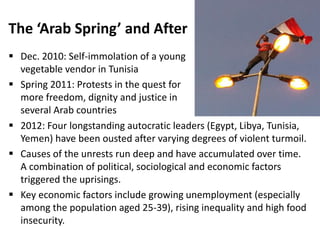
 Dec. 2010: Self-immolation of a young
vegetable vendor in Tunisia
 Spring 2011: Protests in the quest for
more freedom, dignity and justice in
several Arab countries
 2012: Four longstanding autocratic leaders (Egypt, Libya, Tunisia,
Yemen) have been ousted after varying degrees of violent turmoil.
 Causes of the unrests run deep and have accumulated over time.
A combination of political, sociological and economic factors
triggered the uprisings.
 Key economic factors include growing unemployment (especially
among the population aged 25-39), rising inequality and high food
insecurity.
Outline of the Session
Objective:
Initiate and inform the debate on key challenges and opportunities
for achieving food security and preventing conflict across the Arab
World.
Presentations:
1. Policies and Investments for Poverty Reduction and Food
Security—by Perrihan Al-Riffai
2. Does Food Security Matter for Transition in Arab Countries?—by
Jean-Francois Maystadt
3. Growth and Food Security Impacts of Yemen’s Uprising and
Scenarios for Transition—by Olivier Ecker
Policies and Investments for Poverty Reduction
and Food Security in the Arab World
C. Breisinger, O. Ecker, P. Al-Riffai and B. Yu
Growth, Poverty and Food Security
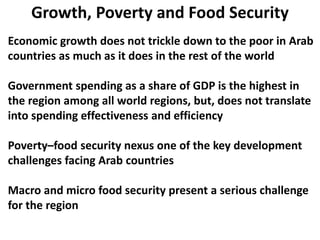
Economic growth does not trickle down to the poor in Arab
countries as much as it does in the rest of the world
Government spending as a share of GDP is the highest in
the region among all world regions, but, does not translate
into spending effectiveness and efficiency
Poverty–food security nexus one of the key development
challenges facing Arab countries
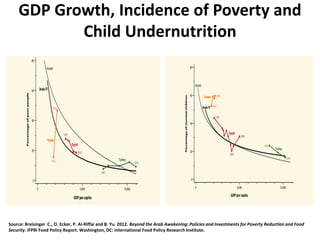
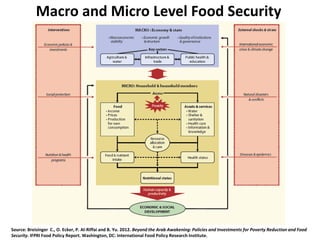
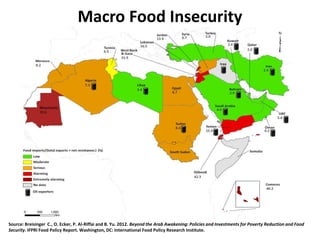
Macro and micro food security present a serious challenge
for the region
GDP Growth, Incidence of Poverty and
Child Undernutrition
Source: Breisinger C., O. Ecker, P. Al-Riffai and B. Yu. 2012. Beyond the Arab Awakening: Policies and Investments for Poverty Reduction and Food
Security. IFPRI Food Policy Report. Washington, DC: International Food Policy Research Institute.
Macro and Micro Level Food Security
Source: Breisinger C., O. Ecker, P. Al-Riffai and B. Yu. 2012. Beyond the Arab Awakening: Policies and Investments for Poverty Reduction and Food
Security. IFPRI Food Policy Report. Washington, DC: International Food Policy Research Institute.
Macro Food Insecurity
Source: Breisinger C., O. Ecker, P. Al-Riffai and B. Yu. 2012. Beyond the Arab Awakening: Policies and Investments for Poverty Reduction and Food
Security. IFPRI Food Policy Report. Washington, DC: International Food Policy Research Institute.
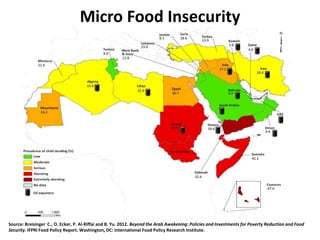
Micro Food Insecurity
Source: Breisinger C., O. Ecker, P. Al-Riffai and B. Yu. 2012. Beyond the Arab Awakening: Policies and Investments for Poverty Reduction and Food
Security. IFPRI Food Policy Report. Washington, DC: International Food Policy Research Institute.
Selected Policies for a Food Secure Arab
World
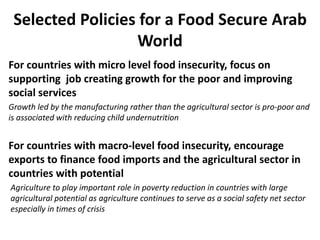
For countries with micro level food insecurity, focus on
supporting job creating growth for the poor and improving
social services
Growth led by the manufacturing rather than the agricultural sector is pro-poor and
is associated with reducing child undernutrition
For countries with macro-level food insecurity, encourage
exports to finance food imports and the agricultural sector in
countries with potential
Agriculture to play important role in poverty reduction in countries with large
agricultural potential as agriculture continues to serve as a social safety net sector
especially in times of crisis
While these selected policies apply for many
Arab countries, strategies and investments have
to be country-owned and adopted to country
and sub-national levels.
Does Food Security Matter
for Transition in Arab Countries?
J.-F. Maystadt, J.-F. Trinh Tan and C. Breisinger
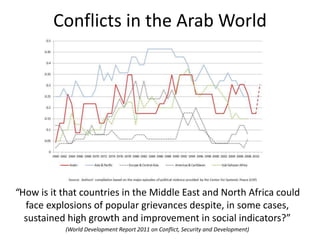
“How is it that countries in the Middle East and North Africa could
face explosions of popular grievances despite, in some cases,
sustained high growth and improvement in social indicators?”
(World Development Report 2011 on Conflict, Security and Development)
Conflicts in the Arab World
The Arab World at a Crossroad
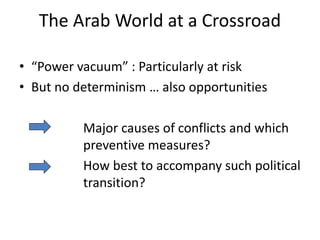
• “Power vacuum” : Particularly at risk
• But no determinism … also opportunities
Major causes of conflicts and which
preventive measures?
How best to accompany such political
transition?
Arab Exceptionalism?
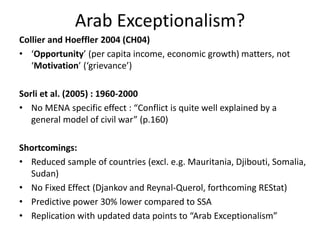
Collier and Hoeffler 2004 (CH04)
• ‘Opportunity’ (per capita income, economic growth) matters, not
‘Motivation’ (‘grievance’)
Sorli et al. (2005) : 1960-2000
• No MENA specific effect : “Conflict is quite well explained by a
general model of civil war” (p.160)
Shortcomings:
• Reduced sample of countries (excl. e.g. Mauritania, Djibouti, Somalia,
Sudan)
• No Fixed Effect (Djankov and Reynal-Querol, forthcoming REStat)
• Predictive power 30% lower compared to SSA
• Replication with updated data points to “Arab Exceptionalism”
Main Empirical Model
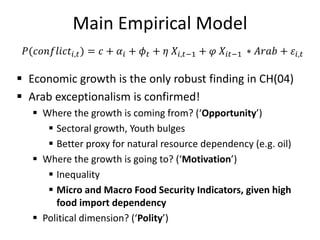
𝑃(𝑐𝑜𝑛𝑓𝑙𝑖𝑐𝑡𝑖,𝑡) = 𝑐 + 𝛼𝑖 + 𝜙 𝑡 + 𝜂 𝑋𝑖,𝑡−1 + 𝜑 𝑋𝑖𝑡−1 ∗ 𝐴𝑟𝑎𝑏 + 𝜀𝑖,𝑡
 Economic growth is the only robust finding in CH(04)
 Arab exceptionalism is confirmed!
 Where the growth is coming from? (‘Opportunity’)
 Sectoral growth, Youth bulges
 Better proxy for natural resource dependency (e.g. oil)
 Where the growth is going to? (‘Motivation’)
 Inequality
 Micro and Macro Food Security Indicators, given high
food import dependency
 Political dimension? (‘Polity’)
Beyond Collier-Hoeffler Framework
Regressions (1) (2) (3) (4) (5)
Dependent variable
Model
GDP growth (t-1) -3.757*** -6.259*** -3.539* -4.644*** -8.644***
[0.980] [1.429] [1.877] [1.85] [1.850]
GDP growth (t-1)*Arab+ 5.919*** 4.409 3.056 3.056
[1.978] [2.784] [4.091] [4.091]
Child stunting (t-1) 0.0522**
[0.0233]
Child stunting (t-1)*Arab+ 0.307***
[0.0992]
Child mortality (t-1) -0.001
[0.003]
Child mortality (t-1)*Arab+ 0.001
[0.006]
Food Insecurity Index (t-1) -0.0107*
[0.00566]
Food Insecurity index (t-1)*Arab+ 0.0294**
[0.0125]
Time dummies incl. incl. incl. incl. incl.
Country Fixed Effects incl. incl. incl. incl. incl.
Observations 1,474 1,474 630 412 1,219
Incidence ofmajor intrastate conflict
Logit fixed effect
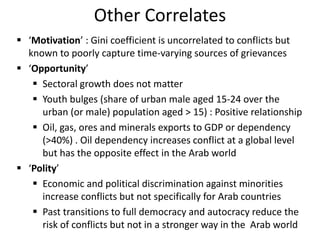
Other Correlates
 ‘Motivation’ : Gini coefficient is uncorrelated to conflicts but
known to poorly capture time-varying sources of grievances
 ‘Opportunity’
 Sectoral growth does not matter
 Youth bulges (share of urban male aged 15-24 over the
urban (or male) population aged > 15) : Positive relationship
 Oil, gas, ores and minerals exports to GDP or dependency
(>40%) . Oil dependency increases conflict at a global level
but has the opposite effect in the Arab world
 ‘Polity’
 Economic and political discrimination against minorities
increase conflicts but not specifically for Arab countries
 Past transitions to full democracy and autocracy reduce the
risk of conflicts but not in a stronger way in the Arab world
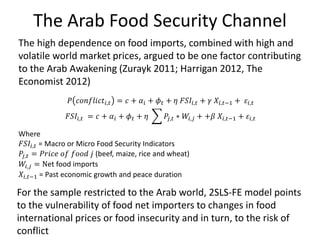
The Arab Food Security Channel
For the sample restricted to the Arab world, 2SLS-FE model points
to the vulnerability of food net importers to changes in food
international prices or food insecurity and in turn, to the risk of
conflict
𝑃 𝑐𝑜𝑛𝑓𝑙𝑖𝑐𝑡𝑖,𝑡 = 𝑐 + 𝛼𝑖 + 𝜙 𝑡 + 𝜂 𝐹𝑆𝐼𝑖,𝑡 + 𝛾 𝑋𝑖,𝑡−1 + 𝜀𝑖,𝑡
𝐹𝑆𝐼𝑖,𝑡 = 𝑐 + 𝛼𝑖 + 𝜙 𝑡 + 𝜂 𝑃𝑗,𝑡 ∗ 𝑊𝑖,𝑗 + +𝛽 𝑋𝑖,𝑡−1 + 𝜀𝑖,𝑡
Where
𝐹𝑆𝐼𝑖,𝑡 = Macro or Micro Food Security Indicators
𝑃𝑗,𝑡 = 𝑃𝑟𝑖𝑐𝑒 𝑜𝑓 𝑓𝑜𝑜𝑑 𝑗 (beef, maize, rice and wheat)
𝑊𝑖,𝑗 = Net food imports
𝑋𝑖,𝑡−1 = Past economic growth and peace duration
The high dependence on food imports, combined with high and
volatile world market prices, argued to be one factor contributing
to the Arab Awakening (Zurayk 2011; Harrigan 2012, The
Economist 2012)
The Arab Food Security Channel
Regression (2) (4) (6) (8)
Dependent variable
Model
Peace duration 0.003 -0.0099*** -0.005*** -0.005***
[0.006] [0.003] [0.002] [0.002]
GDP growth (t-1) 0.196 -0.312 -0.178 -0.184
[0.213] [0.283] [0.163] [0.195]
Child stunting 0.0420***
[0.016]
Child mortality 0.011***
[0.004]
Macro Food 0.011***
Insecurity [0.004]
Macro Food 0.013**
Insecurity [0.006]
incl. remittances
Country Fixed Effects incl. incl. incl. incl.
Time dummies incl. incl. incl. incl.
Observations 433 246 685 685
Number of countries 22 22 22 22
F-test 2.731** 4.603*** 5.335*** 4.484***
Underid test 15.23*** 13.76*** 17.14*** 8.819**
P-value Hansen test 0.52 0.24 0.66 0.46
F-test on excl. IV 10.83*** 6.85*** 7.74*** 3.99**
Root MSE 0.25 0.26 0.24 0.26
Incidence of major intra-state conflicts
FE2SLS
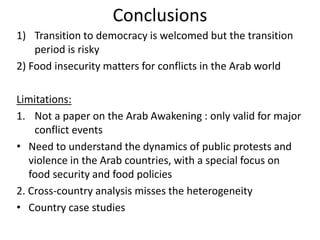
Conclusions
1) Transition to democracy is welcomed but the transition
period is risky
2) Food insecurity matters for conflicts in the Arab world
Limitations:
1. Not a paper on the Arab Awakening : only valid for major
conflict events
• Need to understand the dynamics of public protests and
violence in the Arab countries, with a special focus on
food security and food policies
2. Cross-country analysis misses the heterogeneity
• Country case studies
Growth and Food Security Impacts of Yemen’s
Uprising and Scenarios for Transition
C. Breisinger and O. Ecker
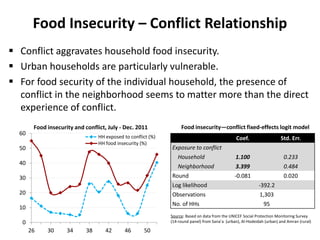
Food Insecurity – Conflict Relationship
 Conflict aggravates household food insecurity.
 Urban households are particularly vulnerable.
 For food security of the individual household, the presence of
conflict in the neighborhood seems to matter more than the direct
experience of conflict.
Coef. Std. Err.
Exposure to conflict
Household 1.100 0.233
Neighborhood 3.399 0.484
Round -0.081 0.020
Log likelihood -392.2
Observations 1,303
No. of HHs 95
Food insecurity—conflict fixed-effects logit model
Source: Based on data from the UNICEF Social Protection Monitoring Survey
(14-round panel) from Sana’a (urban), Al-Hodeidah (urban) and Amran (rural)0
10
20
30
40
50
60
26 30 34 38 42 46 50
HH exposed to conflict (%)
HH food insecurity (%)
Food insecurity and conflict, July - Dec. 2011
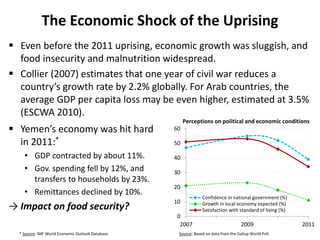
The Economic Shock of the Uprising
 Even before the 2011 uprising, economic growth was sluggish, and
food insecurity and malnutrition widespread.
 Collier (2007) estimates that one year of civil war reduces a
country’s growth rate by 2.2% globally. For Arab countries, the
average GDP per capita loss may be even higher, estimated at 3.5%
(ESCWA 2010).
Source: Based on data from the Gallup World Poll.
0
10
20
30
40
50
60
2007 2009 2011
Confidence in national government (%)
Growth in local economy expected (%)
Satisfaction with standard of living (%)
Perceptions on political and economic conditions
 Yemen’s economy was hit hard
in 2011:*
• GDP contracted by about 11%.
• Gov. spending fell by 12%, and
transfers to households by 23%.
• Remittances declined by 10%.
→ Impact on food security?
* Source: IMF World Economic Outlook Database.
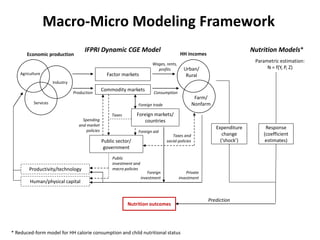
Macro-Micro Modeling Framework
Factor markets
Commodity markets
Foreign markets/
countries
Public sector/
government
Human/physical capital
Productivity/technology
Urban/
Rural
Farm/
Nonfarm
Agriculture
Industry
Services
Economic production HH incomes
Production Consumption
Wages, rents,
profits
Foreign trade
Foreign aid
Taxes
Spending
and market
policies
Foreign
investment
Taxes and
social policies
Public
investment and
macro policies
Private
investment
IFPRI Dynamic CGE Model Nutrition Models*
Parametric estimation:
N = f(Y, P, Z)
Response
(coefficient
estimates)
Prediction
Expenditure
change
(‘shock’)
Nutrition outcomes
* Reduced-form model for HH calorie consumption and child nutritional status
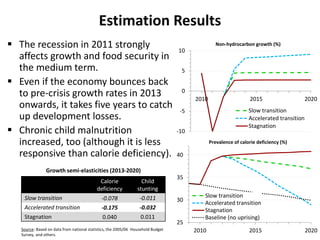
Estimation Results
 The recession in 2011 strongly
affects growth and food security in
the medium term.
 Even if the economy bounces back
to pre-crisis growth rates in 2013
onwards, it takes five years to catch
up development losses.
 Chronic child malnutrition
increased, too (although it is less
responsive than calorie deficiency).
25
30
35
40
2010 2015 2020
Slow transition
Accelerated transition
Stagnation
Baseline (no uprising)
Prevalence of calorie deficiency (%)
Source: Based on data from national statistics, the 2005/06 Household Budget
Survey, and others.
-10
-5
0
5
10
2010 2015 2020
Slow transition
Accelerated transition
Stagnation
Non-hydrocarbon growth (%)
Calorie
deficiency
Child
stunting
Slow transition -0.078 -0.011
Accelerated transition -0.175 -0.032
Stagnation 0.040 0.011
Growth semi-elasticities (2013-2020)
Conclusions
 If no action is taken and political turmoil continues, Yemen is likely
to suffer for years to come from low growth.
 To make up for the lost half-decade, policies and investments for
growth acceleration is urgently needed.
 This will require additional public spending of between USD 5.4
and 11.3 billion over the next eight years, depending on the
spending efficiency.
 In addition, direct nutrition and health interventions are necessary
to bring down child malnutrition rates and prevent further losses in
productivity and growth potential of the next generation.
 Yemen has a comprehensive food security strategy in place, but its
implementation is still outstanding.
Summary of the Session and Ways Forward
IFPRI MENA Team
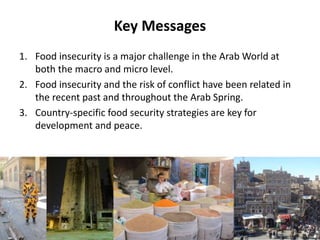
Key Messages
1. Food insecurity is a major challenge in the Arab World at
both the macro and micro level.
2. Food insecurity and the risk of conflict have been related in
the recent past and throughout the Arab Spring.
3. Country-specific food security strategies are key for
development and peace.
Work in Progress
 Arab Spatial – Mapping Food Security and Development
 Papers:
 The Double Burden of Malnutrition and the Role of Food
Subsidies in Egypt
 Extreme Weather and Civil War in Somalia: Does Drought
Fuel Conflict through Livestock Price Shocks?
 Improving Resilience to Conflict among pastoralist population
in Sudan: Understanding the climate-conflict nexus
 Analyzing the Nutritional Impacts of Economic Policies in
Yemen: A Macro-Micro Modeling Framework
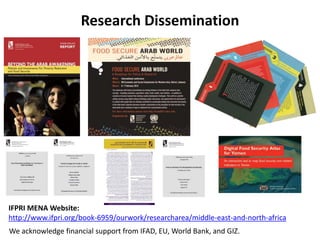
Research Dissemination
IFPRI MENA Website:
http://www.ifpri.org/book-6959/ourwork/researcharea/middle-east-and-north-africa
We acknowledge financial support from IFAD, EU, World Bank, and GIZ.

Beyond the Arab Srping: Improving Food Security and Resilience to Conflict

  • 1.
    Beyond the ArabSpring Improving Food Security and Resilience to Conflict 28th International Conference of Agricultural Economists Rafain Convention Center, Foz do Iguaçu, Brazil August 18-24, 2012
  • 2.
    The ‘Arab Spring’and After  Dec. 2010: Self-immolation of a young vegetable vendor in Tunisia  Spring 2011: Protests in the quest for more freedom, dignity and justice in several Arab countries  2012: Four longstanding autocratic leaders (Egypt, Libya, Tunisia, Yemen) have been ousted after varying degrees of violent turmoil.  Causes of the unrests run deep and have accumulated over time. A combination of political, sociological and economic factors triggered the uprisings.  Key economic factors include growing unemployment (especially among the population aged 25-39), rising inequality and high food insecurity.
  • 3.
    Outline of theSession Objective: Initiate and inform the debate on key challenges and opportunities for achieving food security and preventing conflict across the Arab World. Presentations: 1. Policies and Investments for Poverty Reduction and Food Security—by Perrihan Al-Riffai 2. Does Food Security Matter for Transition in Arab Countries?—by Jean-Francois Maystadt 3. Growth and Food Security Impacts of Yemen’s Uprising and Scenarios for Transition—by Olivier Ecker
  • 4.
    Policies and Investmentsfor Poverty Reduction and Food Security in the Arab World C. Breisinger, O. Ecker, P. Al-Riffai and B. Yu
  • 5.
    Growth, Poverty andFood Security Economic growth does not trickle down to the poor in Arab countries as much as it does in the rest of the world Government spending as a share of GDP is the highest in the region among all world regions, but, does not translate into spending effectiveness and efficiency Poverty–food security nexus one of the key development challenges facing Arab countries Macro and micro food security present a serious challenge for the region
  • 6.
    GDP Growth, Incidenceof Poverty and Child Undernutrition Source: Breisinger C., O. Ecker, P. Al-Riffai and B. Yu. 2012. Beyond the Arab Awakening: Policies and Investments for Poverty Reduction and Food Security. IFPRI Food Policy Report. Washington, DC: International Food Policy Research Institute.
  • 7.
    Macro and MicroLevel Food Security Source: Breisinger C., O. Ecker, P. Al-Riffai and B. Yu. 2012. Beyond the Arab Awakening: Policies and Investments for Poverty Reduction and Food Security. IFPRI Food Policy Report. Washington, DC: International Food Policy Research Institute.
  • 8.
    Macro Food Insecurity Source:Breisinger C., O. Ecker, P. Al-Riffai and B. Yu. 2012. Beyond the Arab Awakening: Policies and Investments for Poverty Reduction and Food Security. IFPRI Food Policy Report. Washington, DC: International Food Policy Research Institute.
  • 9.
    Micro Food Insecurity Source:Breisinger C., O. Ecker, P. Al-Riffai and B. Yu. 2012. Beyond the Arab Awakening: Policies and Investments for Poverty Reduction and Food Security. IFPRI Food Policy Report. Washington, DC: International Food Policy Research Institute.
  • 10.
    Selected Policies fora Food Secure Arab World For countries with micro level food insecurity, focus on supporting job creating growth for the poor and improving social services Growth led by the manufacturing rather than the agricultural sector is pro-poor and is associated with reducing child undernutrition For countries with macro-level food insecurity, encourage exports to finance food imports and the agricultural sector in countries with potential Agriculture to play important role in poverty reduction in countries with large agricultural potential as agriculture continues to serve as a social safety net sector especially in times of crisis
  • 11.
    While these selectedpolicies apply for many Arab countries, strategies and investments have to be country-owned and adopted to country and sub-national levels.
  • 12.
    Does Food SecurityMatter for Transition in Arab Countries? J.-F. Maystadt, J.-F. Trinh Tan and C. Breisinger
  • 13.
    “How is itthat countries in the Middle East and North Africa could face explosions of popular grievances despite, in some cases, sustained high growth and improvement in social indicators?” (World Development Report 2011 on Conflict, Security and Development) Conflicts in the Arab World
  • 14.
    The Arab Worldat a Crossroad • “Power vacuum” : Particularly at risk • But no determinism … also opportunities Major causes of conflicts and which preventive measures? How best to accompany such political transition?
  • 15.
    Arab Exceptionalism? Collier andHoeffler 2004 (CH04) • ‘Opportunity’ (per capita income, economic growth) matters, not ‘Motivation’ (‘grievance’) Sorli et al. (2005) : 1960-2000 • No MENA specific effect : “Conflict is quite well explained by a general model of civil war” (p.160) Shortcomings: • Reduced sample of countries (excl. e.g. Mauritania, Djibouti, Somalia, Sudan) • No Fixed Effect (Djankov and Reynal-Querol, forthcoming REStat) • Predictive power 30% lower compared to SSA • Replication with updated data points to “Arab Exceptionalism”
  • 16.
    Main Empirical Model 𝑃(𝑐𝑜𝑛𝑓𝑙𝑖𝑐𝑡𝑖,𝑡)= 𝑐 + 𝛼𝑖 + 𝜙 𝑡 + 𝜂 𝑋𝑖,𝑡−1 + 𝜑 𝑋𝑖𝑡−1 ∗ 𝐴𝑟𝑎𝑏 + 𝜀𝑖,𝑡  Economic growth is the only robust finding in CH(04)  Arab exceptionalism is confirmed!  Where the growth is coming from? (‘Opportunity’)  Sectoral growth, Youth bulges  Better proxy for natural resource dependency (e.g. oil)  Where the growth is going to? (‘Motivation’)  Inequality  Micro and Macro Food Security Indicators, given high food import dependency  Political dimension? (‘Polity’)
  • 17.
    Beyond Collier-Hoeffler Framework Regressions(1) (2) (3) (4) (5) Dependent variable Model GDP growth (t-1) -3.757*** -6.259*** -3.539* -4.644*** -8.644*** [0.980] [1.429] [1.877] [1.85] [1.850] GDP growth (t-1)*Arab+ 5.919*** 4.409 3.056 3.056 [1.978] [2.784] [4.091] [4.091] Child stunting (t-1) 0.0522** [0.0233] Child stunting (t-1)*Arab+ 0.307*** [0.0992] Child mortality (t-1) -0.001 [0.003] Child mortality (t-1)*Arab+ 0.001 [0.006] Food Insecurity Index (t-1) -0.0107* [0.00566] Food Insecurity index (t-1)*Arab+ 0.0294** [0.0125] Time dummies incl. incl. incl. incl. incl. Country Fixed Effects incl. incl. incl. incl. incl. Observations 1,474 1,474 630 412 1,219 Incidence ofmajor intrastate conflict Logit fixed effect
  • 18.
    Other Correlates  ‘Motivation’: Gini coefficient is uncorrelated to conflicts but known to poorly capture time-varying sources of grievances  ‘Opportunity’  Sectoral growth does not matter  Youth bulges (share of urban male aged 15-24 over the urban (or male) population aged > 15) : Positive relationship  Oil, gas, ores and minerals exports to GDP or dependency (>40%) . Oil dependency increases conflict at a global level but has the opposite effect in the Arab world  ‘Polity’  Economic and political discrimination against minorities increase conflicts but not specifically for Arab countries  Past transitions to full democracy and autocracy reduce the risk of conflicts but not in a stronger way in the Arab world
  • 19.
    The Arab FoodSecurity Channel For the sample restricted to the Arab world, 2SLS-FE model points to the vulnerability of food net importers to changes in food international prices or food insecurity and in turn, to the risk of conflict 𝑃 𝑐𝑜𝑛𝑓𝑙𝑖𝑐𝑡𝑖,𝑡 = 𝑐 + 𝛼𝑖 + 𝜙 𝑡 + 𝜂 𝐹𝑆𝐼𝑖,𝑡 + 𝛾 𝑋𝑖,𝑡−1 + 𝜀𝑖,𝑡 𝐹𝑆𝐼𝑖,𝑡 = 𝑐 + 𝛼𝑖 + 𝜙 𝑡 + 𝜂 𝑃𝑗,𝑡 ∗ 𝑊𝑖,𝑗 + +𝛽 𝑋𝑖,𝑡−1 + 𝜀𝑖,𝑡 Where 𝐹𝑆𝐼𝑖,𝑡 = Macro or Micro Food Security Indicators 𝑃𝑗,𝑡 = 𝑃𝑟𝑖𝑐𝑒 𝑜𝑓 𝑓𝑜𝑜𝑑 𝑗 (beef, maize, rice and wheat) 𝑊𝑖,𝑗 = Net food imports 𝑋𝑖,𝑡−1 = Past economic growth and peace duration The high dependence on food imports, combined with high and volatile world market prices, argued to be one factor contributing to the Arab Awakening (Zurayk 2011; Harrigan 2012, The Economist 2012)
  • 20.
    The Arab FoodSecurity Channel Regression (2) (4) (6) (8) Dependent variable Model Peace duration 0.003 -0.0099*** -0.005*** -0.005*** [0.006] [0.003] [0.002] [0.002] GDP growth (t-1) 0.196 -0.312 -0.178 -0.184 [0.213] [0.283] [0.163] [0.195] Child stunting 0.0420*** [0.016] Child mortality 0.011*** [0.004] Macro Food 0.011*** Insecurity [0.004] Macro Food 0.013** Insecurity [0.006] incl. remittances Country Fixed Effects incl. incl. incl. incl. Time dummies incl. incl. incl. incl. Observations 433 246 685 685 Number of countries 22 22 22 22 F-test 2.731** 4.603*** 5.335*** 4.484*** Underid test 15.23*** 13.76*** 17.14*** 8.819** P-value Hansen test 0.52 0.24 0.66 0.46 F-test on excl. IV 10.83*** 6.85*** 7.74*** 3.99** Root MSE 0.25 0.26 0.24 0.26 Incidence of major intra-state conflicts FE2SLS
  • 21.
    Conclusions 1) Transition todemocracy is welcomed but the transition period is risky 2) Food insecurity matters for conflicts in the Arab world Limitations: 1. Not a paper on the Arab Awakening : only valid for major conflict events • Need to understand the dynamics of public protests and violence in the Arab countries, with a special focus on food security and food policies 2. Cross-country analysis misses the heterogeneity • Country case studies
  • 22.
    Growth and FoodSecurity Impacts of Yemen’s Uprising and Scenarios for Transition C. Breisinger and O. Ecker
  • 23.
    Food Insecurity –Conflict Relationship  Conflict aggravates household food insecurity.  Urban households are particularly vulnerable.  For food security of the individual household, the presence of conflict in the neighborhood seems to matter more than the direct experience of conflict. Coef. Std. Err. Exposure to conflict Household 1.100 0.233 Neighborhood 3.399 0.484 Round -0.081 0.020 Log likelihood -392.2 Observations 1,303 No. of HHs 95 Food insecurity—conflict fixed-effects logit model Source: Based on data from the UNICEF Social Protection Monitoring Survey (14-round panel) from Sana’a (urban), Al-Hodeidah (urban) and Amran (rural)0 10 20 30 40 50 60 26 30 34 38 42 46 50 HH exposed to conflict (%) HH food insecurity (%) Food insecurity and conflict, July - Dec. 2011
  • 24.
    The Economic Shockof the Uprising  Even before the 2011 uprising, economic growth was sluggish, and food insecurity and malnutrition widespread.  Collier (2007) estimates that one year of civil war reduces a country’s growth rate by 2.2% globally. For Arab countries, the average GDP per capita loss may be even higher, estimated at 3.5% (ESCWA 2010). Source: Based on data from the Gallup World Poll. 0 10 20 30 40 50 60 2007 2009 2011 Confidence in national government (%) Growth in local economy expected (%) Satisfaction with standard of living (%) Perceptions on political and economic conditions  Yemen’s economy was hit hard in 2011:* • GDP contracted by about 11%. • Gov. spending fell by 12%, and transfers to households by 23%. • Remittances declined by 10%. → Impact on food security? * Source: IMF World Economic Outlook Database.
  • 25.
    Macro-Micro Modeling Framework Factormarkets Commodity markets Foreign markets/ countries Public sector/ government Human/physical capital Productivity/technology Urban/ Rural Farm/ Nonfarm Agriculture Industry Services Economic production HH incomes Production Consumption Wages, rents, profits Foreign trade Foreign aid Taxes Spending and market policies Foreign investment Taxes and social policies Public investment and macro policies Private investment IFPRI Dynamic CGE Model Nutrition Models* Parametric estimation: N = f(Y, P, Z) Response (coefficient estimates) Prediction Expenditure change (‘shock’) Nutrition outcomes * Reduced-form model for HH calorie consumption and child nutritional status
  • 26.
    Estimation Results  Therecession in 2011 strongly affects growth and food security in the medium term.  Even if the economy bounces back to pre-crisis growth rates in 2013 onwards, it takes five years to catch up development losses.  Chronic child malnutrition increased, too (although it is less responsive than calorie deficiency). 25 30 35 40 2010 2015 2020 Slow transition Accelerated transition Stagnation Baseline (no uprising) Prevalence of calorie deficiency (%) Source: Based on data from national statistics, the 2005/06 Household Budget Survey, and others. -10 -5 0 5 10 2010 2015 2020 Slow transition Accelerated transition Stagnation Non-hydrocarbon growth (%) Calorie deficiency Child stunting Slow transition -0.078 -0.011 Accelerated transition -0.175 -0.032 Stagnation 0.040 0.011 Growth semi-elasticities (2013-2020)
  • 27.
    Conclusions  If noaction is taken and political turmoil continues, Yemen is likely to suffer for years to come from low growth.  To make up for the lost half-decade, policies and investments for growth acceleration is urgently needed.  This will require additional public spending of between USD 5.4 and 11.3 billion over the next eight years, depending on the spending efficiency.  In addition, direct nutrition and health interventions are necessary to bring down child malnutrition rates and prevent further losses in productivity and growth potential of the next generation.  Yemen has a comprehensive food security strategy in place, but its implementation is still outstanding.
  • 28.
    Summary of theSession and Ways Forward IFPRI MENA Team
  • 29.
    Key Messages 1. Foodinsecurity is a major challenge in the Arab World at both the macro and micro level. 2. Food insecurity and the risk of conflict have been related in the recent past and throughout the Arab Spring. 3. Country-specific food security strategies are key for development and peace.
  • 30.
    Work in Progress Arab Spatial – Mapping Food Security and Development  Papers:  The Double Burden of Malnutrition and the Role of Food Subsidies in Egypt  Extreme Weather and Civil War in Somalia: Does Drought Fuel Conflict through Livestock Price Shocks?  Improving Resilience to Conflict among pastoralist population in Sudan: Understanding the climate-conflict nexus  Analyzing the Nutritional Impacts of Economic Policies in Yemen: A Macro-Micro Modeling Framework
  • 31.
    Research Dissemination IFPRI MENAWebsite: http://www.ifpri.org/book-6959/ourwork/researcharea/middle-east-and-north-africa We acknowledge financial support from IFAD, EU, World Bank, and GIZ.

Editor's Notes

  • #3 … or ‘Arab Awakening’ Tunisia: Dec. 17, 2010 Violent protests erupted quickly in many Arab countries, incl. Egypt, Libya, Tunisia, Yemen [Dictators: Hosni Mubarak (Egypt), Muammar el-Qaddafi (Libya), Zine El Abidine Ben Ali (Tunisia), Ali Abdullah Saleh (Yemen)] Ongoing civil war in Syria. In neighboring Arab countries like Morocco, Algeria, and Jordan (and eventually Saudi Arabia and Bahrain), the political leaders have been pressured into enacting reforms to assuage public demands. High food insecurity perhaps mainly due to high levels of poverty and high and volatile food prices In addition, some of the Arab countries’ longer standing challenges such as large social disparities, limited agricultural potential, and extreme water scarcity are likely to require different solutions for achieving food security and preventing conflict than in other world regions.
  • #4 Introduction of speakers Structure: Presentations—10 min each; short session summary; Q&A—20 min
  • #6 The macro-level dimension comprises the key elements of macroeconomic stability, economic growth, and governance,
  • #8 Macro: National level Agricultural production Food consumption Ability to bridge the gap between production and consumption – ability to import Micro: Household-level Access of households to food, rural, urban, farm, nonfarm For all household members, including children  
  • #9 The map categorizes countries according to their risk of overall food insecurity (and relative to global averages). The indicator of overall food insecurity risk comprises two components: a macro-level and a micro-level measure of food insecurity. The macro-level indicator captures the ability of a country to finance food imports through exports of goods and services and the net remittances received. Food security at the macro level, goes beyond the simple notion of food self-sufficiency, particularly in the MENA region with its high food import dependency and limited agricultural potential. A country’s trade and budget balances play major roles in food security. The general idea behind this “trade-based” view is countries that generate sufficient foreign exchange earnings from their exports (of goods and services), and thus have sufficient access to food imports from world markets, have no food security problem. In Arab countries remittances play an important role in foreign exchange earnings and household incomes directly. The ratio of food imports to total exports also takes agricultural performance (and thus, indirectly, agricultural potential) into account, where a change in agricultural exports and a change in food production for the domestic market both directly affect the ratio. The prevalence of child undernutrition, preciously stunting in children under 5, is the indicator of food security at the micro level. The indicator is chosen because it captures household access to food in terms of quantity and quality and the adequacy of nutrition considers the interaction between food and nutrient intake and individual health reflects the longer-term perspective (compared to the other two child anthropometric measures) provides information of intrahousehold distribution of food and resources Considers other factors relevant for a healthy diet and nutrition such as education, nutritional knowledge, care, especially by mothers has important long-term implications for future economic potential at the household and population levels. Young children’s nutritional status tends tobe most responsive to changes in living conditions and to be particularly vulnerable to food shortages and diseases, due to their high physiological nutrient requirements for growth, their special dietary needs, their often more direct exposure to adverse health conditions, and their dependency on adults.
  • #11 micro-level dimension includes household access to food and assets and services necessary for an individual to be healthy, which are typically constrained by poverty in food insecure households
  • #15 Long history of conflicts Uprisings in Tunisia November 2010 IFAD call for proposals in March 2011 Launch WDR April 2011
  • #22 A price-induced change in child stunting, the mortality rate, and the macroeconomic food insecurity index increases the risk of conflict by 10.19, 11.02 and 0.04 percentage points.
  • #25 Motivation of the study Data: Small-scale, high-frequency (biweekly) panel survey from UNICEF with perception-based questions: [Proxy for exposure to conflict, thus insecurity: “During the past two weeks has any child become afraid of playing outside?” – “Yes”. “During the past two weeks have you or any family member experienced going to bed hungry due to lack of food?” – “Yes”.] Estimation: Controlling for fixed effects (between location and over time) and uniform trend in the data Consideration of neighborhood effects ( level of insecurity in cluster) [Testing of lag effects  not important] So, we established that conflict has an immediate effect on household food insecurity in the short run. And, what about the long-term impact of the uprising, and what is needed to bring Yemen back to its pre-revolution situation? [History of Yemen’s 2011 uprising: January 27: First major demonstration in Sana’a City with more than 10,000 people February/March: Major protests erupted in cities all over the country. July: Government rejected the opposition's demands, including the formation of a transitional council with the goal of formally transferring power from the current administration to a caretaker government. In response, fractions of the opposition announced the formation of their own transitional council. Late November: After several attempts, Saleh signed a power-transfer agreement brokered by the Gulf Cooperation Council in Riyadh, under which he would transfer his power to his Vice-President within 30 days and leave his post as president by February 2012, in exchange for immunity from prosecution. First, Saleh tried to hold on power but had to leave after resurgence of protests. February 2012: Presidential election and transfer of power to al-Hadi (former vice-president)] [Even before the Arab Spring, Yemen was rattled by conflict: secession movement in the South, war between government forces and al-Houti rebels in the North, and al-Qaida attacks]
  • #26 In 2009, 32 percent of the population suffered from food shortages (calorie deficiency), and around 60 percent of all preschool children was chronically malnourished (stunted). Impact on Yemen’s economy: Decline in oil production, domestic supply, and revenue earnings due to security deterioration and attack on major oil pipeline (Marib-Hodeidah) Reduction in foreign grants and loans by around 60-70% from 2010 to 2011 [GDP per capita (USD): 15,286 in 2009, 13.892 in 2011  -9.1%] Nonetheless, increase in public wages and salaries by 20% from 2010 to 2011 [The presented GALLUP indicators are based on the following questions and answers: Confidence in national government: “In this country, do you have confidence in each of the following, or not? How about national government?” – “Yes”. Growth in local economy expected: “Right now, do you think that economic conditions in the city or area where you live, as a whole, are getting better or getting worse?” – “Getting better”. Satisfaction with standard of living: “Are you satisfied or dissatisfied with your standard of living, all the things you can buy and do?” – “Satisfied”.]
  • #27 Innovative approach: Linking dynamic computable general equilibrium (CGE) model to household and individual nutrition models to consistently estimate the food security and nutrition effects of economic shocks and policies Macro model: CGE models are constructed consistently with the neoclassical general equilibrium theory. They are based on social accounting matrices (SAMs), which capture all economic linkages and interactions between all sectors and institutions within the domestic economy and the relationships with the rest of the world. [The recursive dynamic version of the CGE model—developed by IFPRI—incorporates a series of dynamic factors into the standard, static CGE model to make it dynamic ( the system of equation is solved for each year independently, and the base conditions for the next year are adjusted accordingly).] Our Yemen DCGE model is quite detailed (65 sectors of which 22 are in agriculture, 12 HH groups). Simulation: Shock the system through changes in TFP, in-/outflows, tax flows, etc. Micro model: Estimation of changes in household calorie consumption levels and child nutritional status as a response to changes in HH total expenditure, controlling for non-income factors such as HH size and composition, education of HH members, level of HH food self-sufficiency, certain habits, HH health environment, HH location and agricultural zone, seasonality Reduced-form model [ estimation of food security and nutrition responses to HH expenditure changes directly] Forward-looking simulation of sector-specific growth, household income/expenditure, food security, and nutrition impacts based on projected, aggregated growth rates Time period of simulation: 2010-2020 (base year of SAM 2009  latest reliable estimates)
  • #28 Assumptions of scenarios ( focus on non-hydrocarbon growth, because hydrocarbon hardly predictable due to lacking data and uncertainty of world market price): Baseline (no uprising in 2011, no transition afterwards): Overall (annual) growth: 4%; non-ag. sectors: 2%; government spending, transfer to HH, remittances: 4%; pop. and labor force growth: 3% (all average in 2000s  continuation of trend; for calibration of the basic model parameters) Slow transition, incl. uprising ( “business-as-usual” scenario): For 2011: Overall growth: -10% (to impose that, TFP of all sectors: -12%); non-agr. sectors: 2%; government spending: -12.2%; transfer to HH: -23.4%; remittances: 4%; [pop. and labor force growth: 3%]  based on IMF assessment 2012: Overall growth: -0.9% (non-hydrocarbon: -1.6%); TFP slowly comes back and reach baseline levels in 2013 onwards  IMF projections (and distribution across sectors based on growth composition by MOPIC) Accelerated transition: 2013 onwards: Agr.: 1% (because of limited agr. potential); industry (electricity, water, construction, mining—excl. oil and gas, food processing, other manufacturing): 6% ( reconstruction); services (trade, transportation, other private, social): 6% ( high potential of tourism, expansion of public services)  Optimistic scenario: 8-9% overall growth in 2014-2020 Stagnation: Overall growth: 3%  like pop. and labor force growth Semi-elasticities: Reduction in the prevalence of calorie deficiency/child stunting rate due to 1% growth Low responsiveness of chronic child malnutrition to shocks ( as expected, because long-term nutrition indicator) due to limiting non-income factors such as disease burden, inappropriate child care, etc.
  • #29 Estimation of costs for growth acceleration, using elasticity-based 3-step approach: Calculation of public spending patterns by sector in 2008-10 based on MOPIC data Application of the shares to calculate total spending by aggregate sector to match the IMP estimates on total spending in 2008-10 Assumption of public spending/growth elasticities for two efficiency levels (from Fan et al. 2012, Breisinger et al. 2012), given lacking Yemen-specific data Yemen’s past performance in translating spending into growth outcomes suggests that the low-efficiency scenario may be more realistic. Nutrition and health programs (target at e.g. the ‘1,000-day period’), incl. components of WHO’s Integrated Management of Childhood Illnesses (IMCI) strategy, addressing the five major childhood diseases (malnutrition, anemia, diarrhea, fever, acute respiratory infections); nutrition education, information, and communication (IEC); breastfeeding promotion; hospitalized treatment of severe, acute malnutrition
  • #31 Going forward, dealing with the root causes of the uprisings—including food insecurity—and overcoming ongoing conflicts will be a precondition for achieving medium- and long-term prosperity.