“Collaboration and sharing
           of data, tools, and research
           capacities to inform future
            food security strategies”
                         Michael Johnson
             International Food Policy research Institute

                         February 7th, 2012
    “Food Secure Arab World: A Roadmap for Policy and Research”, UN-
                       ESCWA, Beirut, Lebanon


INTERNATIONAL FOOD POLICY RESEARCH INSTITUTE
Motivation & Context

 Translating evidence into policy action – to strengthen and
  impact on food security and economic growth in the region

 Large benefits to had from enhancing the spillover of
  knowledge and analysis across countries facing similar
  policy challenges and opportunities

 Generating regional and international public goods
  (knowledge products, capacity strengthening, and
  outreach)
Motivation & Context #1
       “Translating Evidence into Action”

 Links between research and policy tends to be weak –
  different capacities, cultures and incentives:
   • On supply side - capacity to generate sufficient, relevant and
     credible evidence
   • On demand side – capacity among policymakers to demand and
     use research
 Research, including data collection and analysis tend to
  suffer from a shortage of attention and resources.
 Knowledge sharing is often minimal, with different
  agencies sometimes carrying out parallel and overlapping
  processes of information gathering and analysis.
Motivation & Context #2
     “Enhancing knowledge spillovers”
 Underlying biophysical, climatic, and socio-economic
  characteristics – across borders (similar and diverse)
 Political, economic and social ties - variations
 Some common problems and emerging issues, policy, and
  investment options for ensuring food and nutrition security
 Diversities in stages of economic development and
  experiences
 Variations in state of poverty and food insecurity (depth,
  distribution)
 Research and technical capacities (individuals &
  institutions)
 Knowledge base and data systems
Motivation & Context #3
           “Generating public goods”
 Evidence-based dialogue and knowledge sharing among
  researchers, practitioners and policy makers on key policy
  challenges - to contribute to improved food security
  outcomes

 Regional and global platforms for exchange of knowledge,
  data, analysis, tools, and outreach - to encourage greater
  development partner coordination

 Collaborative research outputs and sharing lessons of
  practice and data (working papers, policy briefs, web-based
  tools) - strengthening national and regional capacities
Translating evidence into action
        “when evidence matters”
 It is less politically contentious (e.g. in the design of
  policy instruments), thus playing a marginal role to
  politics

 It is accidental or purposefully, so long as there is a
  policy window of opportunity

 It supports a specific political viewpoint

 It satisfies a number of criteria – it is relevant, credible
  and salient by policy makers
Translating evidence into action
       “Understanding the policy process
             matters a great deal”
 Social aspects... multiple actors and actor networks who
  are defined by local political, social (cultural and belief
  systems), as well as institutional (bureaucratic structures
  and capacities) realities.

 Human behavior... because they are rooted in people,
  vested interests, corruption, and external influence can
  sometimes play a distinct role

 Politics.. Power relations and ideas are particularly
  important – easily superseding any credible evidence.
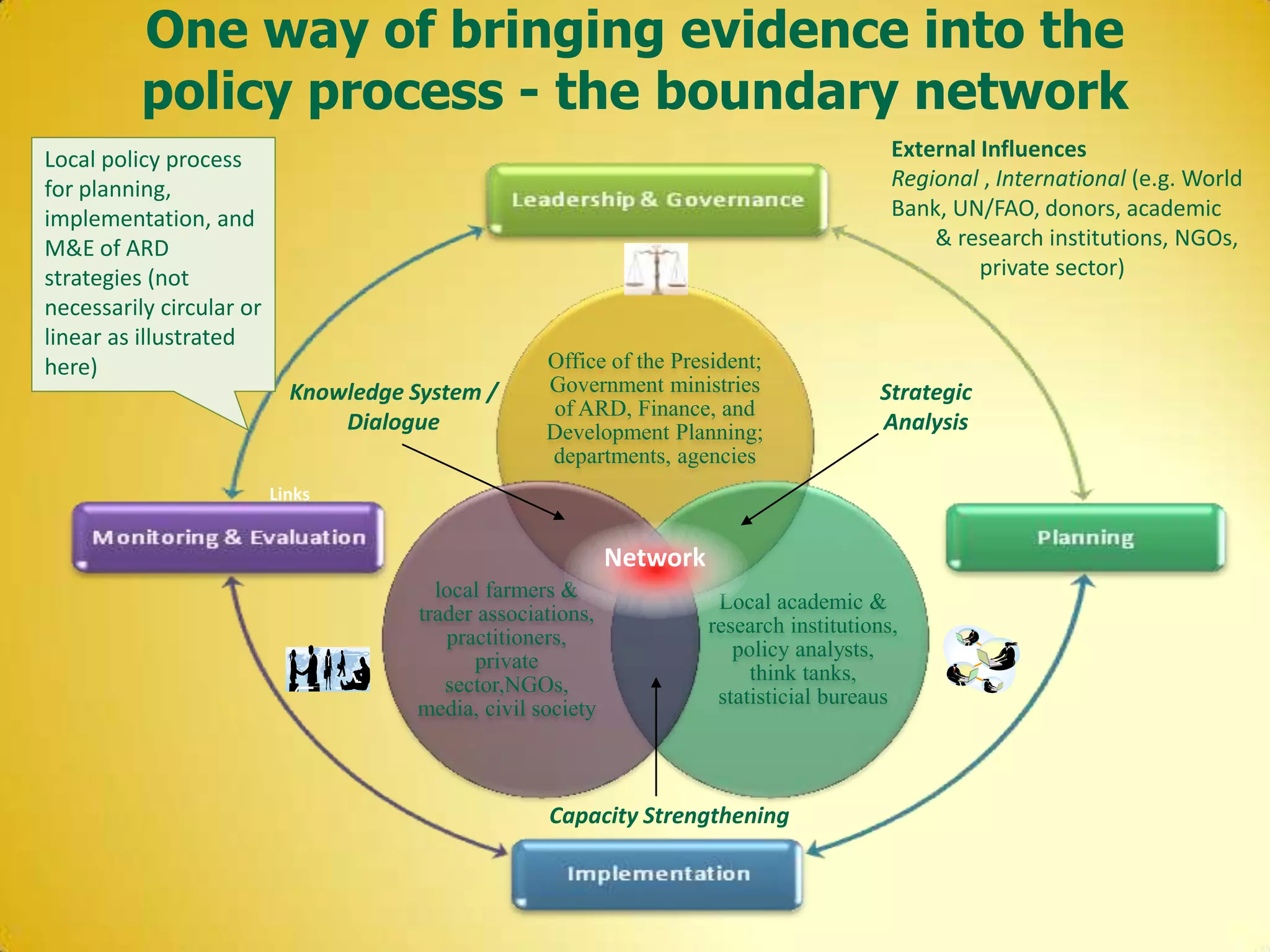
One way of bringing evidence into the
          policy process - the boundary network
Local policy process                                                                         External Influences
for planning,                                                                                Regional , International (e.g. World
implementation, and                                                                          Bank, UN/FAO, donors, academic
M&E of ARD                                                                                       & research institutions, NGOs,
strategies (not                                                                                       private sector)
necessarily circular or
linear as illustrated
here)                                                Office of the President;
                            Knowledge System /       Government ministries                 Strategic
                                                     of ARD, Finance, and
                                Dialogue             Development Planning;                 Analysis
                                                     departments, agencies
                          Links


                                                              Network
                                         local farmers &
                                                                         Local academic &
                                       trader associations,
                                                                        research institutions,
                                          practitioners,
                                                                           policy analysts,
                                             private
                                                                             think tanks,
                                          sector,NGOs,
                                                                         statisticial bureaus
                                       media, civil society


                                                     Capacity Strengthening
Examples


 Africa Model (ReSAKSS-Africa) – launched in 2006 and
  established to support the Africa Union and NEPAD’s
  Comprehensive African Agricultural Development
  Programme (CAADP).

 Asia Model (ReSAKSS_Asia) – in its infancy, to be
  officially launched this year.
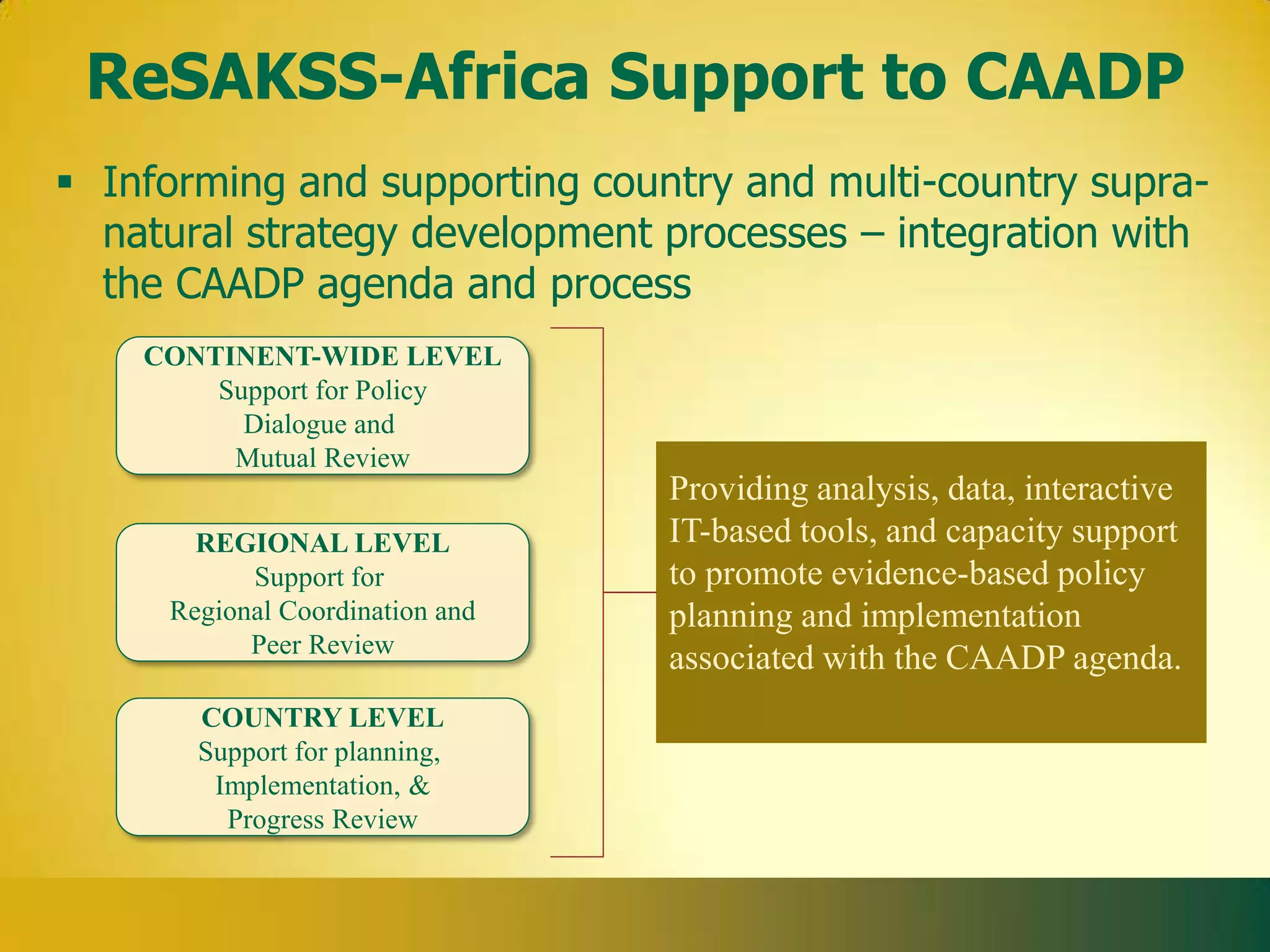
ReSAKSS-Africa Support to CAADP
 Informing and supporting country and multi-country supra-
  natural strategy development processes – integration with
  the CAADP agenda and process
    CONTINENT-WIDE LEVEL
        Support for Policy
          Dialogue and
         Mutual Review
                                 Providing analysis, data, interactive
       REGIONAL LEVEL            IT-based tools, and capacity support
           Support for           to promote evidence-based policy
     Regional Coordination and   planning and implementation
           Peer Review
                                 associated with the CAADP agenda.
       COUNTRY LEVEL
       Support for planning,
        Implementation, &
         Progress Review
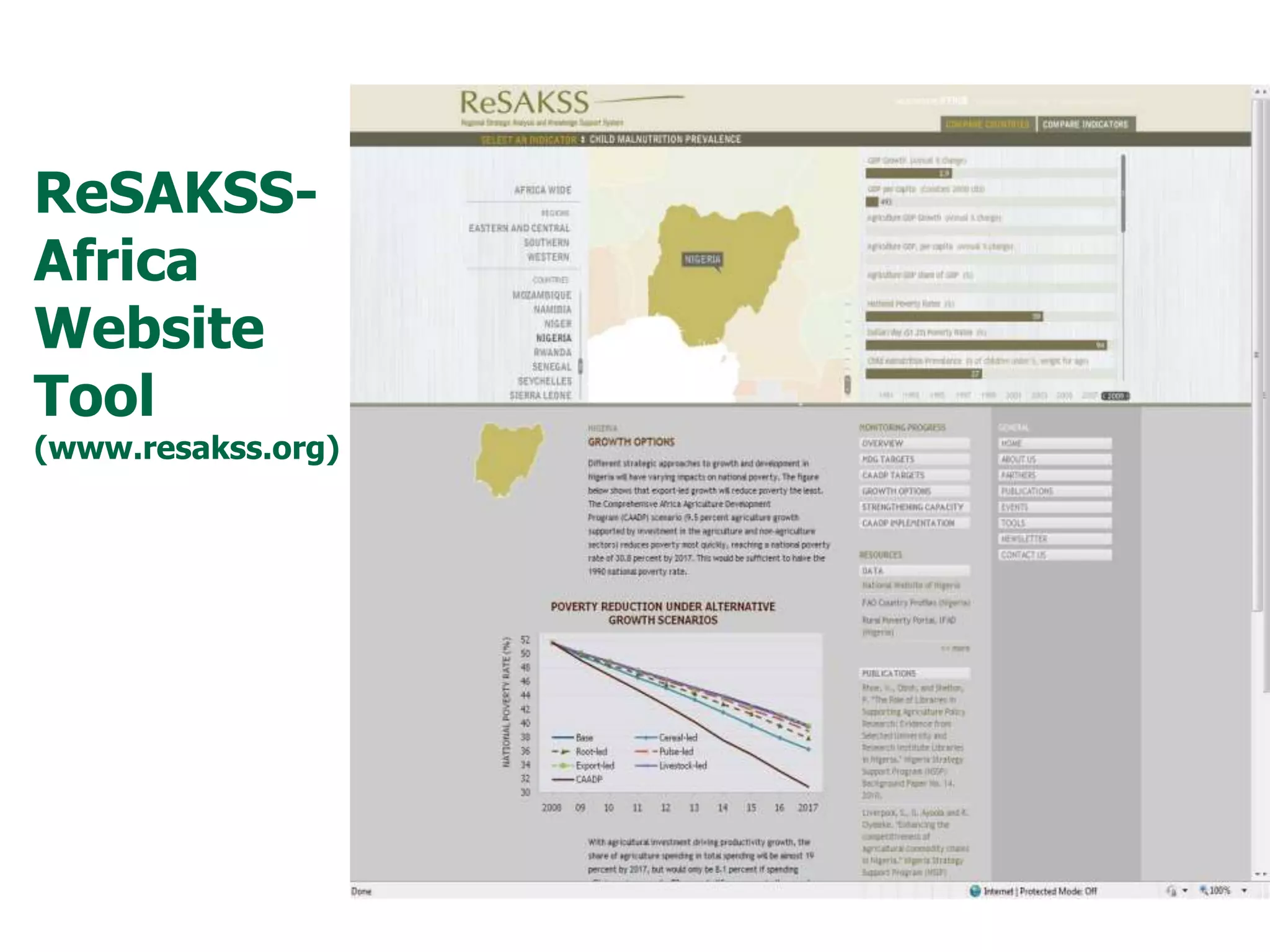
ReSAKSS-
Africa
Website
Tool
(www.resakss.org)
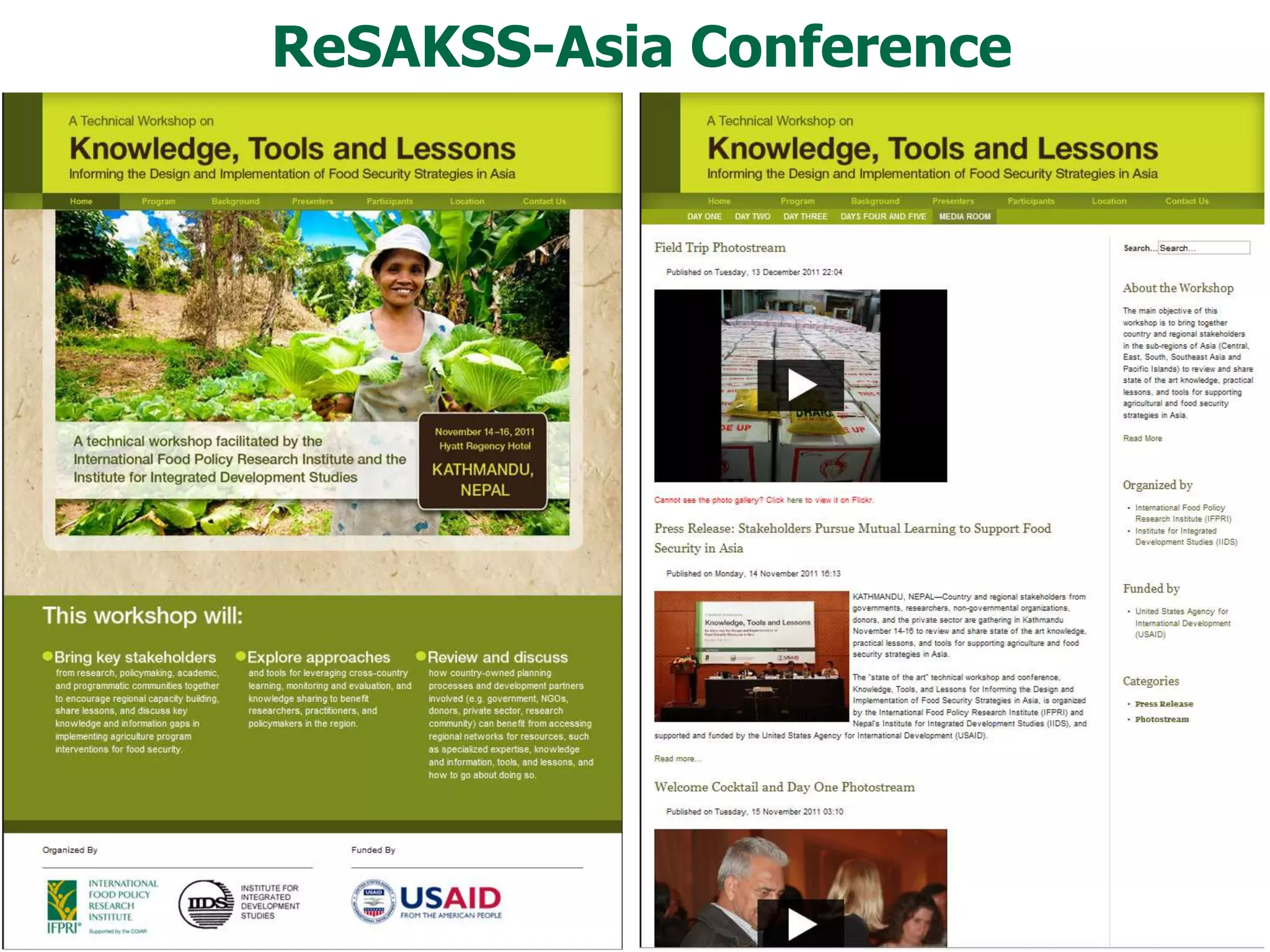
ReSAKSS-Asia Conference
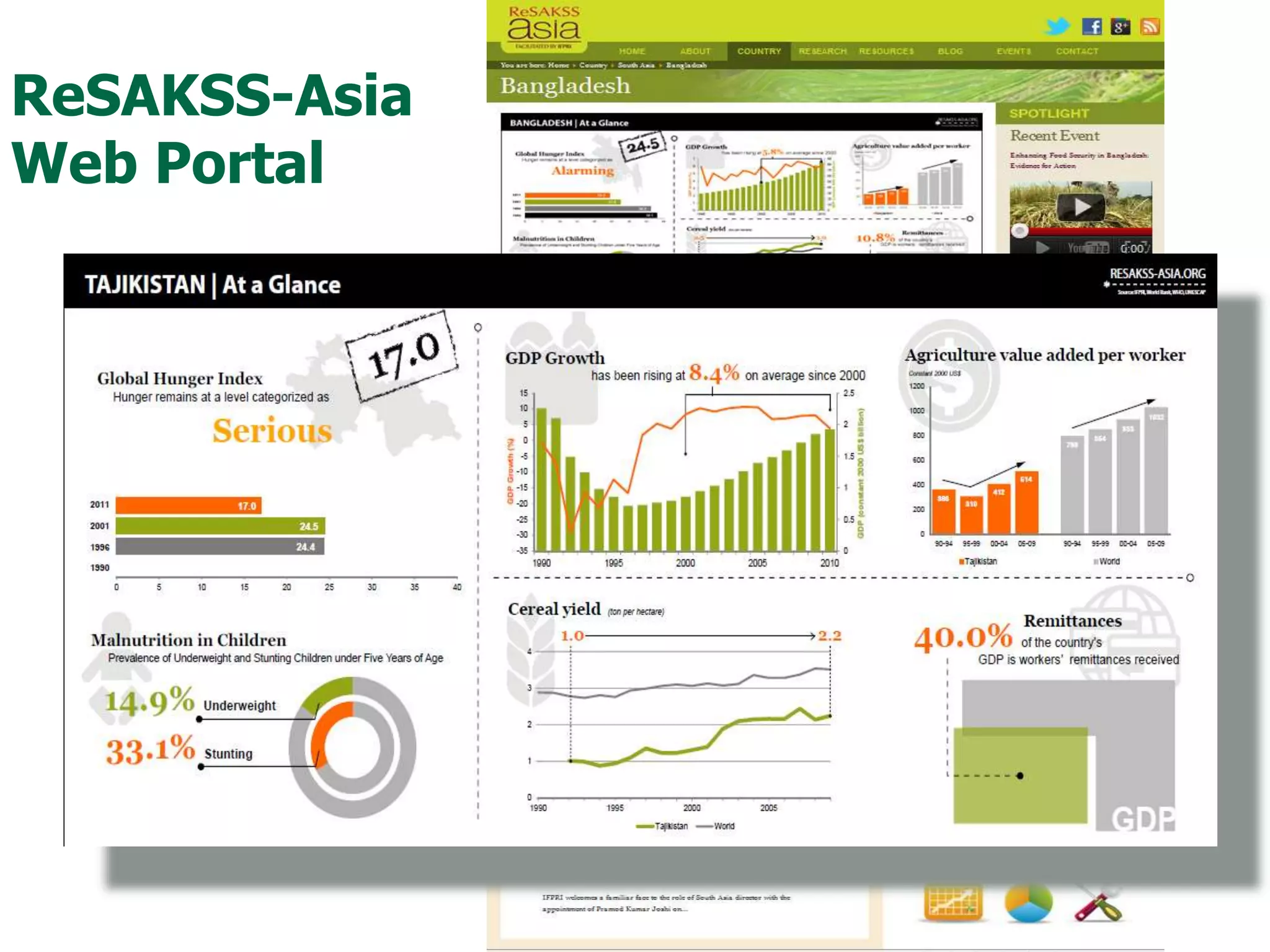
ReSAKSS-Asia
Web Portal
Reflecting on lessons
 Networking and dialogue with local policy makers, analysts,
  and existing networks is essential during the early stages

 Having local champions has had an important impact on the
  effectiveness and speed of implementation – especially on
  Steering/Advisory Committee

 Stronger ties with local partner institutions and government
  bodies (ownership)

 Ability to maintain quality products produced in close
  collaboration with local partners and institutions—raises
  credibility and relevance

 Multiple donor support and sufficient levels of resources
Lessons also raise research questions
   What’s the existing tools and network in the region?

   What drives the interactions in ReSAKSS networks?

   What factors constrain their ability to function well (such as incentives,
    institutional affiliations and tensions, transaction costs, competitiveness,
    different underlying development paradigms, values, and approaches)?

   Does the type of membership mix in the networks affect the credibility of the
    analysis?

   How can the ReSAKSS balance the supply of credible information (which is
    limited) with its demand (which is almost endless)?

   How to incorporate knowledge and research evidence in policy process?

   Can those who seek the information most also pay for it? If not, what are the
    tradeoffs for accepting external donor involvement and influence?

5 b michaeljohnson

  • 1.
    “Collaboration and sharing of data, tools, and research capacities to inform future food security strategies” Michael Johnson International Food Policy research Institute February 7th, 2012 “Food Secure Arab World: A Roadmap for Policy and Research”, UN- ESCWA, Beirut, Lebanon INTERNATIONAL FOOD POLICY RESEARCH INSTITUTE
  • 2.
    Motivation & Context Translating evidence into policy action – to strengthen and impact on food security and economic growth in the region  Large benefits to had from enhancing the spillover of knowledge and analysis across countries facing similar policy challenges and opportunities  Generating regional and international public goods (knowledge products, capacity strengthening, and outreach)
  • 3.
    Motivation & Context#1 “Translating Evidence into Action”  Links between research and policy tends to be weak – different capacities, cultures and incentives: • On supply side - capacity to generate sufficient, relevant and credible evidence • On demand side – capacity among policymakers to demand and use research  Research, including data collection and analysis tend to suffer from a shortage of attention and resources.  Knowledge sharing is often minimal, with different agencies sometimes carrying out parallel and overlapping processes of information gathering and analysis.
  • 4.
    Motivation & Context#2 “Enhancing knowledge spillovers”  Underlying biophysical, climatic, and socio-economic characteristics – across borders (similar and diverse)  Political, economic and social ties - variations  Some common problems and emerging issues, policy, and investment options for ensuring food and nutrition security  Diversities in stages of economic development and experiences  Variations in state of poverty and food insecurity (depth, distribution)  Research and technical capacities (individuals & institutions)  Knowledge base and data systems
  • 5.
    Motivation & Context#3 “Generating public goods”  Evidence-based dialogue and knowledge sharing among researchers, practitioners and policy makers on key policy challenges - to contribute to improved food security outcomes  Regional and global platforms for exchange of knowledge, data, analysis, tools, and outreach - to encourage greater development partner coordination  Collaborative research outputs and sharing lessons of practice and data (working papers, policy briefs, web-based tools) - strengthening national and regional capacities
  • 6.
    Translating evidence intoaction “when evidence matters”  It is less politically contentious (e.g. in the design of policy instruments), thus playing a marginal role to politics  It is accidental or purposefully, so long as there is a policy window of opportunity  It supports a specific political viewpoint  It satisfies a number of criteria – it is relevant, credible and salient by policy makers
  • 7.
    Translating evidence intoaction “Understanding the policy process matters a great deal”  Social aspects... multiple actors and actor networks who are defined by local political, social (cultural and belief systems), as well as institutional (bureaucratic structures and capacities) realities.  Human behavior... because they are rooted in people, vested interests, corruption, and external influence can sometimes play a distinct role  Politics.. Power relations and ideas are particularly important – easily superseding any credible evidence.
  • 8.
    One way ofbringing evidence into the policy process - the boundary network Local policy process External Influences for planning, Regional , International (e.g. World implementation, and Bank, UN/FAO, donors, academic M&E of ARD & research institutions, NGOs, strategies (not private sector) necessarily circular or linear as illustrated here) Office of the President; Knowledge System / Government ministries Strategic of ARD, Finance, and Dialogue Development Planning; Analysis departments, agencies Links Network local farmers & Local academic & trader associations, research institutions, practitioners, policy analysts, private think tanks, sector,NGOs, statisticial bureaus media, civil society Capacity Strengthening
  • 9.
    Examples  Africa Model(ReSAKSS-Africa) – launched in 2006 and established to support the Africa Union and NEPAD’s Comprehensive African Agricultural Development Programme (CAADP).  Asia Model (ReSAKSS_Asia) – in its infancy, to be officially launched this year.
  • 10.
    ReSAKSS-Africa Support toCAADP  Informing and supporting country and multi-country supra- natural strategy development processes – integration with the CAADP agenda and process CONTINENT-WIDE LEVEL Support for Policy Dialogue and Mutual Review Providing analysis, data, interactive REGIONAL LEVEL IT-based tools, and capacity support Support for to promote evidence-based policy Regional Coordination and planning and implementation Peer Review associated with the CAADP agenda. COUNTRY LEVEL Support for planning, Implementation, & Progress Review
  • 11.
  • 12.
  • 13.
  • 14.
    Reflecting on lessons Networking and dialogue with local policy makers, analysts, and existing networks is essential during the early stages  Having local champions has had an important impact on the effectiveness and speed of implementation – especially on Steering/Advisory Committee  Stronger ties with local partner institutions and government bodies (ownership)  Ability to maintain quality products produced in close collaboration with local partners and institutions—raises credibility and relevance  Multiple donor support and sufficient levels of resources
  • 15.
    Lessons also raiseresearch questions  What’s the existing tools and network in the region?  What drives the interactions in ReSAKSS networks?  What factors constrain their ability to function well (such as incentives, institutional affiliations and tensions, transaction costs, competitiveness, different underlying development paradigms, values, and approaches)?  Does the type of membership mix in the networks affect the credibility of the analysis?  How can the ReSAKSS balance the supply of credible information (which is limited) with its demand (which is almost endless)?  How to incorporate knowledge and research evidence in policy process?  Can those who seek the information most also pay for it? If not, what are the tradeoffs for accepting external donor involvement and influence?