Addressing Food and
Nutrition security in
Developing world.
BY
L. Muralikrishnan,
Scientist, Division of Agricultural Extension
ICAR-IARI, New Delhi-12
Introduction
 Addressing Food and Nutrition security in developing world depends on the elements of
Livelihood security, the vulnerability and coping strategies.
 What is food security?
 Food security “exists when all people at all times have both physical and economic access to
sufficient, safe, and nutritious food that meets their dietary needs for an active and healthy
life.”
Food and Agricultural Organization of the United Nations (2013).
Important elements in Food Security
assessments
 Livelihood depends on people capabilities, their assets, their income and the
activities they require in order to make a living. Hence, Food security is the
outcome of a livelihood.
 The household’s vulnerability is determined by the peoples ability to cope up
the risks and shocks, such as drought, flooding, etc. In order to minimize the
impact of such shocks and maintain adequate food access, households and
communities requires coping strategies.
 Coping strategies are activities people use as a means of getting through
difficult times, brought on by events affecting their livelihood and way of
living.
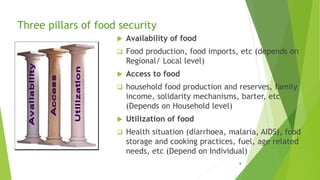
Three pillars of food security
 Availability of food
 Food production, food imports, etc (depends on
Regional/ Local level)
 Access to food
 household food production and reserves, family
income, solidarity mechanisms, barter, etc
(Depends on Household level)
 Utilization of food
 Health situation (diarrhoea, malaria, AIDS), food
storage and cooking practices, fuel, age related
needs, etc (Depend on Individual)
4
Importance of Food Security Assessment
 It provides the current nutrition situation
 It predict the worsening of particular nutrition situation
 It also suggest the solution to improve of nutrition situation
 EX: Successful effort under the Progress of MDG 1 (2000-2015).
 In1990/92 - one billion people (23.2 %) under undernourished category and it was reduced on
2010/12 - 870 million (12.5 %) in the world
 It shows that, MDGs plays important catalyst to address root causes of food security issues.
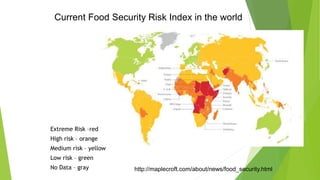
Extreme Risk –red
High risk – orange
Medium risk – yellow
Low risk – green
No Data – gray http://maplecroft.com/about/news/food_security.html
Current Food Security Risk Index in the world
Nutrition Security
 Nutrition security means access by all people at all times to the adequate
utilization and absorption of nutrients in food, in order to be able to live a healthy
and active life.
 At present,
1 billion insufficient kcals and nutrients (hunger)
2billion sufficient kcals, but insufficient nutrients (hidden hunger)
3billion sufficient kcals and nutrients (healthy)
1.4billion excess kcals (some with insufficient nutrients)
(overweight/obesity)
Hunger
 The uneasy or painful sensation caused by a lack of food.
 Involuntary hunger that results from not being able to afford enough food
 The recurrent and involuntary lack of access to food
 It produce malnutrition over time.
Malnutrition Worldwide
World
Number and percentage of undernourished persons
2010-2012 868 million (12%)
2007-2009 867 million (13%)
2004-2006 898 million (14%)
1991-2001 919 million (15%)
1990-1992 1000 million (19%)
The FAO defines undernourishment
as the state of consistently
consuming less energy, in the form of
protein and calories, to maintain a
weight appropriate for height, and
for mild activity.
Food and Agricultural Organization of the United Nations (2013). Hunger Portal: FAQ. Date retrieved: June 11, 2013.
Retrieved from: http://www.fao.org/hunger/en/
“Malnutrition” -
Globally, one in three people are malnourished
This global crisis is happening now!
Higher morbidity
Higher mortality
Lower cognitive ability
Lower work productivity
Impaired growth
Impaired reproduction
Consequences of micronutrient malnutrition
10
Nutritional benefits of Iron rich Pearl millet - Dr. Tara Satyavathi in CAFT- “Extension strategies for nutrition sensitive agriculture to address SDG”- Ag. Extn, IARI, N.
Malnutrition
- Children do not grow properly
- Adults are too thin
- People are deficient in vitamins & minerals
- Adults are overweight or obese
Caused by
- Interaction of poor diets & unhealthy
Vitamin/Mineral deficiencies
 Vitamin A
 Approximately 250000 – 500000 children that are Vitamin A deficient develop
blindness each year
 Iron
 Affects approximately 30% of people in the world
 Zinc
 As of 2009, it was estimated that approximately 2 billion people were deficient in
zinc
Major issues related to nutrition insecurity
(World Health Assembly 2012)
• Stunting
• Anemia
• Low birth
weight
• Childhood
obesity
• Breastfeeding
• Wasting
So, What is the problem?
 Understand the context
Linkages Ag-Nutrition-Health
Limited resources
Limited communication
 Nutrition is not part of national agendas
 Data on micronutrient status are absent (beyond hemoglobin) and collection is expensive
Pathway to ending hunger
 Sustainable agricultural growth
 Right to food and nutrition sensitive policies
 More equitable food systems
 Social protection
 National political commitment
 Public and private investment
 Transparent and inclusive governance
1. Commitment
 Strengthen national targets on nutrition
 Make a Nutrition for Growth commitment at Rio 2016
 Join SUN!
2. Coverage
 Increase coverage of nutrition programmes & measure coverage!
3. Coherence
 Build alliances between nutrition & other communities
4. Cash
 Find more funding for nutrition action
5. Counting
 Identify the data gaps that hinder action—and fill them
International solidarity
 Committee World Food Security
 High Level Task Force on Global Food Security
 Zero Hunger Challenge
 100 % access to adequate food
 zero stunted children less than 2 years old
 all food systems sustainable
 100 % increase in smallholder productivity and income
 zero loss and waste of food
 Innovative financing in food and nutrition security related programmes
 Addressing food and nutrition security through Sustainable Development Goals post
2015 process
Challenges
 Increasing global population
 Climate change
 Potable water shortage
 Loss of arable land, urbanization
 Increasing food wastage
 Food related issues
 Malnutrition
 Obesity
Challenges
 An increasing global population, in combination with climate change,
poses a threat to food security as arable land becomes more scarce
 Global population: 4.4 billion  6.1 billion from 1980-2000
 Projected 9 billion 2050
 Food production: 50% increase from 1980-2000
 Degradation of arable land:
 75% in Central America
 One-fifth in Africa
 11% in Asia
Sample, I. (2007, August 31). Global food crisis looms as climate change and population growth strip fertile land.
The Guardian. Retrieved from: http://www.guardian.co.uk/environment/2007/aug/31/climatechange.food
 Agri- nutria linkage based Integrated approach of blending the best of
both traditional and modern practices supports the food and nutrition
security issues.
 Providing food and Nutrition education to all stake holders support to
enhance the food and nutrition security indicators
 Focus on sensitizing women for nutrition sensitive agriculture
 Fund allocation plays very important role.
Conclusion

Nutrition security

  • 1.
    Addressing Food and Nutritionsecurity in Developing world. BY L. Muralikrishnan, Scientist, Division of Agricultural Extension ICAR-IARI, New Delhi-12
  • 2.
    Introduction  Addressing Foodand Nutrition security in developing world depends on the elements of Livelihood security, the vulnerability and coping strategies.  What is food security?  Food security “exists when all people at all times have both physical and economic access to sufficient, safe, and nutritious food that meets their dietary needs for an active and healthy life.” Food and Agricultural Organization of the United Nations (2013).
  • 3.
    Important elements inFood Security assessments  Livelihood depends on people capabilities, their assets, their income and the activities they require in order to make a living. Hence, Food security is the outcome of a livelihood.  The household’s vulnerability is determined by the peoples ability to cope up the risks and shocks, such as drought, flooding, etc. In order to minimize the impact of such shocks and maintain adequate food access, households and communities requires coping strategies.  Coping strategies are activities people use as a means of getting through difficult times, brought on by events affecting their livelihood and way of living.
  • 4.
    Three pillars offood security  Availability of food  Food production, food imports, etc (depends on Regional/ Local level)  Access to food  household food production and reserves, family income, solidarity mechanisms, barter, etc (Depends on Household level)  Utilization of food  Health situation (diarrhoea, malaria, AIDS), food storage and cooking practices, fuel, age related needs, etc (Depend on Individual) 4
  • 5.
    Importance of FoodSecurity Assessment  It provides the current nutrition situation  It predict the worsening of particular nutrition situation  It also suggest the solution to improve of nutrition situation  EX: Successful effort under the Progress of MDG 1 (2000-2015).  In1990/92 - one billion people (23.2 %) under undernourished category and it was reduced on 2010/12 - 870 million (12.5 %) in the world  It shows that, MDGs plays important catalyst to address root causes of food security issues.
  • 6.
    Extreme Risk –red Highrisk – orange Medium risk – yellow Low risk – green No Data – gray http://maplecroft.com/about/news/food_security.html Current Food Security Risk Index in the world
  • 7.
    Nutrition Security  Nutritionsecurity means access by all people at all times to the adequate utilization and absorption of nutrients in food, in order to be able to live a healthy and active life.  At present, 1 billion insufficient kcals and nutrients (hunger) 2billion sufficient kcals, but insufficient nutrients (hidden hunger) 3billion sufficient kcals and nutrients (healthy) 1.4billion excess kcals (some with insufficient nutrients) (overweight/obesity)
  • 8.
    Hunger  The uneasyor painful sensation caused by a lack of food.  Involuntary hunger that results from not being able to afford enough food  The recurrent and involuntary lack of access to food  It produce malnutrition over time.
  • 9.
    Malnutrition Worldwide World Number andpercentage of undernourished persons 2010-2012 868 million (12%) 2007-2009 867 million (13%) 2004-2006 898 million (14%) 1991-2001 919 million (15%) 1990-1992 1000 million (19%) The FAO defines undernourishment as the state of consistently consuming less energy, in the form of protein and calories, to maintain a weight appropriate for height, and for mild activity. Food and Agricultural Organization of the United Nations (2013). Hunger Portal: FAQ. Date retrieved: June 11, 2013. Retrieved from: http://www.fao.org/hunger/en/
  • 10.
    “Malnutrition” - Globally, onein three people are malnourished This global crisis is happening now! Higher morbidity Higher mortality Lower cognitive ability Lower work productivity Impaired growth Impaired reproduction Consequences of micronutrient malnutrition 10 Nutritional benefits of Iron rich Pearl millet - Dr. Tara Satyavathi in CAFT- “Extension strategies for nutrition sensitive agriculture to address SDG”- Ag. Extn, IARI, N.
  • 11.
    Malnutrition - Children donot grow properly - Adults are too thin - People are deficient in vitamins & minerals - Adults are overweight or obese Caused by - Interaction of poor diets & unhealthy
  • 12.
    Vitamin/Mineral deficiencies  VitaminA  Approximately 250000 – 500000 children that are Vitamin A deficient develop blindness each year  Iron  Affects approximately 30% of people in the world  Zinc  As of 2009, it was estimated that approximately 2 billion people were deficient in zinc
  • 13.
    Major issues relatedto nutrition insecurity (World Health Assembly 2012) • Stunting • Anemia • Low birth weight • Childhood obesity • Breastfeeding • Wasting
  • 14.
    So, What isthe problem?  Understand the context Linkages Ag-Nutrition-Health Limited resources Limited communication  Nutrition is not part of national agendas  Data on micronutrient status are absent (beyond hemoglobin) and collection is expensive
  • 15.
    Pathway to endinghunger  Sustainable agricultural growth  Right to food and nutrition sensitive policies  More equitable food systems  Social protection  National political commitment  Public and private investment  Transparent and inclusive governance
  • 16.
    1. Commitment  Strengthennational targets on nutrition  Make a Nutrition for Growth commitment at Rio 2016  Join SUN! 2. Coverage  Increase coverage of nutrition programmes & measure coverage! 3. Coherence  Build alliances between nutrition & other communities 4. Cash  Find more funding for nutrition action 5. Counting  Identify the data gaps that hinder action—and fill them
  • 17.
    International solidarity  CommitteeWorld Food Security  High Level Task Force on Global Food Security  Zero Hunger Challenge  100 % access to adequate food  zero stunted children less than 2 years old  all food systems sustainable  100 % increase in smallholder productivity and income  zero loss and waste of food  Innovative financing in food and nutrition security related programmes  Addressing food and nutrition security through Sustainable Development Goals post 2015 process
  • 18.
    Challenges  Increasing globalpopulation  Climate change  Potable water shortage  Loss of arable land, urbanization  Increasing food wastage  Food related issues  Malnutrition  Obesity
  • 19.
    Challenges  An increasingglobal population, in combination with climate change, poses a threat to food security as arable land becomes more scarce  Global population: 4.4 billion  6.1 billion from 1980-2000  Projected 9 billion 2050  Food production: 50% increase from 1980-2000  Degradation of arable land:  75% in Central America  One-fifth in Africa  11% in Asia Sample, I. (2007, August 31). Global food crisis looms as climate change and population growth strip fertile land. The Guardian. Retrieved from: http://www.guardian.co.uk/environment/2007/aug/31/climatechange.food
  • 20.
     Agri- nutrialinkage based Integrated approach of blending the best of both traditional and modern practices supports the food and nutrition security issues.  Providing food and Nutrition education to all stake holders support to enhance the food and nutrition security indicators  Focus on sensitizing women for nutrition sensitive agriculture  Fund allocation plays very important role. Conclusion