Organizational Behavior

          Session 6


   Motivation theories
         Part 1
Definitions

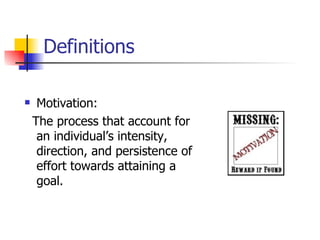
    Motivation:
    The process that account for
     an individual’s intensity,
     direction, and persistence of
     effort towards attaining a
     goal.
Reinforcement theory
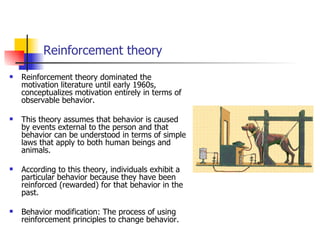
   Reinforcement theory dominated the
    motivation literature until early 1960s,
    conceptualizes motivation entirely in terms of
    observable behavior.

   This theory assumes that behavior is caused
    by events external to the person and that
    behavior can be understood in terms of simple
    laws that apply to both human beings and
    animals.

   According to this theory, individuals exhibit a
    particular behavior because they have been
    reinforced (rewarded) for that behavior in the
    past.

   Behavior modification: The process of using
    reinforcement principles to change behavior.
Reinforcement theory (continued)


   Skinner (1974) defined consequences that influence the probability
    of behaviors:

1- Positive reinforcement increases the probability of behaviors that
   they were contingent upon.

2- Negative reinforcement increases the probability of behaviors by
   taking away or reducing its intensity.

3- Punishments reduce the probability of behaviors.
Reinforcement theory (continued)

   Punishment may be effective when positive
    reinforcers are also used.

   Without using positive reinforcers, punishment leads
    to only short term suppression of the undesirable
    behaviors.

   If managers frequently use punishment, it may
    create a fearful atmosphere, which undermines
    learning and the effectiveness of communication.
Reinforcement theory (continued)

Some important points for using rewards effectively:

1- Use reward to get individuals engaged in an activity, and then gradually withdraw
    the reward when they show some interest.

2- Make sure that it is clear to individuals what behavior the reward is contingent.

3- Reward genuine achievements, such as high levels of effort and persistence.
    Avoid rewarding performance that required little or no effort.

4- Use the most modest reward that will work.

5-Make sure that the time between the desired behavior and the reward is not so
   great that reward has no effect.

6- Make sure that rewards are realistically available.

7- Make sure that you treat employees fairly!
Equity theory (J. Stacy Adams)
   Adams described the employment relationship
    as an exchange relationship in which
    employees contributed inputs and received
    outcomes in return.

   Inputs: education, previous work experience,
    effort on the job, training, and etc.

   Outcomes: Pay, recognition, praise by
    supervisors, promotion, and etc.
Equity theory (continued)
     According to this theory, every employee compares
      himself/herself with other employees.

     When an inequity is perceived, there are six choices:
4.    Changing inputs
5.    Changing outcomes
6.    Distorting perception of self or others
7.    Changing the inputs or outcomes of the referent
      others
8.    Choosing a different referent
9.    Leaving the field
Equity theory (continued)
   procedural justice, the perceived fairness of the
    process used to determine the distribution of
    rewards, has strong impact on organizational
    commitment, trust in managers, intention to quit,
    and organizational citizenship behaviors.

   Distributive justice (fairness of allocation) is more
    important for job satisfaction.

   Research has shown that perceived distributive
    justice is greatly influenced by perceived procedural
    justice.
Reading
   Please read page 162 to 194 of the text
    book.

Sess 7

  • 1.
    Organizational Behavior Session 6 Motivation theories Part 1
  • 2.
    Definitions  Motivation: The process that account for an individual’s intensity, direction, and persistence of effort towards attaining a goal.
  • 3.
    Reinforcement theory  Reinforcement theory dominated the motivation literature until early 1960s, conceptualizes motivation entirely in terms of observable behavior.  This theory assumes that behavior is caused by events external to the person and that behavior can be understood in terms of simple laws that apply to both human beings and animals.  According to this theory, individuals exhibit a particular behavior because they have been reinforced (rewarded) for that behavior in the past.  Behavior modification: The process of using reinforcement principles to change behavior.
  • 4.
    Reinforcement theory (continued)  Skinner (1974) defined consequences that influence the probability of behaviors: 1- Positive reinforcement increases the probability of behaviors that they were contingent upon. 2- Negative reinforcement increases the probability of behaviors by taking away or reducing its intensity. 3- Punishments reduce the probability of behaviors.
  • 5.
    Reinforcement theory (continued)  Punishment may be effective when positive reinforcers are also used.  Without using positive reinforcers, punishment leads to only short term suppression of the undesirable behaviors.  If managers frequently use punishment, it may create a fearful atmosphere, which undermines learning and the effectiveness of communication.
  • 6.
    Reinforcement theory (continued) Someimportant points for using rewards effectively: 1- Use reward to get individuals engaged in an activity, and then gradually withdraw the reward when they show some interest. 2- Make sure that it is clear to individuals what behavior the reward is contingent. 3- Reward genuine achievements, such as high levels of effort and persistence. Avoid rewarding performance that required little or no effort. 4- Use the most modest reward that will work. 5-Make sure that the time between the desired behavior and the reward is not so great that reward has no effect. 6- Make sure that rewards are realistically available. 7- Make sure that you treat employees fairly!
  • 7.
    Equity theory (J.Stacy Adams)  Adams described the employment relationship as an exchange relationship in which employees contributed inputs and received outcomes in return.  Inputs: education, previous work experience, effort on the job, training, and etc.  Outcomes: Pay, recognition, praise by supervisors, promotion, and etc.
  • 8.
    Equity theory (continued)  According to this theory, every employee compares himself/herself with other employees.  When an inequity is perceived, there are six choices: 4. Changing inputs 5. Changing outcomes 6. Distorting perception of self or others 7. Changing the inputs or outcomes of the referent others 8. Choosing a different referent 9. Leaving the field
  • 9.
    Equity theory (continued)  procedural justice, the perceived fairness of the process used to determine the distribution of rewards, has strong impact on organizational commitment, trust in managers, intention to quit, and organizational citizenship behaviors.  Distributive justice (fairness of allocation) is more important for job satisfaction.  Research has shown that perceived distributive justice is greatly influenced by perceived procedural justice.
  • 11.
    Reading  Please read page 162 to 194 of the text book.