ORGANIZATIONAL BEHAVIOR
After studying chapter six and listening to my lecture, you should be able to: Outline the motivation process. Describe Maslow’s need hierarchy. Contrast Theory X and Theory Y. Differentiate motivators from hygiene factors. List the characteristics that high achievers prefer in a job. Summarize the types of goals that increase performance. L E A R N I N G  O B J E C T I V E S
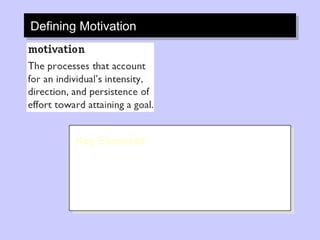
Defining Motivation Key Elements Intensity: how hard a person tries Direction: toward beneficial goal Persistence: how long a person tries
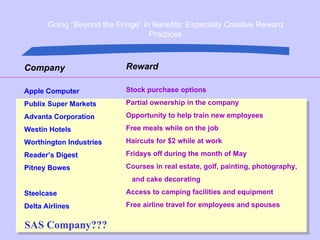
Going “Beyond the Fringe” in Benefits: Especially Creative Reward Practices Company Apple Computer Publix Super Markets Advanta Corporation Westin Hotels Worthington Industries Reader’s Digest Pitney Bowes Steelcase Delta Airlines Reward Stock purchase options Partial ownership in the company Opportunity to help train new employees Free meals while on the job Haircuts for $2 while at work Fridays off during the month of May Courses in real estate, golf, painting, photography, and cake decorating Access to camping facilities and equipment Free airline travel for employees and spouses SAS Company???
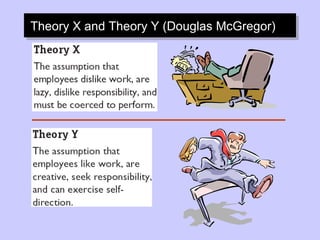
Theory X and Theory Y (Douglas McGregor)
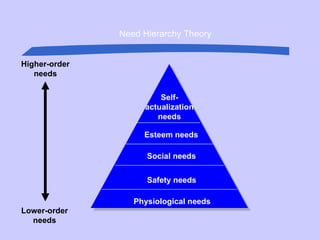
Need Hierarchy Theory Physiological needs Safety needs Social needs Esteem needs Self- actualization needs Lower-order needs Higher-order needs
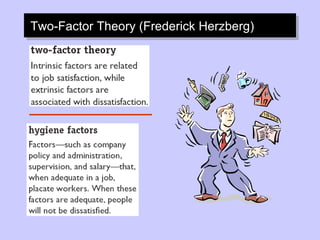
Two-Factor Theory (Frederick Herzberg)
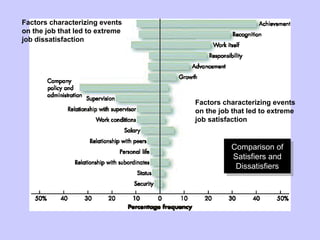
Comparison of Satisfiers and Dissatisfiers Factors characterizing events on the job that led to extreme job dissatisfaction Factors characterizing events on the job that led to extreme job satisfaction
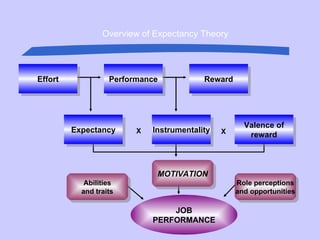
Overview of Expectancy Theory Effort Expectancy Instrumentality Valence of reward Performance Reward MOTIVATION Role perceptions and opportunities Abilities and traits JOB PERFORMANCE X X
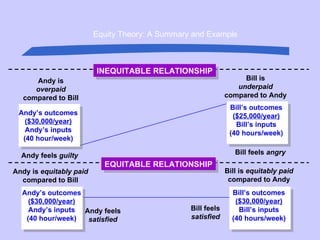
Equity Theory: A Summary and Example INEQUITABLE RELATIONSHIP Andy is overpaid compared to Bill Bill is underpaid compared to Andy Bill’s outcomes ($25,000/year) Bill’s inputs (40 hours/week) Andy’s outcomes ($30,000/year) Andy’s inputs (40 hour/week) Andy feels  guilty Bill feels  angry EQUITABLE RELATIONSHIP Andy’s outcomes ($30,000/year) Andy’s inputs (40 hour/week) Andy is  equitably paid compared to Bill Bill’s outcomes ($30,000/year) Bill’s inputs (40 hours/week) Bill is  equitably paid compared to Andy Bill feels satisfied Andy feels satisfied
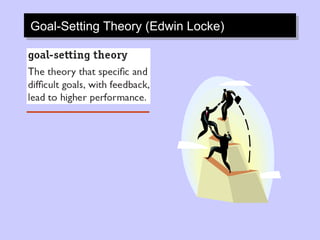
Goal-Setting Theory (Edwin Locke)
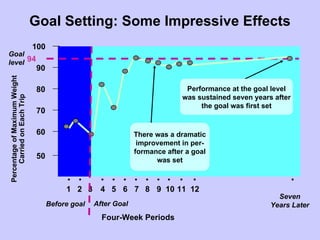
Goal Setting: Some Impressive Effects Percentage of Maximum Weight Carried on Each Trip Before goal After Goal Four-Week Periods 50 60 70 80 90 100 1 2 4 5 6 7 8 9 10 11 12 Seven Years Later 94 There was a dramatic improvement in per- formance after a goal was set Performance at the goal level was sustained seven years after the goal was first set Goal level 3
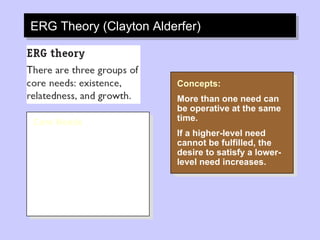
ERG Theory (Clayton Alderfer) Core Needs Existence: provision of basic material requirements.  Relatedness: desire for relationships. Growth: desire for personal development. Concepts: More than one need can be operative at the same time. If a higher-level need cannot be fulfilled, the desire to satisfy a lower-level need increases.
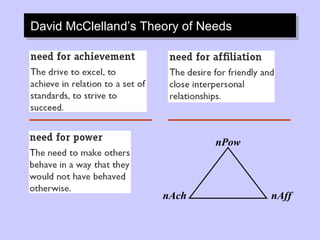
David McClelland’s Theory of Needs nAch nPow nAff
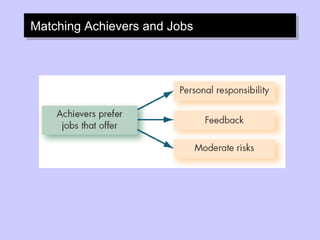
Matching Achievers and Jobs
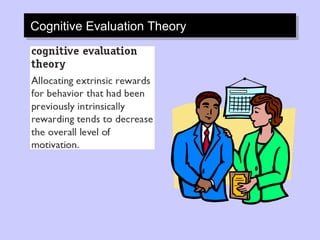
Cognitive Evaluation Theory
Reinforcement Theory Concepts: Behavior is environmentally caused. Behavior can be modified (reinforced) by providing (controlling) consequences. Reinforced behavior tends to be repeated.
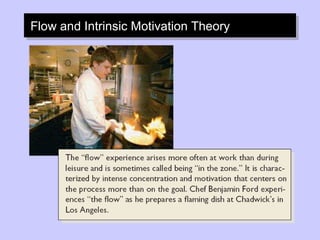
Flow and Intrinsic Motivation Theory
Ken Thomas’s Model of Intrinsic Motivation Employees are intrinsically motivated when rewards an employee gets from work result from: Choice – the ability to freely self-select and perform task activities. Competence – the sense of accomplishment from skillfully performing chosen tasks or activities. Meaningfulness – pursuing a task that matters in the larger scheme of things. Progress – the feeling of significant advancement in achieving the task’s purpose.
Equity Theory Referent Comparisons: Self-inside Self-outside Other-inside Other-outside
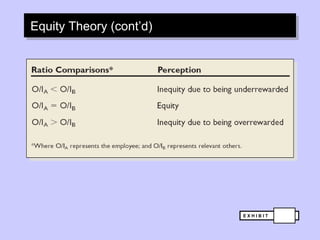
Equity Theory (cont’d) E X H I B I T 6-7
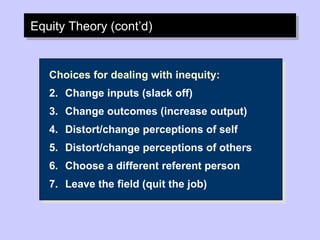
Equity Theory (cont’d) Choices for dealing with inequity: Change inputs (slack off) Change outcomes (increase output) Distort/change perceptions of self Distort/change perceptions of others Choose a different referent person Leave the field (quit the job)
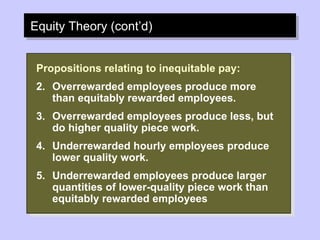
Equity Theory (cont’d) Propositions relating to inequitable pay: Overrewarded employees produce more than equitably rewarded employees. Overrewarded employees produce less, but do higher quality piece work. Underrewarded hourly employees produce lower quality work. Underrewarded employees produce larger quantities of lower-quality piece work than equitably rewarded employees
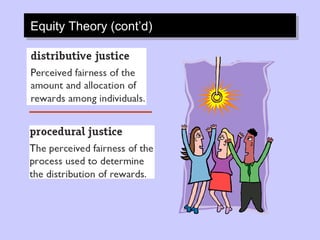
Equity Theory (cont’d)
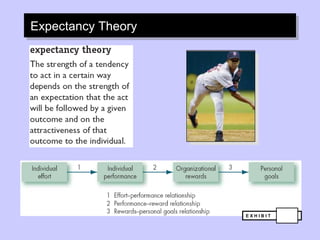
Expectancy Theory E X H I B I T 6-8
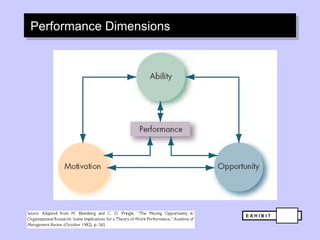
Performance Dimensions E X H I B I T 6-9
Integrating Contemporary Theories of Motivation E X H I B I T

  • 1.
  • 2.
    After studying chaptersix and listening to my lecture, you should be able to: Outline the motivation process. Describe Maslow’s need hierarchy. Contrast Theory X and Theory Y. Differentiate motivators from hygiene factors. List the characteristics that high achievers prefer in a job. Summarize the types of goals that increase performance. L E A R N I N G O B J E C T I V E S
  • 3.
    Defining Motivation KeyElements Intensity: how hard a person tries Direction: toward beneficial goal Persistence: how long a person tries
  • 4.
    Going “Beyond theFringe” in Benefits: Especially Creative Reward Practices Company Apple Computer Publix Super Markets Advanta Corporation Westin Hotels Worthington Industries Reader’s Digest Pitney Bowes Steelcase Delta Airlines Reward Stock purchase options Partial ownership in the company Opportunity to help train new employees Free meals while on the job Haircuts for $2 while at work Fridays off during the month of May Courses in real estate, golf, painting, photography, and cake decorating Access to camping facilities and equipment Free airline travel for employees and spouses SAS Company???
  • 5.
    Theory X andTheory Y (Douglas McGregor)
  • 6.
    Need Hierarchy TheoryPhysiological needs Safety needs Social needs Esteem needs Self- actualization needs Lower-order needs Higher-order needs
  • 7.
  • 8.
    Comparison of Satisfiersand Dissatisfiers Factors characterizing events on the job that led to extreme job dissatisfaction Factors characterizing events on the job that led to extreme job satisfaction
  • 9.
    Overview of ExpectancyTheory Effort Expectancy Instrumentality Valence of reward Performance Reward MOTIVATION Role perceptions and opportunities Abilities and traits JOB PERFORMANCE X X
  • 10.
    Equity Theory: ASummary and Example INEQUITABLE RELATIONSHIP Andy is overpaid compared to Bill Bill is underpaid compared to Andy Bill’s outcomes ($25,000/year) Bill’s inputs (40 hours/week) Andy’s outcomes ($30,000/year) Andy’s inputs (40 hour/week) Andy feels guilty Bill feels angry EQUITABLE RELATIONSHIP Andy’s outcomes ($30,000/year) Andy’s inputs (40 hour/week) Andy is equitably paid compared to Bill Bill’s outcomes ($30,000/year) Bill’s inputs (40 hours/week) Bill is equitably paid compared to Andy Bill feels satisfied Andy feels satisfied
  • 11.
  • 12.
    Goal Setting: SomeImpressive Effects Percentage of Maximum Weight Carried on Each Trip Before goal After Goal Four-Week Periods 50 60 70 80 90 100 1 2 4 5 6 7 8 9 10 11 12 Seven Years Later 94 There was a dramatic improvement in per- formance after a goal was set Performance at the goal level was sustained seven years after the goal was first set Goal level 3
  • 13.
    ERG Theory (ClaytonAlderfer) Core Needs Existence: provision of basic material requirements. Relatedness: desire for relationships. Growth: desire for personal development. Concepts: More than one need can be operative at the same time. If a higher-level need cannot be fulfilled, the desire to satisfy a lower-level need increases.
  • 14.
    David McClelland’s Theoryof Needs nAch nPow nAff
  • 15.
  • 16.
  • 17.
    Reinforcement Theory Concepts:Behavior is environmentally caused. Behavior can be modified (reinforced) by providing (controlling) consequences. Reinforced behavior tends to be repeated.
  • 18.
    Flow and IntrinsicMotivation Theory
  • 19.
    Ken Thomas’s Modelof Intrinsic Motivation Employees are intrinsically motivated when rewards an employee gets from work result from: Choice – the ability to freely self-select and perform task activities. Competence – the sense of accomplishment from skillfully performing chosen tasks or activities. Meaningfulness – pursuing a task that matters in the larger scheme of things. Progress – the feeling of significant advancement in achieving the task’s purpose.
  • 20.
    Equity Theory ReferentComparisons: Self-inside Self-outside Other-inside Other-outside
  • 21.
    Equity Theory (cont’d)E X H I B I T 6-7
  • 22.
    Equity Theory (cont’d)Choices for dealing with inequity: Change inputs (slack off) Change outcomes (increase output) Distort/change perceptions of self Distort/change perceptions of others Choose a different referent person Leave the field (quit the job)
  • 23.
    Equity Theory (cont’d)Propositions relating to inequitable pay: Overrewarded employees produce more than equitably rewarded employees. Overrewarded employees produce less, but do higher quality piece work. Underrewarded hourly employees produce lower quality work. Underrewarded employees produce larger quantities of lower-quality piece work than equitably rewarded employees
  • 24.
  • 25.
    Expectancy Theory EX H I B I T 6-8
  • 26.
    Performance Dimensions EX H I B I T 6-9
  • 27.
    Integrating Contemporary Theoriesof Motivation E X H I B I T

Editor's Notes