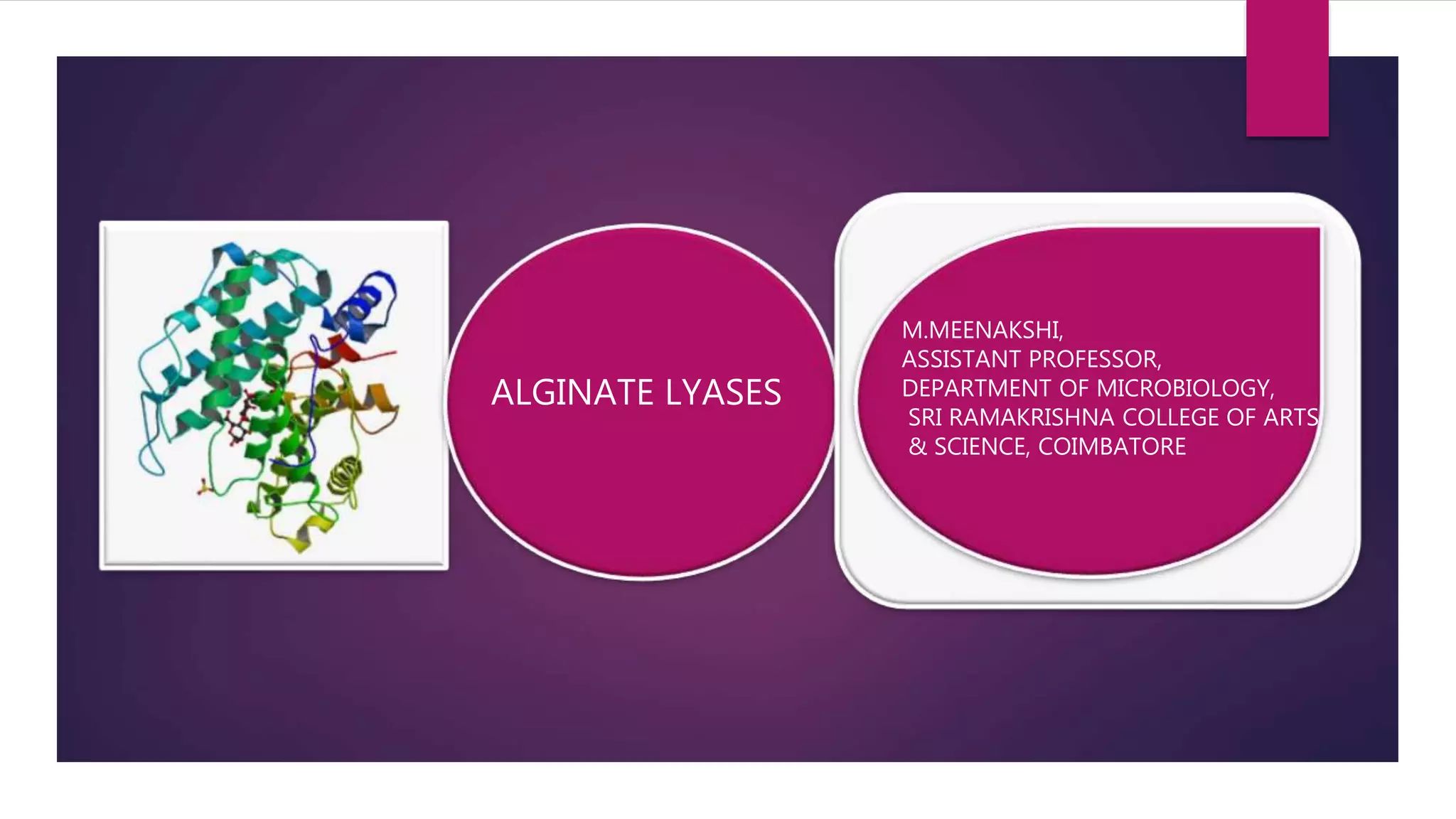
ALGINATE LYASES
M.MEENAKSHI,
ASSISTANT PROFESSOR,
DEPARTMENT OF MICROBIOLOGY,
SRI RAMAKRISHNA COLLEGE OF ARTS
& SCIENCE, COIMBATORE
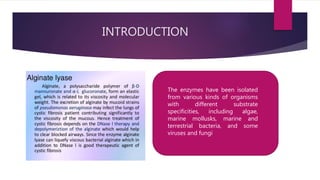
INTRODUCTION
The enzymes have been isolated
from various kinds of organisms
with different substrate
specificities, including algae,
marine mollusks, marine and
terrestrial bacteria, and some
viruses and fungi
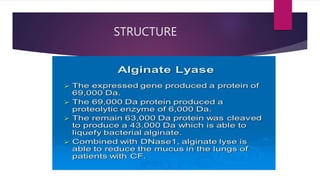
STRUCTURE
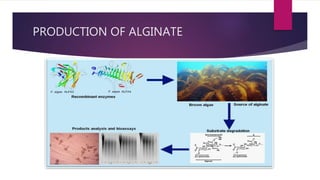
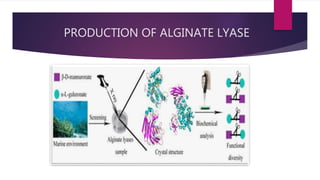
PRODUCTION OF ALGINATE
PRODUCTION OF ALGINATE LYASE
FERMENTATION PROCESS
 A high-density-cell fermentation process for production of an exracellular alginate
lyase from Klebseilla pneumoniae on a defined medium has been developed.
 The process employs a strategy using two carbon sources.
 One low-molecular-mass, low-viscosity carbon source (sucrose) with high water
solubililty is used as the main carbons source for growth, while the high-
molecular-mass and viscous alginate in low concentration is used as an inducer for
enzyme synthesis.
 The repression of alginate lyase production by sucrose and the growth inhibition
that we observed at increased levels of ammonia were circumvented by a
computer-assisted fed-batch addition of the carbon sources (succrose and
alginate) and by supplying nitrogen source as ammonia in the pH control.
FERMENTATION PROCESS……
 No enzyme production was observed when dissolved oxygen limited growth at an
oxygen uptake rate of 40%–50% of the maximum uptake rate.
 An optimal composition of the feeding solution (12.5 g alginate and 587.5 g sucrose
1−1) was found both for the maximum final concentration of enzyme (1330 U 1−1)
and for the maximum volumetric rate of enzyme production (67 U 1−1 h−1).
 The enzyme production depends of the growth rate in the linear growth phase,
giving a maximum enzyme concentration at the highest growth rate tested.
 The final enzyme concentration shows a fivefold increase compare with previously
reported data where alginate was used as a carbon source.
 In addition, the ratio of alginate lyase by a factor of apporximately 15. A doubling in
extracellular specific activity of the enzyme was observed, a property of significant
interest, especially for purification of the enzyme.
 On the other hand, the final dry cell weight concentration of the bacteria also
increased by a factor of 15–20 thus giving a relatively lower specific productivity of
0.4 U (g cell dry weight)−1 h−1.
ALGINATE LYASES
 Alginate lyases are group of enzymes which catalyze depolymerization
of alginate into oligosaccharides. Alginate lyase have been widely used in many
applications such as in production of bioactive oligosaccharides, control of
polysaccharide rheological properties, and polysaccharide structure analysis.
 This enzyme belongs to the family of lyases, specifically those carbon-oxygen
lyases acting on polysaccharides. The systematic name of this enzyme class
is poly(beta-D-1,4-mannuronide) lyase. Other names in common use
include alginate lyase I, alginate lyase, alginase I, alginase II, and alginase. This
enzyme participates in fructose and mannose metabolism.
SOURCE AND CLASSIFICATION
 Alginate lyases have been isolated from various sources, including marine algae,
marine mollusks (Littorina spp., Haliotis spp, Turbo cornutus.), and a wide range of
marine and terrestrial bacteria. In addition, some lyases have been isolated from
fungi and viruses .
 The alginate lyases can be classified into 2 groups due to their substrate
specificities, one is G block-specific lyase (polyG lyase, EC4.2.2.11), and the other is
M block-specific lyase (polyM lyase, EC4.2.2.3).
 This classification has been widely accepted, but some enzymes show activities
toward both polyM and polyG,30-33 which may degrade alginate more effectively.
In terms of the mode of action, alginate lyase can be grouped into endolytic and
exolytic alginate lyase
SOURCE AND CLASSIFICATION
 In terms of the mode of action, alginate lyase can be grouped into endolytic and
exolytic alginate lyase.
 Endolytic alginate lyase cleaves glycosidic bonds inside alginate polymer and
releases unsaturated oligosaccharides (di-, tri-, and tetra-saccharides) as main
products, while exolytic alginate lyase can further degrade oligosaccharides into
monomers.
 Based on the analysis of hydrophobic cluster of primary structures, alginate lyases
can be grouped into 7 families of Polysaccharide Lyase (PL) family (Table 2), PL-5,
-6, -7, -14,-15, -17, and -18.
SOURCE AND CLASSIFICATION
 Most of endolytic bacterial alginate lyases are assigned to PL-5 and PL-7. The
most exolytic alginate lyases are grouped into PL-15 and PL-17 families.
 Most alginate lyases from bacteria are assigned into PL-5, -7, -15, and -17 families.
The lyases isolated from marine mollusks and viruses are collected in PL-14 family.
 The bifunctional alginate lyases belong to PL-18 family, while other lyases are
dispersed in other 6 families.
 The alginate lyases can also be grouped into 3 types based on their molecular
masses: small (25–30 kDa), mediu655m-sized (around 40 kDa), and large lyases
(>60 kDa).
USES
 Pseudomonas aeruginosa (P. aeruginosa) infections lead to a high mortality rate for
cystic fibrosis or immunocompromised patients.
 The alginate of the biofilm was believed to be the key factor disabling immune therapy
and antibiotic treatments.
 A silver nanocomposite consisting of silver nanoparticles and a mesoporous
organosilica layer was created to deliver two pharmaceutical compounds (alginate
lyase and ceftazidime) to degrade the alginate and eradicate P. aeruginosa from the
lungs.
 The introduction of thioether-bridged mesoporous organosilica into the
nanocomposites greatly benefited the conjunction of foreign functional molecules
such as alginate lyase and increased their hemocompatibility and drug-loading
capacity.
USES….
 Silver nanocomposites with a uniform diameter (∼39 nm) exhibited a high dispersity, good
biocompatibility, and high ceftazidime-loading capacity (380.96 mg/g).
 Notably, the silver nanocomposites displayed a low pH-dependent drug release and degradation
profiles (pH 6.4), guaranteeing the targeted release of the drugs in the acidic niches of the P.
aeruginosa biofilm.
 Indeed, particles loaded with alginate lyase and ceftazidime exhibited high inhibitory and
degradation effects on the biofilm of P. aeruginosa PAO1 based on the specific catalytic activity of
the enzyme to the alginate and antibacterial function of their loaded ceftazidime and silver ions.
 It should be noted that the enzyme-decorated nanocomposites succeeded in eradicating P.
aeruginosa PAO1 from the mouse lungs and decreasing the lung injuries.
 No deaths or serious side effects were observed during the experiments.
 We believe that the silver nanocomposites with high biocompatibility and organic group-
incorporated framework have the potential to be used to deliver multiple functional molecules for
antibacterial therapy in clinical application.
USES
 Alginate is mainly used as a food additive to modify food texture due to its high
viscosity and gelling property. Alginate lyase can degrade alginate by cleaving the
glycosidic bond through a β-elimination reaction, generating oligomer with 4-
deoxy-L-erythro-hex-4-enepyranosyluronate at the nonreducing end.
 Alginate oligosaccharides have been shown to stimulate the growth of human
endothelial cells and the secretion of cytotoxic cytokines from human
macrophage.
 Alginate can be converted into unsaturated monosaccharide by saccharification
process using endolytic and exolytic alginate lyases, thus alginate lyases have
potential as key biocatalyst for application of alginate as a renewable source for
biochemicals and biofuels in near future.
REFERENCES
 Aasen IM, Folkvord K, Levine DW (1992) Develpment of a process for large-scale
chromatography purification of an alginate from Klebsiella pneumoniae. Appl
Microbiol Biotechnol 37:163–171
 Boyd J, Turvey JR (1977) Isolation of a poly-α-L-guluronate lyase from Klebsiella
aerogenes. Carbohyr Res 57:163–171
 Bod J, Turvey JR (1978) Structural studies of alginic acid, using a bacterial poly-α-L-
guluronate lyase. Carbohydr Res 66:187–194
 Boyen C, Bertheau Y, Barbeyron T, Kloareg B (1990a) Preparation of guluronate lyase
from Pseudomonas alginovora for protoplast isolation in Laminaria. Enzyme Micrbo
Technol 12:885–890

Alginate lyases

  • 1.
    ALGINATE LYASES M.MEENAKSHI, ASSISTANT PROFESSOR, DEPARTMENTOF MICROBIOLOGY, SRI RAMAKRISHNA COLLEGE OF ARTS & SCIENCE, COIMBATORE
  • 2.
    INTRODUCTION The enzymes havebeen isolated from various kinds of organisms with different substrate specificities, including algae, marine mollusks, marine and terrestrial bacteria, and some viruses and fungi
  • 3.
  • 4.
  • 5.
  • 6.
    FERMENTATION PROCESS  Ahigh-density-cell fermentation process for production of an exracellular alginate lyase from Klebseilla pneumoniae on a defined medium has been developed.  The process employs a strategy using two carbon sources.  One low-molecular-mass, low-viscosity carbon source (sucrose) with high water solubililty is used as the main carbons source for growth, while the high- molecular-mass and viscous alginate in low concentration is used as an inducer for enzyme synthesis.  The repression of alginate lyase production by sucrose and the growth inhibition that we observed at increased levels of ammonia were circumvented by a computer-assisted fed-batch addition of the carbon sources (succrose and alginate) and by supplying nitrogen source as ammonia in the pH control.
  • 7.
    FERMENTATION PROCESS……  Noenzyme production was observed when dissolved oxygen limited growth at an oxygen uptake rate of 40%–50% of the maximum uptake rate.  An optimal composition of the feeding solution (12.5 g alginate and 587.5 g sucrose 1−1) was found both for the maximum final concentration of enzyme (1330 U 1−1) and for the maximum volumetric rate of enzyme production (67 U 1−1 h−1).  The enzyme production depends of the growth rate in the linear growth phase, giving a maximum enzyme concentration at the highest growth rate tested.  The final enzyme concentration shows a fivefold increase compare with previously reported data where alginate was used as a carbon source.  In addition, the ratio of alginate lyase by a factor of apporximately 15. A doubling in extracellular specific activity of the enzyme was observed, a property of significant interest, especially for purification of the enzyme.  On the other hand, the final dry cell weight concentration of the bacteria also increased by a factor of 15–20 thus giving a relatively lower specific productivity of 0.4 U (g cell dry weight)−1 h−1.
  • 8.
    ALGINATE LYASES  Alginatelyases are group of enzymes which catalyze depolymerization of alginate into oligosaccharides. Alginate lyase have been widely used in many applications such as in production of bioactive oligosaccharides, control of polysaccharide rheological properties, and polysaccharide structure analysis.  This enzyme belongs to the family of lyases, specifically those carbon-oxygen lyases acting on polysaccharides. The systematic name of this enzyme class is poly(beta-D-1,4-mannuronide) lyase. Other names in common use include alginate lyase I, alginate lyase, alginase I, alginase II, and alginase. This enzyme participates in fructose and mannose metabolism.
  • 9.
    SOURCE AND CLASSIFICATION Alginate lyases have been isolated from various sources, including marine algae, marine mollusks (Littorina spp., Haliotis spp, Turbo cornutus.), and a wide range of marine and terrestrial bacteria. In addition, some lyases have been isolated from fungi and viruses .  The alginate lyases can be classified into 2 groups due to their substrate specificities, one is G block-specific lyase (polyG lyase, EC4.2.2.11), and the other is M block-specific lyase (polyM lyase, EC4.2.2.3).  This classification has been widely accepted, but some enzymes show activities toward both polyM and polyG,30-33 which may degrade alginate more effectively. In terms of the mode of action, alginate lyase can be grouped into endolytic and exolytic alginate lyase
  • 10.
    SOURCE AND CLASSIFICATION In terms of the mode of action, alginate lyase can be grouped into endolytic and exolytic alginate lyase.  Endolytic alginate lyase cleaves glycosidic bonds inside alginate polymer and releases unsaturated oligosaccharides (di-, tri-, and tetra-saccharides) as main products, while exolytic alginate lyase can further degrade oligosaccharides into monomers.  Based on the analysis of hydrophobic cluster of primary structures, alginate lyases can be grouped into 7 families of Polysaccharide Lyase (PL) family (Table 2), PL-5, -6, -7, -14,-15, -17, and -18.
  • 11.
    SOURCE AND CLASSIFICATION Most of endolytic bacterial alginate lyases are assigned to PL-5 and PL-7. The most exolytic alginate lyases are grouped into PL-15 and PL-17 families.  Most alginate lyases from bacteria are assigned into PL-5, -7, -15, and -17 families. The lyases isolated from marine mollusks and viruses are collected in PL-14 family.  The bifunctional alginate lyases belong to PL-18 family, while other lyases are dispersed in other 6 families.  The alginate lyases can also be grouped into 3 types based on their molecular masses: small (25–30 kDa), mediu655m-sized (around 40 kDa), and large lyases (>60 kDa).
  • 12.
    USES  Pseudomonas aeruginosa(P. aeruginosa) infections lead to a high mortality rate for cystic fibrosis or immunocompromised patients.  The alginate of the biofilm was believed to be the key factor disabling immune therapy and antibiotic treatments.  A silver nanocomposite consisting of silver nanoparticles and a mesoporous organosilica layer was created to deliver two pharmaceutical compounds (alginate lyase and ceftazidime) to degrade the alginate and eradicate P. aeruginosa from the lungs.  The introduction of thioether-bridged mesoporous organosilica into the nanocomposites greatly benefited the conjunction of foreign functional molecules such as alginate lyase and increased their hemocompatibility and drug-loading capacity.
  • 13.
    USES….  Silver nanocompositeswith a uniform diameter (∼39 nm) exhibited a high dispersity, good biocompatibility, and high ceftazidime-loading capacity (380.96 mg/g).  Notably, the silver nanocomposites displayed a low pH-dependent drug release and degradation profiles (pH 6.4), guaranteeing the targeted release of the drugs in the acidic niches of the P. aeruginosa biofilm.  Indeed, particles loaded with alginate lyase and ceftazidime exhibited high inhibitory and degradation effects on the biofilm of P. aeruginosa PAO1 based on the specific catalytic activity of the enzyme to the alginate and antibacterial function of their loaded ceftazidime and silver ions.  It should be noted that the enzyme-decorated nanocomposites succeeded in eradicating P. aeruginosa PAO1 from the mouse lungs and decreasing the lung injuries.  No deaths or serious side effects were observed during the experiments.  We believe that the silver nanocomposites with high biocompatibility and organic group- incorporated framework have the potential to be used to deliver multiple functional molecules for antibacterial therapy in clinical application.
  • 14.
    USES  Alginate ismainly used as a food additive to modify food texture due to its high viscosity and gelling property. Alginate lyase can degrade alginate by cleaving the glycosidic bond through a β-elimination reaction, generating oligomer with 4- deoxy-L-erythro-hex-4-enepyranosyluronate at the nonreducing end.  Alginate oligosaccharides have been shown to stimulate the growth of human endothelial cells and the secretion of cytotoxic cytokines from human macrophage.  Alginate can be converted into unsaturated monosaccharide by saccharification process using endolytic and exolytic alginate lyases, thus alginate lyases have potential as key biocatalyst for application of alginate as a renewable source for biochemicals and biofuels in near future.
  • 15.
    REFERENCES  Aasen IM,Folkvord K, Levine DW (1992) Develpment of a process for large-scale chromatography purification of an alginate from Klebsiella pneumoniae. Appl Microbiol Biotechnol 37:163–171  Boyd J, Turvey JR (1977) Isolation of a poly-α-L-guluronate lyase from Klebsiella aerogenes. Carbohyr Res 57:163–171  Bod J, Turvey JR (1978) Structural studies of alginic acid, using a bacterial poly-α-L- guluronate lyase. Carbohydr Res 66:187–194  Boyen C, Bertheau Y, Barbeyron T, Kloareg B (1990a) Preparation of guluronate lyase from Pseudomonas alginovora for protoplast isolation in Laminaria. Enzyme Micrbo Technol 12:885–890