@AnnStanley
SEO tips and tools for
local businesses
By Ann Stanley
Managing Director of Anicca Digital
@AnnStanley
Contents
1. The digital marketing landscape
2. Maximising your visibility in the local Google search
results
3. Understanding Search Engine Optimisation (SEO) -
a beginners' guide
4. Recent changes to the Google algorithm and how
to avoid getting a Google penalty
5. Essential tools and techniques to help you carry out
your own SEO
@AnnStanley
1: The Digital Marketing
Landscape
@AnnStanley
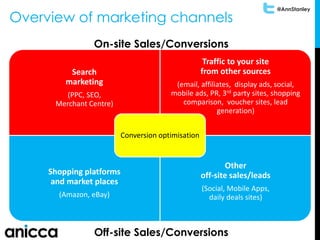
Overview of marketing channels
Search
marketing
(PPC, SEO,
Merchant Centre)
Traffic to your site
from other sources
(email, affiliates, display ads, social,
mobile ads, PR, 3rd party sites, shopping
comparison, voucher sites, lead
generation)
Shopping platforms
and market places
(Amazon, eBay)
Other
off-site sales/leads
(Social, Mobile Apps,
daily deals sites)
Conversion optimisation
On-site Sales/Conversions
Off-site Sales/Conversions
@AnnStanley
Digital advertising in the UK – 2014 full
year results
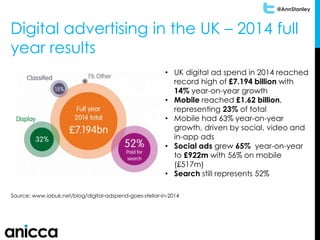
• UK digital ad spend in 2014 reached
record high of £7.194 billion with
14% year-on-year growth
• Mobile reached £1.62 billion,
representing 23% of total
• Mobile had 63% year-on-year
growth, driven by social, video and
in-app ads
• Social ads grew 65% year-on-year
to £922m with 56% on mobile
(£517m)
• Search still represents 52%
Source: www.iabuk.net/blog/digital-adspend-goes-stellar-in-2014
@AnnStanley
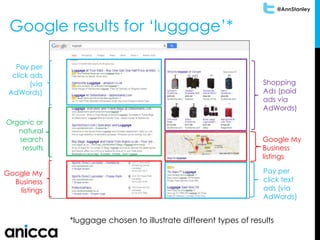
Google results for ‘luggage’*
Pay per
click ads
(via
AdWords)
Pay per
click text
ads (via
AdWords)
Organic or
natural
search
results
Shopping
Ads (paid
ads via
AdWords)
Google My
Business
listings
*luggage chosen to illustrate different types of results
Google My
Business
listings
@AnnStanley
How to get into the Google results - free
• Organic or natural listings – search engine
optimisation of your website i.e. SEO
• Map – create a free Google My Business Listing –
which is part of Google+
• Images and videos – make sure these have
keyphrases in the file names and tags
• News, blogs and author results – create ongoing
blog content on your site or via news feed sites (PR)
@AnnStanley
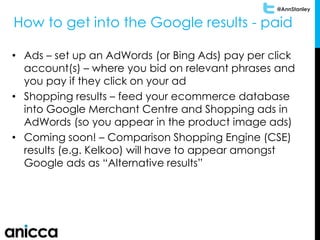
• Ads – set up an AdWords (or Bing Ads) pay per click
account(s) – where you bid on relevant phrases and
you pay if they click on your ad
• Shopping results – feed your ecommerce database
into Google Merchant Centre and Shopping ads in
AdWords (so you appear in the product image ads)
• Coming soon! – Comparison Shopping Engine (CSE)
results (e.g. Kelkoo) will have to appear amongst
Google ads as “Alternative results”
How to get into the Google results - paid
@AnnStanley
2: Maximising your visibility in the
local Google search results
@AnnStanley
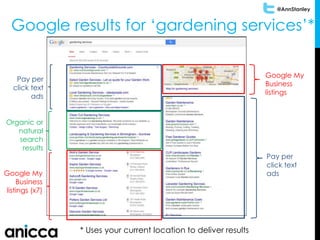
Google results for ‘gardening services’*
Pay per
click text
ads
Pay per
click text
ads
Organic or
natural
search
results
Google My
Business
listings
Google My
Business
listings (x7)
* Uses your current location to deliver results
@AnnStanley
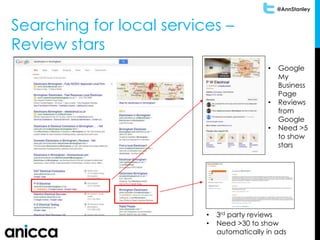
Searching for local services –
Review stars
• Google
My
Business
Page
• Reviews
from
Google
• Need >5
to show
stars
• 3rd party reviews
• Need >30 to show
automatically in ads
@AnnStanley
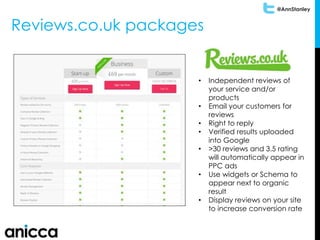
Reviews.co.uk packages
• Independent reviews of
your service and/or
products
• Email your customers for
reviews
• Right to reply
• Verified results uploaded
into Google
• >30 reviews and 3.5 rating
will automatically appear in
PPC ads
• Use widgets or Schema to
appear next to organic
result
• Display reviews on your site
to increase conversion rate
@AnnStanley
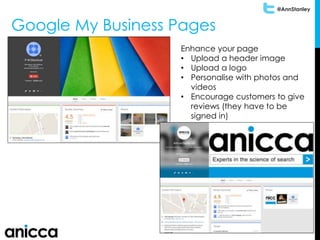
Google My Business Pages
Enhance your page
• Upload a header image
• Upload a logo
• Personalise with photos and
videos
• Encourage customers to give
reviews (they have to be
signed in)
@AnnStanley
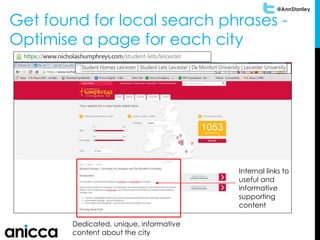
Get found for local search phrases -
Optimise a page for each city
Dedicated, unique, informative
content about the city
Internal links to
useful and
informative
supporting
content
@AnnStanley
• Pay (AdWords)
– Use local PPC ads, where you opt to only show your ads in your
selected area
– Include your phone number and address in your ads (using ad
extensions). This will also give you “click-to-call” on mobiles
– Use independent reviews, so your stars show up in your ads (you
need >30 reviews with >3.5 rating)
• Google My Business Pages
– Appear in the map and 7 local results by creating a strong Google
My Business page (via Google+)
– You will need a minimum of 5 Google reviews for your stars to show
• Main organic results
– Get found in the local organic results for local search phrases by
creating and optimising a page for each city or town (SEO)
How to get in the local search results
@AnnStanley
3: Understanding Search Engine
Optimisation (SEO) – a beginners guide
@AnnStanley
What is SEO?
SEO stands for “search engine optimisation.”
It is the process of getting higher rankings and
more traffic from the “free”, “organic”,
“editorial” or “natural” listings on search engines
@AnnStanley
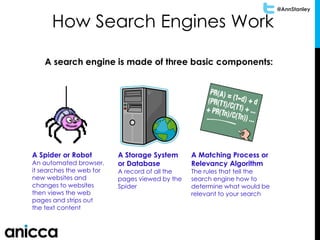
A search engine is made of three basic components:
A Spider or Robot
An automated browser,
it searches the web for
new websites and
changes to websites
then views the web
pages and strips out
the text content
A Storage System
or Database
A record of all the
pages viewed by the
Spider
A Matching Process or
Relevancy Algorithm
The rules that tell the
search engine how to
determine what would be
relevant to your search
How Search Engines Work
@AnnStanley
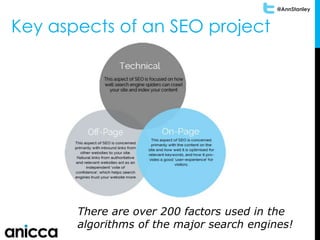
Key aspects of an SEO project
There are over 200 factors used in the
algorithms of the major search engines!
@AnnStanley
Technical SEO
This aspect of SEO is focused on how well search engine
spiders can crawl your site and index your content
@AnnStanley
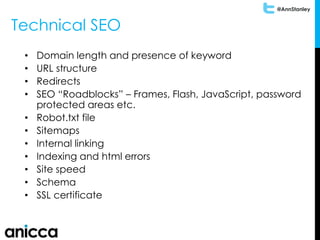
Technical SEO
• Domain length and presence of keyword
• URL structure
• Redirects
• SEO “Roadblocks” – Frames, Flash, JavaScript, password
protected areas etc.
• Robot.txt file
• Sitemaps
• Internal linking
• Indexing and html errors
• Site speed
• Schema
• SSL certificate
@AnnStanley
On-page optimisation
This aspect of SEO is concerned primarily with the
content on the site and how well it is optimised for
relevant keywords, and how it provides a good ‘user-
experience’ for visitors.
@AnnStanley
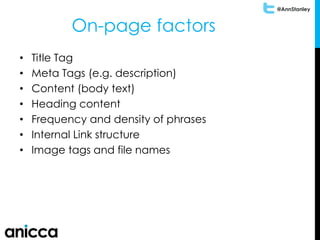
• Title Tag
• Meta Tags (e.g. description)
• Content (body text)
• Heading content
• Frequency and density of phrases
• Internal Link structure
• Image tags and file names
On-page factors
@AnnStanley
Off-page optimisation
This aspect of SEO is concerned primarily with inbound
links from other websites to your site. Natural links from
authoritative and relevant websites act as an
independent ‘vote of confidence’, which helps search
engines trust your website more
@AnnStanley
Off-site SEO (website authority)
• Link earning
– Quality of referring site
– Anchor text – mix of text, brand, domain name, service,
keyword (penalise if too many exact match keywords)
– Mix of follow and no-follow links
– Citation – mentions your company name but no link
• Social mentions – correlation or causation?
– Google+
– Authorship – images were recently removed and will only
show if your post is in Google+
– Facebook Shares
– Reviews
@AnnStanley
4: Google Algorithm Updates
Google regularly changes its search algorithm to ensure
only the most relevant and authoritative websites are
shown at the top of the search results.
The majority of algorithm updates target spammy
techniques and low quality sites.
@AnnStanley
Panda
When: February 2011
Target: Sites with low quality content
Impact: At its launch Panda affected up to 12% of
search results. Panda seemed to crack down on
thin content, content farms, sites with high ad-to-
content ratios, & a number of other quality issues
@AnnStanley
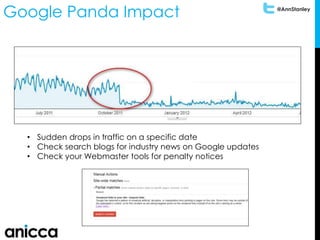
Google Panda Impact
• Sudden drops in traffic on a specific date
• Check search blogs for industry news on Google updates
• Check your Webmaster tools for penalty notices
@AnnStanley
Google Panda
Panda
4.0 & 4.1
When: September 2014
Target: Sites with low quality content.
More precise and will allow more high-quality
small and medium-sized sites to rank better
What Google said: “Based on user
(and webmaster!) feedback, we’ve been
able to discover a few more signals to
help Panda identify low-quality content
more precisely.”
@AnnStanley
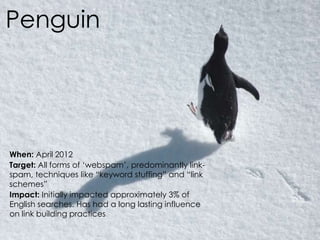
Penguin
When: April 2012
Target: All forms of ‘webspam’, predominantly link-
spam, techniques like “keyword stuffing” and “link
schemes”
Impact: Initially impacted approximately 3% of
English searches. Has had a long lasting influence
on link building practices
@AnnStanley
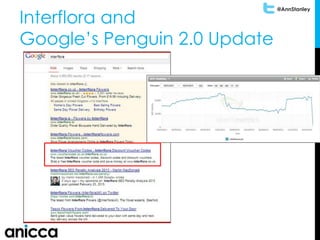
Interflora and
Google’s Penguin 2.0 Update
@AnnStanley
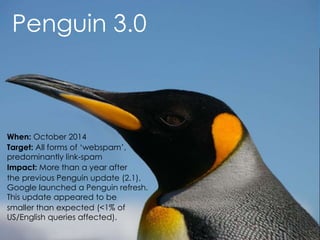
Penguin 3.0
When: October 2014
Target: All forms of ‘webspam’,
predominantly link-spam
Impact: More than a year after
the previous Penguin update (2.1),
Google launched a Penguin refresh.
This update appeared to be
smaller than expected (<1% of
US/English queries affected).
@AnnStanley
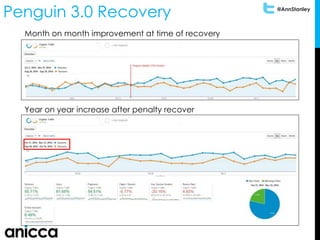
Penguin 3.0 Recovery
Month on month improvement at time of recovery
Year on year increase after penalty recover
@AnnStanley
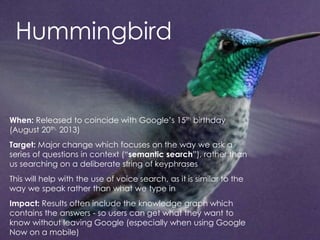
Hummingbird
When: Released to coincide with Google’s 15th birthday
(August 20th, 2013)
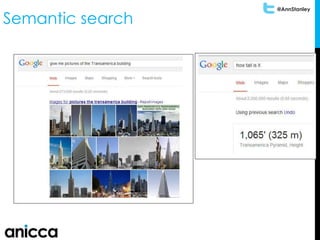
Target: Major change which focuses on the way we ask a
series of questions in context (“semantic search”), rather than
us searching on a deliberate string of keyphrases
This will help with the use of voice search, as it is similar to the
way we speak rather than what we type in
Impact: Results often include the knowledge graph which
contains the answers - so users can get what they want to
know without leaving Google (especially when using Google
Now on a mobile)
@AnnStanley
Semantic search
@AnnStanley
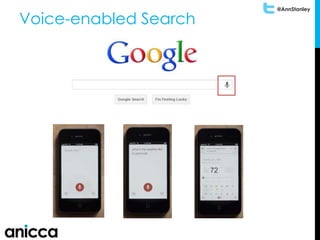
Voice-enabled Search
@AnnStanley
Other Google Changes
@AnnStanley
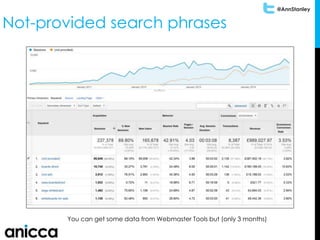
Not-provided search phrases
You can get some data from Webmaster Tools but (only 3 months)
@AnnStanley
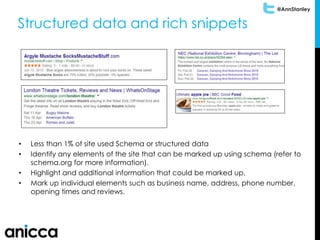
Structured data and rich snippets
• Less than 1% of site used Schema or structured data
• Identify any elements of the site that can be marked up using schema (refer to
schema.org for more information).
• Highlight and additional information that could be marked up.
• Mark up individual elements such as business name, address, phone number,
opening times and reviews.
@AnnStanley
HTTPS/SSL – secure websites –
ranking factor?
• August 6th 2014
• Google announced that they would be giving
preference to secure sites
• Adding encryption would provide a
"lightweight" rankings boost!
@AnnStanley
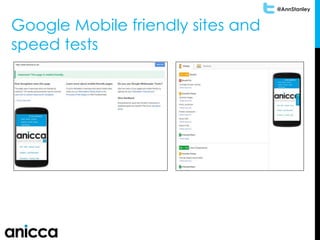
Google Mobile friendly sites and
speed tests
@AnnStanley
April 21st – Mobilegeddon!
• Each page on your site will be
classed as either mobile friendly or
not – and tested every time there is
a relevant search
• Results can be marked as “mobile
friendly” or you can run pages
through mobile test
• After April 21st “unfriendly” pages
will get lower rankings on mobile
search results
• Get your mobile load speed to <1
second or all ranking will suffer
• Mobile apps (Android) will achieve
better rankings in mobile search
result (and its worth linking your
app to the your mobile pages)
@AnnStanley
Exercise - get Google on your
phone and search for “sofa”
• What do you see?
@AnnStanley
5: Essential tools and techniques to
help you carry out your own SEO
@AnnStanley
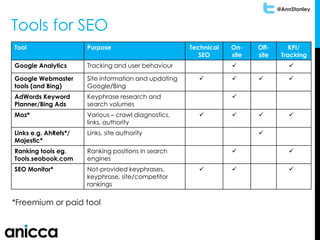
Tools for SEO
Tool Purpose Technical
SEO
On-
site
Off-
site
KPI/
Tracking
Google Analytics Tracking and user behaviour  
Google Webmaster
tools (and Bing)
Site information and updating
Google/Bing
   
AdWords Keyword
Planner/Bing Ads
Keyphrase research and
search volumes

Moz* Various – crawl diagnostics,
links, authority
   
Links e.g. AhRefs*/
Majestic*
Links, site authority 
Ranking tools eg.
Tools.seobook.com
Ranking positions in search
engines
 
SEO Monitor* Not-provided keyphrases,
keyphrase, site/competitor
rankings
  
*Freemium or paid tool

Seo tips and tools for local businesses

  • 1.
    @AnnStanley SEO tips andtools for local businesses By Ann Stanley Managing Director of Anicca Digital
  • 2.
    @AnnStanley Contents 1. The digitalmarketing landscape 2. Maximising your visibility in the local Google search results 3. Understanding Search Engine Optimisation (SEO) - a beginners' guide 4. Recent changes to the Google algorithm and how to avoid getting a Google penalty 5. Essential tools and techniques to help you carry out your own SEO
  • 3.
    @AnnStanley 1: The DigitalMarketing Landscape
  • 4.
    @AnnStanley Overview of marketingchannels Search marketing (PPC, SEO, Merchant Centre) Traffic to your site from other sources (email, affiliates, display ads, social, mobile ads, PR, 3rd party sites, shopping comparison, voucher sites, lead generation) Shopping platforms and market places (Amazon, eBay) Other off-site sales/leads (Social, Mobile Apps, daily deals sites) Conversion optimisation On-site Sales/Conversions Off-site Sales/Conversions
  • 5.
    @AnnStanley Digital advertising inthe UK – 2014 full year results • UK digital ad spend in 2014 reached record high of £7.194 billion with 14% year-on-year growth • Mobile reached £1.62 billion, representing 23% of total • Mobile had 63% year-on-year growth, driven by social, video and in-app ads • Social ads grew 65% year-on-year to £922m with 56% on mobile (£517m) • Search still represents 52% Source: www.iabuk.net/blog/digital-adspend-goes-stellar-in-2014
  • 6.
    @AnnStanley Google results for‘luggage’* Pay per click ads (via AdWords) Pay per click text ads (via AdWords) Organic or natural search results Shopping Ads (paid ads via AdWords) Google My Business listings *luggage chosen to illustrate different types of results Google My Business listings
  • 7.
    @AnnStanley How to getinto the Google results - free • Organic or natural listings – search engine optimisation of your website i.e. SEO • Map – create a free Google My Business Listing – which is part of Google+ • Images and videos – make sure these have keyphrases in the file names and tags • News, blogs and author results – create ongoing blog content on your site or via news feed sites (PR)
  • 8.
    @AnnStanley • Ads –set up an AdWords (or Bing Ads) pay per click account(s) – where you bid on relevant phrases and you pay if they click on your ad • Shopping results – feed your ecommerce database into Google Merchant Centre and Shopping ads in AdWords (so you appear in the product image ads) • Coming soon! – Comparison Shopping Engine (CSE) results (e.g. Kelkoo) will have to appear amongst Google ads as “Alternative results” How to get into the Google results - paid
  • 9.
    @AnnStanley 2: Maximising yourvisibility in the local Google search results
  • 10.
    @AnnStanley Google results for‘gardening services’* Pay per click text ads Pay per click text ads Organic or natural search results Google My Business listings Google My Business listings (x7) * Uses your current location to deliver results
  • 11.
    @AnnStanley Searching for localservices – Review stars • Google My Business Page • Reviews from Google • Need >5 to show stars • 3rd party reviews • Need >30 to show automatically in ads
  • 12.
    @AnnStanley Reviews.co.uk packages • Independentreviews of your service and/or products • Email your customers for reviews • Right to reply • Verified results uploaded into Google • >30 reviews and 3.5 rating will automatically appear in PPC ads • Use widgets or Schema to appear next to organic result • Display reviews on your site to increase conversion rate
  • 13.
    @AnnStanley Google My BusinessPages Enhance your page • Upload a header image • Upload a logo • Personalise with photos and videos • Encourage customers to give reviews (they have to be signed in)
  • 14.
    @AnnStanley Get found forlocal search phrases - Optimise a page for each city Dedicated, unique, informative content about the city Internal links to useful and informative supporting content
  • 15.
    @AnnStanley • Pay (AdWords) –Use local PPC ads, where you opt to only show your ads in your selected area – Include your phone number and address in your ads (using ad extensions). This will also give you “click-to-call” on mobiles – Use independent reviews, so your stars show up in your ads (you need >30 reviews with >3.5 rating) • Google My Business Pages – Appear in the map and 7 local results by creating a strong Google My Business page (via Google+) – You will need a minimum of 5 Google reviews for your stars to show • Main organic results – Get found in the local organic results for local search phrases by creating and optimising a page for each city or town (SEO) How to get in the local search results
  • 16.
    @AnnStanley 3: Understanding SearchEngine Optimisation (SEO) – a beginners guide
  • 17.
    @AnnStanley What is SEO? SEOstands for “search engine optimisation.” It is the process of getting higher rankings and more traffic from the “free”, “organic”, “editorial” or “natural” listings on search engines
  • 18.
    @AnnStanley A search engineis made of three basic components: A Spider or Robot An automated browser, it searches the web for new websites and changes to websites then views the web pages and strips out the text content A Storage System or Database A record of all the pages viewed by the Spider A Matching Process or Relevancy Algorithm The rules that tell the search engine how to determine what would be relevant to your search How Search Engines Work
  • 19.
    @AnnStanley Key aspects ofan SEO project There are over 200 factors used in the algorithms of the major search engines!
  • 20.
    @AnnStanley Technical SEO This aspectof SEO is focused on how well search engine spiders can crawl your site and index your content
  • 21.
    @AnnStanley Technical SEO • Domainlength and presence of keyword • URL structure • Redirects • SEO “Roadblocks” – Frames, Flash, JavaScript, password protected areas etc. • Robot.txt file • Sitemaps • Internal linking • Indexing and html errors • Site speed • Schema • SSL certificate
  • 22.
    @AnnStanley On-page optimisation This aspectof SEO is concerned primarily with the content on the site and how well it is optimised for relevant keywords, and how it provides a good ‘user- experience’ for visitors.
  • 23.
    @AnnStanley • Title Tag •Meta Tags (e.g. description) • Content (body text) • Heading content • Frequency and density of phrases • Internal Link structure • Image tags and file names On-page factors
  • 24.
    @AnnStanley Off-page optimisation This aspectof SEO is concerned primarily with inbound links from other websites to your site. Natural links from authoritative and relevant websites act as an independent ‘vote of confidence’, which helps search engines trust your website more
  • 25.
    @AnnStanley Off-site SEO (websiteauthority) • Link earning – Quality of referring site – Anchor text – mix of text, brand, domain name, service, keyword (penalise if too many exact match keywords) – Mix of follow and no-follow links – Citation – mentions your company name but no link • Social mentions – correlation or causation? – Google+ – Authorship – images were recently removed and will only show if your post is in Google+ – Facebook Shares – Reviews
  • 26.
    @AnnStanley 4: Google AlgorithmUpdates Google regularly changes its search algorithm to ensure only the most relevant and authoritative websites are shown at the top of the search results. The majority of algorithm updates target spammy techniques and low quality sites.
  • 27.
    @AnnStanley Panda When: February 2011 Target:Sites with low quality content Impact: At its launch Panda affected up to 12% of search results. Panda seemed to crack down on thin content, content farms, sites with high ad-to- content ratios, & a number of other quality issues
  • 28.
    @AnnStanley Google Panda Impact •Sudden drops in traffic on a specific date • Check search blogs for industry news on Google updates • Check your Webmaster tools for penalty notices
  • 29.
    @AnnStanley Google Panda Panda 4.0 &4.1 When: September 2014 Target: Sites with low quality content. More precise and will allow more high-quality small and medium-sized sites to rank better What Google said: “Based on user (and webmaster!) feedback, we’ve been able to discover a few more signals to help Panda identify low-quality content more precisely.”
  • 30.
    @AnnStanley Penguin When: April 2012 Target:All forms of ‘webspam’, predominantly link- spam, techniques like “keyword stuffing” and “link schemes” Impact: Initially impacted approximately 3% of English searches. Has had a long lasting influence on link building practices
  • 31.
  • 32.
    @AnnStanley Penguin 3.0 When: October2014 Target: All forms of ‘webspam’, predominantly link-spam Impact: More than a year after the previous Penguin update (2.1), Google launched a Penguin refresh. This update appeared to be smaller than expected (<1% of US/English queries affected).
  • 33.
    @AnnStanley Penguin 3.0 Recovery Monthon month improvement at time of recovery Year on year increase after penalty recover
  • 34.
    @AnnStanley Hummingbird When: Released tocoincide with Google’s 15th birthday (August 20th, 2013) Target: Major change which focuses on the way we ask a series of questions in context (“semantic search”), rather than us searching on a deliberate string of keyphrases This will help with the use of voice search, as it is similar to the way we speak rather than what we type in Impact: Results often include the knowledge graph which contains the answers - so users can get what they want to know without leaving Google (especially when using Google Now on a mobile)
  • 35.
  • 36.
  • 37.
  • 38.
    @AnnStanley Not-provided search phrases Youcan get some data from Webmaster Tools but (only 3 months)
  • 39.
    @AnnStanley Structured data andrich snippets • Less than 1% of site used Schema or structured data • Identify any elements of the site that can be marked up using schema (refer to schema.org for more information). • Highlight and additional information that could be marked up. • Mark up individual elements such as business name, address, phone number, opening times and reviews.
  • 40.
    @AnnStanley HTTPS/SSL – securewebsites – ranking factor? • August 6th 2014 • Google announced that they would be giving preference to secure sites • Adding encryption would provide a "lightweight" rankings boost!
  • 41.
  • 42.
    @AnnStanley April 21st –Mobilegeddon! • Each page on your site will be classed as either mobile friendly or not – and tested every time there is a relevant search • Results can be marked as “mobile friendly” or you can run pages through mobile test • After April 21st “unfriendly” pages will get lower rankings on mobile search results • Get your mobile load speed to <1 second or all ranking will suffer • Mobile apps (Android) will achieve better rankings in mobile search result (and its worth linking your app to the your mobile pages)
  • 43.
    @AnnStanley Exercise - getGoogle on your phone and search for “sofa” • What do you see?
  • 44.
    @AnnStanley 5: Essential toolsand techniques to help you carry out your own SEO
  • 45.
    @AnnStanley Tools for SEO ToolPurpose Technical SEO On- site Off- site KPI/ Tracking Google Analytics Tracking and user behaviour   Google Webmaster tools (and Bing) Site information and updating Google/Bing     AdWords Keyword Planner/Bing Ads Keyphrase research and search volumes  Moz* Various – crawl diagnostics, links, authority     Links e.g. AhRefs*/ Majestic* Links, site authority  Ranking tools eg. Tools.seobook.com Ranking positions in search engines   SEO Monitor* Not-provided keyphrases, keyphrase, site/competitor rankings    *Freemium or paid tool