










SEARCH ENGINE
OPTIMIZATION
2017
Hello!
I am Sean Hecking
Consultant & Owner of Interactive Cleveland
You can find me at:
Twitter: @seanhecking
Linkedin: https://www.linkedin.com/in/seanhecking/
Email: sean@interactivecleveland.com
Web: www.interactivecleveland.com
Interactive Cleveland
SECTION 1
What is SEO?
SEARCH ENGINES
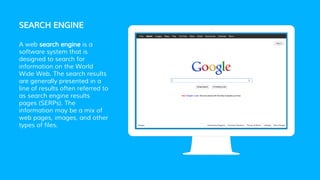
SEARCH ENGINE
A web search engine is a
software system that is
designed to search for
information on the World Wide
Web. The search results are
generally presented in a line of
results often referred to as
search engine results pages
(SERPs). The information may
be a mix of web pages,
images, and other types of
files.
Place your screenshot here
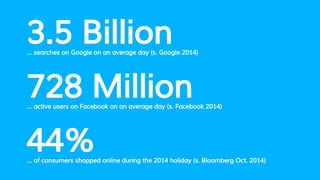
3.5 Billion… searches on Google on an average day (s. Google 2017)
51%… of consumers shopped online during the 2016 holiday (s. comScore & UPS 2016)
1.15 Billion… active users on Facebook on an average day (s. Facebook 2017)
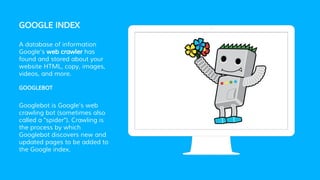
GOOGLE INDEX
A database of information
Google’s web crawler has
found and stored about your
website HTML, copy, images,
videos, and more.
GOOGLEBOT
Googlebot is Google's web
crawling bot (sometimes also
called a "spider"). Crawling is
the process by which
Googlebot discovers new and
updated pages to be added to
the Google index.
Place your screenshot here
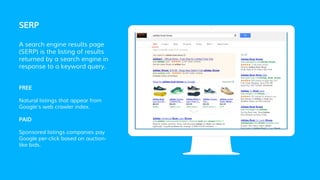
SERP
A search engine results page
(SERP) is the listing of results
returned by a search engine in
response to a keyword query.
FREE
Natural listings that appear from
Google’s web crawler index.
PAID
Sponsored listings companies pay
Google per-click based on auction-
like bids.
Place your screenshot here
PAID - Text
Paid listings usually appear in the
top 3-4 text positions and in the
bottom 2-3 listings on each search
page. Google recently removed the
right column listings.
PAID - Shopping
A product listing with images,
reviews, and pricing.
PAID - Maps
Paid local search listings began to
appear in local pack results in early
2017. Paid local results do not
appear on all local searches.
Place your screenshot here
FREE ORGANIC
Free listings appear after the paid
listings, usually in positions #4-10 or
#4-12 depending on the search
performed.
FREE MAPS
Local pack listings can appear for
searches Google things are more
local in nature.
Example: “Pizza shops near me”
KNOWLEDGE GRAPH
Typically brand searches for specific
companies or places will appear to
the right or under the search box
with few if any paid listings.
Place your screenshot here
WHAT IS SEO?
2007 vs. 2017
“In contrast to PPC or Pay-Per-Click Advertising,
Search Engine Optimization is the art and science of a
strategy aimed at placing web pages at the top of
organic search results for their targeted keywords.
Keywords are the phrases people search for to find
what they are looking for.”
What is Search Engine Optimization (SEO)?
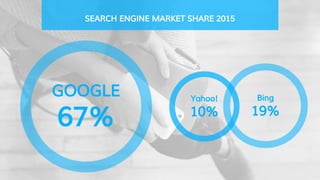
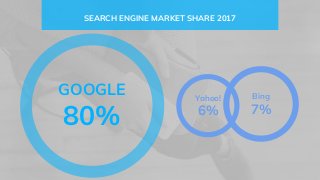
SEARCH ENGINE MARKET SHARE 2017
Yahoo!
6%
Bing
7%
GOOGLE
80%
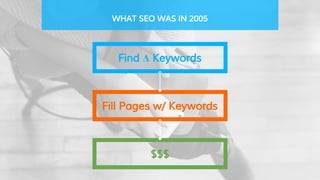
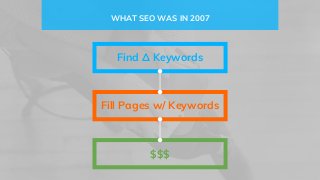
WHAT SEO WAS IN 2007
Find Δ Keywords
Fill Pages w/ Keywords
$$$
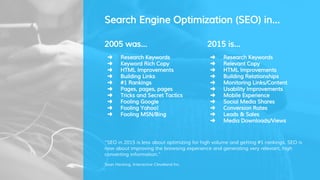
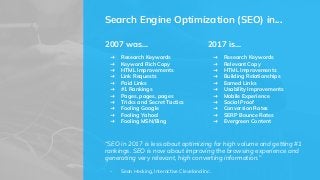
2017 is...
➜ Research Keywords
➜ Relevant Copy
➜ HTML Improvements
➜ Building Relationships
➜ Earned Links
➜ Usability Improvements
➜ Mobile Experience
➜ Social Proof
➜ Conversion Rates
➜ SERP Bounce Rates
➜ Evergreen Content
“SEO in 2017 is less about optimizing for high volume and getting #1
rankings. SEO is now about improving the browsing experience and
generating very relevant, high converting information.”
- Sean Hecking, Interactive Cleveland Inc.
Search Engine Optimization (SEO) in...
2007 was...
➜ Research Keywords
➜ Keyword Rich Copy
➜ HTML Improvements
➜ Link Requests
➜ Paid Links
➜ #1 Rankings
➜ Pages, pages, pages
➜ Tricks and Secret Tactics
➜ Fooling Google
➜ Fooling Yahoo!
➜ Fooling MSN/Bing
GOOGLE ALGORITHM
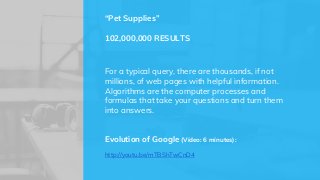
For a typical query, there are thousands, if not
millions, of web pages with helpful information.
Algorithms are the computer processes and
formulas that take your questions and turn them
into answers.
Evolution of Google (Video: 6 minutes):
http://youtu.be/mTBShTwCnD4
“Pet Supplies”
102,000,000 RESULTS
GOOGLE UPDATES
Google is constantly updating their computer
programs that manage search engine listings.
Smaller and less noticeable changes happen every
week. Less frequent major updates typically happen
a few times each year.
➜ “Possum” Aug. 2017: Local pack results
➜ “Fred” March 2017: Low value content sites hit
➜ “Penguin 4.0” Oct. 2016: Links
➜ “Possum” Sept. 2016: Local pack results
➜ “Mobile Friendly” May 2016: Mobile SEO
GOOGLE UPDATES (2016-2017)
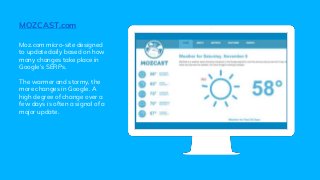
MOZCAST.com
Moz.com micro-site designed
to update daily based on how
many changes take place in
Google’s SERPs.
The warmer and stormy, the
more changes in Google. A
high degree of change over a
few days is often a signal of a
major update.
Place your screenshot here
KNOWLEDGE & TOOLS
➜ Basic graphics skills
➜ Word processing, spreadsheets
➜ Content management skills (WordPress)
➜ Basic HTML
➜ English (other languages a big plus for
translations)
KNOWLEDGE NEEDED
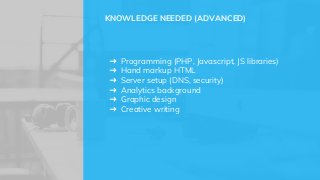
➜ Programming (PHP, Javascript, JS libraries)
➜ Hand markup HTML
➜ Server setup (DNS, security)
➜ Analytics background
➜ Graphic design
➜ Creative writing
KNOWLEDGE NEEDED (ADVANCED)
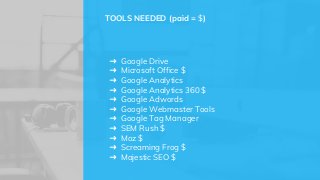
➜ Google Drive
➜ Microsoft Office $
➜ Google Analytics
➜ Google Analytics 360 $
➜ Google Adwords
➜ Google Webmaster Tools
➜ Google Tag Manager
➜ SEM Rush $
➜ Moz $
➜ Screaming Frog $
➜ Majestic SEO $
TOOLS NEEDED (paid = $)
PROCESS
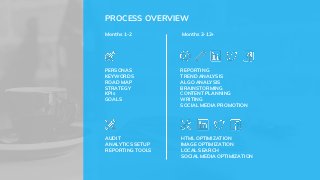
PROCESS OVERVIEW
PERSONAS
KEYWORDS
ROAD MAP
STRATEGY
KPIs
GOALS
AUDIT
ANALYTICS SETUP
REPORTING TOOLS
REPORTING
TREND ANALYSIS
ALGO ANALYSIS
BRAINSTORMING
CONTENT PLANNING
WRITING
SOCIAL MEDIA PROMOTION
HTML OPTIMIZATION
IMAGE OPTIMIZATION
LOCAL SEARCH
SOCIAL MEDIA OPTIMIZATION
Months 1-2 Months 2-12+
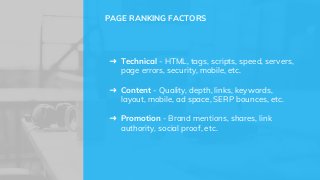
➜ Technical - HTML, tags, scripts, speed, servers,
page errors, security, mobile, etc.
➜ Content - Quality, depth, links, keywords,
layout, mobile, ad space, SERP bounces, etc.
➜ Promotion - Brand mentions, shares, link
authority, social proof, etc.
PAGE RANKING FACTORS
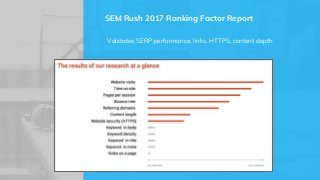
SEM Rush 2017 Ranking Factor Report
Validates SERP performance, links, HTTPS, content depth
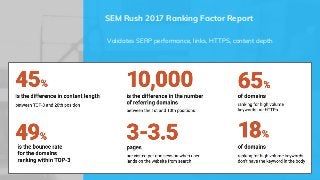
SEM Rush 2017 Ranking Factor Report
Validates SERP performance, links, HTTPS, content depth
SECTION 2a
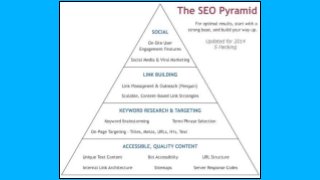
Pyramid
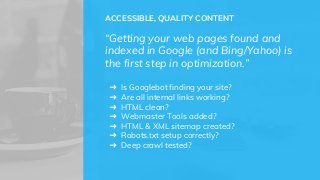
ACCESSIBLE, QUALITY CONTENT
“Getting your web pages found and
indexed in Google (and Bing/Yahoo) is
the first step in optimization.”
➜ Is Googlebot finding your site?
➜ Are all internal links working?
➜ HTML clean?
➜ Webmaster Tools added?
➜ HTML & XML sitemap created?
➜ Robots.txt setup correctly?
➜ Deep crawl tested?
KEYWORD RESEARCH & TARGETING
“SEO starts with keyword research.”
➜ What’s your business and industry?
➜ Who are your top competitors?
➜ Do you offer services locally or nationally?
➜ What does your company offer?
➜ Who are the influencers in your industry?
➜ Do you have a list of core search keywords?
LINK BUILDING (a.k.a. Inbound Marketing, Content Marketing)
“The best link building is to build
shareable content.”
➜ Have you reviewed your link profile?
➜ What types of sites are linking to yours?
➜ Who are you linking to?
➜ Is anyone sharing your pages or content?
➜ Are you losing potential traffic due to broken links
or lost referring traffic hitting 404 pages?
SOCIAL PROMOTION
“Getting your content shared is key to
increasing links and influence.”
➜ What type of content is shared most?
➜ Do you use topics that educate, entertain, or drive
engagement?
➜ Do you have any thought leaders?
➜ Can you offer any free expertise to customers?
➜ Are you using video or downloadable media to
promote your company?
Content Management
“A content management system (CMS) is a
computer application that allows publishing, editing
and modifying content, organizing, deleting as well
as maintenance from a central interface. Such
systems of content management provide procedures
to manage workflow in a collaborative
environment.”
➜ Easy to use without programming
➜ Help manage content and contributor roles
➜ Help sell products and manage web pages
Content Management Systems (CMS)
Good CMS Options
To be found on the internet,
you’re going to need a basic
website. There are several
CMS options available for
small businesses, large
corporations, and everything
in-between.
● WordPress.org
● Magento
● Drupal
● Umbraco
● Shopify
SECTION 2d
Social Proof
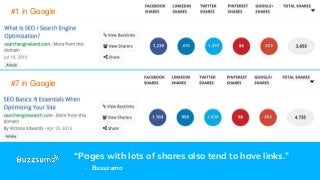
“Pages with lots of shares also tend to have links.”
- Busszumo
#7 in Google
#1 in Google
“Social proof (also known as informational social
influence) is a psychological and social phenomenon
where people assume the actions of others in an
attempt to reflect correct behavior in a given
situation”
➜ Shares = more shares
➜ Likes = more likes
➜ Positive social engagement = Brand growth
➜ More shares = more links
Social Proof = Better SEO
SECTION 3
SEO Setup
➜ Interview sales team and key stakeholders
➜ Research customer demographics: Age, gender,
salary, job role, likes, dislikes, etc.
➜ Review Google Display Planner
➜ Review Google Analytics
➜ Review search demographic trend reports
➜ Write down feedback and create a model
BASIC PERSONAS
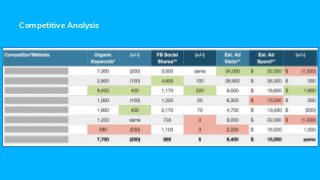
➜ Prepare a competitive analysis
➜ Identify 10-20 core keywords as a starting point
➜ Use AdWords CPC as an indicator of how
competitive the market
➜ How far are your from your competitors in
search engines?
➜ Determine how much effort may be required or
how much budget you will need for paid search
KEYWORD DISCOVERY
Competitive Analysis
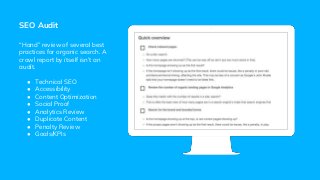
SEO Audit
“Hand” review of several best
practices for organic search. A
crawl report by itself isn’t an
audit.
● Technical SEO
● Accessibility
● Content Optimization
● Social Proof
● Analytics Review
● Duplicate Content
● Penalty Review
● Goals/KPIs
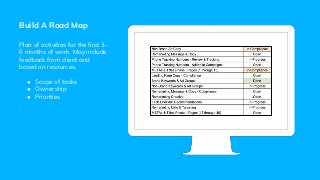
Build A Road Map
Plan of activities for the first 3-
6 months of work. May include
feedback from client and
based on resources.
● Scope of tasks
● Ownership
● Priorities
Analytics Setup
Getting the right metrics in
place to measure campaigns.
Without proper KPIs, clients
can only focus on keywords
and traffic (YIKES!)
● Google Tag Manager
● KPIs
● Goals/Funnels
● Downloads
● Orders
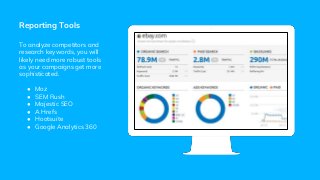
Reporting Tools
To analyze competitors and
research keywords, you will
likely need more robust tools
as your campaigns get more
sophisticated.
● Moz
● SEM Rush
● Majestic SEO
● A Hrefs
● Hootsuite
● Google Analytics 360
➜ Quarterly review of performance
➜ Review any changes in your industry or
seasonal opportunities
➜ Review competitors
➜ Discuss budget and resources needed
ONGOING STRATEGY
SECTION 4
SEO Reporting
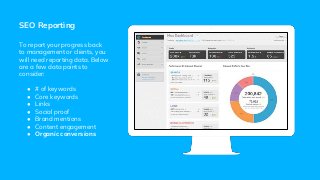
SEO Reporting
To report your progress back
to management or clients, you
will need reporting data. Below
are a few data points to
consider:
● # of keywords
● Core keywords
● Links
● Social proof
● Brand mentions
● Content engagement
● Organic conversions
➜ Avoid focusing on top keyword rankings
➜ Shift discussion to conversion goals, keyword
growth, and content engagement
➜ Rankings ≠ Results
➜ Rankings can increase awareness and lead to
audience growth
➜ Discuss page visibility vs. rank
SEO REPORTING TIPS
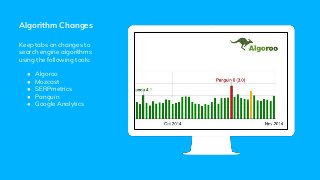
Algorithm Changes
Keep tabs on changes to
search engine algorithms
using the following tools:
● Algoroo
● Mozcast
● SERPmetrics
● Panguin
● Google Analytics
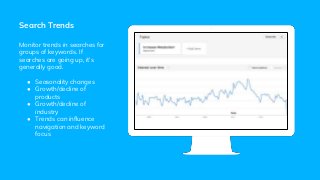
Search Trends
Monitor trends in searches for
groups of keywords. If
searches are going up, it’s
generally good.
● Seasonality changes
● Growth/decline of
products
● Growth/decline of
industry
● Trends can influence
navigation and keyword
focus
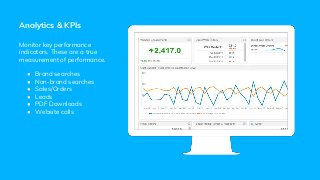
Analytics & KPIs
Monitor key performance
indicators. These are a true
measurement of performance.
● Brand searches
● Non-brand searches
● Sales/Orders
● Leads
● PDF Downloads
● Website calls
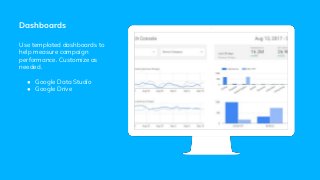
Dashboards
Use templated dashboards to
help measure campaign
performance. Customize as
needed.
● Google Data Studio
● Google Drive
Thanks!
Sean Hecking
Consultant & Owner of Interactive Cleveland
You can find me at:
Twitter: @seanhecking
Linkedin: https://www.linkedin.com/in/seanhecking/
Email: sean@interactivecleveland.com
Web: www.interactivecleveland.com
Interactive Cleveland

What is SEO?

  • 1.
  • 2.
    Hello! I am SeanHecking Consultant & Owner of Interactive Cleveland You can find me at: Twitter: @seanhecking Linkedin: https://www.linkedin.com/in/seanhecking/ Email: sean@interactivecleveland.com Web: www.interactivecleveland.com Interactive Cleveland
  • 3.
  • 4.
  • 5.
    SEARCH ENGINE A websearch engine is a software system that is designed to search for information on the World Wide Web. The search results are generally presented in a line of results often referred to as search engine results pages (SERPs). The information may be a mix of web pages, images, and other types of files. Place your screenshot here
  • 6.
    3.5 Billion… searcheson Google on an average day (s. Google 2017) 51%… of consumers shopped online during the 2016 holiday (s. comScore & UPS 2016) 1.15 Billion… active users on Facebook on an average day (s. Facebook 2017)
  • 7.
    GOOGLE INDEX A databaseof information Google’s web crawler has found and stored about your website HTML, copy, images, videos, and more. GOOGLEBOT Googlebot is Google's web crawling bot (sometimes also called a "spider"). Crawling is the process by which Googlebot discovers new and updated pages to be added to the Google index. Place your screenshot here
  • 8.
    SERP A search engineresults page (SERP) is the listing of results returned by a search engine in response to a keyword query. FREE Natural listings that appear from Google’s web crawler index. PAID Sponsored listings companies pay Google per-click based on auction- like bids. Place your screenshot here
  • 9.
    PAID - Text Paidlistings usually appear in the top 3-4 text positions and in the bottom 2-3 listings on each search page. Google recently removed the right column listings. PAID - Shopping A product listing with images, reviews, and pricing. PAID - Maps Paid local search listings began to appear in local pack results in early 2017. Paid local results do not appear on all local searches. Place your screenshot here
  • 10.
    FREE ORGANIC Free listingsappear after the paid listings, usually in positions #4-10 or #4-12 depending on the search performed. FREE MAPS Local pack listings can appear for searches Google things are more local in nature. Example: “Pizza shops near me” KNOWLEDGE GRAPH Typically brand searches for specific companies or places will appear to the right or under the search box with few if any paid listings. Place your screenshot here
  • 12.
  • 13.
    “In contrast toPPC or Pay-Per-Click Advertising, Search Engine Optimization is the art and science of a strategy aimed at placing web pages at the top of organic search results for their targeted keywords. Keywords are the phrases people search for to find what they are looking for.” What is Search Engine Optimization (SEO)?
  • 14.
    SEARCH ENGINE MARKETSHARE 2017 Yahoo! 6% Bing 7% GOOGLE 80%
  • 15.
    WHAT SEO WASIN 2007 Find Δ Keywords Fill Pages w/ Keywords $$$
  • 16.
    2017 is... ➜ ResearchKeywords ➜ Relevant Copy ➜ HTML Improvements ➜ Building Relationships ➜ Earned Links ➜ Usability Improvements ➜ Mobile Experience ➜ Social Proof ➜ Conversion Rates ➜ SERP Bounce Rates ➜ Evergreen Content “SEO in 2017 is less about optimizing for high volume and getting #1 rankings. SEO is now about improving the browsing experience and generating very relevant, high converting information.” - Sean Hecking, Interactive Cleveland Inc. Search Engine Optimization (SEO) in... 2007 was... ➜ Research Keywords ➜ Keyword Rich Copy ➜ HTML Improvements ➜ Link Requests ➜ Paid Links ➜ #1 Rankings ➜ Pages, pages, pages ➜ Tricks and Secret Tactics ➜ Fooling Google ➜ Fooling Yahoo! ➜ Fooling MSN/Bing
  • 17.
  • 18.
    For a typicalquery, there are thousands, if not millions, of web pages with helpful information. Algorithms are the computer processes and formulas that take your questions and turn them into answers. Evolution of Google (Video: 6 minutes): http://youtu.be/mTBShTwCnD4 “Pet Supplies” 102,000,000 RESULTS
  • 20.
  • 21.
    Google is constantlyupdating their computer programs that manage search engine listings. Smaller and less noticeable changes happen every week. Less frequent major updates typically happen a few times each year. ➜ “Possum” Aug. 2017: Local pack results ➜ “Fred” March 2017: Low value content sites hit ➜ “Penguin 4.0” Oct. 2016: Links ➜ “Possum” Sept. 2016: Local pack results ➜ “Mobile Friendly” May 2016: Mobile SEO GOOGLE UPDATES (2016-2017)
  • 22.
    MOZCAST.com Moz.com micro-site designed toupdate daily based on how many changes take place in Google’s SERPs. The warmer and stormy, the more changes in Google. A high degree of change over a few days is often a signal of a major update. Place your screenshot here
  • 23.
  • 24.
    ➜ Basic graphicsskills ➜ Word processing, spreadsheets ➜ Content management skills (WordPress) ➜ Basic HTML ➜ English (other languages a big plus for translations) KNOWLEDGE NEEDED
  • 25.
    ➜ Programming (PHP,Javascript, JS libraries) ➜ Hand markup HTML ➜ Server setup (DNS, security) ➜ Analytics background ➜ Graphic design ➜ Creative writing KNOWLEDGE NEEDED (ADVANCED)
  • 26.
    ➜ Google Drive ➜Microsoft Office $ ➜ Google Analytics ➜ Google Analytics 360 $ ➜ Google Adwords ➜ Google Webmaster Tools ➜ Google Tag Manager ➜ SEM Rush $ ➜ Moz $ ➜ Screaming Frog $ ➜ Majestic SEO $ TOOLS NEEDED (paid = $)
  • 27.
  • 28.
    PROCESS OVERVIEW PERSONAS KEYWORDS ROAD MAP STRATEGY KPIs GOALS AUDIT ANALYTICSSETUP REPORTING TOOLS REPORTING TREND ANALYSIS ALGO ANALYSIS BRAINSTORMING CONTENT PLANNING WRITING SOCIAL MEDIA PROMOTION HTML OPTIMIZATION IMAGE OPTIMIZATION LOCAL SEARCH SOCIAL MEDIA OPTIMIZATION Months 1-2 Months 2-12+
  • 29.
    ➜ Technical -HTML, tags, scripts, speed, servers, page errors, security, mobile, etc. ➜ Content - Quality, depth, links, keywords, layout, mobile, ad space, SERP bounces, etc. ➜ Promotion - Brand mentions, shares, link authority, social proof, etc. PAGE RANKING FACTORS
  • 30.
    SEM Rush 2017Ranking Factor Report Validates SERP performance, links, HTTPS, content depth
  • 31.
    SEM Rush 2017Ranking Factor Report Validates SERP performance, links, HTTPS, content depth
  • 32.
  • 34.
    ACCESSIBLE, QUALITY CONTENT “Gettingyour web pages found and indexed in Google (and Bing/Yahoo) is the first step in optimization.” ➜ Is Googlebot finding your site? ➜ Are all internal links working? ➜ HTML clean? ➜ Webmaster Tools added? ➜ HTML & XML sitemap created? ➜ Robots.txt setup correctly? ➜ Deep crawl tested?
  • 35.
    KEYWORD RESEARCH &TARGETING “SEO starts with keyword research.” ➜ What’s your business and industry? ➜ Who are your top competitors? ➜ Do you offer services locally or nationally? ➜ What does your company offer? ➜ Who are the influencers in your industry? ➜ Do you have a list of core search keywords?
  • 36.
    LINK BUILDING (a.k.a.Inbound Marketing, Content Marketing) “The best link building is to build shareable content.” ➜ Have you reviewed your link profile? ➜ What types of sites are linking to yours? ➜ Who are you linking to? ➜ Is anyone sharing your pages or content? ➜ Are you losing potential traffic due to broken links or lost referring traffic hitting 404 pages?
  • 37.
    SOCIAL PROMOTION “Getting yourcontent shared is key to increasing links and influence.” ➜ What type of content is shared most? ➜ Do you use topics that educate, entertain, or drive engagement? ➜ Do you have any thought leaders? ➜ Can you offer any free expertise to customers? ➜ Are you using video or downloadable media to promote your company?
  • 38.
  • 39.
    “A content managementsystem (CMS) is a computer application that allows publishing, editing and modifying content, organizing, deleting as well as maintenance from a central interface. Such systems of content management provide procedures to manage workflow in a collaborative environment.” ➜ Easy to use without programming ➜ Help manage content and contributor roles ➜ Help sell products and manage web pages Content Management Systems (CMS)
  • 40.
    Good CMS Options Tobe found on the internet, you’re going to need a basic website. There are several CMS options available for small businesses, large corporations, and everything in-between. ● WordPress.org ● Magento ● Drupal ● Umbraco ● Shopify
  • 41.
  • 42.
    “Pages with lotsof shares also tend to have links.” - Busszumo #7 in Google #1 in Google
  • 43.
    “Social proof (alsoknown as informational social influence) is a psychological and social phenomenon where people assume the actions of others in an attempt to reflect correct behavior in a given situation” ➜ Shares = more shares ➜ Likes = more likes ➜ Positive social engagement = Brand growth ➜ More shares = more links Social Proof = Better SEO
  • 44.
  • 45.
    ➜ Interview salesteam and key stakeholders ➜ Research customer demographics: Age, gender, salary, job role, likes, dislikes, etc. ➜ Review Google Display Planner ➜ Review Google Analytics ➜ Review search demographic trend reports ➜ Write down feedback and create a model BASIC PERSONAS
  • 46.
    ➜ Prepare acompetitive analysis ➜ Identify 10-20 core keywords as a starting point ➜ Use AdWords CPC as an indicator of how competitive the market ➜ How far are your from your competitors in search engines? ➜ Determine how much effort may be required or how much budget you will need for paid search KEYWORD DISCOVERY
  • 47.
  • 48.
    SEO Audit “Hand” reviewof several best practices for organic search. A crawl report by itself isn’t an audit. ● Technical SEO ● Accessibility ● Content Optimization ● Social Proof ● Analytics Review ● Duplicate Content ● Penalty Review ● Goals/KPIs
  • 49.
    Build A RoadMap Plan of activities for the first 3- 6 months of work. May include feedback from client and based on resources. ● Scope of tasks ● Ownership ● Priorities
  • 50.
    Analytics Setup Getting theright metrics in place to measure campaigns. Without proper KPIs, clients can only focus on keywords and traffic (YIKES!) ● Google Tag Manager ● KPIs ● Goals/Funnels ● Downloads ● Orders
  • 51.
    Reporting Tools To analyzecompetitors and research keywords, you will likely need more robust tools as your campaigns get more sophisticated. ● Moz ● SEM Rush ● Majestic SEO ● A Hrefs ● Hootsuite ● Google Analytics 360
  • 52.
    ➜ Quarterly reviewof performance ➜ Review any changes in your industry or seasonal opportunities ➜ Review competitors ➜ Discuss budget and resources needed ONGOING STRATEGY
  • 53.
  • 54.
    SEO Reporting To reportyour progress back to management or clients, you will need reporting data. Below are a few data points to consider: ● # of keywords ● Core keywords ● Links ● Social proof ● Brand mentions ● Content engagement ● Organic conversions
  • 55.
    ➜ Avoid focusingon top keyword rankings ➜ Shift discussion to conversion goals, keyword growth, and content engagement ➜ Rankings ≠ Results ➜ Rankings can increase awareness and lead to audience growth ➜ Discuss page visibility vs. rank SEO REPORTING TIPS
  • 56.
    Algorithm Changes Keep tabson changes to search engine algorithms using the following tools: ● Algoroo ● Mozcast ● SERPmetrics ● Panguin ● Google Analytics
  • 57.
    Search Trends Monitor trendsin searches for groups of keywords. If searches are going up, it’s generally good. ● Seasonality changes ● Growth/decline of products ● Growth/decline of industry ● Trends can influence navigation and keyword focus
  • 58.
    Analytics & KPIs Monitorkey performance indicators. These are a true measurement of performance. ● Brand searches ● Non-brand searches ● Sales/Orders ● Leads ● PDF Downloads ● Website calls
  • 59.
    Dashboards Use templated dashboardsto help measure campaign performance. Customize as needed. ● Google Data Studio ● Google Drive
  • 60.
    Thanks! Sean Hecking Consultant &Owner of Interactive Cleveland You can find me at: Twitter: @seanhecking Linkedin: https://www.linkedin.com/in/seanhecking/ Email: sean@interactivecleveland.com Web: www.interactivecleveland.com Interactive Cleveland

Editor's Notes

  • #7 Google and Facebook clearly dominate the web