@cazzaspence
An introduction
to public relations
By Caroline Spence
PR Director of Anicca Digital
@cazzaspence
Our brands
Paid Media & Search
Marketing (SEO, PPC,
Analytics, ecommerce)
Owned & Earned media
(SEO, Content, PR, Social,
Email, MAS)
Marketing training for
business professionals
More leads and sales Building your brand Educating your team
@cazzaspence
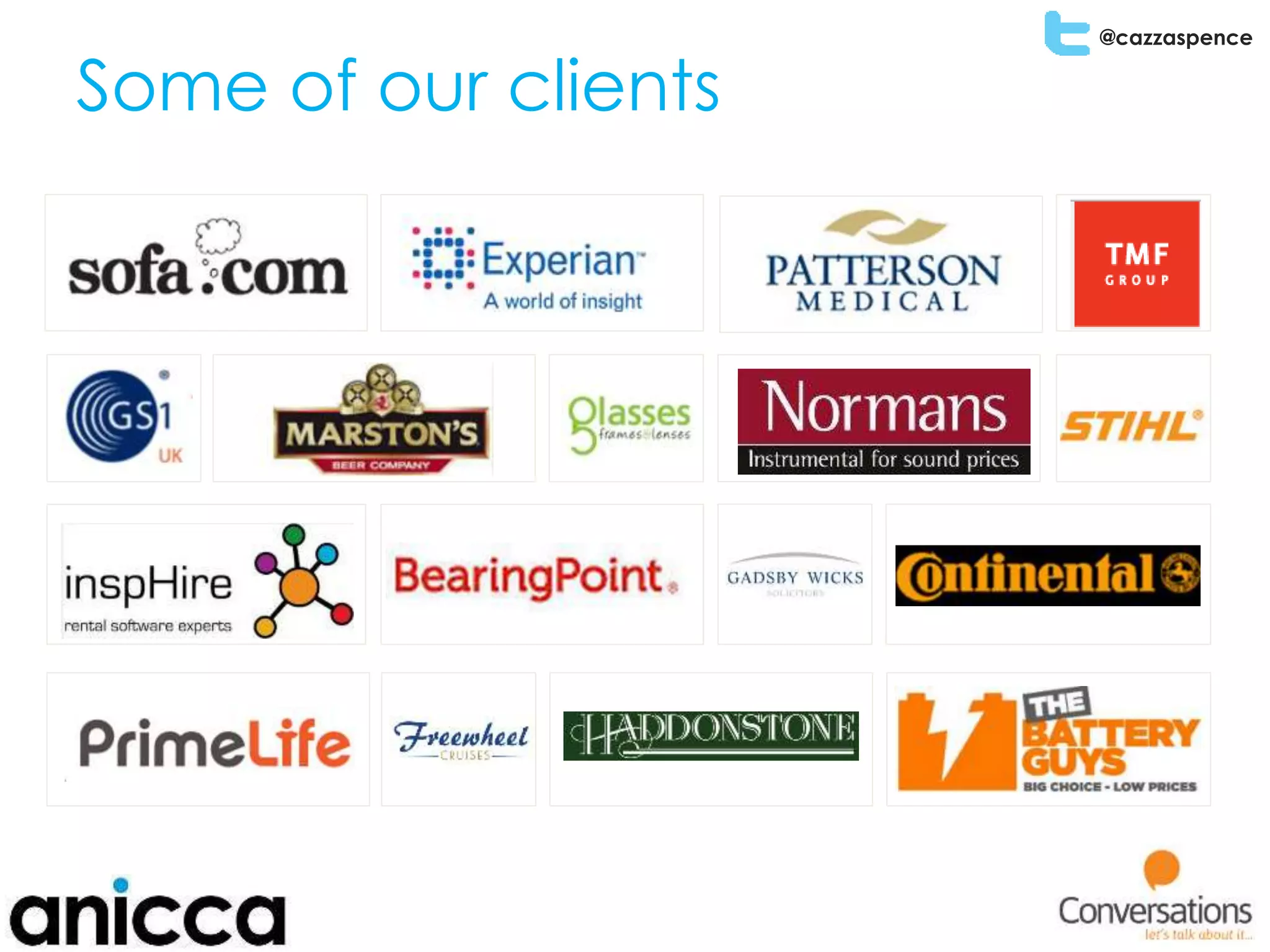
Some of our clients
@cazzaspence
Contents
• Introduction
– What is PR?
– PR tactics
– Difference between PR and advertising
• Getting started
– Understanding the time / resources
commitment
– Willingness to participate
– What is of interest to the media? Story Mining
• PR techniques
– Preparing content
– Talking to the media
– Blogs and social media
– Events
– Reviews/ sampling
• Measurement
– Collating and measuring coverage
– How PR can help SEO and social media
• Useful Tips
@cazzaspence
Introduction
@cazzaspence
What is PR?
PR has had some bad press!
However, used correctly it can
be really beneficial for your
business
• Free editorial content
• Written by a third party
(journalist or blogger)
• Word of Mouth
recommendation –
credible, powerful
• Can be TV, radio, print,
online, social media
• Great for raising awareness
• Can generate sales – BUT
not always trackable
@cazzaspence
How prevalent is PR?
PR has had some bad press!
However, used correctly it can
be really beneficial for your
business
• Free editorial content
• Written by a third party
(journalist or blogger)
• Word of Mouth
recommendation –
credible, powerful
• Can be TV, radio, print,
online, social media
• Great for raising awareness
• Can generate sales – BUT
not always trackable
@cazzaspence
PR Tactics
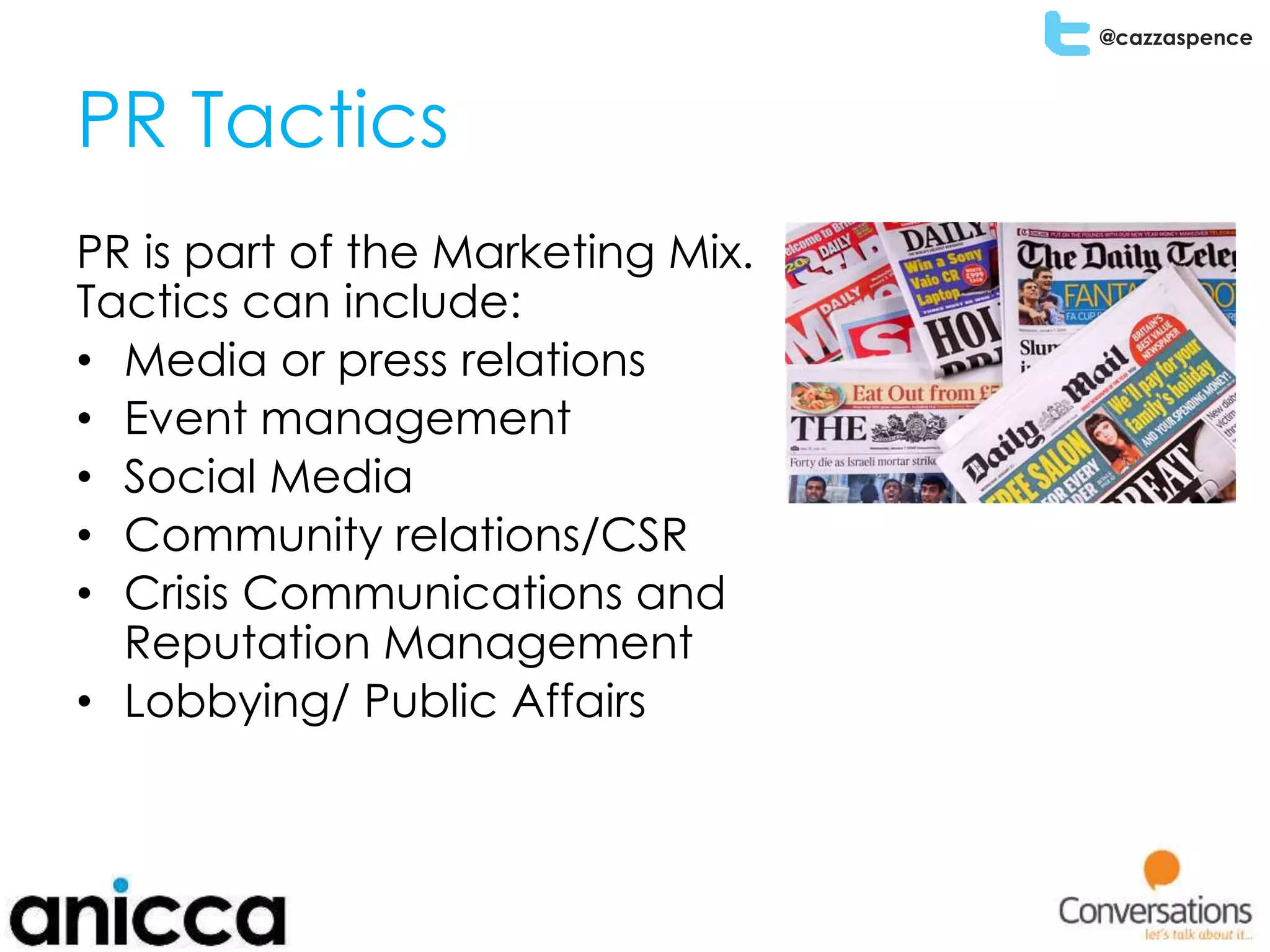
PR is part of the Marketing Mix.
Tactics can include:
• Media or press relations
• Event management
• Social Media
• Community relations/CSR
• Crisis Communications and
Reputation Management
• Lobbying/ Public Affairs
@cazzaspence
Difference between PR and Advertising
It’s just advertising ain’t it? Erm, no.
Often confused, here are the main
differences.
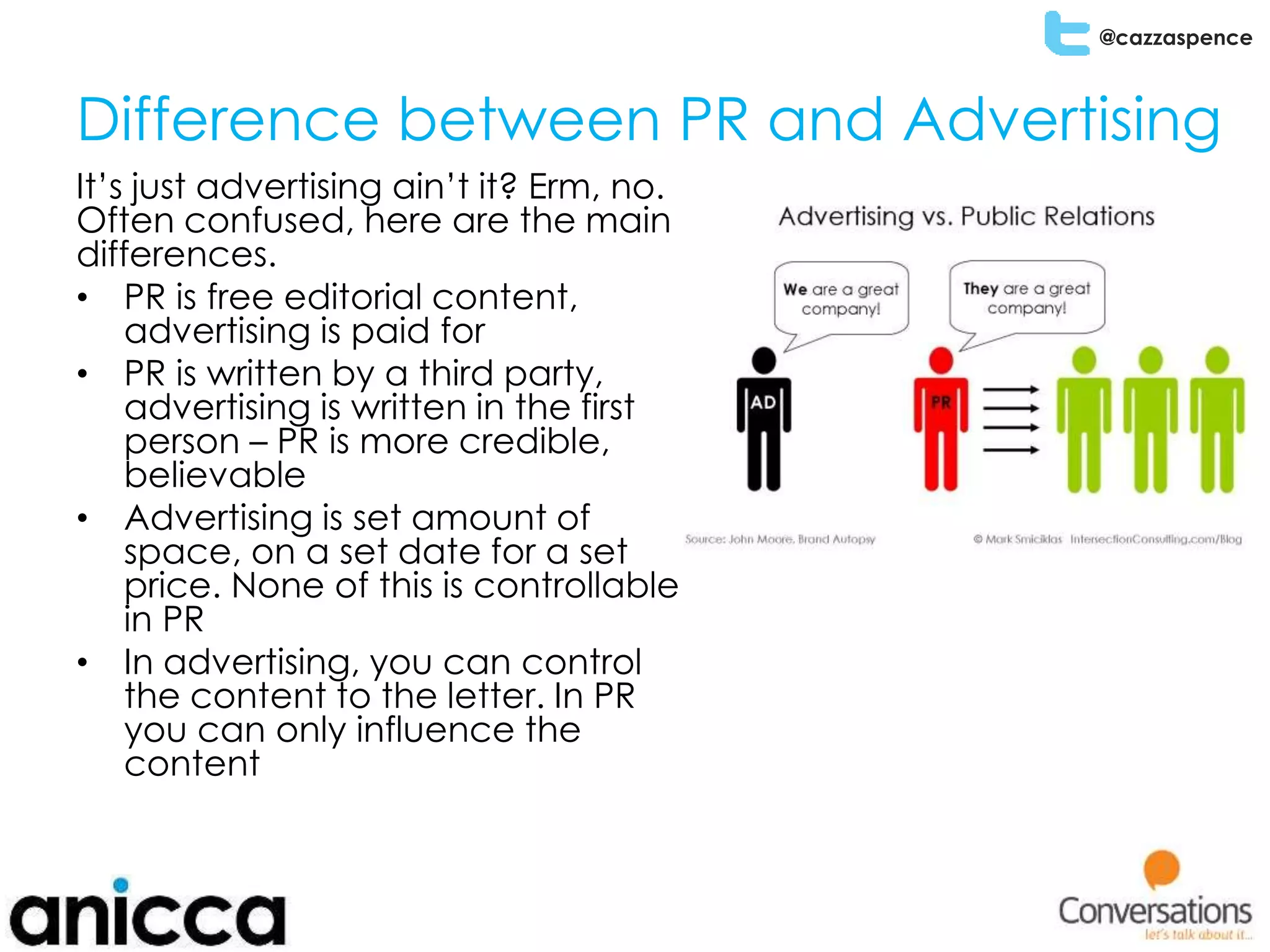
• PR is free editorial content,
advertising is paid for
• PR is written by a third party,
advertising is written in the first
person – PR is more credible,
believable
• Advertising is set amount of
space, on a set date for a set
price. None of this is controllable
in PR
• In advertising, you can control
the content to the letter. In PR
you can only influence the
content
@cazzaspence
What can PR do for your
business?
• Raise awareness of the
brand/ products/ services
• Drive traffic/ footfall
• Positive brand associations
• Improve reputation
• Promote the people behind
the business
• Increase brand engagement
• Funding/ grants/ awards/
buyers
• Massive increases in sales
cannot be guaranteed!
@cazzaspence
Getting Started
@cazzaspence
Understanding the time /
resources commitment
• PR is low cost, which
means it’s time intensive
• Need to understand that
resources will have to be
used, either conducting a
campaign or managing
an agency
• Journalists will not wait for
you, arrange calls/
appointments around you
• Short deadlines/ fast
reactions
@cazzaspence
What you need to be prepared to do
• Get out there – no business
ever promoted itself alone
in an office
• Make cold calls to media
• Sell your business in person –
inevitably exposure for you
• Networking
• Public speaking/ interviews
• Have your picture taken!
• Be nice to people
• Change
@cazzaspence
What are the media interested in?
• Story mining – first step in PR
• News Value, newsworthiness
• What is interesting that is happening
in your business right now?
• New premises, client wins, hires,
products
• Human interest – charity, learning,
quirky
• Investment/ expansion
/refurbishment - £££
• VIPs, celebrities, Royalty, MPs, Mayors
etc
• Produce a list and then a calendar
of ideas to keep you ontrack
@cazzaspence
PR Techniques
@cazzaspence
Preparing Content
Content needs preparing in specific ways to meet
media needs
• Copy – needs to be concise, catchy, factually
correct, no superlatives and written in the third
person eg. ‘Waltham College said’ not ‘We said’
• Spell and grammar check – also check facts
with relevant parties
• Press release format – headline, body copy,
contact details and website, social media
handles etc
• Images – high resolution 300 dpi, taken by a
professional, not just a boring line up, colour not
b+w
• Timely – find out the frequency of the
publication and its deadlines
@cazzaspence
Talking to the Media
You’ve got your content sorted, now what?
• Who will be interested? Research relevant
media titles – look locally, nationally and
don’t forget trade titles
• Buy the publication or look online. Read it,
make sure it’s relevant. Is it in the right
location?
• Find the Newsdesk or Editorial contacts
• Ring in and pitch the story – sound friendly,
confident and enthusiastic, rehearse if
necessary
• Answer questions succinctly, send more
information if required
• Email press release and images/ links to
photos over
@cazzaspence
Talking to the Media
So they are interested, what happens next?
• Photo opportunity – a newspaper may send
a photographer to get a picture to
accompany the story. Arrange a time/date
and ensure the right people are there
• Interview – can be by phone or face-to-face.
Can be for print, radio or TV. Broadcast
media can be recorded or live. You will need
to prepare for this! Get your key messages
lined up, practice making your point in under
30 secs
• Coverage – make sure you get the finished
article or interview. Think what you could
have done better – you learn each time
• Try to get a link back to the website – this can
improve site authority
@cazzaspence
Blogs and social media
• Online media such as blogs and social
media has affected media relations and
they need to be treated differently
• More like a conversation – you need to
read Tweets and blogs to find out what
they are talking about/ interested in
• Join in with NON-COMMERCIAL
conversation to start with then drop your
story / product in after you have
established a rapport
• Find hard-to-reach journalists for national
newspapers/ magazines on Twitter
• #journalistalert is a good one to set on
your Twitter or join the closed group on
Facebook
@cazzaspence
Events
Having a launch event/ anniversary party/
fundraising dinner?
• Invite the media! Free spots for journos always
go down well – especially if food & booze are
involved!
• Ring the Picture Desk of newspapers and
magazines to invite photgraphers
• If they don’t come, take your own pictures,
write your own press release and issue to
relevant titles
• Check local glossy magazines for Diary and
Social sections – they are always looking for
stories
• If you are struggling to get interest offer
goodie bags, heavy discounts or free samples
@cazzaspence
Reviews/ sampling
Is yours a lifestyle business? If so why not invite
the media in for a review/ free trial?
• Free stuff is amazing for the media who are
normally poorly paid or voluntary
• If you offer a service or low value product,
a freebie is normally a guaranteed way to
get coverage
• This especially works for:
• Food & drink
• Fashion & accessories
• Hair & beauty
• Home accessories
• Just ensure you know who the journalist is
(check LinkedIn to find out what they look
like) and treat them like a super VIP!
@cazzaspence
Measuring and monitoring
@cazzaspence
How to Measure Success
• Historically difficult to measure, there are various forms
of measurement dependning on how in-depth you
want/ need to be
• Number of cuttings – how many positive articles
have you created?
• Size of article – always key, the bigger the better!
• Does it include an image? It’s more likely to be read
and remembered
• Does it have a weblink? This drives traffic and
improves authority
• How much would it cost to buy the equivalent
space as advertising? From here you can work out
how much money you have saved or ROI figures
• Audience reach – how many people have been
reached by the campaign in total?
• Hard numbers – website referrals, customers who
have mentioned it, no. of new customers
@cazzaspence
Integrated strategy
@cazzaspence
Our strategy for integrating PR
and SEO (for our own and clients sites)
• Websites should be built to have an integrated blog and
social media icons or they should be add retrospectively to
existing sites
• We try and blog at least once a week
– Optimise the blog to maximise SEO benefits (especially title,
perma-link (URL) and use SEO plug-ins for sitemap, titles and
descriptions)
– Allow comments (screened and approved)
– Everyone in the team is encouraged to contribute to our own
blog
• Our own content is focussed on
– Innovation or what’s new in search and online marketing
– Areas where we are technical experts
– Case studies (including new websites)
– Events or speaking slots
• We then re-tweet, use share/like using Facebook, LinkedIn
and Google+
• We create Press releases and submit to media sites
• We also use Tweetdeck or Hootsuite to track areas of interest
@cazzaspence
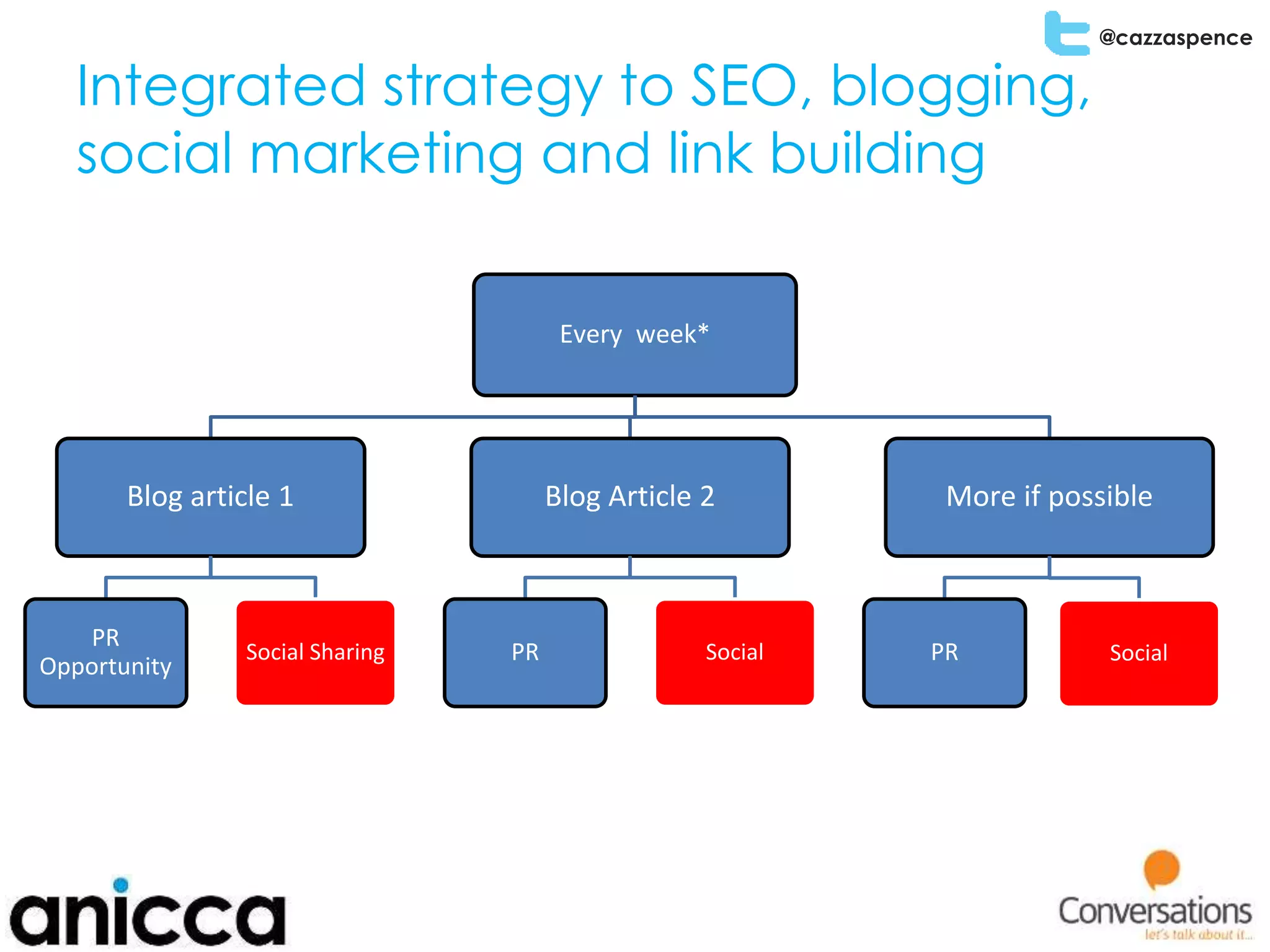
Integrated strategy to SEO, blogging,
social marketing and link building
Every week*
Blog article 1
PR
Opportunity
Social Sharing
Blog Article 2
PR Social
More if possible
PR Social
@cazzaspence
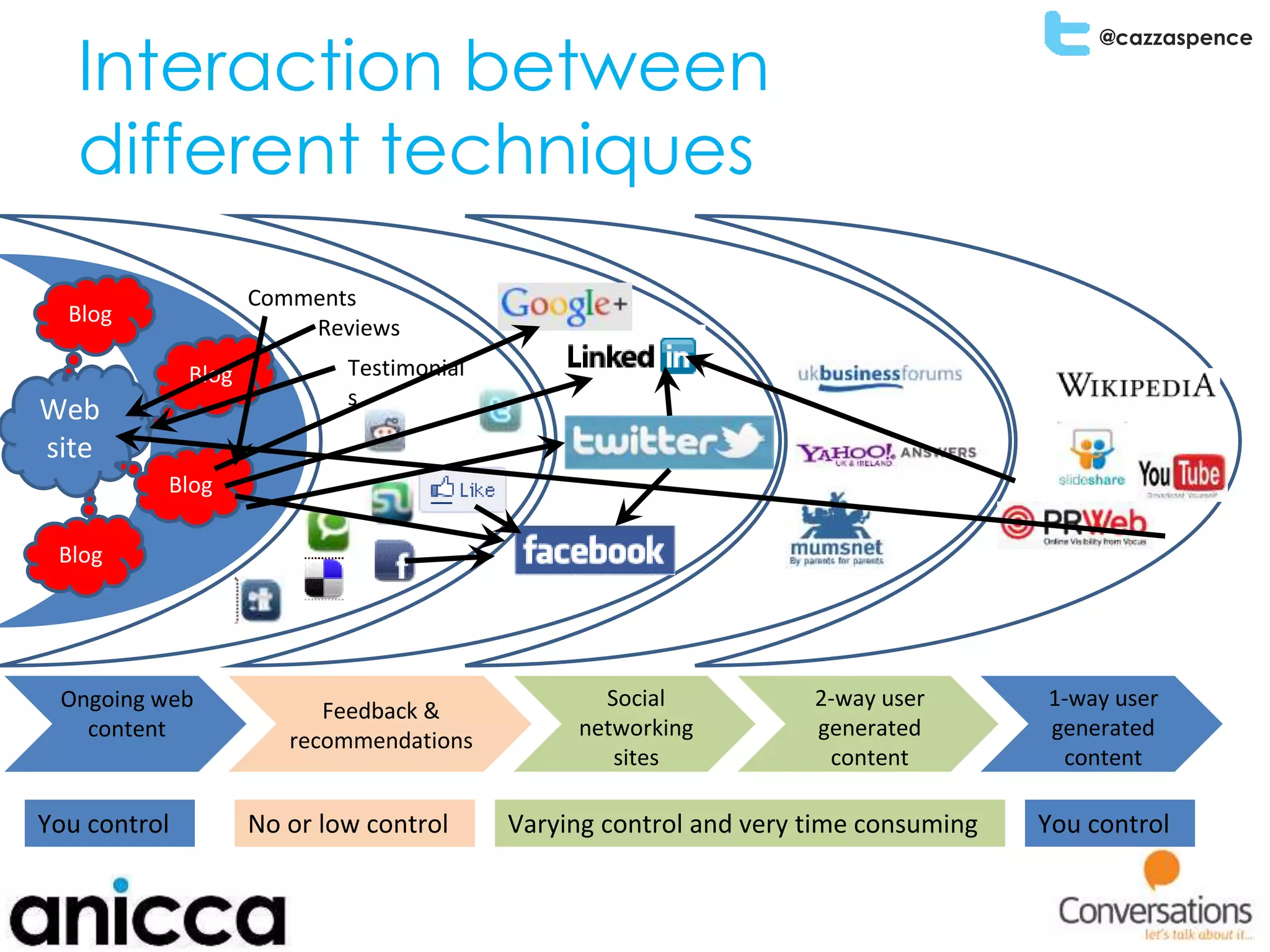
Ongoing web
content
Feedback &
recommendations
Social
networking
sites
2-way user
generated
content
1-way user
generated
content
Interaction between
different techniques
Web
site
Blog
Blog
Blog
Blog
Comments
Reviews
Testimonial
s
You control No or low control Varying control and very time consuming You control
@cazzaspence
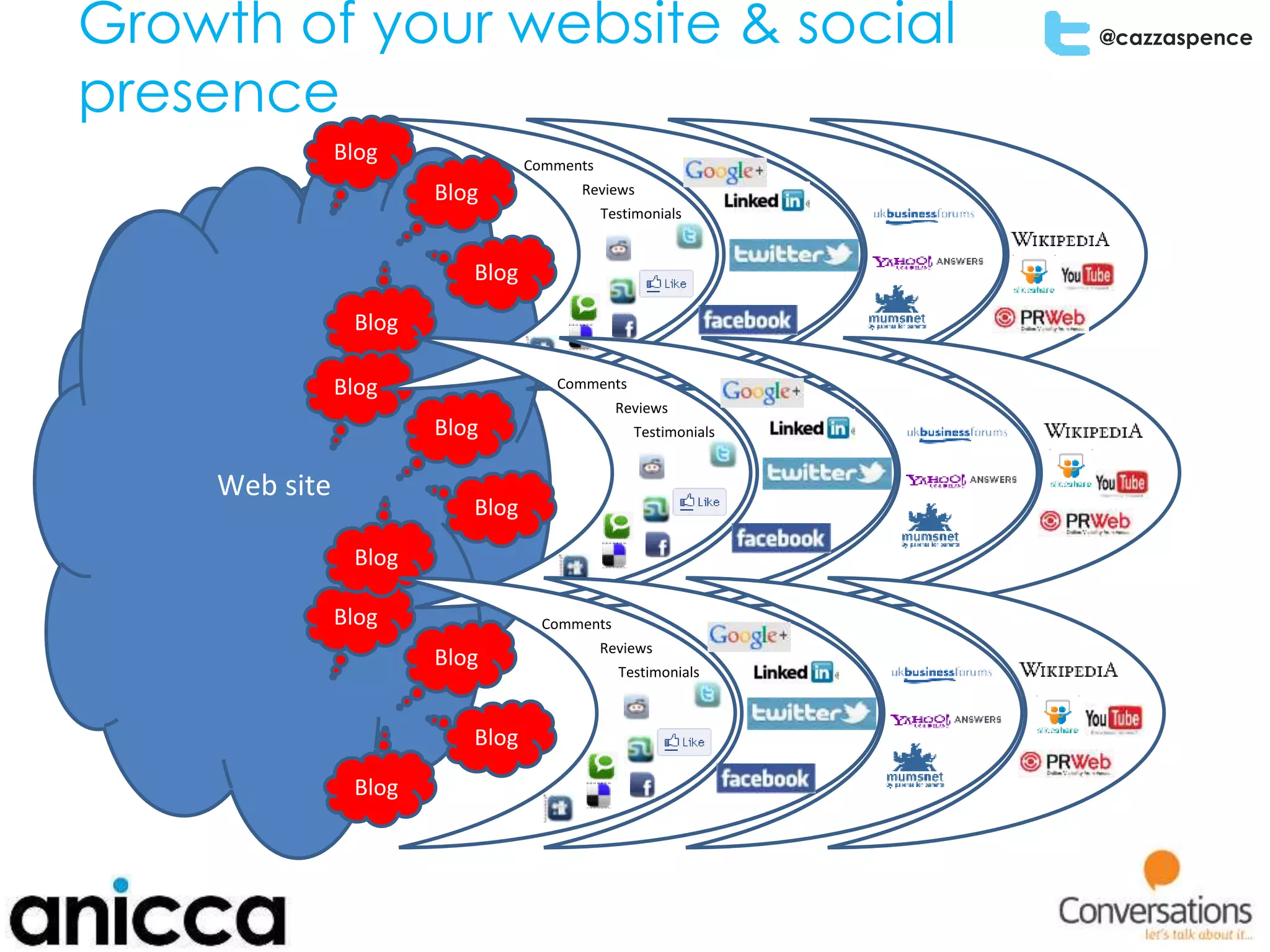
Web
site
Web site
Web site
Growth of your website & social
presence
Blog
Blog
Blog
Blog
Blog
Blog
Blog
Blog
Blog
Blog
Blog
Blog
Comments
Reviews
Testimonials
Comments
Reviews
Testimonials
Comments
Reviews
Testimonials
@cazzaspence
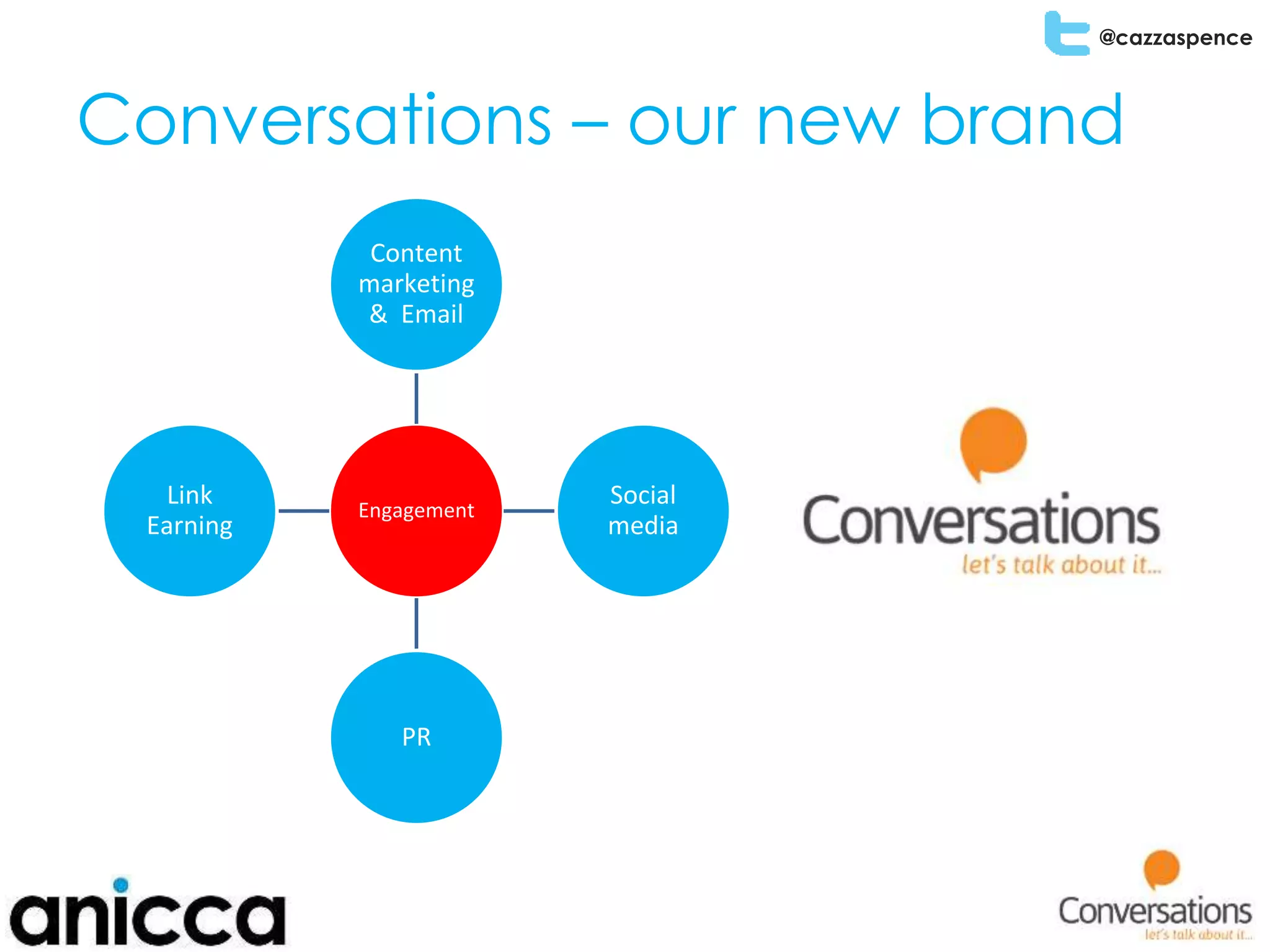
Conversations – our new brand
Engagement
Content
marketing
& Email
Social
media
PR
Link
Earning
@cazzaspence
Thank You
caroline@anicca.co.uk
www.anicca.co.uk

Introduction to Public Relations

  • 1.
    @cazzaspence An introduction to publicrelations By Caroline Spence PR Director of Anicca Digital
  • 2.
    @cazzaspence Our brands Paid Media& Search Marketing (SEO, PPC, Analytics, ecommerce) Owned & Earned media (SEO, Content, PR, Social, Email, MAS) Marketing training for business professionals More leads and sales Building your brand Educating your team
  • 3.
  • 4.
    @cazzaspence Contents • Introduction – Whatis PR? – PR tactics – Difference between PR and advertising • Getting started – Understanding the time / resources commitment – Willingness to participate – What is of interest to the media? Story Mining • PR techniques – Preparing content – Talking to the media – Blogs and social media – Events – Reviews/ sampling • Measurement – Collating and measuring coverage – How PR can help SEO and social media • Useful Tips
  • 5.
  • 6.
    @cazzaspence What is PR? PRhas had some bad press! However, used correctly it can be really beneficial for your business • Free editorial content • Written by a third party (journalist or blogger) • Word of Mouth recommendation – credible, powerful • Can be TV, radio, print, online, social media • Great for raising awareness • Can generate sales – BUT not always trackable
  • 7.
    @cazzaspence How prevalent isPR? PR has had some bad press! However, used correctly it can be really beneficial for your business • Free editorial content • Written by a third party (journalist or blogger) • Word of Mouth recommendation – credible, powerful • Can be TV, radio, print, online, social media • Great for raising awareness • Can generate sales – BUT not always trackable
  • 8.
    @cazzaspence PR Tactics PR ispart of the Marketing Mix. Tactics can include: • Media or press relations • Event management • Social Media • Community relations/CSR • Crisis Communications and Reputation Management • Lobbying/ Public Affairs
  • 9.
    @cazzaspence Difference between PRand Advertising It’s just advertising ain’t it? Erm, no. Often confused, here are the main differences. • PR is free editorial content, advertising is paid for • PR is written by a third party, advertising is written in the first person – PR is more credible, believable • Advertising is set amount of space, on a set date for a set price. None of this is controllable in PR • In advertising, you can control the content to the letter. In PR you can only influence the content
  • 10.
    @cazzaspence What can PRdo for your business? • Raise awareness of the brand/ products/ services • Drive traffic/ footfall • Positive brand associations • Improve reputation • Promote the people behind the business • Increase brand engagement • Funding/ grants/ awards/ buyers • Massive increases in sales cannot be guaranteed!
  • 11.
  • 12.
    @cazzaspence Understanding the time/ resources commitment • PR is low cost, which means it’s time intensive • Need to understand that resources will have to be used, either conducting a campaign or managing an agency • Journalists will not wait for you, arrange calls/ appointments around you • Short deadlines/ fast reactions
  • 13.
    @cazzaspence What you needto be prepared to do • Get out there – no business ever promoted itself alone in an office • Make cold calls to media • Sell your business in person – inevitably exposure for you • Networking • Public speaking/ interviews • Have your picture taken! • Be nice to people • Change
  • 14.
    @cazzaspence What are themedia interested in? • Story mining – first step in PR • News Value, newsworthiness • What is interesting that is happening in your business right now? • New premises, client wins, hires, products • Human interest – charity, learning, quirky • Investment/ expansion /refurbishment - £££ • VIPs, celebrities, Royalty, MPs, Mayors etc • Produce a list and then a calendar of ideas to keep you ontrack
  • 15.
  • 16.
    @cazzaspence Preparing Content Content needspreparing in specific ways to meet media needs • Copy – needs to be concise, catchy, factually correct, no superlatives and written in the third person eg. ‘Waltham College said’ not ‘We said’ • Spell and grammar check – also check facts with relevant parties • Press release format – headline, body copy, contact details and website, social media handles etc • Images – high resolution 300 dpi, taken by a professional, not just a boring line up, colour not b+w • Timely – find out the frequency of the publication and its deadlines
  • 17.
    @cazzaspence Talking to theMedia You’ve got your content sorted, now what? • Who will be interested? Research relevant media titles – look locally, nationally and don’t forget trade titles • Buy the publication or look online. Read it, make sure it’s relevant. Is it in the right location? • Find the Newsdesk or Editorial contacts • Ring in and pitch the story – sound friendly, confident and enthusiastic, rehearse if necessary • Answer questions succinctly, send more information if required • Email press release and images/ links to photos over
  • 18.
    @cazzaspence Talking to theMedia So they are interested, what happens next? • Photo opportunity – a newspaper may send a photographer to get a picture to accompany the story. Arrange a time/date and ensure the right people are there • Interview – can be by phone or face-to-face. Can be for print, radio or TV. Broadcast media can be recorded or live. You will need to prepare for this! Get your key messages lined up, practice making your point in under 30 secs • Coverage – make sure you get the finished article or interview. Think what you could have done better – you learn each time • Try to get a link back to the website – this can improve site authority
  • 19.
    @cazzaspence Blogs and socialmedia • Online media such as blogs and social media has affected media relations and they need to be treated differently • More like a conversation – you need to read Tweets and blogs to find out what they are talking about/ interested in • Join in with NON-COMMERCIAL conversation to start with then drop your story / product in after you have established a rapport • Find hard-to-reach journalists for national newspapers/ magazines on Twitter • #journalistalert is a good one to set on your Twitter or join the closed group on Facebook
  • 20.
    @cazzaspence Events Having a launchevent/ anniversary party/ fundraising dinner? • Invite the media! Free spots for journos always go down well – especially if food & booze are involved! • Ring the Picture Desk of newspapers and magazines to invite photgraphers • If they don’t come, take your own pictures, write your own press release and issue to relevant titles • Check local glossy magazines for Diary and Social sections – they are always looking for stories • If you are struggling to get interest offer goodie bags, heavy discounts or free samples
  • 21.
    @cazzaspence Reviews/ sampling Is yoursa lifestyle business? If so why not invite the media in for a review/ free trial? • Free stuff is amazing for the media who are normally poorly paid or voluntary • If you offer a service or low value product, a freebie is normally a guaranteed way to get coverage • This especially works for: • Food & drink • Fashion & accessories • Hair & beauty • Home accessories • Just ensure you know who the journalist is (check LinkedIn to find out what they look like) and treat them like a super VIP!
  • 22.
  • 23.
    @cazzaspence How to MeasureSuccess • Historically difficult to measure, there are various forms of measurement dependning on how in-depth you want/ need to be • Number of cuttings – how many positive articles have you created? • Size of article – always key, the bigger the better! • Does it include an image? It’s more likely to be read and remembered • Does it have a weblink? This drives traffic and improves authority • How much would it cost to buy the equivalent space as advertising? From here you can work out how much money you have saved or ROI figures • Audience reach – how many people have been reached by the campaign in total? • Hard numbers – website referrals, customers who have mentioned it, no. of new customers
  • 24.
  • 25.
    @cazzaspence Our strategy forintegrating PR and SEO (for our own and clients sites) • Websites should be built to have an integrated blog and social media icons or they should be add retrospectively to existing sites • We try and blog at least once a week – Optimise the blog to maximise SEO benefits (especially title, perma-link (URL) and use SEO plug-ins for sitemap, titles and descriptions) – Allow comments (screened and approved) – Everyone in the team is encouraged to contribute to our own blog • Our own content is focussed on – Innovation or what’s new in search and online marketing – Areas where we are technical experts – Case studies (including new websites) – Events or speaking slots • We then re-tweet, use share/like using Facebook, LinkedIn and Google+ • We create Press releases and submit to media sites • We also use Tweetdeck or Hootsuite to track areas of interest
  • 26.
    @cazzaspence Integrated strategy toSEO, blogging, social marketing and link building Every week* Blog article 1 PR Opportunity Social Sharing Blog Article 2 PR Social More if possible PR Social
  • 27.
    @cazzaspence Ongoing web content Feedback & recommendations Social networking sites 2-wayuser generated content 1-way user generated content Interaction between different techniques Web site Blog Blog Blog Blog Comments Reviews Testimonial s You control No or low control Varying control and very time consuming You control
  • 28.
    @cazzaspence Web site Web site Web site Growthof your website & social presence Blog Blog Blog Blog Blog Blog Blog Blog Blog Blog Blog Blog Comments Reviews Testimonials Comments Reviews Testimonials Comments Reviews Testimonials
  • 29.
    @cazzaspence Conversations – ournew brand Engagement Content marketing & Email Social media PR Link Earning
  • 30.