By
SUBBIAH L
ANNAPOORANI M
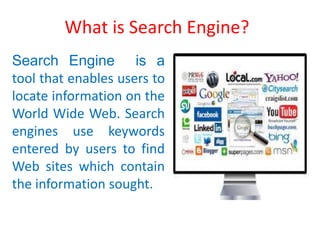
Search Engine is a
tool that enables users to
locate information on the
World Wide Web. Search
engines use keywords
entered by users to find
Web sites which contain
the information sought.
What is Search Engine?
Key internet marketing strategies
• Search engine optimization (SEO)
- no cost per click
• Search engine marketing (SEM)
- cost per click
• What is SEO?
SEO is the act of modifying a website to
increase its ranking in organic (vs paid),
crawler-based listings of search engines.
• What is SEM?
SEM is a act of marketing a website via
search engines by purchasing paid listings.
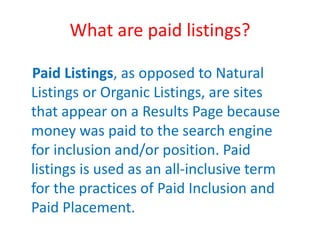
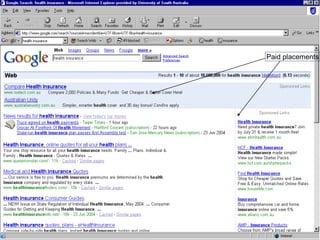
What are paid listings?
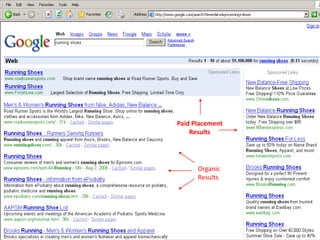
Paid Listings, as opposed to Natural
Listings or Organic Listings, are sites
that appear on a Results Page because
money was paid to the search engine
for inclusion and/or position. Paid
listings is used as an all-inclusive term
for the practices of Paid Inclusion and
Paid Placement.
Paid placements
Paid Placement
Results
Organic
Results
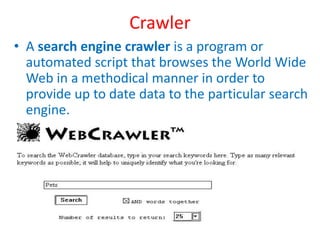
Crawler
• A search engine crawler is a program or
automated script that browses the World Wide
Web in a methodical manner in order to
provide up to date data to the particular search
engine.
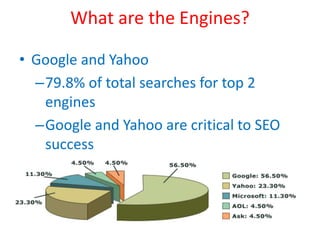
What are the Engines?
• Google and Yahoo
–79.8% of total searches for top 2
engines
–Google and Yahoo are critical to SEO
success
What is a SEO Algorithm?
• Top Secret! The selection of employees of a
search engine companies known for their
certain talents.
• Varies by Search Engine – some give more
weight to on-page factors, some to link
popularity.
• The SEO algorithm is constantly changed,
tweaked & updated.
• Websites and documents being searched
are also constantly changing.
Ranking Factors
• On-Page Factors (Code & Content)
• Title tags <title>
• Header tags <h1>
• ALT image tags
• Content, Content, Content (Body text) <body>
• Hyperlink text
• Keyword frequency & density
• Off-Page Factors
• Link Popularity (“votes” for your site) – adds
credibility
• Anchor text
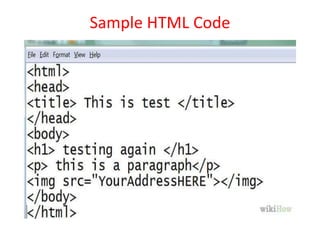
Sample HTML Code
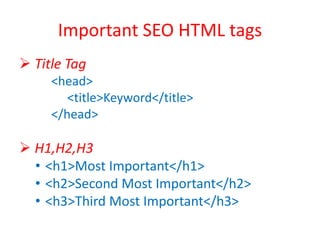
Important SEO HTML tags
 Title Tag
<head>
<title>Keyword</title>
</head>
 H1,H2,H3
• <h1>Most Important</h1>
• <h2>Second Most Important</h2>
• <h3>Third Most Important</h3>
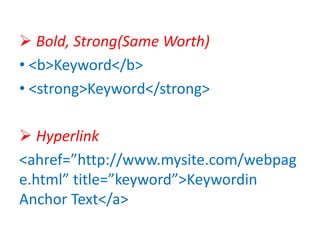
 Bold, Strong(Same Worth)
• <b>Keyword</b>
• <strong>Keyword</strong>
 Hyperlink
<ahref=”http://www.mysite.com/webpag
e.html” title=”keyword”>Keywordin
Anchor Text</a>
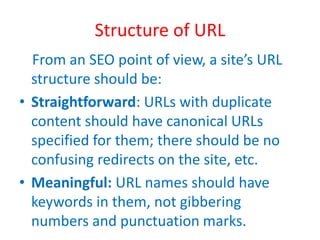
Structure of URL
From an SEO point of view, a site’s URL
structure should be:
• Straightforward: URLs with duplicate
content should have canonical URLs
specified for them; there should be no
confusing redirects on the site, etc.
• Meaningful: URL names should have
keywords in them, not gibbering
numbers and punctuation marks.
Parameters in URL
 Bad Example:
• object=1&type=2&kind=3&node=5&arg=6
 Good Example:
• http://www.mysite.com/brands.php?nike
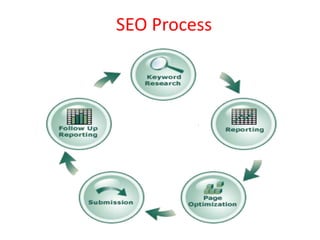
SEO Process
Do’s and Don'ts in SEO
 Use meaningful
filenames such as
"turtle-food.jpg"
instead of
"image1.jpg" for all
files including graphics,
sound, scripts, etc...
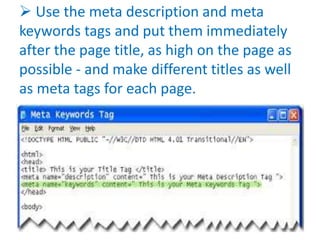
 Use the meta description and meta
keywords tags and put them immediately
after the page title, as high on the page as
possible - and make different titles as well
as meta tags for each page.
 Get a list of keywords for EACH PAGE and
work them into the tags. Also, use them in
the page titles. Put keywords ahead of the
company name in page titles, such as in:
“Turtle Food Experts” .
 Use hyphens in filenames instead of
underscores .
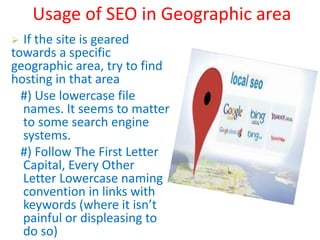
 If the site is geared
towards a specific
geographic area, try to find
hosting in that area
#) Use lowercase file
names. It seems to matter
to some search engine
systems.
#) Follow The First Letter
Capital, Every Other
Letter Lowercase naming
convention in links with
keywords (where it isn’t
painful or displeasing to
do so)
Usage of SEO in Geographic area
Keyword Research
• Keyword research is the process of
determining the best words for a website
to use to influence its SEO.
Conducting research helps marketers to
plan content strategies efficiently.
• A good start would be to choose 3 or 4
keywords you would like your website to
rank well for.
• Keyword research is a vital first step for
successful SEM campaigns.
Different Types of Keywords
• Broad Keyword
• Specific Keywords
• Unique or Branded Keywords
• Similar Keywords
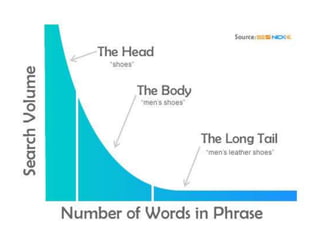
 Broad Keywords
• Broad keywords tend to be very short and
aren't very specific (e.g. "shoes" or
"sports").
 Specific Keywords
• A specific keyword is something that
contains many adjectives or words that
make the search very targeted..
 Unique or Branded Keywords
• These are the words that are specific to
only your company.
 Similar Keywords
• If you're making a page to target "big hats,"
consider changing up the adjective "big" to
its synonyms, like "huge," "giant,“ or
"large," You can also use the names of
specific words that relate to "big hats," like
"cowboy hat“.
Keyword Research Tools
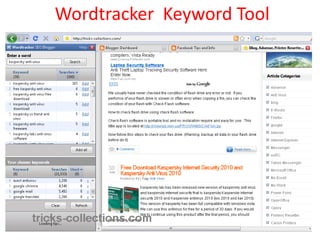
• The Wordtracker Keyword Tool helps you to
grow your business and multiply your profits.
• Get keyword results you can trust
• Saves time
• Boost your search engine rankings
• Discover profitable new market niches
• Attract targeted, profitable traffic to your site
• The Wordtracker Keywords Tool is the industry
standard for keyword research today, and is
trusted by SEO professionals and online
marketers around the world.
Wordtracker Keyword Tool
Page Ranking
Page Ranking
What is Page ranking?
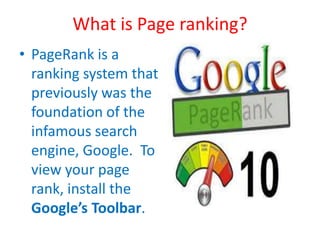
• PageRank is a
ranking system that
previously was the
foundation of the
infamous search
engine, Google. To
view your page
rank, install the
Google’s Toolbar.
Users of Page Rank
• When Page Rank first came out, only
Google was using the technology, but as
other search engines have seen how
much it improved Google's accuracy,
nearly every search engine has added the
Page Rank system in to be at least part of
their algorithm.
How Important is Page Rank?
• When Google was in its childhood, Page
Rank was the single most important
factor for ranking well. However, as soon
as the SEO community caught on to this,
there was a great deal of people who
found ways to artificially boost their
clients' PageRank.
Where do I Get PageRank for my Site?
• The only way to
get PageRank is
to get a link from
a site that
already has
PageRank.
• There are a lot of repetitive tasks to be
done when optimizing your site for the
search engines.
• To make it easier, we've compiled a list
of the most popular SEO Tools (nearly all
100% free) and categorized them into
the following.,
• Keyword Discovery - Find popular
keywords that your site should be
targeting.
• Keyword Volume - Estimate how
much search traffic a specific keyword
receives each month.
• Keyword Density - Analyse how well
a specific webpage is targeting a
keyword.
• Site Popularity - Determine how
popular your site is on the internet.
• Keyword Rankings - Track of your
site's rankings for a keyword in the
search engines.
• Firefox Add on - Install these add on
features to turn your browser into an SEO
research powerhouse.
Emerging Trends of SEO in 2014!
Mobile SEO is already very important and is
set to get more significant in 2014. Tablets
and cell phones already make up one-third
of all the search traffic. Websites need to be
compatible in mobile phones if they are to
be really successful. Websites not
supporting mobile browsers will be
significantly affected in the rankings since
they would not appear when users search for
related stuff from their mobile devices.
• If you have done
everything as
discussed in the
previous sessions you
will observe that
gradually your
website moves up and
finally starts
appearing in the first
page.
Conclusion
Search Engine Optimization

Search Engine Optimization

  • 1.
  • 2.
    Search Engine isa tool that enables users to locate information on the World Wide Web. Search engines use keywords entered by users to find Web sites which contain the information sought. What is Search Engine?
  • 3.
    Key internet marketingstrategies • Search engine optimization (SEO) - no cost per click • Search engine marketing (SEM) - cost per click
  • 4.
    • What isSEO? SEO is the act of modifying a website to increase its ranking in organic (vs paid), crawler-based listings of search engines. • What is SEM? SEM is a act of marketing a website via search engines by purchasing paid listings.
  • 5.
    What are paidlistings? Paid Listings, as opposed to Natural Listings or Organic Listings, are sites that appear on a Results Page because money was paid to the search engine for inclusion and/or position. Paid listings is used as an all-inclusive term for the practices of Paid Inclusion and Paid Placement.
  • 6.
  • 7.
  • 8.
    Crawler • A searchengine crawler is a program or automated script that browses the World Wide Web in a methodical manner in order to provide up to date data to the particular search engine.
  • 9.
    What are theEngines? • Google and Yahoo –79.8% of total searches for top 2 engines –Google and Yahoo are critical to SEO success
  • 10.
    What is aSEO Algorithm? • Top Secret! The selection of employees of a search engine companies known for their certain talents. • Varies by Search Engine – some give more weight to on-page factors, some to link popularity. • The SEO algorithm is constantly changed, tweaked & updated. • Websites and documents being searched are also constantly changing.
  • 11.
    Ranking Factors • On-PageFactors (Code & Content) • Title tags <title> • Header tags <h1> • ALT image tags • Content, Content, Content (Body text) <body> • Hyperlink text • Keyword frequency & density • Off-Page Factors • Link Popularity (“votes” for your site) – adds credibility • Anchor text
  • 12.
  • 13.
    Important SEO HTMLtags  Title Tag <head> <title>Keyword</title> </head>  H1,H2,H3 • <h1>Most Important</h1> • <h2>Second Most Important</h2> • <h3>Third Most Important</h3>
  • 14.
     Bold, Strong(SameWorth) • <b>Keyword</b> • <strong>Keyword</strong>  Hyperlink <ahref=”http://www.mysite.com/webpag e.html” title=”keyword”>Keywordin Anchor Text</a>
  • 15.
    Structure of URL Froman SEO point of view, a site’s URL structure should be: • Straightforward: URLs with duplicate content should have canonical URLs specified for them; there should be no confusing redirects on the site, etc. • Meaningful: URL names should have keywords in them, not gibbering numbers and punctuation marks.
  • 16.
    Parameters in URL Bad Example: • object=1&type=2&kind=3&node=5&arg=6  Good Example: • http://www.mysite.com/brands.php?nike
  • 18.
  • 19.
    Do’s and Don'tsin SEO  Use meaningful filenames such as "turtle-food.jpg" instead of "image1.jpg" for all files including graphics, sound, scripts, etc...
  • 20.
     Use themeta description and meta keywords tags and put them immediately after the page title, as high on the page as possible - and make different titles as well as meta tags for each page.
  • 21.
     Get alist of keywords for EACH PAGE and work them into the tags. Also, use them in the page titles. Put keywords ahead of the company name in page titles, such as in: “Turtle Food Experts” .  Use hyphens in filenames instead of underscores .

  • 22.
     If thesite is geared towards a specific geographic area, try to find hosting in that area #) Use lowercase file names. It seems to matter to some search engine systems. #) Follow The First Letter Capital, Every Other Letter Lowercase naming convention in links with keywords (where it isn’t painful or displeasing to do so) Usage of SEO in Geographic area
  • 24.
    Keyword Research • Keywordresearch is the process of determining the best words for a website to use to influence its SEO. Conducting research helps marketers to plan content strategies efficiently. • A good start would be to choose 3 or 4 keywords you would like your website to rank well for. • Keyword research is a vital first step for successful SEM campaigns.
  • 26.
    Different Types ofKeywords • Broad Keyword • Specific Keywords • Unique or Branded Keywords • Similar Keywords
  • 27.
     Broad Keywords •Broad keywords tend to be very short and aren't very specific (e.g. "shoes" or "sports").  Specific Keywords • A specific keyword is something that contains many adjectives or words that make the search very targeted..
  • 28.
     Unique orBranded Keywords • These are the words that are specific to only your company.  Similar Keywords • If you're making a page to target "big hats," consider changing up the adjective "big" to its synonyms, like "huge," "giant,“ or "large," You can also use the names of specific words that relate to "big hats," like "cowboy hat“.
  • 29.
    Keyword Research Tools •The Wordtracker Keyword Tool helps you to grow your business and multiply your profits. • Get keyword results you can trust • Saves time • Boost your search engine rankings • Discover profitable new market niches • Attract targeted, profitable traffic to your site • The Wordtracker Keywords Tool is the industry standard for keyword research today, and is trusted by SEO professionals and online marketers around the world.
  • 30.
  • 31.
  • 32.
    What is Pageranking? • PageRank is a ranking system that previously was the foundation of the infamous search engine, Google. To view your page rank, install the Google’s Toolbar.
  • 33.
    Users of PageRank • When Page Rank first came out, only Google was using the technology, but as other search engines have seen how much it improved Google's accuracy, nearly every search engine has added the Page Rank system in to be at least part of their algorithm.
  • 34.
    How Important isPage Rank? • When Google was in its childhood, Page Rank was the single most important factor for ranking well. However, as soon as the SEO community caught on to this, there was a great deal of people who found ways to artificially boost their clients' PageRank.
  • 35.
    Where do IGet PageRank for my Site? • The only way to get PageRank is to get a link from a site that already has PageRank.
  • 37.
    • There area lot of repetitive tasks to be done when optimizing your site for the search engines. • To make it easier, we've compiled a list of the most popular SEO Tools (nearly all 100% free) and categorized them into the following.,
  • 38.
    • Keyword Discovery- Find popular keywords that your site should be targeting. • Keyword Volume - Estimate how much search traffic a specific keyword receives each month. • Keyword Density - Analyse how well a specific webpage is targeting a keyword.
  • 39.
    • Site Popularity- Determine how popular your site is on the internet. • Keyword Rankings - Track of your site's rankings for a keyword in the search engines. • Firefox Add on - Install these add on features to turn your browser into an SEO research powerhouse.
  • 40.
    Emerging Trends ofSEO in 2014! Mobile SEO is already very important and is set to get more significant in 2014. Tablets and cell phones already make up one-third of all the search traffic. Websites need to be compatible in mobile phones if they are to be really successful. Websites not supporting mobile browsers will be significantly affected in the rankings since they would not appear when users search for related stuff from their mobile devices.
  • 41.
    • If youhave done everything as discussed in the previous sessions you will observe that gradually your website moves up and finally starts appearing in the first page. Conclusion