Prepared by
Parveen Kumar
Department of International Foundation Studies
Amity University Tashkent
pkumar@amity.uz
Programme: International Foundation Studies
Course Title: Intensive English Through Practice-I
Module V: Writing
• Punctuations
• Types of Sentence
• Writing Paragraphs with Unity,
Coherence, Focus and Flow
https://ifsamityenglish.blogspot.com/
Parveen Kumar | pkumar@amity.uz
Punctuation
Your Speech in Writing with the
STYLE – TONE – WAY of
Speaking!
WHY PUNCTUATION,”/.](‘?
Parveen Kumar | pkumar@amity.uz
What is Punctuation?
• Punctuation is the system of symbols (. , ! - : etc) that we use to
separate sentences and parts of sentences, and to make their meaning
clear. Each symbol is called a "punctuation mark".
• Punctuation makes your speech Meaningful.
• It gives a Proper Idea to the Reader about the intention and tone of
the text.
• Without Punctuations, English is WRONG!
• Punctuation makes us Good Speakers.
Parveen Kumar | pkumar@amity.uz
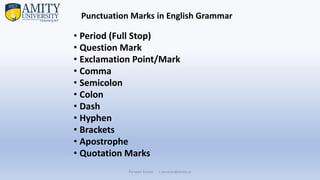
• Period (Full Stop)
• Question Mark
• Exclamation Point/Mark
• Comma
• Semicolon
• Colon
• Dash
• Hyphen
• Brackets
• Apostrophe
• Quotation Marks
Parveen Kumar | pkumar@amity.uz
Punctuation Marks in English Grammar
Parveen Kumar | pkumar@amity.uz
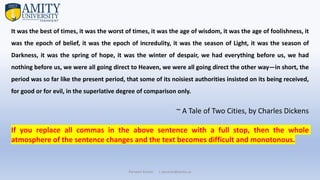
It was the best of times, it was the worst of times, it was the age of wisdom, it was the age of foolishness, it
was the epoch of belief, it was the epoch of incredulity, it was the season of Light, it was the season of
Darkness, it was the spring of hope, it was the winter of despair, we had everything before us, we had
nothing before us, we were all going direct to Heaven, we were all going direct the other way—in short, the
period was so far like the present period, that some of its noisiest authorities insisted on its being received,
for good or for evil, in the superlative degree of comparison only.
~ A Tale of Two Cities, by Charles Dickens
If you replace all commas in the above sentence with a full stop, then the whole
atmosphere of the sentence changes and the text becomes difficult and monotonous.
Parveen Kumar | pkumar@amity.uz
Period or Full Stop
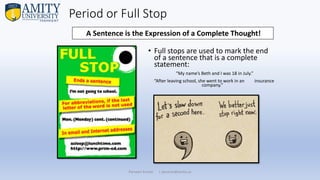
• Full stops are used to mark the end
of a sentence that is a complete
statement:
“My name’s Beth and I was 18 in July.”
“After leaving school, she went to work in an insurance
company.”
Parveen Kumar | pkumar@amity.uz
A Sentence is the Expression of a Complete Thought!
Comma
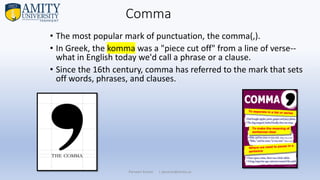
• The most popular mark of punctuation, the comma(,).
• In Greek, the komma was a "piece cut off" from a line of verse--
what in English today we'd call a phrase or a clause.
• Since the 16th century, comma has referred to the mark that sets
off words, phrases, and clauses.
Parveen Kumar | pkumar@amity.uz
When is a Comma used?
• The comma is mainly used
• To separate items in a series or list
• To separate phrases and clauses
• To separate question tags from the rest of the sentence
• To separate certain words like however, moreover, in addition
to, in short, in fact, of course, firstly, secondly, etc.
• To separate spoken part of the text from the unspoken part
• when words or phrases are used in direct address
• After the words like Yes, No, Oh, Ah, etc
Parveen Kumar | pkumar@amity.uz
• To show that a direct question has been asked whether in direct
speech enclosed within inverted commas or as a part of a
passage of writing.
• A Statement which asks a Questions shall attract an
Interrogation Mark
Example: “What do you think I should wear for the party
tonight?” asked Sheron.
Parveen Kumar | pkumar@amity.uz
The Question Mark
• To exclaim over something- a dramatic confession, a warning, an
expression of anger, joy etc.
• It is used by writers to convey an emotion to the reader.
• An exclamatory mark is used after a strong imperative sentence
Example: Keep quiet!
after the words expressing anger, joy, surprise, sorrow, etc.
Example: What a victory!
Oh, that was a terrible accident!
What a wastage of money on these elections!
Parveen Kumar | pkumar@amity.uz
The Exclamatory Mark!
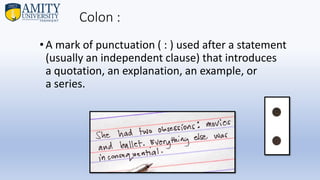
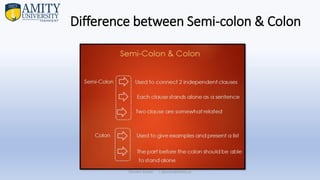
Colon :
•A mark of punctuation ( : ) used after a statement
(usually an independent clause) that introduces
a quotation, an explanation, an example, or
a series.
Parveen Kumar | pkumar@amity.uz
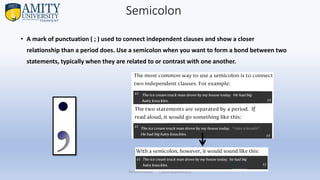
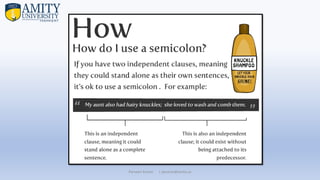
Semicolon
• A mark of punctuation ( ; ) used to connect independent clauses and show a closer
relationship than a period does. Use a semicolon when you want to form a bond between two
statements, typically when they are related to or contrast with one another.
Parveen Kumar | pkumar@amity.uz
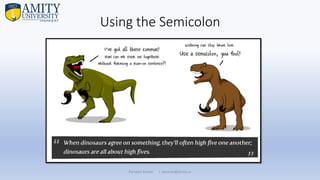
Using the Semicolon
Parveen Kumar | pkumar@amity.uz
Difference between Semi-colon & Colon
Parveen Kumar | pkumar@amity.uz
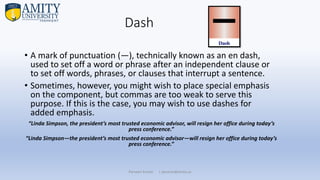
Dash
• A mark of punctuation (—), technically known as an en dash,
used to set off a word or phrase after an independent clause or
to set off words, phrases, or clauses that interrupt a sentence.
• Sometimes, however, you might wish to place special emphasis
on the component, but commas are too weak to serve this
purpose. If this is the case, you may wish to use dashes for
added emphasis.
“Linda Simpson, the president’s most trusted economic advisor, will resign her office during today’s
press conference.”
“Linda Simpson—the president’s most trusted economic advisor—will resign her office during today’s
press conference.”
Parveen Kumar | pkumar@amity.uz
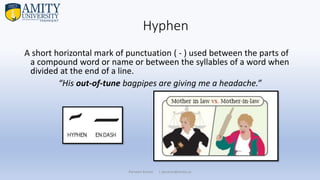
Hyphen
A short horizontal mark of punctuation ( - ) used between the parts of
a compound word or name or between the syllables of a word when
divided at the end of a line.
“His out-of-tune bagpipes are giving me a headache.”
Parveen Kumar | pkumar@amity.uz
Brackets/Parentheses/Braces
• These are used to set off material that is not very closely related to
the rest of the sentence. They usually give extra information.
• Example: The findings of the research (refer to Appendix 2) are
quite surprising.
• Katrina (a hurricane) had a devastating effect on thousands of
people.
Note: Generally, 'parentheses' refers to round brackets ( ) and 'brackets' to
square brackets [ ]. However, we are more and more used to hearing these
referred to simply as 'round brackets' or 'square brackets'. We shall also learn
about the difference between parentheses, brackets, and braces.
Parveen Kumar | pkumar@amity.uz
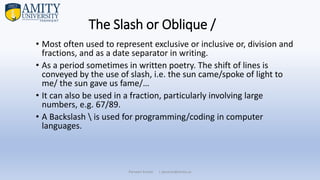
The Slash or Oblique /
• Most often used to represent exclusive or inclusive or, division and
fractions, and as a date separator in writing.
• As a period sometimes in written poetry. The shift of lines is
conveyed by the use of slash, i.e. the sun came/spoke of light to
me/ the sun gave us fame/…
• It can also be used in a fraction, particularly involving large
numbers, e.g. 67/89.
• A Backslash  is used for programming/coding in computer
languages.
Parveen Kumar | pkumar@amity.uz
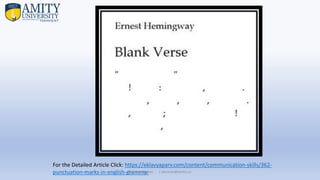
For the Detailed Article Click: https://eklavyaparv.com/content/communication-skills/362-
punctuation-marks-in-english-grammar
Parveen Kumar | pkumar@amity.uz
Module V: Writing
Types of Sentence
• English Alphabet has 26 Letters.
• Meaningful combination of letters makes
WORDS!
• Meaningful combination of words makes
SENTENCES!
A Sentence is the Expression of a
Complete Thought!
Parveen Kumar | pkumar@amity.uz
Module V: Writing
Types of Sentence
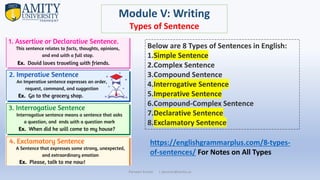
Below are 8 Types of Sentences in English:
1.Simple Sentence
2.Complex Sentence
3.Compound Sentence
4.Interrogative Sentence
5.Imperative Sentence
6.Compound-Complex Sentence
7.Declarative Sentence
8.Exclamatory Sentence
https://englishgrammarplus.com/8-types-
of-sentences/ For Notes on All Types
Parveen Kumar | pkumar@amity.uz
Module V: Writing
Types of Sentence
There are four different kinds of sentences in English grammar and they are as follows:
• Declarative or Assertive Sentence – A declarative or assertive sentence is a
sentence that is informative and ends with a period or a full stop.
Examples:
• I like fantasy novels.
• There is a white house around the corner.
• Imperative Sentence – An imperative sentence is a sentence that expresses a
command, an order, or a request.
Examples:
• Please pick up the notes when you come.
• Close the door.
Parveen Kumar | pkumar@amity.uz
Module V: Writing
Types of Sentence
• Interrogative Sentence – An interrogative sentence is one that is used to
question something and it ends with a question mark.
Examples:
• What is the name of the movie you were watching?
• Can I come with you to the book fair?
• Exclamatory Sentence – An exclamatory sentence is one which is used to
express sudden and strong emotions, and it ends with an exclamation mark.
You can also use interjections to form exclamatory sentences.
Examples:
• Wow, how good this is!
• That was a great match!
Parveen Kumar | pkumar@amity.uz
Module V: Writing
Paragraph Writing
Paragraphs are medium-sized units of writing, longer than sentences, but
shorter than sections, chapters, or entire works. Because they connect the
“small” ideas of individual sentences to a “bigger” idea, paragraph structure
is essential to any writing for organization, flow, and comprehension.
https://www.grammarly.com/blog/paragraph-structure/
Paragraphs follow a standard three-part structure with a beginning, middle,
and end. These parts are:
topic sentence
development and support
and conclusion.
Parveen Kumar | pkumar@amity.uz
Module V: Writing
Paragraph Writing - Types of Paragraphs
Depending on the kind of writing you’re doing, you may need to use different types of
paragraphs. Here’s a brief explanation of the common paragraph types most writing deals
with.
•Expository: Common in nonfiction and all types of essays, expository paragraphs revolve
around explaining and discussing a single point or idea.
•Persuasive: Just like expository paragraphs, persuasive paragraphs focus on discussing a
single point; however, they support opinions instead of facts.
•Narrative: When telling a story, a narrative paragraph explains an action or event. Each
new sentence furthers or expands upon the action by providing new information.
•Descriptive: Also common in storytelling, descriptive paragraphs focus on describing a
single topic, such as a person or an environment. Each new sentence adds a new detail
about that topic.
Parveen Kumar | pkumar@amity.uz
Module V: Writing
Paragraph Writing
Do read these articles on Paragraph Writing Skills:
https://wts.indiana.edu/writing-guides/paragraphs-and-topic-sentences.html
https://www.grammarly.com/blog/paragraph-structure/
https://eklavyaparv.com/content/communication-skills/366-how-to-write-impressive-paragraphs
Parveen Kumar | pkumar@amity.uz
Module V: Writing

Punctuation Marks, Sentences and Paragraph Writing

  • 1.
    Prepared by Parveen Kumar Departmentof International Foundation Studies Amity University Tashkent pkumar@amity.uz Programme: International Foundation Studies Course Title: Intensive English Through Practice-I Module V: Writing • Punctuations • Types of Sentence • Writing Paragraphs with Unity, Coherence, Focus and Flow https://ifsamityenglish.blogspot.com/
  • 2.
    Parveen Kumar |pkumar@amity.uz
  • 3.
    Punctuation Your Speech inWriting with the STYLE – TONE – WAY of Speaking!
  • 4.
  • 5.
    What is Punctuation? •Punctuation is the system of symbols (. , ! - : etc) that we use to separate sentences and parts of sentences, and to make their meaning clear. Each symbol is called a "punctuation mark". • Punctuation makes your speech Meaningful. • It gives a Proper Idea to the Reader about the intention and tone of the text. • Without Punctuations, English is WRONG! • Punctuation makes us Good Speakers. Parveen Kumar | pkumar@amity.uz
  • 6.
    • Period (FullStop) • Question Mark • Exclamation Point/Mark • Comma • Semicolon • Colon • Dash • Hyphen • Brackets • Apostrophe • Quotation Marks Parveen Kumar | pkumar@amity.uz Punctuation Marks in English Grammar
  • 7.
    Parveen Kumar |pkumar@amity.uz It was the best of times, it was the worst of times, it was the age of wisdom, it was the age of foolishness, it was the epoch of belief, it was the epoch of incredulity, it was the season of Light, it was the season of Darkness, it was the spring of hope, it was the winter of despair, we had everything before us, we had nothing before us, we were all going direct to Heaven, we were all going direct the other way—in short, the period was so far like the present period, that some of its noisiest authorities insisted on its being received, for good or for evil, in the superlative degree of comparison only. ~ A Tale of Two Cities, by Charles Dickens If you replace all commas in the above sentence with a full stop, then the whole atmosphere of the sentence changes and the text becomes difficult and monotonous.
  • 8.
    Parveen Kumar |pkumar@amity.uz
  • 9.
    Period or FullStop • Full stops are used to mark the end of a sentence that is a complete statement: “My name’s Beth and I was 18 in July.” “After leaving school, she went to work in an insurance company.” Parveen Kumar | pkumar@amity.uz A Sentence is the Expression of a Complete Thought!
  • 10.
    Comma • The mostpopular mark of punctuation, the comma(,). • In Greek, the komma was a "piece cut off" from a line of verse-- what in English today we'd call a phrase or a clause. • Since the 16th century, comma has referred to the mark that sets off words, phrases, and clauses. Parveen Kumar | pkumar@amity.uz
  • 11.
    When is aComma used? • The comma is mainly used • To separate items in a series or list • To separate phrases and clauses • To separate question tags from the rest of the sentence • To separate certain words like however, moreover, in addition to, in short, in fact, of course, firstly, secondly, etc. • To separate spoken part of the text from the unspoken part • when words or phrases are used in direct address • After the words like Yes, No, Oh, Ah, etc Parveen Kumar | pkumar@amity.uz
  • 12.
    • To showthat a direct question has been asked whether in direct speech enclosed within inverted commas or as a part of a passage of writing. • A Statement which asks a Questions shall attract an Interrogation Mark Example: “What do you think I should wear for the party tonight?” asked Sheron. Parveen Kumar | pkumar@amity.uz The Question Mark
  • 13.
    • To exclaimover something- a dramatic confession, a warning, an expression of anger, joy etc. • It is used by writers to convey an emotion to the reader. • An exclamatory mark is used after a strong imperative sentence Example: Keep quiet! after the words expressing anger, joy, surprise, sorrow, etc. Example: What a victory! Oh, that was a terrible accident! What a wastage of money on these elections! Parveen Kumar | pkumar@amity.uz The Exclamatory Mark!
  • 14.
    Colon : •A markof punctuation ( : ) used after a statement (usually an independent clause) that introduces a quotation, an explanation, an example, or a series. Parveen Kumar | pkumar@amity.uz
  • 15.
    Semicolon • A markof punctuation ( ; ) used to connect independent clauses and show a closer relationship than a period does. Use a semicolon when you want to form a bond between two statements, typically when they are related to or contrast with one another. Parveen Kumar | pkumar@amity.uz
  • 16.
    Using the Semicolon ParveenKumar | pkumar@amity.uz
  • 17.
    Parveen Kumar |pkumar@amity.uz
  • 18.
    Difference between Semi-colon& Colon Parveen Kumar | pkumar@amity.uz
  • 19.
    Dash • A markof punctuation (—), technically known as an en dash, used to set off a word or phrase after an independent clause or to set off words, phrases, or clauses that interrupt a sentence. • Sometimes, however, you might wish to place special emphasis on the component, but commas are too weak to serve this purpose. If this is the case, you may wish to use dashes for added emphasis. “Linda Simpson, the president’s most trusted economic advisor, will resign her office during today’s press conference.” “Linda Simpson—the president’s most trusted economic advisor—will resign her office during today’s press conference.” Parveen Kumar | pkumar@amity.uz
  • 20.
    Hyphen A short horizontalmark of punctuation ( - ) used between the parts of a compound word or name or between the syllables of a word when divided at the end of a line. “His out-of-tune bagpipes are giving me a headache.” Parveen Kumar | pkumar@amity.uz
  • 21.
    Brackets/Parentheses/Braces • These areused to set off material that is not very closely related to the rest of the sentence. They usually give extra information. • Example: The findings of the research (refer to Appendix 2) are quite surprising. • Katrina (a hurricane) had a devastating effect on thousands of people. Note: Generally, 'parentheses' refers to round brackets ( ) and 'brackets' to square brackets [ ]. However, we are more and more used to hearing these referred to simply as 'round brackets' or 'square brackets'. We shall also learn about the difference between parentheses, brackets, and braces. Parveen Kumar | pkumar@amity.uz
  • 22.
    The Slash orOblique / • Most often used to represent exclusive or inclusive or, division and fractions, and as a date separator in writing. • As a period sometimes in written poetry. The shift of lines is conveyed by the use of slash, i.e. the sun came/spoke of light to me/ the sun gave us fame/… • It can also be used in a fraction, particularly involving large numbers, e.g. 67/89. • A Backslash is used for programming/coding in computer languages. Parveen Kumar | pkumar@amity.uz
  • 23.
    For the DetailedArticle Click: https://eklavyaparv.com/content/communication-skills/362- punctuation-marks-in-english-grammar Parveen Kumar | pkumar@amity.uz
  • 24.
    Parveen Kumar |pkumar@amity.uz Module V: Writing Types of Sentence • English Alphabet has 26 Letters. • Meaningful combination of letters makes WORDS! • Meaningful combination of words makes SENTENCES! A Sentence is the Expression of a Complete Thought!
  • 25.
    Parveen Kumar |pkumar@amity.uz Module V: Writing Types of Sentence Below are 8 Types of Sentences in English: 1.Simple Sentence 2.Complex Sentence 3.Compound Sentence 4.Interrogative Sentence 5.Imperative Sentence 6.Compound-Complex Sentence 7.Declarative Sentence 8.Exclamatory Sentence https://englishgrammarplus.com/8-types- of-sentences/ For Notes on All Types
  • 26.
    Parveen Kumar |pkumar@amity.uz Module V: Writing Types of Sentence There are four different kinds of sentences in English grammar and they are as follows: • Declarative or Assertive Sentence – A declarative or assertive sentence is a sentence that is informative and ends with a period or a full stop. Examples: • I like fantasy novels. • There is a white house around the corner. • Imperative Sentence – An imperative sentence is a sentence that expresses a command, an order, or a request. Examples: • Please pick up the notes when you come. • Close the door.
  • 27.
    Parveen Kumar |pkumar@amity.uz Module V: Writing Types of Sentence • Interrogative Sentence – An interrogative sentence is one that is used to question something and it ends with a question mark. Examples: • What is the name of the movie you were watching? • Can I come with you to the book fair? • Exclamatory Sentence – An exclamatory sentence is one which is used to express sudden and strong emotions, and it ends with an exclamation mark. You can also use interjections to form exclamatory sentences. Examples: • Wow, how good this is! • That was a great match!
  • 28.
    Parveen Kumar |pkumar@amity.uz Module V: Writing Paragraph Writing Paragraphs are medium-sized units of writing, longer than sentences, but shorter than sections, chapters, or entire works. Because they connect the “small” ideas of individual sentences to a “bigger” idea, paragraph structure is essential to any writing for organization, flow, and comprehension. https://www.grammarly.com/blog/paragraph-structure/ Paragraphs follow a standard three-part structure with a beginning, middle, and end. These parts are: topic sentence development and support and conclusion.
  • 29.
    Parveen Kumar |pkumar@amity.uz Module V: Writing Paragraph Writing - Types of Paragraphs Depending on the kind of writing you’re doing, you may need to use different types of paragraphs. Here’s a brief explanation of the common paragraph types most writing deals with. •Expository: Common in nonfiction and all types of essays, expository paragraphs revolve around explaining and discussing a single point or idea. •Persuasive: Just like expository paragraphs, persuasive paragraphs focus on discussing a single point; however, they support opinions instead of facts. •Narrative: When telling a story, a narrative paragraph explains an action or event. Each new sentence furthers or expands upon the action by providing new information. •Descriptive: Also common in storytelling, descriptive paragraphs focus on describing a single topic, such as a person or an environment. Each new sentence adds a new detail about that topic.
  • 30.
    Parveen Kumar |pkumar@amity.uz Module V: Writing Paragraph Writing Do read these articles on Paragraph Writing Skills: https://wts.indiana.edu/writing-guides/paragraphs-and-topic-sentences.html https://www.grammarly.com/blog/paragraph-structure/ https://eklavyaparv.com/content/communication-skills/366-how-to-write-impressive-paragraphs
  • 31.
    Parveen Kumar |pkumar@amity.uz Module V: Writing