SUBTOPICS:-
Sentence Structures
Use of phrases and clauses in sentences
Importance of proper punctuation
Creating coherence
Organizing principles of paragraphs in documents
SENTENCE STRUCTURE
WHAT IS A SENTENCE?
A group of words, which make complete sense, is called a
sentence.
Examples:-
• Little Jack Horner sat in a corner.
• He went to watch a movie.
KINDS OF SENTENCE:-
There are four kinds of sentence.
• Assertive sentence
• Interrogative sentence
• Imperative sentence
• Exclamatory sentence
ASSERTIVE SENTENCE
A sentence that make a statement or assertion is called a Declarative or
Assertive Sentence.
Example:-
• Humpty Dumpty sat on the wall.
• We are the students of an engineering college.
INTERROGATIVE SENTENCE
A sentence that asks a question is called Interrogative
sentence.
Examples:-
• Where do you live?
• Why did Katappa kill Bahubali?
• Is winter coming?
• Does she correct?
IMPERATIVE SENTENCE
A sentence that expresses a command or an entreaty is called
Imperative Sentence.
Examples:-
• Be quiet.
• Have mercy upon us.
EXCLAMATORY SENTENCE
A sentence that expresses strong feeling is called an
Exclamatory Sentence.
Examples:-
• What a shame!
• How cold the night is!!
• Oh yeah! That’s a goal!
SUBJECT AND PREDICATE
SENTENCE:-
A sentence contains a subject and a predicate.
o Subject can be a noun and pronoun .The rest of the sentence is termed predicate,
which includes the action done by the subject, starting with a verb.
Examples:-
• Sachin Tendulkar(Subject) broke many records during his cricket career(Predicate).
TYPES OF SENTENCES:-
• Simple sentence- Simple sentence contains a subject and a verb.
Examples:- She complete her literature review.
• Compound Sentence- Compound sentence contains two independent
clauses.
Examples:- She completed her literature review and she created her
reference list.
• Complex Sentence- Complex Sentence contain at least one
Independent and one dependent clause.
Examples:- Although she complete her literature review and she
needed to work on her method section.
• Compound-Complex Sentences- This type of sentence contains
two independent clause and at
least one dependent clause.
Examples:-Whenever you go on vacation, your neighbours mow
your grass, and they take up your mail.
CLAUSES
Group of words with both subject and verb are
called clause.
Examples:-
• I am feeling well today.
• Although she is hungry , she will give him some of her food.
• Whatever they decide, I will agree to.
TYPES OF CLAUSES
There are two types of clauses.
• Independent clause- Part of sentence that express a complete
part of sentence.
Example :- She is hungry.
• Dependent clause- Part of sentence that doesn’t express a
complete meaning.
Example :- Although she is hungry.
PHRASES
Group of words without both subject and verb are called phrase.
Examples:-
• Best Friend
• Needing help
• With the blue shirt
TYPES OF PHRASES
There are three types of phrases.
• Adjective phrases
• Adverb phrases
• Noun phrases
ADJECTIVE PHRASES
Group of words that does the work of an Adjective is called an Adjective
phrase.
Example :- A crown is made of gold.
ADVERB PHRASE
Group of words that does the work of an Adverb is called an Adverb Phrase.
Example:- I have done well on the whole.
NOUN PHRASE
Group of words that does the work of an Noun is called an Noun phrase.
Example :- To win a prize is my ambition.
PUNCTUATIONS
IMPORTANCE OF PROPER
PUNCTUATION
Punctuation is the system of sign or symbol
given to a reader to show how a sentence is constructed
and how it should be read.
WHY DO WE USE PUNCTUATIONS??
Marks the beginning and ending of a sentence.
Ex.- Hey, how are you?
Give or mark the meaningful sentence.
Ex.- I just reached here.
To show expressions.
Ex.- What an amazing movie !
DIFFERENT PUNCTUATION
o Full stop/Period( . )
o Semicolon( ; )
o Colon( : )
o Question Mark( ? )
o Apostrophe( ‘ )
o Dash( - )
o Comma( , )
o Hyphen( – )
o Brackets( [ ] )
o Braces( { } )
o Exclamation Mark( ! )
o Parentheses( ( ) )
o Quotations Mark( “ “ )
( . ) – PERIOD /FULL STOP
The period ( . ) is placed at the end of declarative sentences, statement
thought to be complete and after many abbreviation.
Example:-
• I am fine .
• There are so many colours .
( ! ) – EXCLAMATION POINT
The Exclamation point( ! ) is used when a person wants to express a
sudden outcry or add emphasis.
Example:-
• “Holy cow ! ” screamed Jane.
• How amazing this is !
( ? ) – QUESTION MARK
The Question mark ( ? ) is placed at the end of the sentence to
indicate a direct question.
Example:-
• Where do you live?
• How are you?
( , ) – COMMA
The Comma( , ) is used to show a separation of ideas or elements
within the structure of a sentence. Additionally , it is used in numbers, dates and letter
writing the situation and closing.
Example:-
• Thanks for all your help, Akash .
• I have the red, blue and red t-shirt .
( ; ) - SEMICOLON
The Semicolon ( ; ) is used to connect independent clauses. It shows a
closer relationship between the clauses than a period would show .
Examples:-
• Ajay was hurt ; he knew she only said it to upset him .
( : ) - COLON
A Colon ( : ) has three main uses. The first is after a word introducing a
quotation , an explanation , an example , or a series .
Examples:-
• He was planning to study dour subjects: PPS, BE, BEE and maths.
• I didn’t have time to get changed : I was already late .
( - ) - DASH
The Dash ( - ) is used to separate words into statements.
There are two common types of dashes : en dash and em dash.
Examples:-
• She gave him her answer – NO! ( em dash )
• 1880 - 1945 ( en dash )
( – ) - HYPHEN
A Hyphen ( – ) is used to join two or more words together into a
compound term and is not separate by spaces.
Examples:-
• Part – time
• Back – to –back
( [ ] ) - BRACKETS
Brackets are the squared off notation ( [ ] ) used for technical
explanations or to clarify meaning.
If you remove the information in the brackets , the sentence will still make sense.
Examples:-
• He [ Mr. Ram ] was the last person seen at the home.
( ( ) ) – PARENTHESES
Parentheses( ( ) ) are curved notation used to contain
further thoughts or qualifying remarks.
However , parentheses can be replaced by commas without changing the
meaning in most cases.
Examples:-
• Akash and Seeta(who were actually half brother and sister) both have red
hair.
• There are several books on the subject ( see page 113 ).
( ‘ ) - APOSTROPHE
An Apostrophe( ‘ ) is used to indicate the omission of a letter or letter
from a word, the possessive case, or the plurals of lowercase letters.
Examples:-
• I’ve seen that movie several times.
• Jaya’s dog bit the neighbour.
( “ “ ) – QUOTATIONS MARK
Quotation marks( “ “ ) are a pair of punctuation marks used primarily
to mark the beginning and end a passage attributed to another and repeated word
for word.
Examples:-
• “ Don’t go outside “, she said.
• Raj asked her “ hey, how are you ? “
CREATING COHERENCE
WHAT IS COHERENCE IN
SENTENCES??
When sentences, ideas, and details fit together clearly,
readers can follow along easily, and the writing is Coherent.
• The ideas tie together smoothly and clearly to establish the links
that readers need, you can use the methods listed here.
CONNECTIVES AND THEIR
FUNCTIONS
Connectives Function
1 To add a point …and… , Also… , Similarly… , Moreover…
2
.
To contrast two points …but…, Although… ,Yet… , In other hand…
3
.
To move on to next
point
Then…, After this…, Subsequently…
4
.
To note consequences …as…, …since…, So…, Therefore…
5
.
To summarize or
conclude
Finally…, In sum…, To conclude…
USE REPETITION TO LINK IDEAS,
SENTENCES, AND PARAGRAPHS
• Repeating key words or phrases helps connect and focus idea(s) throughout the
essay.
• Repetition also helps the reader remain focused and headed in the right direction.
Example:-
• Most students are intimidated by the works of William Shakespeare. They believe
Shakespeare’s sonnets and plays are far to complicated to read and understand.
ORGANISING PRINCIPLES OF
PARAGRAPH IN DOCUMENTS
PARAGRAPH WRITING
A paragraph is a collection of sentences expressing an idea or
discussing a topic in a meaningful way.
 Different components of a paragraph are:
1. Topic sentences
2. Detail 1.
3. Detail 2.
4. Concluding sentences.
REQUIREMENT OF PARAGRAPH
While writing a paragraph proper attention should be paid to the following points:
• Proper paragraph length
• Unity
• Coherence
• Emphasis/emphatic organization
• Logical develop of idea
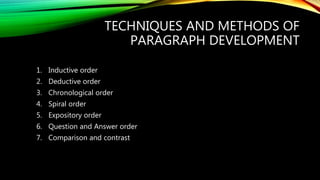
TECHNIQUES AND METHODS OF
PARAGRAPH DEVELOPMENT
1. Inductive order
2. Deductive order
3. Chronological order
4. Spiral order
5. Expository order
6. Question and Answer order
7. Comparison and contrast
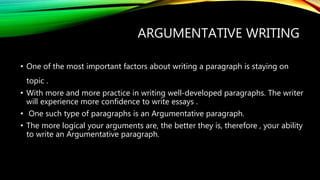
ARGUMENTATIVE WRITING
• One of the most important factors about writing a paragraph is staying on
topic .
• With more and more practice in writing well-developed paragraphs. The writer
will experience more confidence to write essays .
• One such type of paragraphs is an Argumentative paragraph.
• The more logical your arguments are, the better they is, therefore , your ability
to write an Argumentative paragraph.
DESCRIPTIVE WRITING
• Descriptive writing is paying close attention to details.
• The primary intension of descriptive writing is to make our readers
see, feel and hear what we have seen, felt and heard.
• When we are describing a person, a place or a thing, our aim is to
expose a topic through vivid, carefully arranged details.
THANK YOU !!!
PREPARED BY:- OJAS WANI
www.linkedin.com/in/ojas-wani-83108a153/

Basic Writing Skill

  • 2.
    SUBTOPICS:- Sentence Structures Use ofphrases and clauses in sentences Importance of proper punctuation Creating coherence Organizing principles of paragraphs in documents
  • 3.
  • 4.
    WHAT IS ASENTENCE? A group of words, which make complete sense, is called a sentence. Examples:- • Little Jack Horner sat in a corner. • He went to watch a movie.
  • 5.
    KINDS OF SENTENCE:- Thereare four kinds of sentence. • Assertive sentence • Interrogative sentence • Imperative sentence • Exclamatory sentence
  • 6.
    ASSERTIVE SENTENCE A sentencethat make a statement or assertion is called a Declarative or Assertive Sentence. Example:- • Humpty Dumpty sat on the wall. • We are the students of an engineering college.
  • 7.
    INTERROGATIVE SENTENCE A sentencethat asks a question is called Interrogative sentence. Examples:- • Where do you live? • Why did Katappa kill Bahubali? • Is winter coming? • Does she correct?
  • 8.
    IMPERATIVE SENTENCE A sentencethat expresses a command or an entreaty is called Imperative Sentence. Examples:- • Be quiet. • Have mercy upon us.
  • 9.
    EXCLAMATORY SENTENCE A sentencethat expresses strong feeling is called an Exclamatory Sentence. Examples:- • What a shame! • How cold the night is!! • Oh yeah! That’s a goal!
  • 10.
    SUBJECT AND PREDICATE SENTENCE:- Asentence contains a subject and a predicate. o Subject can be a noun and pronoun .The rest of the sentence is termed predicate, which includes the action done by the subject, starting with a verb. Examples:- • Sachin Tendulkar(Subject) broke many records during his cricket career(Predicate).
  • 11.
    TYPES OF SENTENCES:- •Simple sentence- Simple sentence contains a subject and a verb. Examples:- She complete her literature review. • Compound Sentence- Compound sentence contains two independent clauses. Examples:- She completed her literature review and she created her reference list.
  • 12.
    • Complex Sentence-Complex Sentence contain at least one Independent and one dependent clause. Examples:- Although she complete her literature review and she needed to work on her method section. • Compound-Complex Sentences- This type of sentence contains two independent clause and at least one dependent clause. Examples:-Whenever you go on vacation, your neighbours mow your grass, and they take up your mail.
  • 13.
    CLAUSES Group of wordswith both subject and verb are called clause. Examples:- • I am feeling well today. • Although she is hungry , she will give him some of her food. • Whatever they decide, I will agree to.
  • 14.
    TYPES OF CLAUSES Thereare two types of clauses. • Independent clause- Part of sentence that express a complete part of sentence. Example :- She is hungry. • Dependent clause- Part of sentence that doesn’t express a complete meaning. Example :- Although she is hungry.
  • 15.
    PHRASES Group of wordswithout both subject and verb are called phrase. Examples:- • Best Friend • Needing help • With the blue shirt
  • 16.
    TYPES OF PHRASES Thereare three types of phrases. • Adjective phrases • Adverb phrases • Noun phrases
  • 17.
    ADJECTIVE PHRASES Group ofwords that does the work of an Adjective is called an Adjective phrase. Example :- A crown is made of gold.
  • 18.
    ADVERB PHRASE Group ofwords that does the work of an Adverb is called an Adverb Phrase. Example:- I have done well on the whole.
  • 19.
    NOUN PHRASE Group ofwords that does the work of an Noun is called an Noun phrase. Example :- To win a prize is my ambition.
  • 20.
  • 21.
    IMPORTANCE OF PROPER PUNCTUATION Punctuationis the system of sign or symbol given to a reader to show how a sentence is constructed and how it should be read.
  • 22.
    WHY DO WEUSE PUNCTUATIONS?? Marks the beginning and ending of a sentence. Ex.- Hey, how are you? Give or mark the meaningful sentence. Ex.- I just reached here. To show expressions. Ex.- What an amazing movie !
  • 23.
    DIFFERENT PUNCTUATION o Fullstop/Period( . ) o Semicolon( ; ) o Colon( : ) o Question Mark( ? ) o Apostrophe( ‘ ) o Dash( - ) o Comma( , ) o Hyphen( – ) o Brackets( [ ] ) o Braces( { } ) o Exclamation Mark( ! ) o Parentheses( ( ) ) o Quotations Mark( “ “ )
  • 24.
    ( . )– PERIOD /FULL STOP The period ( . ) is placed at the end of declarative sentences, statement thought to be complete and after many abbreviation. Example:- • I am fine . • There are so many colours .
  • 25.
    ( ! )– EXCLAMATION POINT The Exclamation point( ! ) is used when a person wants to express a sudden outcry or add emphasis. Example:- • “Holy cow ! ” screamed Jane. • How amazing this is !
  • 26.
    ( ? )– QUESTION MARK The Question mark ( ? ) is placed at the end of the sentence to indicate a direct question. Example:- • Where do you live? • How are you?
  • 27.
    ( , )– COMMA The Comma( , ) is used to show a separation of ideas or elements within the structure of a sentence. Additionally , it is used in numbers, dates and letter writing the situation and closing. Example:- • Thanks for all your help, Akash . • I have the red, blue and red t-shirt .
  • 28.
    ( ; )- SEMICOLON The Semicolon ( ; ) is used to connect independent clauses. It shows a closer relationship between the clauses than a period would show . Examples:- • Ajay was hurt ; he knew she only said it to upset him .
  • 29.
    ( : )- COLON A Colon ( : ) has three main uses. The first is after a word introducing a quotation , an explanation , an example , or a series . Examples:- • He was planning to study dour subjects: PPS, BE, BEE and maths. • I didn’t have time to get changed : I was already late .
  • 30.
    ( - )- DASH The Dash ( - ) is used to separate words into statements. There are two common types of dashes : en dash and em dash. Examples:- • She gave him her answer – NO! ( em dash ) • 1880 - 1945 ( en dash )
  • 31.
    ( – )- HYPHEN A Hyphen ( – ) is used to join two or more words together into a compound term and is not separate by spaces. Examples:- • Part – time • Back – to –back
  • 32.
    ( [ ]) - BRACKETS Brackets are the squared off notation ( [ ] ) used for technical explanations or to clarify meaning. If you remove the information in the brackets , the sentence will still make sense. Examples:- • He [ Mr. Ram ] was the last person seen at the home.
  • 33.
    ( ( )) – PARENTHESES Parentheses( ( ) ) are curved notation used to contain further thoughts or qualifying remarks. However , parentheses can be replaced by commas without changing the meaning in most cases. Examples:- • Akash and Seeta(who were actually half brother and sister) both have red hair. • There are several books on the subject ( see page 113 ).
  • 34.
    ( ‘ )- APOSTROPHE An Apostrophe( ‘ ) is used to indicate the omission of a letter or letter from a word, the possessive case, or the plurals of lowercase letters. Examples:- • I’ve seen that movie several times. • Jaya’s dog bit the neighbour.
  • 35.
    ( “ “) – QUOTATIONS MARK Quotation marks( “ “ ) are a pair of punctuation marks used primarily to mark the beginning and end a passage attributed to another and repeated word for word. Examples:- • “ Don’t go outside “, she said. • Raj asked her “ hey, how are you ? “
  • 36.
  • 37.
    WHAT IS COHERENCEIN SENTENCES?? When sentences, ideas, and details fit together clearly, readers can follow along easily, and the writing is Coherent. • The ideas tie together smoothly and clearly to establish the links that readers need, you can use the methods listed here.
  • 38.
    CONNECTIVES AND THEIR FUNCTIONS ConnectivesFunction 1 To add a point …and… , Also… , Similarly… , Moreover… 2 . To contrast two points …but…, Although… ,Yet… , In other hand… 3 . To move on to next point Then…, After this…, Subsequently… 4 . To note consequences …as…, …since…, So…, Therefore… 5 . To summarize or conclude Finally…, In sum…, To conclude…
  • 39.
    USE REPETITION TOLINK IDEAS, SENTENCES, AND PARAGRAPHS • Repeating key words or phrases helps connect and focus idea(s) throughout the essay. • Repetition also helps the reader remain focused and headed in the right direction. Example:- • Most students are intimidated by the works of William Shakespeare. They believe Shakespeare’s sonnets and plays are far to complicated to read and understand.
  • 40.
  • 41.
    PARAGRAPH WRITING A paragraphis a collection of sentences expressing an idea or discussing a topic in a meaningful way.  Different components of a paragraph are: 1. Topic sentences 2. Detail 1. 3. Detail 2. 4. Concluding sentences.
  • 42.
    REQUIREMENT OF PARAGRAPH Whilewriting a paragraph proper attention should be paid to the following points: • Proper paragraph length • Unity • Coherence • Emphasis/emphatic organization • Logical develop of idea
  • 43.
    TECHNIQUES AND METHODSOF PARAGRAPH DEVELOPMENT 1. Inductive order 2. Deductive order 3. Chronological order 4. Spiral order 5. Expository order 6. Question and Answer order 7. Comparison and contrast
  • 44.
    ARGUMENTATIVE WRITING • Oneof the most important factors about writing a paragraph is staying on topic . • With more and more practice in writing well-developed paragraphs. The writer will experience more confidence to write essays . • One such type of paragraphs is an Argumentative paragraph. • The more logical your arguments are, the better they is, therefore , your ability to write an Argumentative paragraph.
  • 45.
    DESCRIPTIVE WRITING • Descriptivewriting is paying close attention to details. • The primary intension of descriptive writing is to make our readers see, feel and hear what we have seen, felt and heard. • When we are describing a person, a place or a thing, our aim is to expose a topic through vivid, carefully arranged details.
  • 46.
  • 47.
    PREPARED BY:- OJASWANI www.linkedin.com/in/ojas-wani-83108a153/