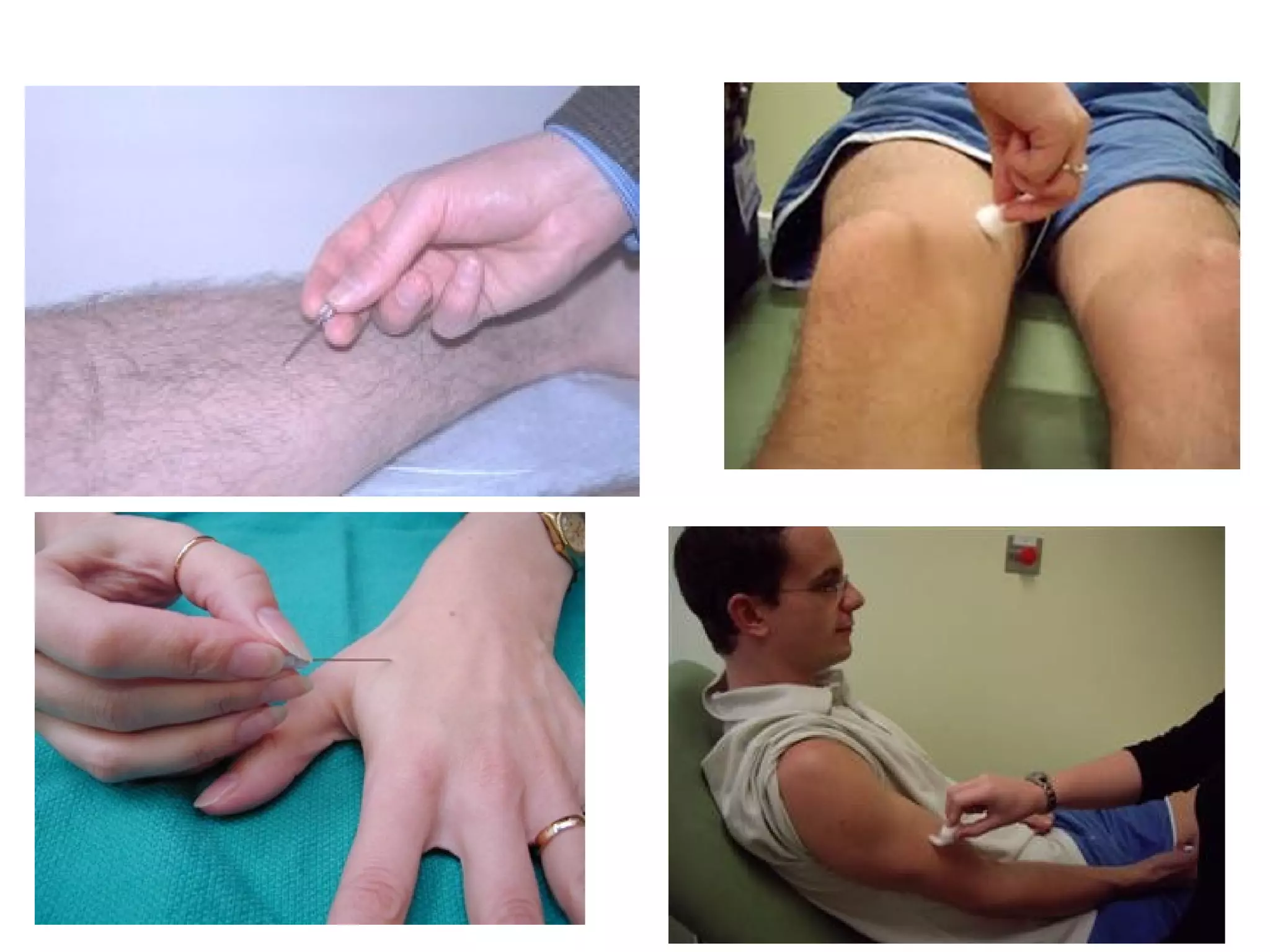
SENSORY SYSTEM
DR. SNEHAL PALLOD
GUIDE-DR.GIRISH NANOTI
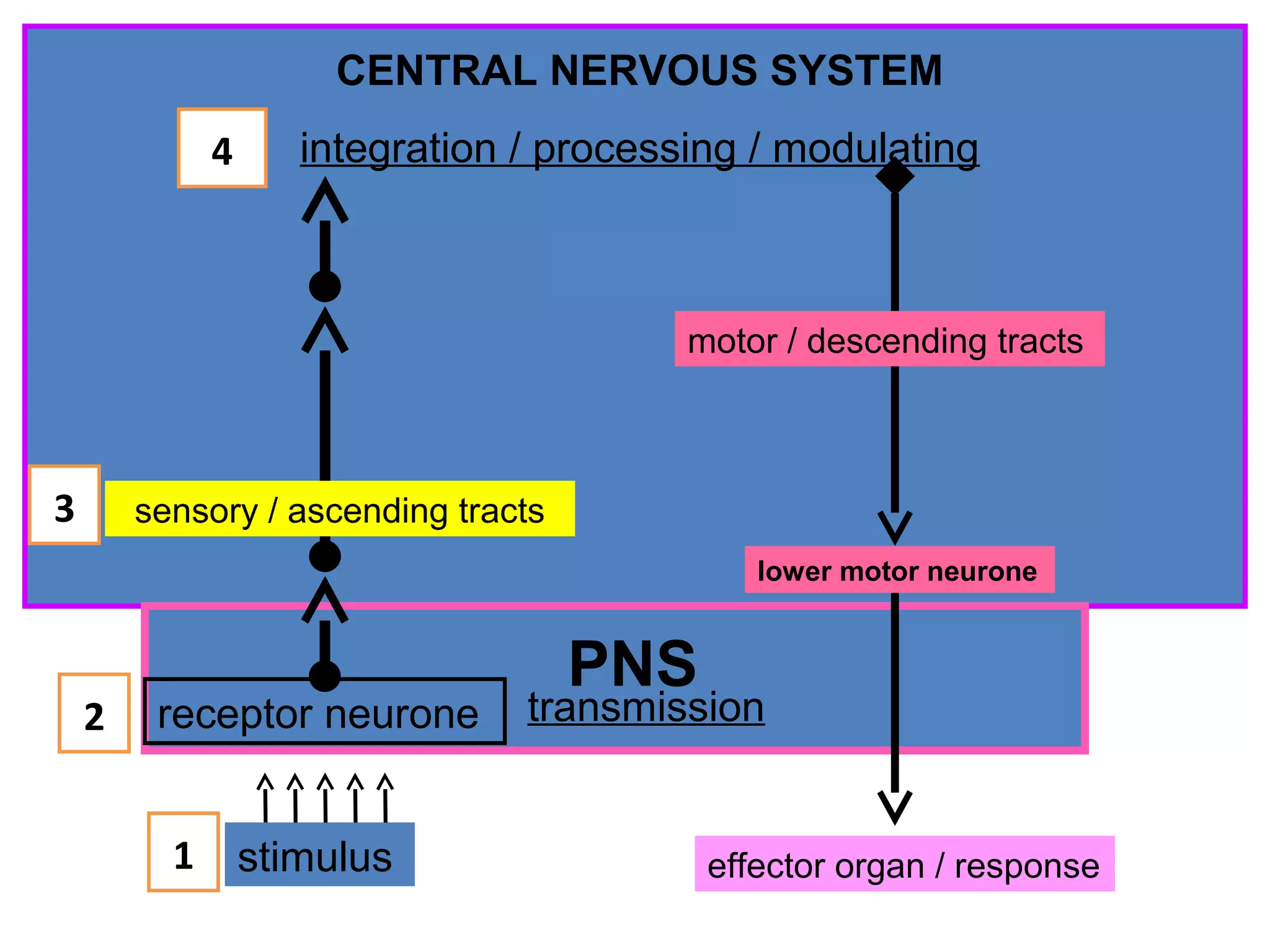
CENTRAL NERVOUS SYSTEM
integration / processing / modulating
stimulus
receptor neurone
motor / descending tracts
effector organ / response
PNS
transmission
lower motor neurone
sensory / ascending tracts
4
3
2
1
• Sensory information
• Exteroceptive information
• Proprioceptive information
sensory information
are received and carried by ascending tracts
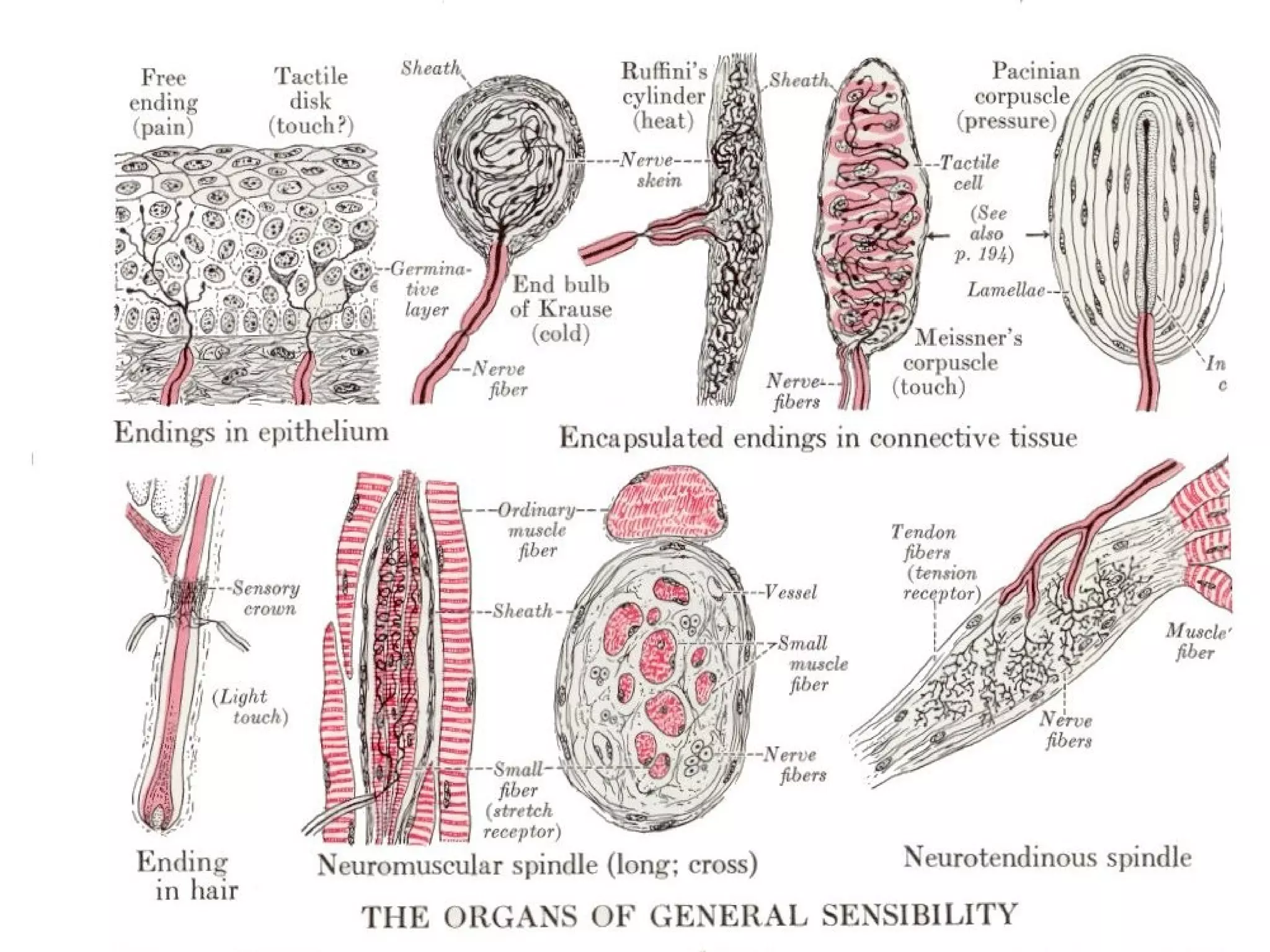
• exteroceptive sensation
origin:- outside the body
e.g. temp, touch, light, sound, chemicals, mechanical
receptors:- surface layer of skin, mucosa
• proprioceptive sensation
origin:- within the body
e.g. muscles, joints, tendons
receptors – deeper layer of skin, tendons, joints, GTO, muscle
spindles, ligament
• Steriognosis , graphesthesia, and two point discrimination combind
( pc) and cortical sensation
sensory information
from the peripheral sensory endings
is conducted through the nervous system
by a series of neurones
information
• conscious sensation
– reach the cerebral cortex
• unconscious sensation
– reach to the areas other than cortex
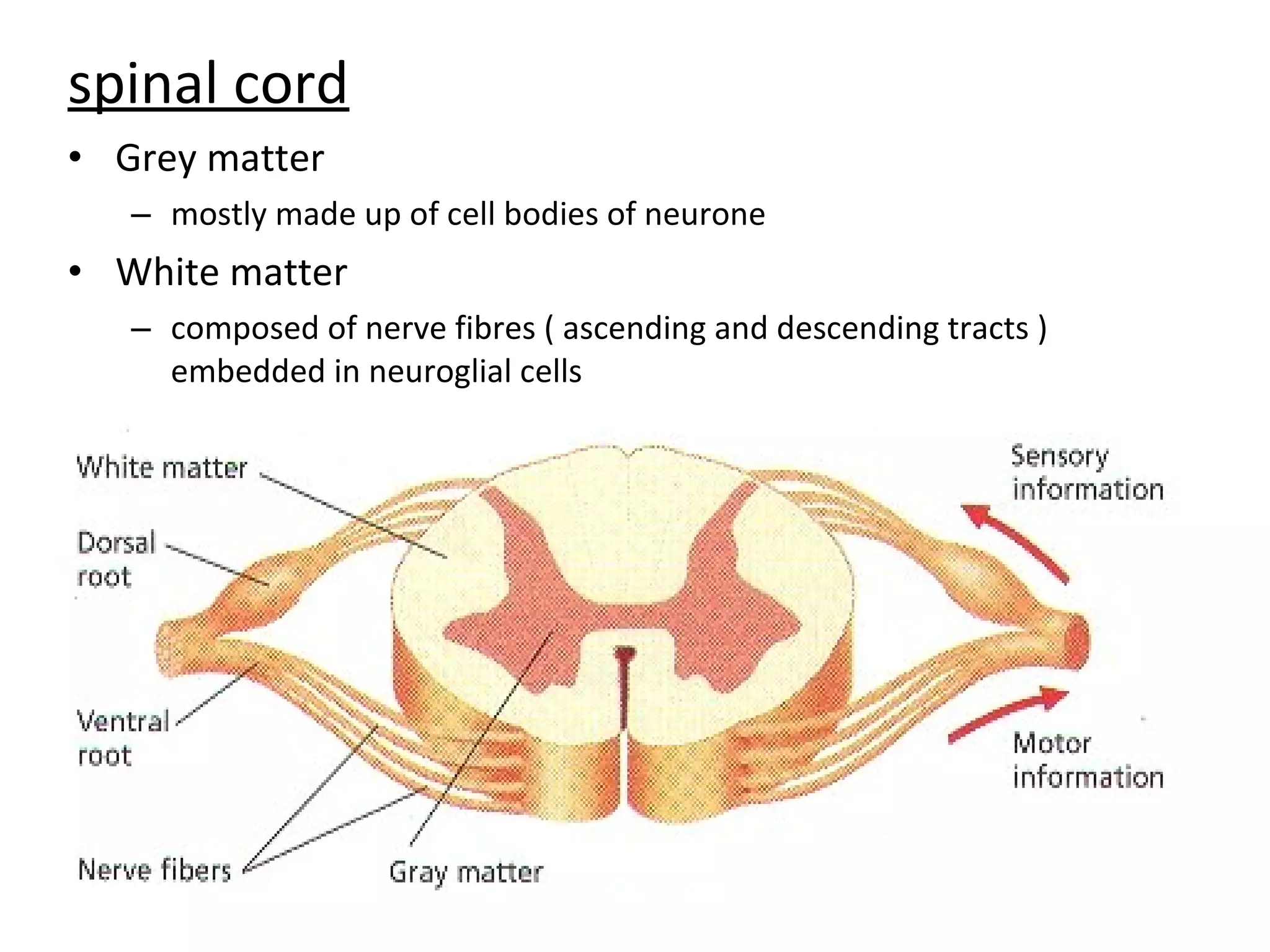
spinal cord
• Grey matter
– mostly made up of cell bodies of neurone
• White matter
– composed of nerve fibres ( ascending and descending tracts )
embedded in neuroglial cells
nerve fibres
• enter the spinal cord through posterior nerve root
• after entering the spinal cord
sorted out and segregated into nerve bundles, tracts
( origin, function, termination )
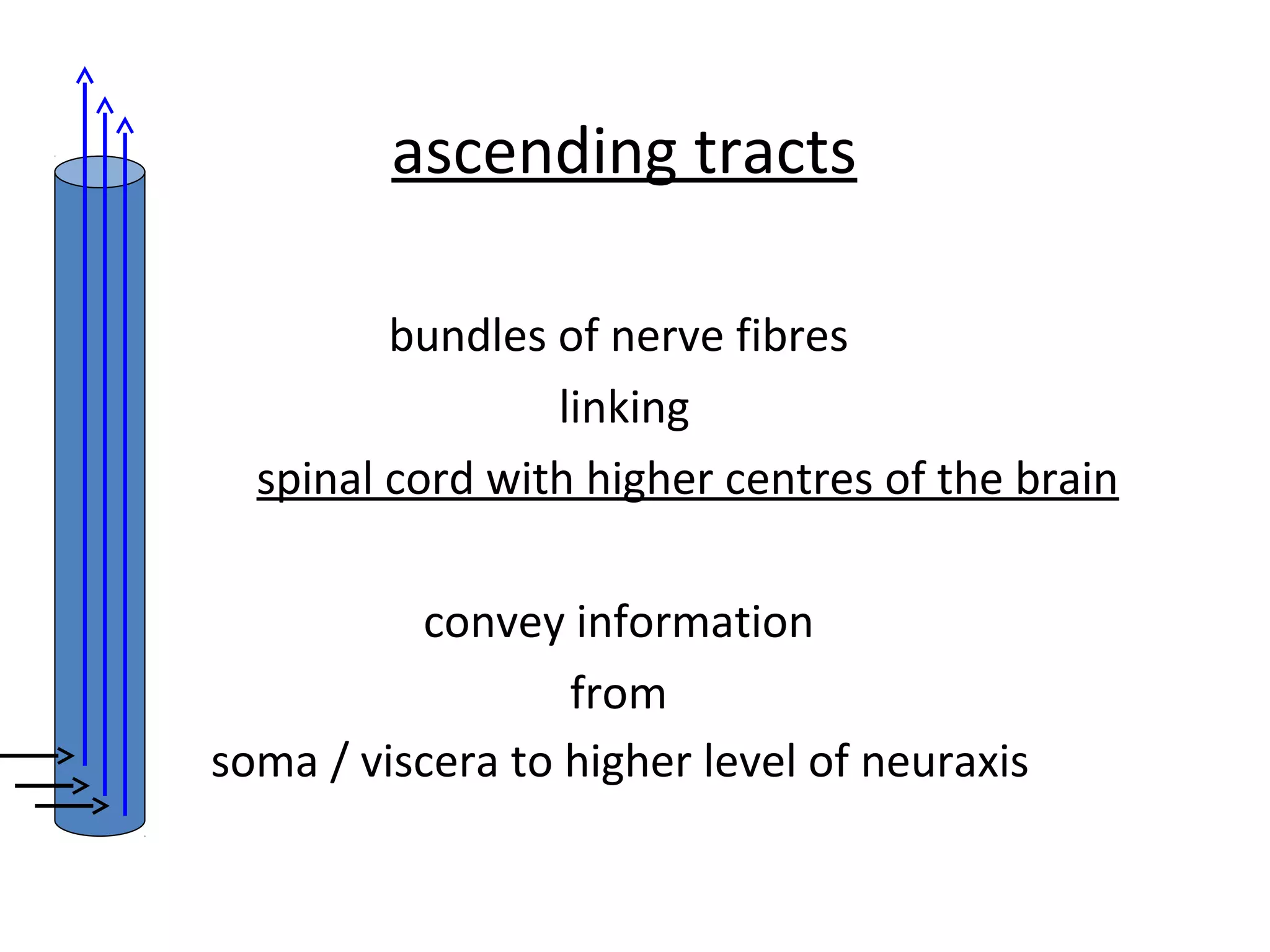
ascending tracts
bundles of nerve fibres
linking
spinal cord with higher centres of the brain
convey information
from
soma / viscera to higher level of neuraxis
Ascending sensory pathway are organized
in three neuronal chain
- First order neurone
- Second order neurone
- Third order neurone
First order neurone
• cell body in posterior root ganglion
• peripheral process connects with sensory receptor
ending
• central process enter the spinal cord through the
posterior root
• synapse with second order neuron in spinal gray
matter
dorsal root
dorsal root
ganglion
spinal
nervedorsal
horn
FIRST ORDER NEURON
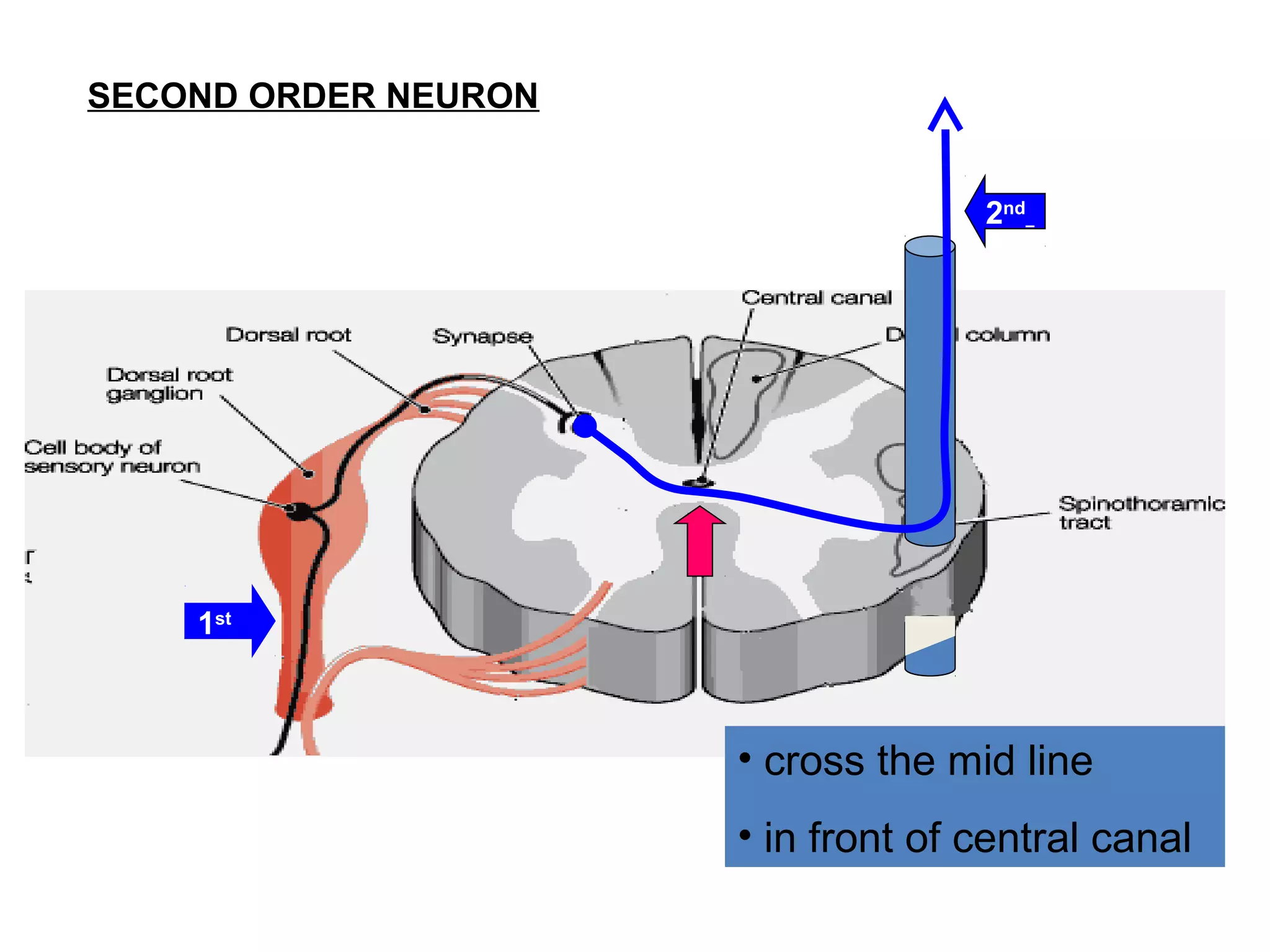
Second order neurone
• cell body in posterior gray column of spinal cord
• axon crosses the midline ( decussate )
• ascend & synapse with third order neuron in VPL
nucleus of thalamus
SECOND ORDER NEURON
• cross the mid line
• in front of central canal
1st
2nd
Third order neurone
• cell body in the thalamus( ventro lateral nucleus)
• give rise to projection fibres to the cerebral cortex,
postcentral gyrus ( sensory area )
ascending sensory pathway
( in general form )
from sensory endings
to
cerebral cortex
( note the three neurons chain )
sensory sensation
Three type
1. Superficial : pain ,temperature and superficial touch
carried by spinothalamic pathway(lateral)
2. Deep : crude touch ,joint position ,vibration carried
by dorsal coloumn
3. Cortical sensation : tactile localization, tactile
discrimination,tactile extiction,astereognosis,two
point discrimination and graphasthesia
Arrangements Of Sensory Fibers
• Posterior column : fibers from lower limb are placed
medially while fibers upper limbs are placed laterally
• Spinothalamic tract : just opposite to posterior
column
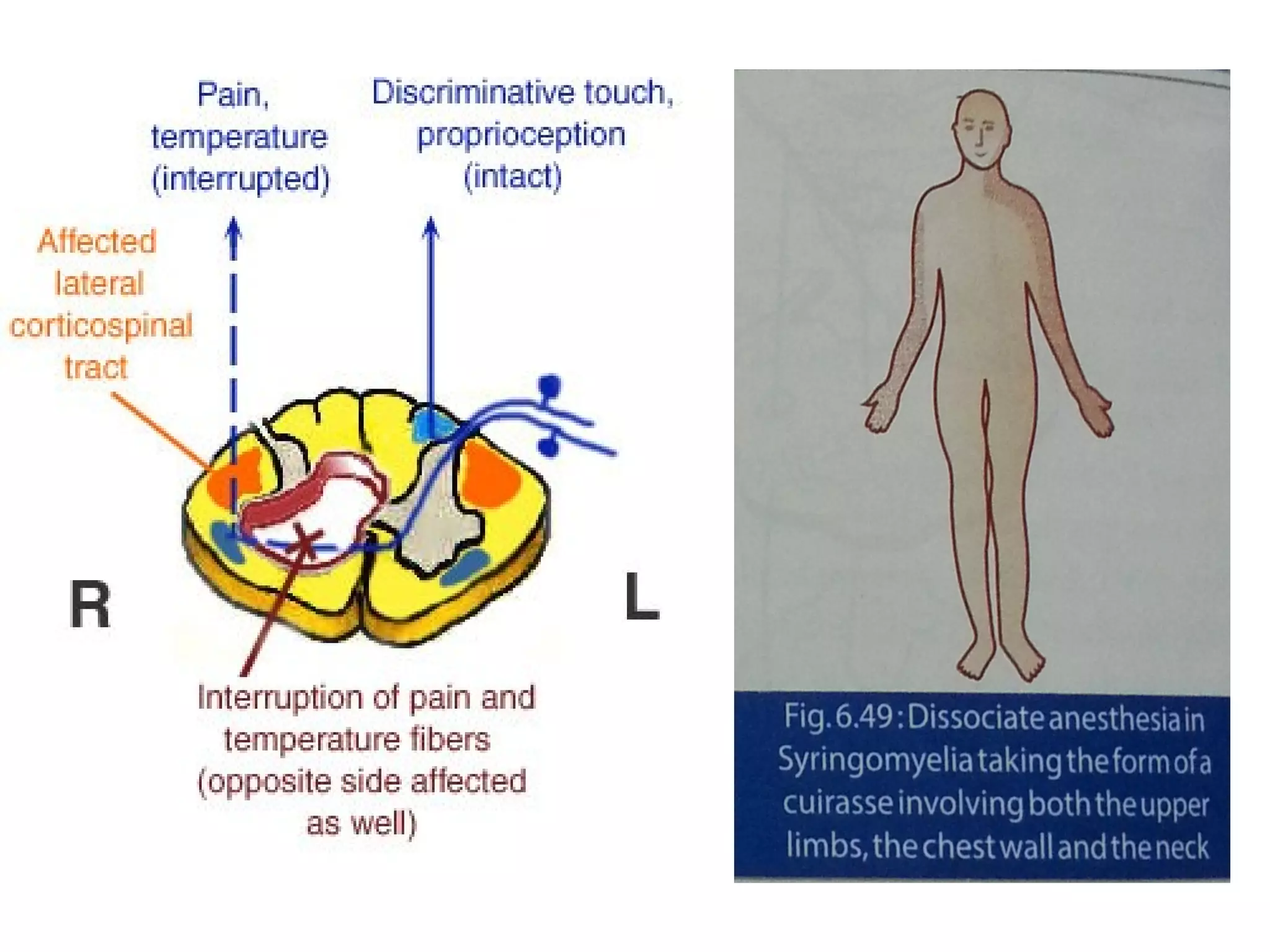
• In central cord lesion lateral spinothalamic tract is
affected 1st
while posterior column sensations are
preserved this causes dissociative aneshesia
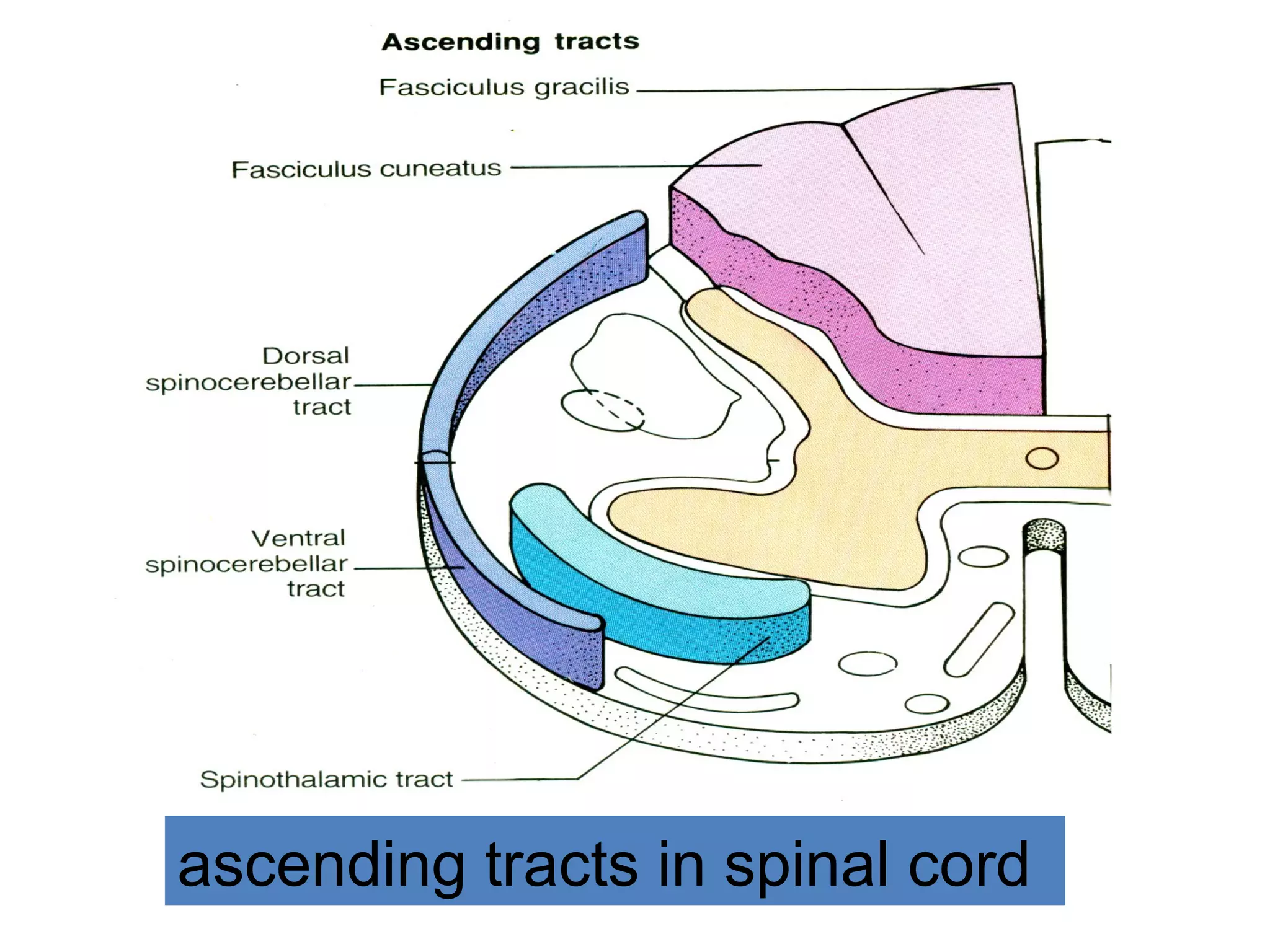
ascending tracts in spinal cord
Tracts & their functional components
• lateral spinothalamic tract
– pain, temperature
• anterior spinothalamic tract
– touch, pressure
• posterior white column
– conscious proprioceptive sense, discriminative
touch, vibratory sense
• spinocerebellar tract / cuneocerebellar
tract
– unconscious information from muscle, joints,
skin, subcutaneous tissues
sensation receptors pathways destination
Pain and temperature Free nerve endings Lateral STT
Spinal lemniscus
Postcentral
gyrus
Light touch and pressure Free nerve endings Anterior STT
Spinal lemniscus
Postcentral
gyrus
Discriminative touch,
vibratory sense,
conscious muscle joint sense
Meissner’s corpuscle,
pacinian corpuscles,
muscle spindles,
tendon organs
Fasciculus gracilis and cuneatus
Medial lemniscus
Postcentral
gyrus
Main somatosensory pathways
Tracts and their course in detail
Lateral spinothalamic tract
pain and thermal impulses
( input from free nerve endings, thermal receptors )
• transmitted to spinal cord in delta A and C fibres
• central process enters the spinal cord through posterior
nerve root, proceed to the tip of the dorsal gray column
• The central process of 1st
order neuron synapse with cell body
of 2nd
order neuron in substantia gelatinosa of posterior gray
column of the spinal cord
• The axon of 2nd
order neuron cross to the opposite side
in the anterior gray and white commissure and ascend in
contralateral white column as lateral spinothalamic tract
• End by synapsing with 3rd
order neuron in the ventral
posterolateral nucleus of thalamus
• Axon of the 3rd
order neuron passes through the posterior
limb of internal capsule and corona radiata to reach the
postcentral gyrus of cerebral cortex ( area 3, 1 and 2 )
pain and temperature
pathways
Clinical application
destruction of LSTT
• loss of
– pain and thermal sensation
– on the contralateral side
– below the level of the lesion
patient will not
respond to pinprick
recognize hot and cold
Anterior spinothalamic tract
light touch and pressure impulses
( input from free nerve endings, Merkel’s tactile disks )
• First order neuron
– dorsal root ganglion( all level )
• Second order neuron
– in the dorsal horn, cross to the opposite side (decussate)
– ascend in the contralateral ventral column as ASTT
– end in VPL nucleus of thalamus
• Third order neuron
– in the VPL nucleus of thalamus
– project to cerebral cortex ( area 3, 1 and 2 )
Touch and Pressure Pathway
Clinical application
destruction of ASTT
loss of touch and pressure sense
– below the level of lesion
– on the contralateral side of the body
Fasciculus gracilis and fasciculus cuneatus
discriminative touch, vibratory sense and conscious
muscle joint sense
( inputs from pacinian corpuscles, Messiner’s corpuscles,
joint receptors, muscle spindles and Golgi tendon organs )
• axon of 1st
order neuron enter the spinal cord
• passes directly to the posterior white column of the
same side ( without synapsing )
• long ascending fibres travel upward in the posterior
column of the same side as fasciculus gracilis and
fasciculus cuneatus
– ( FG – carrying fibres from lower thoracic, lumbar and sacral regions /
including lower limbs )
– ( FC - only in thoracic and cervical segments / including upper limb fibres )
• synapse on the 2nd
order neuron in the nucleus
gracilis and cuneatus of medulla oblongata of the
same side.
lower 6 thoracic segments
lumbar segments
sacral segments
cervical segments
upper 6 thoracic segments
fasciculus gracilis
fasciculus cuneatus
[ nucleus G & C ]
in medulla
G
C
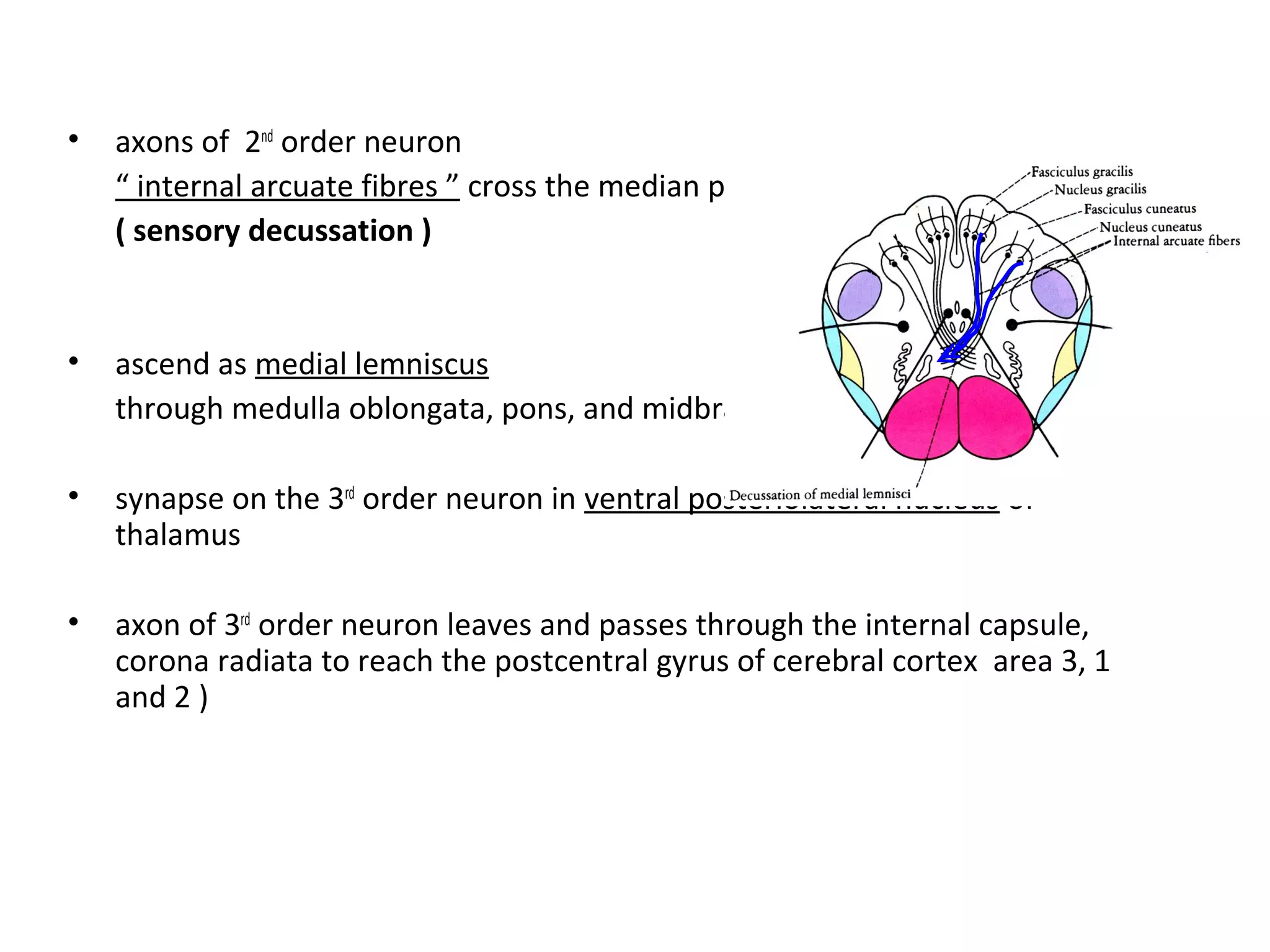
• axons of 2nd
order neuron
“ internal arcuate fibres ” cross the median plane
( sensory decussation )
• ascend as medial lemniscus
through medulla oblongata, pons, and midbrain
• synapse on the 3rd
order neuron in ventral posteriolateral nucleus of
thalamus
• axon of 3rd
order neuron leaves and passes through the internal capsule,
corona radiata to reach the postcentral gyrus of cerebral cortex area 3, 1
and 2 )
pathways for
conscious proprioception
discriminative touch
vibratory sense
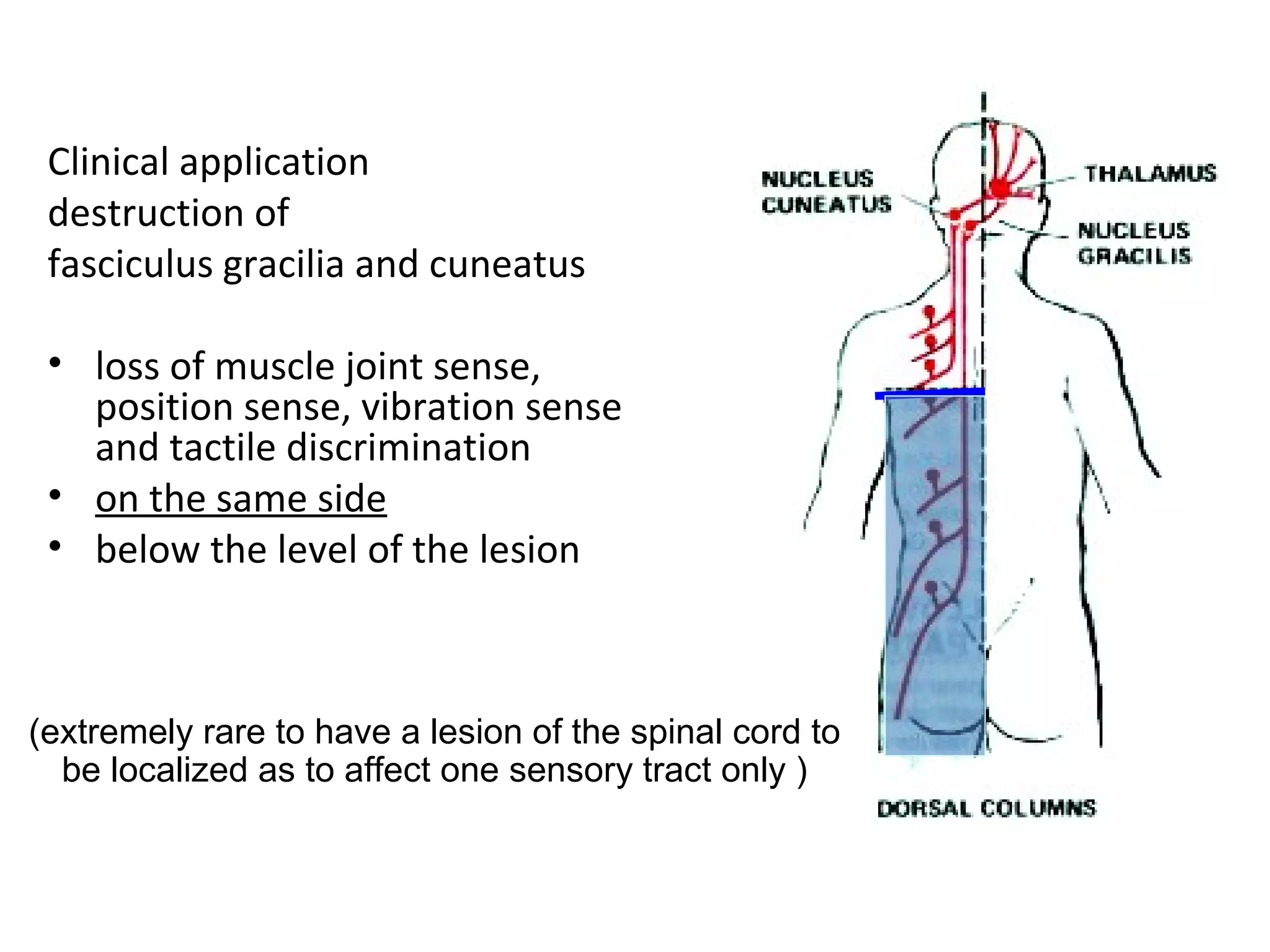
Clinical application
destruction of
fasciculus gracilia and cuneatus
• loss of muscle joint sense,
position sense, vibration sense
and tactile discrimination
• on the same side
• below the level of the lesion
(extremely rare to have a lesion of the spinal cord to
be localized as to affect one sensory tract only )
Posterior & Anterior Spinocerebellar Tract
• transmit unconscious proprioceptive information to
the cerebellum
• receive input from muscle spindles, GTOs and pressure
receptors
• involved in coordination of posture and movement of
individual muscles of the lower limb
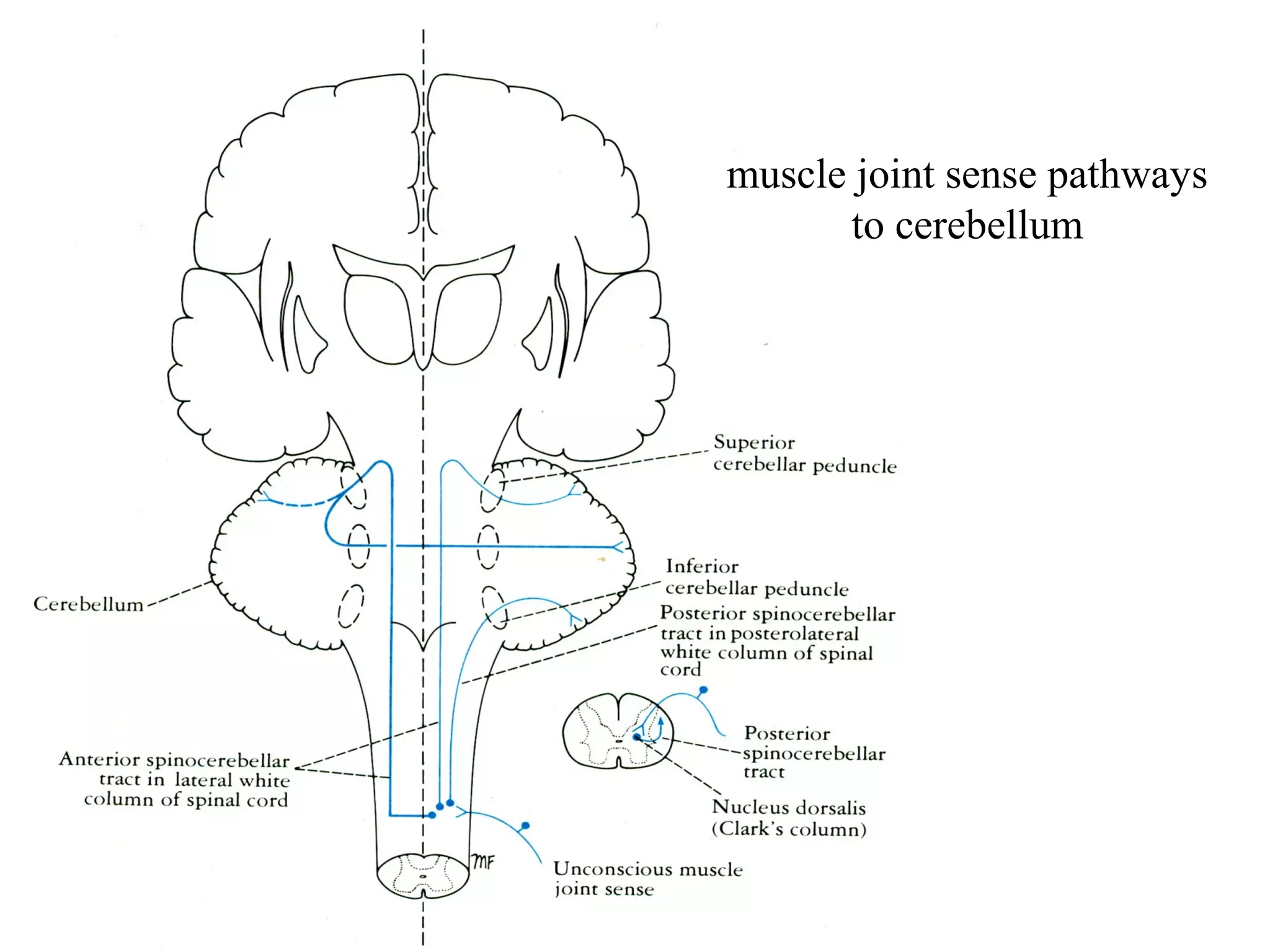
First order neuron
• in dorsal root ganglion
• axons end in nucleus dorsalis of Clarke
Second order neuron
• cell body in nucleus dorsalis of Clarke
• give rise to axons ascending to the cerebellum of the
same side
( anterior – crossed & uncrossed fibres / posterior – uncrossed fibres)
muscle joint sense pathways
to cerebellum
• Spinotectal tract
– passes pain, thermal, tactile information to superior
colliculus for spinovisual reflexes
• cross the median plane
• synapse in the superior colliculus
• integrate visual and somatic sensory information
( it brings about the movement of eye and head
towards the source of information )
• Spinoreticular tract
– uncrossed fibres, synapse with neurones of reticular
formation
(important role in influencing level of consciousness)
• Spino-olivary tract
spinotectal tract
spinoreticular tract
spino-oloivary tract
clinical application
• relief of pain
posterior rhizotomy (posterior root)
cordotomy (lateral STT)
• Injury
hemisection of spinal cord
• diseases
tabes dorsalis / syringomyelia / vascular
FRONT:
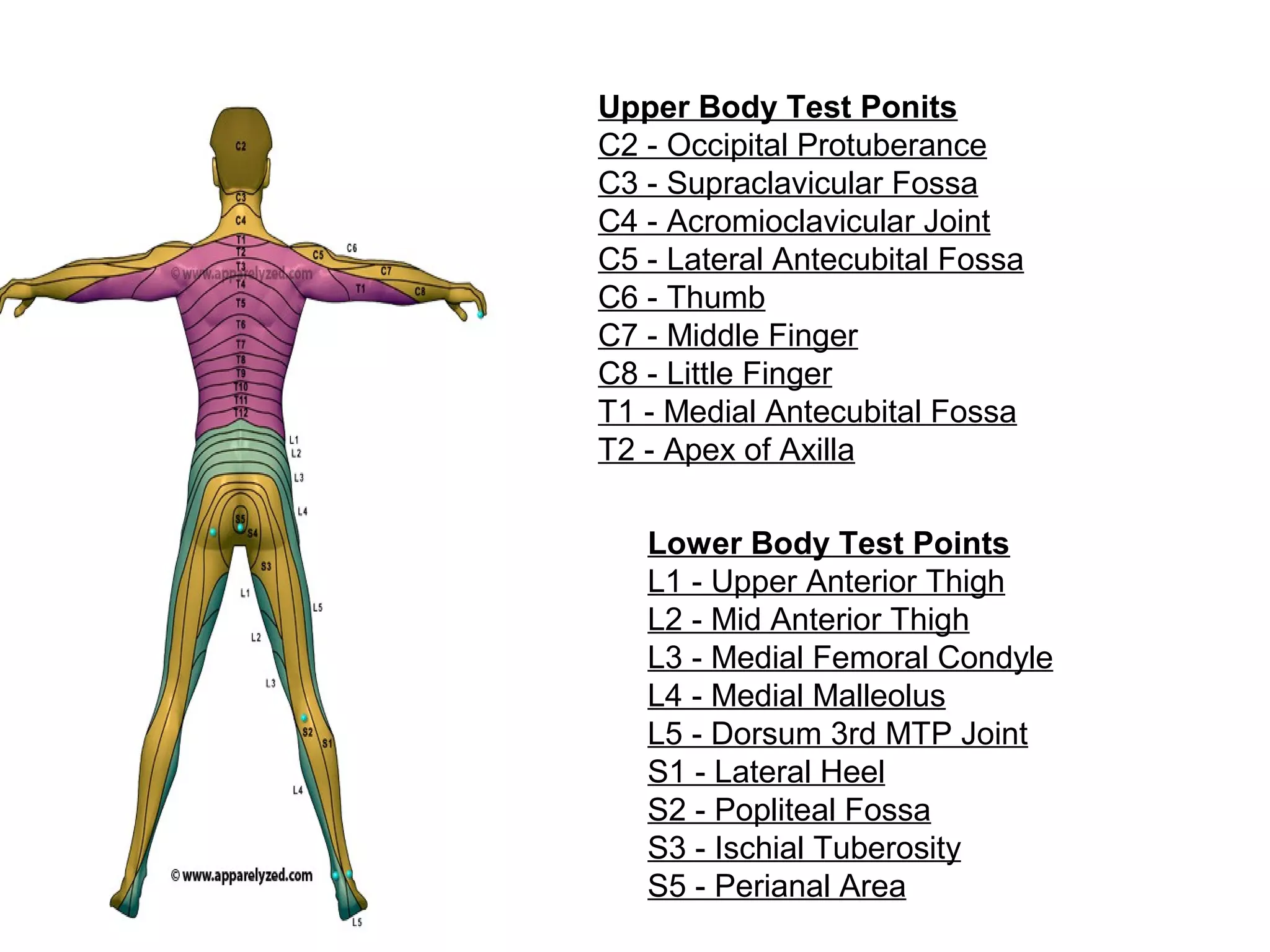
UPPER BODY TEST POINT:
C2: OCCIPITAL PROTUBERANCE
C3: SUPRACLAVICULAR FOSSA
C4: ACROMIOCLAVICULAR JOINT
C5:LATERAL ANTICUBITAL FOSSA
C6:THUMB
C7:MIDDLE FINGER
C8:LITTLE FINGER
T!: MEDIAL ANTICUBITAL FOSSA
T2:APEX OF AXILLA
LOWER BODY TEST POINT:
L1: UPPER ANTERIOR THIGH
L2:MID ANTERIOR THIGH
L3:MEDIAL FEMORAL
CONDYLE
L4:MEDIAL MALLEOLUS
L5: DORSUM OF THE THIRD
MTP JOINT
S1: LATERAL HEEL
S2:POPLITEAL FOSSA
S3:ISCHIAL TUBEROSITY
S5:PERIANAL AREA
Upper Body Test Ponits
C2 - Occipital Protuberance
C3 - Supraclavicular Fossa
C4 - Acromioclavicular Joint
C5 - Lateral Antecubital Fossa
C6 - Thumb
C7 - Middle Finger
C8 - Little Finger
T1 - Medial Antecubital Fossa
T2 - Apex of Axilla
Lower Body Test Points
L1 - Upper Anterior Thigh
L2 - Mid Anterior Thigh
L3 - Medial Femoral Condyle
L4 - Medial Malleolus
L5 - Dorsum 3rd MTP Joint
S1 - Lateral Heel
S2 - Popliteal Fossa
S3 - Ischial Tuberosity
S5 - Perianal Area
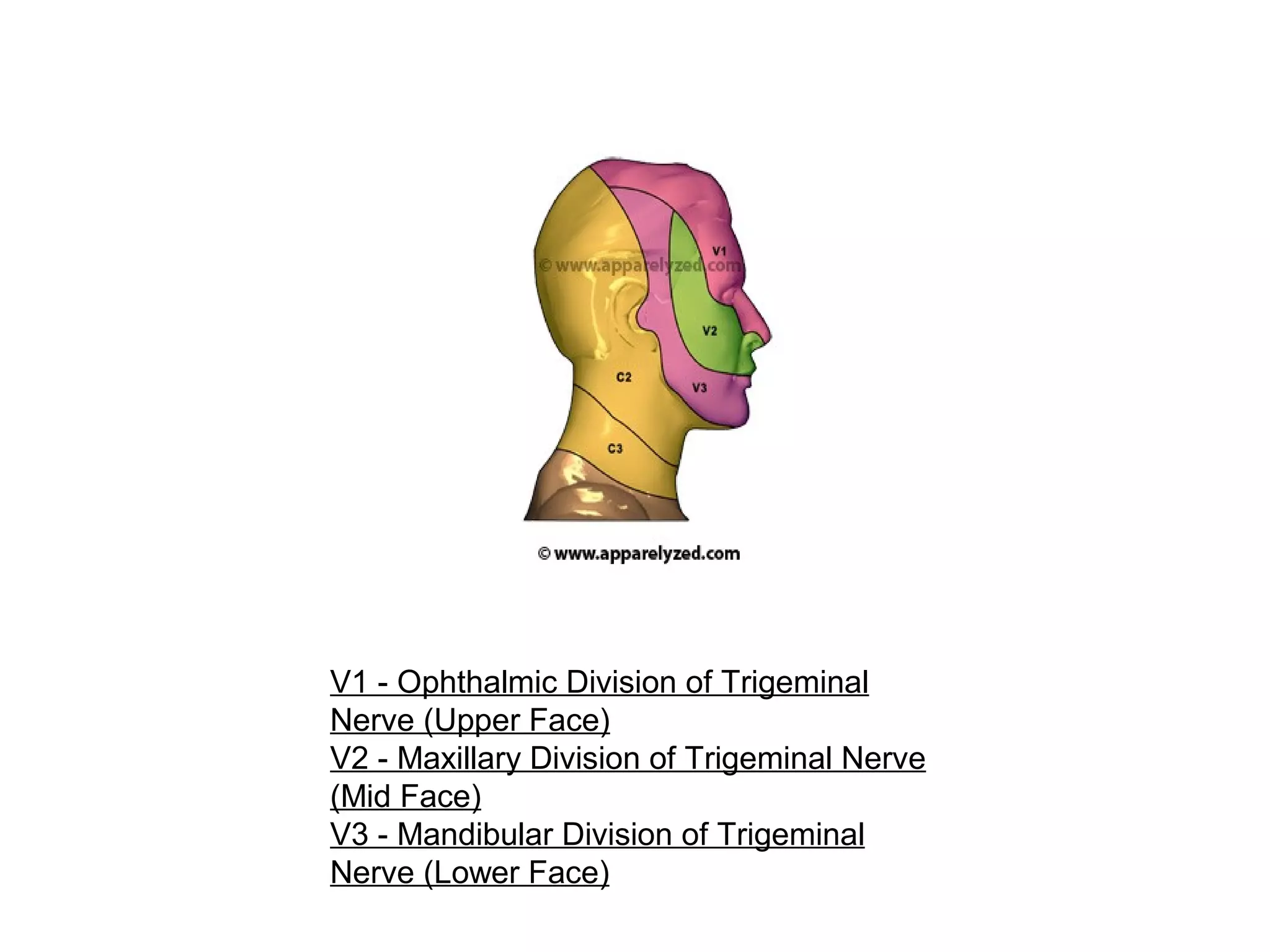
Upper Body Test Ponits
C2 - Occipital Protuberance
C3 - Supraclavicular Fossa
C4 - Acromioclavicular Joint
C5 - Lateral Antecubital Fossa
C6 - Thumb
C7 - Middle Finger
C8 - Little Finger
T1 - Medial Antecubital Fossa
T2 - Apex of Axilla
V1 - Ophthalmic Division of Trigeminal
Nerve (Upper Face)
V2 - Maxillary Division of Trigeminal Nerve
(Mid Face)
V3 - Mandibular Division of Trigeminal
Nerve (Lower Face)
Lesions and sensory system
involvement
BRAIN STEM SYNDROME:
loss of pain ,touch and
temperature on same
side of the face and
opposite side of the body
due to involvement of
trigeminal tract and
nucleus and lateral
spinothalamic tract
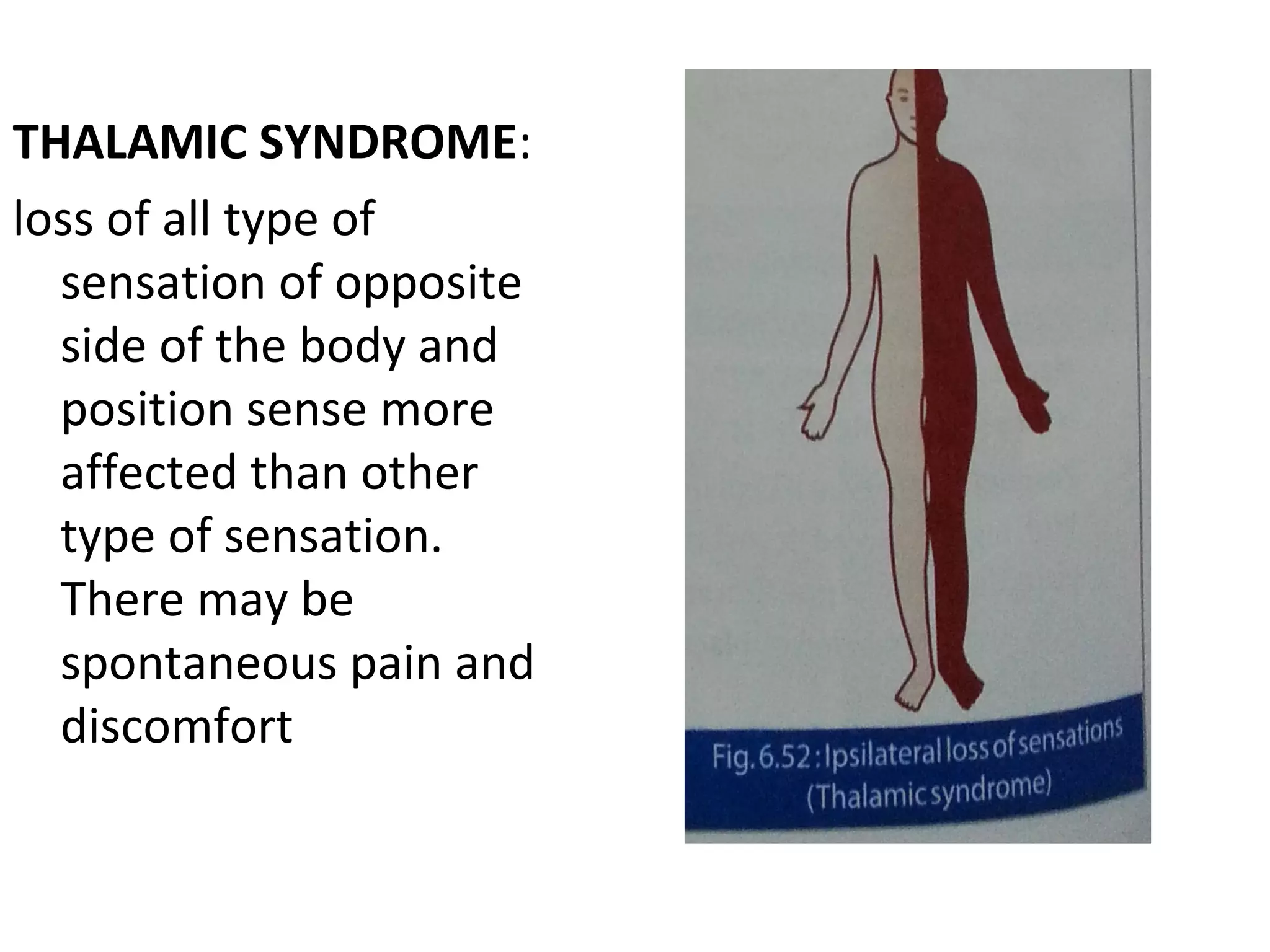
THALAMIC SYNDROME:
loss of all type of
sensation of opposite
side of the body and
position sense more
affected than other
type of sensation.
There may be
spontaneous pain and
discomfort
PARIETAL LOBE SYNDROME:
A) loss of tactile localization
b) loss of tactile discrimination
C)tactile extinction
D)astereognosis
E)two point discrimination: finger pulp, lips,
palm, sole,dorsum of the foot ,back
HYSTERICAL:
A)complete hemianaesthesia with reduced
hearing vision taste smell ,reduced vibration,
only over one half of the skull.
B)sharply defined sensory loss not confined to
the distribution of the root or cutaneous
nerve
C)postural sense is rarely affected.
• It is divided into complete and incomplete
cord syndromes.
• INCOMPLETE CORD SYNDROMES.
• Brown sequards syndrome.
• Central cord syndrome.
• Anterior cord syndrome.
• Posterior cord syndrome.
• Conus medullaris syndrome.
• Cauda equina syndrome.
COMPLETE CORD TRANSECTION
Complete Transaction Of Spinal Cord
CAUSES-
Trauma
Metastatic carcinoma
Multiple sclerosis
Spinal epidural haematoma
Autoimmune disorders
Post vaccinial syndromes.
All ascending tracts from below and descending
tracts from above are interrupted.
Affects motor sensory and autonomic functions.
SENSORY
all sensations are affected.
Pin prick test is very valuable.
Sensory level is usually 2
segments below the level of
lesion.
Segmental paresthesia occur
at the level of lesion.
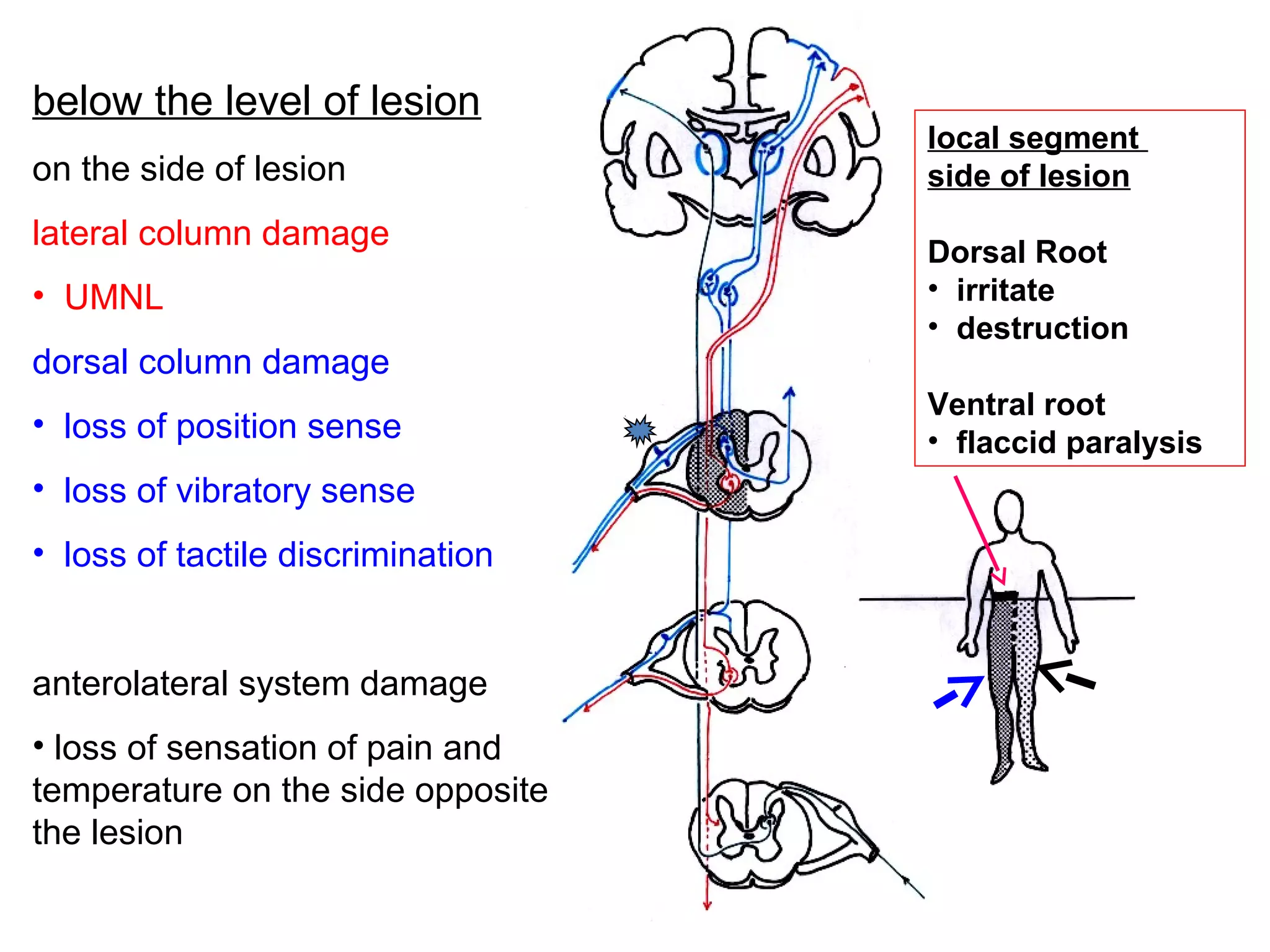
Hemisection of the spinal cord
( Brown Sequard’s syndrome )
• Dorsal column damage
• Lateral column damage
• Anterolateral column damage
• Damage to local cord segment and nerve roots
spinal cord hemisection
below the level of lesion
on the side of lesion
lateral column damage
• UMNL
dorsal column damage
• loss of position sense
• loss of vibratory sense
• loss of tactile discrimination
anterolateral system damage
• loss of sensation of pain and
temperature on the side opposite
the lesion
local segment
side of lesion
Dorsal Root
• irritate
• destruction
Ventral root
• flaccid paralysis
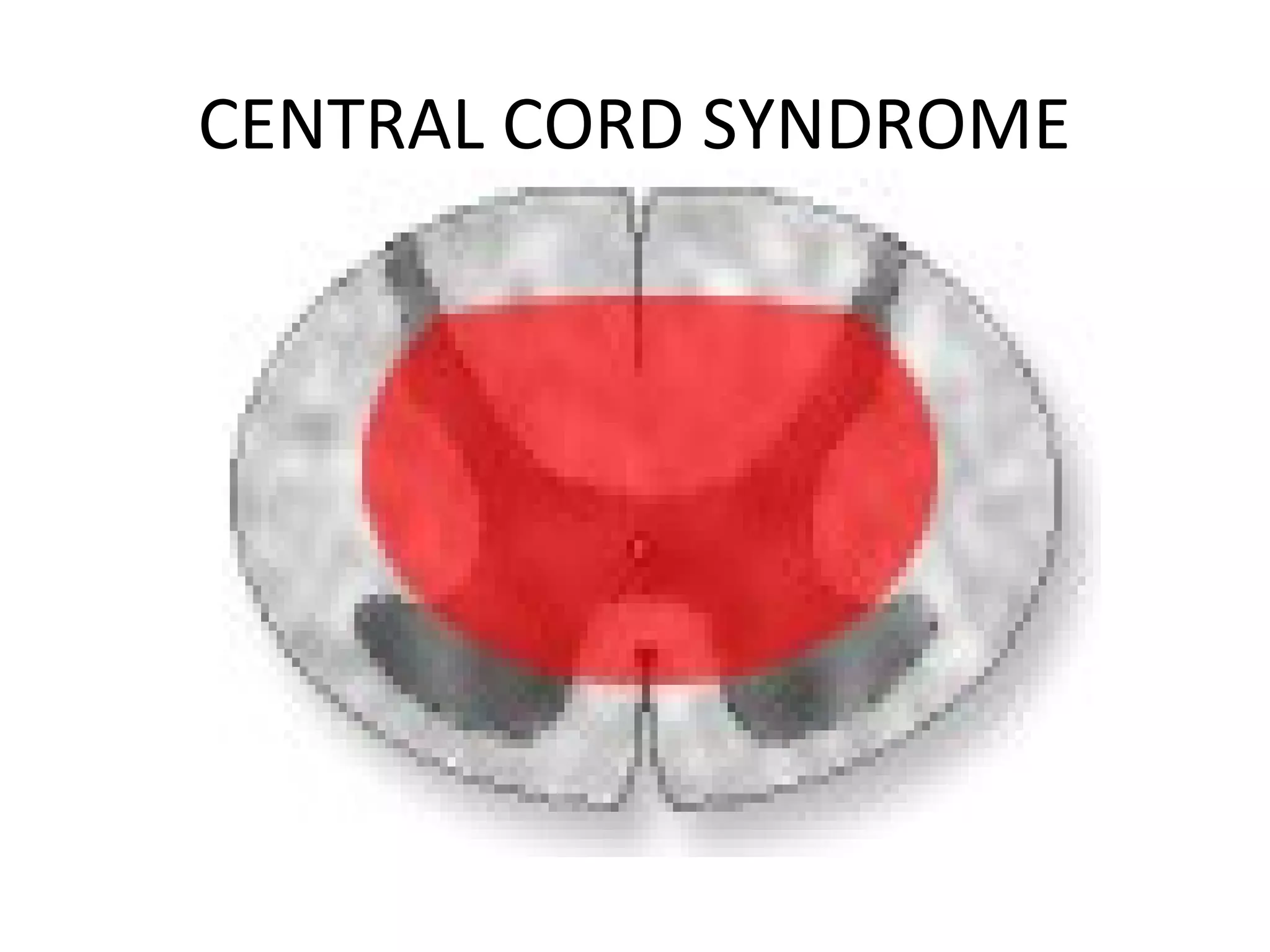
CENTRAL CORD SYNDROME
Most common cause is syringomyelia.
others hyperextension injuries of neck,intramedullary
tumours,trauma.
Associated with chiari type 1 and 2.and dandy walker
malformation.
SENSORY
Pain and temperature are affected.
Touch and proprioception are preserved.
Dissociative anaesthesia.
Shawl like distribution of sensory loss.
MOTOR.
Upper limb weakness >lowerlimb
• Other features;
– Horners syndrome
– Kyphoscoliosis
– . Sacral sparing
– Neuropathic arthropathy of shoulder and elbow
joint
– Prognosis is fair.
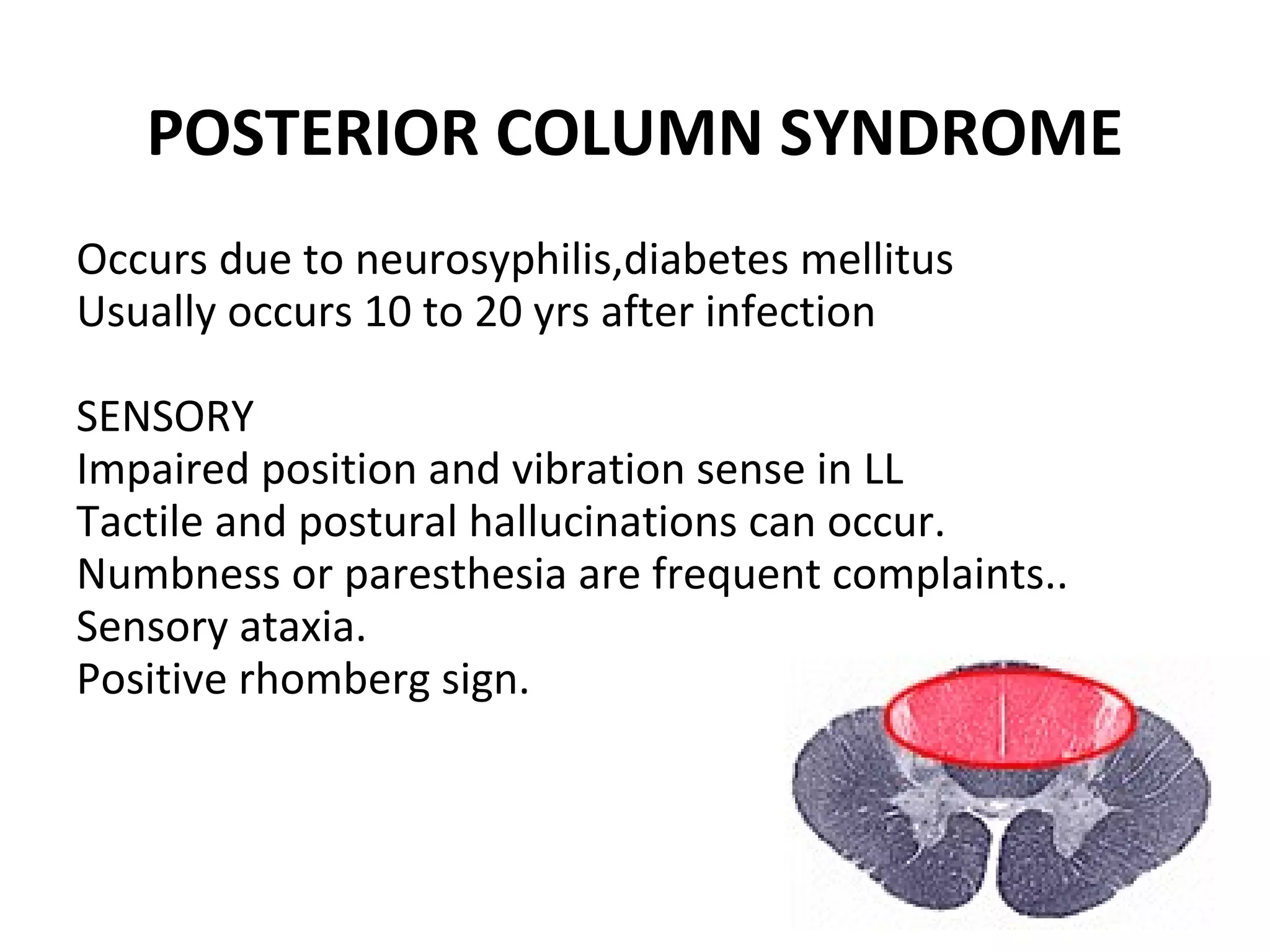
Occurs due to neurosyphilis,diabetes mellitus
Usually occurs 10 to 20 yrs after infection
SENSORY
Impaired position and vibration sense in LL
Tactile and postural hallucinations can occur.
Numbness or paresthesia are frequent complaints..
Sensory ataxia.
Positive rhomberg sign.
POSTERIOR COLUMN SYNDROME
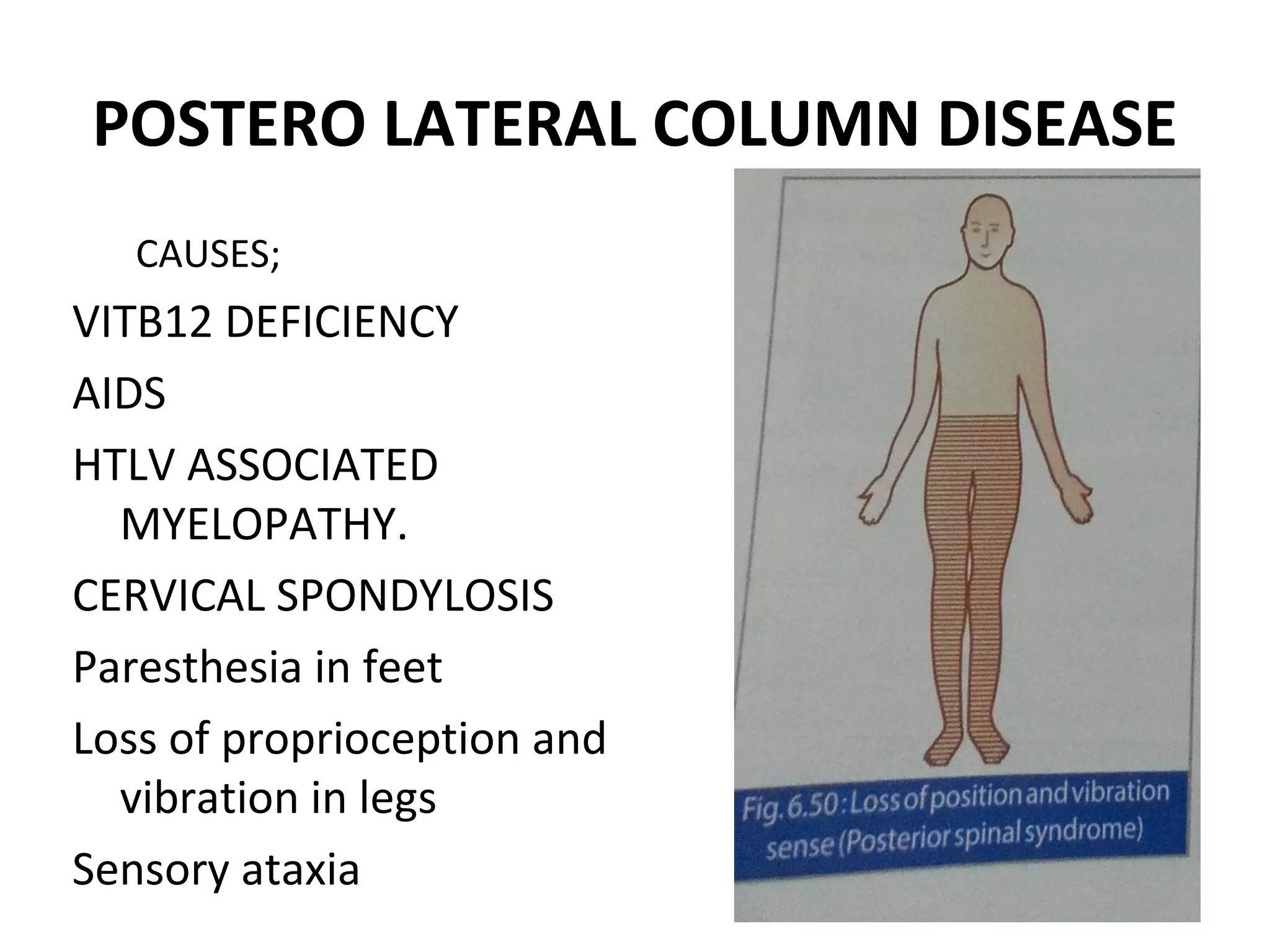
POSTERO LATERAL COLUMN DISEASE
CAUSES;
VITB12 DEFICIENCY
AIDS
HTLV ASSOCIATED
MYELOPATHY.
CERVICAL SPONDYLOSIS
Paresthesia in feet
Loss of proprioception and
vibration in legs
Sensory ataxia
positive rhomberg sign
Bladder atony
Corticospinal tract
involvement;spasticity,hyperreflexia ,bilateral
Babinski sign.
Aids:associated dementia and spastic bladder is
present
HTLV associated myelopathy;slowly progressive
paraparesis increase in csf igG with antibodies
to HTLV1.
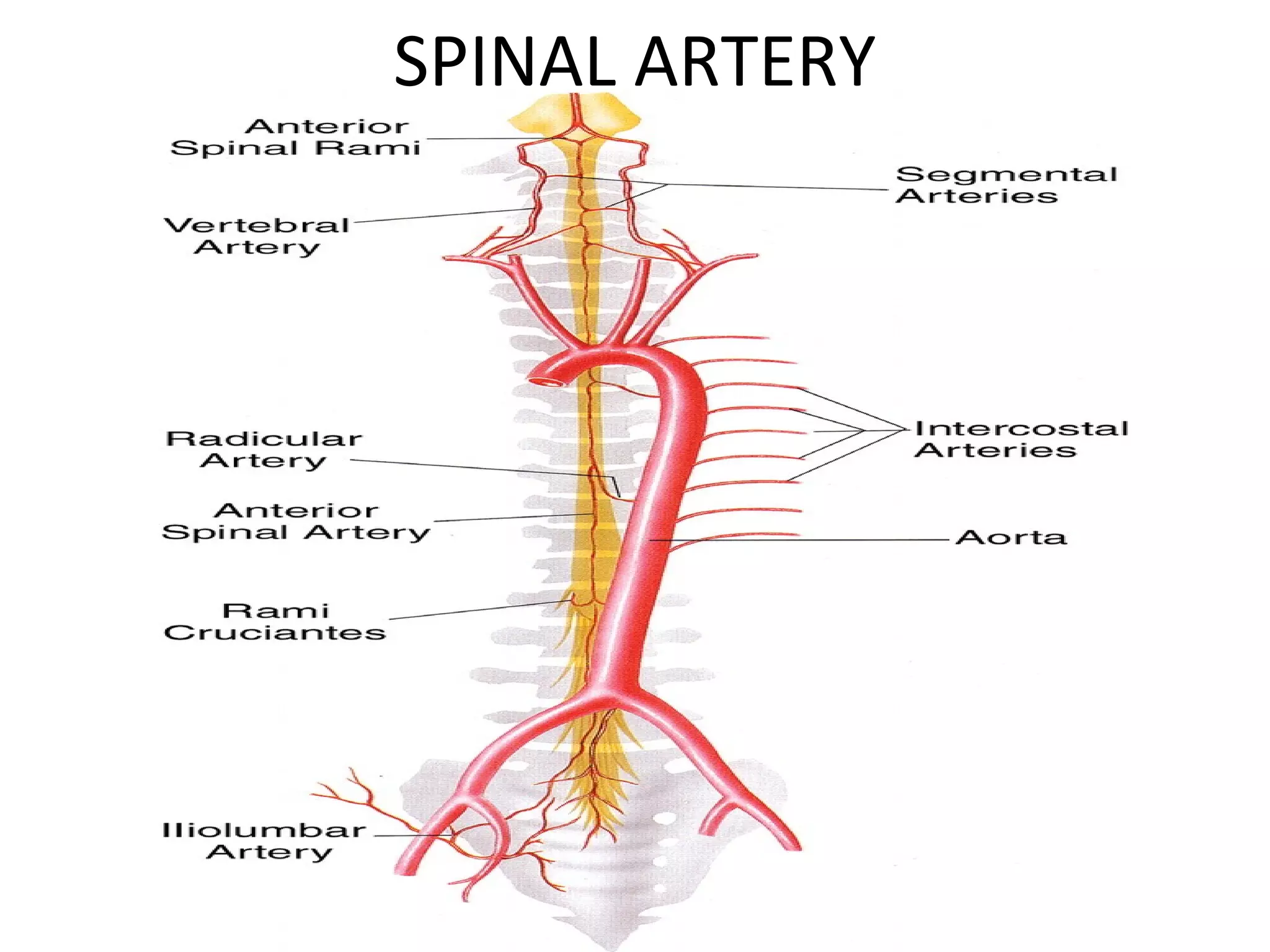
SPINAL ARTERY
ANTERIOR CORD SYNDROME
VASCULAR SYNDROMES OF SPINAL
CORD
Mostly occurs due to anterior spinal artery.
conus medullaris is frequently involved.lies
opposite to vertebral bodies T12 and L1.
Neck pain of sudden onset.
MOTOR
Flaccid and areflexic paraplegia
SENSORY
Loss of pain and temperature.
Preservation of positon and vibration.
AUTONOMIC
urinary incontinence.
Spinal cord infarction usually occurs in T1 to T4
segment.and L1
Occurs due to syphilitic arteritis ,aortic
dissection,atherosclerosis of aorta,SLE
,AIDS,AV malformation
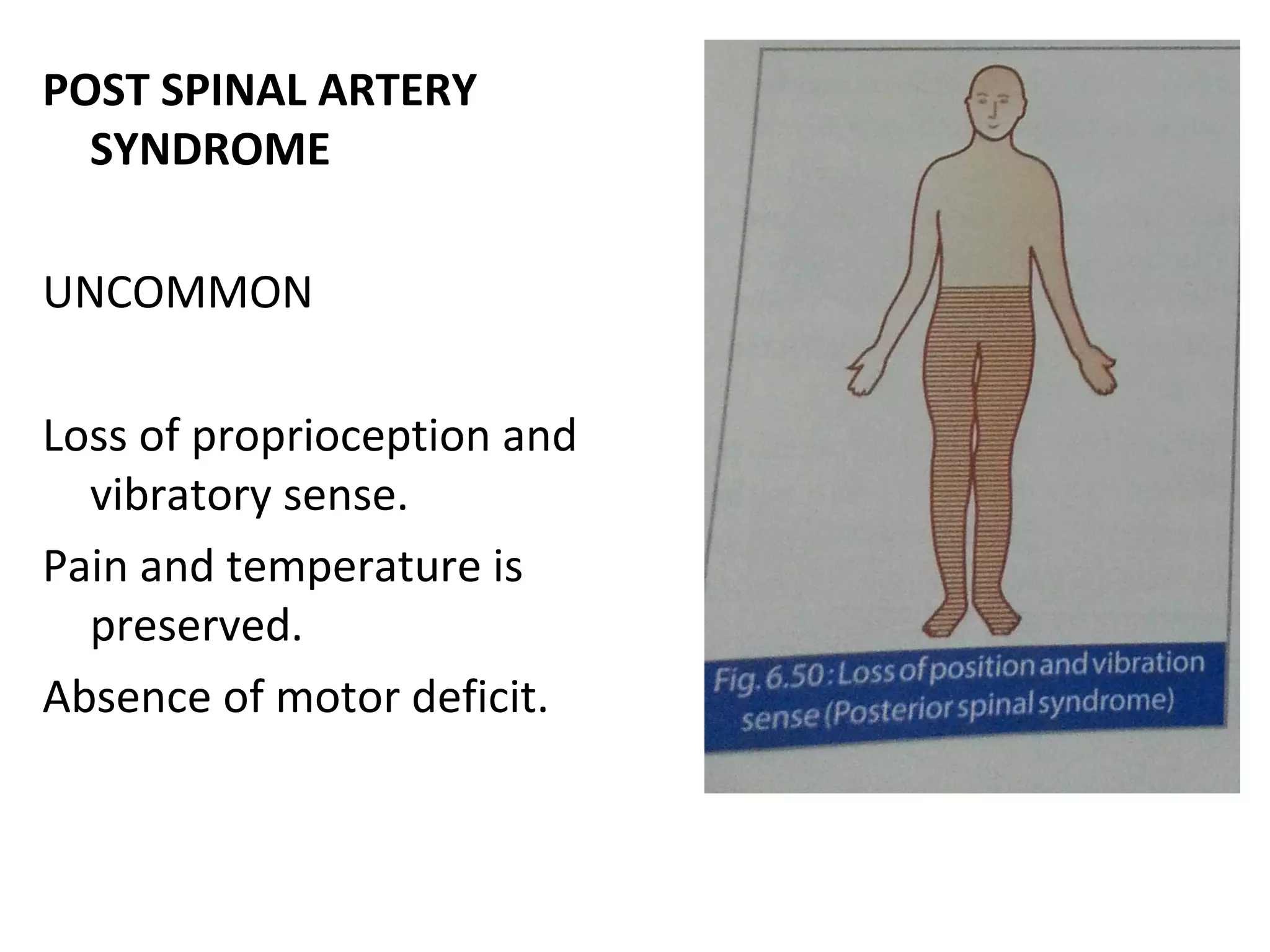
POST SPINAL ARTERY
SYNDROME
UNCOMMON
Loss of proprioception and
vibratory sense.
Pain and temperature is
preserved.
Absence of motor deficit.
CONUS MEDULLARIS SYNDROME
Contributes to 25%spinal cord injuries.
Lies opposite to vertebral bodies of T12 and L1.
Caused by flexion distraction injuries and burst
fractures.
Both UMN and LMN deficits occur.
Development of neurogenic bladder.
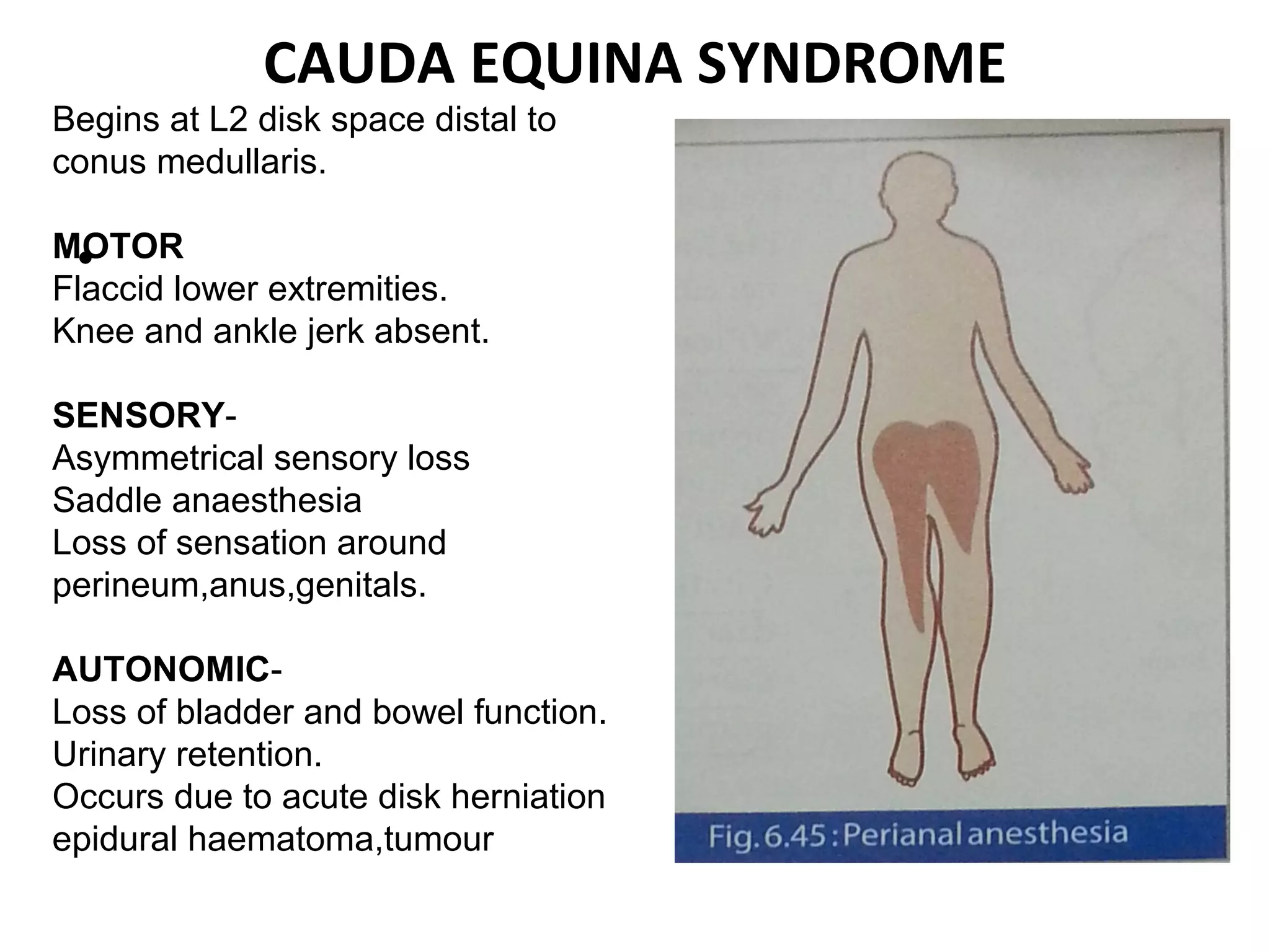
CAUDA EQUINA SYNDROME
•
Begins at L2 disk space distal to
conus medullaris.
MOTOR
Flaccid lower extremities.
Knee and ankle jerk absent.
SENSORY-
Asymmetrical sensory loss
Saddle anaesthesia
Loss of sensation around
perineum,anus,genitals.
AUTONOMIC-
Loss of bladder and bowel function.
Urinary retention.
Occurs due to acute disk herniation
epidural haematoma,tumour
Polyneuropathy:
symmetrical glove
stocking anesthesia
( distal part is more
affected)
THANK YOU

Sensory system

  • 1.
    SENSORY SYSTEM DR. SNEHALPALLOD GUIDE-DR.GIRISH NANOTI
  • 2.
    CENTRAL NERVOUS SYSTEM integration/ processing / modulating stimulus receptor neurone motor / descending tracts effector organ / response PNS transmission lower motor neurone sensory / ascending tracts 4 3 2 1
  • 3.
    • Sensory information •Exteroceptive information • Proprioceptive information
  • 4.
    sensory information are receivedand carried by ascending tracts • exteroceptive sensation origin:- outside the body e.g. temp, touch, light, sound, chemicals, mechanical receptors:- surface layer of skin, mucosa • proprioceptive sensation origin:- within the body e.g. muscles, joints, tendons receptors – deeper layer of skin, tendons, joints, GTO, muscle spindles, ligament • Steriognosis , graphesthesia, and two point discrimination combind ( pc) and cortical sensation
  • 6.
    sensory information from theperipheral sensory endings is conducted through the nervous system by a series of neurones
  • 7.
    information • conscious sensation –reach the cerebral cortex • unconscious sensation – reach to the areas other than cortex
  • 8.
    spinal cord • Greymatter – mostly made up of cell bodies of neurone • White matter – composed of nerve fibres ( ascending and descending tracts ) embedded in neuroglial cells
  • 9.
    nerve fibres • enterthe spinal cord through posterior nerve root • after entering the spinal cord sorted out and segregated into nerve bundles, tracts ( origin, function, termination )
  • 10.
    ascending tracts bundles ofnerve fibres linking spinal cord with higher centres of the brain convey information from soma / viscera to higher level of neuraxis
  • 11.
    Ascending sensory pathwayare organized in three neuronal chain - First order neurone - Second order neurone - Third order neurone
  • 12.
    First order neurone •cell body in posterior root ganglion • peripheral process connects with sensory receptor ending • central process enter the spinal cord through the posterior root • synapse with second order neuron in spinal gray matter
  • 13.
  • 14.
    Second order neurone •cell body in posterior gray column of spinal cord • axon crosses the midline ( decussate ) • ascend & synapse with third order neuron in VPL nucleus of thalamus
  • 15.
    SECOND ORDER NEURON •cross the mid line • in front of central canal 1st 2nd
  • 16.
    Third order neurone •cell body in the thalamus( ventro lateral nucleus) • give rise to projection fibres to the cerebral cortex, postcentral gyrus ( sensory area )
  • 17.
    ascending sensory pathway (in general form ) from sensory endings to cerebral cortex ( note the three neurons chain )
  • 18.
    sensory sensation Three type 1.Superficial : pain ,temperature and superficial touch carried by spinothalamic pathway(lateral) 2. Deep : crude touch ,joint position ,vibration carried by dorsal coloumn 3. Cortical sensation : tactile localization, tactile discrimination,tactile extiction,astereognosis,two point discrimination and graphasthesia
  • 19.
    Arrangements Of SensoryFibers • Posterior column : fibers from lower limb are placed medially while fibers upper limbs are placed laterally • Spinothalamic tract : just opposite to posterior column • In central cord lesion lateral spinothalamic tract is affected 1st while posterior column sensations are preserved this causes dissociative aneshesia
  • 20.
  • 21.
    Tracts & theirfunctional components • lateral spinothalamic tract – pain, temperature • anterior spinothalamic tract – touch, pressure
  • 22.
    • posterior whitecolumn – conscious proprioceptive sense, discriminative touch, vibratory sense • spinocerebellar tract / cuneocerebellar tract – unconscious information from muscle, joints, skin, subcutaneous tissues
  • 23.
    sensation receptors pathwaysdestination Pain and temperature Free nerve endings Lateral STT Spinal lemniscus Postcentral gyrus Light touch and pressure Free nerve endings Anterior STT Spinal lemniscus Postcentral gyrus Discriminative touch, vibratory sense, conscious muscle joint sense Meissner’s corpuscle, pacinian corpuscles, muscle spindles, tendon organs Fasciculus gracilis and cuneatus Medial lemniscus Postcentral gyrus Main somatosensory pathways
  • 24.
    Tracts and theircourse in detail
  • 25.
    Lateral spinothalamic tract painand thermal impulses ( input from free nerve endings, thermal receptors ) • transmitted to spinal cord in delta A and C fibres • central process enters the spinal cord through posterior nerve root, proceed to the tip of the dorsal gray column
  • 26.
    • The centralprocess of 1st order neuron synapse with cell body of 2nd order neuron in substantia gelatinosa of posterior gray column of the spinal cord • The axon of 2nd order neuron cross to the opposite side in the anterior gray and white commissure and ascend in contralateral white column as lateral spinothalamic tract • End by synapsing with 3rd order neuron in the ventral posterolateral nucleus of thalamus • Axon of the 3rd order neuron passes through the posterior limb of internal capsule and corona radiata to reach the postcentral gyrus of cerebral cortex ( area 3, 1 and 2 )
  • 27.
  • 28.
    Clinical application destruction ofLSTT • loss of – pain and thermal sensation – on the contralateral side – below the level of the lesion patient will not respond to pinprick recognize hot and cold
  • 29.
    Anterior spinothalamic tract lighttouch and pressure impulses ( input from free nerve endings, Merkel’s tactile disks ) • First order neuron – dorsal root ganglion( all level ) • Second order neuron – in the dorsal horn, cross to the opposite side (decussate) – ascend in the contralateral ventral column as ASTT – end in VPL nucleus of thalamus • Third order neuron – in the VPL nucleus of thalamus – project to cerebral cortex ( area 3, 1 and 2 )
  • 30.
  • 31.
    Clinical application destruction ofASTT loss of touch and pressure sense – below the level of lesion – on the contralateral side of the body
  • 32.
    Fasciculus gracilis andfasciculus cuneatus discriminative touch, vibratory sense and conscious muscle joint sense ( inputs from pacinian corpuscles, Messiner’s corpuscles, joint receptors, muscle spindles and Golgi tendon organs ) • axon of 1st order neuron enter the spinal cord • passes directly to the posterior white column of the same side ( without synapsing )
  • 33.
    • long ascendingfibres travel upward in the posterior column of the same side as fasciculus gracilis and fasciculus cuneatus – ( FG – carrying fibres from lower thoracic, lumbar and sacral regions / including lower limbs ) – ( FC - only in thoracic and cervical segments / including upper limb fibres ) • synapse on the 2nd order neuron in the nucleus gracilis and cuneatus of medulla oblongata of the same side.
  • 34.
    lower 6 thoracicsegments lumbar segments sacral segments cervical segments upper 6 thoracic segments fasciculus gracilis fasciculus cuneatus [ nucleus G & C ] in medulla G C
  • 35.
    • axons of2nd order neuron “ internal arcuate fibres ” cross the median plane ( sensory decussation ) • ascend as medial lemniscus through medulla oblongata, pons, and midbrain • synapse on the 3rd order neuron in ventral posteriolateral nucleus of thalamus • axon of 3rd order neuron leaves and passes through the internal capsule, corona radiata to reach the postcentral gyrus of cerebral cortex area 3, 1 and 2 )
  • 36.
  • 37.
    Clinical application destruction of fasciculusgracilia and cuneatus • loss of muscle joint sense, position sense, vibration sense and tactile discrimination • on the same side • below the level of the lesion (extremely rare to have a lesion of the spinal cord to be localized as to affect one sensory tract only )
  • 38.
    Posterior & AnteriorSpinocerebellar Tract • transmit unconscious proprioceptive information to the cerebellum • receive input from muscle spindles, GTOs and pressure receptors • involved in coordination of posture and movement of individual muscles of the lower limb
  • 39.
    First order neuron •in dorsal root ganglion • axons end in nucleus dorsalis of Clarke Second order neuron • cell body in nucleus dorsalis of Clarke • give rise to axons ascending to the cerebellum of the same side ( anterior – crossed & uncrossed fibres / posterior – uncrossed fibres)
  • 40.
    muscle joint sensepathways to cerebellum
  • 41.
    • Spinotectal tract –passes pain, thermal, tactile information to superior colliculus for spinovisual reflexes • cross the median plane • synapse in the superior colliculus • integrate visual and somatic sensory information ( it brings about the movement of eye and head towards the source of information ) • Spinoreticular tract – uncrossed fibres, synapse with neurones of reticular formation (important role in influencing level of consciousness) • Spino-olivary tract
  • 42.
  • 43.
    clinical application • reliefof pain posterior rhizotomy (posterior root) cordotomy (lateral STT) • Injury hemisection of spinal cord • diseases tabes dorsalis / syringomyelia / vascular
  • 45.
    FRONT: UPPER BODY TESTPOINT: C2: OCCIPITAL PROTUBERANCE C3: SUPRACLAVICULAR FOSSA C4: ACROMIOCLAVICULAR JOINT C5:LATERAL ANTICUBITAL FOSSA C6:THUMB C7:MIDDLE FINGER C8:LITTLE FINGER T!: MEDIAL ANTICUBITAL FOSSA T2:APEX OF AXILLA LOWER BODY TEST POINT: L1: UPPER ANTERIOR THIGH L2:MID ANTERIOR THIGH L3:MEDIAL FEMORAL CONDYLE L4:MEDIAL MALLEOLUS L5: DORSUM OF THE THIRD MTP JOINT S1: LATERAL HEEL S2:POPLITEAL FOSSA S3:ISCHIAL TUBEROSITY S5:PERIANAL AREA
  • 46.
    Upper Body TestPonits C2 - Occipital Protuberance C3 - Supraclavicular Fossa C4 - Acromioclavicular Joint C5 - Lateral Antecubital Fossa C6 - Thumb C7 - Middle Finger C8 - Little Finger T1 - Medial Antecubital Fossa T2 - Apex of Axilla Lower Body Test Points L1 - Upper Anterior Thigh L2 - Mid Anterior Thigh L3 - Medial Femoral Condyle L4 - Medial Malleolus L5 - Dorsum 3rd MTP Joint S1 - Lateral Heel S2 - Popliteal Fossa S3 - Ischial Tuberosity S5 - Perianal Area
  • 47.
    Upper Body TestPonits C2 - Occipital Protuberance C3 - Supraclavicular Fossa C4 - Acromioclavicular Joint C5 - Lateral Antecubital Fossa C6 - Thumb C7 - Middle Finger C8 - Little Finger T1 - Medial Antecubital Fossa T2 - Apex of Axilla
  • 48.
    V1 - OphthalmicDivision of Trigeminal Nerve (Upper Face) V2 - Maxillary Division of Trigeminal Nerve (Mid Face) V3 - Mandibular Division of Trigeminal Nerve (Lower Face)
  • 51.
    Lesions and sensorysystem involvement
  • 52.
    BRAIN STEM SYNDROME: lossof pain ,touch and temperature on same side of the face and opposite side of the body due to involvement of trigeminal tract and nucleus and lateral spinothalamic tract
  • 53.
    THALAMIC SYNDROME: loss ofall type of sensation of opposite side of the body and position sense more affected than other type of sensation. There may be spontaneous pain and discomfort
  • 54.
    PARIETAL LOBE SYNDROME: A)loss of tactile localization b) loss of tactile discrimination C)tactile extinction D)astereognosis E)two point discrimination: finger pulp, lips, palm, sole,dorsum of the foot ,back
  • 55.
    HYSTERICAL: A)complete hemianaesthesia withreduced hearing vision taste smell ,reduced vibration, only over one half of the skull. B)sharply defined sensory loss not confined to the distribution of the root or cutaneous nerve C)postural sense is rarely affected.
  • 56.
    • It isdivided into complete and incomplete cord syndromes. • INCOMPLETE CORD SYNDROMES. • Brown sequards syndrome. • Central cord syndrome. • Anterior cord syndrome. • Posterior cord syndrome. • Conus medullaris syndrome. • Cauda equina syndrome.
  • 57.
  • 58.
    Complete Transaction OfSpinal Cord CAUSES- Trauma Metastatic carcinoma Multiple sclerosis Spinal epidural haematoma Autoimmune disorders Post vaccinial syndromes. All ascending tracts from below and descending tracts from above are interrupted. Affects motor sensory and autonomic functions.
  • 59.
    SENSORY all sensations areaffected. Pin prick test is very valuable. Sensory level is usually 2 segments below the level of lesion. Segmental paresthesia occur at the level of lesion.
  • 60.
    Hemisection of thespinal cord ( Brown Sequard’s syndrome ) • Dorsal column damage • Lateral column damage • Anterolateral column damage • Damage to local cord segment and nerve roots
  • 61.
  • 62.
    below the levelof lesion on the side of lesion lateral column damage • UMNL dorsal column damage • loss of position sense • loss of vibratory sense • loss of tactile discrimination anterolateral system damage • loss of sensation of pain and temperature on the side opposite the lesion local segment side of lesion Dorsal Root • irritate • destruction Ventral root • flaccid paralysis
  • 63.
  • 64.
    CENTRAL CORD SYNDROME Mostcommon cause is syringomyelia. others hyperextension injuries of neck,intramedullary tumours,trauma. Associated with chiari type 1 and 2.and dandy walker malformation. SENSORY Pain and temperature are affected. Touch and proprioception are preserved. Dissociative anaesthesia. Shawl like distribution of sensory loss. MOTOR. Upper limb weakness >lowerlimb
  • 66.
    • Other features; –Horners syndrome – Kyphoscoliosis – . Sacral sparing – Neuropathic arthropathy of shoulder and elbow joint – Prognosis is fair.
  • 67.
    Occurs due toneurosyphilis,diabetes mellitus Usually occurs 10 to 20 yrs after infection SENSORY Impaired position and vibration sense in LL Tactile and postural hallucinations can occur. Numbness or paresthesia are frequent complaints.. Sensory ataxia. Positive rhomberg sign. POSTERIOR COLUMN SYNDROME
  • 68.
    POSTERO LATERAL COLUMNDISEASE CAUSES; VITB12 DEFICIENCY AIDS HTLV ASSOCIATED MYELOPATHY. CERVICAL SPONDYLOSIS Paresthesia in feet Loss of proprioception and vibration in legs Sensory ataxia
  • 69.
    positive rhomberg sign Bladderatony Corticospinal tract involvement;spasticity,hyperreflexia ,bilateral Babinski sign. Aids:associated dementia and spastic bladder is present HTLV associated myelopathy;slowly progressive paraparesis increase in csf igG with antibodies to HTLV1.
  • 70.
  • 71.
  • 72.
    VASCULAR SYNDROMES OFSPINAL CORD Mostly occurs due to anterior spinal artery. conus medullaris is frequently involved.lies opposite to vertebral bodies T12 and L1. Neck pain of sudden onset. MOTOR Flaccid and areflexic paraplegia
  • 73.
    SENSORY Loss of painand temperature. Preservation of positon and vibration. AUTONOMIC urinary incontinence. Spinal cord infarction usually occurs in T1 to T4 segment.and L1 Occurs due to syphilitic arteritis ,aortic dissection,atherosclerosis of aorta,SLE ,AIDS,AV malformation
  • 74.
    POST SPINAL ARTERY SYNDROME UNCOMMON Lossof proprioception and vibratory sense. Pain and temperature is preserved. Absence of motor deficit.
  • 75.
    CONUS MEDULLARIS SYNDROME Contributesto 25%spinal cord injuries. Lies opposite to vertebral bodies of T12 and L1. Caused by flexion distraction injuries and burst fractures. Both UMN and LMN deficits occur. Development of neurogenic bladder.
  • 76.
  • 77.
    CAUDA EQUINA SYNDROME • Beginsat L2 disk space distal to conus medullaris. MOTOR Flaccid lower extremities. Knee and ankle jerk absent. SENSORY- Asymmetrical sensory loss Saddle anaesthesia Loss of sensation around perineum,anus,genitals. AUTONOMIC- Loss of bladder and bowel function. Urinary retention. Occurs due to acute disk herniation epidural haematoma,tumour
  • 78.
  • 79.