Sensory Systems 1stEdition Aage R. Moller
download
https://ebookname.com/product/sensory-systems-1st-edition-aage-r-
moller/
Get Instant Ebook Downloads – Browse at https://ebookname.com
2.
Instant digital products(PDF, ePub, MOBI) available
Download now and explore formats that suit you...
Intraoperative Neurophysiological Monitoring 2nd
Edition Aage R. Moller
https://ebookname.com/product/intraoperative-neurophysiological-
monitoring-2nd-edition-aage-r-moller/
Introduction to Dynamic Modeling of Neuro Sensory
Systems 1st Edition Robert B. Northrop
https://ebookname.com/product/introduction-to-dynamic-modeling-
of-neuro-sensory-systems-1st-edition-robert-b-northrop/
Neural Plasticity in Adult Somatic Sensory Motor
Systems Frontiers in Neuroscience 1st Edition Ford F.
Ebner
https://ebookname.com/product/neural-plasticity-in-adult-somatic-
sensory-motor-systems-frontiers-in-neuroscience-1st-edition-ford-
f-ebner/
Lonely Planet India 2011 14th Edition Sarina Singh
https://ebookname.com/product/lonely-planet-india-2011-14th-
edition-sarina-singh/
3.
Modern America 1964present Discovering U S History 1st
Edition Tim Mcneese
https://ebookname.com/product/modern-america-1964-present-
discovering-u-s-history-1st-edition-tim-mcneese/
Heritage and Tourism Place Encounter Engagement 1st
Edition Russell Staiff
https://ebookname.com/product/heritage-and-tourism-place-
encounter-engagement-1st-edition-russell-staiff/
MRI Techniques 1st Edition Vincent Perrin(Auth.)
https://ebookname.com/product/mri-techniques-1st-edition-vincent-
perrinauth/
J G Ballard Contemporary Critical Perspectives 1st
Edition Jeannette Baxter (Editor)
https://ebookname.com/product/j-g-ballard-contemporary-critical-
perspectives-1st-edition-jeannette-baxter-editor/
Dangerous Sex Invisible Labor Sex Work and the Law in
India Prabha Kotiswaran
https://ebookname.com/product/dangerous-sex-invisible-labor-sex-
work-and-the-law-in-india-prabha-kotiswaran/
4.
Pediatric Fitness SecularTrends and Geographic
Variability Medicine and Sport Science 1st Edition G.
R. Tomkinson And T. S. Olds (Editors)
https://ebookname.com/product/pediatric-fitness-secular-trends-
and-geographic-variability-medicine-and-sport-science-1st-
edition-g-r-tomkinson-and-t-s-olds-editors/
Sensory
Systems
ANATOMY AND
PHYSIOLOGY
Aage R.Møller
School of Human Development
Callier Center for Communication Disorders
The University of Texas at Dallas
Dallas, Texas
Amsterdam Boston London New York Oxford Paris
San Diego San Francisco Singapore Sydney Tokyo
8.
This book isprinted on acid-free paper.
Copyright ß 2003, Elsevier Science (USA).
All Rights Reserved.
No part of this publication may be reproduced or transmitted in any
form or by any means, electronic or mechanical, including photocopy,
recording, or any information storage and retrieval system, without
permission in writing from the publisher.
Requests for permission to make copies of any part of the work
should be mailed to: Permissions Department, Academic Press,
6277 Sea Harbor Drive, Orlando, Florida 32887-6777
Academic Press
An imprint of Elsevier Science.
525 B Street, Suite 1900, San Diego, California 92101-4495, USA
http://www.academicpress.com
Academic Press
84 Theobald’s Road, London WC1X 8RR, UK
http://www.academicpress.com
Library of Congress Catalog Card Number: 2002107709
International Standard Book Number: 0-12-504257-4
PRINTED IN THE UNITED STATES OF AMERICA
02 03 04 05 06 07 MM 9 8 7 6 5 4 3 2 1
9.
CONTENTS
General Introduction xi
Acknowledgmentsxv
Preface xvii
1 Basic Psychophysics
Abbreviations 1
Abstract 2
I. Introduction 2
II. Threshold of Detection 3
A. Factors That Affect Detection of Faint Stimuli 4
III. Discrimination Between Different Stimuli 18
A. Perception of Stimulus Strength 19
B. Discrimination of Small Differences Between Stimuli 19
C. Temporal Resolution 20
D. Spatial Resolution 24
References 30
2 Anatomy and Physiology of Sensory Organs
Abbreviations 33
Abstract 34
v
10.
I. Introduction 35
II.Anatomy of Sensory Organs 37
A. The Ear 37
B. The Eye 40
C. Skin 42
D. The Chemical Senses 42
III. Sensory Receptors 43
A. Anatomy of Sensory Receptors 44
B. Innervation of Sensory Cells 51
IV. Conduction of the Physical Stimulus to the Receptors 56
A. Improvement of Transmission to the Receptors 56
B. Modification of the Physical Stimulus 57
V. Physiology of Sensory Receptors 63
A. General Principles for Sensory Transduction 64
B. Information Processing at the Receptor Level 68
C. Amplitude Compression 69
D. Selectivity of Receptors 70
E. Receptive Fields 71
References 72
3 Sensory Nervous Systems
Abbreviations 75
Abstract 76
Anatomy 76
Information Processing in Ascending Sensory Pathways 78
I. Introduction 80
II. Anatomy of Sensory Nervous Systems 81
A. Ascending Sensory Pathways 81
B. Descending Systems 97
C. The Thalamus is the Gateway to the Cerebral Cortex 99
D. Anatomy of Sensory Cerebral Cortices 102
E. Corpus Callosum 107
III. Information Processing in the Sensory Nervous System 108
A. Information Processing in the Classical Ascending
System 109
B. Processing of Object and Spatial Properties of
Sensory Stimuli 116
C. Processing of Spatial Information 127
IV. Neural Control of Sensory Processing in
Ascending Sensory Pathways 140
A. Arousal 141
B. Attention 142
vi Contents
11.
C. Control ofAscending Neural Activity by Descending Pathways 143
V. Processing of Information in the Nonclassical Pathways 145
A. Developmental Aspects of Classical and
Nonclassical Pathways 146
B. Processing of Information in Descending
Nonclassical Systems 147
VI. How is the Neural Code of Sensory Information
Interpreted? 148
A. Coding in Single Nerve Cells 148
B. Coherent Firing of Groups of Neurons 149
C. Maps 149
D. Where is the Anatomical Location for Interpretation of
Sensory Information? 152
VII. Sensory Information Can Reach Nonsensory
Regions of the CNS 153
A. Motor Systems 153
B. Autonomic Reactions to Sensory Stimulation 154
C. Emotional Reactions to Sensory Stimuli 155
VIII. Processing of Information in the Sensory Nervous
System is Dynamic 164
A. Neural Plasticity 165
B. Plastic Changes in the Nervous System May Cause
Symptoms and Signs of Disease 170
References 172
4 Somatosensory System
Abbreviations 185
Abstract 186
Classical Somatosensory System 186
Nonclassical Somatosensory System 188
Pain 189
I. Introduction 189
II. Anatomy of the Somatosensory System 190
A. Classical Somatosensory System 190
B. Nonclassical System 205
C. Descending Somatosensory Pathways 217
III. Physiology of the Somatosensory System 220
A. The Classical Somatosensory System 221
B. Physiology of the Nonclassical System 238
C. Function of Descending Systems 241
D. Pain 241
E. Itch 262
References 263
Contents vii
12.
5 Hearing
Abbreviations 271
Abstract272
Conduction of Sounds to the Receptors 272
Receptors 273
Classical Auditory Pathways 274
Physiology of the Classical Auditory System 274
Nonclassical Pathways 276
Physiology of the Nonclassical Pathways 276
I. Introduction 276
II. The Ear 277
A. Anatomy 278
B. Physiology of the Ear 284
III. The Auditory Nervous System 305
A. Anatomy of the Classical Ascending Auditory Pathways 305
B. Physiology of the Classical Auditory Nervous System 316
C. Descending Systems 346
IV. The Nonclassical Ascending Pathways 347
A. Anatomy of the Nonclassical Ascending Pathway 347
B. Physiology of the Nonclassical System 353
V. Neural Plasticity 357
A. Neural Plasticity Can Alter the Threshold and
Perception of Sounds 358
B. Neural Plasticity from Overstimulation 359
References 359
6 Vision
Abbreviations 373
Abstract 374
The Eye 374
Visual Nervous System 374
I. Introduction 376
II. The Eye 376
A. Anatomy 377
B. Physiology of the Eye 380
III. The Visual Nervous System 387
A. Anatomy of the Classical Ascending Visual Nervous System 388
B. Physiology of the Visual Nervous System 400
IV. Nonclassical Visual Pathways 416
A. Anatomy of Nonclassical Visual Pathways 416
B. Physiology of the Nonclassical System 419
References 421
viii Contents
13.
7 Chemical Senses:Olfaction and Gustation
Abbreviations 425
Abstract 425
Taste 426
Olfaction 426
I. Introduction 427
II. Anatomy 428
A. Receptors 429
B. The Media that Conduct the Stimulus to the Receptors 431
C. Innervation of Receptors 432
D. Gustatory and Olfactory Neural Pathways 435
III. Physiology of the Chemical Senses 443
A. Receptors 443
B. Coding of Information in the Gustatory and
Olfactory Nervous Systems 448
References 449
Index 451
Contents ix
14.
GENERAL INTRODUCTION
This bookis written for students of physiology, anatomy, and behavioral
sciences, and for all individuals who want to understand some of the most
fascinating wonders in biology. René Descartes, (1596–1650) summarizes his
line of reasoning in the famous phrase, ‘I think, therefore I am.’ This is true, but
without sensory systems there would not be an intellect. While many people
are fascinated by our technological achievements in such areas as computers
and communication systems, the efficiency and complexity of sensory systems
far exceeds even the most sophisticated man-made systems. Sensory systems
not only interpret physical stimuli such as those carried by sound, light, and
odors but they also provide input to our emotional brain either consciously or
unconsciously. Understanding the function of sensory systems is important for
many professions. This book discusses many aspects of sensory systems and
their interaction with many other parts of the brain. Sensory Systems: Anatomy
and Physiology provides a ‘‘joy of understanding’’ of some truly fascinating
biological systems and can be appreciated by all individuals with an interest in
living things.
Sensory Systems: Anatomy and Physiology not only presents facts regarding the
anatomy and function of sensory systems but it also provides interpretation and
synthesis of our present understanding of the organization and function of these
complex systems. The book covers areas that have not been extensively
represented in other books such as the function of nonclassical sensory pathways
and the input to the emotional brain. The book discusses parallel processing
(processing of the same information in different populations of nerve cells) and
stream segregation (processing of different kinds of information in different
populations of nerve cells).
Scientists try to relate neural activity in the central nervous system (CNS) to
sensory stimulation in order to understand how sensory stimuli reach
xi
15.
our consciousness andhow they become interpreted. This problem has been
approached in two different ways: the first approach attempts to understand
how individual neurons work and the second approach attempts to understand
how different parts of the CNS are connected into systems and how such systems
process information (systems approach). A modern analogy to these two
approaches would be similar to studying how transistors work and how
computers work. This book concerns a systems approach to understand
how sensory systems work.
Sensory systems are also important for our general well-being. Sensory
systems control basic bodily functions such as what we eat and how much.
Whether we are going to be overweight or anorexic depends to some extent
on our sensory systems. Under normal circumstances and during diseases,
sensory systems are important for our mood. The connections to the limbic
system are important in that respect. Sensory systems also provide input to other
regions of the brain such as the motor systems, the cerebellum, and to the core
of the brainstem (reticular formation) that control the degree of wakefulness.
This book covers the anatomy and function of the five senses: hearing, vision,
somesthesia, taste, and olfaction. Pain is also included as a part of somesthesia.
The book emphasizes the similarities between the function of receptors and
between the ways that these different senses process very different physical
stimuli. Specifically, the book discusses the information processing that occurs
in the sensory organs and the nervous system.
Proprioception is not included in this book because activation of proprio-
ception does not reach consciousness. The feeling of mental fatigue or the
sensations of hunger and thirst are not included either because the feeling
of fatigue, hunger, and thirst are caused by some internal processes and
although they reach consciousness they are very different from the sensory
systems that communicate information from the environment. Why include
pain in this book? Although pain is not always caused by external events,
the close association with the somatosensory system and the fact that it often
communicates information from the environment to the conscious mind justifies
inclusion.
Sensory Systems: Anatomy and Physiology emphasizes the similarities between
the different sensory systems and their function. Therefore the different
components of sensory systems are first discussed together in order to emphasize
the similarities and differences rather than the more conventional way of treating
the different sensory systems separately.
Why do we want to know about sensory systems and why write a book
devoted to them? First of all, sensory systems are some of the most intriguing
systems of our body. Exploring sensory systems is now more fascinating
than ever before because technological advances have provided excellent tools
xii General Introduction
16.
for studying thefunction of sense organs and in particular to study the function
of the nervous system.
Sensory Systems: Anatomy and Physiology is directed to physiologists who study
sensory systems, to health professionals who are involved in diagnosis of
disorders of sensory systems, and to any interested person who wants a broad
understanding of how sensory systems function.
Chapter 1 provides a brief introduction to psychophysics. Chapter 2 is
devoted to the anatomy and general function of sense organs. Chapter 3
discusses the anatomy and physiology of the ascending and descending
sensory pathways. The anatomy and physiology of classical and nonclassical
sensory systems are described and parallel processing and stream segregation
important for processing sensory information are discussed. The different
connections from sensory systems to limbic structures and other nonsensory
parts of the CNS and their functional importance are also discussed in this
chapter. Neural plasticity and its importance for development of sensory systems
are discussed extensively in Chapter 3. How external and internal events can
cause changes in the function of the nervous system by ‘‘rewiring’’ parts of
the brain is described. Such changes can compensate for losses caused by injuries
or diseases such as stroke. Plastic changes can also cause symptoms and signs
of diseases that can manifest by chronic pain, hyperactivity, hypersensitivity,
distension of sensory input, and emotional reactions to stimuli that normally
do not elicit such reactions. Thus, there is both ‘‘good’’ and ‘‘bad’’ neural
plasticity. Chapters 4 through 7 provide detailed descriptions of the anatomy and
physiology of each of the five senses beginning with somesthesia (Chapter 4),
followed by hearing (Chapter 5), vision (Chapter 6), and the chemical senses,
taste and olfaction (Chapter 7).
General Introduction xiii
17.
ACKNOWLEDGMENTS
I have hadhelp from many people in writing this book, especially Dr. George
Gerken for his valuable comments on early versions of the manuscripts for
many of the chapters of this book. Dr. Steve Lomber’s suggestions about the
chapter on vision were most valuable. Jan Nordmark commented on certain
parts of the manuscripts. I also would like to thank many of my students at the
University of Texas at Dallas for their valuable comments, and a special thanks
to Pritesh Pandya for his comments on earlier versions of all the chapters. Many
of my students at the School of Human Development, University of Texas at
Dallas have provided valuable feedback and comments on earlier versions of the
manuscript, as well as Dr. Karen Pawlowski. Phillip Gilley helped with the
graphs and Karen Schweitzer typed the many revisions of the manuscripts.
I also want to thank Hilary Rowe and Cindy Minor at Academic Press in San
Diego for their excellent work on the book, as well as Paul Gottehrer, Project
Manager, for his dedicated work and professionalism. His copyeditor, Sarah
Nicely Fortener meticulously copyedited this specialized book without changing
its style or meaning. Debby Bicher worked on the artwork and supervised the
redrawing of many of the illustrations. It has been a real pleasure to work with
these professionals.
Without the support from the School of Human Development at the
University of Texas at Dallas I would not have been able to write this book.
Last but not least I want to thank my wife, Margareta B. Møller, M.D., D.
Med. Sci. not only for her patience with my occupation on this book and
her encouragement during my writing of this book, but also for her comments
and suggestions regarding earlier versions of the manuscripts.
xv
18.
PREFACE
The purpose ofSensory Systems: Anatomy and Physiology is to provide a
comprehensive understanding of the anatomy and function of sensory systems.
This book provides a systems approach to sensory systems and covers aspects
of sensory systems not commonly found in textbooks such as the anatomy
and function of nonclassical (nonspecific) sensory systems, parallel processing,
stream segregation, and neural plasticity. The role of sensory input to nonsensory
parts of the brain such as the limbic system (the emotional brain) and the
physiology of various forms of pain are topics discussed extensively.
The book is written for all students of life sciences, for scientists who want
a broad and comprehensive coverage of sensory systems, and for healthcare
professionals dependent on sensory systems in one way or another, such as in
restoring function after diseases that have impaired normal function of one
or more of our senses. The book is based on a course I teach in the School
of Human Development at the University of Texas at Dallas.
Sensory Systems: Anatomy and Physiology is suitable for anyone who wants
to learn about the function of biological systems. I hope this book will encourage
students to choose biology in one form or another for their career, be it clinical
medicine, biomedical research, or other forms of life sciences.
I have enjoyed writing this book very much and hope the reader will have
an equal enjoyment in acquiring insight to truly fascinating biological systems.
Aage R. Møller
Dallas, Texas
May, 2002
xvii
19.
CHAPTER 1
Basic Psychophysics
ABBREVIATIONS
CFF:Critical fusion frequency
CNS: Central nervous system
dB: Decibel, one tenth of a logarithmic unit
HL: Hearing level. (Sound level above the normal threshold of hearing)
Hz: Hertz, (frequency in cycles per second)
MAF: Minimal audible field
MAP: Minimal audible pressure
msec: Millisecond
nm: Nanometer, 10~^ millimeter
SL: Sensation level. (Sound levels an individual person's threshold)
TTS: Temporary threshold shift
jim: Micrometers, (10~^ meter or 1/1000 millimeter)
jiS: Microsecond
20.
2 Chapter 1:Basic Psychophysics
ABSTRACT
1. Threshold of detection and discrimination of specific features of sensory
stimuU are assessed through psychophysics studies.
2. Detection of stimuli is dependent on:
a. The intensity of the stimulus that reaches the receptor
b. The sensitivity of the receptors for the stimulus in question
c. The duration of the stimulation (temporal integration)
d. Number of receptors that are stimulated (spatial integration)
d. Background stimulation (masking)
e. Prior stimulation (adaptation and fatigue)
f. Attention
3. Discrimination of stimuli depends on temporal and spatial resolution of
the sense.
4. Qualities of the stimuli that can be discriminated include:
a. Intensity of stimuli
b. Temporal properties
c. Spatial properties
d. Small difference in quaUties (difference limen) such as intensity, visual
contrast, frequency of sounds, concentration of odors and taste
I. INTRODUCTION
Psychophysics is a branch of psychology that deals with the relationship
between a physical stimulus and the resulting sensation. Detecting the presence
of a stimulus was probably the primary advantage of the evolution of such
senses as vision and hearing when vertebrate species began to adapt to terrestrial
life. Detecting odors was also important for many species. Early in the
development of species, discrimination between different kinds of stimuli was of
less importance. Much later in the evolution of terrestrial vertebrates it was still
important to be able to detect the faintest sound or the weakest light, but the
ability to discriminate between different stimuli became increasingly important
as vertebrate species developed sensory systems adapted to these needs.
In this chapter, we will discuss such basic properties as the threshold of
detection and the perception of strength and their relation to the physical
properties of stimulation. The purpose is to provide the reader with a general
overview of basic psychophysics in order to support the perspective on the main
theme of this book, namely that of the anatomy and physiology of sensory
systems. For more details on psychophysics, the readers are referred to standard
texts on the subject.
21.
II. Threshold ofDetection
10"'
1 0 '
10"'
o 10"'
•o
B 10"
"Q.
E
< 10"'
10'^
10
Wave length
of light
N
Diameter of hydrogen
molecule
—' 1—
50 100
1 1
500010000
500 1000
Frequency (Hz)
FIGURE 1.1 Threshold of hearing in a human subject. Circles indicate the ampUtude of the dis-
placement of the tympanic membrane at threshold (in cm);'^"^ the soUd line is a curve fit to the data
points.
II. THRESHOLD OF DETECTION
In psychophysics the threshold of detection of a physical stimulus refers to the
minimum amount of the stimulus that is needed for the sensory system to elicit
a behavioral response. The threshold varies between sensory systems, between
animal species, and as a function of the properties of the stimulus.
The sensitivity of sensory systems is enormous and it surpasses most of
our technical systems. Eyes of insects such as night moths, which are active
when light is very weak, can detect one or two light quanta, and even our own
eyes are very sensitive and can detect approximately 15 light quanta. *'^^ The
threshold of hearing is no less impressive than that of vision. In the most
sensitive frequency range the amplitude of vibration of the eardrum at the
threshold of hearing is less than 10~^ cm (1/100 of one millimicron or
nanometer [nm] or 10^ micrometers [jim]), corresponding to less than 1% of the
diameter of a hydrogen molecule (Fig. 1.1)."^^
*A light quantum is the smallest amount of hght that can be produced. It refers to the quantum theory
of light production, which assumes that light is both a particle and a wave.
22.
4 Chapter 1:Basic Psychophysics
Under the best circumstances, the sensitivity of the auditory system in
humans is near its theoretical limits set by Brownian motion of the cochlear fluid.
The sensitivity of the human ear is similar to that of other animal species,
although the cat has an approximately 10-dB-lower threshold than humans
between 1 kHz and 7 kHz and 20 dB or more between 10 and 20 kHz. Some
animals can hear in a wider range of frequencies than humans. ^^ For example the
cat and the common laboratory rat hear up to 50 kHz, and some species of the
flying bat, whales, and dolphins hear up to or above 100 kHz.
The sensitivity of the vibration of the skin is much less impressive, but
nonetheless the stimulus required to elicit a conscious response is small. The
greatest sensitivity for sinusoidal vibration applied to the palm is approximately
0.2 |im of skin displacement in humans. It is slightly higher for the monkey when
the threshold is defined as a 50% correct response rate.^° The sense of the skin is
highly complex, involving several stimulus modalities, such as touch, pain, and
thermal stimuli. The threshold of sensitivity in each of these modalities varies
according to region of the body and species.
The sensitivity of the olfactory system also varies widely among species
of mammals.^^ The sensitivity of the olfactory system in some mammals
(for instance, dogs) is very high and only a few molecules of a substance are
required for detection. The nose of humans is less sensitive, but the sensitivity of
the human sense of smell varies within wide ranges for different odors. It also
varies widely among different individuals and decreases with age.^^
A. FACTORS THAT AFFECT DETECTION OF FAINT STIMULI
The sensitivity to a stimulus depends on many factors besides the type of the
physical stimulus, such as the frequency of sounds or vibration, the wavelength
of light, or the kind of taste and odor. Prior stimulation can decrease the
sensitivity of sensory systems because of adaptation or fatigue. Simultaneous
presentation of another stimulus can also increase the threshold to stimulation
known as masking. Additionally, the threshold of detection decreases as the
duration of the stimulus is increased up to a certain duration. This is known as
temporal integration. Stimulation of a large number of receptors may decrease
the threshold because oi spatial integration. Finally, detection of faint stimuli as
determined experimentally depends on the criteria for detection and how and
where the stimulus is measured.
1. Type of Stimulation
The frequency range of hearing in different species of terrestrial verte-
brates differs. Humans can hear in the frequency range from approximately
23.
II. Threshold ofDetection
O
• D
Q.
O
CO
-10
-20 A
-30 H
T. -40 H
-50 H
-60
-70 -I
-80 H
-90
1 - Monaural M.A.P.
2 - Binaural M.A.F., 0° Azimuth
100
I — • I • I • I
1000
Frequency
r-T-n
10000
FIGURE 1.2 Threshold curves of hearing in three different situations: (1) monaural minimum
audible pressure (MAP) determined using a calibrated earphone; (2) binaural minimum audible field
(MAF) determined using a loudspeaker as sound source placed in front of the observer; and (3) similar
as (2) but with the sound coming from a random azimuth.^"^
20 to 20,000 Hz (Fig. 1.1). The upper limit decreases with age. Some animals
have hearing at higher frequencies than do humans. For example, the cat hears
up to approximately 50 kHz, approximately the same as the rat. The flying bat,
dolphins, and whales can hear sounds above 100 kHz.
The threshold of sensory systems depends on the type of stimulation, and the
sensitivity of the ear is not uniform over the audible frequency range. The highest
sensitivity of the human ear is in the frequency range from 500 to 6000 Hz
(Fig. 1.1). The absolute value of the threshold depends on how the sounds are
presented: monaural (sound to one ear only), binaural (sound to both ears at the
same time) by earphones or in a free field at 0 degrees azimuth (angle in the
horizontal plane) or at random incidence (Fig. 1.2).^^
when measured in the ear canal, near the tympanic membrane, or at the entrance of
the ear canal, hearing thresholds are usually referred to as the minimal audible pressure
(MAP). If the threshold is referred to the sound pressure at the place where the person
is located (without the person being present), yet other threshold values will be
obtained. When the sound is measured in the place where the test subject is to be
placed during the test, the threshold is known as the minimal audible field (MAF).
Typically, the threshold for a MAP response is lower than that for a MAF response for
sounds coming from a direction in front of the person being tested. The threshold for
24.
6 Chapter 1:Basic Psychophysics
sounds that reach both ears is approximately 3 dB lower than when sounds reach only
one ear when referred to the sound pressure at the entrance of the ear canal. However,
when placed in a free soundfield,the effect of the head on the sound pressure at the
entrance of the ear canal is in most situations greater than that. The reason is the
acoustic effects of the head on the sound pressure that reaches the entrance of the ear
canal. Depending on the direction to the sound source, the head functions either as a
baffle (that increases the sound, mostly for high frequencies) or as a shadow to the ear
on the opposite side of where the sound source is located, which generally makes the
sound at the ear canal lower than that measured in the place of the person in question.
Like the ear, the sensitivity of the eye depends on the stimulus, and the
sensitivity of the eye is not uniform over the range of wavelengths to which it
responds (Fig. 1.3). The range of vision is similar for most mammals but, for
instance, insects can see ultraviolet light, which is outside the visible range for
mammals. Rods have their best sensitivity at wavelengths of approximately 500
nm, corresponding to green, bluish light (Fig. 1.4). The color or wavelength of
light to which the human eye is most sensitive therefore depends on its state of
adaptation (see below). Daylight in the middle of the day has a broad spectrum
with considerable energy emitted in the range of wavelengths from 420 to
700 nm, (i.e., from violet to deep red). The light-adapted eye using cones
(photopic vision) is most sensitive to light of a wavelength of approximately
555 nm, corresponding to green light. The sensitivity of the eye also depends on
Bn
^ 6
(D
>
(0
0
O)
O
*
—
'
• D
O
(D
0)
(n
o
C
O
c
<a
3
CT
5 4
^ 4
2 4
1 4
- 1 — I — I — I — I — I — I — I — I — I — 1 — I — I — I — I — I — I — I — I — I
300 350 400 450 500 550 600 650 700 750 800
Wavelength (nm)
FIGURE 1.3 The sensitivity of the dark-adapted eye, peripheral to the fovea, expressed in the
number of light quanta Qeft scale) and in log units (right scale) required to be detected as a function of
the w^avelength (in nm) of the test light.^
25.
II. Threshold ofDetection
8 -|
— 7-1
o
(0
>» CD
"w "
c
o
c
(
O ^
0) C
O
> 3
o -Q
-J E
5
4
3-1
2 J
1 -I
0
Rods
1
28000 24000 20000
1
16000
1
12000
Wave number (cm" )
FIGURE 1.4 Photopic (cones) and scotopic (rods) spectral sensitivity, given in logarithmic
measures, and shown as a hinction of the wave number (1/wavelength) (horizontal scale).^ (Adapted
from Wald.^^)
the location on the retina where the light is projected because the density of
photoreceptors on the retina is not uniform (see Chapters 6, Fig. 6.1).
Mechanoreceptors in the skin are sensitive to deformation of the skin, and
different types of mechanoreceptors have different sensitivity to such stimuli. The
sensitivity to sinusoidal vibration is greatest around 200 Hz for some receptors
known as Pacinian corpuscles (Fig. 1.5). Some receptors are most sensitive to
rapid change in deformation of the skin compared with steady deformation of the
skin, while in others the opposite is true.
While the olfactory receptors respond to a wide range of different odors, taste
is limited to four categories, namely sweet, sour, salty, and bitter (and possibly a
fifth, monosodium glutamate). The olfactory system has different sensitivity to
different odors, and likewise the taste sense has different sensitivity to the four or
five different substances to which taste receptors are sensitive.
2. Adaptation
The dependence of the threshold of sensory systems on prior stimulation
is known as adaptation. Prior exposure decreases sensitivity of sensory
receptors. For vision, the highest sensitivity is achieved when no light has
26.
8 Chapter 1:Basic Psychophysics
100
o
ioH
•i "
• H
"Q.
E
<
0.1 I
10 100
Frequency of sine wave (Hz)
FIGURE 1.5 Threshold to mechanical vibration delivered to the skin of the hand for an experienced
human observer. The ampUtude that gave a response in 50% of the trials is shown as a function of the
frequency of sinusoidal vibration."^^
reached the eye for some time (the dark adapted state of the eye) (Fig. 1.6).
Exposure to Ught reduces the sensitivity of the eye to an extent and for a period
of time that depends on the exposure. In that state the sensitivity of the eye is
determined by the sensitivity of the rods (scotopic vision).
Prior stimulation also affects the sensitivity of the ear, and exposure to loud
sounds causes temporary threshold shift (TTS); exposure to even louder sounds
causes permanent damage to the ear known as permanent threshold shift (PTS).
The decrease in sensitivity that is caused by overexposure is also sometimes
referred to as (auditory) fatigue. The reduction in the sensitivity of the ear
depends on the intensity of the sound and its duration and frequency
(spectrum). The TTS is largest approximately Yi octave (1400 Hz) above the
frequency of the tone that caused the fatigue (1000 Hz) (Fig. 1.7); it accelerates
as the intensity of the fatiguing sound is increased. In a similar way, prior
stimulation of the chemical senses, olfaction and taste, affects the sensitivity of
these senses, and prior stimulation of the skin causes a reduction in sensitivity.
3. Masking
The threshold of a test stimulus can be elevated by the concomitant presence of
another stimulus of the same type, thereby masking the perception of the test
27.
II. Threshold ofDetection
5H
<
D 4-
3H
2-
-^ 1
o
OH
'Rod monochromat
10 15 20 25 30
Dark-adaptation time (min)
FIGURE 1.6 Dark-adaptation curves showing the relative intensity of light to reach threshold as a
function of time after exposure to bright light. The dotted curve was obtained in a totally color-blind
person assumed to have only rods. The dashed curve was obtained in response to red light
illuminating the fovea, and the continuous curve was obtained using white light illuminating the extra
foveal regions of the retina in a person with normal vision."^^
7 -1
6-]
5 A
4 -I
T3
^ 3H
CO
I -
^ 2H
1
• O - 1000 Hz
- • - 1 4 0 0 Hz
o..
. - O
• • • • o -
I
20
—r—
40
— [ —
60 80 100
Sensation level of exposure (dB)
FIGURE 1.7 Temporary threshold shift (TTS) induced by exposure to 1000-Hz tones of different
intensity given in sensation level (SL) (i.e., the level in decibels above the test subject's hearing
threshold for two tones of different frequencies).^^'^®
28.
10 Chapter 1:Basic Psychophysics
Simultaneous
700 800 900
Masker frequency Hz
T 1 1 . 1 1 1
1000 1100 1200 1300
FIGURE 1.8 Comparison between simultaneous and forward masking of a weak (10-dB sensation
level [SL]) 1000-Hz tone as a function of the frequency of the masker/''
Stimulus. Masking is pronounced in hearing, where it has been studied
extensively. It is well-known how stimulus parameters affect a sound's ability to
mask another sound.
The efficiency of a sound in masking another sound depends on its
intensity and its frequency relative to the test sound. In general, low-frequency
sounds are more effective in masking high-frequency sounds rather than
vice versa. Different sounds mask each other according to the width of the critical
hand.* Two sounds that are separated in frequency by less than one critical
band are most efficient in masking each other, while sounds that are separated
in frequency by more than one critical band are less effective in masking
each other.
Stimuli do not have to occur simultaneously to mask each other. A
stimulus that occurs just before another (second) stimulus, but does not overlap
it in time, may change the threshold of the second stimulus. This temporal effect
in masking is referred to as forward masking. Forward masking is less efficient
than simultaneous masking (Fig. 1.8). A masker can also affect the threshold of
*Critical band is the band of frequencies over which the auditory system integrates the energy of a
broadband sound. It is also a measure of the ability of one sound to mask another sound.
29.
II. Threshold ofDetection 11
50
40
30
(D
S 20
o
E
<
10
-400 -300
Forward masking
1 1 1 1 1 r
-200 -100 0
Time interval (msec)
100 200
Baclcward masl<ing
FIGURE 1.9 Stimulation of two points on the skin; masking of one stimulus by the other as a
function of the temporal interval between the two stimuli.^
sensory systems to a stimulus that is presented after the masker, and this is
known as backward masking. Backward masking is usually less efficient than
forward masking, and its effect occurs during a shorter interval of time relative to
the test stimulus.
For stimulation of the skin (touch), stimuli are most effective in masking each
other if they occur within 100 msec relative to each other^ (Fig. 1.9), but a masker
can affect the threshold of a test sound that is presented as much as 1.2 sec prior
to the test stimulus.
4. Temporal Integration
Temporal integration implies that energy is summed over a certain period of
time. The result is that the threshold is lower for stimuli that last longer up to a
duration, known as the integration time. For instance, the threshold of hearing
decreases as the duration of the stimulus is increased up to approximately
300 msec"^^'"^^ (Fig. 1.10), but the relationship between duration of sounds and
the threshold is not an exact power function. Also, the temporal integration
depends on the frequency of the sounds and it is different above threshold,
where it is generally shorter. Temporal integration of mechanical stimulation of
the skin is similar to that of sound in hearing, and it is different for different
types of skin receptors.
Olfactory sensory organs integrate stimulus input over time; consequently,
the sensitivity to short puffs of odors is less than it is to longer exposures when
not. The nightwas remarkably cold. Some spirits which I
had in a small keg congealed to the consistency of honey.
32.
CHAPTER III.
ITINERARY, CONCLUDED:LEECH LAKE TO ST. LOUIS, FEBRUARY
1ST-APRIL 30TH, 1806.
Saturday, Feb. 1st. Left our camp pretty early. Passed a
continued train of prairie, and arrived at Lake La Sang Sue
[Leech lake] at half-past two o'clock. I will not attempt to
describe my feelings on the accomplishment of my
voyage, for this is [what was then mistaken to be] the
main source of the Mississippi.[III-1]
The Lake Winipie
branch is navigable thence to [Upper] Red Cedar [now
Cass] lake, for the distance of five leagues, which is [very
far from being] the extremity of the navigation. Crossed
the lake 12 miles to the establishment of the N. W.
Company, where we arrived about three o'clock [10
o'clock, p. m.]; found all the gates locked, but upon
knocking were admitted, and received with marked
attention and hospitality by Mr. Hugh M'Gillis. Had a good
dish of coffee, biscuit, butter, and cheese for supper.
Sunday, Feb. 2d. Remained all day within doors. In the
evening sent an invitation to Mr. [George] Anderson, who
was an agent of Dickson, and also for some young Indians
at his house, to come over and breakfast in the morning.
33.
Feb. 3d. Spentthe day in reading Volney's Egypt,[III-2]
proposing some queries to Mr. Anderson, and preparing
my young man [Miller] to return with a supply of
provisions to my party.
Feb. 4th. Miller departed this morning. Mr. Anderson
returned to his quarters. My legs and ankles were so
much swelled that I was not able to wear my own clothes
and was obliged to borrow some from Mr. M'Gillis.
Feb. 5th. One of Mr. M'Gillis' clerks [Roussand or
Boussant[III-3]
] had been sent to some Indian lodges and
expected to return in four days, but had now been absent
nine. Mr. Grant was dispatched in order to find out what
had become of him.
Feb. 6th. My men arrived at the fort about four o'clock.[III-
4]
Mr. M'Gillis asked if I had any objections to his hoisting
their [British] flag in compliment to ours. I made none, as
I had not yet explained to him my ideas. In making a
traverse of the lake, some of my men had their ears,
some their noses, and others their chins frozen.
Feb. 7th. Remained within doors, my limbs being still very
much swelled. Addressed a letter to Mr. M'Gillis on the
subject of the N. W. Company trade in this quarter.[III-5]
Feb. 8th. Took the latitude and found it to be 47° 16´ 13
´´. Shot with our rifles.
Sunday, Feb. 9th. Mr. M'Gillis and myself paid a visit to Mr.
Anderson, an agent of Mr. Dickson of the Lower
34.
Mississippi, who residedat the west end of the lake.[III-6]
Found him eligibly situated as to trade, but his houses
bad. I rode in a cariole for one person, constructed in the
following manner: Boards planed smooth, turned up in
front about two feet, coming to a point, and about 2½
feet wide behind; on which is fixed a box covered with
dressed skins painted; this box is open at the top, but
covered in front about two-thirds of the length. The horse
is fastened between the shafts. The rider wraps himself
up in a buffalo-robe and sits flat down, having a cushion
to lean his back against. Thus accoutered, with a fur cap,
etc., he may bid defiance to the wind and weather. Upon
our return we found that some of the Indians had already
returned from the hunting-camps; also, Monsieur
Roussand [Mr. M'Gillis' clerk of Feb. 5th], the gentleman
supposed to have been killed by the Indians. His arrival
with Mr. Grant diffused a general satisfaction through the
fort.
Feb. 10th. Hoisted the American flag in the fort. The
English yacht [Jack] still flying at the top of the flagstaff, I
directed the Indians and my riflemen to shoot at it. They
soon broke the iron pin to which it was fastened, and
brought it to the ground. Reading Shenstone, etc.
Feb. 11th. The Sweet, Buck, Burnt, etc., arrived, all chiefs
of note, but the former in particular, a venerable old man.
[III-7]
From him I learned that the Sioux occupied this
ground when, to use his own phrase, "he was a made
man and began to hunt; that they occupied it the year
35.
that the Frenchmissionaries were killed at the river
Pacagama." The Indians flocked in.
Feb. 12th. Bradley and myself, with Mr. M'Gillis and two of
his men, left Leech Lake at ten o'clock, and arrived at the
house at [Upper] Red Cedar [now Cass[III-8]
] Lake, at
sunset, a distance of 30 miles. My ankles were very much
swelled and I was very lame. From the entrance of the
Mississippi to the streight is called six miles, S. W. course.
Thence to the south end, S. 30 E. four miles. The bay at
the entrance extends nearly E. and W. six miles; it is
about 2½ from the north side to a large point. This may
be called the upper source of the Mississippi, being 15
miles above Little Lake Winipie [i. e., Lake
Winnibigoshish]; and the extent of canoe navigation only
two leagues to some of the Hudson's Bay waters.
Feb. 13th. Were favored with a beautiful day. Took the
latitude, and found it to be 47° 42´ 40´´ N. At this place
it was that Mr. Thompson[III-9]
made his observations in
1798, from which he determined that the source of the
Mississippi was in 47° 38´. I walked about three miles
back in the country, at two-thirds water. One of our men
marched to Lake Winepie [i. e., Lake Winnibigoshish] and
returned by one o'clock, for the stem of the Sweet's pipe,
a matter of more consequence in his affairs with the Sioux
than the diploma of many an ambassador. We feasted on
whitefish [Coregonus sp.], roasted on two iron grates
fixed horizontally in the back of the chimney; the entrails
left in the fish.
36.
Feb. 14th. Leftthe house at nine o'clock. It becomes me
here to do justice to the hospitality of our hosts: one Roy,
a Canadian, and his wife, a Chipeway squaw. They
relinquished for our use the only thing in the house that
could be called a bed, attended us like servants, nor could
either of them be persuaded to touch a mouthful until we
had finished our repasts. We made the [Leech Lake]
garrison about sundown, having been drawn at least 10
miles in a sleigh by two small dogs. They were loaded
with 200 pounds, and went so fast as to render it difficult
for the men with snowshoes to keep up with them. The
chiefs asked my permission to dance the calumet-dance,
which I granted.
Feb. 15th. The Flat Mouth,[III-10]
chief of the Leech Lake
village, and many other Indians arrived. Received a letter
from Mr. M'Gillis.[III-11]
Noted down the heads of my
speech, and had it translated into French, in order that
the interpreter should be perfectly master of his subject.
Sunday, Feb. 16th. Held a council with the chiefs and
warriors of this place and of Red Lake; but it required
much patience, coolness, and management to obtain the
objects I desired, viz.: That they should make peace with
the Sioux; deliver up their [British] medals and flags; and
that some of their chiefs should follow me to St. Louis.[III-
12]
As a proof of their agreeing to the peace, I directed
that they should smoke out of the [Sioux chief] Wabasha's
pipe, which lay on the table; they all smoked, from the
head chief to the youngest soldier. They generally
delivered up their flags with a good grace, except Flat
37.
Mouth, who saidhe had left both at his camp, three days'
march, and promised to deliver them up to Mr. M'Gillis to
be forwarded. With respect to their returning with me, old
Sweet thought it most proper to return to the Indians of
Red lake, Red river, and Rainy Lake river. Flat Mouth said
it was necessary for him to restrain his young warriors,
etc. The other chiefs did not think themselves of sufficient
consequence to offer any reason for not following me to
St. Louis, a journey of between 2,000 and 3,000 miles
through hostile tribes of Indians. I then told them, "that I
was sorry to find that the hearts of the Sauteurs of this
quarter were so weak; that the other nations would say,
'What! were there no soldiers at Leech, Red, and Rainy
Lakes who had the hearts to carry the calumet of their
chief to their father?'" This had the desired effect. The
Bucks and Beaux [sic—both pl.], two of the most
celebrated young warriors, rose and offered themselves to
me for the embassy; they were accepted, adopted as my
children, and I was installed their father. Their example
animated the others, and it would have been no difficult
matter to have taken a company; two, however, were
sufficient. I determined that it should be my care never to
make them regret the noble confidence placed in me; for
I would have protected their lives with my own. Beaux is
brother to Flat Mouth. Gave my new soldiers a dance and
a small dram. They attempted to get more liquor, but a
firm and peremptory denial convinced them I was not to
be trifled with.
38.
Feb. 17th. Thechief of the land[III-13]
brought in his flag
and delivered it up. Made arrangements to march my
party the next day. Instructed Sweet how to send the
parole to the Indians of Red river, etc. Put my men
through the manual, and fired three blank rounds, all of
which not a little astonished the Indians. I was obliged to
give my two new soldiers each a blanket, pair of leggins,
scissors, and looking-glass.
Feb. 18th. We[III-14]
marched for [Lower] Red Cedar Lake
about eleven o'clock, with a guide provided for me by Mr.
M'Gillis; were all provided with snowshoes. Marched off
amid the acclamations and shouts of the Indians, who
generally had remained to see us take our departure. Mr.
Anderson promised to come on with letters; he arrived
about twelve o'clock and remained all night. He concluded
to go down with me to see Mr. Dickson.
Feb. 19th. Bradley, Mr. L'Rone [?], the two young Indians
[Buck and Beau], and myself, left Mr. M'Gillis' at ten
o'clock; crossed Leech Lake in a S. E. direction 24 miles.
Mr. M'Gillis' hospitality deserves to be particularly noticed;
he presented me with his dogs and cariole, valued in this
country at $200. One of the dogs broke out of his
harness, and we were not able during that day to catch
him again; the other poor fellow was obliged to pull the
whole load—at least 150 pounds. This day's march was
from lake to lake.[III-15]
Feb. 20th. I allowed my men to march at least three hours
before me; notwithstanding which, as it was cold and the
39.
road good, mysleigh dogs brought me ahead of all by
one o'clock. Halted for an encampment at half past two
o'clock. Our courses this day were S. E. six miles, then S.
18 miles, almost all the way over lakes, some of which
were six miles across. Encamped on the bank of a lake
called Sandy Lake.[III-16]
Indians were out hunting.
Feb. 21st. Traveled this day generally S. Passed but two
lakes; Sandy Lake, which is of an oblong form, N. and S.
four miles, and one other small one. The Indians, at the
instigation of Mr. L'Rone, applied for him to accompany us.
I consented that he should go as far as [Lower] Red
Cedar Lake. I then wrote a note to M'Gillis upon the
occasion. After Reale had departed with it, L'Rone
disclosed to me that it was his wish to desert the N. W.
Company entirely, and accompany me. To have
countenanced for a moment anything of this kind, I
conceived would have been inconsistent with every
principle of honor; I therefore obliged him to return
immediately. We then had no guide, our Indians not
knowing the road. Our course was through woods and
bad brush, 15 miles.
Feb. 22d. Our course a little to the S. of E., through woods
not very thick. Arrived at White Fish Lake[III-17]
at eleven
o'clock, and took an observation. My party crossed this
lake and encamped between two lakes. This may be
called the source of Pine river. At this place has been one
of the N. W. Company's establishments at the N. E. and S.
side. It was a square stockade of about 50 feet, but at
40.
this time nearlyall consumed by fire. Also one standing
over the point on the E. side.
Sunday, Feb. 23d. My two Indians, Boley, and myself, with
my sleigh and dogs, left the party under an idea that we
should make [Lower] Red Cedar lake. We marched hard
all day, without arriving at the Mississippi. Our course was
nearly due east until near night, when we changed more
south. Took no provision or bedding. My Indians killed 15
partridges, some nearly black, with a red mark over their
eyes, called the savanna partridge [Canada grouse or
spruce partridge, Dendragapus canadensis]. Overtaken
about noon by two of Mr. Anderson's men, named Brurie
and [Blank], Mr. Anderson himself not being able to come.
Distance 30 miles.
Feb. 24th. We started early, and after passing over one of
the worst roads in the world, found ourselves on a lake
about three o'clock; took its outlet [Dean creek] and
struck the Mississippi about one mile below the
[Chippewa] canoes mentioned on Jan. 1st, by which I
knew where we were. Ascended the Mississippi about four
miles, and encamped on the west side [about the mouth
of Hay creek[III-18]
]. Our general course this day was nearly
S., when it should have been S. E. My young warriors
were still in good heart, singing and showing every wish
to keep me so. The pressure of my racket-strings brought
the blood through my socks and mockinsons, from which
the pain I marched in may be imagined.
41.
Feb. 25th. Wemarched and arrived at [Lower Red] Cedar
lake before noon; found Mr. Grant and De Breche, chief of
Sandy lake [Chippewas[III-19]
] at the house. This gave me
much pleasure, for I conceive Mr. Grant to be a gentleman
of as much candor as any with whom I made an
acquaintance in this quarter, and the chief, De Breche, is
reputed to be a man of better information than any
[other] of the Sauteurs.
Feb. 26th. Sent one of Mr. Grant's men down with a bag
of rice to meet my people; he found them encamped on
the Mississippi. Wrote a letter[III-20]
to Mr. Dickson on the
subject of the Fols Avoins [Folle Avoine or Menomonee
Indians]; also, some orders to my sergeant [Kennerman,
at the stockade on Swan river]. This evening I had a long
conversation with De Breche; he informed me that a
string of wampum had been sent among the Chipeways,
he thought by the British commanding officer at St.
Joseph. He appeared to be a very intelligent man.
Feb. 27th. The chief called the White Fisher and seven
Indians arrived at the house. My men also arrived about
twelve o'clock.
Feb. 28th. We left [Lower] Red Cedar lake about eleven
o'clock, and went to where the canoes were [near Dean
creek], mentioned in my journal of Jan. 1st. My young
Indians [Buck and Beau] remained behind under the
pretense of waiting for the chief De Breche, who returned
to Sandy Lake for his [British] flag and medals, and was
42.
to render himselfat my post with Mr. Grant about the
15th of the following month.
Mar. 1st. Departed early. Passed our encampment of Dec.
31st at nine o'clock. Passed Pine river at twelve o'clock.
Passed our encampment of Dec. 30th at three o'clock.
Passed our encampment of Dec. 29th just before we came
to our present, which we made on the point of the Pine
Ridge below. Distance 43 miles.[III-21]
Sunday, Mar. 2d. Passed our encampment of Dec. 28th at
ten o'clock, that of Dec. 27th at one o'clock, and
encamped at that of Dec. 26th [Brainerd]. Found wood
nearly sufficient for our use. This morning dispatched
Bradley to the last place we had buried a barrel of flour
[Dec. 20th, a short distance below Crow Wing river], to
thaw the ground and hunt. This day a party of Indians
struck the river behind Bradley and before us, but left it
10 miles above Raven [Crow Wing] river.
Mar. 3d. Marched early; passed our Christmas
encampment at sunrise. I was ahead of my party in my
cariole. Soon afterward I observed a smoke on the W.
shore. I hallooed, and some Indians appeared on the
bank. I waited until my interpreter came up; we then
went to the camp. They proved to be a party of
Chipeways, who had left the encampment the same day
we left it. They presented me with some roast meat,
which I gave my sleigh dogs. They then left their camp
and accompanied us down the river. We passed our
encampment of Dec. 24th at nine o'clock, of the 23d at
43.
ten o'clock, andof the 22d at eleven o'clock; here the
Indians crossed over to the W. shore; arrived at the
encampment of Dec. 21st at twelve o'clock, where we had
a barrel of flour [cached Dec. 20th, short of Crow Wing
river].
I here found Corporal Meek and another man from the
post [on Swan river], from whom I heard that the men
were all well; they confirmed the account of a Sioux
having fired on a sentinel; and added that the sentinel
had first made him drunk and then turned him out of the
tent; upon which he fired on the sentinel and ran off, but
promised to deliver himself up in the spring. The corporal
informed me that the sergeant [Kennerman] had used all
the elegant hams and saddles of venison which I had
preserved to present to the commander-in-chief and other
friends; that he had made away with all the whisky,
including a keg I had for my own use, having publicly sold
it to the men, and a barrel of pork; that he had broken
open my trunk and sold some things out of it, traded with
the Indians, gave them liquor, etc.; and this, too, contrary
to my most pointed and particular directions. Thus, after I
had used in going up the river with my party the strictest
economy, living upon two pounds of frozen venison a day,
in order that we might have provision to carry us down in
the spring, this fellow was squandering the flour, pork,
and liquor during the winter, while we were starving with
hunger and cold. I had saved all our corn, bacon, and the
meat of six deer, and left it at Sandy Lake, with some
tents, my mess-boxes, salt, tobacco, etc., all of which we
44.
were obliged tosacrifice by not returning the same route
we went; we had consoled ourselves at this loss by the
flattering idea that we should find at our little post a
handsome stock preserved—how mortifying the
disappointment!
We raised our barrel of flour and came down to the mouth
of the little [Nokasippi] river, on the E., which we had
passed on Dec. 21st. The ice covered with water.
Mar. 4th. Proceeded early. Passed our encampment of
Dec. 20th at sunrise. Arrived at that of the 19th [read
17th] at nine o'clock; here we had buried two barrels.[III-
22]
Made a large fire to thaw the ground. Went on the
prairie and found Sparks, one of my hunters, and brought
him to the river at the Pine Camp [of Dec. 14th, 15th,
16th, vicinity of Olmsted's bar]. Passed on opposite our
encampment of Dec. 13th [at or near Topeka], and
encamped where Sparks and some men had an old
hunting-camp, and where Fresaie, a Chipeway chief,
surrounded them.
Mar. 5th. Passed all the encampments [Dec. 12th, 11th,
10th, 9th] between Pine creek and the post, at which we
arrived about ten o'clock.[III-23]
I sent a man on ahead to
prevent the salute I had before ordered by letter [of Feb.
28th]; this I had done from the idea that the Sioux chiefs
would accompany me. Found all well. Confined my
sergeant. About one o'clock Mr. Dickson arrived, with
Killeur Rouge, his son, and two other Sioux men, with two
women who had come up to be introduced to the
45.
Sauteurs they expectedto find with me. Received a letter
from [Joseph] Reinville.
Mar. 6th. Thomas [Carron[III-24]
], the Fols Avoin's first
chief, arrived with ten others of his nation. I made a
serious and authoritative expostulative representation to
him of my opinion of the conduct of Shawonoe, another
chief of his nation, who had behaved ill. Had also a
conference with Killeur Rouge and his people. At night
wrote to Messrs. Grant, M'Gillis, and Anderson.
Mar. 7th. Held conversations with the Indians. Thomas
[Carron], the Fols Avoin chief, assured me that he would
interest himself in obliging the Puants to deliver up the
men who had recently committed murders on the
Ouiscousing and Rock rivers; and if necessary he would
make it a national quarrel, on the side of the Americans.
This Thomas is a fine fellow, of a very masculine figure,
noble and animated delivery, and appears to be very
much attached to the Americans. The Sioux informed me
that they would wait until I had determined my affairs in
this country, and then bear my words to the St. Peters.
Mar. 8th. The Fols Avoin chief presented me with his pipe
to give to the Sauteurs on their arrival, with assurances of
their safety on their voyage, and his wish for them to
descend the river. The Fils de Killeur Rouge also presented
me with his pipe to present to the Sauteur Indians on
their arrival, to make them smoke, and assure them of his
friendly disposition, and that he would wait to see them at
Mr. Dickson's. Thomas made a formal complaint against a
46.
Frenchman, by nameGreignor,[III-25]
who resided in Green
bay, and who he said abused the Indians, beat them, etc.,
without provocation. I promised to write to the
commanding officer or Indian agent at Michilimackinac
upon the occasion. The Indians with Mr. Dickson all took
their departure. Hitched my dogs in the sleigh, which
drew one of the Indian women down the ice, to the no
little amusement of the others. Went some distance down
the river in order to cut a mast. Cut a pine mast 35 feet
long for my big boat at the prairie [Prairie du Chien]. This
day my little boy broke the cock of my gun; few trifling
misfortunes could have happened which I should have
regretted more, as the wild fowl just began to return on
the approach of spring.
Sunday, Mar. 9th. I examined into the conduct of my
sergeant, and found that he was guilty; punished him by
reduction, etc. Visited the Fols Avoin lodges and received
a present of some tallow. One of my men arrived from the
hunting-camp with two deer.
Mar. 10th. Was visited by the Fols Avoin chief and several
others of his nation. This chief was an extraordinary
hunter; to instance his power, he killed 40 elk and a bear
in one day, chasing the former from dawn to eve. We
were all busied in preparing oars, guns, mast, etc., by the
time the ice broke up, which was opening fast.
Mar. 11th. In a long conversation with a Reynard, he
professed not to believe in an hereafter; but he believed
that the world would all be drowned by water at some
47.
future period; heasked how it was to be repeopled. In
justice to his nation, however, I must observe that his
opinion was singular.[III-26]
Mar. 12th. Made preparations; had a fine chase with deer
on the ice; killed one. Since our return I have received
eight deer from our camp.
Mar. 13th. Received two deer from my hunting-camp.
Went out with my gun on the opposite side of the river.
Ascended the mountain which borders the prairie. On the
point of it I found a stone on which the Indians had
sharpened their knives, and a war-club half finished. From
this spot you may extend the eye over vast prairies with
scarcely any interruption but clumps of trees, which at a
distance appeared like mountains, from two or three of
which the smoke rising in the air denoted the habitation
of the wandering savage, and too often marked them out
as victims to their enemies; from whose cruelty I have
had the pleasure in the course of the winter and through
a wilderness of immense extent to relieve them, as peace
has reigned through my mediation from the prairie Des
Cheins to the lower Red river. If a subaltern with but 20
men, at so great a distance from the seat of his
government, could effect so important a change in the
minds of those savages, what might not a great and
independent power effect, if, instead of blowing up the
flames of discord, they exerted their influence in the
sacred cause of peace?
48.
When I returnedto the fort, I found the Fols Avoin chief,
who intended to remain all night. He told me that near
the conclusion of the Revolutionary War his nation began
to look upon him as a warrior; that they received a parole
from Michilimackinac, on which he was dispatched with 40
warriors; and that on his arrival he was requested to lead
them against the Americans. To which he replied: "We
have considered you and the Americans as one people.
You are now at war; how are we to decide who has
justice on their side? Besides, you white people are like
the leaves on the trees for numbers. Should I march with
my 40 warriors to the field of battle, they with their chief
would be unnoticed in the multitude, and would be
swallowed up as the big water embosoms the small
rivulets which discharge themselves into it. No, I will
return to my nation, where my countrymen may be of
service against our red enemies, and their actions
renowned in the dance of our nation."
Mar. 14th. Took the latitude by an artificial horizon, and
measured the river. Received one deer and a half from my
hunting-camp. Ice thinner.
Mar. 15th. This was the day fixed upon by Mr. Grant and
the Chipeway warriors for their arrival at my fort. I was all
day anxiously expecting them, for I knew that should they
not accompany me down, the peace partially effected
between them and the Sioux would not be on a
permanent footing. Upon this I take them to be neither so
brave or generous as the Sioux, who in all their
transactions appear to be candid and brave, whereas the
49.
Chipeways are suspicious,consequently treacherous and
of course cowards.
Sunday, Mar. 16th. Received three deer from our hunting-
camp. Examined trees for canoes.
Mar. 17th. Left the fort with my interpreter [Rousseau]
and [Private Alexander] Roy, in order to visit Thomas, the
Fols Avoin chief, who was encamped, with six lodges of
his nation, about 20 miles below us, on a little [Wolf creek
of Pike, now Spunk] river which empties into the
Mississippi on the W. side, a little above Clear river [of
Pike, now the Platte]. On our way down killed one goose,
wounded another, and a deer that the dogs had driven
into an air-hole; hung our game on the trees. Arrived at
the creek; took out on it; ascended three or four miles on
one bank, and descended on the other [missing Carron's
camp both ways]. Killed another goose. Struck the
Mississippi below [Spunk river]. Encamped at our
encampment of the [13th] of October, when we ascended
the river. Ate our goose for supper. It snowed all day, and
at night a very severe storm arose. It may be imagined
that we spent a very disagreeable night without shelter,
and but one blanket each.
Mar. 18th. We marched [up Spunk river], determined to
find the [Menomonee] lodges. Met an Indian whose track
we pursued through almost impenetrable woods for about
2½ miles to the camp. Here there was one of the finest
sugar-camps I almost ever saw, the whole of the timber
being sugar-tree. We were conducted to the chief's lodge,
50.
who received usin patriarchal style. He pulled off my
leggings and mockinsons, put me in the best place in his
lodge, and offered me dry clothes. He then presented us
with syrup of the maple to drink, and asked whether I
preferred eating beaver, swan, elk, or deer; upon my
giving the preference to the first, a large kettle was filled
by his wife, in which soup was made; this being thickened
with flour, we had what I then thought a delicious repast.
After we had refreshed ourselves, he asked whether we
would visit his people at the other lodges, which we did,
and in each were presented with something to eat; by
some, with a bowl of sugar; by others, a beaver's tail, etc.
After making this tour we returned to the chief's lodge,
and found a berth provided for each of us, of good soft
bearskins nicely spread, and on mine there was a large
feather pillow.
I must not here omit to mention an anecdote which
serves to characterize more particularly their manners.
This in the eyes of the contracted moralist would deform
my hospitable host into a monster of libertinism; but by a
liberal mind would be considered as arising from the
hearty generosity of the wild savage. In the course of the
day, observing a ring on one of my fingers, he inquired if
it was gold; he was told it was the gift of one with whom I
should be happy to be at that time; he seemed to think
seriously, and at night told my interpreter, "That perhaps
his father" (as they all called me) "felt much grieved for
the want of a woman; if so, he could furnish him with
one." He was answered that with us each man had but
51.
one wife, andthat I considered it strictly my duty to
remain faithful to her. This he thought strange, he himself
having three, and replied that "He knew some Americans
at his nation who had half a dozen wives during the
winter." The interpreter observed that they were men
without character; but that all our great men had each but
one wife. The chief acquiesced, but said he liked better to
have as many as he pleased. This conversation passing
without any appeal to me, as the interpreter knew my
mind on those occasions and answered immediately, it did
not appear as an immediate refusal of the woman.
Continued snowing very hard all day. Slept very warm.
Mar. 19th. This morning purchased two baskets of sugar,
for the amount of which I gave orders on Mr. Dickson.
After feasting upon a swan, took our leave for [the Swan
river] camp; still snowing. Finding my two companions
[the interpreter and Private Roy] unable to keep up, I
pushed on and arrived at the [Mississippi] river. When I
arrived at the place where I had hung up my first goose
[Mar. 17th], I found that the ravens and eagles had not
left a feather; and feasting upon the deer was a band
sufficient to have carried it away, which had picked its
bones nearly clean; what remained I gave my dogs.
Stopped at the place where I expected to find the last
goose, but could see nothing of it; at length I found it hid
under the grass and snow, where some animal had
concealed it, after eating off its head and neck. I carried it
to the fort, where I arrived about an hour before
sundown. Dispatched immediately two men with rackets
52.
to meet theinterpreter and Le Roy [Private A. Roy]. They
arrived about two hours after dark. Some men also
arrived at [from?] the hunting-camp with three deer. The
snow ceased falling about one hour after dark; it was
nearly two feet deep on a level, the deepest that had
fallen so low down this winter.
Mar. 20th. Dispatched nine men to my hunting-camp,
whence received two deer. Cloudy almost all day; but the
water rose fast over the ice.
Mar. 21st. Received a visit from the Fols Avoin chief called
the Shawonoe, and six young men. I informed him
without reserve of the news I had heard of him at [Lower]
Red Cedar Lake, and the letter I wrote to Mr. Dickson. He
denied it in toto, and on the contrary said that he
presented his flag and two medals to the Chipeways, as
an inducement for them to descend in the spring; and
gave them all the encouragement in his power. His party
was much astonished at the language I held with him. But
from his firm protestations we finally parted friends. He
informed me that a camp of Sauteurs were on the river,
waiting for the chiefs to come down; from which it
appeared they were still expected. At night, after the
others had gone, Thomas arrived and stayed all night. We
agreed upon a hunting-party; also promised to pay old
Shawonoe a visit. He informed me that he set out the
other day to follow me, but finding the storm so very bad
returned to his wigwam. The thermometer lower than it
has been at any time since I commenced my voyage.
53.
Mar. 22d. Tenof my men arrived from the hunting-camp
with 4½ deer. Thomas departed; I sent a man with him to
his camps, from which he sent me two beavers.
Sunday, Mar. 23d. Agreeably to promise, after breakfast I
departed with Miller and my interpreter to pay a visit to
the old chief Shawonoe. We arrived at his camp in about
two hours. On our way we met the Fols Avoin called Chein
Blanche [Chien Blanc], who had visited my post [Dec. 7th]
previously to my starting up the river, and at whose house
we stopped when passing. We were received by old
Shawonoe at his lodge with the usual Indian hospitality,
but very different from the polite reception given us by
Thomas.
Charlevoix and others have all borne testimony to the
beauty of this nation. From my own observation, I had
sufficient reason to confirm their information as respected
the males; for they were all straight and well-made, about
the middle size; their complexions generally fair for
savages, their teeth good, their eyes large and rather
languishing; they have a mild but independent expression
of countenance, that charms at first sight; in short, they
would be considered anywhere as handsome men. But
their account of the women I never before believed to be
correct. In this lodge there were five very handsome
women when we arrived; and about sundown a married
pair arrived, whom my interpreter observed were the
handsomest couple he knew; and in truth they were, the
man being about 5 feet 11 inches, and possessing in an
eminent manner all the beauties of countenance which
54.
distinguish his nation.His companion was 22 years old,
having dark brown eyes, jet hair, an elegantly
proportioned neck, and her figure by no means inclined to
corpulency, as they generally are after marriage. He
appeared to attach himself particularly to me, and
informed that his wife was the daughter of an American
who, passing through the nation about 23 years before,
remained a week or two possessed of her mother, and
that she was the fruit of this amour; but his name they
were unacquainted with. I had brought six biscuits with
me, which I presented her on the score of her being my
countrywoman; this raised a loud laugh, and she was
called "the Bostonian"[III-27]
during the rest of my stay.
I found them generally extremely hard to deal with. My
provision being only a little venison, I wished to procure
some bear's oil, for a few gallons of which I was obliged
to pay $1 per gallon, and then they wanted to mix tallow
with the oil. They also demanded $10 for a bearskin, the
most beautiful I ever saw, which I wanted to mount a
saddle. Indeed I was informed that traders in this country
sometimes give as much as $16 [apiece] for bearskins, for
they are eminently superior to anything of the kind on the
lower Mississippi, and sell in Europe for double the price.
In the evening we were entertained with the calumet and
dog dance; also the dance of the ——. Some of the men
struck the post and told some of their war exploits; but as
they spoke in Menomene, my interpreter could not explain
it. After the dance, we had the feast of the dead, as it is
called, at which each two or three were served with a pan
55.
or vessel fullof meat, and when all were ready there was
a prayer, after which the eating commenced. Then it was
expected we should eat up our portion entirely, being
careful not to drop a bone, but to gather all up and put
them in the dish. We were then treated with soup. After
the eating was finished the chief again gave an
exhortation, which finished the ceremony. I am told they
then gather up all the fragments, and throw them in the
water, lest the dogs should get them. Burning them is
considered as sacrilegious. In this lodge were collected at
one time 41 persons, great and small, 17 of whom were
capable of bearing arms, besides dogs without number.
Mar. 24th. Rose early and with my dog-sled arrived at the
fort before ten o'clock. In the afternoon Mr. Grant arrived
with De Breche [Brèche-dent] and some of his young
men. Saluted him with 14 rounds. Found my two young
warriors [Buck and Beau] of Leech Lake were brave
enough to return to their homes. Mr. Grant and myself sat
up late talking.
Mar. 25th. Sent an Indian to Thomas' lodge, and a letter
to Mr. Dickson. It snowed and stormed all day. Gave the
chief the news.
Mar. 26th. Thomas, the Fols Avoin chief, arrived with
seven of his men, and old Shawonoe and six of his party. I
had them all to feed as well as my own men. At night I
gave them leave to dance in the garrison, which they did
until ten o'clock; but once or twice told me that if I was
tired of them the dance should cease. Old Shawonoe and
56.
White Dog [ChienBlanc] of the Fols Avoins told their
exploits, which we could not understand; but De Breche
arose and said, "I once killed a Sioux and cut off his head
with such a spear as I now present to this Winebago"—at
the same time presenting one to a Winebago present,
with whom the Chipeways were at war; this was
considered by the former as a great honor. My hunters
went out but killed nothing.
Mar. 27th. In the morning the Chipeway chief made a
speech and presented his peace pipe to me to bear to the
Sioux, on which were seven strings of wampum, as
authority from seven bands of the Chipeways either to
conclude peace or to make war. As he had chosen the
former, he sent his pipe to the Sioux and requested me to
inform them that he and his people would encamp at the
mouth of the Riviere De Corbeau the ensuing summer,
where he would see the United States flag flying. As a
proof of his pacific disposition, the Fols Avoin chief then
spoke and said: "His nation was rendered small by its
enemies; only a remnant was left, but they could boast of
not being slaves; for that always in preference to their
women and children being taken, they themselves killed
them. But that their father (as they called me) had
traveled far, and had taken much pains to prevent the
Sioux and Chipeways from killing one another; that he
thought none could be so ungenerous as to neglect
listening to the words of their father; that he would report
to the Sioux the pacific disposition of the Sauteurs, and
hoped the peace would be firm and lasting." I then in a
57.
few words informedDe Breche "that I would report to the
Sioux all he had said, and that I should ever feel pleased
and grateful that the two nations had laid aside the
tomahawk at my request. That I thanked the Fols Avoin
chief for his good wishes and parole which he had given
the Sauteurs." After all this, each chief was furnished with
a kettle of liquor, to drink each other's health; and De
Breche's flag which I had presented him was displayed in
the fort. The Fols Avoins then departed, at which I was by
no means displeased; for they had already consumed all
the dry meat I had laid aside for my voyage, and I was
apprehensive that my hunters would not be able to lay up
another supply.
Mar. 28th. Late in the afternoon Mr. Grant and the
Sauteurs took their departure, calculating that the Sioux
had left the country. Took with me one of my soldiers and
accompanied them to the Fols Avoins lodge, called the
Shawonese, where we ten stayed all night. The Fols
Avoins and Sauteurs had a dance, at which I left them
and went to sleep. Feasted on elk, sugar, and syrup.
Previously to the Indians' departing from my post, I
demanded the chief's medal and flags; the former he
delivered, but with a bad grace; the latter he said were in
the lands when I left Lake De Sable (as instructed by the
traders I suppose), and that he could not obtain them. It
thundered and lightened.
Mar. 29th. We all marched in the morning, Mr. Grant and
party for Sandy Lake, and I for my hunting-camp. I gave
him my spaniel dog. He joined me again after we had
58.
separated about fivemiles. Arrived at my hunting-camp
about eight o'clock in the morning, and was informed that
my hunters had gone to bring in a deer; they arrived with
it, and about eleven o'clock we all went out hunting. Saw
but few deer, out of which I had the good fortune to kill
two. On our arrival at camp found one of my men at the
garrison with a letter from Mr. Dickson. The soldier
informed me that one Sioux had arrived with Mr. Dickson's
men. Although much fatigued, as soon as I had eaten
something I took one of my men and departed for the
garrison one hour before sundown. The distance was 21
miles, and the ice very dangerous, being rotten, with
water over it nearly a foot deep; we had sticks in our
hands, and in many places ran them through the ice. It
thundered and lightened, with rain. The Sioux, not finding
the Sauteurs, had returned immediately.
Sunday, Mar. 30th. Wrote to Mr. Dickson, and dispatched
his man. Considerably stiff from my yesterday's march.
Calked our boats, as the ice had every appearance of
breaking up in a few days. Thus while on the wing of
eager expectation, every day seemed an age. Received
2½ deer from our hunting-camp.
Mar. 31st. Finished calking my boats; the difficulty then
was with me, what I should get to pitch the seams. We
were all this day and next as anxiously watching the ice as
a lover would the arrival of the priest who was to unite
him to his beloved. Sometimes it moved a little, but soon
closed. An Indian and his woman crossed it when the
poles which they held in their hands were forced through
59.
Welcome to ourwebsite – the ideal destination for book lovers and
knowledge seekers. With a mission to inspire endlessly, we offer a
vast collection of books, ranging from classic literary works to
specialized publications, self-development books, and children's
literature. Each book is a new journey of discovery, expanding
knowledge and enriching the soul of the reade
Our website is not just a platform for buying books, but a bridge
connecting readers to the timeless values of culture and wisdom. With
an elegant, user-friendly interface and an intelligent search system,
we are committed to providing a quick and convenient shopping
experience. Additionally, our special promotions and home delivery
services ensure that you save time and fully enjoy the joy of reading.
Let us accompany you on the journey of exploring knowledge and
personal growth!
ebookname.com








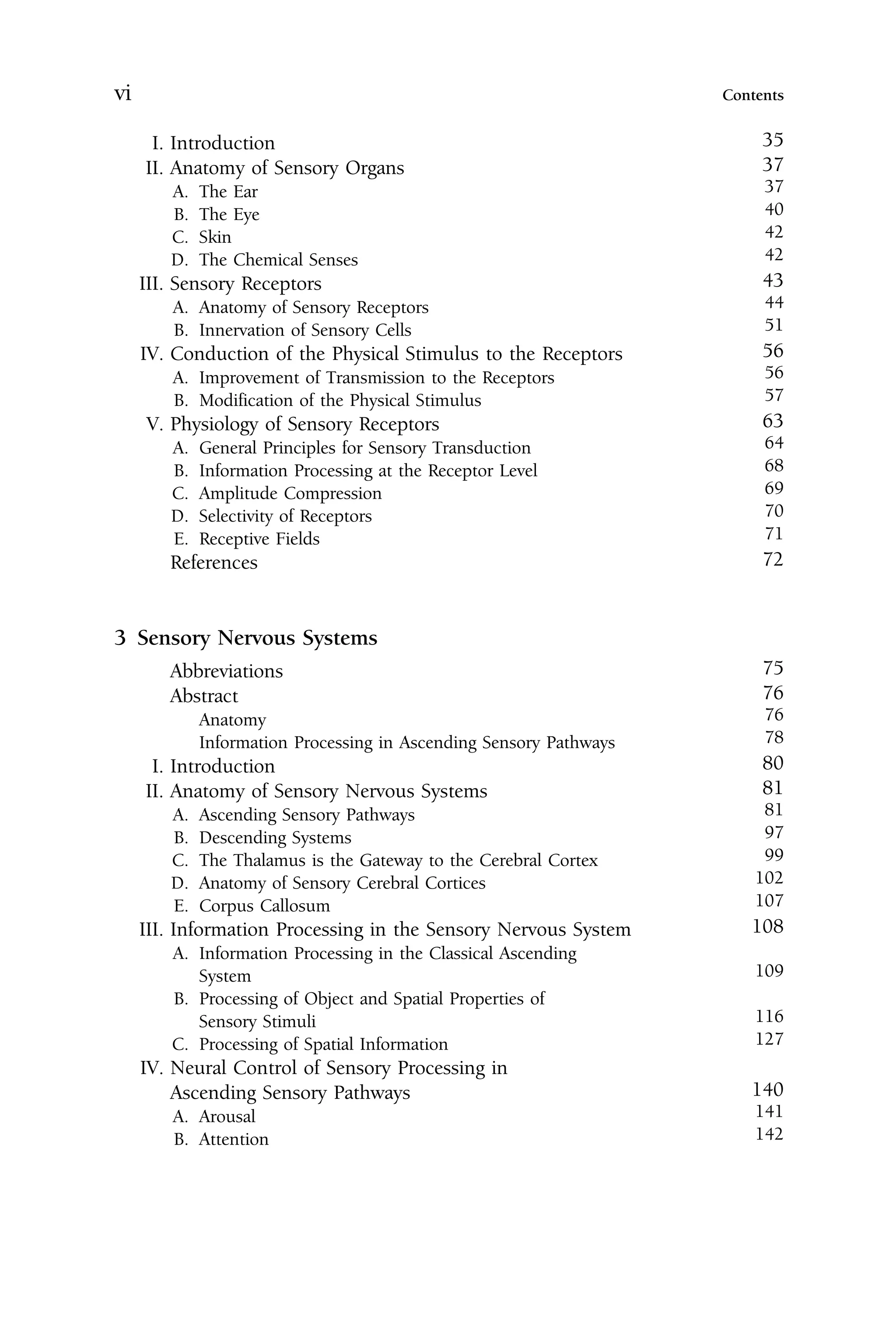

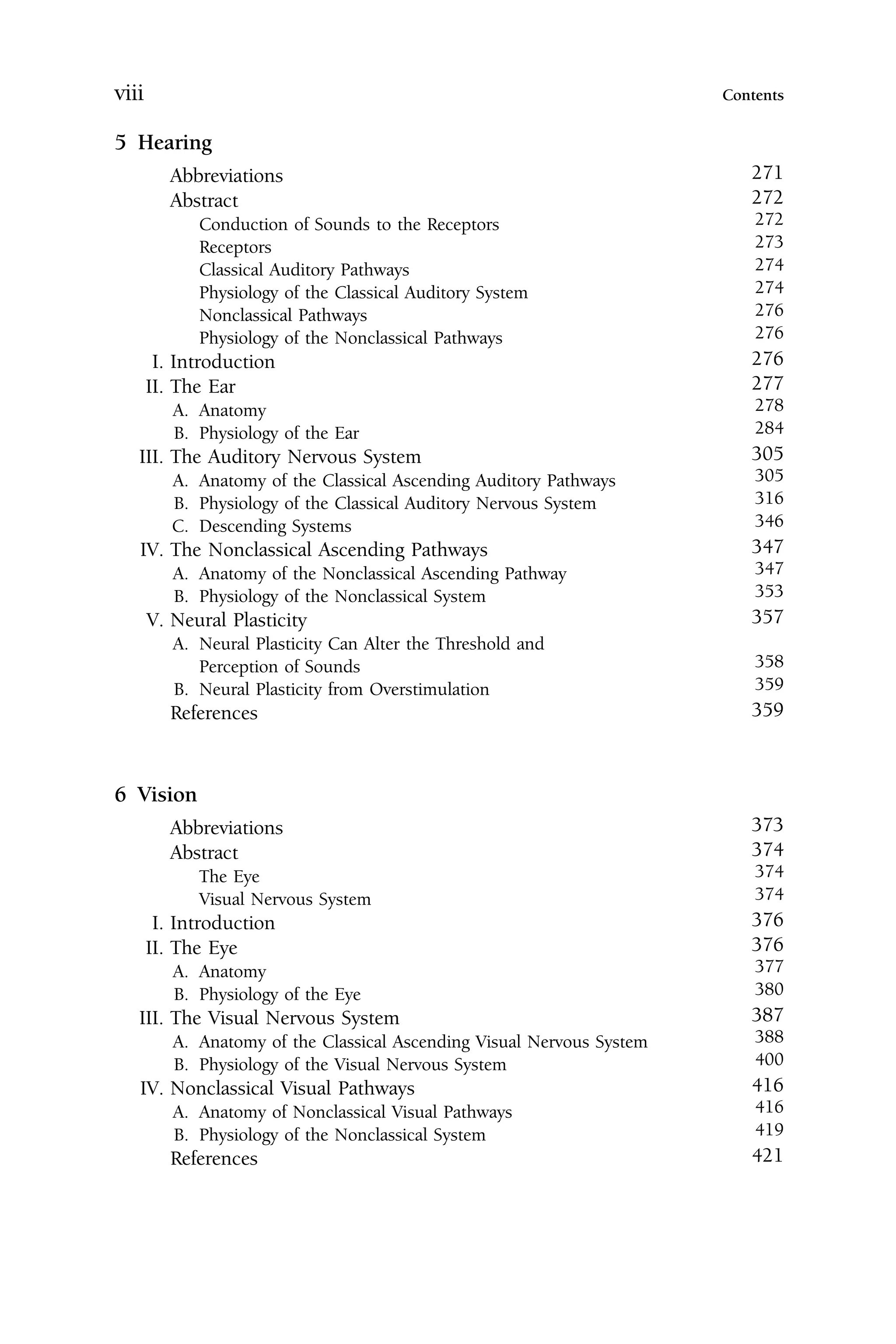
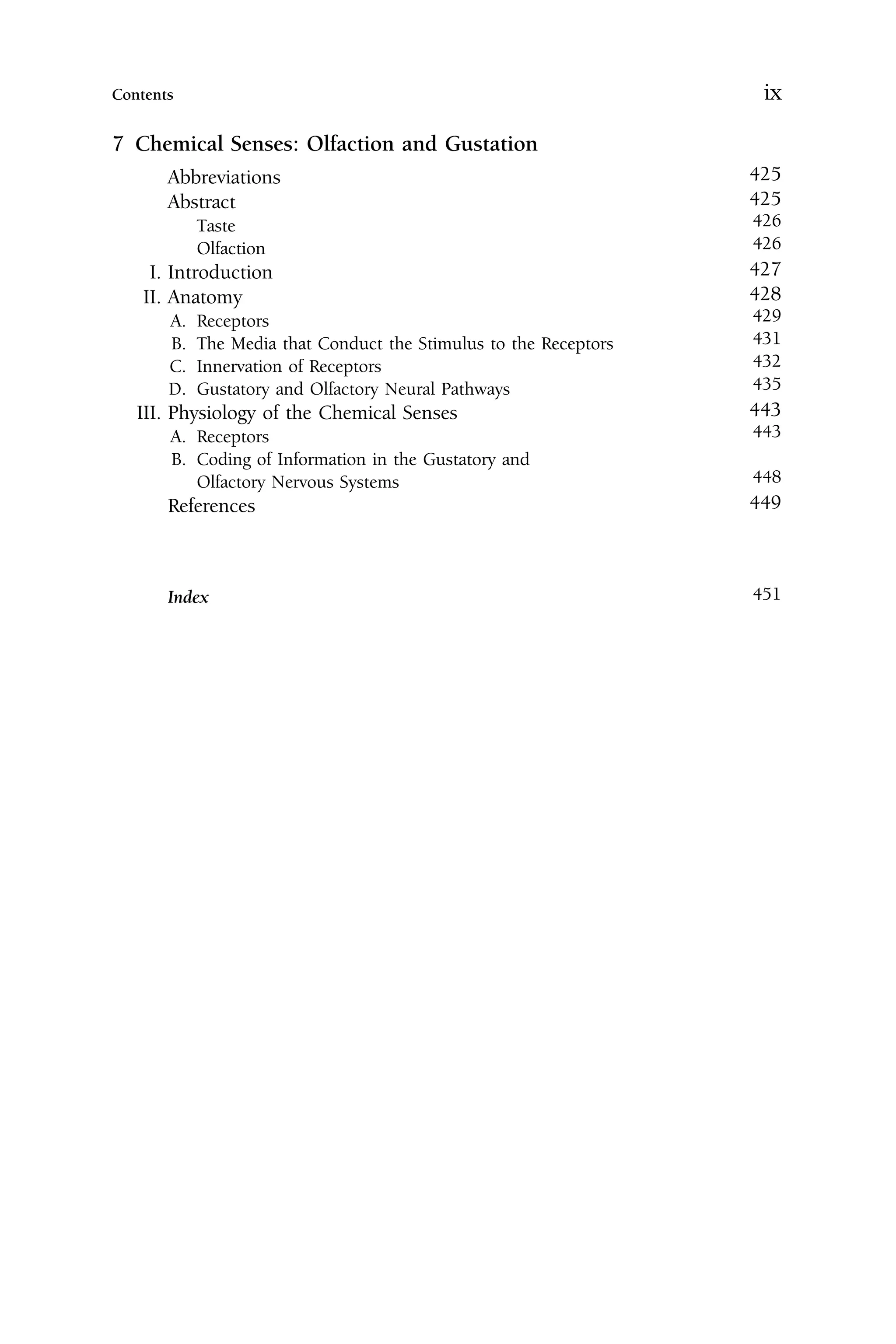




![II. Threshold of Detection
10"'
1 0 '
10"'
o 10"'
•o
B 10"
"Q.
E
< 10"'
10'^
10
Wave length
of light
N
Diameter of hydrogen
molecule
—' 1—
50 100
1 1
500010000
500 1000
Frequency (Hz)
FIGURE 1.1 Threshold of hearing in a human subject. Circles indicate the ampUtude of the dis-
placement of the tympanic membrane at threshold (in cm);'^"^ the soUd line is a curve fit to the data
points.
II. THRESHOLD OF DETECTION
In psychophysics the threshold of detection of a physical stimulus refers to the
minimum amount of the stimulus that is needed for the sensory system to elicit
a behavioral response. The threshold varies between sensory systems, between
animal species, and as a function of the properties of the stimulus.
The sensitivity of sensory systems is enormous and it surpasses most of
our technical systems. Eyes of insects such as night moths, which are active
when light is very weak, can detect one or two light quanta, and even our own
eyes are very sensitive and can detect approximately 15 light quanta. *'^^ The
threshold of hearing is no less impressive than that of vision. In the most
sensitive frequency range the amplitude of vibration of the eardrum at the
threshold of hearing is less than 10~^ cm (1/100 of one millimicron or
nanometer [nm] or 10^ micrometers [jim]), corresponding to less than 1% of the
diameter of a hydrogen molecule (Fig. 1.1)."^^
*A light quantum is the smallest amount of hght that can be produced. It refers to the quantum theory
of light production, which assumes that light is both a particle and a wave.](https://image.slidesharecdn.com/66729-250520102730-9c99958c/75/Sensory-Systems-1st-Edition-Aage-R-Moller-21-2048.jpg)
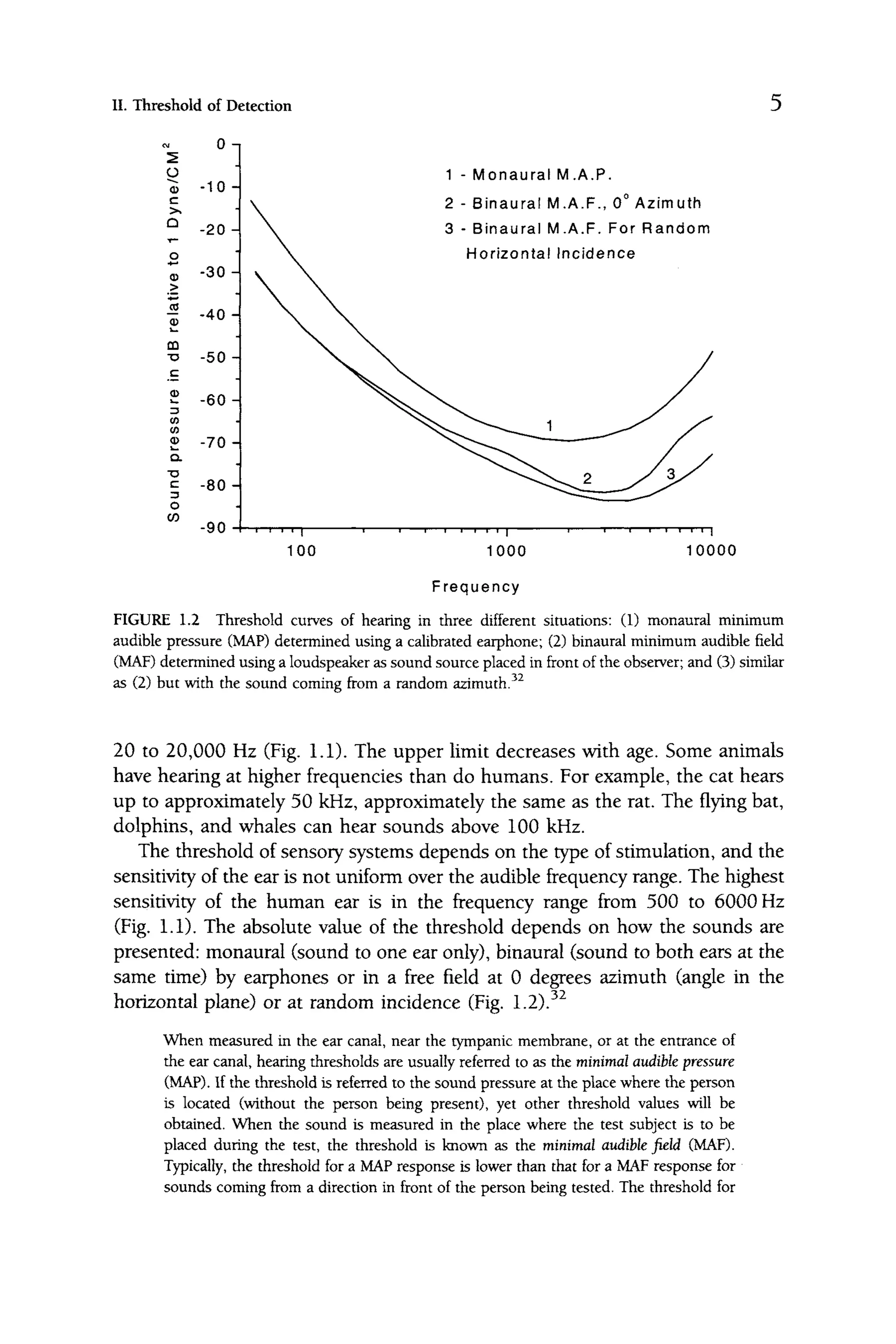

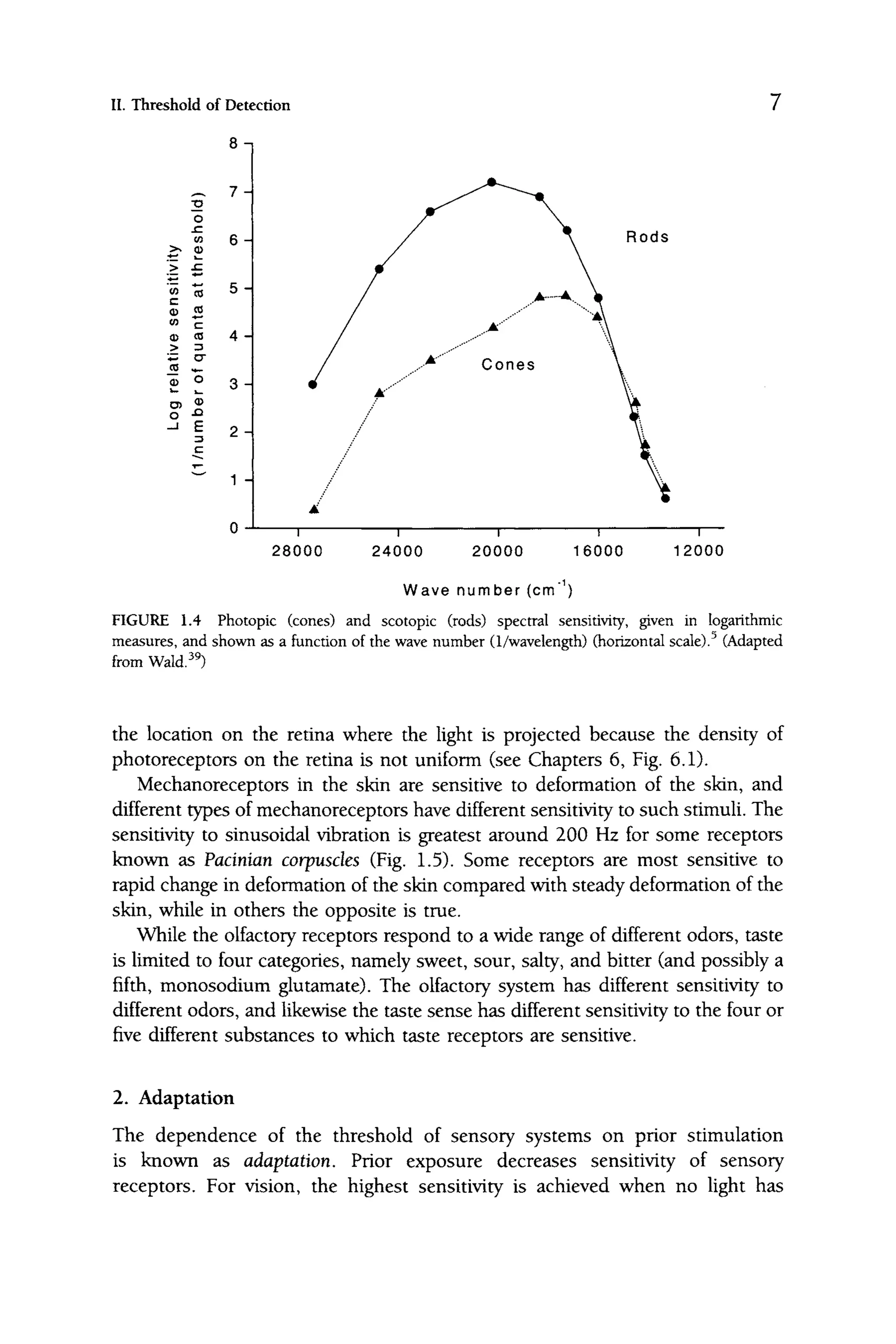

![II. Threshold of Detection
5H
<
D 4-
3H
2-
-^ 1
o
OH
'Rod monochromat
10 15 20 25 30
Dark-adaptation time (min)
FIGURE 1.6 Dark-adaptation curves showing the relative intensity of light to reach threshold as a
function of time after exposure to bright light. The dotted curve was obtained in a totally color-blind
person assumed to have only rods. The dashed curve was obtained in response to red light
illuminating the fovea, and the continuous curve was obtained using white light illuminating the extra
foveal regions of the retina in a person with normal vision."^^
7 -1
6-]
5 A
4 -I
T3
^ 3H
CO
I -
^ 2H
1
• O - 1000 Hz
- • - 1 4 0 0 Hz
o..
. - O
• • • • o -
I
20
—r—
40
— [ —
60 80 100
Sensation level of exposure (dB)
FIGURE 1.7 Temporary threshold shift (TTS) induced by exposure to 1000-Hz tones of different
intensity given in sensation level (SL) (i.e., the level in decibels above the test subject's hearing
threshold for two tones of different frequencies).^^'^®](https://image.slidesharecdn.com/66729-250520102730-9c99958c/75/Sensory-Systems-1st-Edition-Aage-R-Moller-27-2048.jpg)
![10 Chapter 1: Basic Psychophysics
Simultaneous
700 800 900
Masker frequency Hz
T 1 1 . 1 1 1
1000 1100 1200 1300
FIGURE 1.8 Comparison between simultaneous and forward masking of a weak (10-dB sensation
level [SL]) 1000-Hz tone as a function of the frequency of the masker/''
Stimulus. Masking is pronounced in hearing, where it has been studied
extensively. It is well-known how stimulus parameters affect a sound's ability to
mask another sound.
The efficiency of a sound in masking another sound depends on its
intensity and its frequency relative to the test sound. In general, low-frequency
sounds are more effective in masking high-frequency sounds rather than
vice versa. Different sounds mask each other according to the width of the critical
hand.* Two sounds that are separated in frequency by less than one critical
band are most efficient in masking each other, while sounds that are separated
in frequency by more than one critical band are less effective in masking
each other.
Stimuli do not have to occur simultaneously to mask each other. A
stimulus that occurs just before another (second) stimulus, but does not overlap
it in time, may change the threshold of the second stimulus. This temporal effect
in masking is referred to as forward masking. Forward masking is less efficient
than simultaneous masking (Fig. 1.8). A masker can also affect the threshold of
*Critical band is the band of frequencies over which the auditory system integrates the energy of a
broadband sound. It is also a measure of the ability of one sound to mask another sound.](https://image.slidesharecdn.com/66729-250520102730-9c99958c/75/Sensory-Systems-1st-Edition-Aage-R-Moller-28-2048.jpg)
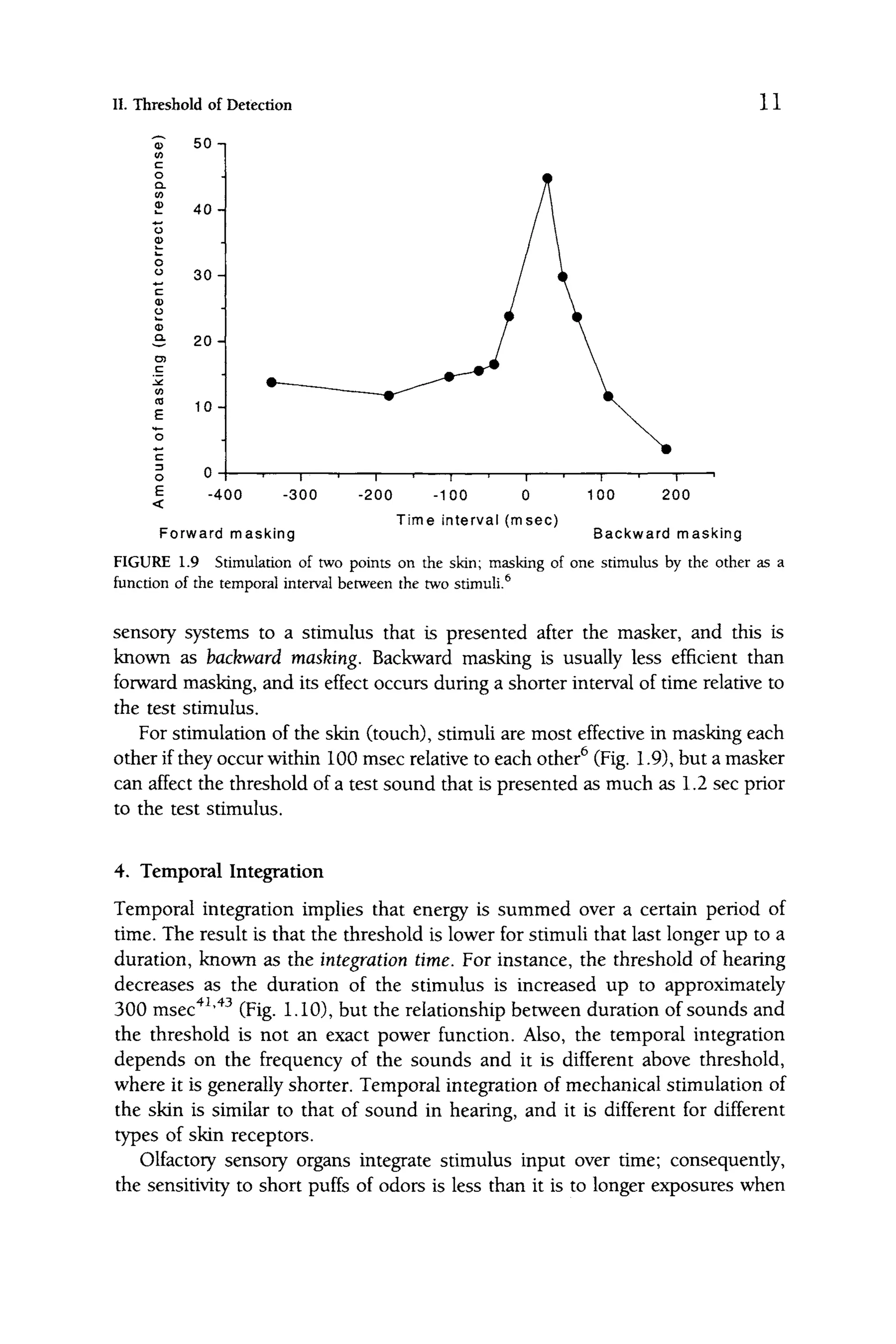


![CHAPTER III.
ITINERARY, CONCLUDED: LEECH LAKE TO ST. LOUIS, FEBRUARY
1ST-APRIL 30TH, 1806.
Saturday, Feb. 1st. Left our camp pretty early. Passed a
continued train of prairie, and arrived at Lake La Sang Sue
[Leech lake] at half-past two o'clock. I will not attempt to
describe my feelings on the accomplishment of my
voyage, for this is [what was then mistaken to be] the
main source of the Mississippi.[III-1]
The Lake Winipie
branch is navigable thence to [Upper] Red Cedar [now
Cass] lake, for the distance of five leagues, which is [very
far from being] the extremity of the navigation. Crossed
the lake 12 miles to the establishment of the N. W.
Company, where we arrived about three o'clock [10
o'clock, p. m.]; found all the gates locked, but upon
knocking were admitted, and received with marked
attention and hospitality by Mr. Hugh M'Gillis. Had a good
dish of coffee, biscuit, butter, and cheese for supper.
Sunday, Feb. 2d. Remained all day within doors. In the
evening sent an invitation to Mr. [George] Anderson, who
was an agent of Dickson, and also for some young Indians
at his house, to come over and breakfast in the morning.](https://image.slidesharecdn.com/66729-250520102730-9c99958c/75/Sensory-Systems-1st-Edition-Aage-R-Moller-32-2048.jpg)
![Feb. 3d. Spent the day in reading Volney's Egypt,[III-2]
proposing some queries to Mr. Anderson, and preparing
my young man [Miller] to return with a supply of
provisions to my party.
Feb. 4th. Miller departed this morning. Mr. Anderson
returned to his quarters. My legs and ankles were so
much swelled that I was not able to wear my own clothes
and was obliged to borrow some from Mr. M'Gillis.
Feb. 5th. One of Mr. M'Gillis' clerks [Roussand or
Boussant[III-3]
] had been sent to some Indian lodges and
expected to return in four days, but had now been absent
nine. Mr. Grant was dispatched in order to find out what
had become of him.
Feb. 6th. My men arrived at the fort about four o'clock.[III-
4]
Mr. M'Gillis asked if I had any objections to his hoisting
their [British] flag in compliment to ours. I made none, as
I had not yet explained to him my ideas. In making a
traverse of the lake, some of my men had their ears,
some their noses, and others their chins frozen.
Feb. 7th. Remained within doors, my limbs being still very
much swelled. Addressed a letter to Mr. M'Gillis on the
subject of the N. W. Company trade in this quarter.[III-5]
Feb. 8th. Took the latitude and found it to be 47° 16´ 13
´´. Shot with our rifles.
Sunday, Feb. 9th. Mr. M'Gillis and myself paid a visit to Mr.
Anderson, an agent of Mr. Dickson of the Lower](https://image.slidesharecdn.com/66729-250520102730-9c99958c/75/Sensory-Systems-1st-Edition-Aage-R-Moller-33-2048.jpg)
![Mississippi, who resided at the west end of the lake.[III-6]
Found him eligibly situated as to trade, but his houses
bad. I rode in a cariole for one person, constructed in the
following manner: Boards planed smooth, turned up in
front about two feet, coming to a point, and about 2½
feet wide behind; on which is fixed a box covered with
dressed skins painted; this box is open at the top, but
covered in front about two-thirds of the length. The horse
is fastened between the shafts. The rider wraps himself
up in a buffalo-robe and sits flat down, having a cushion
to lean his back against. Thus accoutered, with a fur cap,
etc., he may bid defiance to the wind and weather. Upon
our return we found that some of the Indians had already
returned from the hunting-camps; also, Monsieur
Roussand [Mr. M'Gillis' clerk of Feb. 5th], the gentleman
supposed to have been killed by the Indians. His arrival
with Mr. Grant diffused a general satisfaction through the
fort.
Feb. 10th. Hoisted the American flag in the fort. The
English yacht [Jack] still flying at the top of the flagstaff, I
directed the Indians and my riflemen to shoot at it. They
soon broke the iron pin to which it was fastened, and
brought it to the ground. Reading Shenstone, etc.
Feb. 11th. The Sweet, Buck, Burnt, etc., arrived, all chiefs
of note, but the former in particular, a venerable old man.
[III-7]
From him I learned that the Sioux occupied this
ground when, to use his own phrase, "he was a made
man and began to hunt; that they occupied it the year](https://image.slidesharecdn.com/66729-250520102730-9c99958c/75/Sensory-Systems-1st-Edition-Aage-R-Moller-34-2048.jpg)
![that the French missionaries were killed at the river
Pacagama." The Indians flocked in.
Feb. 12th. Bradley and myself, with Mr. M'Gillis and two of
his men, left Leech Lake at ten o'clock, and arrived at the
house at [Upper] Red Cedar [now Cass[III-8]
] Lake, at
sunset, a distance of 30 miles. My ankles were very much
swelled and I was very lame. From the entrance of the
Mississippi to the streight is called six miles, S. W. course.
Thence to the south end, S. 30 E. four miles. The bay at
the entrance extends nearly E. and W. six miles; it is
about 2½ from the north side to a large point. This may
be called the upper source of the Mississippi, being 15
miles above Little Lake Winipie [i. e., Lake
Winnibigoshish]; and the extent of canoe navigation only
two leagues to some of the Hudson's Bay waters.
Feb. 13th. Were favored with a beautiful day. Took the
latitude, and found it to be 47° 42´ 40´´ N. At this place
it was that Mr. Thompson[III-9]
made his observations in
1798, from which he determined that the source of the
Mississippi was in 47° 38´. I walked about three miles
back in the country, at two-thirds water. One of our men
marched to Lake Winepie [i. e., Lake Winnibigoshish] and
returned by one o'clock, for the stem of the Sweet's pipe,
a matter of more consequence in his affairs with the Sioux
than the diploma of many an ambassador. We feasted on
whitefish [Coregonus sp.], roasted on two iron grates
fixed horizontally in the back of the chimney; the entrails
left in the fish.](https://image.slidesharecdn.com/66729-250520102730-9c99958c/75/Sensory-Systems-1st-Edition-Aage-R-Moller-35-2048.jpg)
![Feb. 14th. Left the house at nine o'clock. It becomes me
here to do justice to the hospitality of our hosts: one Roy,
a Canadian, and his wife, a Chipeway squaw. They
relinquished for our use the only thing in the house that
could be called a bed, attended us like servants, nor could
either of them be persuaded to touch a mouthful until we
had finished our repasts. We made the [Leech Lake]
garrison about sundown, having been drawn at least 10
miles in a sleigh by two small dogs. They were loaded
with 200 pounds, and went so fast as to render it difficult
for the men with snowshoes to keep up with them. The
chiefs asked my permission to dance the calumet-dance,
which I granted.
Feb. 15th. The Flat Mouth,[III-10]
chief of the Leech Lake
village, and many other Indians arrived. Received a letter
from Mr. M'Gillis.[III-11]
Noted down the heads of my
speech, and had it translated into French, in order that
the interpreter should be perfectly master of his subject.
Sunday, Feb. 16th. Held a council with the chiefs and
warriors of this place and of Red Lake; but it required
much patience, coolness, and management to obtain the
objects I desired, viz.: That they should make peace with
the Sioux; deliver up their [British] medals and flags; and
that some of their chiefs should follow me to St. Louis.[III-
12]
As a proof of their agreeing to the peace, I directed
that they should smoke out of the [Sioux chief] Wabasha's
pipe, which lay on the table; they all smoked, from the
head chief to the youngest soldier. They generally
delivered up their flags with a good grace, except Flat](https://image.slidesharecdn.com/66729-250520102730-9c99958c/75/Sensory-Systems-1st-Edition-Aage-R-Moller-36-2048.jpg)
![Mouth, who said he had left both at his camp, three days'
march, and promised to deliver them up to Mr. M'Gillis to
be forwarded. With respect to their returning with me, old
Sweet thought it most proper to return to the Indians of
Red lake, Red river, and Rainy Lake river. Flat Mouth said
it was necessary for him to restrain his young warriors,
etc. The other chiefs did not think themselves of sufficient
consequence to offer any reason for not following me to
St. Louis, a journey of between 2,000 and 3,000 miles
through hostile tribes of Indians. I then told them, "that I
was sorry to find that the hearts of the Sauteurs of this
quarter were so weak; that the other nations would say,
'What! were there no soldiers at Leech, Red, and Rainy
Lakes who had the hearts to carry the calumet of their
chief to their father?'" This had the desired effect. The
Bucks and Beaux [sic—both pl.], two of the most
celebrated young warriors, rose and offered themselves to
me for the embassy; they were accepted, adopted as my
children, and I was installed their father. Their example
animated the others, and it would have been no difficult
matter to have taken a company; two, however, were
sufficient. I determined that it should be my care never to
make them regret the noble confidence placed in me; for
I would have protected their lives with my own. Beaux is
brother to Flat Mouth. Gave my new soldiers a dance and
a small dram. They attempted to get more liquor, but a
firm and peremptory denial convinced them I was not to
be trifled with.](https://image.slidesharecdn.com/66729-250520102730-9c99958c/75/Sensory-Systems-1st-Edition-Aage-R-Moller-37-2048.jpg)
![Feb. 17th. The chief of the land[III-13]
brought in his flag
and delivered it up. Made arrangements to march my
party the next day. Instructed Sweet how to send the
parole to the Indians of Red river, etc. Put my men
through the manual, and fired three blank rounds, all of
which not a little astonished the Indians. I was obliged to
give my two new soldiers each a blanket, pair of leggins,
scissors, and looking-glass.
Feb. 18th. We[III-14]
marched for [Lower] Red Cedar Lake
about eleven o'clock, with a guide provided for me by Mr.
M'Gillis; were all provided with snowshoes. Marched off
amid the acclamations and shouts of the Indians, who
generally had remained to see us take our departure. Mr.
Anderson promised to come on with letters; he arrived
about twelve o'clock and remained all night. He concluded
to go down with me to see Mr. Dickson.
Feb. 19th. Bradley, Mr. L'Rone [?], the two young Indians
[Buck and Beau], and myself, left Mr. M'Gillis' at ten
o'clock; crossed Leech Lake in a S. E. direction 24 miles.
Mr. M'Gillis' hospitality deserves to be particularly noticed;
he presented me with his dogs and cariole, valued in this
country at $200. One of the dogs broke out of his
harness, and we were not able during that day to catch
him again; the other poor fellow was obliged to pull the
whole load—at least 150 pounds. This day's march was
from lake to lake.[III-15]
Feb. 20th. I allowed my men to march at least three hours
before me; notwithstanding which, as it was cold and the](https://image.slidesharecdn.com/66729-250520102730-9c99958c/75/Sensory-Systems-1st-Edition-Aage-R-Moller-38-2048.jpg)
![road good, my sleigh dogs brought me ahead of all by
one o'clock. Halted for an encampment at half past two
o'clock. Our courses this day were S. E. six miles, then S.
18 miles, almost all the way over lakes, some of which
were six miles across. Encamped on the bank of a lake
called Sandy Lake.[III-16]
Indians were out hunting.
Feb. 21st. Traveled this day generally S. Passed but two
lakes; Sandy Lake, which is of an oblong form, N. and S.
four miles, and one other small one. The Indians, at the
instigation of Mr. L'Rone, applied for him to accompany us.
I consented that he should go as far as [Lower] Red
Cedar Lake. I then wrote a note to M'Gillis upon the
occasion. After Reale had departed with it, L'Rone
disclosed to me that it was his wish to desert the N. W.
Company entirely, and accompany me. To have
countenanced for a moment anything of this kind, I
conceived would have been inconsistent with every
principle of honor; I therefore obliged him to return
immediately. We then had no guide, our Indians not
knowing the road. Our course was through woods and
bad brush, 15 miles.
Feb. 22d. Our course a little to the S. of E., through woods
not very thick. Arrived at White Fish Lake[III-17]
at eleven
o'clock, and took an observation. My party crossed this
lake and encamped between two lakes. This may be
called the source of Pine river. At this place has been one
of the N. W. Company's establishments at the N. E. and S.
side. It was a square stockade of about 50 feet, but at](https://image.slidesharecdn.com/66729-250520102730-9c99958c/75/Sensory-Systems-1st-Edition-Aage-R-Moller-39-2048.jpg)
![this time nearly all consumed by fire. Also one standing
over the point on the E. side.
Sunday, Feb. 23d. My two Indians, Boley, and myself, with
my sleigh and dogs, left the party under an idea that we
should make [Lower] Red Cedar lake. We marched hard
all day, without arriving at the Mississippi. Our course was
nearly due east until near night, when we changed more
south. Took no provision or bedding. My Indians killed 15
partridges, some nearly black, with a red mark over their
eyes, called the savanna partridge [Canada grouse or
spruce partridge, Dendragapus canadensis]. Overtaken
about noon by two of Mr. Anderson's men, named Brurie
and [Blank], Mr. Anderson himself not being able to come.
Distance 30 miles.
Feb. 24th. We started early, and after passing over one of
the worst roads in the world, found ourselves on a lake
about three o'clock; took its outlet [Dean creek] and
struck the Mississippi about one mile below the
[Chippewa] canoes mentioned on Jan. 1st, by which I
knew where we were. Ascended the Mississippi about four
miles, and encamped on the west side [about the mouth
of Hay creek[III-18]
]. Our general course this day was nearly
S., when it should have been S. E. My young warriors
were still in good heart, singing and showing every wish
to keep me so. The pressure of my racket-strings brought
the blood through my socks and mockinsons, from which
the pain I marched in may be imagined.](https://image.slidesharecdn.com/66729-250520102730-9c99958c/75/Sensory-Systems-1st-Edition-Aage-R-Moller-40-2048.jpg)
![Feb. 25th. We marched and arrived at [Lower Red] Cedar
lake before noon; found Mr. Grant and De Breche, chief of
Sandy lake [Chippewas[III-19]
] at the house. This gave me
much pleasure, for I conceive Mr. Grant to be a gentleman
of as much candor as any with whom I made an
acquaintance in this quarter, and the chief, De Breche, is
reputed to be a man of better information than any
[other] of the Sauteurs.
Feb. 26th. Sent one of Mr. Grant's men down with a bag
of rice to meet my people; he found them encamped on
the Mississippi. Wrote a letter[III-20]
to Mr. Dickson on the
subject of the Fols Avoins [Folle Avoine or Menomonee
Indians]; also, some orders to my sergeant [Kennerman,
at the stockade on Swan river]. This evening I had a long
conversation with De Breche; he informed me that a
string of wampum had been sent among the Chipeways,
he thought by the British commanding officer at St.
Joseph. He appeared to be a very intelligent man.
Feb. 27th. The chief called the White Fisher and seven
Indians arrived at the house. My men also arrived about
twelve o'clock.
Feb. 28th. We left [Lower] Red Cedar lake about eleven
o'clock, and went to where the canoes were [near Dean
creek], mentioned in my journal of Jan. 1st. My young
Indians [Buck and Beau] remained behind under the
pretense of waiting for the chief De Breche, who returned
to Sandy Lake for his [British] flag and medals, and was](https://image.slidesharecdn.com/66729-250520102730-9c99958c/75/Sensory-Systems-1st-Edition-Aage-R-Moller-41-2048.jpg)
![to render himself at my post with Mr. Grant about the
15th of the following month.
Mar. 1st. Departed early. Passed our encampment of Dec.
31st at nine o'clock. Passed Pine river at twelve o'clock.
Passed our encampment of Dec. 30th at three o'clock.
Passed our encampment of Dec. 29th just before we came
to our present, which we made on the point of the Pine
Ridge below. Distance 43 miles.[III-21]
Sunday, Mar. 2d. Passed our encampment of Dec. 28th at
ten o'clock, that of Dec. 27th at one o'clock, and
encamped at that of Dec. 26th [Brainerd]. Found wood
nearly sufficient for our use. This morning dispatched
Bradley to the last place we had buried a barrel of flour
[Dec. 20th, a short distance below Crow Wing river], to
thaw the ground and hunt. This day a party of Indians
struck the river behind Bradley and before us, but left it
10 miles above Raven [Crow Wing] river.
Mar. 3d. Marched early; passed our Christmas
encampment at sunrise. I was ahead of my party in my
cariole. Soon afterward I observed a smoke on the W.
shore. I hallooed, and some Indians appeared on the
bank. I waited until my interpreter came up; we then
went to the camp. They proved to be a party of
Chipeways, who had left the encampment the same day
we left it. They presented me with some roast meat,
which I gave my sleigh dogs. They then left their camp
and accompanied us down the river. We passed our
encampment of Dec. 24th at nine o'clock, of the 23d at](https://image.slidesharecdn.com/66729-250520102730-9c99958c/75/Sensory-Systems-1st-Edition-Aage-R-Moller-42-2048.jpg)
![ten o'clock, and of the 22d at eleven o'clock; here the
Indians crossed over to the W. shore; arrived at the
encampment of Dec. 21st at twelve o'clock, where we had
a barrel of flour [cached Dec. 20th, short of Crow Wing
river].
I here found Corporal Meek and another man from the
post [on Swan river], from whom I heard that the men
were all well; they confirmed the account of a Sioux
having fired on a sentinel; and added that the sentinel
had first made him drunk and then turned him out of the
tent; upon which he fired on the sentinel and ran off, but
promised to deliver himself up in the spring. The corporal
informed me that the sergeant [Kennerman] had used all
the elegant hams and saddles of venison which I had
preserved to present to the commander-in-chief and other
friends; that he had made away with all the whisky,
including a keg I had for my own use, having publicly sold
it to the men, and a barrel of pork; that he had broken
open my trunk and sold some things out of it, traded with
the Indians, gave them liquor, etc.; and this, too, contrary
to my most pointed and particular directions. Thus, after I
had used in going up the river with my party the strictest
economy, living upon two pounds of frozen venison a day,
in order that we might have provision to carry us down in
the spring, this fellow was squandering the flour, pork,
and liquor during the winter, while we were starving with
hunger and cold. I had saved all our corn, bacon, and the
meat of six deer, and left it at Sandy Lake, with some
tents, my mess-boxes, salt, tobacco, etc., all of which we](https://image.slidesharecdn.com/66729-250520102730-9c99958c/75/Sensory-Systems-1st-Edition-Aage-R-Moller-43-2048.jpg)
![were obliged to sacrifice by not returning the same route
we went; we had consoled ourselves at this loss by the
flattering idea that we should find at our little post a
handsome stock preserved—how mortifying the
disappointment!
We raised our barrel of flour and came down to the mouth
of the little [Nokasippi] river, on the E., which we had
passed on Dec. 21st. The ice covered with water.
Mar. 4th. Proceeded early. Passed our encampment of
Dec. 20th at sunrise. Arrived at that of the 19th [read
17th] at nine o'clock; here we had buried two barrels.[III-
22]
Made a large fire to thaw the ground. Went on the
prairie and found Sparks, one of my hunters, and brought
him to the river at the Pine Camp [of Dec. 14th, 15th,
16th, vicinity of Olmsted's bar]. Passed on opposite our
encampment of Dec. 13th [at or near Topeka], and
encamped where Sparks and some men had an old
hunting-camp, and where Fresaie, a Chipeway chief,
surrounded them.
Mar. 5th. Passed all the encampments [Dec. 12th, 11th,
10th, 9th] between Pine creek and the post, at which we
arrived about ten o'clock.[III-23]
I sent a man on ahead to
prevent the salute I had before ordered by letter [of Feb.
28th]; this I had done from the idea that the Sioux chiefs
would accompany me. Found all well. Confined my
sergeant. About one o'clock Mr. Dickson arrived, with
Killeur Rouge, his son, and two other Sioux men, with two
women who had come up to be introduced to the](https://image.slidesharecdn.com/66729-250520102730-9c99958c/75/Sensory-Systems-1st-Edition-Aage-R-Moller-44-2048.jpg)
![Sauteurs they expected to find with me. Received a letter
from [Joseph] Reinville.
Mar. 6th. Thomas [Carron[III-24]
], the Fols Avoin's first
chief, arrived with ten others of his nation. I made a
serious and authoritative expostulative representation to
him of my opinion of the conduct of Shawonoe, another
chief of his nation, who had behaved ill. Had also a
conference with Killeur Rouge and his people. At night
wrote to Messrs. Grant, M'Gillis, and Anderson.
Mar. 7th. Held conversations with the Indians. Thomas
[Carron], the Fols Avoin chief, assured me that he would
interest himself in obliging the Puants to deliver up the
men who had recently committed murders on the
Ouiscousing and Rock rivers; and if necessary he would
make it a national quarrel, on the side of the Americans.
This Thomas is a fine fellow, of a very masculine figure,
noble and animated delivery, and appears to be very
much attached to the Americans. The Sioux informed me
that they would wait until I had determined my affairs in
this country, and then bear my words to the St. Peters.
Mar. 8th. The Fols Avoin chief presented me with his pipe
to give to the Sauteurs on their arrival, with assurances of
their safety on their voyage, and his wish for them to
descend the river. The Fils de Killeur Rouge also presented
me with his pipe to present to the Sauteur Indians on
their arrival, to make them smoke, and assure them of his
friendly disposition, and that he would wait to see them at
Mr. Dickson's. Thomas made a formal complaint against a](https://image.slidesharecdn.com/66729-250520102730-9c99958c/75/Sensory-Systems-1st-Edition-Aage-R-Moller-45-2048.jpg)
![Frenchman, by name Greignor,[III-25]
who resided in Green
bay, and who he said abused the Indians, beat them, etc.,
without provocation. I promised to write to the
commanding officer or Indian agent at Michilimackinac
upon the occasion. The Indians with Mr. Dickson all took
their departure. Hitched my dogs in the sleigh, which
drew one of the Indian women down the ice, to the no
little amusement of the others. Went some distance down
the river in order to cut a mast. Cut a pine mast 35 feet
long for my big boat at the prairie [Prairie du Chien]. This
day my little boy broke the cock of my gun; few trifling
misfortunes could have happened which I should have
regretted more, as the wild fowl just began to return on
the approach of spring.
Sunday, Mar. 9th. I examined into the conduct of my
sergeant, and found that he was guilty; punished him by
reduction, etc. Visited the Fols Avoin lodges and received
a present of some tallow. One of my men arrived from the
hunting-camp with two deer.
Mar. 10th. Was visited by the Fols Avoin chief and several
others of his nation. This chief was an extraordinary
hunter; to instance his power, he killed 40 elk and a bear
in one day, chasing the former from dawn to eve. We
were all busied in preparing oars, guns, mast, etc., by the
time the ice broke up, which was opening fast.
Mar. 11th. In a long conversation with a Reynard, he
professed not to believe in an hereafter; but he believed
that the world would all be drowned by water at some](https://image.slidesharecdn.com/66729-250520102730-9c99958c/75/Sensory-Systems-1st-Edition-Aage-R-Moller-46-2048.jpg)
![future period; he asked how it was to be repeopled. In
justice to his nation, however, I must observe that his
opinion was singular.[III-26]
Mar. 12th. Made preparations; had a fine chase with deer
on the ice; killed one. Since our return I have received
eight deer from our camp.
Mar. 13th. Received two deer from my hunting-camp.
Went out with my gun on the opposite side of the river.
Ascended the mountain which borders the prairie. On the
point of it I found a stone on which the Indians had
sharpened their knives, and a war-club half finished. From
this spot you may extend the eye over vast prairies with
scarcely any interruption but clumps of trees, which at a
distance appeared like mountains, from two or three of
which the smoke rising in the air denoted the habitation
of the wandering savage, and too often marked them out
as victims to their enemies; from whose cruelty I have
had the pleasure in the course of the winter and through
a wilderness of immense extent to relieve them, as peace
has reigned through my mediation from the prairie Des
Cheins to the lower Red river. If a subaltern with but 20
men, at so great a distance from the seat of his
government, could effect so important a change in the
minds of those savages, what might not a great and
independent power effect, if, instead of blowing up the
flames of discord, they exerted their influence in the
sacred cause of peace?](https://image.slidesharecdn.com/66729-250520102730-9c99958c/75/Sensory-Systems-1st-Edition-Aage-R-Moller-47-2048.jpg)

![Chipeways are suspicious, consequently treacherous and
of course cowards.
Sunday, Mar. 16th. Received three deer from our hunting-
camp. Examined trees for canoes.
Mar. 17th. Left the fort with my interpreter [Rousseau]
and [Private Alexander] Roy, in order to visit Thomas, the
Fols Avoin chief, who was encamped, with six lodges of
his nation, about 20 miles below us, on a little [Wolf creek
of Pike, now Spunk] river which empties into the
Mississippi on the W. side, a little above Clear river [of
Pike, now the Platte]. On our way down killed one goose,
wounded another, and a deer that the dogs had driven
into an air-hole; hung our game on the trees. Arrived at
the creek; took out on it; ascended three or four miles on
one bank, and descended on the other [missing Carron's
camp both ways]. Killed another goose. Struck the
Mississippi below [Spunk river]. Encamped at our
encampment of the [13th] of October, when we ascended
the river. Ate our goose for supper. It snowed all day, and
at night a very severe storm arose. It may be imagined
that we spent a very disagreeable night without shelter,
and but one blanket each.
Mar. 18th. We marched [up Spunk river], determined to
find the [Menomonee] lodges. Met an Indian whose track
we pursued through almost impenetrable woods for about
2½ miles to the camp. Here there was one of the finest
sugar-camps I almost ever saw, the whole of the timber
being sugar-tree. We were conducted to the chief's lodge,](https://image.slidesharecdn.com/66729-250520102730-9c99958c/75/Sensory-Systems-1st-Edition-Aage-R-Moller-49-2048.jpg)

![one wife, and that I considered it strictly my duty to
remain faithful to her. This he thought strange, he himself
having three, and replied that "He knew some Americans
at his nation who had half a dozen wives during the
winter." The interpreter observed that they were men
without character; but that all our great men had each but
one wife. The chief acquiesced, but said he liked better to
have as many as he pleased. This conversation passing
without any appeal to me, as the interpreter knew my
mind on those occasions and answered immediately, it did
not appear as an immediate refusal of the woman.
Continued snowing very hard all day. Slept very warm.
Mar. 19th. This morning purchased two baskets of sugar,
for the amount of which I gave orders on Mr. Dickson.
After feasting upon a swan, took our leave for [the Swan
river] camp; still snowing. Finding my two companions
[the interpreter and Private Roy] unable to keep up, I
pushed on and arrived at the [Mississippi] river. When I
arrived at the place where I had hung up my first goose
[Mar. 17th], I found that the ravens and eagles had not
left a feather; and feasting upon the deer was a band
sufficient to have carried it away, which had picked its
bones nearly clean; what remained I gave my dogs.
Stopped at the place where I expected to find the last
goose, but could see nothing of it; at length I found it hid
under the grass and snow, where some animal had
concealed it, after eating off its head and neck. I carried it
to the fort, where I arrived about an hour before
sundown. Dispatched immediately two men with rackets](https://image.slidesharecdn.com/66729-250520102730-9c99958c/75/Sensory-Systems-1st-Edition-Aage-R-Moller-51-2048.jpg)
![to meet the interpreter and Le Roy [Private A. Roy]. They
arrived about two hours after dark. Some men also
arrived at [from?] the hunting-camp with three deer. The
snow ceased falling about one hour after dark; it was
nearly two feet deep on a level, the deepest that had
fallen so low down this winter.
Mar. 20th. Dispatched nine men to my hunting-camp,
whence received two deer. Cloudy almost all day; but the
water rose fast over the ice.
Mar. 21st. Received a visit from the Fols Avoin chief called
the Shawonoe, and six young men. I informed him
without reserve of the news I had heard of him at [Lower]
Red Cedar Lake, and the letter I wrote to Mr. Dickson. He
denied it in toto, and on the contrary said that he
presented his flag and two medals to the Chipeways, as
an inducement for them to descend in the spring; and
gave them all the encouragement in his power. His party
was much astonished at the language I held with him. But
from his firm protestations we finally parted friends. He
informed me that a camp of Sauteurs were on the river,
waiting for the chiefs to come down; from which it
appeared they were still expected. At night, after the
others had gone, Thomas arrived and stayed all night. We
agreed upon a hunting-party; also promised to pay old
Shawonoe a visit. He informed me that he set out the
other day to follow me, but finding the storm so very bad
returned to his wigwam. The thermometer lower than it
has been at any time since I commenced my voyage.](https://image.slidesharecdn.com/66729-250520102730-9c99958c/75/Sensory-Systems-1st-Edition-Aage-R-Moller-52-2048.jpg)
![Mar. 22d. Ten of my men arrived from the hunting-camp
with 4½ deer. Thomas departed; I sent a man with him to
his camps, from which he sent me two beavers.
Sunday, Mar. 23d. Agreeably to promise, after breakfast I
departed with Miller and my interpreter to pay a visit to
the old chief Shawonoe. We arrived at his camp in about
two hours. On our way we met the Fols Avoin called Chein
Blanche [Chien Blanc], who had visited my post [Dec. 7th]
previously to my starting up the river, and at whose house
we stopped when passing. We were received by old
Shawonoe at his lodge with the usual Indian hospitality,
but very different from the polite reception given us by
Thomas.
Charlevoix and others have all borne testimony to the
beauty of this nation. From my own observation, I had
sufficient reason to confirm their information as respected
the males; for they were all straight and well-made, about
the middle size; their complexions generally fair for
savages, their teeth good, their eyes large and rather
languishing; they have a mild but independent expression
of countenance, that charms at first sight; in short, they
would be considered anywhere as handsome men. But
their account of the women I never before believed to be
correct. In this lodge there were five very handsome
women when we arrived; and about sundown a married
pair arrived, whom my interpreter observed were the
handsomest couple he knew; and in truth they were, the
man being about 5 feet 11 inches, and possessing in an
eminent manner all the beauties of countenance which](https://image.slidesharecdn.com/66729-250520102730-9c99958c/75/Sensory-Systems-1st-Edition-Aage-R-Moller-53-2048.jpg)
![distinguish his nation. His companion was 22 years old,
having dark brown eyes, jet hair, an elegantly
proportioned neck, and her figure by no means inclined to
corpulency, as they generally are after marriage. He
appeared to attach himself particularly to me, and
informed that his wife was the daughter of an American
who, passing through the nation about 23 years before,
remained a week or two possessed of her mother, and
that she was the fruit of this amour; but his name they
were unacquainted with. I had brought six biscuits with
me, which I presented her on the score of her being my
countrywoman; this raised a loud laugh, and she was
called "the Bostonian"[III-27]
during the rest of my stay.
I found them generally extremely hard to deal with. My
provision being only a little venison, I wished to procure
some bear's oil, for a few gallons of which I was obliged
to pay $1 per gallon, and then they wanted to mix tallow
with the oil. They also demanded $10 for a bearskin, the
most beautiful I ever saw, which I wanted to mount a
saddle. Indeed I was informed that traders in this country
sometimes give as much as $16 [apiece] for bearskins, for
they are eminently superior to anything of the kind on the
lower Mississippi, and sell in Europe for double the price.
In the evening we were entertained with the calumet and
dog dance; also the dance of the ——. Some of the men
struck the post and told some of their war exploits; but as
they spoke in Menomene, my interpreter could not explain
it. After the dance, we had the feast of the dead, as it is
called, at which each two or three were served with a pan](https://image.slidesharecdn.com/66729-250520102730-9c99958c/75/Sensory-Systems-1st-Edition-Aage-R-Moller-54-2048.jpg)
![or vessel full of meat, and when all were ready there was
a prayer, after which the eating commenced. Then it was
expected we should eat up our portion entirely, being
careful not to drop a bone, but to gather all up and put
them in the dish. We were then treated with soup. After
the eating was finished the chief again gave an
exhortation, which finished the ceremony. I am told they
then gather up all the fragments, and throw them in the
water, lest the dogs should get them. Burning them is
considered as sacrilegious. In this lodge were collected at
one time 41 persons, great and small, 17 of whom were
capable of bearing arms, besides dogs without number.
Mar. 24th. Rose early and with my dog-sled arrived at the
fort before ten o'clock. In the afternoon Mr. Grant arrived
with De Breche [Brèche-dent] and some of his young
men. Saluted him with 14 rounds. Found my two young
warriors [Buck and Beau] of Leech Lake were brave
enough to return to their homes. Mr. Grant and myself sat
up late talking.
Mar. 25th. Sent an Indian to Thomas' lodge, and a letter
to Mr. Dickson. It snowed and stormed all day. Gave the
chief the news.
Mar. 26th. Thomas, the Fols Avoin chief, arrived with
seven of his men, and old Shawonoe and six of his party. I
had them all to feed as well as my own men. At night I
gave them leave to dance in the garrison, which they did
until ten o'clock; but once or twice told me that if I was
tired of them the dance should cease. Old Shawonoe and](https://image.slidesharecdn.com/66729-250520102730-9c99958c/75/Sensory-Systems-1st-Edition-Aage-R-Moller-55-2048.jpg)
![White Dog [Chien Blanc] of the Fols Avoins told their
exploits, which we could not understand; but De Breche
arose and said, "I once killed a Sioux and cut off his head
with such a spear as I now present to this Winebago"—at
the same time presenting one to a Winebago present,
with whom the Chipeways were at war; this was
considered by the former as a great honor. My hunters
went out but killed nothing.
Mar. 27th. In the morning the Chipeway chief made a
speech and presented his peace pipe to me to bear to the
Sioux, on which were seven strings of wampum, as
authority from seven bands of the Chipeways either to
conclude peace or to make war. As he had chosen the
former, he sent his pipe to the Sioux and requested me to
inform them that he and his people would encamp at the
mouth of the Riviere De Corbeau the ensuing summer,
where he would see the United States flag flying. As a
proof of his pacific disposition, the Fols Avoin chief then
spoke and said: "His nation was rendered small by its
enemies; only a remnant was left, but they could boast of
not being slaves; for that always in preference to their
women and children being taken, they themselves killed
them. But that their father (as they called me) had
traveled far, and had taken much pains to prevent the
Sioux and Chipeways from killing one another; that he
thought none could be so ungenerous as to neglect
listening to the words of their father; that he would report
to the Sioux the pacific disposition of the Sauteurs, and
hoped the peace would be firm and lasting." I then in a](https://image.slidesharecdn.com/66729-250520102730-9c99958c/75/Sensory-Systems-1st-Edition-Aage-R-Moller-56-2048.jpg)