Chapter 14: SOMATIC NERVOUS SYSTEM 1
• The somatic nervous system is
traditionally considered a division
within the peripheral nervous system.
• However, this misses an important
point: somatic refers to a functional
division, whereas peripheral refers to
an anatomic division.
• The somatic nervous system is
responsible for our conscious
perception of the environment and
for our voluntary responses to that
perception by means of skeletal
muscles.
SENSORY PERCEPTION 2
• Describing sensory function with the term
sensation or perception is a deliberate
distinction.
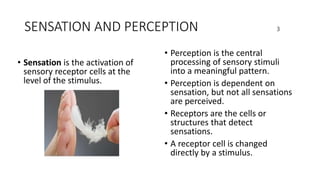
• Sensation is the activation of sensory receptor
cells at the level of the stimulus.
• Perception is the central processing of
sensory stimuli into a meaningful pattern.
Perception is dependent on sensation, but
not all sensations are perceived.
• Receptors are the cells or structures that
detect sensations. A receptor cell is changed
directly by a stimulus.
• A major role of sensory receptors is to help us
learn about the environment around us, or
about the state of our internal environment.
• A transmembrane protein receptor is a
protein in the cell membrane that mediates a
physiological change in a neuron, most often
through the opening of ion channels or
changes in the cell signaling processes.
Transmembrane receptors are activated by
chemicals called ligands.
• For example, a molecule in food can serve as
a ligand for taste receptors. Other
transmembrane proteins, which are not
accurately called receptors, are sensitive to
mechanical or thermal changes. Physical
changes in these proteins increase ion flow
across the membrane, and can generate an
action potential or a graded potential in the
sensory neurons.
SENSATION AND PERCEPTION 3
• Sensation is the activation of
sensory receptor cells at the
level of the stimulus.
• Perception is the central
processing of sensory stimuli
into a meaningful pattern.
• Perception is dependent on
sensation, but not all sensations
are perceived.
• Receptors are the cells or
structures that detect
sensations.
• A receptor cell is changed
directly by a stimulus.
SENSORY MODALITIES 4
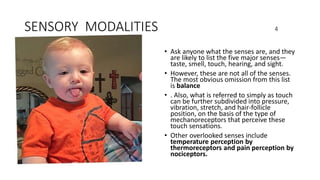
• Ask anyone what the senses are, and they
are likely to list the five major senses—
taste, smell, touch, hearing, and sight.
• However, these are not all of the senses.
The most obvious omission from this list
is balance
• . Also, what is referred to simply as touch
can be further subdivided into pressure,
vibration, stretch, and hair-follicle
position, on the basis of the type of
mechanoreceptors that perceive these
touch sensations.
• Other overlooked senses include
temperature perception by
thermoreceptors and pain perception by
nociceptors.
GENERAL AND SPECIAL SENSE 5
• A general sense is one that is
distributed throughout the body
and has receptor cells within the
structures of other organs.
• General sense receptors are
those for temperature, pain,
pressure, touch, vibration
• A special sense is one that has a
specific organ devoted to it,
namely the eye, inner ear,
tongue, or nose.
RECEPTORS AND SENSATIONS 6
• TYPES OF RECEPTORS:
• CHEMORECEPTORS
• MECHANORECEPTORS
• NOCICEPTORS
• THERMORECEPTORS
• PHOTORECEPTORS
CHEMORECEPTORS 7
• Chemoreceptor: sensory
receptor cell that is sensitive to
chemical stimuli, such as in
taste, smell, or pain
GUSTATION – SENSE OF TASTE 8
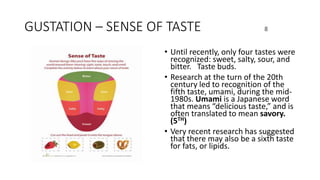
• Until recently, only four tastes were
recognized: sweet, salty, sour, and
bitter. Taste buds.
• Research at the turn of the 20th
century led to recognition of the
fifth taste, umami, during the mid-
1980s. Umami is a Japanese word
that means “delicious taste,” and is
often translated to mean savory.
(5TH)
• Very recent research has suggested
that there may also be a sixth taste
for fats, or lipids.
MECHANORECEPTORS 9
• Perceive touch sensations
• Mechanoreceptor receptor cell
that transduces mechanical
stimuli into an electrochemical
signal like the sensations of
sound and balance.
•
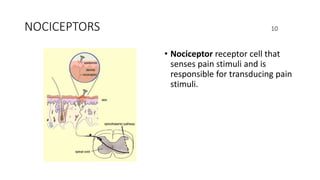
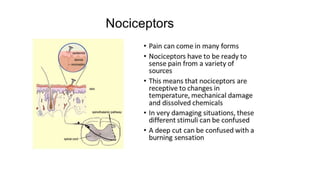
NOCICEPTORS 10
• Nociceptor receptor cell that
senses pain stimuli and is
responsible for transducing pain
stimuli.
THERMORECEPTORS PHOTORECEPTOR 12
• Photoreceptor: receptor cell
specialized to respond to light
stimuli or involved in vision.
Touch 13
• When you touch a hot stove, you pull
your hand away. Sensory receptors in
the skin sense extreme temperature
and the early signs of tissue damage.
This triggers an action potential,
which travels along the sensory fiber
from the skin, through the dorsal
spinal root to the spinal cord, and
directly activates a ventral horn motor
neuron. That neuron sends a signal
along its axon to excite the biceps
brachii, causing contraction of the
muscle and flexion of the forearm at
the elbow to withdraw the hand from
the hot stove.
Olfaction (Smell) 14
• Like taste, the sense of smell, or
olfaction, is also responsive to
chemical stimuli. The olfactory
receptor neurons are located in
a small region within the
superior nasal cavity.
• This region is referred to as the
olfactory epithelium and
contains bipolar sensory
neurons
Audition (Hearing) 15
• Hearing, or audition, is the
transduction of sound waves
into a neural signal that is made
possible by the structures of the
ear.
• Sound is transduced into neural
signals within the cochlear
region of the inner ear.
Equilibrium (Balance) 16
• Along with audition, the inner
ear is responsible for encoding
information about equilibrium,
the sense of balance.
Vision 17
• Vision is the special sense of sight that is
based on the transduction of light stimuli
received through the eyes.
• The eye is also divided into two cavities:
the anterior cavity and the posterior
cavity.
• The anterior cavity is the space between
the cornea and lens, including the iris and
ciliary body. It is filled with a watery fluid
called the aqueous humor.
• The posterior cavity is the space behind
the lens that extends to the posterior side
of the interior eyeball, where the retina is
located. The posterior cavity is filled with
a more viscous fluid called the vitreous
humor.
Vision – Fovea 18
• At the exact center of the retina is a
small area known as the fovea.
• At the fovea, the retina lacks the
supporting cells and blood vessels,
and only contains photoreceptors.
• Therefore, visual acuity, or the
sharpness of vision, is greatest at
the fovea. This is because the fovea
is where the least amount of
incoming light is absorbed by
Depth Perception
Motor Responses
• The defining characteristic of the somatic nervous
system is that it controls skeletal muscles.
• Somatic senses inform the nervous system about
the external environment, but the response to that
is through voluntary muscle movement.
• The term “voluntary” suggests that there is a
conscious decision to make a movement.
• However, some aspects of the somatic system use
voluntary muscles without conscious control.
• One example is the ability of our breathing to
switch to unconscious control while we are focused
on another task.
• However, the muscles that are responsible for the
basic process of breathing are also utilized for
speech, which is entirely voluntary.

Basic ap chapter 14 powerpoint 2017

  • 1.
    Chapter 14: SOMATICNERVOUS SYSTEM 1 • The somatic nervous system is traditionally considered a division within the peripheral nervous system. • However, this misses an important point: somatic refers to a functional division, whereas peripheral refers to an anatomic division. • The somatic nervous system is responsible for our conscious perception of the environment and for our voluntary responses to that perception by means of skeletal muscles.
  • 2.
    SENSORY PERCEPTION 2 •Describing sensory function with the term sensation or perception is a deliberate distinction. • Sensation is the activation of sensory receptor cells at the level of the stimulus. • Perception is the central processing of sensory stimuli into a meaningful pattern. Perception is dependent on sensation, but not all sensations are perceived. • Receptors are the cells or structures that detect sensations. A receptor cell is changed directly by a stimulus. • A major role of sensory receptors is to help us learn about the environment around us, or about the state of our internal environment. • A transmembrane protein receptor is a protein in the cell membrane that mediates a physiological change in a neuron, most often through the opening of ion channels or changes in the cell signaling processes. Transmembrane receptors are activated by chemicals called ligands. • For example, a molecule in food can serve as a ligand for taste receptors. Other transmembrane proteins, which are not accurately called receptors, are sensitive to mechanical or thermal changes. Physical changes in these proteins increase ion flow across the membrane, and can generate an action potential or a graded potential in the sensory neurons.
  • 3.
    SENSATION AND PERCEPTION3 • Sensation is the activation of sensory receptor cells at the level of the stimulus. • Perception is the central processing of sensory stimuli into a meaningful pattern. • Perception is dependent on sensation, but not all sensations are perceived. • Receptors are the cells or structures that detect sensations. • A receptor cell is changed directly by a stimulus.
  • 4.
    SENSORY MODALITIES 4 •Ask anyone what the senses are, and they are likely to list the five major senses— taste, smell, touch, hearing, and sight. • However, these are not all of the senses. The most obvious omission from this list is balance • . Also, what is referred to simply as touch can be further subdivided into pressure, vibration, stretch, and hair-follicle position, on the basis of the type of mechanoreceptors that perceive these touch sensations. • Other overlooked senses include temperature perception by thermoreceptors and pain perception by nociceptors.
  • 5.
    GENERAL AND SPECIALSENSE 5 • A general sense is one that is distributed throughout the body and has receptor cells within the structures of other organs. • General sense receptors are those for temperature, pain, pressure, touch, vibration • A special sense is one that has a specific organ devoted to it, namely the eye, inner ear, tongue, or nose.
  • 6.
    RECEPTORS AND SENSATIONS6 • TYPES OF RECEPTORS: • CHEMORECEPTORS • MECHANORECEPTORS • NOCICEPTORS • THERMORECEPTORS • PHOTORECEPTORS
  • 7.
    CHEMORECEPTORS 7 • Chemoreceptor:sensory receptor cell that is sensitive to chemical stimuli, such as in taste, smell, or pain
  • 8.
    GUSTATION – SENSEOF TASTE 8 • Until recently, only four tastes were recognized: sweet, salty, sour, and bitter. Taste buds. • Research at the turn of the 20th century led to recognition of the fifth taste, umami, during the mid- 1980s. Umami is a Japanese word that means “delicious taste,” and is often translated to mean savory. (5TH) • Very recent research has suggested that there may also be a sixth taste for fats, or lipids.
  • 9.
    MECHANORECEPTORS 9 • Perceivetouch sensations • Mechanoreceptor receptor cell that transduces mechanical stimuli into an electrochemical signal like the sensations of sound and balance. •
  • 10.
    NOCICEPTORS 10 • Nociceptorreceptor cell that senses pain stimuli and is responsible for transducing pain stimuli.
  • 12.
    THERMORECEPTORS PHOTORECEPTOR 12 •Photoreceptor: receptor cell specialized to respond to light stimuli or involved in vision.
  • 13.
    Touch 13 • Whenyou touch a hot stove, you pull your hand away. Sensory receptors in the skin sense extreme temperature and the early signs of tissue damage. This triggers an action potential, which travels along the sensory fiber from the skin, through the dorsal spinal root to the spinal cord, and directly activates a ventral horn motor neuron. That neuron sends a signal along its axon to excite the biceps brachii, causing contraction of the muscle and flexion of the forearm at the elbow to withdraw the hand from the hot stove.
  • 14.
    Olfaction (Smell) 14 •Like taste, the sense of smell, or olfaction, is also responsive to chemical stimuli. The olfactory receptor neurons are located in a small region within the superior nasal cavity. • This region is referred to as the olfactory epithelium and contains bipolar sensory neurons
  • 15.
    Audition (Hearing) 15 •Hearing, or audition, is the transduction of sound waves into a neural signal that is made possible by the structures of the ear. • Sound is transduced into neural signals within the cochlear region of the inner ear.
  • 16.
    Equilibrium (Balance) 16 •Along with audition, the inner ear is responsible for encoding information about equilibrium, the sense of balance.
  • 17.
    Vision 17 • Visionis the special sense of sight that is based on the transduction of light stimuli received through the eyes. • The eye is also divided into two cavities: the anterior cavity and the posterior cavity. • The anterior cavity is the space between the cornea and lens, including the iris and ciliary body. It is filled with a watery fluid called the aqueous humor. • The posterior cavity is the space behind the lens that extends to the posterior side of the interior eyeball, where the retina is located. The posterior cavity is filled with a more viscous fluid called the vitreous humor.
  • 18.
    Vision – Fovea18 • At the exact center of the retina is a small area known as the fovea. • At the fovea, the retina lacks the supporting cells and blood vessels, and only contains photoreceptors. • Therefore, visual acuity, or the sharpness of vision, is greatest at the fovea. This is because the fovea is where the least amount of incoming light is absorbed by Depth Perception
  • 19.
    Motor Responses • Thedefining characteristic of the somatic nervous system is that it controls skeletal muscles. • Somatic senses inform the nervous system about the external environment, but the response to that is through voluntary muscle movement. • The term “voluntary” suggests that there is a conscious decision to make a movement. • However, some aspects of the somatic system use voluntary muscles without conscious control. • One example is the ability of our breathing to switch to unconscious control while we are focused on another task. • However, the muscles that are responsible for the basic process of breathing are also utilized for speech, which is entirely voluntary.