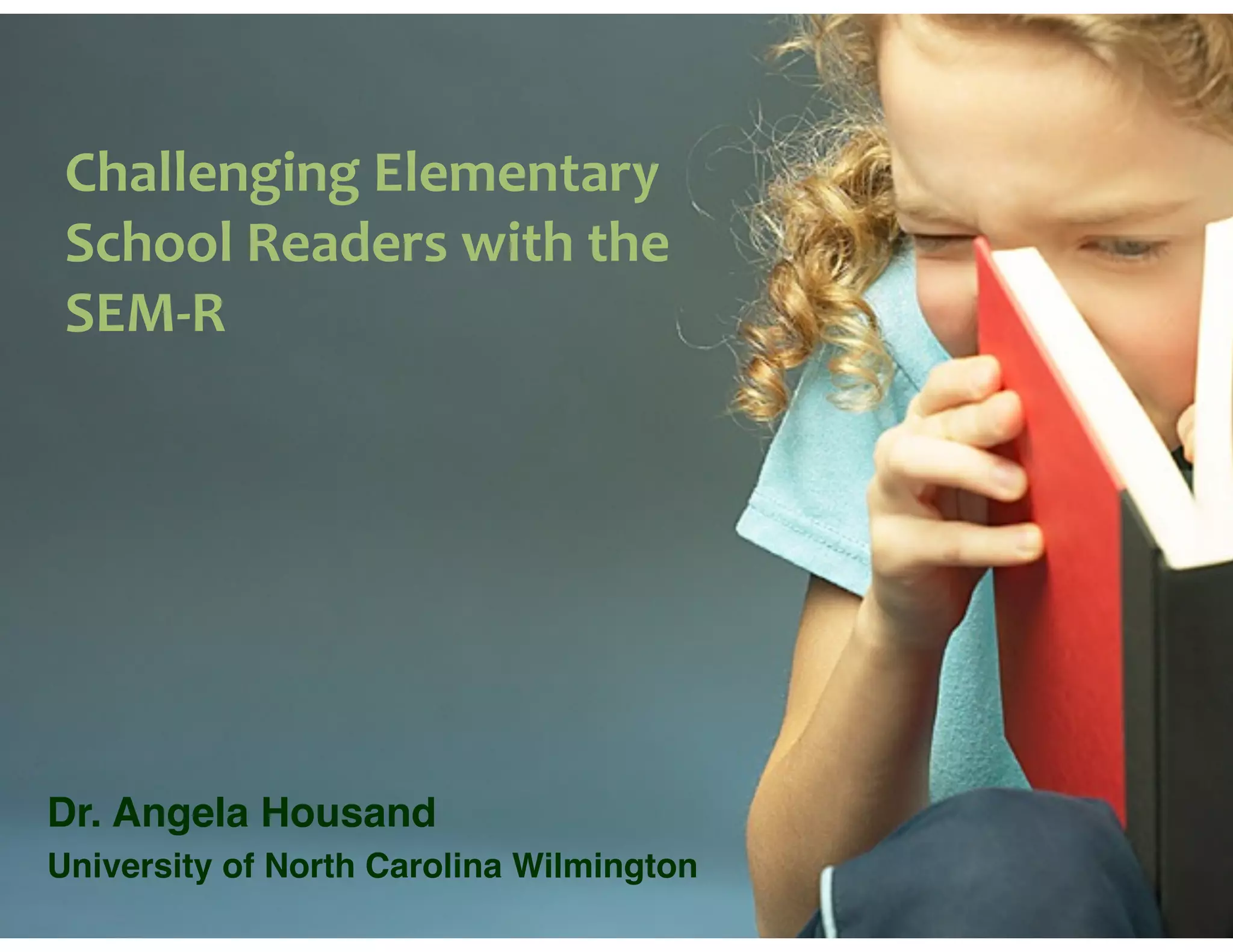


































Challenging	
  Elementary	
  
School	
  Readers	
  with	
  the
SEM-­‐R
Dr. Angela Housand!
University of North Carolina Wilmington
angelahousand.com
&
Sally	
  Reis
Joyful	
  Reading	
  &	
  	
  
The	
  SEM	
  -­‐	
  R
www.gifted.uconn.edu
NRC
G/T
The National Research Center
on the Gifted and Talented
If I were a

book character,
I would be…
(insert your answer here)
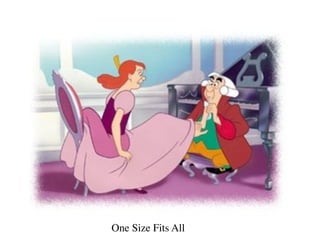
One Size Fits All
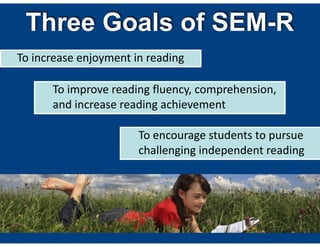
Three Goals of SEM-R
To  increase  enjoyment  in  reading
To  encourage  students  to  pursue  
challenging  independent  reading
To  improve  reading  fluency,  comprehension,  
and  increase  reading  achievement
The SEM-R
An enrichment-based reading
program that seeks to increase
reading achievement for all
students while also addressing
the pressing needs of talented
readers.
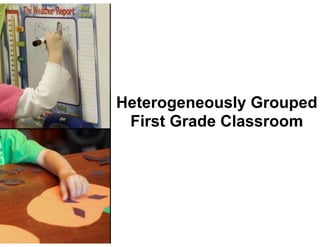
Heterogeneously Grouped
First Grade Classroom
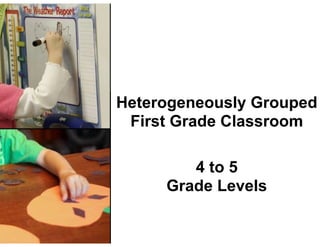
Heterogeneously Grouped
First Grade Classroom
4 to 5
Grade Levels
Lowest Performing
Student at a
1st Grade Level
Lowest Performing
Student at a
1st Grade Level
Highest Performing
Student at a
4th Grade Level
What do you need to

know to implement the SEM-R?
Write your answer on a post-it…
Be as specific as possible.
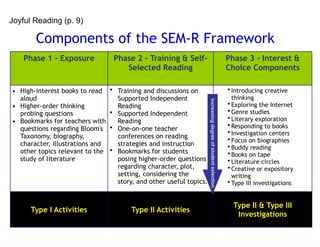
Components of the SEM-R Framework
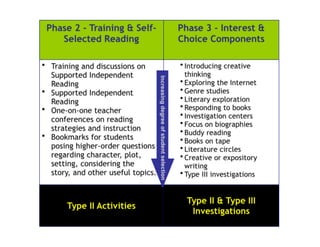
Phase 1 - Exposure Phase 2 - Training & Self-
Selected Reading
Phase 3 - Interest &
Choice Components
• High-interest books to read
aloud
• Higher-order thinking
probing questions
• Bookmarks for teachers with
questions regarding Bloom's
Taxonomy, biography,
character, illustrations and
other topics relevant to the
study of literature
• Training and discussions on
Supported Independent
Reading
• Supported Independent
Reading
• One-on-one teacher
conferences on reading
strategies and instruction
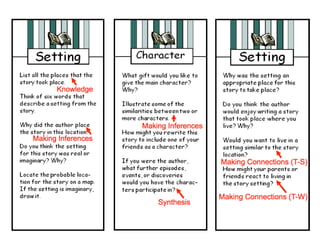
• Bookmarks for students
posing higher-order questions
regarding character, plot,
setting, considering the
story, and other useful topics.
• Introducing creative
thinking
• Exploring the Internet
• Genre studies
• Literary exploration
• Responding to books
• Investigation centers
• Focus on biographies
• Buddy reading
• Books on tape
• Literature circles
• Creative or expository
writing
• Type III investigations
Type I Activities Type II Activities
Type II & Type III
Investigations
Increasingdegreeofstudentselection
Joyful Reading (p. 9)
High interest read alouds
and higher order questions
Phase 1
Phase 1
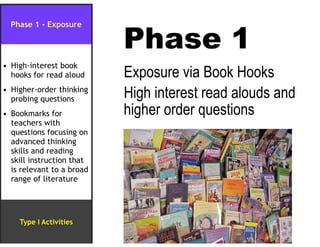
Exposure via Book Hooks
High interest read alouds and
higher order questions
Phase 1 - Exposure
• High-interest book
hooks for read aloud• !• !• !• !• !• !
• Higher-order thinking
probing questions!!!!!!
• Bookmarks for
teachers with
questions focusing on
advanced thinking
skills and reading
skill instruction that
is relevant to a broad
range of literature
Type I Activities
The E’s of Phase 1
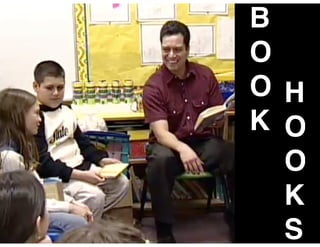
Entice with Book Hooks
B
O
O
K
H
O
O
K
S
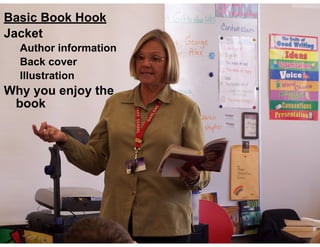
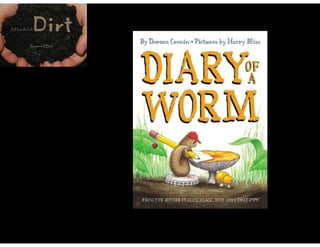
Basic Book Hook
Jacket
Author information
Back cover
Illustration
Why you enjoy the
book
Activity Time:
HookYour Friend
Engage by Questioning
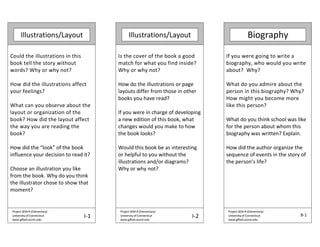
Illustrations/Layout Illustrations/Layout Biography
Could the illustrations in this
book tell the story without
words? Why or why not?
How did the illustrations affect
your feelings?
What can you observe about the
layout or organization of the
book? How did the layout affect
the way you are reading the
book?
How did the “look” of the book
influence your decision to read it?
Choose an illustration you like
from the book. Why do you think
the illustrator chose to show that
moment?
Is the cover of the book a good
match for what you find inside?
Why or why not?
How do the illustrations or page
layouts differ from those in other
books you have read?
If you were in charge of developing
a new edition of this book, what
changes would you make to how
the book looks?
Would this book be as interesting
or helpful to you without the
illustrations and/or diagrams?
Why or why not?
If you were going to write a
biography, who would you write
about? Why?
What do you admire about the
person in this biography? Why?
How might you become more
like this person?
What do you think school was like
for the person about whom this
biography was written? Explain.
How did the author organize the
sequence of events in the story of
the person’s life?
Project SEM R (Elementary)
University of Connecticut
www.gifted.uconn.edu
I 1
Project SEM R (Elementary)
University of Connecticut
www.gifted.uconn.edu
I 2
Project SEM R (Elementary)
University of Connecticut
www.gifted.uconn.edu
B 1
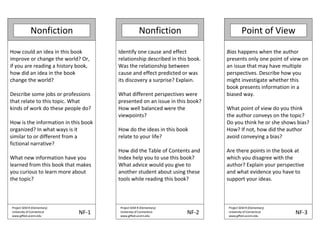
Nonfiction Nonfiction Point of View
How could an idea in this book
improve or change the world? Or,
if you are reading a history book,
how did an idea in the book
change the world?
Describe some jobs or professions
that relate to this topic. What
kinds of work do these people do?
How is the information in this book
organized? In what ways is it
similar to or different from a
fictional narrative?
What new information have you
learned from this book that makes
you curious to learn more about
the topic?
Identify one cause and effect
relationship described in this book.
Was the relationship between
cause and effect predicted or was
its discovery a surprise? Explain.
What different perspectives were
presented on an issue in this book?
How well balanced were the
viewpoints?
How do the ideas in this book
relate to your life?
How did the Table of Contents and
Index help you to use this book?
What advice would you give to
another student about using these
tools while reading this book?
Bias happens when the author
presents only one point of view on
an issue that may have multiple
perspectives. Describe how you
might investigate whether this
book presents information in a
biased way.
What point of view do you think
the author conveys on the topic?
Do you think he or she shows bias?
How? If not, how did the author
avoid conveying a bias?
Are there points in the book at
which you disagree with the
author? Explain your perspective
and what evidence you have to
support your ideas.
Project SEM R (Elementary)
University of Connecticut
www.gifted.uconn.edu
NF 1
Project SEM R (Elementary)
University of Connecticut
www.gifted.uconn.edu
NF 2
Project SEM R (Elementary)
University of Connecticut
www.gifted.uconn.edu
NF 3
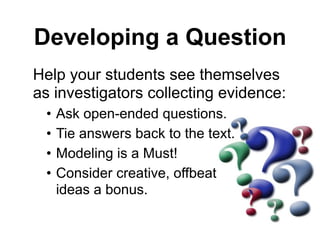
Developing a Question
Help your students see themselves
as investigators collecting evidence:
• Ask open-ended questions.
• Tie answers back to the text.
• Modeling is a Must!
• Consider creative, offbeat 

ideas a bonus.
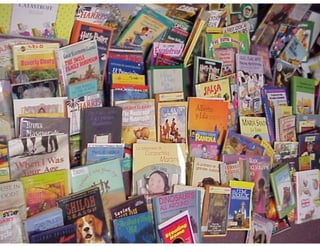
Exposureto a Wide Range of Books
Advanced
Option
ExploreConnections
Weekly Book Hook Themes
● Author !
● Science Concepts!
● weather!
● animals!
● space!
● motion!
● Broad Concepts!
● Change!
● Big Questions!
● Why hate? Why love?
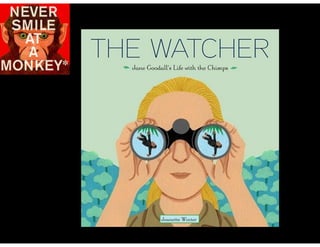
Shout Out:
Possible Book Hook Themes
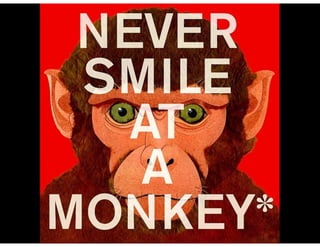
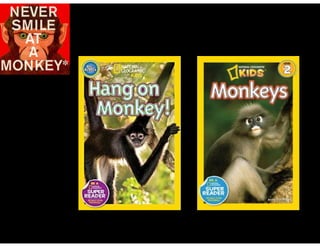
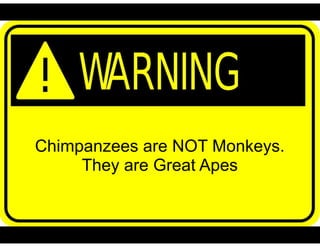
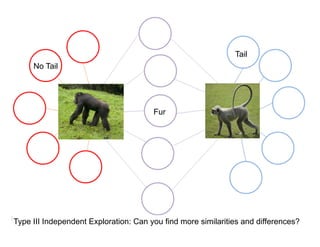
Chimpanzees are NOT Monkeys.
They are Great Apes
Fur
Tail
Type III Independent Exploration: Can you find more similarities and differences?
No Tail
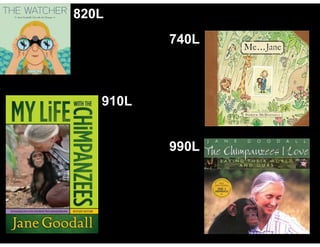
910L
990L
820L
740L
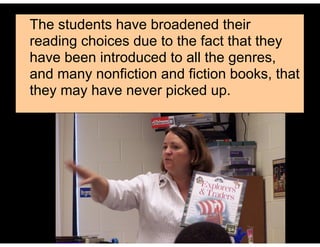
The students have broadened their
reading choices due to the fact that they
have been introduced to all the genres,
and many nonfiction and fiction books, that
they may have never picked up.
I know the purpose of the SEM-R is
to engage kids in reading
appropriately challenging material,
but how do I do that within Phase 1
with so many emergent readers?
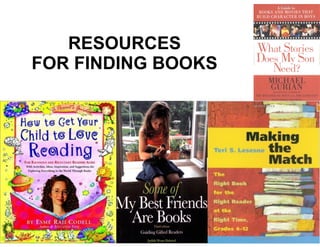
RESOURCES 

FOR FINDING BOOKS 

Online Book Lists:
Science!
ONSTA Outstanding Science Books
http://www.nsta.org/publications/ostb/
!
Robert F. Sibert Medal & Honor Books
http://www.ala.org/alsc/awardsgrants/
bookmedia/sibertmedal
!
Goodreads
http://www.goodreads.com/shelf/show/
kindergarten-science
Online Book Resources
Shelfari
http://www.shelfari.com/
!
!
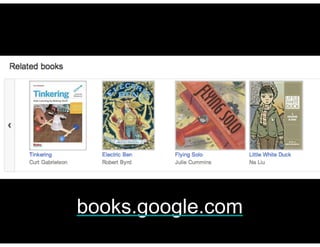
Google Books
A Bookshelf Developed by Dr. B. Housand
!
!
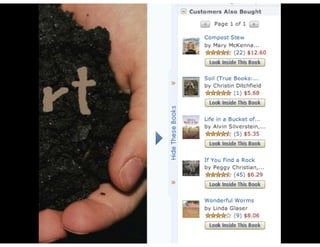
Amazon
http://www.amazon.com
books.google.com
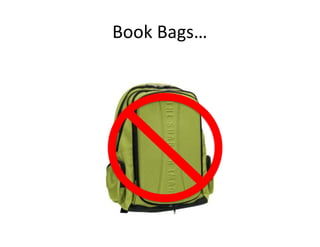
Book  Bags…
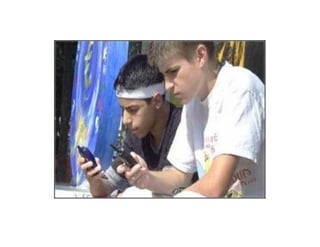
Modern  Day  Books…
eBooks
http://www.icdlbooks.org/!
!
http://books.google.com !
https://play.google.com!
!
http://kids.nypl.org/reading/Childrensebooks.cfm!
!
http://www.amazon.com/Kindle-eBooks/b?
node=154606011
The E’s of Phase 1
• Entice with Book Hooks
• Engage in Questioning with Book Marks
• Expose Students to a Wide Range Books
• Explore Connections
Questions?
Activity Time:
Design a Themed	

Book Hook
angelahousand.com
&
Supported Independent Reading
using individual conferences and
differentiated reading instruction
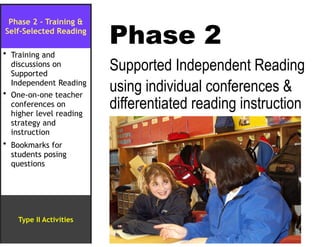
Phase 2
Phase 2
Supported Independent Reading
using individual conferences &
differentiated reading instruction
Phase 2 - Training &
Self-Selected Reading
• Training and
discussions on
Supported
Independent Reading!!!
• One-on-one teacher
conferences on
higher level reading
strategy and
instruction!!!!
• Bookmarks for
students posing
questions
Type II Activities
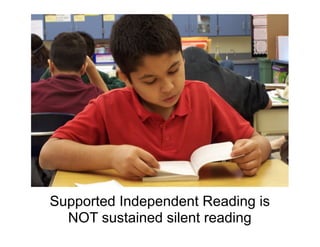
Supported Independent Reading is

NOT sustained silent reading
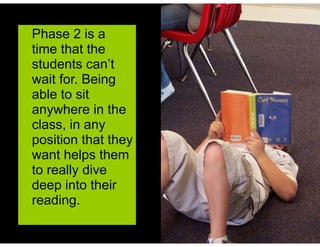
Phase 2 is a
time that the
students can’t
wait for. Being
able to sit
anywhere in the
class, in any
position that they
want helps them
to really dive
deep into their
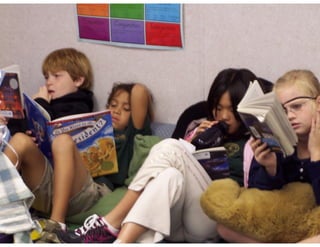
reading.
Students will . . .
• Enjoy reading books of their own selection
• Read appropriately challenging books
• Develop self-regulation skills for sustained independent
reading
• Have individualized reading instruction that is tailored
to each student’s needs
Phase 2 Goals
!
I know the purpose of Phase 2 is
engage students in independent
reading, but how do I manage
conferences that with so many
emergent readers?
Poetry
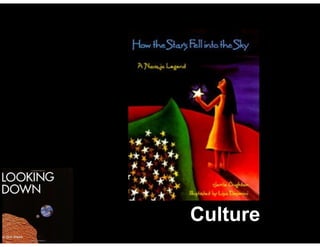
Culture
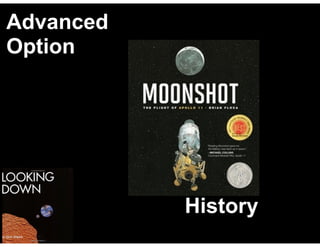
History
Advanced
Option
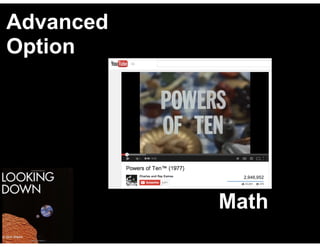
Math
Advanced
Option
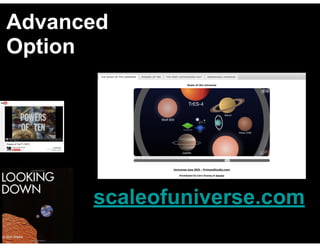
scaleofuniverse.com
Advanced
Option
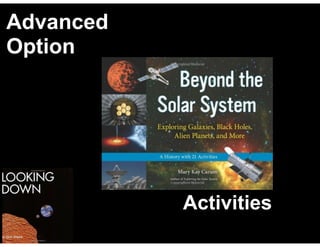
Activities
Advanced
Option
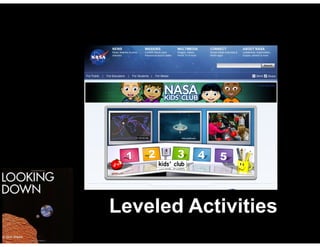
Leveled Activities
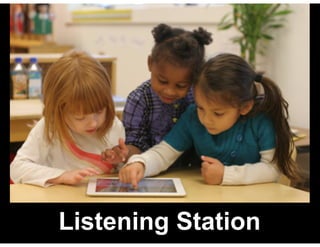
Listening Station
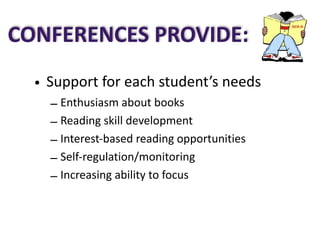
CONFERENCES	
  PROVIDE:
• Support  for  each  student’s  needs  
– Enthusiasm  about  books  
– Reading  skill  development  
– Interest-­‐based  reading  opportunities  
– Self-­‐regulation/monitoring  
– Increasing  ability  to  focus
CONFERENCES	
  PROVIDE:
• Opportunity  to  assess  reading  level  
and  book  match  
• Thoughtful  conversations  about  
literature  
• Opportunities  to  use  higher  order  
thinking  skill  questions
CONFERENCES	
  PROVIDE:
• Differentiation  for  all  students  in    
– Skills  
– Questions  
– Book  Selection  for  OPTIMAL  CHALLENGE!
Common	
  Conference	
  Elements:	
  
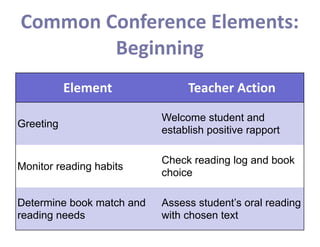
Beginning
Element Teacher	
  Action
Greeting
Welcome student and
establish positive rapport
Monitor reading habits
Check reading log and book
choice
Determine book match and
reading needs
Assess student’s oral reading
with chosen text
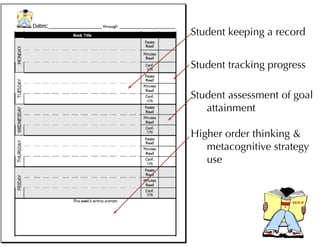
Student keeping a record
!
!
Student tracking progress
!
Student assessment of goal
attainment
!
Higher order thinking &
metacognitive strategy
use
109
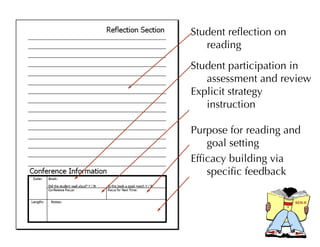
Student reflection on
reading
Student participation in
assessment and review
Explicit strategy
instruction
!
Purpose for reading and
goal setting
Efficacy building via
specific feedback
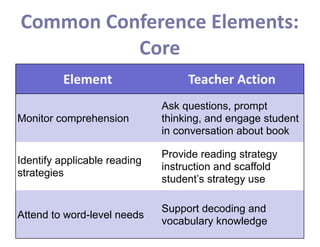
Element Teacher	
  Action
Monitor comprehension
Ask questions, prompt
thinking, and engage student
in conversation about book
Identify applicable reading
strategies
Provide reading strategy
instruction and scaffold
student’s strategy use
Attend to word-level needs
Support decoding and
vocabulary knowledge
Common	
  Conference	
  Elements:	
  
Core
Element Teacher	
  Action
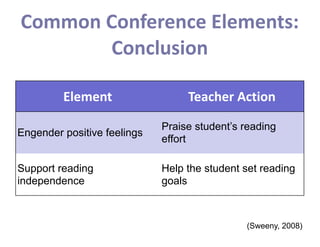
Engender positive feelings
Praise student’s reading
effort
Support reading
independence
Help the student set reading
goals
(Sweeny, 2008)
Common	
  Conference	
  Elements:	
  
Conclusion
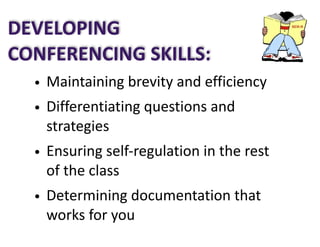
DEVELOPING	
  
CONFERENCING	
  SKILLS:
• Maintaining  brevity  and  efficiency  
• Differentiating  questions  and  
strategies  
• Ensuring  self-­‐regulation  in  the  rest  
of  the  class  
• Determining  documentation  that  
works  for  you
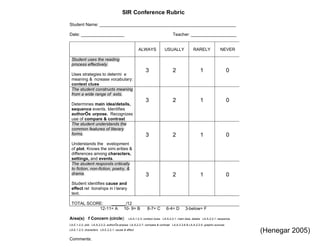
SIR Conference Rubric
Student Name: _________________________________________________________
Date: __________________ Teacher: ___________________
ALWAYS USUALLY RARELY NEVER
Student uses the reading
process effectively.
Uses strategies to determi e
meaning & ncrease vocabulary:
context clues
3 2 1 0
The student constructs meaning
from a wide range of exts.
Determines main idea/details,
sequence events. Identifies
authorÕs urpose. Recognizes
use of compare & contrast
3 2 1 0
The student understands the
common features of literary
forms.
Understands the evelopment
of plot. Knows the simi arities &
differences among characters,
settings, and events.
3 2 1 0
The student responds critically
to fiction, non-fiction, poetry, &
drama.
Student identifies cause and
effect rel tionships in l terary
text.
3 2 1 0
TOTAL SCORE: ______/12
12-11= A 10- 9= B 8-7= C 6-4= D 3-below= F
Area(s) f Concern (circle): LA.A.1.2.3- context clues LA.A.2.2.1- main idea, details LA.A.2.2.1- sequence
LA.E.1.2.2- plot LA.A.2.2.2- authorÕs purpose LA.A.2.2.7- compare & contrast LA.A.2.2.8 & LA.A.2.2.5- graphic sources
LA.E.1.2.3- characters LA.E.2.2.1- cause & effect
Comments:
(Henegar 2005)
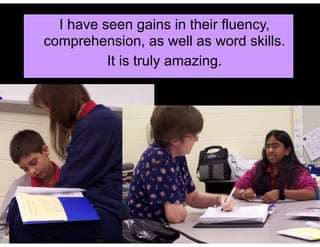
I have seen gains in their fluency,
comprehension, as well as word skills.
It is truly amazing.
Enjoy Reading
Enjoyable activities, “are not
natural; they demand an effort
that initially one is reluctant to
make. But once the interaction
starts to provide feedback to the
person’s skills, it usually begins
to be intrinsically rewarding”
	

 — Csikszentmihalyi, 1990
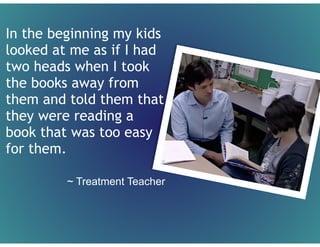
In the beginning my kids
looked at me as if I had
two heads when I took
the books away from
them and told them that
they were reading a
book that was too easy
for them.
!
~ Treatment Teacher
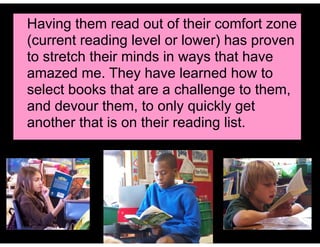
Having them read out of their comfort zone
(current reading level or lower) has proven
to stretch their minds in ways that have
amazed me. They have learned how to
select books that are a challenge to them,
and devour them, to only quickly get
another that is on their reading list.
—Horace Mann
Resolve to edge in a
little reading every
day, if it is but a
single sentence.   
If you gain fifteen
minutes a day, it will
make itself felt at
the end of the year.
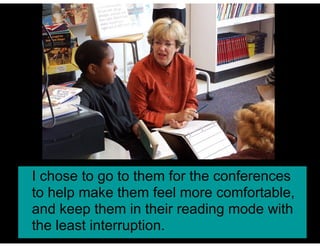
I chose to go to them for the conferences
to help make them feel more comfortable,
and keep them in their reading mode with
the least interruption.
Activity Time:
Conferences
Not all students need the same strategy
instruction at the very same time, but all students
need some instruction if they are reading an
adequately challenging book.
!
For that reason, be sure that strategy instruction
is integrated throughout conferences and
differentiated to meet the needs of individual
students.
Individualizing and Differentiating
Conferences
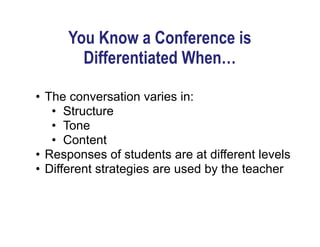
• The conversation varies in:
• Structure
• Tone
• Content
• Responses of students are at different levels
• Different strategies are used by the teacher
You Know a Conference is
Differentiated When…
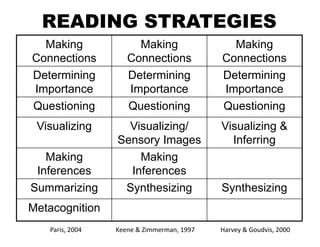
READING STRATEGIES
Making
Connections
Making
Connections
Making
Connections
Determining
Importance
Determining
Importance
Determining
Importance
Questioning Questioning Questioning
Visualizing Visualizing/
Sensory Images
Visualizing &
Inferring
Making
Inferences
Making
Inferences
Summarizing Synthesizing Synthesizing
Metacognition
      Paris,  2004                        Keene  &  Zimmerman,  1997                                Harvey  &  Goudvis,  2000
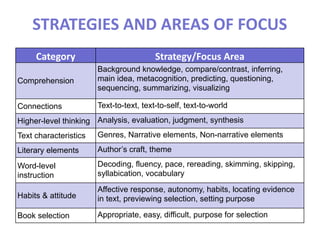
STRATEGIES	
  AND	
  AREAS	
  OF	
  FOCUS
Category Strategy/Focus	
  Area
Comprehension
Background knowledge, compare/contrast, inferring,
main idea, metacognition, predicting, questioning,
sequencing, summarizing, visualizing
Connections Text-to-text, text-to-self, text-to-world
Higher-level thinking Analysis, evaluation, judgment, synthesis
Text characteristics Genres, Narrative elements, Non-narrative elements
Literary elements Author’s craft, theme
Word-level
instruction
Decoding, fluency, pace, rereading, skimming, skipping,
syllabication, vocabulary
Habits & attitude
Affective response, autonomy, habits, locating evidence
in text, previewing selection, setting purpose
Book selection Appropriate, easy, difficult, purpose for selection
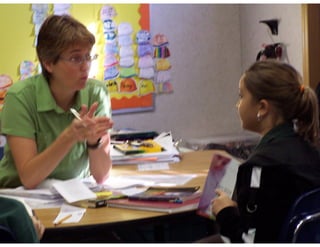
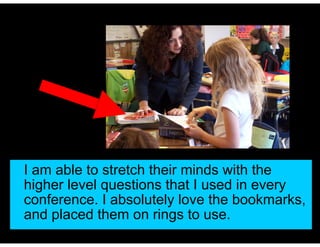
I am able to stretch their minds with the
higher level questions that I used in every
conference. I absolutely love the bookmarks,
and placed them on rings to use.
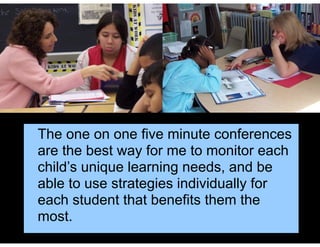
The one on one five minute conferences
are the best way for me to monitor each
child’s unique learning needs, and be
able to use strategies individually for
each student that benefits them the
most.
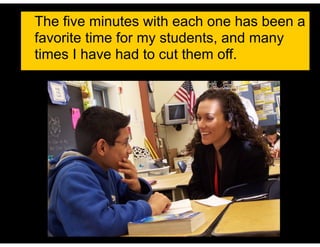
The five minutes with each one has been a
favorite time for my students, and many
times I have had to cut them off.
“We do not need to
burn books to kill
our civilization; 

we need only to
leave them unread
for a generation.”

—R.  M.  Hutchins
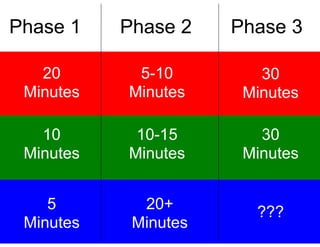
Phase 1 Phase 3Phase 2
5-10
Minutes
20+
Minutes
10-15
Minutes
20
Minutes
30
Minutes
10
Minutes
5
Minutes
30
Minutes
???
Self-selected interest and
choice components
Phase 3
Phase Three:

An Exploration of Reading Enrichment
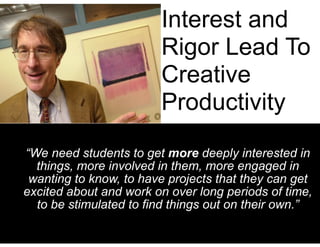
“We need students to get more deeply interested in
things, more involved in them, more engaged in
wanting to know, to have projects that they can get
excited about and work on over long periods of time,
to be stimulated to find things out on their own.”

Interest and
Rigor Lead To
Creative
Productivity
+
What’s Going On?


What are your current classroom practices?


How are you using centers? 


Do you provide choice in activities?
The Illusion of Choice
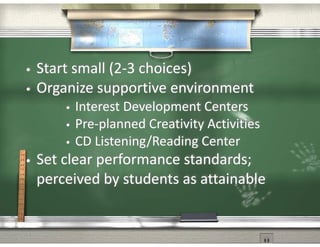
• Start  small  (2-­‐3  choices)  
• Organize  supportive  environment  
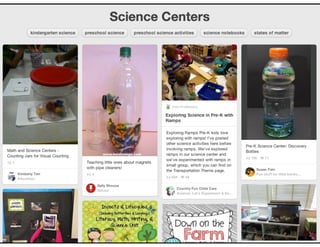
• Interest  Development  Centers
• Pre-­‐planned  Creativity  Activities
• CD  Listening/Reading  Center
• Set  clear  performance  standards;  
perceived  by  students  as  attainable
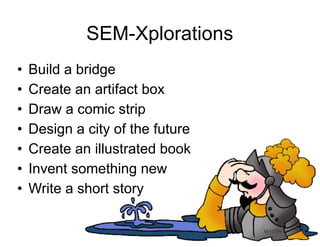
SEM-Xplorations
• Build a bridge
• Create an artifact box
• Draw a comic strip
• Design a city of the future
• Create an illustrated book
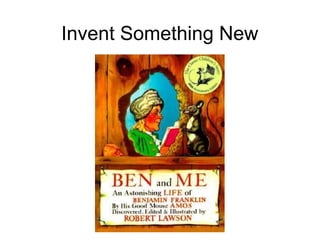
• Invent something new
• Write a short story
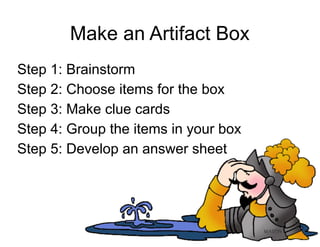
Make an Artifact Box
Step 1: Brainstorm
Step 2: Choose items for the box
Step 3: Make clue cards
Step 4: Group the items in your box
Step 5: Develop an answer sheet
Invent Something New
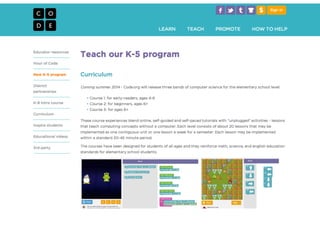
Hour of Code
!
!
!
!
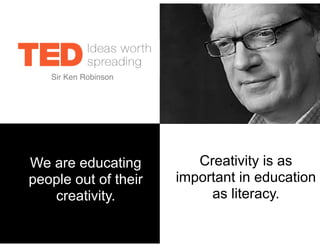
We are educating
people out of their
creativity.
!
Creativity is as
important in education
as literacy.
Sir Ken Robinson
+
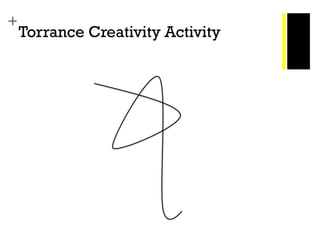
Torrance Creativity Activity
+
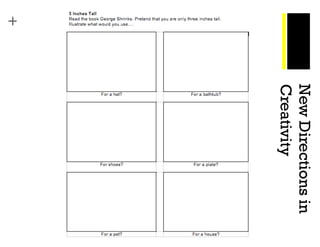
NewDirectionsin
Creativity
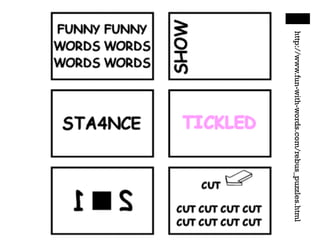
http://www.fun-with-words.com/rebus_puzzles.html
Top Strategies For Phase 3
Books on CD
Group Projects
Buddy Reading
SEM-Xplorations
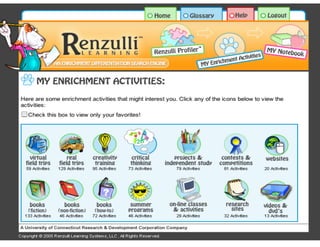
Renzulli Learning
Literature Circles
Creativity Activities
Investigation Centers
Independent Projects
• Build on student interest
• Encourage independence
• Allow work with complex and abstract ideas
• Enable long-term and in-depth work on topics of
interest
• Develop task commitment and self-regulation
• Teach planning and research skills at advanced
levels
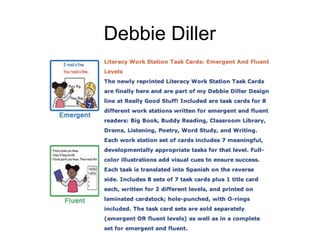
Debbie Diller
Debbie Diller
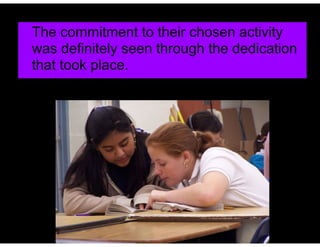
The commitment to their chosen activity
was definitely seen through the dedication
that took place.
“In a completely rational society, the
best of us would aspire to be teachers
and the rest of us would have to settle
for something less, because passing
civilization along from one generation
to the next ought to be the highest
honor and the highest responsibility
anyone could have.”
-Lee Iacocca
Be prepared to let go.
Questions?
We read to
know we’re
not alone.

—C. S. Lewis
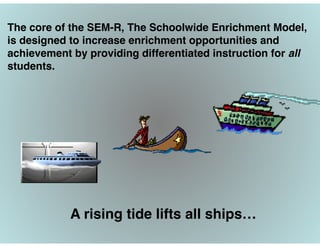
A rising tide lifts all ships…!
The core of the SEM-R, The Schoolwide Enrichment Model,
is designed to increase enrichment opportunities and
achievement by providing differentiated instruction for all
students.

SEM-R for Milwaukee Public Schools

SEM-R for Milwaukee Public Schools

  • 1.
    Challenging  Elementary   School  Readers  with  the SEM-­‐R Dr. Angela Housand! University of North Carolina Wilmington
  • 2.
  • 4.
    Sally  Reis Joyful  Reading  &     The  SEM  -­‐  R
  • 5.
    www.gifted.uconn.edu NRC G/T The National ResearchCenter on the Gifted and Talented
  • 6.
    If I werea
 book character, I would be… (insert your answer here)
  • 7.
  • 8.
    Three Goals ofSEM-R To  increase  enjoyment  in  reading To  encourage  students  to  pursue   challenging  independent  reading To  improve  reading  fluency,  comprehension,   and  increase  reading  achievement
  • 9.
    The SEM-R An enrichment-basedreading program that seeks to increase reading achievement for all students while also addressing the pressing needs of talented readers.
  • 10.
  • 11.
    Heterogeneously Grouped First GradeClassroom 4 to 5 Grade Levels
  • 12.
  • 13.
    Lowest Performing Student ata 1st Grade Level Highest Performing Student at a 4th Grade Level
  • 14.
    What do youneed to
 know to implement the SEM-R? Write your answer on a post-it… Be as specific as possible.
  • 15.
    Components of theSEM-R Framework Phase 1 - Exposure Phase 2 - Training & Self- Selected Reading Phase 3 - Interest & Choice Components • High-interest books to read aloud • Higher-order thinking probing questions • Bookmarks for teachers with questions regarding Bloom's Taxonomy, biography, character, illustrations and other topics relevant to the study of literature • Training and discussions on Supported Independent Reading • Supported Independent Reading • One-on-one teacher conferences on reading strategies and instruction • Bookmarks for students posing higher-order questions regarding character, plot, setting, considering the story, and other useful topics. • Introducing creative thinking • Exploring the Internet • Genre studies • Literary exploration • Responding to books • Investigation centers • Focus on biographies • Buddy reading • Books on tape • Literature circles • Creative or expository writing • Type III investigations Type I Activities Type II Activities Type II & Type III Investigations Increasingdegreeofstudentselection Joyful Reading (p. 9)
  • 16.
    High interest readalouds and higher order questions Phase 1
  • 17.
    Phase 1 Exposure viaBook Hooks High interest read alouds and higher order questions Phase 1 - Exposure • High-interest book hooks for read aloud• !• !• !• !• !• ! • Higher-order thinking probing questions!!!!!! • Bookmarks for teachers with questions focusing on advanced thinking skills and reading skill instruction that is relevant to a broad range of literature Type I Activities
  • 18.
    The E’s ofPhase 1
  • 19.
  • 20.
  • 21.
    Basic Book Hook Jacket Authorinformation Back cover Illustration Why you enjoy the book
  • 29.
  • 34.
  • 35.
    Illustrations/Layout Illustrations/Layout Biography Couldthe illustrations in this book tell the story without words? Why or why not? How did the illustrations affect your feelings? What can you observe about the layout or organization of the book? How did the layout affect the way you are reading the book? How did the “look” of the book influence your decision to read it? Choose an illustration you like from the book. Why do you think the illustrator chose to show that moment? Is the cover of the book a good match for what you find inside? Why or why not? How do the illustrations or page layouts differ from those in other books you have read? If you were in charge of developing a new edition of this book, what changes would you make to how the book looks? Would this book be as interesting or helpful to you without the illustrations and/or diagrams? Why or why not? If you were going to write a biography, who would you write about? Why? What do you admire about the person in this biography? Why? How might you become more like this person? What do you think school was like for the person about whom this biography was written? Explain. How did the author organize the sequence of events in the story of the person’s life? Project SEM R (Elementary) University of Connecticut www.gifted.uconn.edu I 1 Project SEM R (Elementary) University of Connecticut www.gifted.uconn.edu I 2 Project SEM R (Elementary) University of Connecticut www.gifted.uconn.edu B 1
  • 36.
    Nonfiction Nonfiction Pointof View How could an idea in this book improve or change the world? Or, if you are reading a history book, how did an idea in the book change the world? Describe some jobs or professions that relate to this topic. What kinds of work do these people do? How is the information in this book organized? In what ways is it similar to or different from a fictional narrative? What new information have you learned from this book that makes you curious to learn more about the topic? Identify one cause and effect relationship described in this book. Was the relationship between cause and effect predicted or was its discovery a surprise? Explain. What different perspectives were presented on an issue in this book? How well balanced were the viewpoints? How do the ideas in this book relate to your life? How did the Table of Contents and Index help you to use this book? What advice would you give to another student about using these tools while reading this book? Bias happens when the author presents only one point of view on an issue that may have multiple perspectives. Describe how you might investigate whether this book presents information in a biased way. What point of view do you think the author conveys on the topic? Do you think he or she shows bias? How? If not, how did the author avoid conveying a bias? Are there points in the book at which you disagree with the author? Explain your perspective and what evidence you have to support your ideas. Project SEM R (Elementary) University of Connecticut www.gifted.uconn.edu NF 1 Project SEM R (Elementary) University of Connecticut www.gifted.uconn.edu NF 2 Project SEM R (Elementary) University of Connecticut www.gifted.uconn.edu NF 3
  • 37.
    Developing a Question Helpyour students see themselves as investigators collecting evidence: • Ask open-ended questions. • Tie answers back to the text. • Modeling is a Must! • Consider creative, offbeat 
 ideas a bonus.
  • 38.
    Exposureto a WideRange of Books
  • 45.
  • 46.
  • 47.
    Weekly Book HookThemes ● Author ! ● Science Concepts! ● weather! ● animals! ● space! ● motion! ● Broad Concepts! ● Change! ● Big Questions! ● Why hate? Why love?
  • 48.
  • 50.
    Chimpanzees are NOTMonkeys. They are Great Apes
  • 51.
    Fur Tail Type III IndependentExploration: Can you find more similarities and differences? No Tail
  • 54.
  • 59.
    The students havebroadened their reading choices due to the fact that they have been introduced to all the genres, and many nonfiction and fiction books, that they may have never picked up.
  • 60.
    I know thepurpose of the SEM-R is to engage kids in reading appropriately challenging material, but how do I do that within Phase 1 with so many emergent readers?
  • 61.
  • 62.
    Online Book Lists: Science! ONSTAOutstanding Science Books http://www.nsta.org/publications/ostb/ ! Robert F. Sibert Medal & Honor Books http://www.ala.org/alsc/awardsgrants/ bookmedia/sibertmedal ! Goodreads http://www.goodreads.com/shelf/show/ kindergarten-science
  • 63.
    Online Book Resources Shelfari http://www.shelfari.com/ ! ! GoogleBooks A Bookshelf Developed by Dr. B. Housand ! ! Amazon http://www.amazon.com
  • 65.
  • 66.
  • 68.
  • 71.
  • 72.
    The E’s ofPhase 1 • Entice with Book Hooks • Engage in Questioning with Book Marks • Expose Students to a Wide Range Books • Explore Connections
  • 73.
  • 74.
    Activity Time: Design aThemed Book Hook
  • 76.
  • 78.
    Supported Independent Reading usingindividual conferences and differentiated reading instruction Phase 2
  • 79.
    Phase 2 Supported IndependentReading using individual conferences & differentiated reading instruction Phase 2 - Training & Self-Selected Reading • Training and discussions on Supported Independent Reading!!! • One-on-one teacher conferences on higher level reading strategy and instruction!!!! • Bookmarks for students posing questions Type II Activities
  • 80.
    Supported Independent Readingis
 NOT sustained silent reading
  • 81.
    Phase 2 isa time that the students can’t wait for. Being able to sit anywhere in the class, in any position that they want helps them to really dive deep into their reading.
  • 82.
    Students will .. . • Enjoy reading books of their own selection • Read appropriately challenging books • Develop self-regulation skills for sustained independent reading • Have individualized reading instruction that is tailored to each student’s needs Phase 2 Goals
  • 83.
    ! I know thepurpose of Phase 2 is engage students in independent reading, but how do I manage conferences that with so many emergent readers?
  • 88.
  • 89.
  • 90.
  • 91.
  • 92.
  • 93.
  • 94.
  • 95.
  • 103.
    CONFERENCES  PROVIDE: • Support for  each  student’s  needs   – Enthusiasm  about  books   – Reading  skill  development   – Interest-­‐based  reading  opportunities   – Self-­‐regulation/monitoring   – Increasing  ability  to  focus
  • 104.
    CONFERENCES  PROVIDE: • Opportunity to  assess  reading  level   and  book  match   • Thoughtful  conversations  about   literature   • Opportunities  to  use  higher  order   thinking  skill  questions
  • 105.
    CONFERENCES  PROVIDE: • Differentiation for  all  students  in     – Skills   – Questions   – Book  Selection  for  OPTIMAL  CHALLENGE!
  • 106.
    Common  Conference  Elements:   Beginning Element Teacher  Action Greeting Welcome student and establish positive rapport Monitor reading habits Check reading log and book choice Determine book match and reading needs Assess student’s oral reading with chosen text
  • 108.
    Student keeping arecord ! ! Student tracking progress ! Student assessment of goal attainment ! Higher order thinking & metacognitive strategy use
  • 109.
  • 110.
    Student reflection on reading Studentparticipation in assessment and review Explicit strategy instruction ! Purpose for reading and goal setting Efficacy building via specific feedback
  • 111.
    Element Teacher  Action Monitorcomprehension Ask questions, prompt thinking, and engage student in conversation about book Identify applicable reading strategies Provide reading strategy instruction and scaffold student’s strategy use Attend to word-level needs Support decoding and vocabulary knowledge Common  Conference  Elements:   Core
  • 112.
    Element Teacher  Action Engenderpositive feelings Praise student’s reading effort Support reading independence Help the student set reading goals (Sweeny, 2008) Common  Conference  Elements:   Conclusion
  • 115.
    DEVELOPING   CONFERENCING  SKILLS: •Maintaining  brevity  and  efficiency   • Differentiating  questions  and   strategies   • Ensuring  self-­‐regulation  in  the  rest   of  the  class   • Determining  documentation  that   works  for  you
  • 116.
    SIR Conference Rubric StudentName: _________________________________________________________ Date: __________________ Teacher: ___________________ ALWAYS USUALLY RARELY NEVER Student uses the reading process effectively. Uses strategies to determi e meaning & ncrease vocabulary: context clues 3 2 1 0 The student constructs meaning from a wide range of exts. Determines main idea/details, sequence events. Identifies authorÕs urpose. Recognizes use of compare & contrast 3 2 1 0 The student understands the common features of literary forms. Understands the evelopment of plot. Knows the simi arities & differences among characters, settings, and events. 3 2 1 0 The student responds critically to fiction, non-fiction, poetry, & drama. Student identifies cause and effect rel tionships in l terary text. 3 2 1 0 TOTAL SCORE: ______/12 12-11= A 10- 9= B 8-7= C 6-4= D 3-below= F Area(s) f Concern (circle): LA.A.1.2.3- context clues LA.A.2.2.1- main idea, details LA.A.2.2.1- sequence LA.E.1.2.2- plot LA.A.2.2.2- authorÕs purpose LA.A.2.2.7- compare & contrast LA.A.2.2.8 & LA.A.2.2.5- graphic sources LA.E.1.2.3- characters LA.E.2.2.1- cause & effect Comments: (Henegar 2005)
  • 117.
    I have seengains in their fluency, comprehension, as well as word skills. It is truly amazing.
  • 118.
    Enjoy Reading Enjoyable activities,“are not natural; they demand an effort that initially one is reluctant to make. But once the interaction starts to provide feedback to the person’s skills, it usually begins to be intrinsically rewarding” — Csikszentmihalyi, 1990
  • 120.
    In the beginningmy kids looked at me as if I had two heads when I took the books away from them and told them that they were reading a book that was too easy for them. ! ~ Treatment Teacher
  • 121.
    Having them readout of their comfort zone (current reading level or lower) has proven to stretch their minds in ways that have amazed me. They have learned how to select books that are a challenge to them, and devour them, to only quickly get another that is on their reading list.
  • 122.
    —Horace Mann Resolve toedge in a little reading every day, if it is but a single sentence.   If you gain fifteen minutes a day, it will make itself felt at the end of the year.
  • 124.
    I chose togo to them for the conferences to help make them feel more comfortable, and keep them in their reading mode with the least interruption.
  • 125.
  • 126.
    Not all studentsneed the same strategy instruction at the very same time, but all students need some instruction if they are reading an adequately challenging book. ! For that reason, be sure that strategy instruction is integrated throughout conferences and differentiated to meet the needs of individual students. Individualizing and Differentiating Conferences
  • 127.
    • The conversationvaries in: • Structure • Tone • Content • Responses of students are at different levels • Different strategies are used by the teacher You Know a Conference is Differentiated When…
  • 128.
    READING STRATEGIES Making Connections Making Connections Making Connections Determining Importance Determining Importance Determining Importance Questioning QuestioningQuestioning Visualizing Visualizing/ Sensory Images Visualizing & Inferring Making Inferences Making Inferences Summarizing Synthesizing Synthesizing Metacognition     Paris,  2004                      Keene  &  Zimmerman,  1997                                Harvey  &  Goudvis,  2000
  • 129.
    STRATEGIES  AND  AREAS  OF  FOCUS Category Strategy/Focus  Area Comprehension Background knowledge, compare/contrast, inferring, main idea, metacognition, predicting, questioning, sequencing, summarizing, visualizing Connections Text-to-text, text-to-self, text-to-world Higher-level thinking Analysis, evaluation, judgment, synthesis Text characteristics Genres, Narrative elements, Non-narrative elements Literary elements Author’s craft, theme Word-level instruction Decoding, fluency, pace, rereading, skimming, skipping, syllabication, vocabulary Habits & attitude Affective response, autonomy, habits, locating evidence in text, previewing selection, setting purpose Book selection Appropriate, easy, difficult, purpose for selection
  • 131.
    I am ableto stretch their minds with the higher level questions that I used in every conference. I absolutely love the bookmarks, and placed them on rings to use.
  • 132.
    The one onone five minute conferences are the best way for me to monitor each child’s unique learning needs, and be able to use strategies individually for each student that benefits them the most.
  • 133.
    The five minuteswith each one has been a favorite time for my students, and many times I have had to cut them off.
  • 135.
    “We do notneed to burn books to kill our civilization; 
 we need only to leave them unread for a generation.”
 —R.  M.  Hutchins
  • 136.
    Phase 1 Phase3Phase 2 5-10 Minutes 20+ Minutes 10-15 Minutes 20 Minutes 30 Minutes 10 Minutes 5 Minutes 30 Minutes ???
  • 137.
  • 138.
    Phase Three:
 An Explorationof Reading Enrichment
  • 139.
    “We need studentsto get more deeply interested in things, more involved in them, more engaged in wanting to know, to have projects that they can get excited about and work on over long periods of time, to be stimulated to find things out on their own.”
 Interest and Rigor Lead To Creative Productivity
  • 140.
    + What’s Going On?
 
 Whatare your current classroom practices?
 
 How are you using centers? 
 
 Do you provide choice in activities?
  • 142.
  • 143.
    • Start  small (2-­‐3  choices)   • Organize  supportive  environment   • Interest  Development  Centers • Pre-­‐planned  Creativity  Activities • CD  Listening/Reading  Center • Set  clear  performance  standards;   perceived  by  students  as  attainable
  • 145.
    SEM-Xplorations • Build abridge • Create an artifact box • Draw a comic strip • Design a city of the future • Create an illustrated book • Invent something new • Write a short story
  • 146.
    Make an ArtifactBox Step 1: Brainstorm Step 2: Choose items for the box Step 3: Make clue cards Step 4: Group the items in your box Step 5: Develop an answer sheet
  • 147.
  • 149.
  • 151.
    ! ! ! ! We are educating peopleout of their creativity. ! Creativity is as important in education as literacy. Sir Ken Robinson
  • 160.
  • 161.
  • 162.
  • 163.
    Top Strategies ForPhase 3 Books on CD Group Projects Buddy Reading SEM-Xplorations Renzulli Learning Literature Circles Creativity Activities Investigation Centers Independent Projects
  • 164.
    Independent Projects • Buildon student interest • Encourage independence • Allow work with complex and abstract ideas • Enable long-term and in-depth work on topics of interest • Develop task commitment and self-regulation • Teach planning and research skills at advanced levels
  • 167.
  • 168.
  • 169.
    The commitment totheir chosen activity was definitely seen through the dedication that took place.
  • 170.
    “In a completelyrational society, the best of us would aspire to be teachers and the rest of us would have to settle for something less, because passing civilization along from one generation to the next ought to be the highest honor and the highest responsibility anyone could have.” -Lee Iacocca
  • 171.
  • 172.
  • 173.
    We read to knowwe’re not alone.
 —C. S. Lewis
  • 174.
    A rising tidelifts all ships…! The core of the SEM-R, The Schoolwide Enrichment Model, is designed to increase enrichment opportunities and achievement by providing differentiated instruction for all students.