Readasaurus RexReading Strategies for the classroom
Pre-Reading Activities
Some Pre-reading Activities can be simple and encourage:-Anticipation Why did we just hug trees?	How will this connect with the story?-Personal How did I feel when I hugged the tree?	What is my connection to nature?	Is my teacher crazy?
Some Pre-reading Activities can be more complex and help students gain:Background Information	New Vocabulary
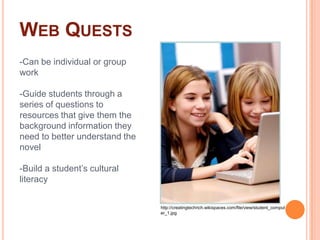
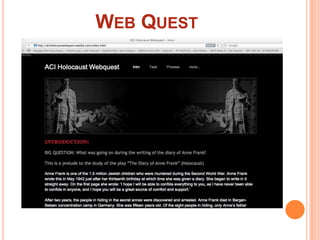
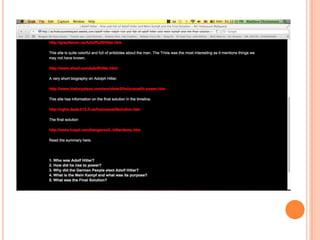
Web Quests-Can be individual or group work-Guide students through a series of questions to resources that give them the background information they need to better understand the novel-Build a student’s cultural literacyhttp://creatingtechrich.wikispaces.com/file/view/student_computer_1.jpg
Web Quest
Presentations-Posters are not the only way to 	presentinformation!	-Think “LESS IS MORE”	-Offer alternatives:-Newspaper articles	-Half-size posters	-Mini books	-Drama	-Biographies
Vocabulary-Word Clusters-Word Walls-Games (Word/Image match)
Word ClustersSightSound
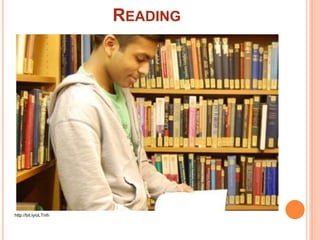
Readinghttp://bit.ly/oLTnih
A Reader Response Approach to Reading“Pieces of literature arouse in us a response – a sense of knowing, of feeling, of moving, of pattern and insight. When these senses coalesce for one of us, we have a kind of pleasure, a sense of the fitness of things. Out of having read what we’ve read, we construct a theory – a theory building on the nature of language and the nature of the mind and the meeting of language and mind in what we would call response” (Purves 17).
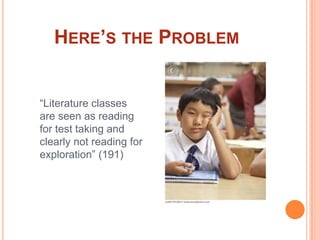
Here’s the Problem“Literature classes are seen as reading for test taking and clearly not reading for exploration” (191)
A Solution“…help students become more reasoning and reasonable, more articulate about what they have read, to share their expressions ... to help them find their place in their community as well as find their individuality.” (57)
How Do We Do This?-Provide a more organic approach to learning-Don’t kill a love of reading by asking for the theme in the first second of discussion-Act as moderator-Value students’ questions and personal responses to what is being read-Let students make discoveries and then provide the framework from which to go deeper from a personal to a critical response-Provide activities that promote a love of reading and a curious mind
Activities to Promote Organic Responses from Students
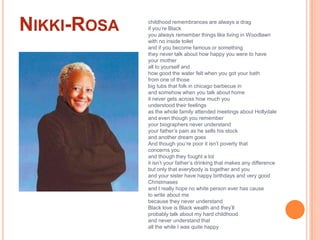
Nikki-Rosachildhood remembrances are always a drag   if you’re Blackyou always remember things like living in Woodlawn   with no inside toiletand if you become famous or somethingthey never talk about how happy you were to have   your motherall to yourself andhow good the water felt when you got your bath   from one of thosebig tubs that folk in chicago barbecue in   and somehow when you talk about home   it never gets across how much youunderstood their feelingsas the whole family attended meetings about Hollydaleand even though you rememberyour biographers never understandyour father’s pain as he sells his stock   and another dream goesAnd though you’re poor it isn’t poverty thatconcerns youand though they fought a lotit isn’t your father’s drinking that makes any difference   but only that everybody is together and youand your sister have happy birthdays and very good   Christmasesand I really hope no white person ever has cause   to write about mebecause they never understandBlack love is Black wealth and they’llprobably talk about my hard childhoodand never understand thatall the while I was quite happy
Discussion and AfterQ: What if the students don’t bring up the questions I want to discuss as a teacher?A: They may not, but these are the real questions students have.  Anyway, if they are important, they will probably come up in discussion.Q: Are students really learning how to read and analyze literature?A: Yes! After discussion, formalize what the students have learned.Tone       Irony       Structure       Diction       AtmosphereMetaphor       Paradox       Symbolism       StyleAnalysis       Impact       Criticism       Evocation Analogical Reasoning       Interpretation       Mood
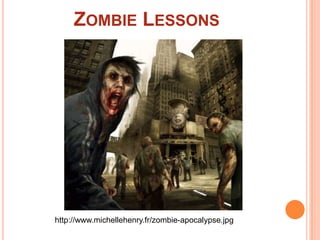
Zombie Lessonshttp://www.michellehenry.fr/zombie-apocalypse.jpg
Ball Toss-Plot Recall-Character-“I Like” / “I Don’t Like”-“Why?”
Strong LinesCan Bonnie describe a strong line in 30 seconds or less?
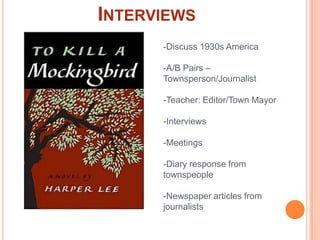
Interviews-Discuss 1930s America-A/B Pairs – Townsperson/Journalist-Teacher: Editor/Town Mayor-Interviews-Meetings-Diary response from townspeople-Newspaper articles from journalists
Reading Films as Texts
A Word About Student ResponseWhat we want to do is to allow for and validate students’ individual emotional responses to what they read while nurturing their ability to read critically.
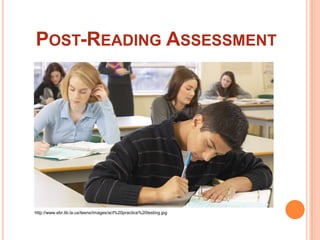
Post-Reading Assessmenthttp://www.ebr.lib.la.us/teens/images/act%20practice%20testing.jpg
TestingQ: Are traditional tests necessary?A: Yes! Um, I mean No! I mean Yes! I mean errrrmmm…Of course they are! Tests (particularly essay exams) are a great means of evaluating what students have learned and getting them expand their minds (critical thinking) after they’ve read a novel, story, poem or play. But,Is it the only means of assessment?
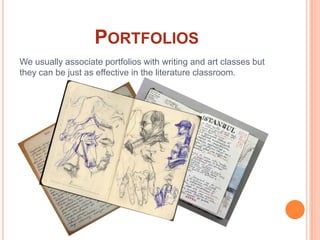
PortfoliosWe usually associate portfolios with writing and art classes but they can be just as effective in the literature classroom.
Portfolio Content-A revised personal response journal-A DVD of a polished student performance of a scene-An audio of a radio play written by a student-A short story inspired by the work of literature-A polished sketch, collage, sculpture orpainting-Mapping a journey (physical, emotional, spiritual)-A critical essay about an aspect of the workWe suggest students choose at least 4 pieces to revise and polish for a portfolio they create themselves. Students must include the critical essay in their four components.Students write a rationale for the choices they’ve made and describe the revision process.
Why Portfolios?-Portfolios present students to the outside world (think Prep Open night!)-Portfolios reflect the breadth of the student’s accomplishments-Portfolios justify the particular course or curriculum that the student has undertaken-Portfolios give the responsibility to the student-Portfolios have a rhetorical purpose – they inform and persuade-Creating a portfolio is different from the portfolio that is created (Purves 199-200)
Assessing PortfoliosAdapting Gail’s rubric (or an IB rubric) to each piece in the portfolio provides a clear means of assessment.Students must know of your multiple roles throughout this process:-During discussion you are their facilitator, helping them better articulate their feelings and thoughts about a work. -While they are generating portfolio pieces, you are their guide and nurturer, encouraging them to dig deeper, to take risks, to dare to be creative.-But they do need to know that ultimately, you are also their judge, evaluating their finished products.
Now It’s Your TurnThink of a literary text (novel, story, poem, play) that you teach and devise one of the following:-A Pre-Reading Activity-A While Reading Activity-A Post-Reading Assessment

Readasaurus rex

  • 1.
  • 2.
  • 3.
    Some Pre-reading Activitiescan be simple and encourage:-Anticipation Why did we just hug trees? How will this connect with the story?-Personal How did I feel when I hugged the tree? What is my connection to nature? Is my teacher crazy?
  • 4.
    Some Pre-reading Activitiescan be more complex and help students gain:Background Information New Vocabulary
  • 5.
    Web Quests-Can beindividual or group work-Guide students through a series of questions to resources that give them the background information they need to better understand the novel-Build a student’s cultural literacyhttp://creatingtechrich.wikispaces.com/file/view/student_computer_1.jpg
  • 6.
  • 8.
    Presentations-Posters are notthe only way to presentinformation! -Think “LESS IS MORE” -Offer alternatives:-Newspaper articles -Half-size posters -Mini books -Drama -Biographies
  • 9.
  • 10.
  • 11.
  • 12.
    A Reader ResponseApproach to Reading“Pieces of literature arouse in us a response – a sense of knowing, of feeling, of moving, of pattern and insight. When these senses coalesce for one of us, we have a kind of pleasure, a sense of the fitness of things. Out of having read what we’ve read, we construct a theory – a theory building on the nature of language and the nature of the mind and the meeting of language and mind in what we would call response” (Purves 17).
  • 13.
    Here’s the Problem“Literatureclasses are seen as reading for test taking and clearly not reading for exploration” (191)
  • 14.
    A Solution“…help studentsbecome more reasoning and reasonable, more articulate about what they have read, to share their expressions ... to help them find their place in their community as well as find their individuality.” (57)
  • 15.
    How Do WeDo This?-Provide a more organic approach to learning-Don’t kill a love of reading by asking for the theme in the first second of discussion-Act as moderator-Value students’ questions and personal responses to what is being read-Let students make discoveries and then provide the framework from which to go deeper from a personal to a critical response-Provide activities that promote a love of reading and a curious mind
  • 16.
    Activities to PromoteOrganic Responses from Students
  • 17.
    Nikki-Rosachildhood remembrances arealways a drag if you’re Blackyou always remember things like living in Woodlawn with no inside toiletand if you become famous or somethingthey never talk about how happy you were to have your motherall to yourself andhow good the water felt when you got your bath from one of thosebig tubs that folk in chicago barbecue in and somehow when you talk about home it never gets across how much youunderstood their feelingsas the whole family attended meetings about Hollydaleand even though you rememberyour biographers never understandyour father’s pain as he sells his stock and another dream goesAnd though you’re poor it isn’t poverty thatconcerns youand though they fought a lotit isn’t your father’s drinking that makes any difference but only that everybody is together and youand your sister have happy birthdays and very good Christmasesand I really hope no white person ever has cause to write about mebecause they never understandBlack love is Black wealth and they’llprobably talk about my hard childhoodand never understand thatall the while I was quite happy
  • 18.
    Discussion and AfterQ:What if the students don’t bring up the questions I want to discuss as a teacher?A: They may not, but these are the real questions students have. Anyway, if they are important, they will probably come up in discussion.Q: Are students really learning how to read and analyze literature?A: Yes! After discussion, formalize what the students have learned.Tone Irony Structure Diction AtmosphereMetaphor Paradox Symbolism StyleAnalysis Impact Criticism Evocation Analogical Reasoning Interpretation Mood
  • 19.
  • 20.
    Ball Toss-Plot Recall-Character-“ILike” / “I Don’t Like”-“Why?”
  • 21.
    Strong LinesCan Bonniedescribe a strong line in 30 seconds or less?
  • 22.
    Interviews-Discuss 1930s America-A/BPairs – Townsperson/Journalist-Teacher: Editor/Town Mayor-Interviews-Meetings-Diary response from townspeople-Newspaper articles from journalists
  • 23.
  • 24.
    A Word AboutStudent ResponseWhat we want to do is to allow for and validate students’ individual emotional responses to what they read while nurturing their ability to read critically.
  • 25.
  • 26.
    TestingQ: Are traditionaltests necessary?A: Yes! Um, I mean No! I mean Yes! I mean errrrmmm…Of course they are! Tests (particularly essay exams) are a great means of evaluating what students have learned and getting them expand their minds (critical thinking) after they’ve read a novel, story, poem or play. But,Is it the only means of assessment?
  • 27.
    PortfoliosWe usually associateportfolios with writing and art classes but they can be just as effective in the literature classroom.
  • 28.
    Portfolio Content-A revisedpersonal response journal-A DVD of a polished student performance of a scene-An audio of a radio play written by a student-A short story inspired by the work of literature-A polished sketch, collage, sculpture orpainting-Mapping a journey (physical, emotional, spiritual)-A critical essay about an aspect of the workWe suggest students choose at least 4 pieces to revise and polish for a portfolio they create themselves. Students must include the critical essay in their four components.Students write a rationale for the choices they’ve made and describe the revision process.
  • 29.
    Why Portfolios?-Portfolios presentstudents to the outside world (think Prep Open night!)-Portfolios reflect the breadth of the student’s accomplishments-Portfolios justify the particular course or curriculum that the student has undertaken-Portfolios give the responsibility to the student-Portfolios have a rhetorical purpose – they inform and persuade-Creating a portfolio is different from the portfolio that is created (Purves 199-200)
  • 30.
    Assessing PortfoliosAdapting Gail’srubric (or an IB rubric) to each piece in the portfolio provides a clear means of assessment.Students must know of your multiple roles throughout this process:-During discussion you are their facilitator, helping them better articulate their feelings and thoughts about a work. -While they are generating portfolio pieces, you are their guide and nurturer, encouraging them to dig deeper, to take risks, to dare to be creative.-But they do need to know that ultimately, you are also their judge, evaluating their finished products.
  • 31.
    Now It’s YourTurnThink of a literary text (novel, story, poem, play) that you teach and devise one of the following:-A Pre-Reading Activity-A While Reading Activity-A Post-Reading Assessment