Rachel E. Strubinger
Walden University
Professor Cindee Easton
The Beginning Reader, prek-3: EDUC 6707R-2
December 18, 2011
Questions teacher should ask each year:

  What is my over all goal?
  What are my students interests?
  What are my students Literacy Autobiographies?
  What materials am I going to use this year to
  maintain their interests?
Teachers should reevaluate their students every year!
In My Classroom …

  My students’ interests, abilities, and learning
  styles are important

  Students’ are able to work at their own pace, yet
  data is collected to document their growth and
  progress

  Use informal and formal assessments frequently
  to document their progress
I use Assessments …

  Use a variety of assessment throughout the year to learn
  my students interest.

  Send home a questionnaire at the beginning of each year
  for my students to complete with their parents!

  Examples of assessments that work for my students:
  Motivation to Read Profile, Conversational
  Interview, Elementary Reading Attitude Survey, and
  Reading Interests Inventories
For My Students …

  Encouraged to read at their own pace

  Provide learners with fiction, non fiction, and
  informative texts, at their reading level

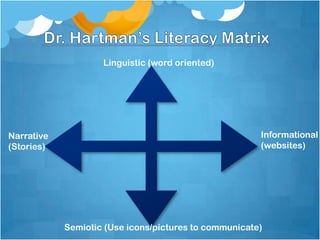
  Use Dr. Hartman’s Literacy Matrix to make sure
  the material is balanced and students are
  exposed to books across the matrix continuum.
Linguistic (word oriented)


Narrative                                              Informational
(Stories)                                              (websites)


            Semiotic (Use icons/pictures to communicate)
Interactive Perspective

 Teach children how to read and write, while
 becoming critical thinkers

 Informal and formal assessments to determine
 strengths and weakness

 Appropriate types and levels of text to meet
 learners literacy goals
Interactive Perspective Strategies


  Interactive Read-Alouds

  Choral Reading

  Comprehension Activities

  Leveled Reading Groups
Critical Perspective

  Teach children how to think critically about the
  text they are reading

  Helping students think about and identify the
  purpose of the text

  Identify authors purpose for writing the text and
  including specific characters
Critical Perspective Strategies


  Open-mind portraits

  Character Hot Seat

  Questioning the Author

  Sketch-to-Stretch
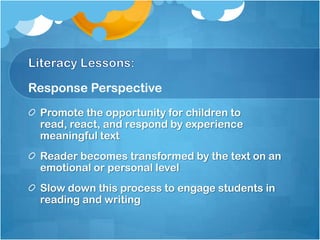
Response Perspective
 Promote the opportunity for children to
 read, react, and respond by experience
 meaningful text
 Reader becomes transformed by the text on an
 emotional or personal level
 Slow down this process to engage students in
 reading and writing
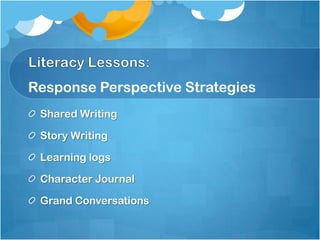
Response Perspective Strategies
 Shared Writing

 Story Writing

 Learning logs

 Character Journal

 Grand Conversations
Edmunds, K. M., & Bauserman, K. L. (2006). What teachers can learn about reading motivation through
conversations with children. The Reading Teacher, 59 (5), 414-424. Retrieved from the Education Research
Complete database.

Gambrell, L. B., Palmer, B. M., Codling, R.M., & Mazzoni, S.A. (1996). Assessing Motivation to Read. The
Reading Teacher, 49 (7), 518-533.

Google Docs. (November 10, 2011). Reading Interest Inventory. Retrieved from:
http://docs.google.com/Doc?docid=0AZvjnHKMsQhRZDV3ZjdqZ183YzM2emJ3Z3o&hl=en&pli=1

Laureate Education,Inc. (Executive Producer). (2010a). Video Program: Analyzing and Selecting Texts. The
Beginning Reader, PreK-3. Baltimore, MD: Author.

Laureate Education, Inc. (Executive Producer).(2010b). Video Program. Critical Perspective. PreK-3.
[webcast] Baltimore, MD: Author.
Laureate Education, Inc. (Executive Producer).(2010b). Video Program. Response Perspective:
Reading and Writing Connections. PreK-3. [webcast] Baltimore, MD: Author.

McKenna, M. C., & Kear, D. J. (1990). Measuring attitude towards reading: A new tool for
teachers. The reading Teacher, 49(9), 626-639.

Walden University (2011). Framework for Literacy Instruction. Retrieved November 21, 2011
from
http://sylvan.live.ecollege.com/ec/courses/37910/CRSWUPSYC62053502436/Frameworkforl
iteracyinstruction03.10.doc
App7 strubingerr

App7 strubingerr

  • 1.
    Rachel E. Strubinger WaldenUniversity Professor Cindee Easton The Beginning Reader, prek-3: EDUC 6707R-2 December 18, 2011
  • 3.
    Questions teacher shouldask each year: What is my over all goal? What are my students interests? What are my students Literacy Autobiographies? What materials am I going to use this year to maintain their interests? Teachers should reevaluate their students every year!
  • 4.
    In My Classroom… My students’ interests, abilities, and learning styles are important Students’ are able to work at their own pace, yet data is collected to document their growth and progress Use informal and formal assessments frequently to document their progress
  • 5.
    I use Assessments… Use a variety of assessment throughout the year to learn my students interest. Send home a questionnaire at the beginning of each year for my students to complete with their parents! Examples of assessments that work for my students: Motivation to Read Profile, Conversational Interview, Elementary Reading Attitude Survey, and Reading Interests Inventories
  • 6.
    For My Students… Encouraged to read at their own pace Provide learners with fiction, non fiction, and informative texts, at their reading level Use Dr. Hartman’s Literacy Matrix to make sure the material is balanced and students are exposed to books across the matrix continuum.
  • 7.
    Linguistic (word oriented) Narrative Informational (Stories) (websites) Semiotic (Use icons/pictures to communicate)
  • 8.
    Interactive Perspective Teachchildren how to read and write, while becoming critical thinkers Informal and formal assessments to determine strengths and weakness Appropriate types and levels of text to meet learners literacy goals
  • 9.
    Interactive Perspective Strategies Interactive Read-Alouds Choral Reading Comprehension Activities Leveled Reading Groups
  • 10.
    Critical Perspective Teach children how to think critically about the text they are reading Helping students think about and identify the purpose of the text Identify authors purpose for writing the text and including specific characters
  • 11.
    Critical Perspective Strategies Open-mind portraits Character Hot Seat Questioning the Author Sketch-to-Stretch
  • 12.
    Response Perspective Promotethe opportunity for children to read, react, and respond by experience meaningful text Reader becomes transformed by the text on an emotional or personal level Slow down this process to engage students in reading and writing
  • 13.
    Response Perspective Strategies Shared Writing Story Writing Learning logs Character Journal Grand Conversations
  • 14.
    Edmunds, K. M.,& Bauserman, K. L. (2006). What teachers can learn about reading motivation through conversations with children. The Reading Teacher, 59 (5), 414-424. Retrieved from the Education Research Complete database. Gambrell, L. B., Palmer, B. M., Codling, R.M., & Mazzoni, S.A. (1996). Assessing Motivation to Read. The Reading Teacher, 49 (7), 518-533. Google Docs. (November 10, 2011). Reading Interest Inventory. Retrieved from: http://docs.google.com/Doc?docid=0AZvjnHKMsQhRZDV3ZjdqZ183YzM2emJ3Z3o&hl=en&pli=1 Laureate Education,Inc. (Executive Producer). (2010a). Video Program: Analyzing and Selecting Texts. The Beginning Reader, PreK-3. Baltimore, MD: Author. Laureate Education, Inc. (Executive Producer).(2010b). Video Program. Critical Perspective. PreK-3. [webcast] Baltimore, MD: Author.
  • 15.
    Laureate Education, Inc.(Executive Producer).(2010b). Video Program. Response Perspective: Reading and Writing Connections. PreK-3. [webcast] Baltimore, MD: Author. McKenna, M. C., & Kear, D. J. (1990). Measuring attitude towards reading: A new tool for teachers. The reading Teacher, 49(9), 626-639. Walden University (2011). Framework for Literacy Instruction. Retrieved November 21, 2011 from http://sylvan.live.ecollege.com/ec/courses/37910/CRSWUPSYC62053502436/Frameworkforl iteracyinstruction03.10.doc