
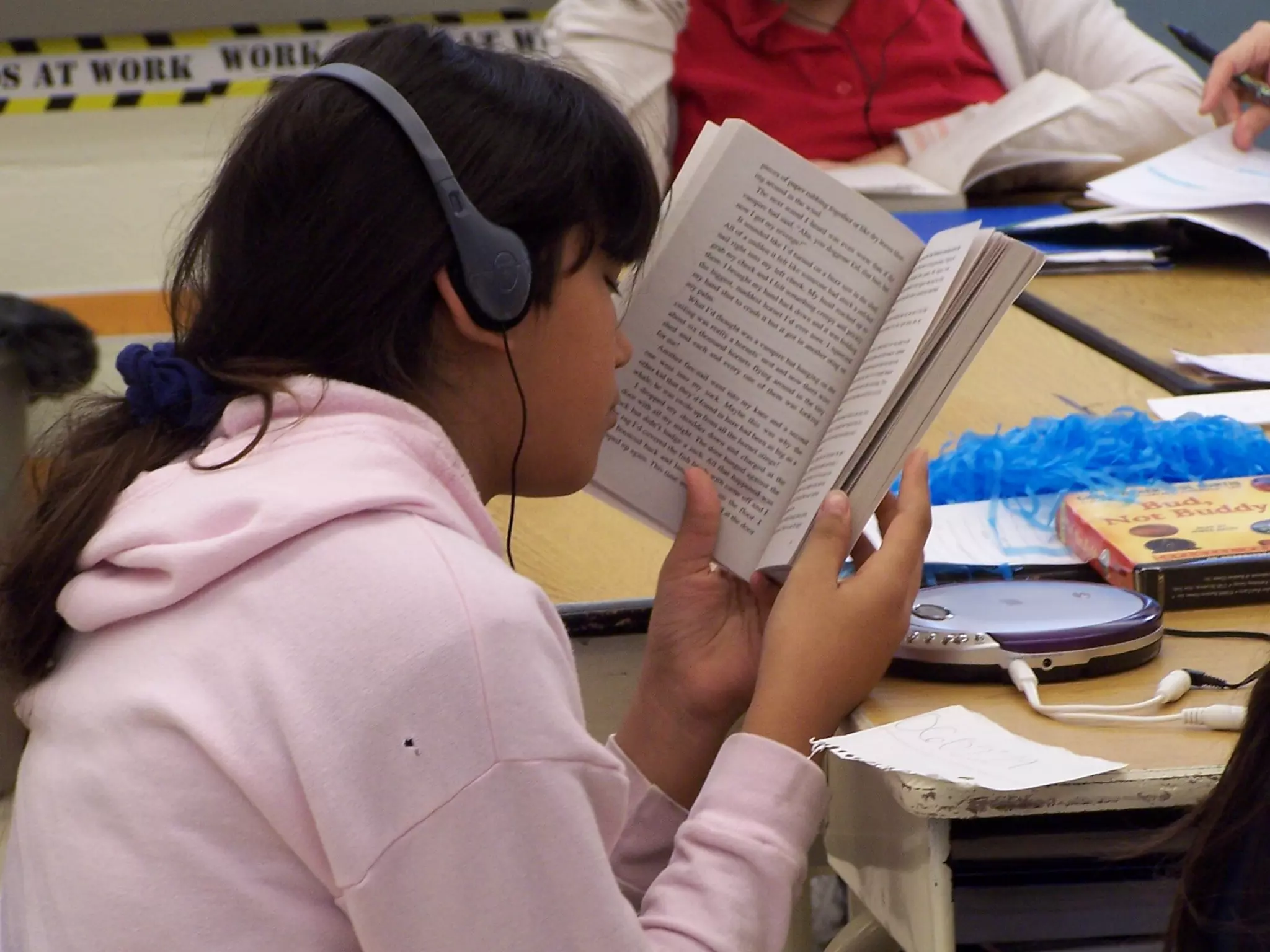



Reading Class Would Be Boring If I Didn’t Read… Elizabeth Fogarty Brian Housand Patricia Owen  John Fogarty Tales From a High School Reading Workshop
Looking For Handouts? http://brianhousand.googlepages.com
 
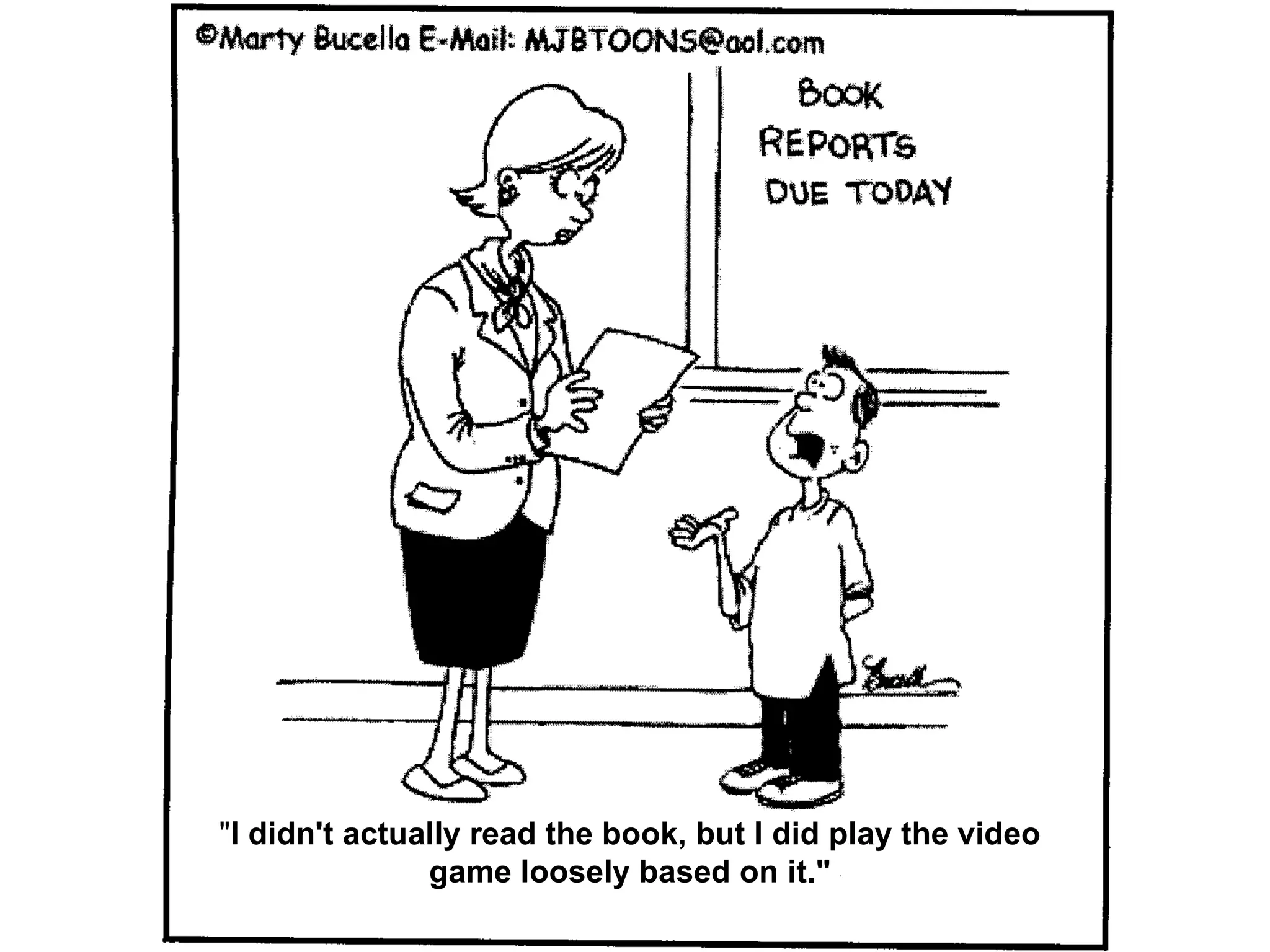
" I didn't actually read the book, but I did play the video game loosely based on it."
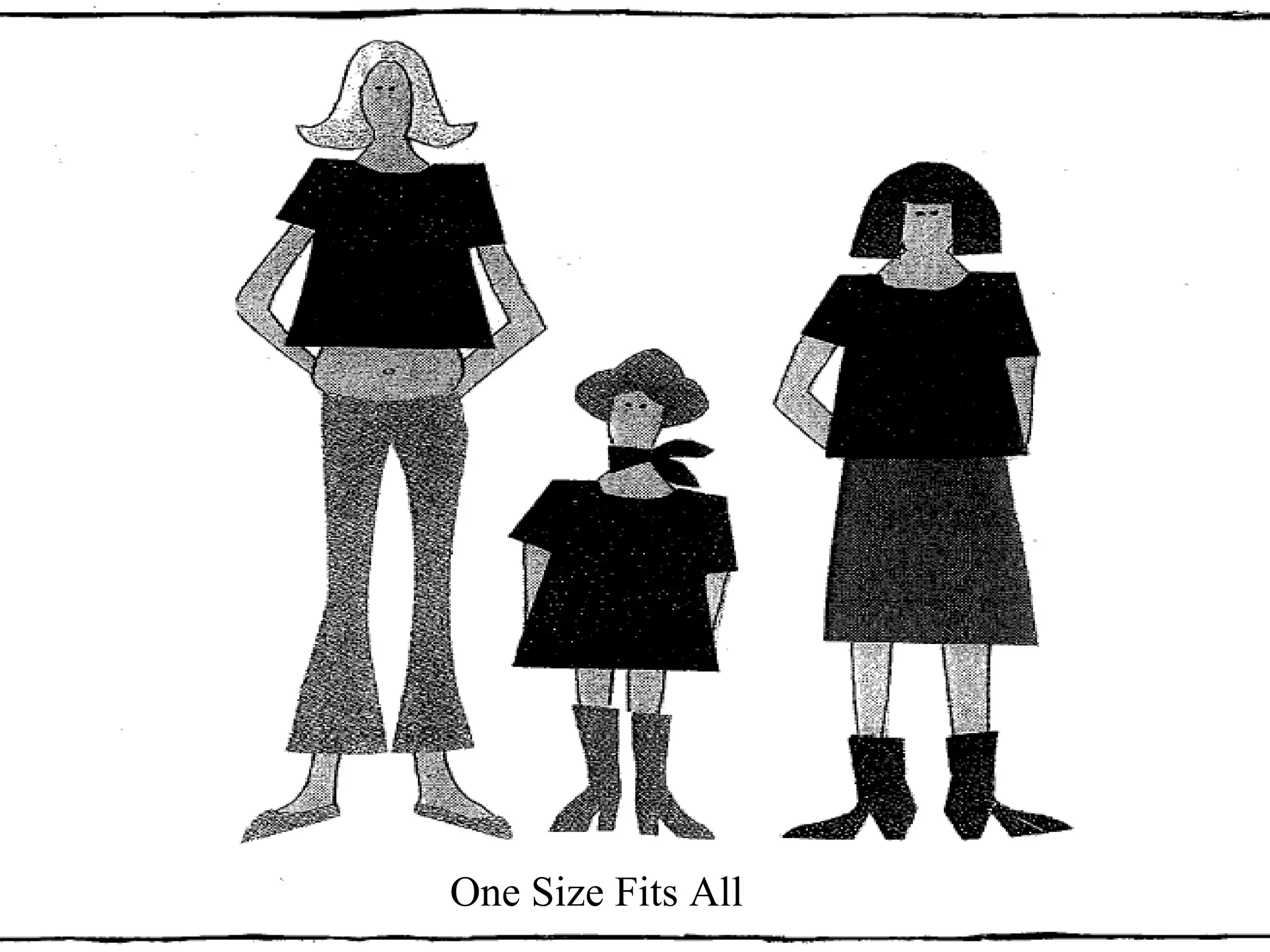
One Size Fits All
Three-Legged Stool Renzulli (1977) Enrichment Triad Model Vygotsky (1962)  Zone of Proximal Development National Reading Panel (2000)  Need for further research
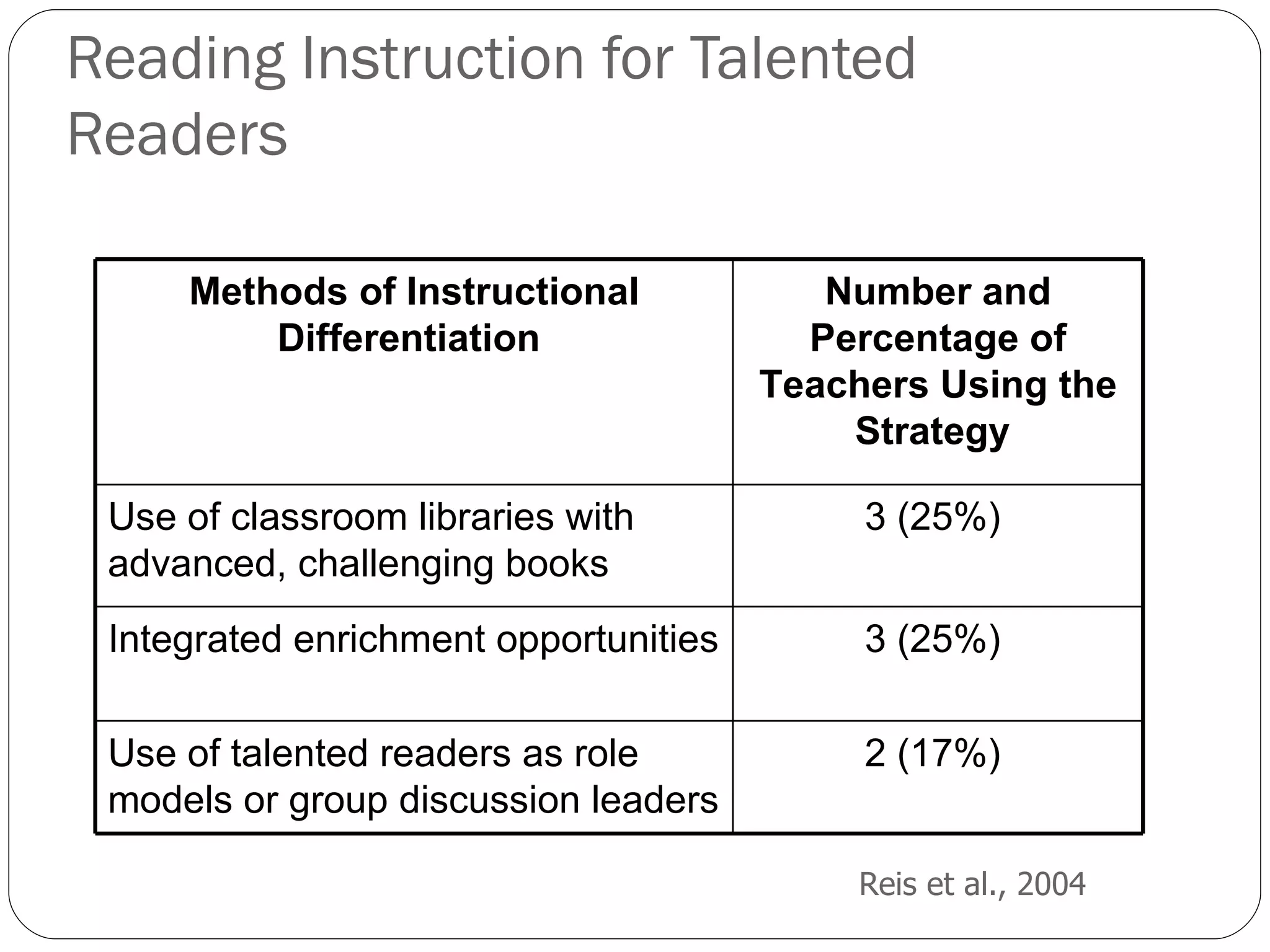
Reading Instruction for Talented  Readers Reis et al., 2004 Methods of Instructional Differentiation  Number and Percentage of Teachers Using the Strategy  Use of classroom libraries with advanced, challenging books  3 (25%)  Integrated enrichment opportunities  3 (25%)  Use of talented readers as role models or group discussion leaders  2 (17%)
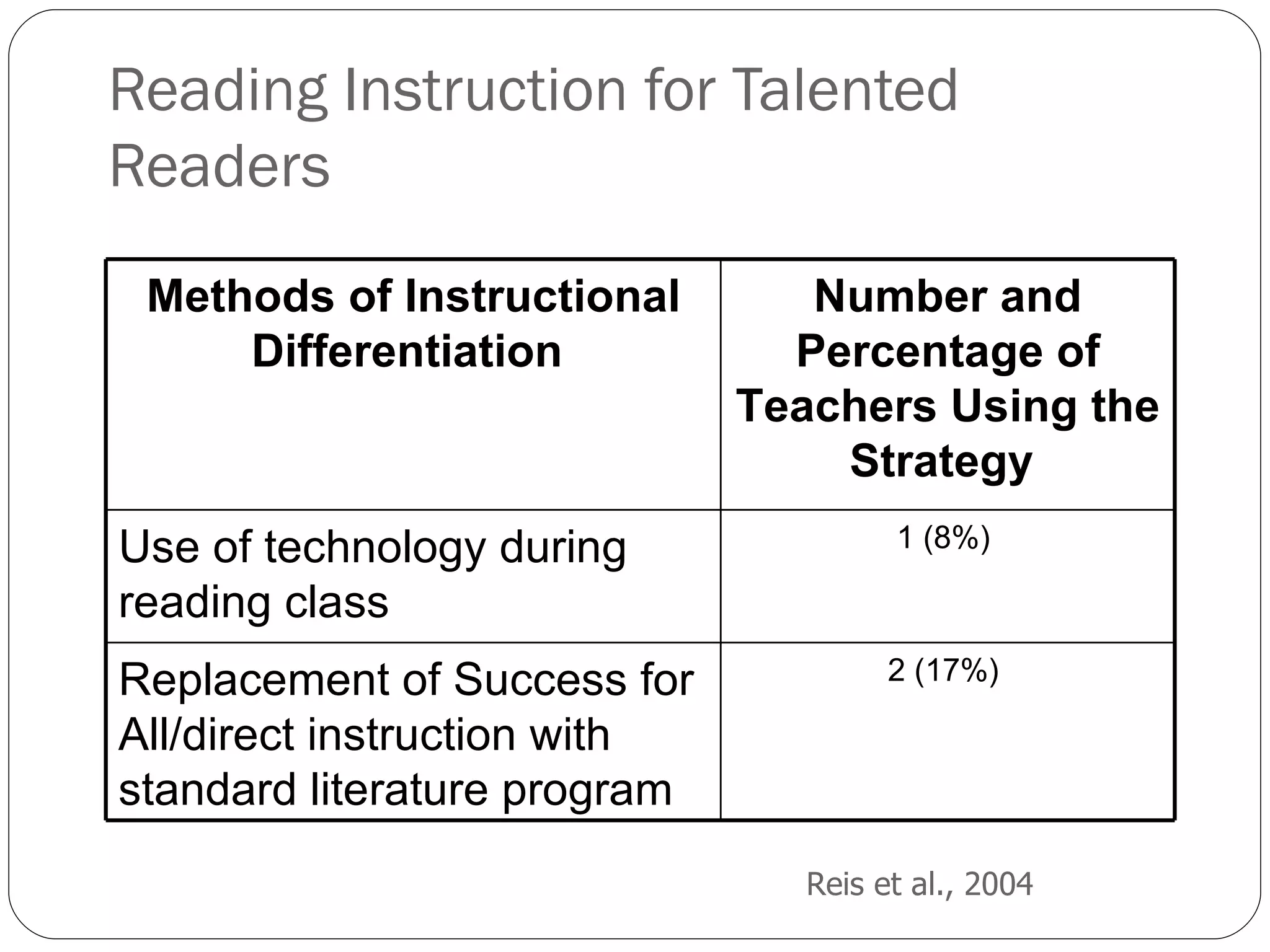
Reading Instruction for Talented Readers Reis et al., 2004 Methods of Instructional Differentiation  Number and Percentage of Teachers Using the Strategy  Use of technology during reading class  1 (8%)  Replacement of Success for All/direct instruction with standard literature program  2 (17%)
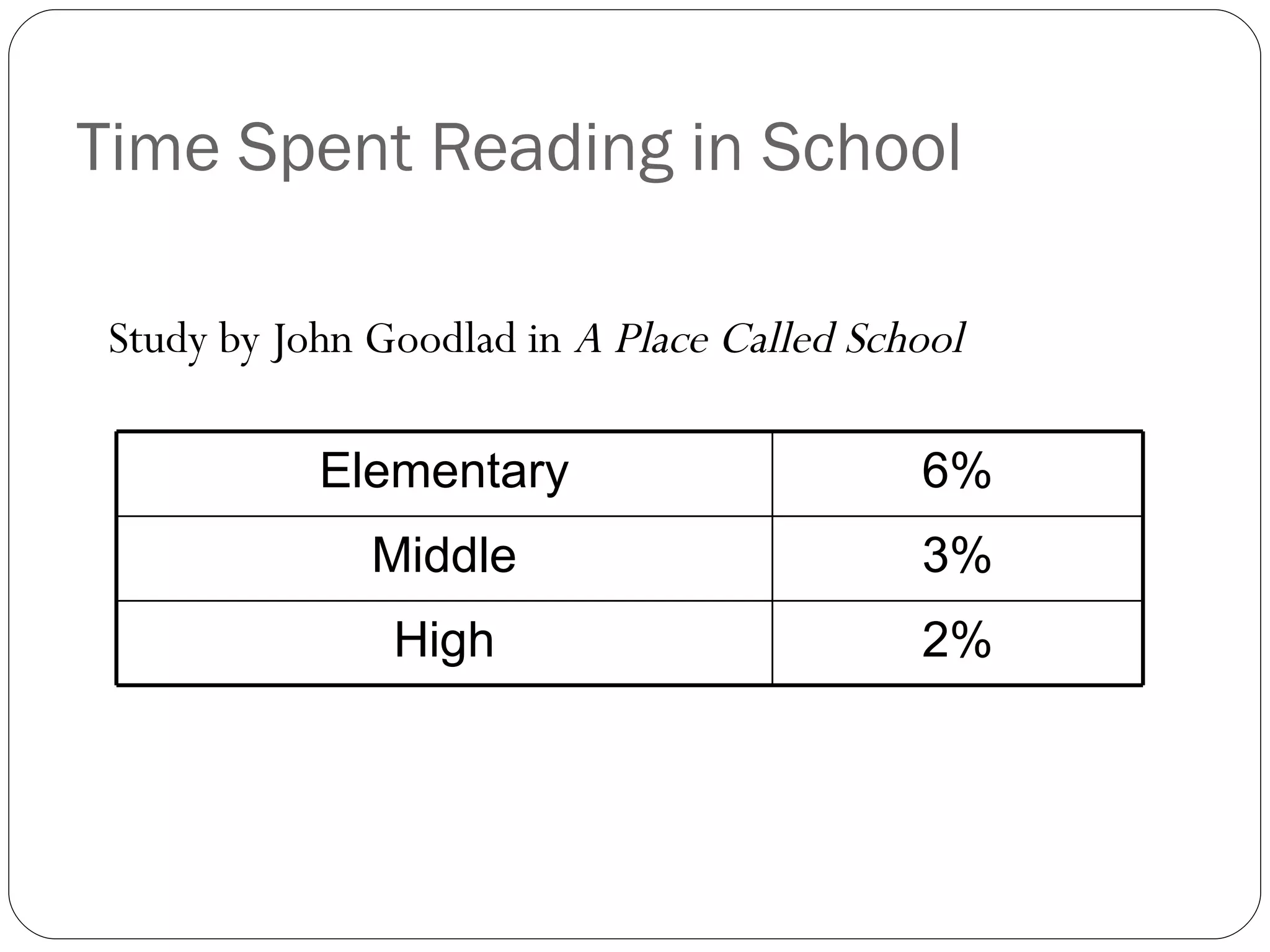
Time Spent Reading in School Study by John Goodlad in  A Place Called School  Elementary 6% Middle 3% High 2%
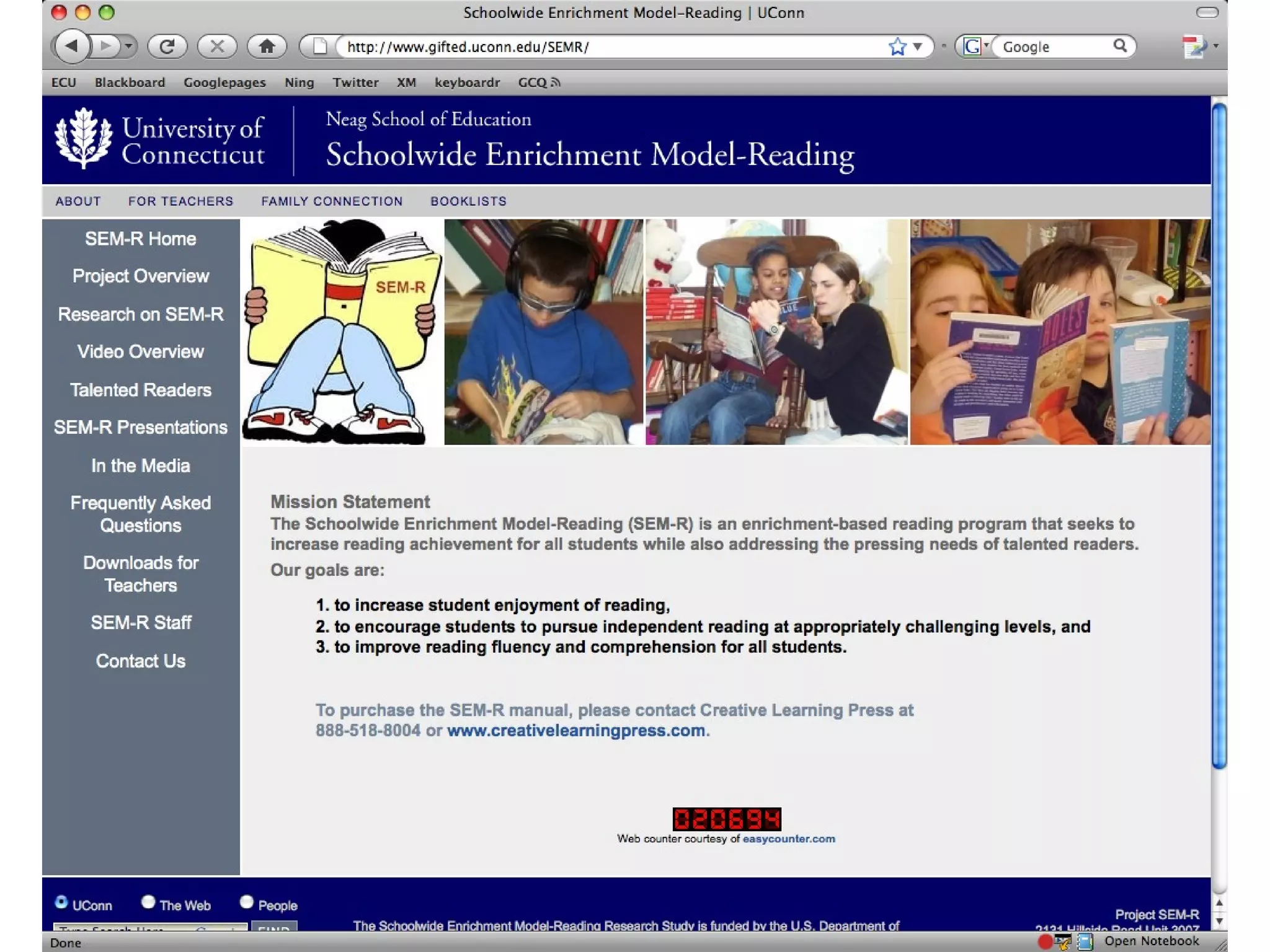
Three Goals of the Schoolwide  Enrichment Model Reading (SEM-R) To increase enjoyment in reading To encourage students to pursue challenging independent reading To improve reading fluency, reading, and comprehension and increase self regulation in reading--leading to higher reading achievement scores
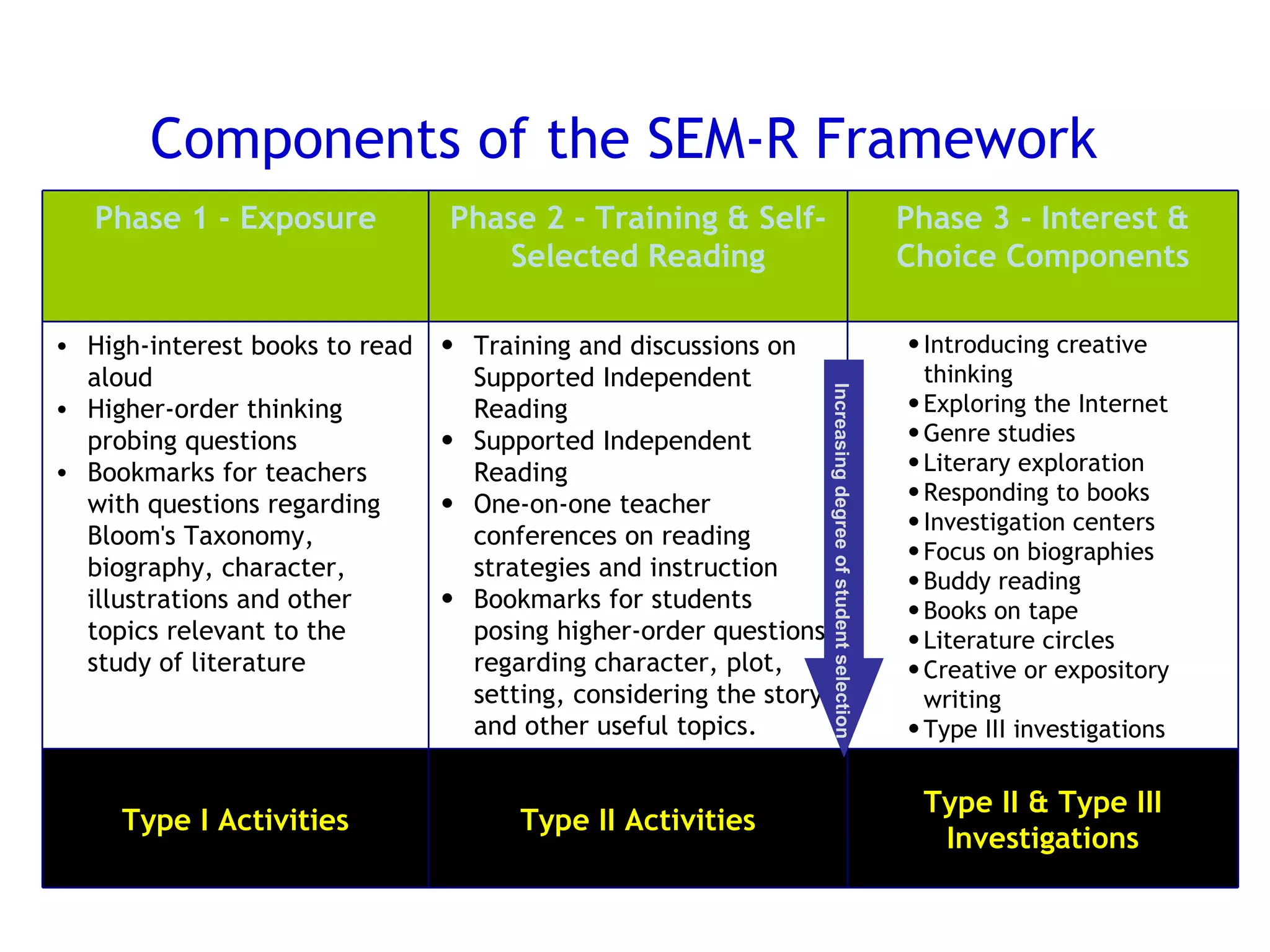
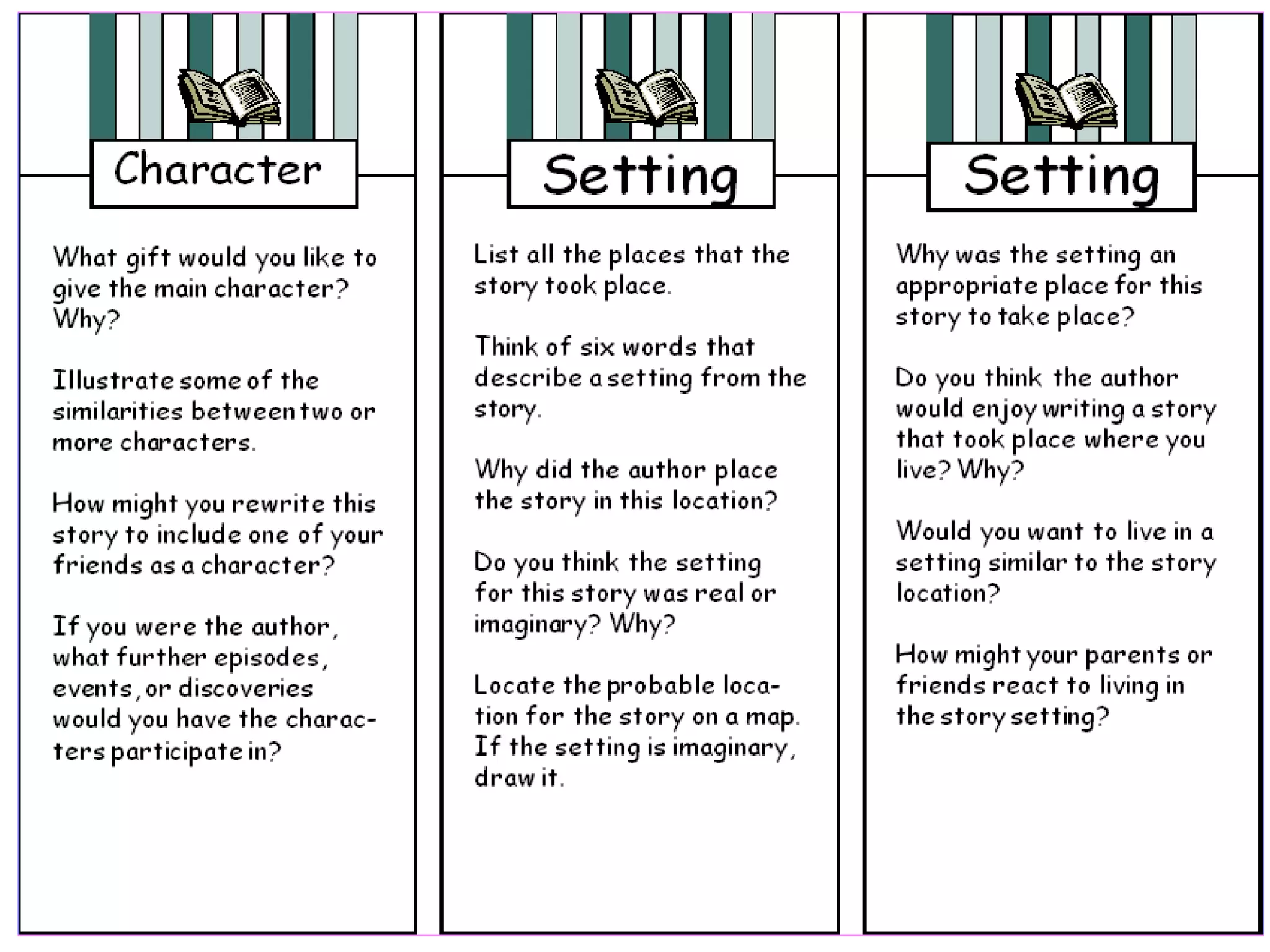
Components of the SEM-R Framework Increasing degree of student selection Phase 1 - Exposure Phase 2 - Training & Self-Selected   Reading Phase 3 - Interest & Choice Components High-interest books to read aloud Higher-order thinking probing questions Bookmarks for teachers with questions regarding Bloom's Taxonomy, biography, character, illustrations and other topics relevant to the study of literature Training and discussions on Supported Independent Reading Supported Independent Reading One-on-one teacher conferences on reading strategies and instruction Bookmarks for students posing higher-order questions regarding character, plot, setting, considering the story, and other useful topics.   Introducing creative thinking Exploring the Internet Genre studies Literary exploration Responding to books Investigation centers Focus on biographies Buddy reading Books on tape Literature circles  Creative or expository writing Type III investigations Type I Activities Type II Activities Type II & Type III Investigations
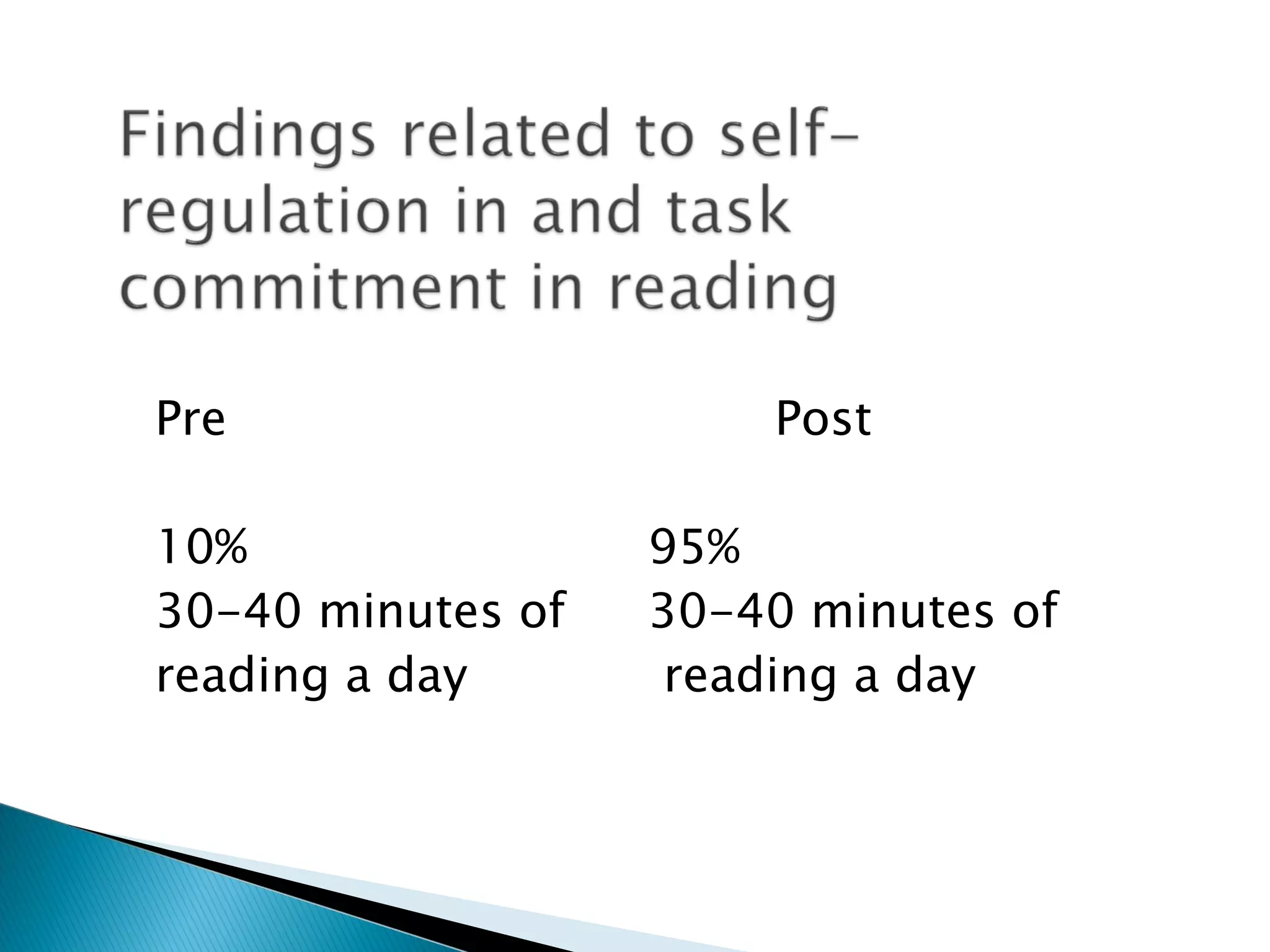
Pre Post 10%  95%  30-40 minutes of  30-40 minutes of  reading a day  reading a day
Phase 1 High interest read alouds and higher order questions
Book Hooks provide enjoyable reading invitations that create positive associations with reading.  encouragement for students to do independent reading.  Invitations to broad selections of books easily accessible to students.  opportunities for a pleasant environment in which to read.  invitations to pursue a wide range of interests and knowledge.
 
Phase 1 Components Read Aloud Book Selection:  Genres Themes Fiction/Nonfiction Book Talks Moving from 15 minutes to 5!!
 
Phase 2 Supported Independent Reading using individual conferences and differentiated reading instruction
Individualizing and Differentiating Conferences It is important to remember that not all students will need the same strategy instruction at the very same time, but that all students need some instruction if they are reading a book that is adequately challenging. For that reason, be sure that strategy instruction is integrated throughout conferences and differentiated to meet the needs of individual students.
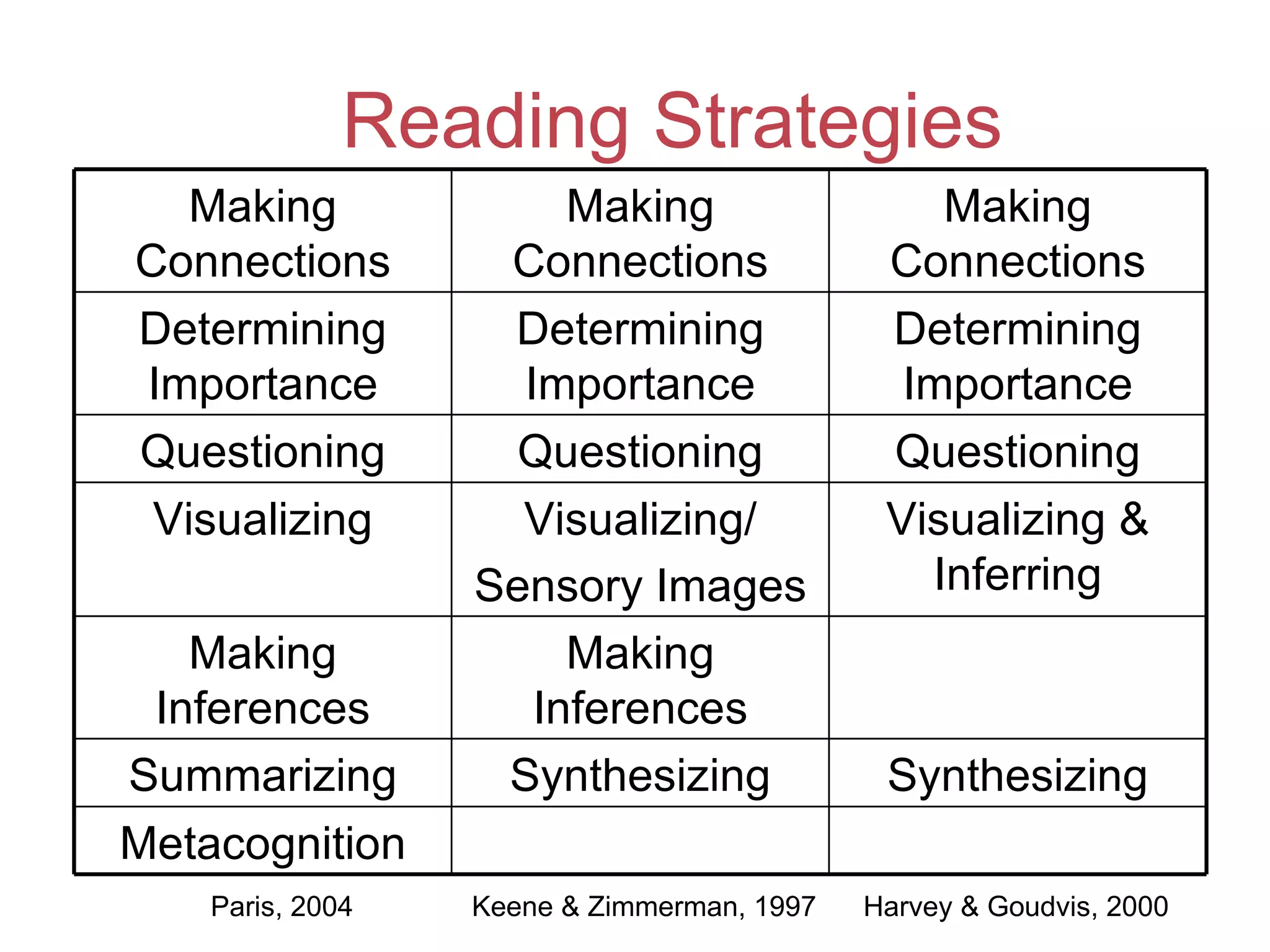
Reading Strategies Paris, 2004   Keene & Zimmerman, 1997  Harvey & Goudvis, 2000 Making Connections Making Connections Making Connections Determining Importance Determining Importance Determining Importance Questioning Questioning Questioning Visualizing Visualizing/ Sensory Images Visualizing & Inferring Making Inferences Making Inferences Summarizing Synthesizing Synthesizing Metacognition
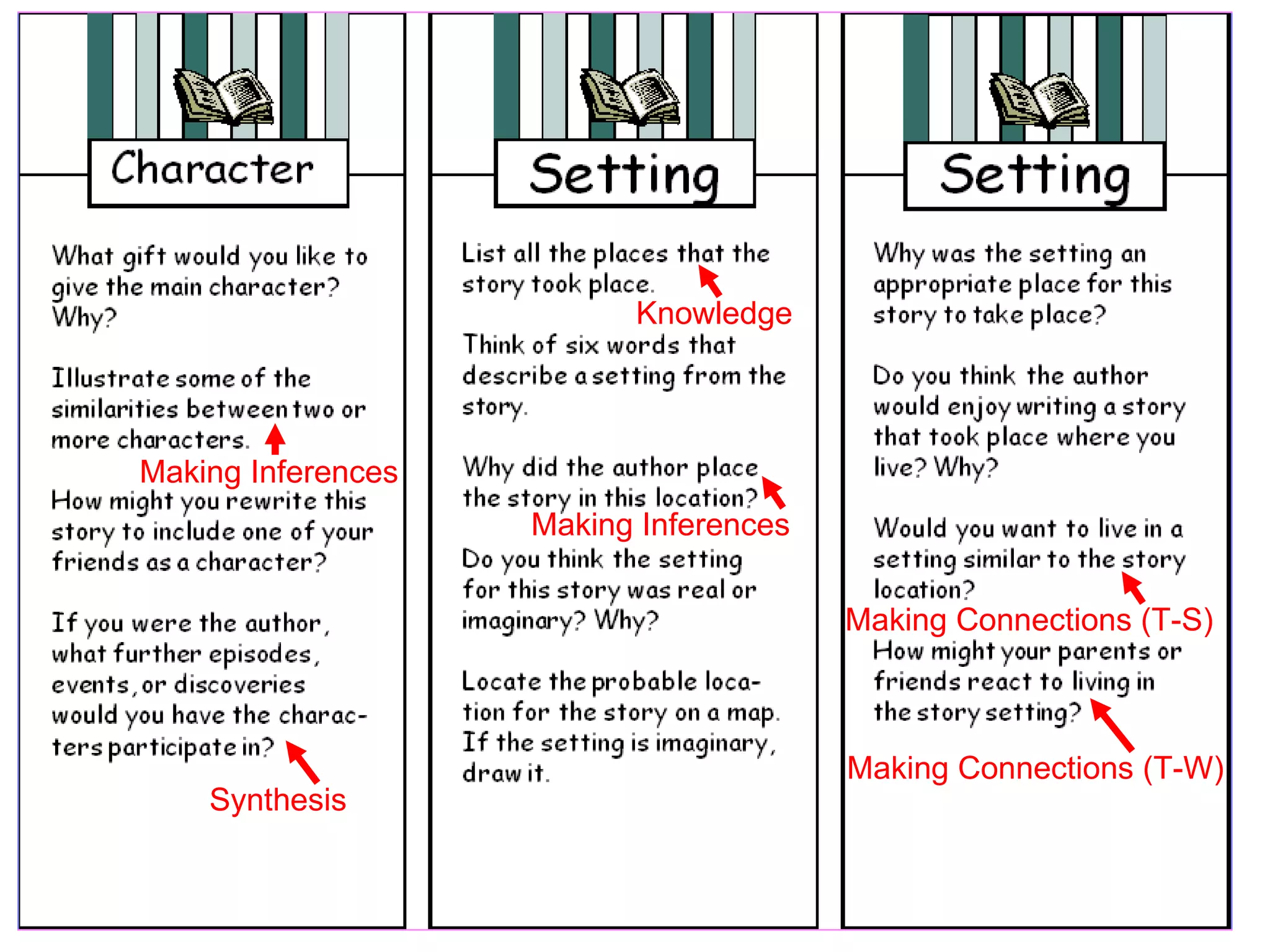
Making Inferences Making Inferences Making Connections (T-W) Knowledge Synthesis Making Connections (T-S)
 
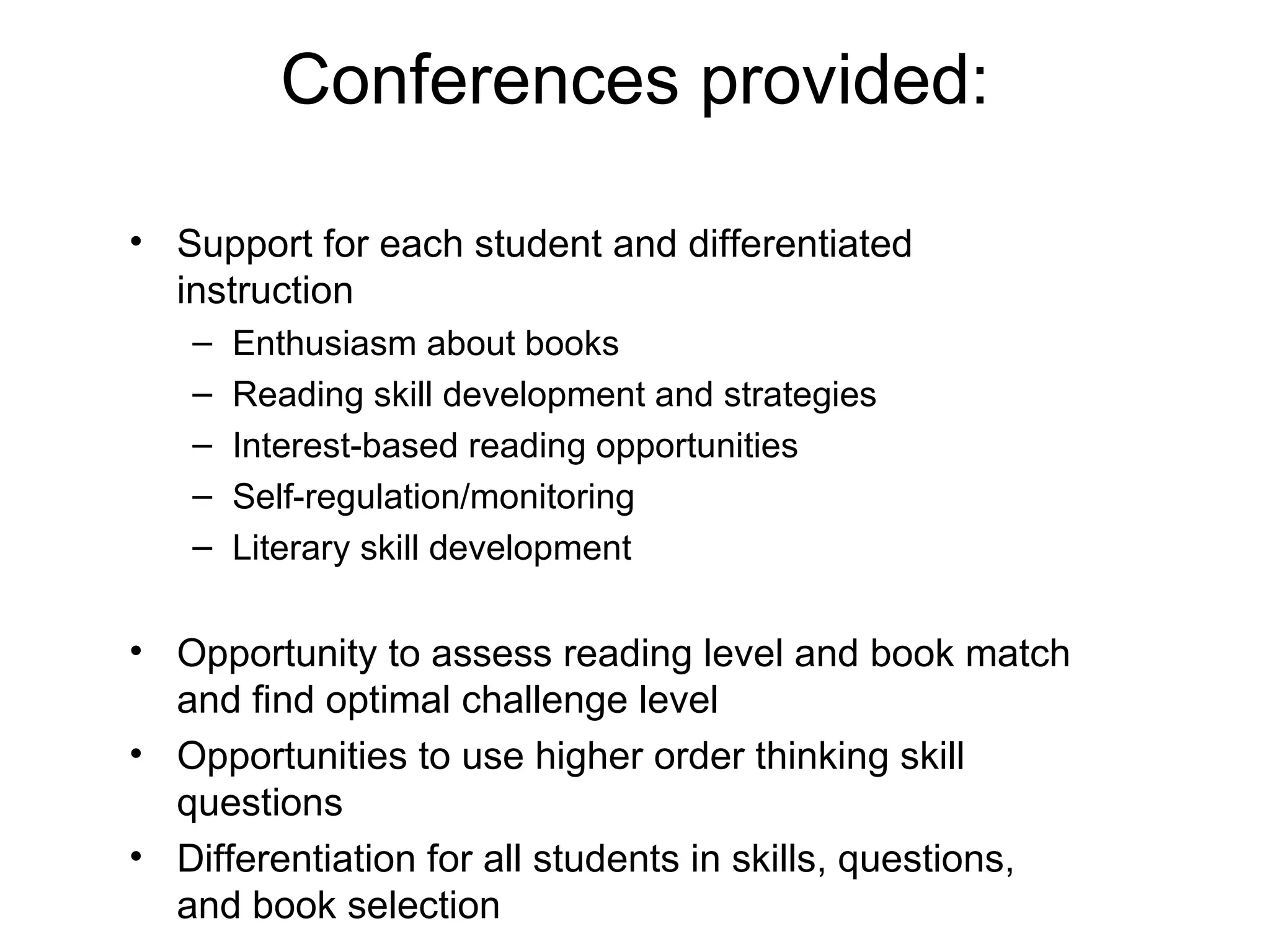
Conferences provided: Support for each student and differentiated instruction Enthusiasm about books Reading skill development and strategies Interest-based reading opportunities Self-regulation/monitoring Literary skill development Opportunity to assess reading level and book match and find optimal challenge level Opportunities to use higher order thinking skill questions Differentiation for all students in skills, questions, and book selection
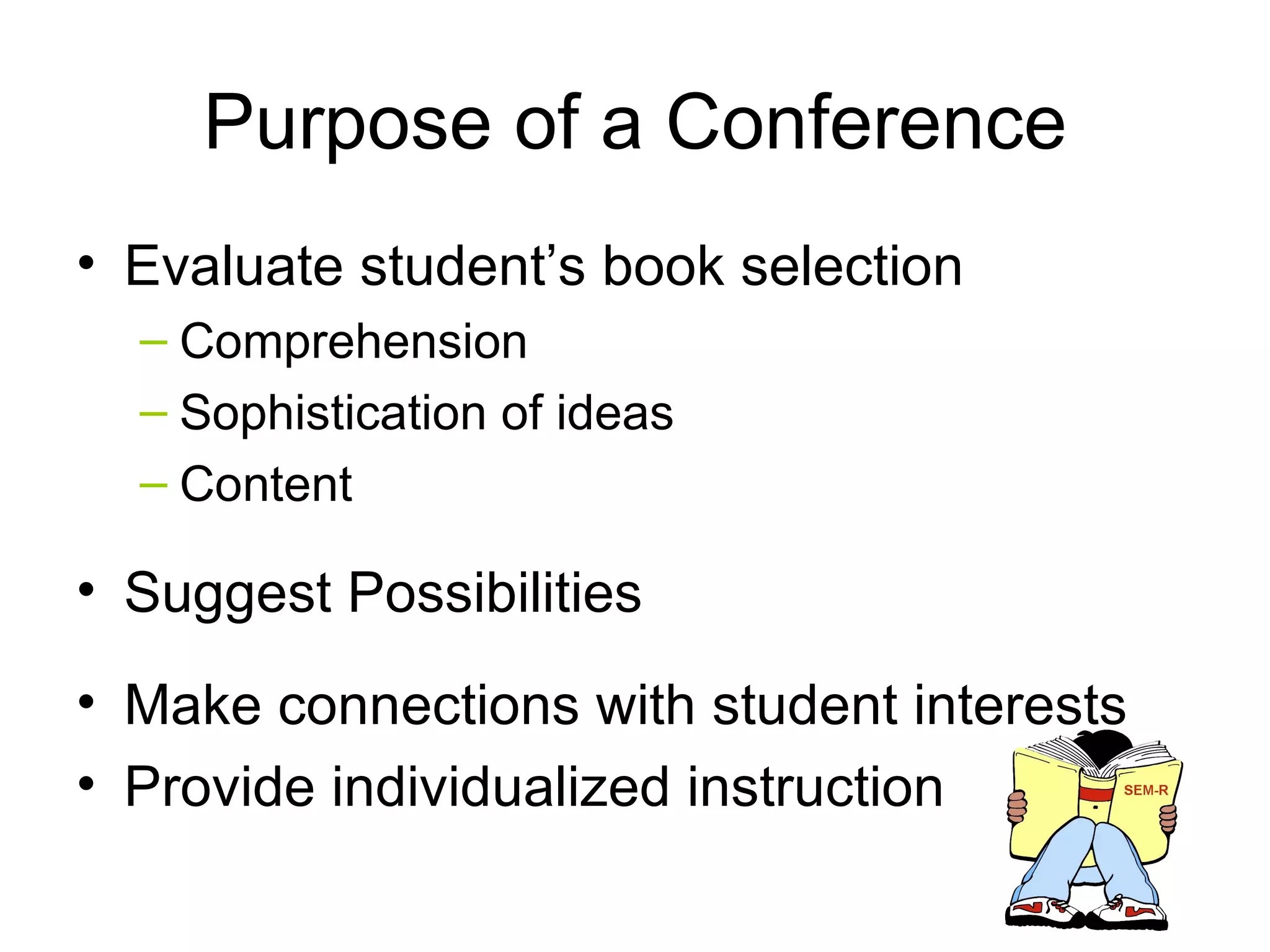
Purpose of a Conference Evaluate student’s book selection Comprehension Sophistication of ideas Content Suggest Possibilities Make connections with student interests Provide individualized instruction
Phase 3 Self-selected interest and choice components
C hoices E xplorations nterests I
Top Strategies For Phase 3 Books on CD Group Projects  Buddy Reading SEM-Xplorations Renzulli Learning Literature Circles Creativity Activities Investigation Centers Independent Projects
I ndependent Projects Enable: students and teachers to identify problems or topics of student interest plan  methods to investigate various types of student products problem solve and demonstrate student’s ability to apply methodological skills and knowledge find opportunities for joyful learning and self-regulation
I ndependent Projects Build on student interest Encourage independence Allow work with complex and abstract ideas Enable long-term and in-depth work on topics of interest Develop task commitment and self-regulation Teach planning and research skills at advanced levels
Interest and Depth lead to Creative Productivity We need students to get more deeply interested in things, more involved in them, more engaged in wanting to know, to have projects that they can get excited about and work on over long periods of time, to be stimulated to find things out on their own. (Howard Gardner in an interview with R. Brandt, Educational Leadership, 1993)
Tales From The Classroom: Experiences with SEM-R
Study Design
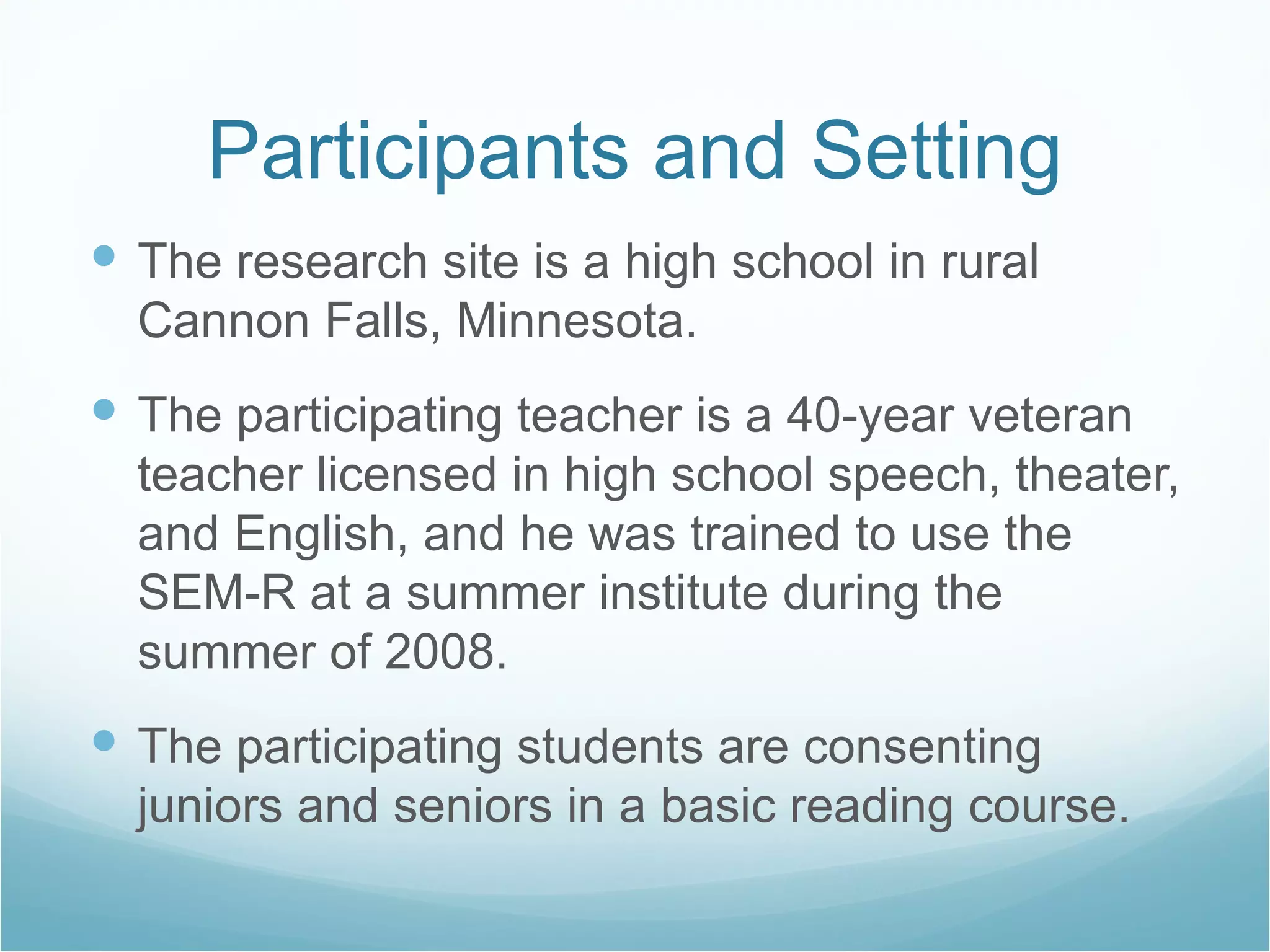
Participants and Setting The research site is a high school in rural Cannon Falls, Minnesota. The participating teacher is a 40-year veteran teacher licensed in high school speech, theater, and English, and he was trained to use the SEM-R at a summer institute during the summer of 2008. The participating students are consenting juniors and seniors in a basic reading course.
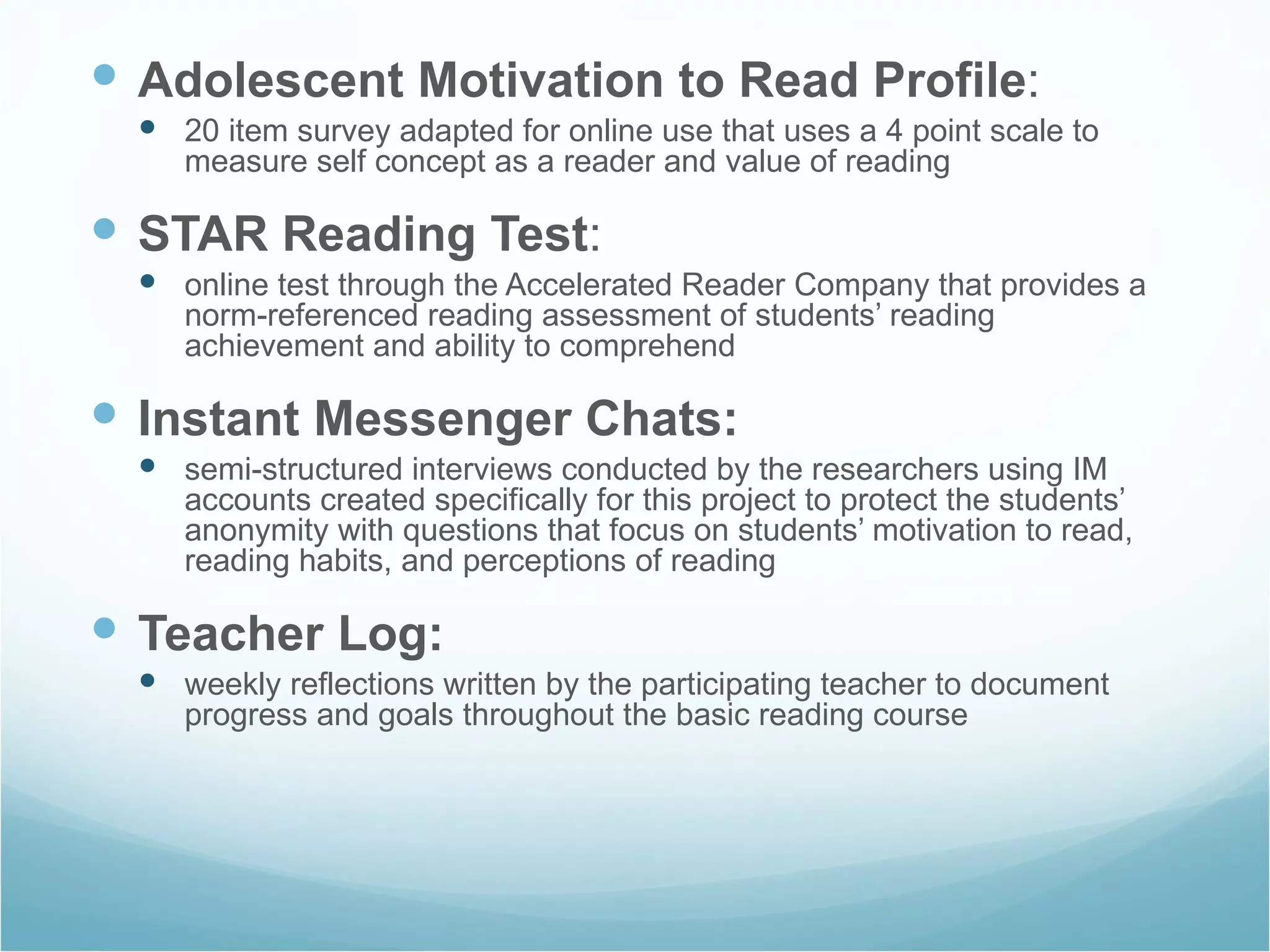
Adolescent Motivation to Read Profile : 20 item survey adapted for online use that uses a 4 point scale to measure self concept as a reader and value of reading STAR Reading Test : online test through the Accelerated Reader Company that provides a norm-referenced reading assessment of students’ reading achievement and ability to comprehend Instant Messenger Chats: semi-structured interviews conducted by the researchers using IM accounts created specifically for this project to protect the students’ anonymity with questions that focus on students’ motivation to read, reading habits, and perceptions of reading Teacher Log: weekly reflections written by the participating teacher to document progress and goals throughout the basic reading course
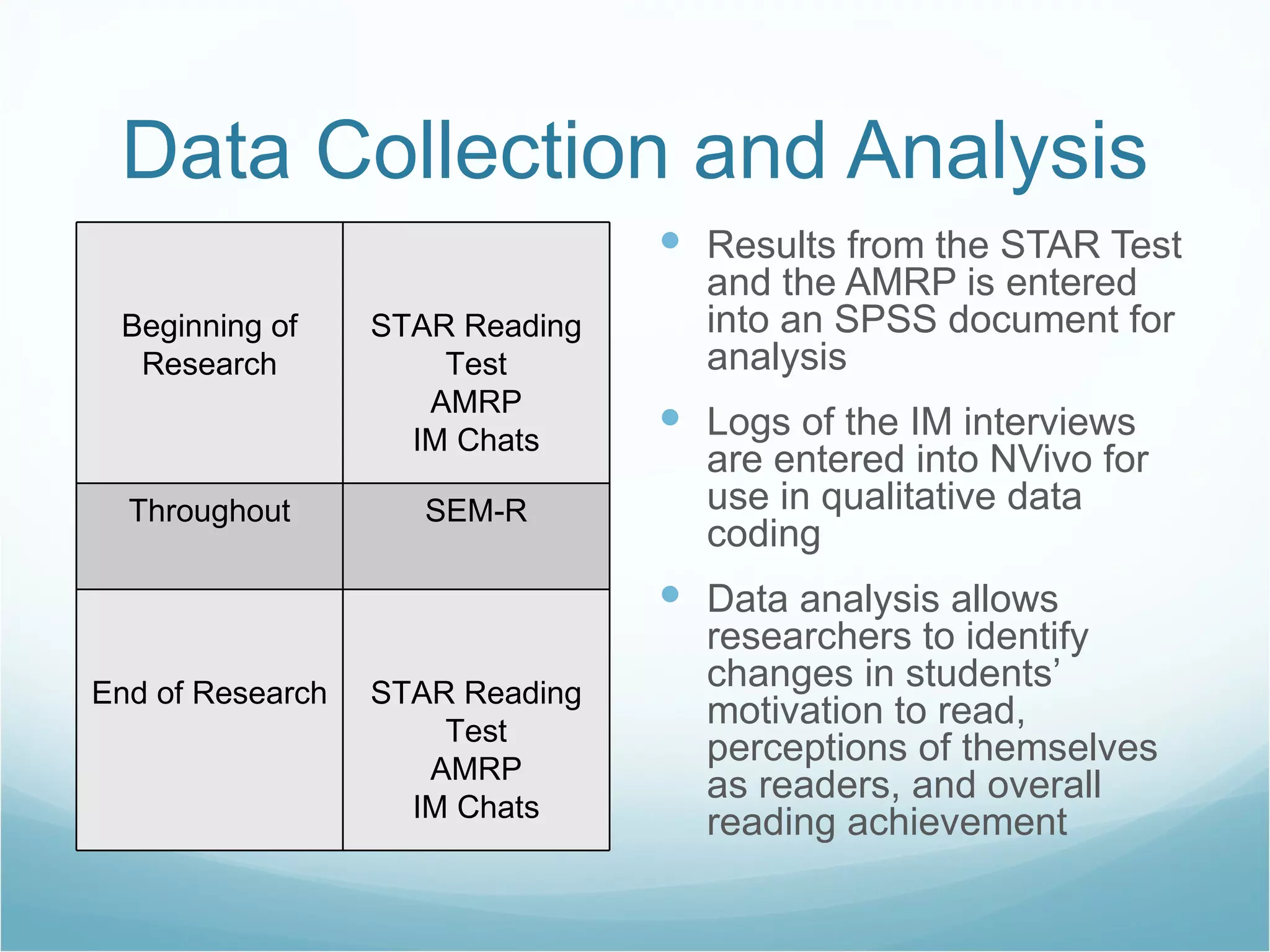
Data Collection and Analysis Results from the STAR Test and the AMRP is entered into an SPSS document for analysis Logs of the IM interviews are entered into NVivo for use in qualitative data coding Data analysis allows researchers to identify changes in students’ motivation to read, perceptions of themselves as readers, and overall reading achievement Beginning of Research STAR Reading Test AMRP IM Chats Throughout SEM-R End of Research STAR Reading Test AMRP IM Chats
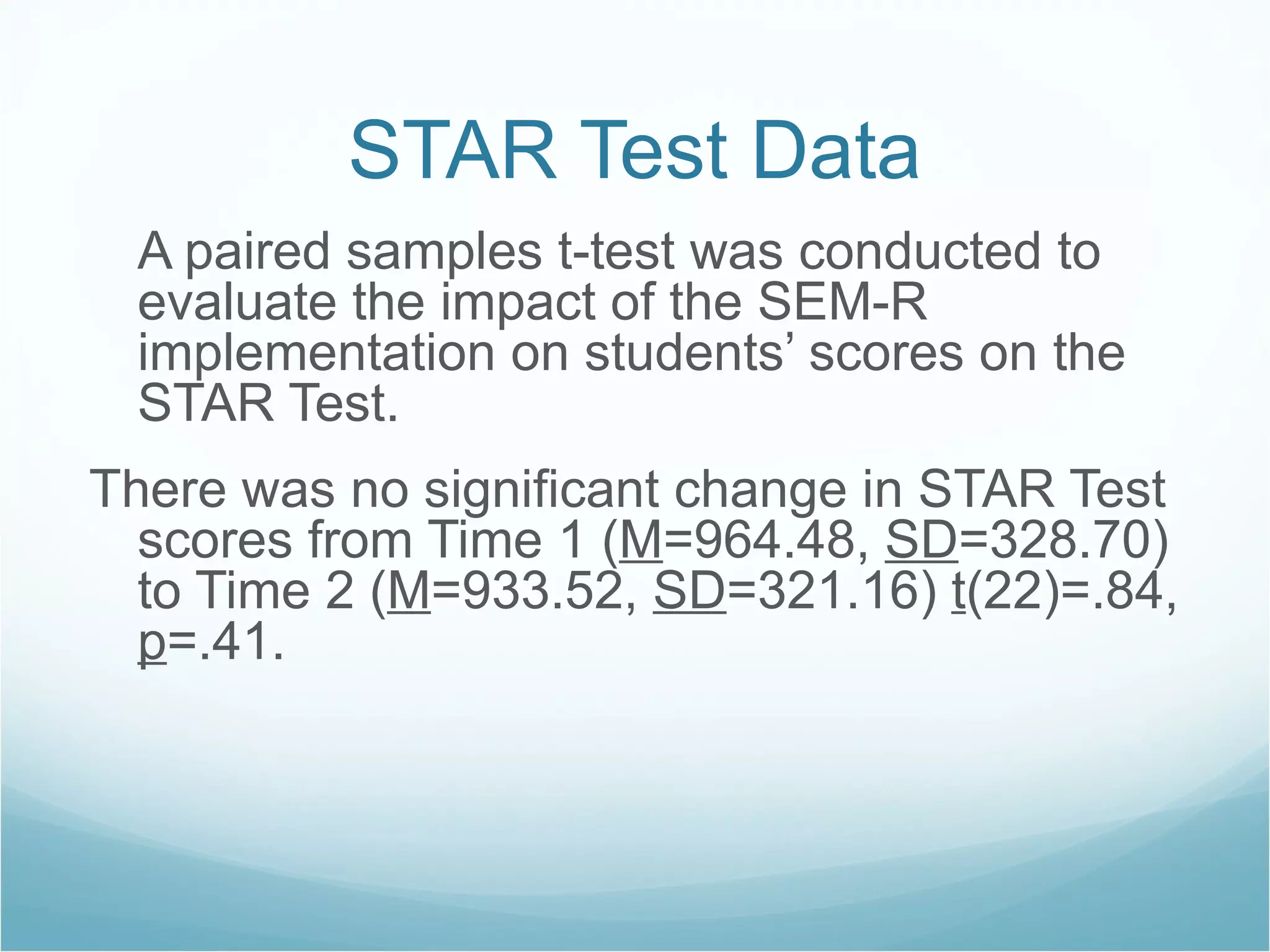
STAR Test Data A paired samples t-test was conducted to evaluate the impact of the SEM-R implementation on students’ scores on the STAR Test.  There was no significant change in STAR Test scores from Time 1 ( M =964.48,  SD =328.70) to Time 2 ( M =933.52,  SD =321.16)  t (22)=.84,  p =.41.
AMRP Data A paired samples t-test was conducted to evaluate the impact of the SEM-R implementation on students’ scores on the AMRP.
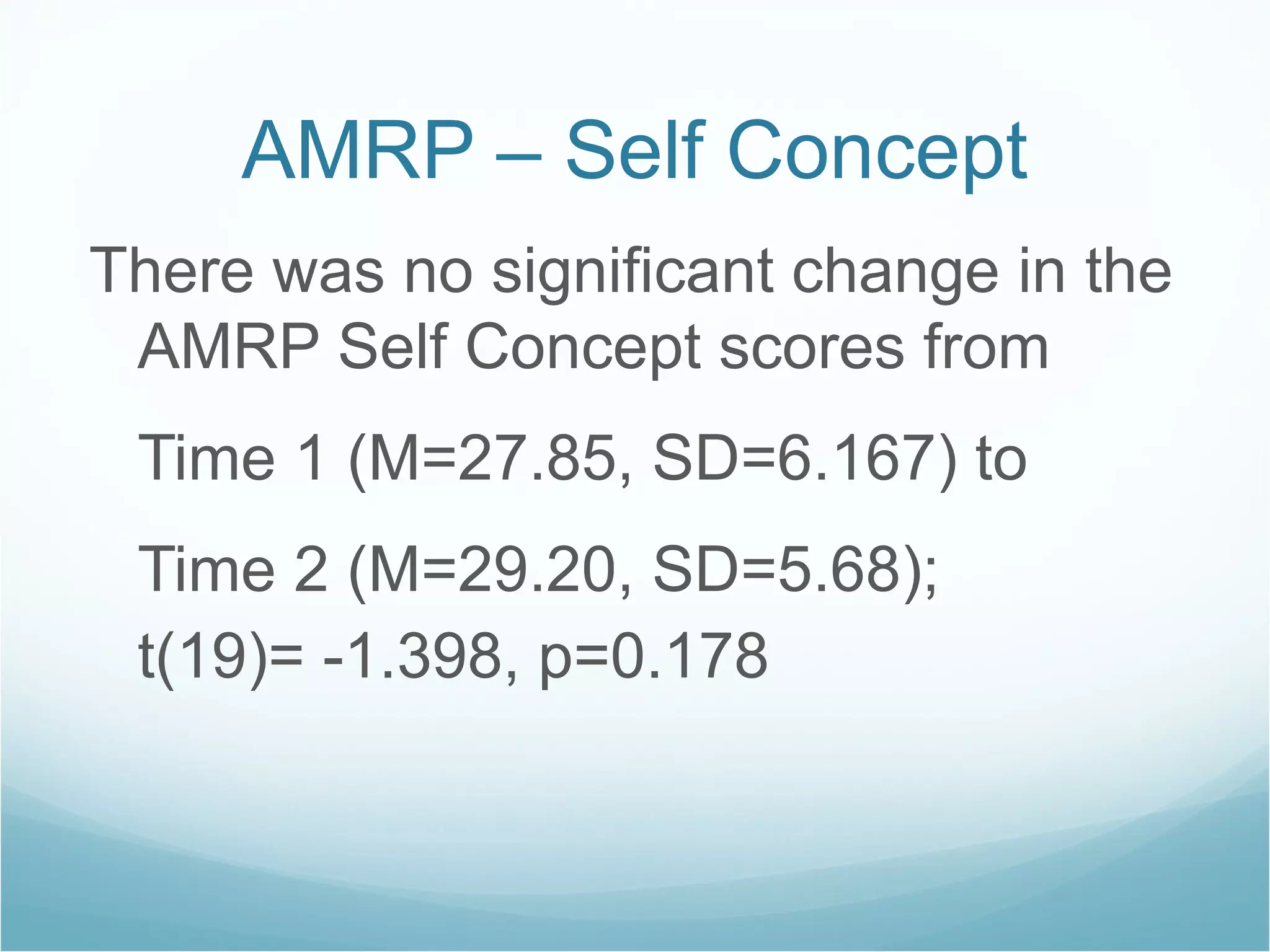
AMRP – Self Concept There was no significant change in the AMRP Self Concept scores from  Time 1 (M=27.85, SD=6.167) to  Time 2 (M=29.20, SD=5.68);  t(19)= -1.398, p=0.178
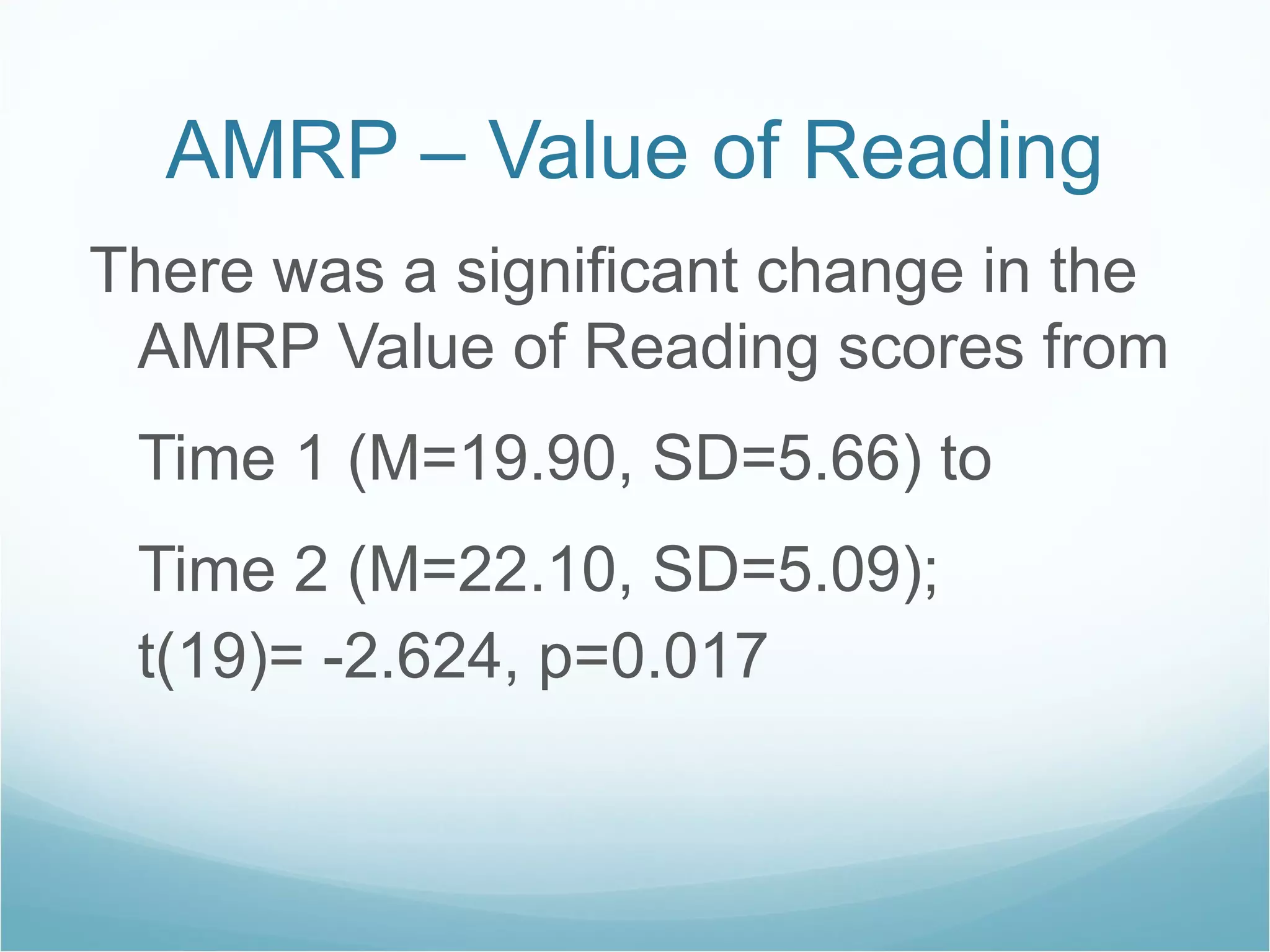
AMRP – Value of Reading There was a significant change in the AMRP Value of Reading scores from  Time 1 (M=19.90, SD=5.66) to  Time 2 (M=22.10, SD=5.09);  t(19)= -2.624, p=0.017
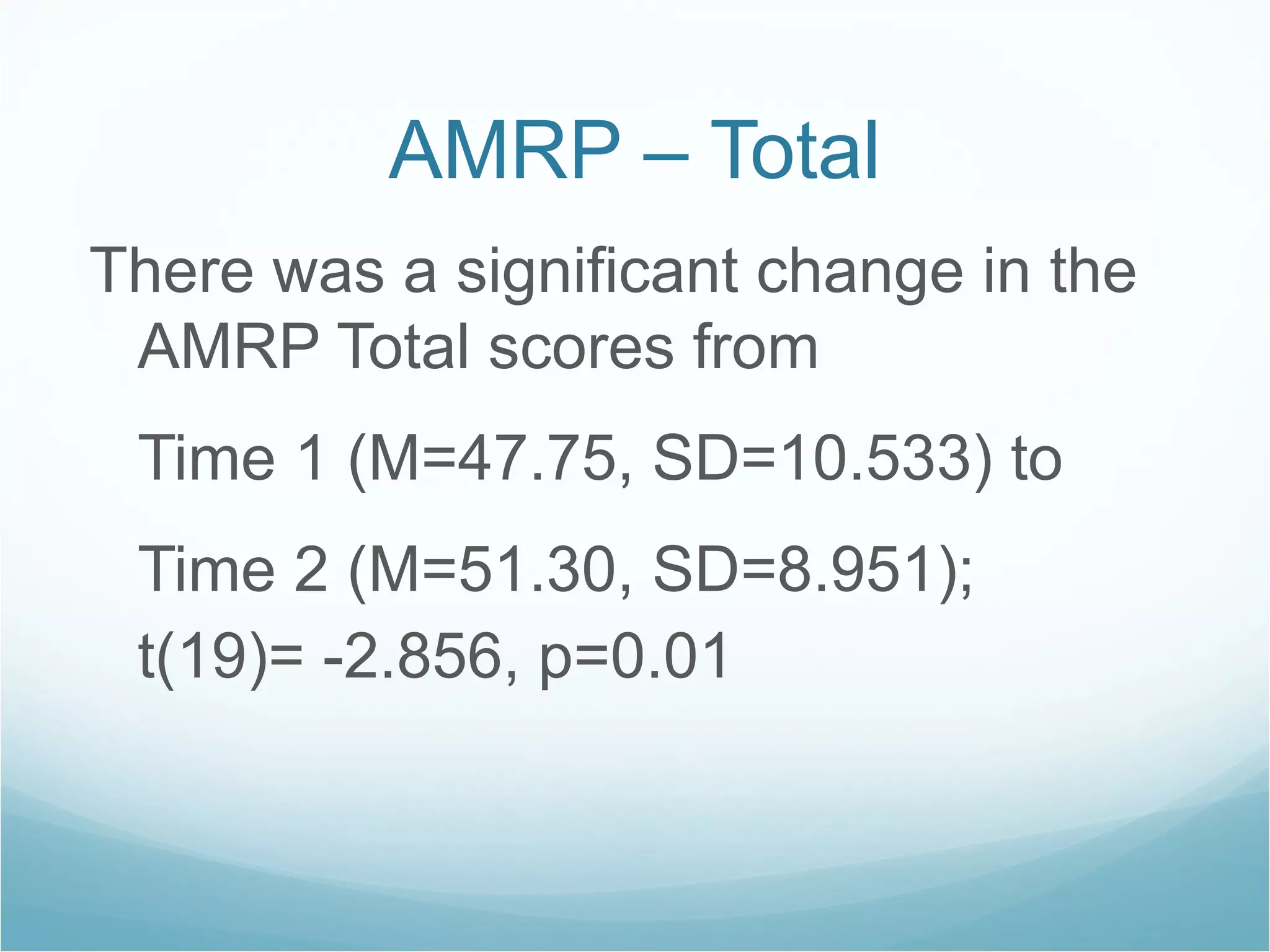
AMRP – Total There was a significant change in the AMRP Total scores from  Time 1 (M=47.75, SD=10.533) to  Time 2 (M=51.30, SD=8.951);  t(19)= -2.856, p=0.01
Questions?
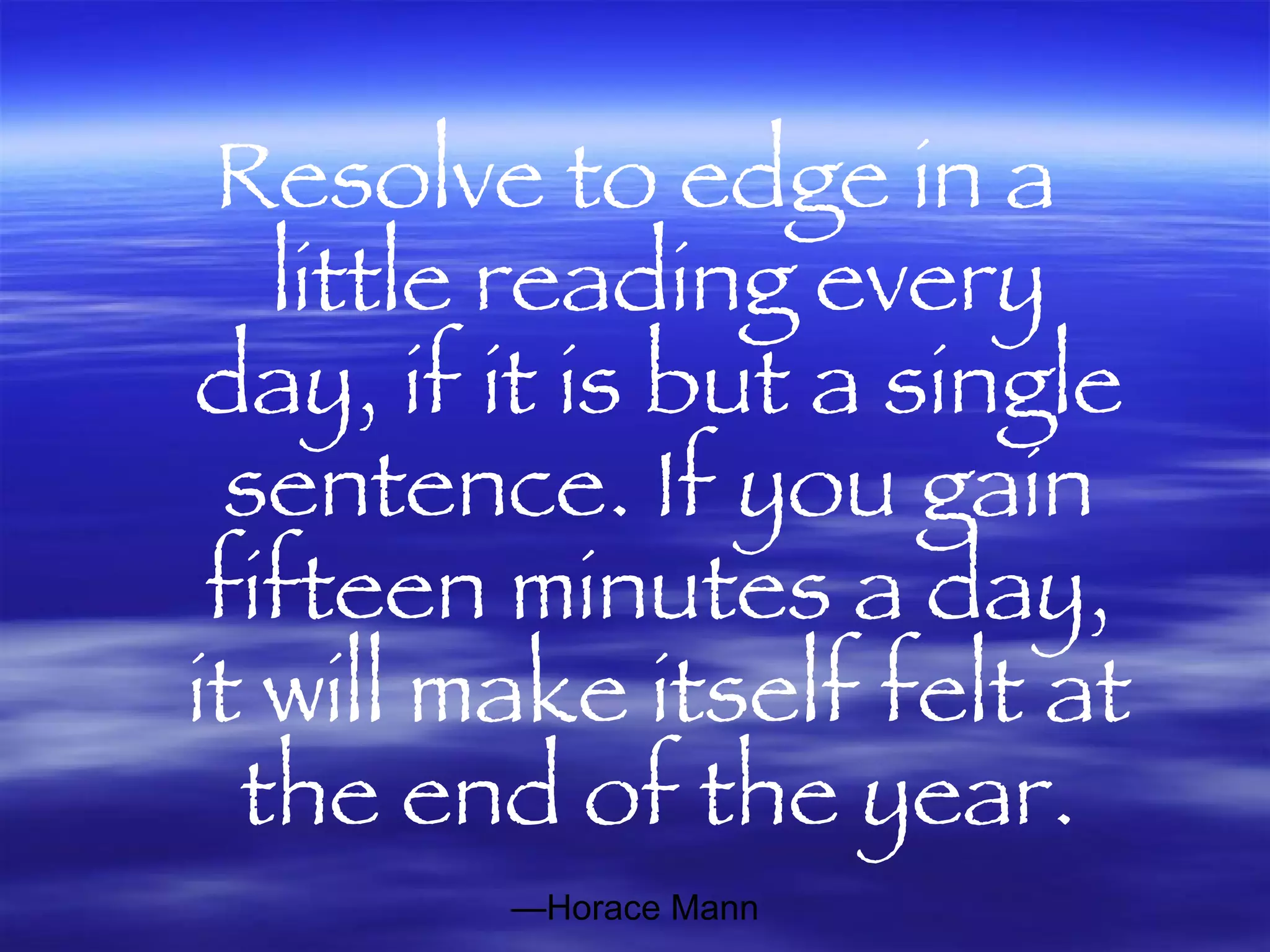
Resolve to edge in a little reading every day, if it is but a single sentence. If you gain fifteen minutes a day, it will make itself felt at the end of the year. — Horace Mann
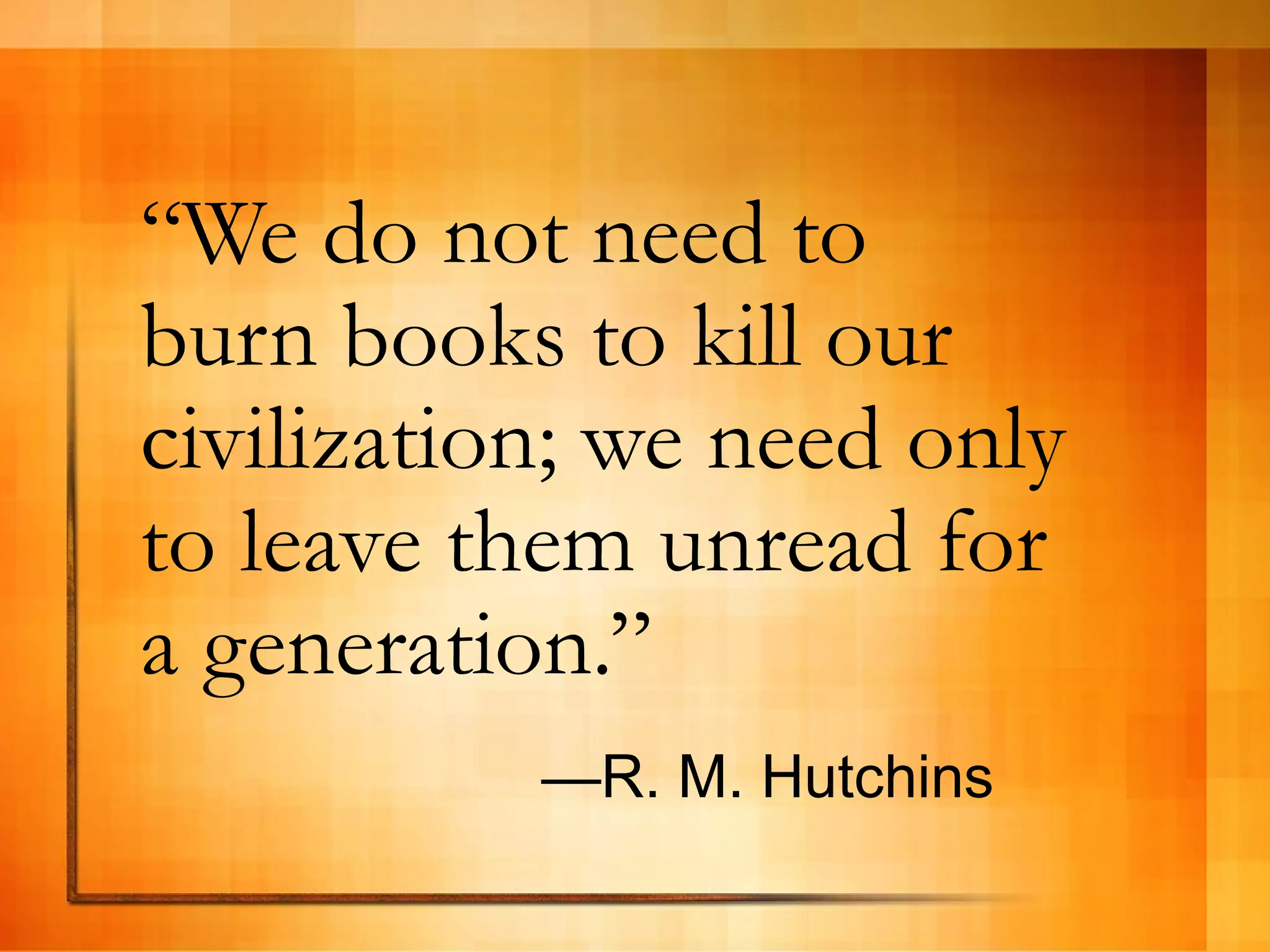
“ We do not need to burn books to kill our civilization; we need only to leave them unread for a generation.” — R. M. Hutchins
We read to know we’re not alone. — C. S. Lewis

HS Sem-R Presentation MLS 2009

  • 1.
    Reading Class WouldBe Boring If I Didn’t Read… Elizabeth Fogarty Brian Housand Patricia Owen John Fogarty Tales From a High School Reading Workshop
  • 2.
    Looking For Handouts?http://brianhousand.googlepages.com
  • 3.
  • 4.
    " I didn'tactually read the book, but I did play the video game loosely based on it."
  • 5.
  • 6.
    Three-Legged Stool Renzulli(1977) Enrichment Triad Model Vygotsky (1962) Zone of Proximal Development National Reading Panel (2000) Need for further research
  • 7.
    Reading Instruction forTalented Readers Reis et al., 2004 Methods of Instructional Differentiation Number and Percentage of Teachers Using the Strategy Use of classroom libraries with advanced, challenging books 3 (25%) Integrated enrichment opportunities 3 (25%) Use of talented readers as role models or group discussion leaders 2 (17%)
  • 8.
    Reading Instruction forTalented Readers Reis et al., 2004 Methods of Instructional Differentiation Number and Percentage of Teachers Using the Strategy Use of technology during reading class 1 (8%) Replacement of Success for All/direct instruction with standard literature program 2 (17%)
  • 9.
    Time Spent Readingin School Study by John Goodlad in A Place Called School Elementary 6% Middle 3% High 2%
  • 10.
    Three Goals ofthe Schoolwide Enrichment Model Reading (SEM-R) To increase enjoyment in reading To encourage students to pursue challenging independent reading To improve reading fluency, reading, and comprehension and increase self regulation in reading--leading to higher reading achievement scores
  • 11.
    Components of theSEM-R Framework Increasing degree of student selection Phase 1 - Exposure Phase 2 - Training & Self-Selected Reading Phase 3 - Interest & Choice Components High-interest books to read aloud Higher-order thinking probing questions Bookmarks for teachers with questions regarding Bloom's Taxonomy, biography, character, illustrations and other topics relevant to the study of literature Training and discussions on Supported Independent Reading Supported Independent Reading One-on-one teacher conferences on reading strategies and instruction Bookmarks for students posing higher-order questions regarding character, plot, setting, considering the story, and other useful topics. Introducing creative thinking Exploring the Internet Genre studies Literary exploration Responding to books Investigation centers Focus on biographies Buddy reading Books on tape Literature circles Creative or expository writing Type III investigations Type I Activities Type II Activities Type II & Type III Investigations
  • 12.
    Pre Post 10% 95% 30-40 minutes of 30-40 minutes of reading a day reading a day
  • 13.
    Phase 1 Highinterest read alouds and higher order questions
  • 14.
    Book Hooks provideenjoyable reading invitations that create positive associations with reading. encouragement for students to do independent reading. Invitations to broad selections of books easily accessible to students. opportunities for a pleasant environment in which to read. invitations to pursue a wide range of interests and knowledge.
  • 15.
  • 16.
    Phase 1 ComponentsRead Aloud Book Selection: Genres Themes Fiction/Nonfiction Book Talks Moving from 15 minutes to 5!!
  • 17.
  • 18.
    Phase 2 SupportedIndependent Reading using individual conferences and differentiated reading instruction
  • 19.
    Individualizing and DifferentiatingConferences It is important to remember that not all students will need the same strategy instruction at the very same time, but that all students need some instruction if they are reading a book that is adequately challenging. For that reason, be sure that strategy instruction is integrated throughout conferences and differentiated to meet the needs of individual students.
  • 20.
    Reading Strategies Paris,2004 Keene & Zimmerman, 1997 Harvey & Goudvis, 2000 Making Connections Making Connections Making Connections Determining Importance Determining Importance Determining Importance Questioning Questioning Questioning Visualizing Visualizing/ Sensory Images Visualizing & Inferring Making Inferences Making Inferences Summarizing Synthesizing Synthesizing Metacognition
  • 21.
    Making Inferences MakingInferences Making Connections (T-W) Knowledge Synthesis Making Connections (T-S)
  • 22.
  • 23.
    Conferences provided: Supportfor each student and differentiated instruction Enthusiasm about books Reading skill development and strategies Interest-based reading opportunities Self-regulation/monitoring Literary skill development Opportunity to assess reading level and book match and find optimal challenge level Opportunities to use higher order thinking skill questions Differentiation for all students in skills, questions, and book selection
  • 24.
    Purpose of aConference Evaluate student’s book selection Comprehension Sophistication of ideas Content Suggest Possibilities Make connections with student interests Provide individualized instruction
  • 25.
    Phase 3 Self-selectedinterest and choice components
  • 26.
    C hoices Explorations nterests I
  • 27.
    Top Strategies ForPhase 3 Books on CD Group Projects Buddy Reading SEM-Xplorations Renzulli Learning Literature Circles Creativity Activities Investigation Centers Independent Projects
  • 28.
    I ndependent ProjectsEnable: students and teachers to identify problems or topics of student interest plan methods to investigate various types of student products problem solve and demonstrate student’s ability to apply methodological skills and knowledge find opportunities for joyful learning and self-regulation
  • 29.
    I ndependent ProjectsBuild on student interest Encourage independence Allow work with complex and abstract ideas Enable long-term and in-depth work on topics of interest Develop task commitment and self-regulation Teach planning and research skills at advanced levels
  • 30.
    Interest and Depthlead to Creative Productivity We need students to get more deeply interested in things, more involved in them, more engaged in wanting to know, to have projects that they can get excited about and work on over long periods of time, to be stimulated to find things out on their own. (Howard Gardner in an interview with R. Brandt, Educational Leadership, 1993)
  • 31.
    Tales From TheClassroom: Experiences with SEM-R
  • 32.
  • 33.
    Participants and SettingThe research site is a high school in rural Cannon Falls, Minnesota. The participating teacher is a 40-year veteran teacher licensed in high school speech, theater, and English, and he was trained to use the SEM-R at a summer institute during the summer of 2008. The participating students are consenting juniors and seniors in a basic reading course.
  • 34.
    Adolescent Motivation toRead Profile : 20 item survey adapted for online use that uses a 4 point scale to measure self concept as a reader and value of reading STAR Reading Test : online test through the Accelerated Reader Company that provides a norm-referenced reading assessment of students’ reading achievement and ability to comprehend Instant Messenger Chats: semi-structured interviews conducted by the researchers using IM accounts created specifically for this project to protect the students’ anonymity with questions that focus on students’ motivation to read, reading habits, and perceptions of reading Teacher Log: weekly reflections written by the participating teacher to document progress and goals throughout the basic reading course
  • 35.
    Data Collection andAnalysis Results from the STAR Test and the AMRP is entered into an SPSS document for analysis Logs of the IM interviews are entered into NVivo for use in qualitative data coding Data analysis allows researchers to identify changes in students’ motivation to read, perceptions of themselves as readers, and overall reading achievement Beginning of Research STAR Reading Test AMRP IM Chats Throughout SEM-R End of Research STAR Reading Test AMRP IM Chats
  • 36.
    STAR Test DataA paired samples t-test was conducted to evaluate the impact of the SEM-R implementation on students’ scores on the STAR Test. There was no significant change in STAR Test scores from Time 1 ( M =964.48, SD =328.70) to Time 2 ( M =933.52, SD =321.16) t (22)=.84, p =.41.
  • 37.
    AMRP Data Apaired samples t-test was conducted to evaluate the impact of the SEM-R implementation on students’ scores on the AMRP.
  • 38.
    AMRP – SelfConcept There was no significant change in the AMRP Self Concept scores from Time 1 (M=27.85, SD=6.167) to Time 2 (M=29.20, SD=5.68); t(19)= -1.398, p=0.178
  • 39.
    AMRP – Valueof Reading There was a significant change in the AMRP Value of Reading scores from Time 1 (M=19.90, SD=5.66) to Time 2 (M=22.10, SD=5.09); t(19)= -2.624, p=0.017
  • 40.
    AMRP – TotalThere was a significant change in the AMRP Total scores from Time 1 (M=47.75, SD=10.533) to Time 2 (M=51.30, SD=8.951); t(19)= -2.856, p=0.01
  • 41.
  • 42.
    Resolve to edgein a little reading every day, if it is but a single sentence. If you gain fifteen minutes a day, it will make itself felt at the end of the year. — Horace Mann
  • 43.
    “ We donot need to burn books to kill our civilization; we need only to leave them unread for a generation.” — R. M. Hutchins
  • 44.
    We read toknow we’re not alone. — C. S. Lewis