Semi-solid
dosage forms
Semi-solid dosage forms
 Semisolid dosage forms: are products which are
applied to skin or mucous membranes for a
therapeutic or protective action or cosmetic
function.
 They may be medicated (containing therapeutic
agents) or non-medicated (used for their physical
effects as protectants , lubricants and emollients).
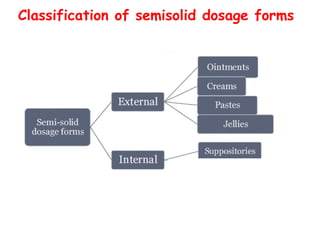
External
Internal
Classification of semisolid dosage forms
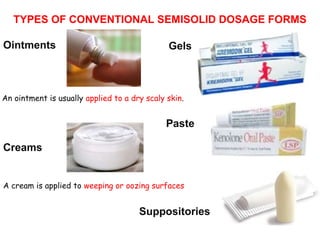
TYPES OF CONVENTIONAL SEMISOLID DOSAGE FORMS
Ointments:
Creams
Gels
Paste
Suppositories
An ointment is usually applied to a dry scaly skin.
A cream is applied to weeping or oozing surfaces
Semi-solid dosage forms
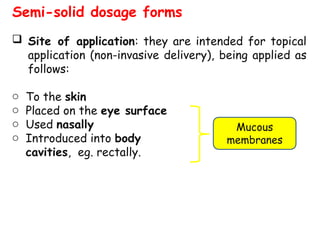
 Site of application: they are intended for topical
application (non-invasive delivery), being applied as
follows:
o To the skin
o Placed on the eye surface
o Used nasally
o Introduced into body
cavities, eg. rectally.
Mucous
membranes
Ideal properties of semi-solid dosage
forms
 Physical properties:
a) Smooth texture
b) Elegant in appearance
c) Non dehydrating
d) Non greasy and non
staining
e) Non hygroscopic
Application properties:
a) Easily applicable with
efficient drug release
b)High aqueous wash-ability
c) Non irritating
d) Miscible with skin secretion
e) Have low sensitization
effect
• It can be used externally
• Probability of side effect is less.
• Local action of the drug on affected area.
• Convenient for unconscious patient
or patient having difficulty on oral administration.
• Suitable dosage form for bitter drugs.
ADVANTAGES OF SEMI SOLID DOSAGE FORMS
DISADVANTAGES OF SEMI SOLID DOSAGE FORMS
• There is no dosage accuracy in this type
of dosage form
• May cause staining.
• They are bulky to handle.
• Application with finger may cause
contamination.
•Physico-chemically less stable than solid
dosage form.
• May cause irritation or allergy to some
patients
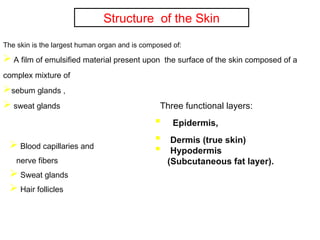
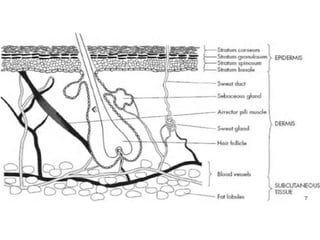
Structure of the Skin
The skin is the largest human organ and is composed of:
 A film of emulsified material present upon the surface of the skin composed of a
complex mixture of
sebum glands ,
 sweat glands Three functional layers:
 Epidermis,
 Dermis (true skin)
 Hypodermis
(Subcutaneous fat layer).
 Blood capillaries and
nerve fibers
 Sweat glands
 Hair follicles
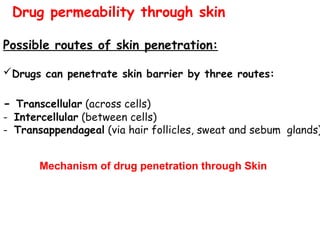
Drug permeability through skin
Possible routes of skin penetration:
Drugs can penetrate skin barrier by three routes:
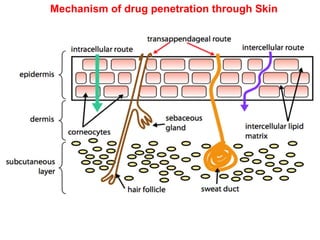
- Transcellular (across cells)
- Intercellular (between cells)
- Transappendageal (via hair follicles, sweat and sebum glands)
Mechanism of drug penetration through Skin
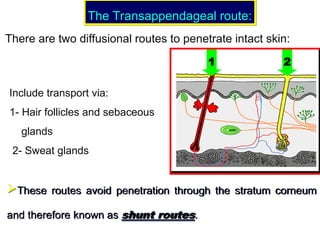
Include transport via:
1- Hair follicles and sebaceous
glands
2- Sweat glands
1 2
These routes avoid penetration through the stratum corneum
and therefore known as shunt routes.
The Transappendageal route:
There are two diffusional routes to penetrate intact skin:
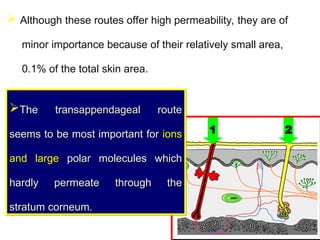
1 2
 Although these routes offer high permeability, they are of
minor importance because of their relatively small area,
0.1% of the total skin area.
The transappendageal route
The transappendageal route
seems to be most important for
seems to be most important for ions
ions
and large
and large polar molecules which
polar molecules which
hardly permeate through the
stratum corneum.
stratum corneum.
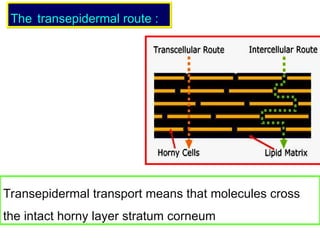
Transepidermal transport means that molecules cross
the intact horny layer stratum corneum
The
The transepidermal route :
transepidermal route :
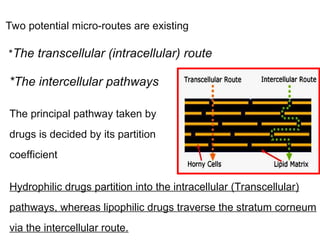
Two potential micro-routes are existing
*The transcellular (intracellular) route
*The intercellular pathways
The principal pathway taken by
drugs is decided by its partition
coefficient
Hydrophilic drugs partition into the intracellular (Transcellular)
pathways, whereas lipophilic drugs traverse the stratum corneum
via the intercellular route.
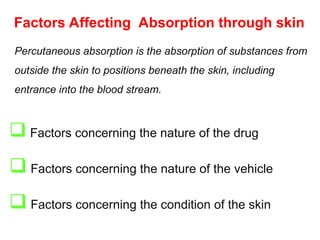
Factors Affecting Absorption through skin
 Factors concerning the nature of the drug
 Factors concerning the nature of the vehicle
 Factors concerning the condition of the skin
Percutaneous absorption is the absorption of substances from
outside the skin to positions beneath the skin, including
entrance into the blood stream.
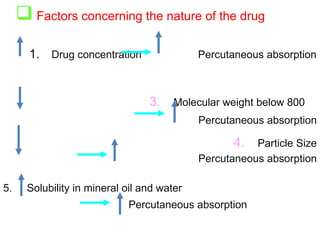
1. Drug concentration Percutaneous absorption
3. Molecular weight below 800
Percutaneous absorption
4. Particle Size
Percutaneous absorption
5. Solubility in mineral oil and water
Percutaneous absorption
 Factors concerning the nature of the drug
1.
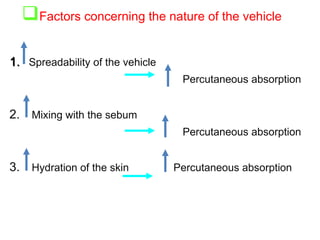
1. Spreadability of the vehicle
Percutaneous absorption
2. Mixing with the sebum
Percutaneous absorption
3. Hydration of the skin Percutaneous absorption
Factors concerning the nature of the vehicle
1.
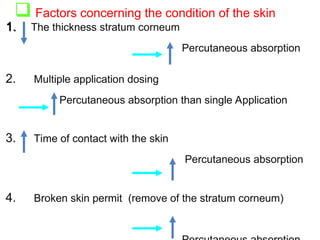
1. The thickness stratum corneum
Percutaneous absorption
2. Multiple application dosing
Percutaneous absorption than single Application
3. Time of contact with the skin
Percutaneous absorption
4. Broken skin permit (remove of the stratum corneum)
 Factors concerning the condition of the skin
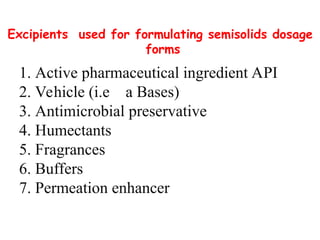
Excipients used for formulating semisolids dosage
forms
1. Active pharmaceutical ingredient API
2. Vehicle (i.e a Bases)
3. Antimicrobial preservative
4. Humectants
5. Fragrances
6. Buffers
7. Permeation enhancer
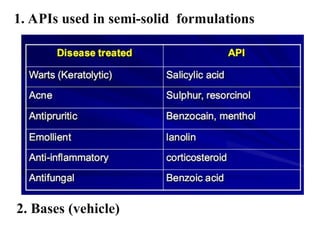
1. APIs used in semi-solid formulations
2. Bases (vehicle)
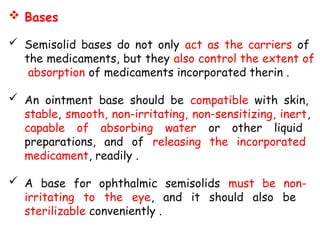
 Bases
 Semisolid bases do not only act as the carriers of
the medicaments, but they also control the extent of
absorption of medicaments incorporated therin .
 An ointment base should be compatible with skin,
stable, smooth, non-irritating, non-sensitizing, inert,
capable of absorbing water or other liquid
preparations, and of releasing the incorporated
medicament, readily .
 A base for ophthalmic semisolids must be non-
irritating to the eye, and it should also be
sterilizable conveniently .
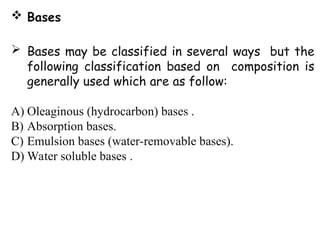
 Bases
 Bases may be classified in several ways but the
following classification based on composition is
generally used which are as follow:
A) Oleaginous (hydrocarbon) bases .
B) Absorption bases.
C) Emulsion bases (water-removable bases).
D) Water soluble bases .
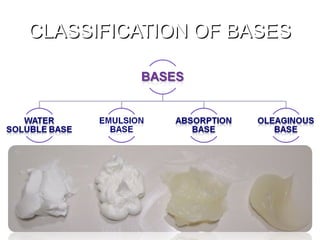
Mainly ointment bases are of following types:
A. Oleaginous (hydrocarbon base).
B. Absorption bases.
C. Water removable bases.
D. Water soluble base
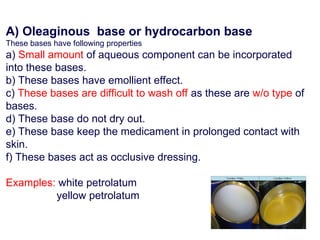
A) Oleaginous base or hydrocarbon base
These bases have following properties
a) Small amount of aqueous component can be incorporated
into these bases.
b) These bases have emollient effect.
c) These bases are difficult to wash off as these are w/o type of
bases.
d) These base do not dry out.
e) These base keep the medicament in prolonged contact with
skin.
f) These bases act as occlusive dressing.
Examples: white petrolatum
yellow petrolatum
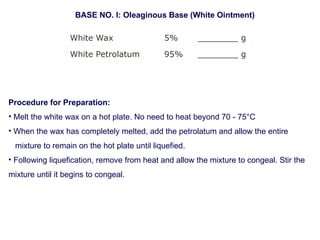
White Wax 5% ________ g
White Petrolatum 95% ________ g
BASE NO. I: Oleaginous Base (White Ointment)
Procedure for Preparation:
• Melt the white wax on a hot plate. No need to heat beyond 70 - 75°C
• When the wax has completely melted, add the petrolatum and allow the entire
mixture to remain on the hot plate until liquefied.
• Following liquefication, remove from heat and allow the mixture to congeal. Stir the
mixture until it begins to congeal.
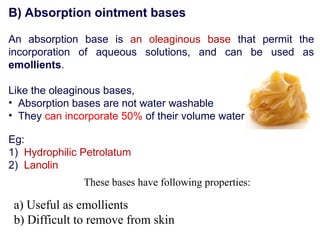
B) Absorption ointment bases
An absorption base is an oleaginous base that permit the
incorporation of aqueous solutions, and can be used as
emollients.
Like the oleaginous bases,
• Absorption bases are not water washable
• They can incorporate 50% of their volume water
Eg:
1) Hydrophilic Petrolatum
2) Lanolin
These bases have following properties:
a) Useful as emollients
b) Difficult to remove from skin
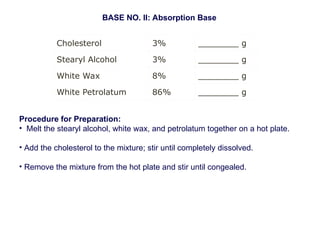
Cholesterol 3% ________ g
Stearyl Alcohol 3% ________ g
White Wax 8% ________ g
White Petrolatum 86% ________ g
BASE NO. II: Absorption Base
Procedure for Preparation:
• Melt the stearyl alcohol, white wax, and petrolatum together on a hot plate.
• Add the cholesterol to the mixture; stir until completely dissolved.
• Remove the mixture from the hot plate and stir until congealed.
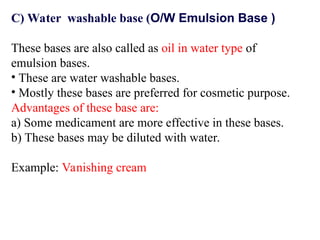
C) Water washable base (O/W Emulsion Base )
These bases are also called as oil in water type of
emulsion bases.
• These are water washable bases.
• Mostly these bases are preferred for cosmetic purpose.
Advantages of these base are:
a) Some medicament are more effective in these bases.
b) These bases may be diluted with water.
Example: Vanishing cream
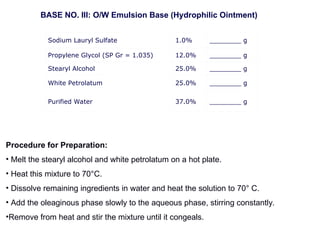
Sodium Lauryl Sulfate 1.0% ________ g
Propylene Glycol (SP Gr = 1.035) 12.0% ________ g
Stearyl Alcohol 25.0% ________ g
White Petrolatum 25.0% ________ g
Purified Water 37.0% ________ g
BASE NO. III: O/W Emulsion Base (Hydrophilic Ointment)
Procedure for Preparation:
• Melt the stearyl alcohol and white petrolatum on a hot plate.
• Heat this mixture to 70°C.
• Dissolve remaining ingredients in water and heat the solution to 70° C.
• Add the oleaginous phase slowly to the aqueous phase, stirring constantly.
•Remove from heat and stir the mixture until it congeals.
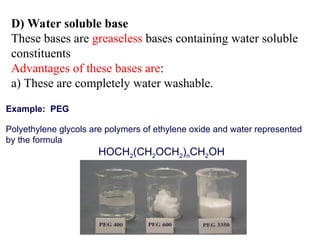
D) Water soluble base
These bases are greaseless bases containing water soluble
constituents
Advantages of these bases are:
a) These are completely water washable.
Example: PEG
Polyethylene glycols are polymers of ethylene oxide and water represented
by the formula
HOCH2(CH2OCH2)nCH2OH
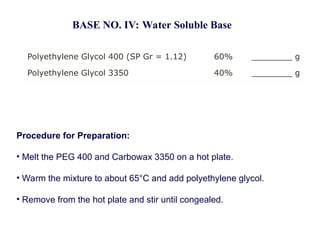
Polyethylene Glycol 400 (SP Gr = 1.12) 60% ________ g
Polyethylene Glycol 3350 40% ________ g
BASE NO. IV: Water Soluble Base
Procedure for Preparation:
• Melt the PEG 400 and Carbowax 3350 on a hot plate.
• Warm the mixture to about 65°C and add polyethylene glycol.
• Remove from the hot plate and stir until congealed.
CLASSIFICATION OF BASES
3. Antimicrobial preservative
Some base, although, resist microbial attack
but because of their high water content, it
require an antimicrobial preservative.
Example: Methyl hydroxyl benzoate,
Propyl- hydroxybenzoate,
Chlorocresol, metacresol
Benzoic acid.
4. Humectants
They are used in semisolids to increase
solubility, skin penetration of active
ingredients and to elevate the hydration of
the skin.
Example: Poly Ethylene Glycol, Glycerol
or Sorbitol is added as humectants
5. Fragrances
They are added for the patient compliance.
Examples :Lavender oil,
Rose oil,
Lemon oil,
Almond oil
6. Gelling agent
Example: Sodium alginate
7. BUFFERS: They are added to make semisolids
preparation compatible with skin, for drug stability and
drug solubility.
Example: Sodium acetate
Penetration enhancer works by reversibly disordering the
lamellar packing of stratum corneum, increasing the
thermodynamic activity of the drug and increasing the
amount of drug in solubilized form at the skin surface.
Example: Limonene, Geraniol
8. Permeation enhancer
METHOD OF PREPARATION OF OINTMENT
Preparation of ointment mainly depend on nature of
ingredients.
Ointments are mainly prepared by two general method:
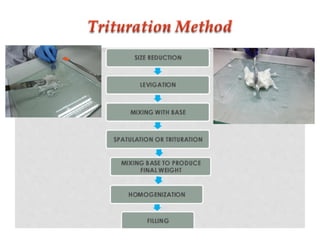
• Incorporation/ Trituration/ Spatulation
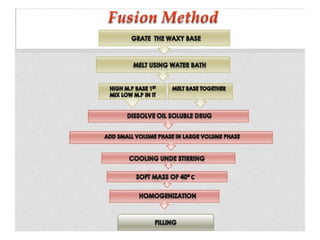
• Fusion
 Examples of medicated ointments:
• Ophthalmic ointments
• Rectal Ointment: it is used for the symptomatic
relief
Medicated ointments primarily consist of a drug
and a vehicle ( a carrier) called a base.
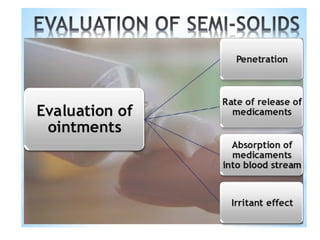
*Penetration-A weighed quantity of ointment is rubbed over
skin for a given period of time and unabsorbed ointment is collected
and weighed. The differences in weights represent the amount
absorbed.
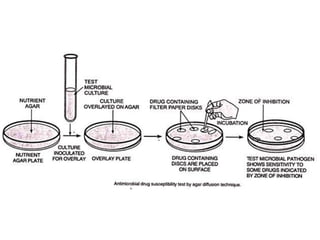
*Rate of release of medicament-To assess rate of
release of medicament, small amount of the ointment can be placed
on the surface of nutrient agar contained in a Petri dish or alternately
in a small cup cut in the agar surface.
If the medicament is bactericidal the agar plate is previously seeded
with a suitable organism like S.aureus. After a suitable period of
incubation, the zone of inhibition is measured and correlated with the
rate of release.
* Absorption of medicament into blood stream
The ointment should be evaluated for the rate of absorption of drug
into the blood stream. This test can be run in-vivo only.
Definite amount of ointments should be rubbed through the skin.
Under standard conditions and medicaments are estimated in the blood
plasma or urine.
*Irritant Effect
The irritant effect can be judged to a certain extent by injecting the
ointment into thigh muscles and under the abdominal skin of rats.
Reaction are noted at intervals of 24,48,72 and 96 hours. Lesions on
cornea, iris, conjunctiva are used for judging the irritancy to the eyes.
Presence of patches on the skin within 2 weeks indicate irritancy.
 Creams
 Semisolid preparations containing one or more
medicinal agents dissolved in either an o/w or w/o
emulsion or in another type of water-washable
base.
 Typically of low viscosity.
 Appears “creamy white” due to the scattering of
light.
 Traditionally, it is the w/o cold cream.
 Currently and most commonly, it is the o/w
emulsion.
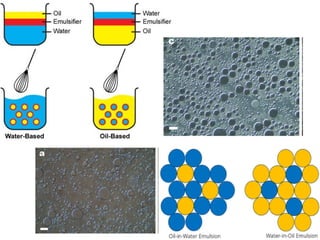
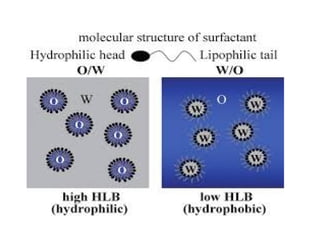
 Oil in Water (O/W) Cream
 Water in Oil (W/O) Cream
 oil-in-water (O/W) creams which are composed of
small droplets of oil dispersed in a continuous phase.
 More comfortable and cosmetically acceptable as they are
less greasy and more easily washed off using water.
 Emulsifying agents of natural origins
(bees wax, wool alcohols, wool fat).
 Emollient and creamy, white or translucent and stiff.
 E.g. Vanishing Cream
 water-in-oil (W/O) creams which are composed of small
droplets of water dispersed in a continuous oily phase.
 More difficult to handle but many drugs which are
incorporated into creams are hydrophobic and will be
released more readily from a W/O cream than an O/W
cream.
 More moisturizing as they provide an oily barrier which
reduces water loss from the stratum corneum, the
outermost layer of the skin.
 e.g. Cold Cream
 They gives prolong contact in their site of application
than any other pharmaceutical semi- solid dosage
forms.
Injured area can be dried quickly by creams than
other semi-solid preparations.
Non-irritating when applied to the skin.
Easily water washable. Easy to wipe away.
Less greasy compared to ointment.
Easy to spread on the skin's surface (i.e. easy to
apply).
 Stability is not as good as ointment.
They are less hydrophobic than other semi- solid
preparation, so risk of contamination is high than
the others.
 It should liquefy at body temperature.
 It shouldpenetrate the epidermis
 Its viscosity should be low enough to permit
easy spreading.
 It should be non-toxic.
 It should be non-irritant.
 It should be non-inflammatory.
• pH of the cream
• Viscosity
 The pH of various formulations was determined by
using digital pH meter.
 About 1gm of the cream was weighed and dissolved
in 100 ml of distilled water and stored for two hours.
 The measurement of pH of each formulation was
done in triplicate and average values were
calculated.
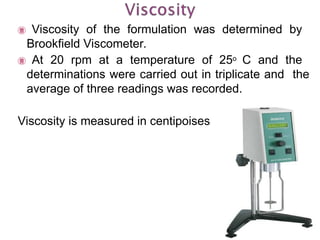
 Viscosity of the formulation was determined by
Brookfield Viscometer.
 At 20 rpm at a temperature of 25o C and the
determinations were carried out in triplicate and the
average of three readings was recorded.
Viscosity is measured in centipoises
 Globule size
 Phase separation
 Moisture absorption studies
 Spreadability
1 ml of cream was diluted to 10 ml
with glycerin.
Afew drops of this were
transferred onto a glass slide and was
focused in a microscope.
 By using eyepiece micrometer, the diameters of
200 particles were determined randomly.
The formulated cream was kept intact in a closed
container at 25 - 300C not exposed to light.
Phase separation was observed carefully every
24 hrs for 30 days.
Any change in phase separation was checked.
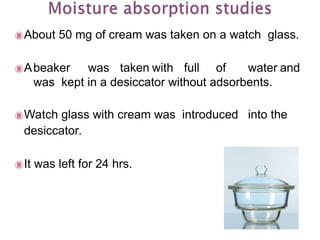
About 50 mg of cream was taken on a watch glass.
Abeaker was taken with full of water and
was kept in a desiccator without adsorbents.
Watch glass with cream was introduced into the
desiccator.
It was left for 24 hrs.
The Spreadability was expressed in terms of
time in seconds.
Take two slides to slip off from the cream, placed in
between the slides, under certain load.
Lesser the time taken for separation of the two slides,
better the Spreadability.
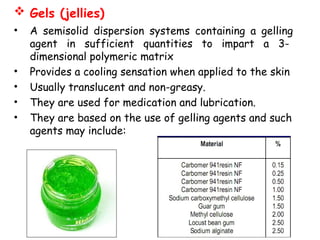
 Gels (jellies)
• A semisolid dispersion systems containing a gelling
agent in sufficient quantities to impart a 3-
dimensional polymeric matrix
• Provides a cooling sensation when applied to the skin
• Usually translucent and non-greasy.
• They are used for medication and lubrication.
• They are based on the use of gelling agents and such
agents may include:
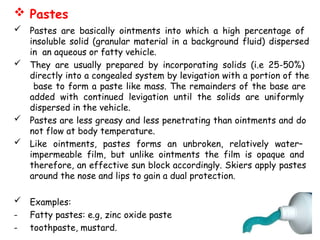
 Pastes
 Pastes are basically ointments into which a high percentage of
insoluble solid (granular material in a background fluid) dispersed
in an aqueous or fatty vehicle.
 They are usually prepared by incorporating solids (i.e 25-50%)
directly into a congealed system by levigation with a portion of the
base to form a paste like mass. The remainders of the base are
added with continued levigation until the solids are uniformly
dispersed in the vehicle.
 Pastes are less greasy and less penetrating than ointments and do
not flow at body temperature.
 Like ointments, pastes forms an unbroken, relatively water–
impermeable film, but unlike ointments the film is opaque and
therefore, an effective sun block accordingly. Skiers apply pastes
around the nose and lips to gain a dual protection.
 Examples:
- Fatty pastes: e.g, zinc oxide paste
- toothpaste, mustard.

AKD Class notes -semi solid dosage forms.ppt

  • 1.
  • 2.
    Semi-solid dosage forms Semisolid dosage forms: are products which are applied to skin or mucous membranes for a therapeutic or protective action or cosmetic function.  They may be medicated (containing therapeutic agents) or non-medicated (used for their physical effects as protectants , lubricants and emollients).
  • 3.
  • 4.
    TYPES OF CONVENTIONALSEMISOLID DOSAGE FORMS Ointments: Creams Gels Paste Suppositories An ointment is usually applied to a dry scaly skin. A cream is applied to weeping or oozing surfaces
  • 5.
    Semi-solid dosage forms Site of application: they are intended for topical application (non-invasive delivery), being applied as follows: o To the skin o Placed on the eye surface o Used nasally o Introduced into body cavities, eg. rectally. Mucous membranes
  • 6.
    Ideal properties ofsemi-solid dosage forms  Physical properties: a) Smooth texture b) Elegant in appearance c) Non dehydrating d) Non greasy and non staining e) Non hygroscopic Application properties: a) Easily applicable with efficient drug release b)High aqueous wash-ability c) Non irritating d) Miscible with skin secretion e) Have low sensitization effect
  • 7.
    • It canbe used externally • Probability of side effect is less. • Local action of the drug on affected area. • Convenient for unconscious patient or patient having difficulty on oral administration. • Suitable dosage form for bitter drugs. ADVANTAGES OF SEMI SOLID DOSAGE FORMS
  • 8.
    DISADVANTAGES OF SEMISOLID DOSAGE FORMS • There is no dosage accuracy in this type of dosage form • May cause staining. • They are bulky to handle. • Application with finger may cause contamination. •Physico-chemically less stable than solid dosage form. • May cause irritation or allergy to some patients
  • 9.
    Structure of theSkin The skin is the largest human organ and is composed of:  A film of emulsified material present upon the surface of the skin composed of a complex mixture of sebum glands ,  sweat glands Three functional layers:  Epidermis,  Dermis (true skin)  Hypodermis (Subcutaneous fat layer).  Blood capillaries and nerve fibers  Sweat glands  Hair follicles
  • 11.
    Drug permeability throughskin Possible routes of skin penetration: Drugs can penetrate skin barrier by three routes: - Transcellular (across cells) - Intercellular (between cells) - Transappendageal (via hair follicles, sweat and sebum glands) Mechanism of drug penetration through Skin
  • 12.
    Mechanism of drugpenetration through Skin
  • 13.
    Include transport via: 1-Hair follicles and sebaceous glands 2- Sweat glands 1 2 These routes avoid penetration through the stratum corneum and therefore known as shunt routes. The Transappendageal route: The Transappendageal route: There are two diffusional routes to penetrate intact skin:
  • 14.
    1 2  Althoughthese routes offer high permeability, they are of minor importance because of their relatively small area, 0.1% of the total skin area. The transappendageal route The transappendageal route seems to be most important for seems to be most important for ions ions and large and large polar molecules which polar molecules which hardly permeate through the hardly permeate through the stratum corneum. stratum corneum.
  • 15.
    Transepidermal transport meansthat molecules cross the intact horny layer stratum corneum The The transepidermal route : transepidermal route :
  • 16.
    Two potential micro-routesare existing *The transcellular (intracellular) route *The intercellular pathways The principal pathway taken by drugs is decided by its partition coefficient Hydrophilic drugs partition into the intracellular (Transcellular) pathways, whereas lipophilic drugs traverse the stratum corneum via the intercellular route.
  • 17.
    Factors Affecting Absorptionthrough skin  Factors concerning the nature of the drug  Factors concerning the nature of the vehicle  Factors concerning the condition of the skin Percutaneous absorption is the absorption of substances from outside the skin to positions beneath the skin, including entrance into the blood stream.
  • 18.
    1. Drug concentrationPercutaneous absorption 3. Molecular weight below 800 Percutaneous absorption 4. Particle Size Percutaneous absorption 5. Solubility in mineral oil and water Percutaneous absorption  Factors concerning the nature of the drug
  • 19.
    1. 1. Spreadability ofthe vehicle Percutaneous absorption 2. Mixing with the sebum Percutaneous absorption 3. Hydration of the skin Percutaneous absorption Factors concerning the nature of the vehicle
  • 20.
    1. 1. The thicknessstratum corneum Percutaneous absorption 2. Multiple application dosing Percutaneous absorption than single Application 3. Time of contact with the skin Percutaneous absorption 4. Broken skin permit (remove of the stratum corneum)  Factors concerning the condition of the skin
  • 21.
    Excipients used forformulating semisolids dosage forms 1. Active pharmaceutical ingredient API 2. Vehicle (i.e a Bases) 3. Antimicrobial preservative 4. Humectants 5. Fragrances 6. Buffers 7. Permeation enhancer
  • 22.
    1. APIs usedin semi-solid formulations 2. Bases (vehicle)
  • 23.
     Bases  Semisolidbases do not only act as the carriers of the medicaments, but they also control the extent of absorption of medicaments incorporated therin .  An ointment base should be compatible with skin, stable, smooth, non-irritating, non-sensitizing, inert, capable of absorbing water or other liquid preparations, and of releasing the incorporated medicament, readily .  A base for ophthalmic semisolids must be non- irritating to the eye, and it should also be sterilizable conveniently .
  • 24.
     Bases  Basesmay be classified in several ways but the following classification based on composition is generally used which are as follow: A) Oleaginous (hydrocarbon) bases . B) Absorption bases. C) Emulsion bases (water-removable bases). D) Water soluble bases .
  • 25.
    Mainly ointment basesare of following types: A. Oleaginous (hydrocarbon base). B. Absorption bases. C. Water removable bases. D. Water soluble base
  • 28.
    A) Oleaginous baseor hydrocarbon base These bases have following properties a) Small amount of aqueous component can be incorporated into these bases. b) These bases have emollient effect. c) These bases are difficult to wash off as these are w/o type of bases. d) These base do not dry out. e) These base keep the medicament in prolonged contact with skin. f) These bases act as occlusive dressing. Examples: white petrolatum yellow petrolatum
  • 29.
    White Wax 5%________ g White Petrolatum 95% ________ g BASE NO. I: Oleaginous Base (White Ointment) Procedure for Preparation: • Melt the white wax on a hot plate. No need to heat beyond 70 - 75°C • When the wax has completely melted, add the petrolatum and allow the entire mixture to remain on the hot plate until liquefied. • Following liquefication, remove from heat and allow the mixture to congeal. Stir the mixture until it begins to congeal.
  • 30.
    B) Absorption ointmentbases An absorption base is an oleaginous base that permit the incorporation of aqueous solutions, and can be used as emollients. Like the oleaginous bases, • Absorption bases are not water washable • They can incorporate 50% of their volume water Eg: 1) Hydrophilic Petrolatum 2) Lanolin These bases have following properties: a) Useful as emollients b) Difficult to remove from skin
  • 31.
    Cholesterol 3% ________g Stearyl Alcohol 3% ________ g White Wax 8% ________ g White Petrolatum 86% ________ g BASE NO. II: Absorption Base Procedure for Preparation: • Melt the stearyl alcohol, white wax, and petrolatum together on a hot plate. • Add the cholesterol to the mixture; stir until completely dissolved. • Remove the mixture from the hot plate and stir until congealed.
  • 32.
    C) Water washablebase (O/W Emulsion Base ) These bases are also called as oil in water type of emulsion bases. • These are water washable bases. • Mostly these bases are preferred for cosmetic purpose. Advantages of these base are: a) Some medicament are more effective in these bases. b) These bases may be diluted with water. Example: Vanishing cream
  • 33.
    Sodium Lauryl Sulfate1.0% ________ g Propylene Glycol (SP Gr = 1.035) 12.0% ________ g Stearyl Alcohol 25.0% ________ g White Petrolatum 25.0% ________ g Purified Water 37.0% ________ g BASE NO. III: O/W Emulsion Base (Hydrophilic Ointment) Procedure for Preparation: • Melt the stearyl alcohol and white petrolatum on a hot plate. • Heat this mixture to 70°C. • Dissolve remaining ingredients in water and heat the solution to 70° C. • Add the oleaginous phase slowly to the aqueous phase, stirring constantly. •Remove from heat and stir the mixture until it congeals.
  • 34.
    D) Water solublebase These bases are greaseless bases containing water soluble constituents Advantages of these bases are: a) These are completely water washable. Example: PEG Polyethylene glycols are polymers of ethylene oxide and water represented by the formula HOCH2(CH2OCH2)nCH2OH
  • 35.
    Polyethylene Glycol 400(SP Gr = 1.12) 60% ________ g Polyethylene Glycol 3350 40% ________ g BASE NO. IV: Water Soluble Base Procedure for Preparation: • Melt the PEG 400 and Carbowax 3350 on a hot plate. • Warm the mixture to about 65°C and add polyethylene glycol. • Remove from the hot plate and stir until congealed.
  • 36.
  • 37.
    3. Antimicrobial preservative Somebase, although, resist microbial attack but because of their high water content, it require an antimicrobial preservative. Example: Methyl hydroxyl benzoate, Propyl- hydroxybenzoate, Chlorocresol, metacresol Benzoic acid.
  • 38.
    4. Humectants They areused in semisolids to increase solubility, skin penetration of active ingredients and to elevate the hydration of the skin. Example: Poly Ethylene Glycol, Glycerol or Sorbitol is added as humectants
  • 39.
    5. Fragrances They areadded for the patient compliance. Examples :Lavender oil, Rose oil, Lemon oil, Almond oil 6. Gelling agent Example: Sodium alginate 7. BUFFERS: They are added to make semisolids preparation compatible with skin, for drug stability and drug solubility. Example: Sodium acetate
  • 40.
    Penetration enhancer worksby reversibly disordering the lamellar packing of stratum corneum, increasing the thermodynamic activity of the drug and increasing the amount of drug in solubilized form at the skin surface. Example: Limonene, Geraniol 8. Permeation enhancer
  • 41.
    METHOD OF PREPARATIONOF OINTMENT Preparation of ointment mainly depend on nature of ingredients. Ointments are mainly prepared by two general method: • Incorporation/ Trituration/ Spatulation • Fusion
  • 44.
     Examples ofmedicated ointments: • Ophthalmic ointments • Rectal Ointment: it is used for the symptomatic relief Medicated ointments primarily consist of a drug and a vehicle ( a carrier) called a base.
  • 46.
    *Penetration-A weighed quantityof ointment is rubbed over skin for a given period of time and unabsorbed ointment is collected and weighed. The differences in weights represent the amount absorbed. *Rate of release of medicament-To assess rate of release of medicament, small amount of the ointment can be placed on the surface of nutrient agar contained in a Petri dish or alternately in a small cup cut in the agar surface. If the medicament is bactericidal the agar plate is previously seeded with a suitable organism like S.aureus. After a suitable period of incubation, the zone of inhibition is measured and correlated with the rate of release.
  • 48.
    * Absorption ofmedicament into blood stream The ointment should be evaluated for the rate of absorption of drug into the blood stream. This test can be run in-vivo only. Definite amount of ointments should be rubbed through the skin. Under standard conditions and medicaments are estimated in the blood plasma or urine. *Irritant Effect The irritant effect can be judged to a certain extent by injecting the ointment into thigh muscles and under the abdominal skin of rats. Reaction are noted at intervals of 24,48,72 and 96 hours. Lesions on cornea, iris, conjunctiva are used for judging the irritancy to the eyes. Presence of patches on the skin within 2 weeks indicate irritancy.
  • 49.
     Creams  Semisolidpreparations containing one or more medicinal agents dissolved in either an o/w or w/o emulsion or in another type of water-washable base.  Typically of low viscosity.  Appears “creamy white” due to the scattering of light.  Traditionally, it is the w/o cold cream.  Currently and most commonly, it is the o/w emulsion.
  • 50.
     Oil inWater (O/W) Cream  Water in Oil (W/O) Cream
  • 51.
     oil-in-water (O/W)creams which are composed of small droplets of oil dispersed in a continuous phase.  More comfortable and cosmetically acceptable as they are less greasy and more easily washed off using water.  Emulsifying agents of natural origins (bees wax, wool alcohols, wool fat).  Emollient and creamy, white or translucent and stiff.  E.g. Vanishing Cream
  • 52.
     water-in-oil (W/O)creams which are composed of small droplets of water dispersed in a continuous oily phase.  More difficult to handle but many drugs which are incorporated into creams are hydrophobic and will be released more readily from a W/O cream than an O/W cream.  More moisturizing as they provide an oily barrier which reduces water loss from the stratum corneum, the outermost layer of the skin.  e.g. Cold Cream
  • 53.
     They givesprolong contact in their site of application than any other pharmaceutical semi- solid dosage forms. Injured area can be dried quickly by creams than other semi-solid preparations. Non-irritating when applied to the skin. Easily water washable. Easy to wipe away. Less greasy compared to ointment. Easy to spread on the skin's surface (i.e. easy to apply).
  • 54.
     Stability isnot as good as ointment. They are less hydrophobic than other semi- solid preparation, so risk of contamination is high than the others.
  • 55.
     It shouldliquefy at body temperature.  It shouldpenetrate the epidermis  Its viscosity should be low enough to permit easy spreading.  It should be non-toxic.  It should be non-irritant.  It should be non-inflammatory.
  • 56.
    • pH ofthe cream • Viscosity
  • 57.
     The pHof various formulations was determined by using digital pH meter.  About 1gm of the cream was weighed and dissolved in 100 ml of distilled water and stored for two hours.  The measurement of pH of each formulation was done in triplicate and average values were calculated.
  • 58.
     Viscosity ofthe formulation was determined by Brookfield Viscometer.  At 20 rpm at a temperature of 25o C and the determinations were carried out in triplicate and the average of three readings was recorded. Viscosity is measured in centipoises
  • 59.
     Globule size Phase separation  Moisture absorption studies  Spreadability
  • 60.
    1 ml ofcream was diluted to 10 ml with glycerin. Afew drops of this were transferred onto a glass slide and was focused in a microscope.  By using eyepiece micrometer, the diameters of 200 particles were determined randomly.
  • 61.
    The formulated creamwas kept intact in a closed container at 25 - 300C not exposed to light. Phase separation was observed carefully every 24 hrs for 30 days. Any change in phase separation was checked.
  • 62.
    About 50 mgof cream was taken on a watch glass. Abeaker was taken with full of water and was kept in a desiccator without adsorbents. Watch glass with cream was introduced into the desiccator. It was left for 24 hrs.
  • 63.
    The Spreadability wasexpressed in terms of time in seconds. Take two slides to slip off from the cream, placed in between the slides, under certain load. Lesser the time taken for separation of the two slides, better the Spreadability.
  • 64.
     Gels (jellies) •A semisolid dispersion systems containing a gelling agent in sufficient quantities to impart a 3- dimensional polymeric matrix • Provides a cooling sensation when applied to the skin • Usually translucent and non-greasy. • They are used for medication and lubrication. • They are based on the use of gelling agents and such agents may include:
  • 65.
     Pastes  Pastesare basically ointments into which a high percentage of insoluble solid (granular material in a background fluid) dispersed in an aqueous or fatty vehicle.  They are usually prepared by incorporating solids (i.e 25-50%) directly into a congealed system by levigation with a portion of the base to form a paste like mass. The remainders of the base are added with continued levigation until the solids are uniformly dispersed in the vehicle.  Pastes are less greasy and less penetrating than ointments and do not flow at body temperature.  Like ointments, pastes forms an unbroken, relatively water– impermeable film, but unlike ointments the film is opaque and therefore, an effective sun block accordingly. Skiers apply pastes around the nose and lips to gain a dual protection.  Examples: - Fatty pastes: e.g, zinc oxide paste - toothpaste, mustard.