SEMISOLID DOSAGE
FORMS
PreparedBy:
Dr. Jigar Vyas
Professor
Sigma Institute of Pharmacy
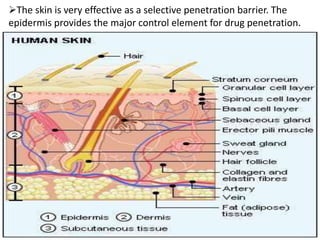
๏ƒ˜The skin is very effective as a selective penetration barrier. The
epidermis provides the major control element for drug penetration.
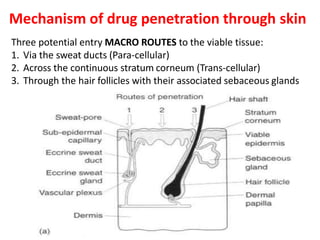
Mechanism of drug penetration through skin
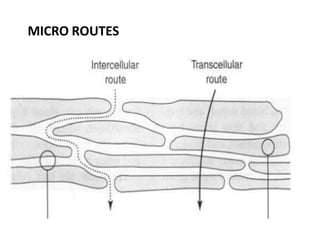
Three potential entry MACRO ROUTES to the viable tissue:
1. Via the sweat ducts (Para-cellular)
2. Across the continuous stratum corneum (Trans-cellular)
3. Through the hair follicles with their associated sebaceous glands
MICRO ROUTES
๏ƒ˜Low molecular weight molecules penetrate through stratum conium
to some extent.
๏ƒ˜Skin appendages are main route for Electrolytes, polar steroids,
antibiotics and colloidal particles.
๏ƒ˜Particles of 3-10 ยต penetrate through hair follicle and particles less
than 3ยต penetrate through stratum conium.
๏ƒ˜Hair follicle route may be important for ions and large polar
molecules.
๏ƒ˜Topically applied agents such as steroids, hexachlorophane,
griseofulvin, sodium fusidate and fusidic acid may form a depot or
reservoir by binding within the stratum corneum.
Once drug permeates through horny layer it readily enters living tissue
and systemic circulation.
๏ƒ˜The average residence time of drug in dermis may be 1 min before it
is washed away by blood.
๏ƒ˜NSAIDS reach far down to muscles to form depots.
Factors influencing dermal penetration of drugs
I. Biological factors:
1. Skin condition
2. Skin age
3. Blood flow
4. Regional skin site
5. Skin metabolism
6. Species difference.
II. Physicochemical
factors:
1.Skin hydration
2.Temperature and pH
3.Diffusion coefficient
4.Drug concentration
5.Partition coefficient
6.Molecular size and
shape.
BIOLOGICAL FACTORS:
1. Skin condition
๏ƒ˜The intact, healthy skin is a tough barrier but acids and alkalis
injure barrier cells and thereby promote penetration.
๏ƒ˜Mixtures of non-polar and polar solvents, such as chloroform and
methanol, remove the lipid fraction and molecules pass more easily.
๏ƒ˜Disease alters skin condition, skin inflamed, with loss of stratum
corneum thus permeability increases.
๏ƒ˜If organ thickened, with corns, calluses and warts, drug permeation
decrease.
2. Skin age
๏ƒ˜Skin of the young and the elderly is more permeable than adult
tissue.
๏ƒ˜Children are more susceptible to the toxic effects of drugs and
chemicals, because of their greater surface area per unit body
weight; thus potent topical steroids, Causes severe side-effects and
death.
3.Blood flow:
๏ƒ˜An increased blood f;low could reduce the amount of time a
penetrant remains in the dermis, and also raise the concentration
gradient across the skin.
๏ƒ˜In clinically hyperaemic disease damages the skin barrier and
increase absorption.
4. Regional skin sites :
๏ƒ˜Variations in permeability depend on the thickness and nature of
the stratum corneum and the density of skin appendages.
๏ƒ˜Absorption changes with substance, volunteer and site.
๏ƒ˜Permeabilities depend on thickness of stratum corneum and the
overall thickness of the tissue.
๏ƒ˜Plantar and palmar callus may be 400-600 ยตm thick compared to
10-20 ยตm for other sites.
๏ƒ˜The hyoscine Transderm system employs in postauricular skin (i.e.
behind the ear) because the layers of stratum corneum are thinner
๏ƒ˜Facial skin in general is more permeable than other body sites
5. Skin metabolism:
๏ƒ˜The skin metabolizes steroid hormones, chemical carcinogens and
some drugs.
๏ƒ˜This is advantage to prodrugs.
๏ƒ˜Skin can metabolize 5% of topical drugs.
6. Species differences:
๏ƒ˜Mice, rats and rabbits are used to assess percutaneous absorption,
but their skins have more hair follicles than human skin and they
lack sweat glands.
๏ƒ˜Hairless mouse, monkey and pig skins are most like that of
humans.
๏ƒ˜Hairless rat and fuzzy guinea pig may be better models for
humans.
๏ƒ˜To obtain skin penetration data it is best to use human skin
Physicochemical factors
1. Skin hydration:
๏ƒ˜When water saturates the skin the tissue swells, softens and wrinkles
and hydration of the stratum corneum increases permeability.
๏ƒ˜Dusting powders or lotions, provide a large surface area for
evaporation and therefore dry the skin
2. Temperature and pH:
๏ƒ˜The penetration rate of material through human skin can change
tenfold for a large temperature variation.
๏ƒ˜Occlusive vehicles increase skin temperature and increase
permeability.
๏ƒ˜According to pH-partition hypothesis, only unionized molecules pass
readily across lipid membranes.
๏ƒ˜Weak acids and bases dissociate to different degrees, depending on
the pH and their PKa or Pkb values.
๏ƒ˜Stratum corneum is resistant to alterations in pH, range of 3-9.
3. Diffusion coefficient:
๏ƒ˜The diffusional speed of a molecule depends mainly on the state of
matter of the medium.
๏ƒ˜In gases, diffusion coefficients are large than liquids
๏ƒ˜In skin, the diffusivities reach their lowest values within the
compacted stratum corneum matrix.
๏ƒ˜The diffusion coefficient of a drug in a topical vehicle depends on
the properties of the drug and the diffusion medium and on the
interaction between them.
4. Drug concentration:
๏ƒ˜Drug permeation and flux of solute is proportional to the
concentration gradient across the barrier.
๏ƒ˜drug permeation follows Fick's law, saturated donor solution gives
maximum flux.
๏ƒ˜pH change, complex formation, or the presence of surfactants,
micelles or cosolvents modify the effective partition coefficient
5. Partition coefficient(K):
๏ƒ˜The partition coefficient is important in establishing the flux of a
drug through the stratum corneum.
๏ƒ˜Drug (K<1) are water soluble, (K>1) are oil soluble.
๏ƒ˜Polar cosolvent mixtures, such as propylene glycol with water,
produce saturated drug solutions and maximize the concentration
gradient across the stratum corneum.
๏ƒ˜Surfactants disruption of intercellular lipid packing in the stratum
corneum, act as penetration Enhancers.
๏ƒ˜Complex formation of drug increases the apparent partition
coefficient may promote drug absorption.
6. Molecular size and shape:
๏ƒ˜Absorption is apparently inversely related to molecular weight.
๏ƒ˜Small molecules penetrate faster than large ones.
๏ƒ˜It is more difficult to determine the effect of molecular shape, as it
is related to partition coefficient.
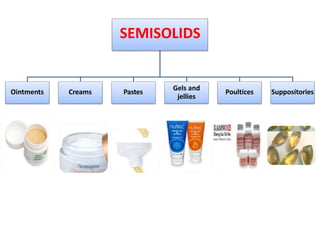
SEMISOLIDS
Ointments Creams Pastes
Gels and
jellies
Poultices Suppositories
Definitions:
1.OINTMENT: these are semi solid preparations meant for
external application to the skin/ mucous membrane.
2.PASTE: these are semisolid preparations intended for external
application to skin.
3.CREAM: these are viscous semisolid emulsions meant for
external use.
4.GELS: these are semisolid dispersion systems which may contain
suspension of either small /large organic molecules dispersed in a
suitable liquid.
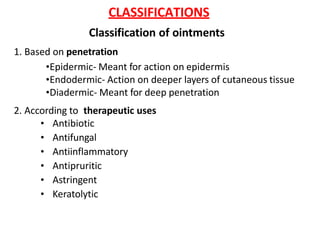
CLASSIFICATIONS
Classification of ointments
1. Based on penetration
โ€ขEpidermic- Meant for action on epidermis
โ€ขEndodermic- Action on deeper layers of cutaneous tissue
โ€ขDiadermic- Meant for deep penetration
2. According to therapeutic uses
โ€ข Antibiotic
โ€ข Antifungal
โ€ข Antiinflammatory
โ€ข Antipruritic
โ€ข Astringent
โ€ข Keratolytic
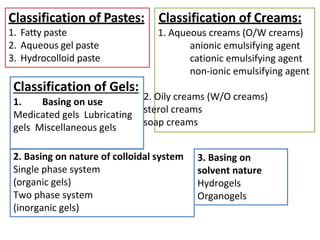
Classification of Pastes:
1. Fatty paste
2. Aqueous gel paste
3. Hydrocolloid paste
Classification of Creams:
1. Aqueous creams (O/W creams)
anionic emulsifying agent
cationic emulsifying agent
non-ionic emulsifying agent
Classification of Gels:
1. Basing on use
Medicated gels Lubricating
gels Miscellaneous gels
2. Oily creams (W/O creams)
sterol creams
soap creams
2. Basing on nature of colloidal system
Single phase system
(organic gels)
Two phase system
(inorganic gels)
3. Basing on
solvent nature
Hydrogels
Organogels
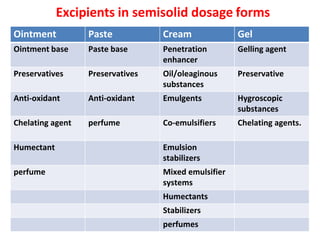
Excipients in semisolid dosage forms
Ointment Paste Cream Gel
Ointment base Paste base Penetration
enhancer
Gelling agent
Preservatives Preservatives Oil/oleaginous
substances
Preservative
Anti-oxidant Anti-oxidant Emulgents Hygroscopic
substances
Chelating agent perfume Co-emulsifiers Chelating agents.
Humectant Emulsion
stabilizers
perfume Mixed emulsifier
systems
Humectants
Stabilizers
perfumes
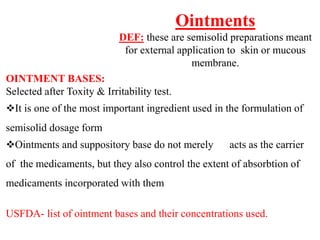
Ointments
DEF: these are semisolid preparations meant
for external application to skin or mucous
membrane.
OINTMENT BASES:
Selected after Toxity & Irritability test.
๏ถIt is one of the most important ingredient used in the formulation of
semisolid dosage form
๏ถOintments and suppository base do not merely acts as the carrier
of the medicaments, but they also control the extent of absorbtion of
medicaments incorporated with them
USFDA- list of ointment bases and their concentrations used.
They should be:
๏ƒผCompatible with skin pH and drug
๏ƒผInert ,non irritating and non sensitizing
๏ƒผGood solvent and/or emulsifying agent
๏ƒผEmollient , protective , non greasy and easily
removable
๏ƒผRelease medicaments easily at the site of
administration
๏ƒผPharmaceutical elegant and possess good stability.
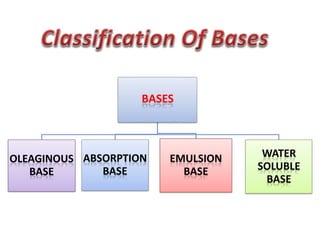
BASES
OLEAGINOUS
BASE
ABSORPTION
BASE
EMULSION
BASE
WATER
SOLUBLE
BASE
1.Oleaginous(hydrocarbon) bases:
๏ถThey consist of a combination of more than one oleaginous material such as
water insoluble hydrophobic oils and fats
Disadvantages:
โ€ขGreasy, sticky-non washable
โ€ขRetain body heat
โ€ขDo not increase absorption
โ€ขPrevent drainage on oozing area.
โ€ขThey are anhydrous, do not absorb water & insoluble in water.
1.Hydrocarbons: Paraffin wax, Soft paraffin, Liquid paraffin
2.Vegetable oils and animal fats: Peanut oil, Coconut oil, Lanolin, Bees wax
3.Hydrogenated & sulfated oils: Hydrogenated castor oil, Hydrogenated &
sulfated castor oil.
4.Acids, Alcohols & Esters: Stearic acid, Stearyl alcohol, Isopropyl Myristicate.
5.Silicones: Dimethyl polysiloxanes
A) Soft paraffin (Petrolatum):
This is purified mixture of semisolid hydrocarbons obtained from
petroleum.
Types
1.Yellow soft paraffin โ€“ M.pt=380C, used in ophthalmic ointments.
2.White soft paraffin- M.pt=560C, obtained from bleaching Yellow
soft paraffin.
B) Hard paraffin:
purified mixture of solid hydrocarbons obtained from petroleum.
USE- harden/soften ointment base
c) Liquid paraffin (white mineral oil/ liquid petroleum):
mixture of liquid hydrocarbons obtained from petroleum by
distillation.
USE- Combine with hard/ soft paraffin to harden/soften ointment
base.
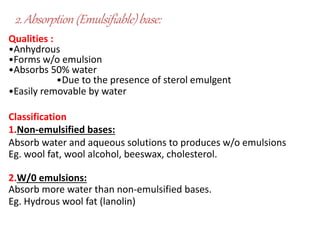
2.Absorption (Emulsifiable)base:
Qualities :
โ€ขAnhydrous
โ€ขForms w/o emulsion
โ€ขAbsorbs 50% water
โ€ขDue to the presence of sterol emulgent
โ€ขEasily removable by water
Classification
1.Non-emulsified bases:
Absorb water and aqueous solutions to produces w/o emulsions
Eg. wool fat, wool alcohol, beeswax, cholesterol.
2.W/0 emulsions:
Absorb more water than non-emulsified bases.
Eg. Hydrous wool fat (lanolin)
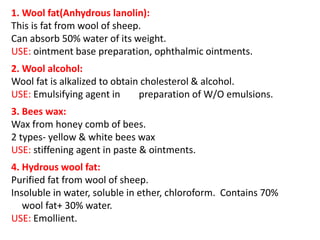
1. Wool fat(Anhydrous lanolin):
This is fat from wool of sheep.
Can absorb 50% water of its weight.
USE: ointment base preparation, ophthalmic ointments.
2. Wool alcohol:
Wool fat is alkalized to obtain cholesterol & alcohol.
USE: Emulsifying agent in preparation of W/O emulsions.
3. Bees wax:
Wax from honey comb of bees.
2 types- yellow & white bees wax
USE: stiffening agent in paste & ointments.
4. Hydrous wool fat:
Purified fat from wool of sheep.
Insoluble in water, soluble in ether, chloroform. Contains 70%
wool fat+ 30% water.
USE: Emollient.
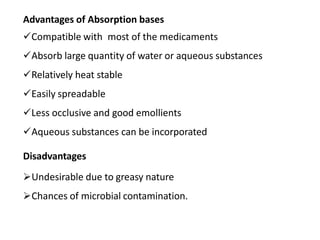
Advantages of Absorption bases
๏ƒผCompatible with most of the medicaments
๏ƒผAbsorb large quantity of water or aqueous substances
๏ƒผRelatively heat stable
๏ƒผEasily spreadable
๏ƒผLess occlusive and good emollients
๏ƒผAqueous substances can be incorporated
Disadvantages
๏ƒ˜Undesirable due to greasy nature
๏ƒ˜Chances of microbial contamination.
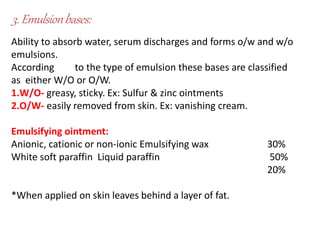
3.Emulsionbases:
Ability to absorb water, serum discharges and forms o/w and w/o
emulsions.
According to the type of emulsion these bases are classified
as either W/O or O/W.
1.W/O- greasy, sticky. Ex: Sulfur & zinc ointments
2.O/W- easily removed from skin. Ex: vanishing cream.
Emulsifying ointment:
Anionic, cationic or non-ionic Emulsifying wax
White soft paraffin Liquid paraffin
30%
50%
20%
*When applied on skin leaves behind a layer of fat.
Advantages Of Emulsion bases
๏ƒผMiscible with exudates from lesions
๏ƒผDoes not interfere with skin function
๏ƒผGood contact with skin because of surfactant content
๏ƒผHigh cosmetic acceptability.
๏ƒผEasy removable from the hair.
Disadvantages of Emulsion bases
๏ƒ˜W/o emulsion greasy and sticky
๏ƒ˜Its acceptance is less
๏ƒ˜Difficult to remove from body and clothing.
4. Water soluble
Bases: (Grease less
Base)
1. Carbo waxes 200,300โ€ฆ1500. (For viscous liquids)
2. Carbo waxes 1540, 3000.. 6000(For Viscous solids)
3. Pectin, Tragacanth & Cellulose derivatives (Form plants)
4. Gelatin (Animal)
5. Silica Gel, Bentonite (Chemical)
6. For low viscosity - Glycerin, Glyceryl mono stearate.
Carbo waxes (Macrogols/ Polyethylene glycols)
General formula CH2OH. (CH2OCH2)n . CH2OH
These are mixtures of polycondensation products of ethylene oxide
and water
โ€ขAverage Molecular weight is represented by numbers
Macrogols 200, 300, 400
Macrogol 1500
-- viscous liquids
-- greasy semi solid
Macrogols 1540, 3000,4000, 6000 -- waxy solids
Liquids
โ€ข Clear and colourless
โ€ข Faint characterisitic odour
โ€ข Miscible with water, alcohol and other glycols
Solids
โ€ข White or cream in colour
โ€ข Hard lumps or flakes
โ€ข Soluble 1 in 3 in water and 1 in 2 in alcohol
โ€ข Solidifying points range from 40 to 60ยฐc
Macrogols Properties:
โ€ข Non-toxic and non-irritating
โ€ข pH โ€“ 4 to 7.5
โ€ข Can be sterilised by heat (solids โ€“ dry heat, liquids โ€“
autoclave)
โ€ข water soluble, non-volatile and inert substances. Different
carbowax mixture produces different consistency.
Paste base:
1. Hydrocarbon bases:-- soft paraffin , liquid paraffin.
2. Water miscible bases:-- glycerin, emulsifying ointment.
3. Water soluble bases:-- poly ethylene glycols.
Chelating agent:
Heavy metals cause degradation of gel bases and medicament.
Chelating agents form complex with heavy metals and
prevent degradation. Ex: EDTA
Humectant:
To maintain humidity in the preparation and to prevent drying.
Ex: glucerin, sorbitan.
Hygroscopic substances:
These prevent quick loss of water due to evaporation in gels and
prevents drying, flake formation.
Ex: glycerol, propylene glycol
Gelling agents
These are organic hydrocolloids/ hydrophilic inorganic substances.
1.Natural gelling agentsโ€“ gum tragacanth, starch, pectin, gelatin,
clays, cellulose derivatives, etc.,
2.Synthetic gelling agentsโ€“ sodium alginate, carbomer, poly vinyl
alcohol, etc.,
CLAYS:
๏ƒ˜7-20% bentonite is used as dermatological base.
๏ƒ˜10% aluminium magnesium silicate is used in medicated
gels.
๏ƒ˜Gels are not clear and form powdery residue on skin.
1.Tragacanth :
Used for preparations of Lubricating, Medicated & Contraceptive Jellies.
Concentrations used for Lubricating (2 to 3%) &
Dermatological vehicle (5%).
๏ƒ˜Tragacanth is poorly wettable
๏ƒ˜On addition to water lumps are formed which is difficult to disperse
๏ƒ˜Dispersing agent is generally used to get a homogenous product
๏ƒ˜Alcohol, glycerol or volatile liquids are used as dispersing agent
Disadvantages :
โ€ข Obtained from natural sources, so vary in viscosity
โ€ข After evaporation, the film left on the skin tends to flake
โ€ข Loss viscosity outside the pH range of 4.5 โ€“ 7
โ€ข Canโ€™t be stored for longer time
โ€ข Prone to microbial growth
2. Pectin :
โ€ข Good gelling agent suitable for acid products
โ€ข Used in many preparations including edible Jellies
โ€ข Glycerine is used as dispersing agent & humectant
โ€ข Pectin jelly is good medium for bacterial growth, add preservative
Storage:
Well closed container to prevent loss of moisture by evaporation
3. Starch :
๏ƒ˜ Used in combination with other Jelling agent
๏ƒ˜ Provides a water soluble dermatological base
๏ƒ˜ Starch + Gelatin + Glycerin jelly product is still used
๏ƒ˜ Glycerin (up to 50%) may be added which acts as preservative
and humectant
Note:
โ€ข Must be freshly prepared
โ€ข Well closed container to prevent loss of moisture by evaporation
4. Gelatin :
๏ƒ˜ Insoluble in cold water (swells and soften)
๏ƒ˜ Soluble in hot water
๏ƒ˜ 2% gelatin forms jelly on cooling
๏ƒ˜ Stiff medicated Jellies can be prepared (15%)
๏ƒ˜ Melted before use and after cooling to desired temperature,
applied with a brush.
๏ƒ˜ Affected area covered with bandage and left in place for several
weeks
๏ƒ˜ Suitable preservative is required
5. Cellulose derivatives :
๏ƒ˜ Produce neutral jellies of very stable viscosity
๏ƒ˜ Afford good resistance against microbial growth
๏ƒ˜ High clarity & produce a soft film after drying
Sodium CMC
โ€ข Used for preparation of lubricating & sterile jellies
โ€ข Withstand autoclaving temperature without deterioration
Example
โ€ข Methyl cellulose - 3%
โ€ข Sodium carboxy methyl cellulose
1.5 - 5% - lubricant gels, 5% - Dermatological gels
6. Sodium aliginate :
โ€ข 1.5 to 2% Used as Lubricant gel & Dermatological vehicle 5 To 10%
โ€ข Viscosity can be increased by adding soluble calcium salt
โ€ข Salting out is observed with high conc.
โ€ข 2-4% alcohol, glycerine, propylene glycol are used as dispersing agent
Advantages over tragacanth
โ€ข Available in several grades of standard viscosity
7. Carbomer:
0.3-1% in lubricating gels & 0.5-5% as dermatological vehicle.
These have high gelling efficiency and used in low concentrations.
8. Poly vinyl alcohol (PVA):
PVA gels provide protection as they dry quickly to form a strong
residual film on skin.
These are available in various grades and viscosities.
Methods of Preparation of Ointments & Creams
1. Trituration
2. Fusion
3. Chemical reaction
4. Emulsification
Methods of Preparation of Pastes
1. Trituration
2. Fusion
Method of Preparation of Gels
General method
1. Trituration Method
Widely used method
For extemporaneous preparation of ointments.
When the base is soft and medicament is solid insoluble Small
amount of liquid to incorporated in the base
Advantage
Involves mixing as well as size reduction
Procedure:
1.Reduce the solid medicament to fine powder
2.Medicament is mixed with small amount of base on ointment slab
with a stainless steel spatula until a homogeneous product is formed.
3. Add remaining quantities of base with uniform mixing
4. Incorporate any liquid ingredient if present
(mortar and pestle to be used in case of large quantity of liquid)
Eg: Prepare and dispense 100 g of sulphur ointment
Rx
Sublimed sulphur, finely sifted - 10 g
Simple ointment - 90g
Prepare an ointment
Direction - Apply the ointment to the affected area as directed.
2. Fusion method:
Suitable when ointment base contains number of solid ingredients
of different melting points.
Procedure:
1.Ointment base are melted in decreasing order of their melting
point.
2.Highest melting point should be melted first, low melting point
next.
3.This avoids over heating of substances of low melting point
4.Incorporate medicament slowly to the melted mass
5.Stir thoroughly until mass cools down and homogeneous
product is formed.
6. Liquid ingredients or aqueous substance should be heated to the
same temperature as the melted bases before addition.
7. If not, wax or solids will cool down quickly and get separated
Precautions:
๏ƒ˜ Strring is done continously- homogeneous mass
๏ƒ˜ Vigorous stirring should be avoided to prevent entrapment of air
๏ƒ˜ Rapid cooling should be avoided to get a uniform product.
๏ƒ˜ To remove the dust or foreign particles strain through muslin
cloth
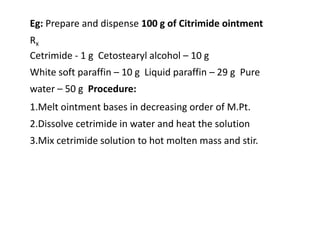
Eg: Prepare and dispense 100 g of Citrimide ointment
Rx
Cetrimide - 1 g Cetostearyl alcohol โ€“ 10 g
White soft paraffin โ€“ 10 g Liquid paraffin โ€“ 29 g Pure
water โ€“ 50 g Procedure:
1.Melt ointment bases in decreasing order of M.Pt.
2.Dissolve cetrimide in water and heat the solution
3.Mix cetrimide solution to hot molten mass and stir.
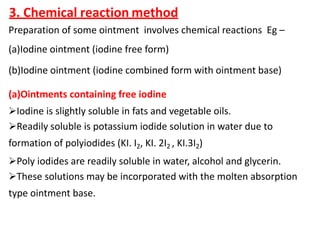
3. Chemical reaction method
Preparation of some ointment involves chemical reactions Eg โ€“
(a)Iodine ointment (iodine free form)
(b)Iodine ointment (iodine combined form with ointment base)
(a)Ointments containing free iodine
๏ƒ˜Iodine is slightly soluble in fats and vegetable oils.
๏ƒ˜Readily soluble is potassium iodide solution in water due to
formation of polyiodides (KI. I2, KI. 2I2 , KI.3I2)
๏ƒ˜Poly iodides are readily soluble in water, alcohol and glycerin.
๏ƒ˜These solutions may be incorporated with the molten absorption
type ointment base.
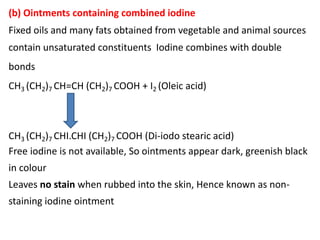
(b) Ointments containing combined iodine
Fixed oils and many fats obtained from vegetable and animal sources
contain unsaturated constituents Iodine combines with double
bonds
CH3 (CH2)7 CH=CH (CH2)7 COOH + I2 (Oleic acid)
CH3 (CH2)7 CHI.CHI (CH2)7 COOH (Di-iodo stearic acid)
Free iodine is not available, So ointments appear dark, greenish black
in colour
Leaves no stain when rubbed into the skin, Hence known as non-
staining iodine ointment
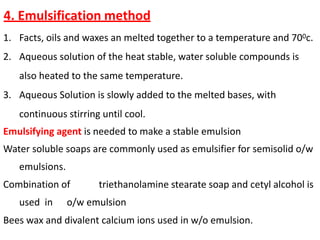
4. Emulsification method
1. Facts, oils and waxes an melted together to a temperature and 700c.
2. Aqueous solution of the heat stable, water soluble compounds is
also heated to the same temperature.
3. Aqueous Solution is slowly added to the melted bases, with
continuous stirring until cool.
Emulsifying agent is needed to make a stable emulsion
Water soluble soaps are commonly used as emulsifier for semisolid o/w
emulsions.
Combination of triethanolamine stearate soap and cetyl alcohol is
used in o/w emulsion
Bees wax and divalent calcium ions used in w/o emulsion.
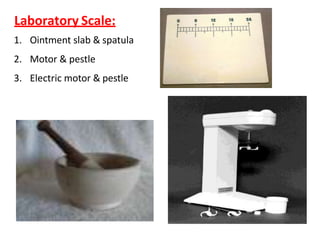
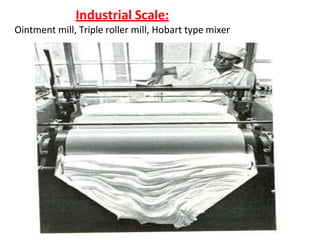
Laboratory Scale:
1. Ointment slab & spatula
2. Motor & pestle
3. Electric motor & pestle
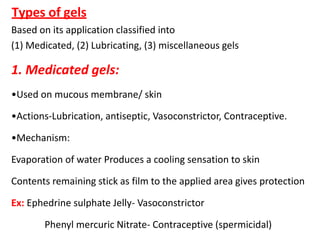
Industrial Scale:
Ointment mill, Triple roller mill, Hobart type mixer
Types of gels
Based on its application classified into
(1) Medicated, (2) Lubricating, (3) miscellaneous gels
1. Medicated gels:
โ€ขUsed on mucous membrane/ skin
โ€ขActions-Lubrication, antiseptic, Vasoconstrictor, Contraceptive.
โ€ขMechanism:
Evaporation of water Produces a cooling sensation to skin
Contents remaining stick as film to the applied area gives protection
Ex: Ephedrine sulphate Jelly- Vasoconstrictor
Phenyl mercuric Nitrate- Contraceptive (spermicidal)
2.Lubricating gels:
Properties:
๏ƒ˜ Should be thin, transparent & water soluble.
๏ƒ˜ Must be sterile when inserted into sterile regions of the body.
Used for lubrication in:
โ€ข Rectal Thermometers
โ€ข Urinary Bladders
โ€ข Fingerstalls
โ€ข Cystoscopes
โ€ข Surgical gloves
โ€ข Catheters
3.Miscellaneous gels:
โ€ข Patch testing
Used as vehicle for allergens applied on skin in allergy test
โ€ข Electrocardiography
Jellies contain Nacl, pumice powder & glycerin.
Toreduce electrical resistance between skin and electrode
Preparation of Gels:
1. Usually prepared by adding thickening agent
ex:Tragacanth,Carboxymethyl cellulose
2. Thickening agent is added to aqueous solution in which drug has
to be dissolved
3. Mass is triturated in a mortar until a smooth product is obtained
4. When coloured drug to be incorporated glass mortar is used
5. Whole gum is preferred to powdered gum to get clear
preparation of uniform consistency
Example:
Rx
Icthammol
Tragacanth
Alcohol (90%)
Glycerine Water
-20g
-5g
-10g
-2g
-qs 100g
Send 100g Icthammol jelly Procedure:
1.Tragacanth + alcohol๏ƒจ motor ๏ƒจ mucilage.
2.Icthammol + glycerine + water ๏ƒจDrug solution
3.Drug solution + mucilage ๏ƒจtriturate
4.Add water qs 100g
5.Transfer into container, label & dispense.
Evaluations of ointment and creams:
1. Drug content
2. Release rate of medicament from base
3. Penetration rate of medicament
4. Absorption of medicament into blood stream
5. Consistency of the preparation
6. Irritant effect
1. Drug content:--Minimum fill test
๏‚งSelect any 10 filled containers
๏‚งWeigh the required amount of ointment
๏‚งMedicament is extracted in a suitable solvent
๏‚งDrug Content is determined by suitable analytical technique
๏‚งResults should be with in labeled quantity. 2. Release rate of
medicament from base:-- Two in vitro techniques are used
1. Agar cup plate method
2. Diffusion method
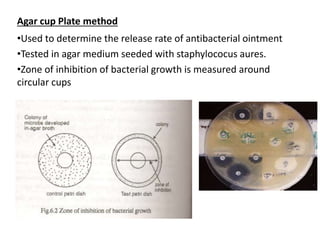
Agar cup Plate method
โ€ขUsed to determine the release rate of antibacterial ointment
โ€ขTested in agar medium seeded with staphylococus aures.
โ€ขZone of inhibition of bacterial growth is measured around
circular cups
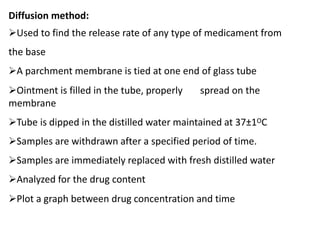
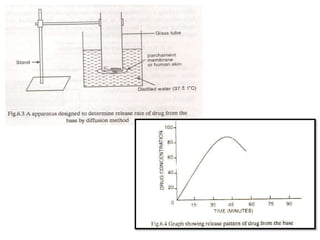
Diffusion method:
๏ƒ˜Used to find the release rate of any type of medicament from
the base
๏ƒ˜A parchment membrane is tied at one end of glass tube
๏ƒ˜Ointment is filled in the tube, properly spread on the
membrane
๏ƒ˜Tube is dipped in the distilled water maintained at 37ยฑ1OC
๏ƒ˜Samples are withdrawn after a specified period of time.
๏ƒ˜Samples are immediately replaced with fresh distilled water
๏ƒ˜Analyzed for the drug content
๏ƒ˜Plot a graph between drug concentration and time
3. Penetration rate of medicament:
๏ƒ˜Determined by rubbing weighed amount into defined areas for a
fixed time
๏ƒ˜Unabsorbed material is removed completely and weighed
๏ƒ˜Difference in weight provides total base penetrated
๏ƒ˜Rate is then calculated
4. Absorption of medicament into blood stream:
๏ƒ˜Diadermic ointments are tested by in-vivo method.
๏ƒ˜Determined by assaying drug content in either blood, urine, faeces
or tissues after rubbing defined amount under standard conditions
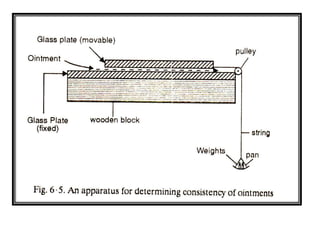
5. Consistency of the preparation:
๏ƒ˜Determined by sliding a glass plate over the product by means of
a pulley.
๏ƒ˜Product is spread evenly on another glass plate fixed on a wooden
block
๏ƒ˜Weights are added to the pan so that sliding of the movable
glass
plate is obtained
๏ƒ˜Ointment which require more weights to allow the plate to slide-
over have high consistency or vice-versa
6. Irritant effect:--
๏ƒ˜Test is performed on skin and eyes of rabbit or human skin
๏ƒ˜Ointment is injected in to thigh muscles and under abdonimal skin
in rats.
๏ƒ˜Results are observed daily for a week
๏ƒ˜Irritant effect of dermatological preparation is shown as lesions
on cornea, iris and conjunctiva
Evaluation of gels
1. Rheological properties
2. Determination of yield value
3. Spreadability
4. Stability test
5. Safety evaluations.
1. Rheological properties:
Gels exhibit non-newtonian rheological behaviour and thixotropy
(gel โ†”sol). Brook field viscometer is used for determination.
2. Determination of yield value:
Penetrometer is used to measure force required to exudate the gel
form collapsible tube.
3. Spreadability:
This is related to rheological property of gel, tested using slides.
4. Stability test:
Gel stability at various temperatures is tested for shipping.
5. Safety evaluations:
Safety is determined by evaluating physical properties of raw
materials.
Evaluation of pastes:
1. Evaluation of heat stability
2. Determination of viscosity
3. Compatibility with container
4. Determination of safety of product
5. Teat for sensitization
6. Determination of particle size
7. Determination of gelation behavior.
Semi solid dosage forms

Semi solid dosage forms

  • 1.
    SEMISOLID DOSAGE FORMS PreparedBy: Dr. JigarVyas Professor Sigma Institute of Pharmacy
  • 2.
    ๏ƒ˜The skin isvery effective as a selective penetration barrier. The epidermis provides the major control element for drug penetration.
  • 3.
    Mechanism of drugpenetration through skin Three potential entry MACRO ROUTES to the viable tissue: 1. Via the sweat ducts (Para-cellular) 2. Across the continuous stratum corneum (Trans-cellular) 3. Through the hair follicles with their associated sebaceous glands
  • 4.
  • 5.
    ๏ƒ˜Low molecular weightmolecules penetrate through stratum conium to some extent. ๏ƒ˜Skin appendages are main route for Electrolytes, polar steroids, antibiotics and colloidal particles. ๏ƒ˜Particles of 3-10 ยต penetrate through hair follicle and particles less than 3ยต penetrate through stratum conium. ๏ƒ˜Hair follicle route may be important for ions and large polar molecules. ๏ƒ˜Topically applied agents such as steroids, hexachlorophane, griseofulvin, sodium fusidate and fusidic acid may form a depot or reservoir by binding within the stratum corneum.
  • 6.
    Once drug permeatesthrough horny layer it readily enters living tissue and systemic circulation. ๏ƒ˜The average residence time of drug in dermis may be 1 min before it is washed away by blood. ๏ƒ˜NSAIDS reach far down to muscles to form depots.
  • 7.
    Factors influencing dermalpenetration of drugs I. Biological factors: 1. Skin condition 2. Skin age 3. Blood flow 4. Regional skin site 5. Skin metabolism 6. Species difference. II. Physicochemical factors: 1.Skin hydration 2.Temperature and pH 3.Diffusion coefficient 4.Drug concentration 5.Partition coefficient 6.Molecular size and shape.
  • 8.
    BIOLOGICAL FACTORS: 1. Skincondition ๏ƒ˜The intact, healthy skin is a tough barrier but acids and alkalis injure barrier cells and thereby promote penetration. ๏ƒ˜Mixtures of non-polar and polar solvents, such as chloroform and methanol, remove the lipid fraction and molecules pass more easily. ๏ƒ˜Disease alters skin condition, skin inflamed, with loss of stratum corneum thus permeability increases. ๏ƒ˜If organ thickened, with corns, calluses and warts, drug permeation decrease. 2. Skin age ๏ƒ˜Skin of the young and the elderly is more permeable than adult tissue. ๏ƒ˜Children are more susceptible to the toxic effects of drugs and chemicals, because of their greater surface area per unit body weight; thus potent topical steroids, Causes severe side-effects and death.
  • 9.
    3.Blood flow: ๏ƒ˜An increasedblood f;low could reduce the amount of time a penetrant remains in the dermis, and also raise the concentration gradient across the skin. ๏ƒ˜In clinically hyperaemic disease damages the skin barrier and increase absorption. 4. Regional skin sites : ๏ƒ˜Variations in permeability depend on the thickness and nature of the stratum corneum and the density of skin appendages. ๏ƒ˜Absorption changes with substance, volunteer and site. ๏ƒ˜Permeabilities depend on thickness of stratum corneum and the overall thickness of the tissue. ๏ƒ˜Plantar and palmar callus may be 400-600 ยตm thick compared to 10-20 ยตm for other sites. ๏ƒ˜The hyoscine Transderm system employs in postauricular skin (i.e. behind the ear) because the layers of stratum corneum are thinner ๏ƒ˜Facial skin in general is more permeable than other body sites
  • 10.
    5. Skin metabolism: ๏ƒ˜Theskin metabolizes steroid hormones, chemical carcinogens and some drugs. ๏ƒ˜This is advantage to prodrugs. ๏ƒ˜Skin can metabolize 5% of topical drugs. 6. Species differences: ๏ƒ˜Mice, rats and rabbits are used to assess percutaneous absorption, but their skins have more hair follicles than human skin and they lack sweat glands. ๏ƒ˜Hairless mouse, monkey and pig skins are most like that of humans. ๏ƒ˜Hairless rat and fuzzy guinea pig may be better models for humans. ๏ƒ˜To obtain skin penetration data it is best to use human skin
  • 11.
    Physicochemical factors 1. Skinhydration: ๏ƒ˜When water saturates the skin the tissue swells, softens and wrinkles and hydration of the stratum corneum increases permeability. ๏ƒ˜Dusting powders or lotions, provide a large surface area for evaporation and therefore dry the skin 2. Temperature and pH: ๏ƒ˜The penetration rate of material through human skin can change tenfold for a large temperature variation. ๏ƒ˜Occlusive vehicles increase skin temperature and increase permeability. ๏ƒ˜According to pH-partition hypothesis, only unionized molecules pass readily across lipid membranes. ๏ƒ˜Weak acids and bases dissociate to different degrees, depending on the pH and their PKa or Pkb values. ๏ƒ˜Stratum corneum is resistant to alterations in pH, range of 3-9.
  • 12.
    3. Diffusion coefficient: ๏ƒ˜Thediffusional speed of a molecule depends mainly on the state of matter of the medium. ๏ƒ˜In gases, diffusion coefficients are large than liquids ๏ƒ˜In skin, the diffusivities reach their lowest values within the compacted stratum corneum matrix. ๏ƒ˜The diffusion coefficient of a drug in a topical vehicle depends on the properties of the drug and the diffusion medium and on the interaction between them. 4. Drug concentration: ๏ƒ˜Drug permeation and flux of solute is proportional to the concentration gradient across the barrier. ๏ƒ˜drug permeation follows Fick's law, saturated donor solution gives maximum flux. ๏ƒ˜pH change, complex formation, or the presence of surfactants, micelles or cosolvents modify the effective partition coefficient
  • 13.
    5. Partition coefficient(K): ๏ƒ˜Thepartition coefficient is important in establishing the flux of a drug through the stratum corneum. ๏ƒ˜Drug (K<1) are water soluble, (K>1) are oil soluble. ๏ƒ˜Polar cosolvent mixtures, such as propylene glycol with water, produce saturated drug solutions and maximize the concentration gradient across the stratum corneum. ๏ƒ˜Surfactants disruption of intercellular lipid packing in the stratum corneum, act as penetration Enhancers. ๏ƒ˜Complex formation of drug increases the apparent partition coefficient may promote drug absorption. 6. Molecular size and shape: ๏ƒ˜Absorption is apparently inversely related to molecular weight. ๏ƒ˜Small molecules penetrate faster than large ones. ๏ƒ˜It is more difficult to determine the effect of molecular shape, as it is related to partition coefficient.
  • 14.
    SEMISOLIDS Ointments Creams Pastes Gelsand jellies Poultices Suppositories
  • 15.
    Definitions: 1.OINTMENT: these aresemi solid preparations meant for external application to the skin/ mucous membrane. 2.PASTE: these are semisolid preparations intended for external application to skin. 3.CREAM: these are viscous semisolid emulsions meant for external use. 4.GELS: these are semisolid dispersion systems which may contain suspension of either small /large organic molecules dispersed in a suitable liquid.
  • 16.
    CLASSIFICATIONS Classification of ointments 1.Based on penetration โ€ขEpidermic- Meant for action on epidermis โ€ขEndodermic- Action on deeper layers of cutaneous tissue โ€ขDiadermic- Meant for deep penetration 2. According to therapeutic uses โ€ข Antibiotic โ€ข Antifungal โ€ข Antiinflammatory โ€ข Antipruritic โ€ข Astringent โ€ข Keratolytic
  • 17.
    Classification of Pastes: 1.Fatty paste 2. Aqueous gel paste 3. Hydrocolloid paste Classification of Creams: 1. Aqueous creams (O/W creams) anionic emulsifying agent cationic emulsifying agent non-ionic emulsifying agent Classification of Gels: 1. Basing on use Medicated gels Lubricating gels Miscellaneous gels 2. Oily creams (W/O creams) sterol creams soap creams 2. Basing on nature of colloidal system Single phase system (organic gels) Two phase system (inorganic gels) 3. Basing on solvent nature Hydrogels Organogels
  • 18.
    Excipients in semisoliddosage forms Ointment Paste Cream Gel Ointment base Paste base Penetration enhancer Gelling agent Preservatives Preservatives Oil/oleaginous substances Preservative Anti-oxidant Anti-oxidant Emulgents Hygroscopic substances Chelating agent perfume Co-emulsifiers Chelating agents. Humectant Emulsion stabilizers perfume Mixed emulsifier systems Humectants Stabilizers perfumes
  • 19.
    Ointments DEF: these aresemisolid preparations meant for external application to skin or mucous membrane. OINTMENT BASES: Selected after Toxity & Irritability test. ๏ถIt is one of the most important ingredient used in the formulation of semisolid dosage form ๏ถOintments and suppository base do not merely acts as the carrier of the medicaments, but they also control the extent of absorbtion of medicaments incorporated with them USFDA- list of ointment bases and their concentrations used.
  • 20.
    They should be: ๏ƒผCompatiblewith skin pH and drug ๏ƒผInert ,non irritating and non sensitizing ๏ƒผGood solvent and/or emulsifying agent ๏ƒผEmollient , protective , non greasy and easily removable ๏ƒผRelease medicaments easily at the site of administration ๏ƒผPharmaceutical elegant and possess good stability.
  • 21.
  • 22.
    1.Oleaginous(hydrocarbon) bases: ๏ถThey consistof a combination of more than one oleaginous material such as water insoluble hydrophobic oils and fats Disadvantages: โ€ขGreasy, sticky-non washable โ€ขRetain body heat โ€ขDo not increase absorption โ€ขPrevent drainage on oozing area. โ€ขThey are anhydrous, do not absorb water & insoluble in water. 1.Hydrocarbons: Paraffin wax, Soft paraffin, Liquid paraffin 2.Vegetable oils and animal fats: Peanut oil, Coconut oil, Lanolin, Bees wax 3.Hydrogenated & sulfated oils: Hydrogenated castor oil, Hydrogenated & sulfated castor oil. 4.Acids, Alcohols & Esters: Stearic acid, Stearyl alcohol, Isopropyl Myristicate. 5.Silicones: Dimethyl polysiloxanes
  • 23.
    A) Soft paraffin(Petrolatum): This is purified mixture of semisolid hydrocarbons obtained from petroleum. Types 1.Yellow soft paraffin โ€“ M.pt=380C, used in ophthalmic ointments. 2.White soft paraffin- M.pt=560C, obtained from bleaching Yellow soft paraffin. B) Hard paraffin: purified mixture of solid hydrocarbons obtained from petroleum. USE- harden/soften ointment base c) Liquid paraffin (white mineral oil/ liquid petroleum): mixture of liquid hydrocarbons obtained from petroleum by distillation. USE- Combine with hard/ soft paraffin to harden/soften ointment base.
  • 24.
    2.Absorption (Emulsifiable)base: Qualities : โ€ขAnhydrous โ€ขFormsw/o emulsion โ€ขAbsorbs 50% water โ€ขDue to the presence of sterol emulgent โ€ขEasily removable by water Classification 1.Non-emulsified bases: Absorb water and aqueous solutions to produces w/o emulsions Eg. wool fat, wool alcohol, beeswax, cholesterol. 2.W/0 emulsions: Absorb more water than non-emulsified bases. Eg. Hydrous wool fat (lanolin)
  • 25.
    1. Wool fat(Anhydrouslanolin): This is fat from wool of sheep. Can absorb 50% water of its weight. USE: ointment base preparation, ophthalmic ointments. 2. Wool alcohol: Wool fat is alkalized to obtain cholesterol & alcohol. USE: Emulsifying agent in preparation of W/O emulsions. 3. Bees wax: Wax from honey comb of bees. 2 types- yellow & white bees wax USE: stiffening agent in paste & ointments. 4. Hydrous wool fat: Purified fat from wool of sheep. Insoluble in water, soluble in ether, chloroform. Contains 70% wool fat+ 30% water. USE: Emollient.
  • 26.
    Advantages of Absorptionbases ๏ƒผCompatible with most of the medicaments ๏ƒผAbsorb large quantity of water or aqueous substances ๏ƒผRelatively heat stable ๏ƒผEasily spreadable ๏ƒผLess occlusive and good emollients ๏ƒผAqueous substances can be incorporated Disadvantages ๏ƒ˜Undesirable due to greasy nature ๏ƒ˜Chances of microbial contamination.
  • 27.
    3.Emulsionbases: Ability to absorbwater, serum discharges and forms o/w and w/o emulsions. According to the type of emulsion these bases are classified as either W/O or O/W. 1.W/O- greasy, sticky. Ex: Sulfur & zinc ointments 2.O/W- easily removed from skin. Ex: vanishing cream. Emulsifying ointment: Anionic, cationic or non-ionic Emulsifying wax White soft paraffin Liquid paraffin 30% 50% 20% *When applied on skin leaves behind a layer of fat.
  • 28.
    Advantages Of Emulsionbases ๏ƒผMiscible with exudates from lesions ๏ƒผDoes not interfere with skin function ๏ƒผGood contact with skin because of surfactant content ๏ƒผHigh cosmetic acceptability. ๏ƒผEasy removable from the hair. Disadvantages of Emulsion bases ๏ƒ˜W/o emulsion greasy and sticky ๏ƒ˜Its acceptance is less ๏ƒ˜Difficult to remove from body and clothing.
  • 29.
    4. Water soluble Bases:(Grease less Base) 1. Carbo waxes 200,300โ€ฆ1500. (For viscous liquids) 2. Carbo waxes 1540, 3000.. 6000(For Viscous solids) 3. Pectin, Tragacanth & Cellulose derivatives (Form plants) 4. Gelatin (Animal) 5. Silica Gel, Bentonite (Chemical) 6. For low viscosity - Glycerin, Glyceryl mono stearate.
  • 30.
    Carbo waxes (Macrogols/Polyethylene glycols) General formula CH2OH. (CH2OCH2)n . CH2OH These are mixtures of polycondensation products of ethylene oxide and water โ€ขAverage Molecular weight is represented by numbers Macrogols 200, 300, 400 Macrogol 1500 -- viscous liquids -- greasy semi solid Macrogols 1540, 3000,4000, 6000 -- waxy solids Liquids โ€ข Clear and colourless โ€ข Faint characterisitic odour โ€ข Miscible with water, alcohol and other glycols
  • 31.
    Solids โ€ข White orcream in colour โ€ข Hard lumps or flakes โ€ข Soluble 1 in 3 in water and 1 in 2 in alcohol โ€ข Solidifying points range from 40 to 60ยฐc Macrogols Properties: โ€ข Non-toxic and non-irritating โ€ข pH โ€“ 4 to 7.5 โ€ข Can be sterilised by heat (solids โ€“ dry heat, liquids โ€“ autoclave) โ€ข water soluble, non-volatile and inert substances. Different carbowax mixture produces different consistency.
  • 32.
    Paste base: 1. Hydrocarbonbases:-- soft paraffin , liquid paraffin. 2. Water miscible bases:-- glycerin, emulsifying ointment. 3. Water soluble bases:-- poly ethylene glycols. Chelating agent: Heavy metals cause degradation of gel bases and medicament. Chelating agents form complex with heavy metals and prevent degradation. Ex: EDTA Humectant: To maintain humidity in the preparation and to prevent drying. Ex: glucerin, sorbitan. Hygroscopic substances: These prevent quick loss of water due to evaporation in gels and prevents drying, flake formation. Ex: glycerol, propylene glycol
  • 33.
    Gelling agents These areorganic hydrocolloids/ hydrophilic inorganic substances. 1.Natural gelling agentsโ€“ gum tragacanth, starch, pectin, gelatin, clays, cellulose derivatives, etc., 2.Synthetic gelling agentsโ€“ sodium alginate, carbomer, poly vinyl alcohol, etc., CLAYS: ๏ƒ˜7-20% bentonite is used as dermatological base. ๏ƒ˜10% aluminium magnesium silicate is used in medicated gels. ๏ƒ˜Gels are not clear and form powdery residue on skin.
  • 34.
    1.Tragacanth : Used forpreparations of Lubricating, Medicated & Contraceptive Jellies. Concentrations used for Lubricating (2 to 3%) & Dermatological vehicle (5%). ๏ƒ˜Tragacanth is poorly wettable ๏ƒ˜On addition to water lumps are formed which is difficult to disperse ๏ƒ˜Dispersing agent is generally used to get a homogenous product ๏ƒ˜Alcohol, glycerol or volatile liquids are used as dispersing agent
  • 35.
    Disadvantages : โ€ข Obtainedfrom natural sources, so vary in viscosity โ€ข After evaporation, the film left on the skin tends to flake โ€ข Loss viscosity outside the pH range of 4.5 โ€“ 7 โ€ข Canโ€™t be stored for longer time โ€ข Prone to microbial growth
  • 36.
    2. Pectin : โ€ขGood gelling agent suitable for acid products โ€ข Used in many preparations including edible Jellies โ€ข Glycerine is used as dispersing agent & humectant โ€ข Pectin jelly is good medium for bacterial growth, add preservative Storage: Well closed container to prevent loss of moisture by evaporation
  • 37.
    3. Starch : ๏ƒ˜Used in combination with other Jelling agent ๏ƒ˜ Provides a water soluble dermatological base ๏ƒ˜ Starch + Gelatin + Glycerin jelly product is still used ๏ƒ˜ Glycerin (up to 50%) may be added which acts as preservative and humectant Note: โ€ข Must be freshly prepared โ€ข Well closed container to prevent loss of moisture by evaporation
  • 38.
    4. Gelatin : ๏ƒ˜Insoluble in cold water (swells and soften) ๏ƒ˜ Soluble in hot water ๏ƒ˜ 2% gelatin forms jelly on cooling ๏ƒ˜ Stiff medicated Jellies can be prepared (15%) ๏ƒ˜ Melted before use and after cooling to desired temperature, applied with a brush. ๏ƒ˜ Affected area covered with bandage and left in place for several weeks ๏ƒ˜ Suitable preservative is required
  • 39.
    5. Cellulose derivatives: ๏ƒ˜ Produce neutral jellies of very stable viscosity ๏ƒ˜ Afford good resistance against microbial growth ๏ƒ˜ High clarity & produce a soft film after drying Sodium CMC โ€ข Used for preparation of lubricating & sterile jellies โ€ข Withstand autoclaving temperature without deterioration Example โ€ข Methyl cellulose - 3% โ€ข Sodium carboxy methyl cellulose 1.5 - 5% - lubricant gels, 5% - Dermatological gels
  • 40.
    6. Sodium aliginate: โ€ข 1.5 to 2% Used as Lubricant gel & Dermatological vehicle 5 To 10% โ€ข Viscosity can be increased by adding soluble calcium salt โ€ข Salting out is observed with high conc. โ€ข 2-4% alcohol, glycerine, propylene glycol are used as dispersing agent Advantages over tragacanth โ€ข Available in several grades of standard viscosity
  • 41.
    7. Carbomer: 0.3-1% inlubricating gels & 0.5-5% as dermatological vehicle. These have high gelling efficiency and used in low concentrations. 8. Poly vinyl alcohol (PVA): PVA gels provide protection as they dry quickly to form a strong residual film on skin. These are available in various grades and viscosities.
  • 42.
    Methods of Preparationof Ointments & Creams 1. Trituration 2. Fusion 3. Chemical reaction 4. Emulsification Methods of Preparation of Pastes 1. Trituration 2. Fusion Method of Preparation of Gels General method
  • 43.
    1. Trituration Method Widelyused method For extemporaneous preparation of ointments. When the base is soft and medicament is solid insoluble Small amount of liquid to incorporated in the base Advantage Involves mixing as well as size reduction Procedure: 1.Reduce the solid medicament to fine powder 2.Medicament is mixed with small amount of base on ointment slab with a stainless steel spatula until a homogeneous product is formed.
  • 44.
    3. Add remainingquantities of base with uniform mixing 4. Incorporate any liquid ingredient if present (mortar and pestle to be used in case of large quantity of liquid) Eg: Prepare and dispense 100 g of sulphur ointment Rx Sublimed sulphur, finely sifted - 10 g Simple ointment - 90g Prepare an ointment Direction - Apply the ointment to the affected area as directed.
  • 45.
    2. Fusion method: Suitablewhen ointment base contains number of solid ingredients of different melting points. Procedure: 1.Ointment base are melted in decreasing order of their melting point. 2.Highest melting point should be melted first, low melting point next. 3.This avoids over heating of substances of low melting point 4.Incorporate medicament slowly to the melted mass 5.Stir thoroughly until mass cools down and homogeneous product is formed.
  • 46.
    6. Liquid ingredientsor aqueous substance should be heated to the same temperature as the melted bases before addition. 7. If not, wax or solids will cool down quickly and get separated Precautions: ๏ƒ˜ Strring is done continously- homogeneous mass ๏ƒ˜ Vigorous stirring should be avoided to prevent entrapment of air ๏ƒ˜ Rapid cooling should be avoided to get a uniform product. ๏ƒ˜ To remove the dust or foreign particles strain through muslin cloth
  • 47.
    Eg: Prepare anddispense 100 g of Citrimide ointment Rx Cetrimide - 1 g Cetostearyl alcohol โ€“ 10 g White soft paraffin โ€“ 10 g Liquid paraffin โ€“ 29 g Pure water โ€“ 50 g Procedure: 1.Melt ointment bases in decreasing order of M.Pt. 2.Dissolve cetrimide in water and heat the solution 3.Mix cetrimide solution to hot molten mass and stir.
  • 48.
    3. Chemical reactionmethod Preparation of some ointment involves chemical reactions Eg โ€“ (a)Iodine ointment (iodine free form) (b)Iodine ointment (iodine combined form with ointment base) (a)Ointments containing free iodine ๏ƒ˜Iodine is slightly soluble in fats and vegetable oils. ๏ƒ˜Readily soluble is potassium iodide solution in water due to formation of polyiodides (KI. I2, KI. 2I2 , KI.3I2) ๏ƒ˜Poly iodides are readily soluble in water, alcohol and glycerin. ๏ƒ˜These solutions may be incorporated with the molten absorption type ointment base.
  • 49.
    (b) Ointments containingcombined iodine Fixed oils and many fats obtained from vegetable and animal sources contain unsaturated constituents Iodine combines with double bonds CH3 (CH2)7 CH=CH (CH2)7 COOH + I2 (Oleic acid) CH3 (CH2)7 CHI.CHI (CH2)7 COOH (Di-iodo stearic acid) Free iodine is not available, So ointments appear dark, greenish black in colour Leaves no stain when rubbed into the skin, Hence known as non- staining iodine ointment
  • 50.
    4. Emulsification method 1.Facts, oils and waxes an melted together to a temperature and 700c. 2. Aqueous solution of the heat stable, water soluble compounds is also heated to the same temperature. 3. Aqueous Solution is slowly added to the melted bases, with continuous stirring until cool. Emulsifying agent is needed to make a stable emulsion Water soluble soaps are commonly used as emulsifier for semisolid o/w emulsions. Combination of triethanolamine stearate soap and cetyl alcohol is used in o/w emulsion Bees wax and divalent calcium ions used in w/o emulsion.
  • 51.
    Laboratory Scale: 1. Ointmentslab & spatula 2. Motor & pestle 3. Electric motor & pestle
  • 52.
    Industrial Scale: Ointment mill,Triple roller mill, Hobart type mixer
  • 53.
    Types of gels Basedon its application classified into (1) Medicated, (2) Lubricating, (3) miscellaneous gels 1. Medicated gels: โ€ขUsed on mucous membrane/ skin โ€ขActions-Lubrication, antiseptic, Vasoconstrictor, Contraceptive. โ€ขMechanism: Evaporation of water Produces a cooling sensation to skin Contents remaining stick as film to the applied area gives protection Ex: Ephedrine sulphate Jelly- Vasoconstrictor Phenyl mercuric Nitrate- Contraceptive (spermicidal)
  • 54.
    2.Lubricating gels: Properties: ๏ƒ˜ Shouldbe thin, transparent & water soluble. ๏ƒ˜ Must be sterile when inserted into sterile regions of the body. Used for lubrication in: โ€ข Rectal Thermometers โ€ข Urinary Bladders โ€ข Fingerstalls โ€ข Cystoscopes โ€ข Surgical gloves โ€ข Catheters
  • 55.
    3.Miscellaneous gels: โ€ข Patchtesting Used as vehicle for allergens applied on skin in allergy test โ€ข Electrocardiography Jellies contain Nacl, pumice powder & glycerin. Toreduce electrical resistance between skin and electrode
  • 56.
    Preparation of Gels: 1.Usually prepared by adding thickening agent ex:Tragacanth,Carboxymethyl cellulose 2. Thickening agent is added to aqueous solution in which drug has to be dissolved 3. Mass is triturated in a mortar until a smooth product is obtained 4. When coloured drug to be incorporated glass mortar is used 5. Whole gum is preferred to powdered gum to get clear preparation of uniform consistency
  • 57.
    Example: Rx Icthammol Tragacanth Alcohol (90%) Glycerine Water -20g -5g -10g -2g -qs100g Send 100g Icthammol jelly Procedure: 1.Tragacanth + alcohol๏ƒจ motor ๏ƒจ mucilage. 2.Icthammol + glycerine + water ๏ƒจDrug solution 3.Drug solution + mucilage ๏ƒจtriturate 4.Add water qs 100g 5.Transfer into container, label & dispense.
  • 58.
    Evaluations of ointmentand creams: 1. Drug content 2. Release rate of medicament from base 3. Penetration rate of medicament 4. Absorption of medicament into blood stream 5. Consistency of the preparation 6. Irritant effect
  • 59.
    1. Drug content:--Minimumfill test ๏‚งSelect any 10 filled containers ๏‚งWeigh the required amount of ointment ๏‚งMedicament is extracted in a suitable solvent ๏‚งDrug Content is determined by suitable analytical technique ๏‚งResults should be with in labeled quantity. 2. Release rate of medicament from base:-- Two in vitro techniques are used 1. Agar cup plate method 2. Diffusion method
  • 60.
    Agar cup Platemethod โ€ขUsed to determine the release rate of antibacterial ointment โ€ขTested in agar medium seeded with staphylococus aures. โ€ขZone of inhibition of bacterial growth is measured around circular cups
  • 61.
    Diffusion method: ๏ƒ˜Used tofind the release rate of any type of medicament from the base ๏ƒ˜A parchment membrane is tied at one end of glass tube ๏ƒ˜Ointment is filled in the tube, properly spread on the membrane ๏ƒ˜Tube is dipped in the distilled water maintained at 37ยฑ1OC ๏ƒ˜Samples are withdrawn after a specified period of time. ๏ƒ˜Samples are immediately replaced with fresh distilled water ๏ƒ˜Analyzed for the drug content ๏ƒ˜Plot a graph between drug concentration and time
  • 63.
    3. Penetration rateof medicament: ๏ƒ˜Determined by rubbing weighed amount into defined areas for a fixed time ๏ƒ˜Unabsorbed material is removed completely and weighed ๏ƒ˜Difference in weight provides total base penetrated ๏ƒ˜Rate is then calculated 4. Absorption of medicament into blood stream: ๏ƒ˜Diadermic ointments are tested by in-vivo method. ๏ƒ˜Determined by assaying drug content in either blood, urine, faeces or tissues after rubbing defined amount under standard conditions
  • 64.
    5. Consistency ofthe preparation: ๏ƒ˜Determined by sliding a glass plate over the product by means of a pulley. ๏ƒ˜Product is spread evenly on another glass plate fixed on a wooden block ๏ƒ˜Weights are added to the pan so that sliding of the movable glass plate is obtained ๏ƒ˜Ointment which require more weights to allow the plate to slide- over have high consistency or vice-versa
  • 66.
    6. Irritant effect:-- ๏ƒ˜Testis performed on skin and eyes of rabbit or human skin ๏ƒ˜Ointment is injected in to thigh muscles and under abdonimal skin in rats. ๏ƒ˜Results are observed daily for a week ๏ƒ˜Irritant effect of dermatological preparation is shown as lesions on cornea, iris and conjunctiva Evaluation of gels 1. Rheological properties 2. Determination of yield value 3. Spreadability 4. Stability test 5. Safety evaluations.
  • 67.
    1. Rheological properties: Gelsexhibit non-newtonian rheological behaviour and thixotropy (gel โ†”sol). Brook field viscometer is used for determination. 2. Determination of yield value: Penetrometer is used to measure force required to exudate the gel form collapsible tube. 3. Spreadability: This is related to rheological property of gel, tested using slides. 4. Stability test: Gel stability at various temperatures is tested for shipping. 5. Safety evaluations: Safety is determined by evaluating physical properties of raw materials.
  • 68.
    Evaluation of pastes: 1.Evaluation of heat stability 2. Determination of viscosity 3. Compatibility with container 4. Determination of safety of product 5. Teat for sensitization 6. Determination of particle size 7. Determination of gelation behavior.