Multiple Choice Questions
Members
Miss Wipaporn Portip No.5681114010
Miss Salimah Tamhama No.5681114013
Miss Jantima Chuseang No.5681114014
Miss Theeranart Jansawat No.5681114061
Multiple choice is a form of assessment in which
respondents are asked to select the best possible answer out of
the choices from a list.
If guessing an answer, there's usually a 25 percent chance
of getting it correct on a 4 answer choice question.
Finding the right answer from multiple choices can be
automated using multiple choice question answering systems.
The multiple choice format is most frequently used in
educational testing, in market research, and in elections, when a
person chooses between multiple candidates, parties, or
policies.
History
Although E. L. Thorndike developed an early multiple
choice test, Frederick J. Kelly was the first to use such items as part
of a large scale assessment. While Director of the Training School
at Kansas State Normal School (now Emporia State University) in
1915, he developed and administered the Kansas Silent Reading
Test.
Soon after, Kelly became the third Dean of the College
of Education at the University of Kansas. The first all multiple
choice, large scale assessment was the Army Alpha, used to
assess the intelligence and more specifically the aptitudes of
World War I military recruits. Multiple choice testing is
particularly popular in the United States.
Characteristics of multiple-choice questions
Multiple-choice Questions are probably the most widely
used of objective tests. Such questions are normally composed of
four parts:
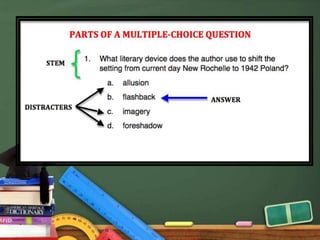
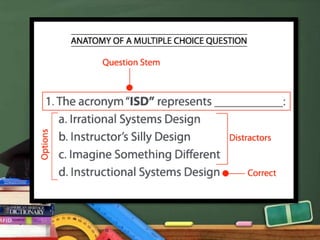
•STEM - question or incomplete statement or picture
•OPTIONS - suggested answers or completions
•DISTRACTERS - incorrect responses
•KEY - correct response
Advantages
•objective tests can sample a broad range of a course
•objective tests are rapidly marked
•students are not able to "bluff" or "pool" answers
•scoring is objective and reliable (e.g. no halo effect)
•distribution of scores is determined by the test - not by the
examiner
•only the objectives tested for are marked
•"good" items may be stored in an item bank and reused
Disadvantages
•objective tests are time consuming to set
•there is no credit for partial information
•objective tests may encourage guessing
•good objective tests are difficult to set
•student "selects" information
•objective tests may encourage reproduction learning
Limitations
•Difficult and time-consuming to write good items that
address thinking skills above the factual level
•The items are difficult to phrase so that all students
interpret them in the same way
•When students study for multiple choice tests, they focus
on recognition, not recall. Recent learning theories
indicate that students need to process information to really
learn it, so time spent studying for recognition is not as
effective as time spent working with information.
•By guessing, students who don’t know the answer have a
25% chance of correctly selecting the correct response in a
multiple choice item with 4 options. This decreases to
20% for items with 5 options, etc.
Options
In particular, the person constructing the test should AVOID
USING:
•serotyped or standard phrases which direct a student to the
correct answer
•unequal length of options where, in order to make the key
unambiguously correct, the examiner makes it obviously
longer than the distracters
• mutually exclusive options where, if one option is incorrect,
its opposite must be correct
• overlapping alternatives when one or more options is a subset
of another
• grammatical inconsistencies where options may be
disregarded because they are grammatically inconsistent with
the stem
• absolutes (never, always, only, none of the above, all of the
above). These options are usually incorrect
• the key in a different form from the distracters makes the
correct response more conspicuous
• double negatives - causes great confusion. Where negatives are
used they should only be used in the stem and should be
highlighted by printing in capitals or by underlining. "None of
the above" should only be used when it is important to conceal
a correct response which is easily recognized
Facility (F)
Facility (F) is the percentage of the class obtaining the
correct answer. In general:
if F < 30% the question is hard
if F = 30-75% the question is satisfactory
if F > 75% the question is easy
Writing Good Multiple Choice Test Questions
Multiple choice test questions, also known as items, can
be an effective and efficient way to assess learning outcomes.
Multiple choice test items have several potential advantages:
Versatility: Multiple choice test items can be written to
assess various levels of learning outcomes, from basic recall to
application, analysis, and evaluation. Because students are
choosing from a set of potential answers, however, there are
obvious limits on what can be tested with multiple choice items.
For example, they are not an effective way to test students’
ability to organize thoughts or articulate explanations or creative
ideas.
Reliability: is defined as the degree to which a test
consistently measures a learning outcome. Multiple choice test
items are less susceptible to guessing than true/false questions,
making them a more reliable means of assessment. The
reliability is enhanced when the number of MC items focused on
a single learning objective is increased. In addition, the
objective scoring associated with multiple choice test items frees
them from problems with scorer inconsistency that can plague
scoring of essay questions.
Validity: is the degree to which a test measures the learning
outcomes it purports to measure. Because students can typically
answer a multiple choice item much more quickly than an essay
question, tests based on multiple choice items can typically focus
on a relatively broad representation of course material, thus
increasing the validity of the assessment.
Multiple choice-questions

Multiple choice-questions

  • 1.
  • 2.
    Members Miss Wipaporn PortipNo.5681114010 Miss Salimah Tamhama No.5681114013 Miss Jantima Chuseang No.5681114014 Miss Theeranart Jansawat No.5681114061
  • 3.
    Multiple choice isa form of assessment in which respondents are asked to select the best possible answer out of the choices from a list. If guessing an answer, there's usually a 25 percent chance of getting it correct on a 4 answer choice question.
  • 4.
    Finding the rightanswer from multiple choices can be automated using multiple choice question answering systems. The multiple choice format is most frequently used in educational testing, in market research, and in elections, when a person chooses between multiple candidates, parties, or policies.
  • 5.
    History Although E. L.Thorndike developed an early multiple choice test, Frederick J. Kelly was the first to use such items as part of a large scale assessment. While Director of the Training School at Kansas State Normal School (now Emporia State University) in 1915, he developed and administered the Kansas Silent Reading Test.
  • 6.
    Soon after, Kellybecame the third Dean of the College of Education at the University of Kansas. The first all multiple choice, large scale assessment was the Army Alpha, used to assess the intelligence and more specifically the aptitudes of World War I military recruits. Multiple choice testing is particularly popular in the United States.
  • 7.
    Characteristics of multiple-choicequestions Multiple-choice Questions are probably the most widely used of objective tests. Such questions are normally composed of four parts: •STEM - question or incomplete statement or picture •OPTIONS - suggested answers or completions •DISTRACTERS - incorrect responses •KEY - correct response
  • 8.
    Advantages •objective tests cansample a broad range of a course •objective tests are rapidly marked •students are not able to "bluff" or "pool" answers
  • 9.
    •scoring is objectiveand reliable (e.g. no halo effect) •distribution of scores is determined by the test - not by the examiner •only the objectives tested for are marked •"good" items may be stored in an item bank and reused
  • 10.
    Disadvantages •objective tests aretime consuming to set •there is no credit for partial information •objective tests may encourage guessing •good objective tests are difficult to set •student "selects" information •objective tests may encourage reproduction learning
  • 11.
    Limitations •Difficult and time-consumingto write good items that address thinking skills above the factual level •The items are difficult to phrase so that all students interpret them in the same way
  • 12.
    •When students studyfor multiple choice tests, they focus on recognition, not recall. Recent learning theories indicate that students need to process information to really learn it, so time spent studying for recognition is not as effective as time spent working with information. •By guessing, students who don’t know the answer have a 25% chance of correctly selecting the correct response in a multiple choice item with 4 options. This decreases to 20% for items with 5 options, etc.
  • 13.
    Options In particular, theperson constructing the test should AVOID USING: •serotyped or standard phrases which direct a student to the correct answer •unequal length of options where, in order to make the key unambiguously correct, the examiner makes it obviously longer than the distracters
  • 14.
    • mutually exclusiveoptions where, if one option is incorrect, its opposite must be correct • overlapping alternatives when one or more options is a subset of another • grammatical inconsistencies where options may be disregarded because they are grammatically inconsistent with the stem • absolutes (never, always, only, none of the above, all of the above). These options are usually incorrect
  • 15.
    • the keyin a different form from the distracters makes the correct response more conspicuous • double negatives - causes great confusion. Where negatives are used they should only be used in the stem and should be highlighted by printing in capitals or by underlining. "None of the above" should only be used when it is important to conceal a correct response which is easily recognized
  • 16.
    Facility (F) Facility (F)is the percentage of the class obtaining the correct answer. In general: if F < 30% the question is hard if F = 30-75% the question is satisfactory if F > 75% the question is easy
  • 17.
    Writing Good MultipleChoice Test Questions Multiple choice test questions, also known as items, can be an effective and efficient way to assess learning outcomes. Multiple choice test items have several potential advantages:
  • 18.
    Versatility: Multiple choicetest items can be written to assess various levels of learning outcomes, from basic recall to application, analysis, and evaluation. Because students are choosing from a set of potential answers, however, there are obvious limits on what can be tested with multiple choice items. For example, they are not an effective way to test students’ ability to organize thoughts or articulate explanations or creative ideas.
  • 19.
    Reliability: is definedas the degree to which a test consistently measures a learning outcome. Multiple choice test items are less susceptible to guessing than true/false questions, making them a more reliable means of assessment. The reliability is enhanced when the number of MC items focused on a single learning objective is increased. In addition, the objective scoring associated with multiple choice test items frees them from problems with scorer inconsistency that can plague scoring of essay questions.
  • 20.
    Validity: is thedegree to which a test measures the learning outcomes it purports to measure. Because students can typically answer a multiple choice item much more quickly than an essay question, tests based on multiple choice items can typically focus on a relatively broad representation of course material, thus increasing the validity of the assessment.