TEPL WEBINAR “LEARNING THROUGH NETWORKS”
Nina Pataraia, PhD Candidate
Caledonian Academy, GCU
March 20, 2013
A general overview of SNA
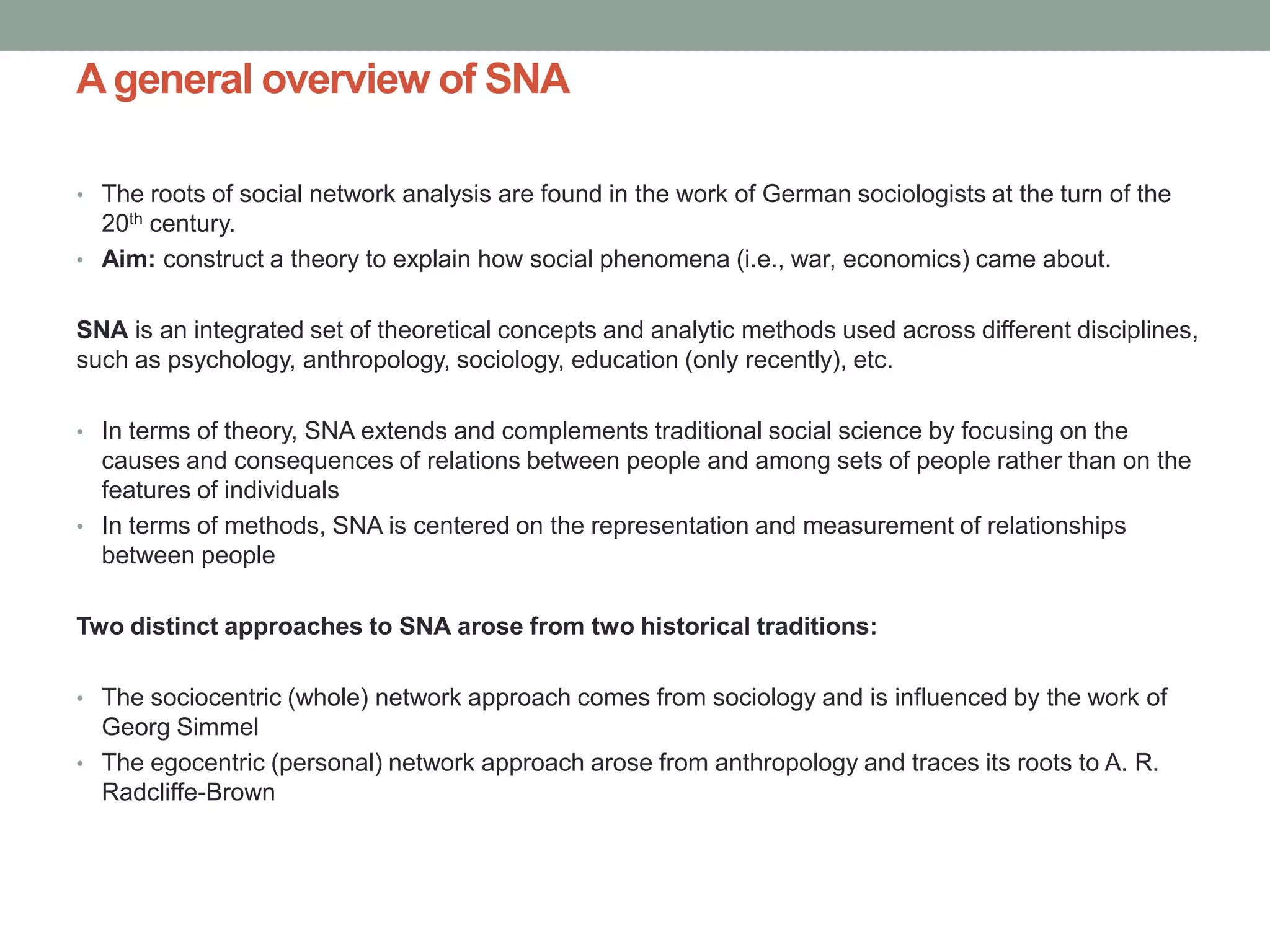
• The roots of social network analysis are found in the work of German sociologists at the turn of the
20th century.
• Aim: construct a theory to explain how social phenomena (i.e., war, economics) came about.
SNA is an integrated set of theoretical concepts and analytic methods used across different disciplines,
such as psychology, anthropology, sociology, education (only recently), etc.
• In terms of theory, SNA extends and complements traditional social science by focusing on the
causes and consequences of relations between people and among sets of people rather than on the
features of individuals
• In terms of methods, SNA is centered on the representation and measurement of relationships
between people
Two distinct approaches to SNA arose from two historical traditions:
• The sociocentric (whole) network approach comes from sociology and is influenced by the work of
Georg Simmel
• The egocentric (personal) network approach arose from anthropology and traces its roots to A. R.
Radcliffe-Brown
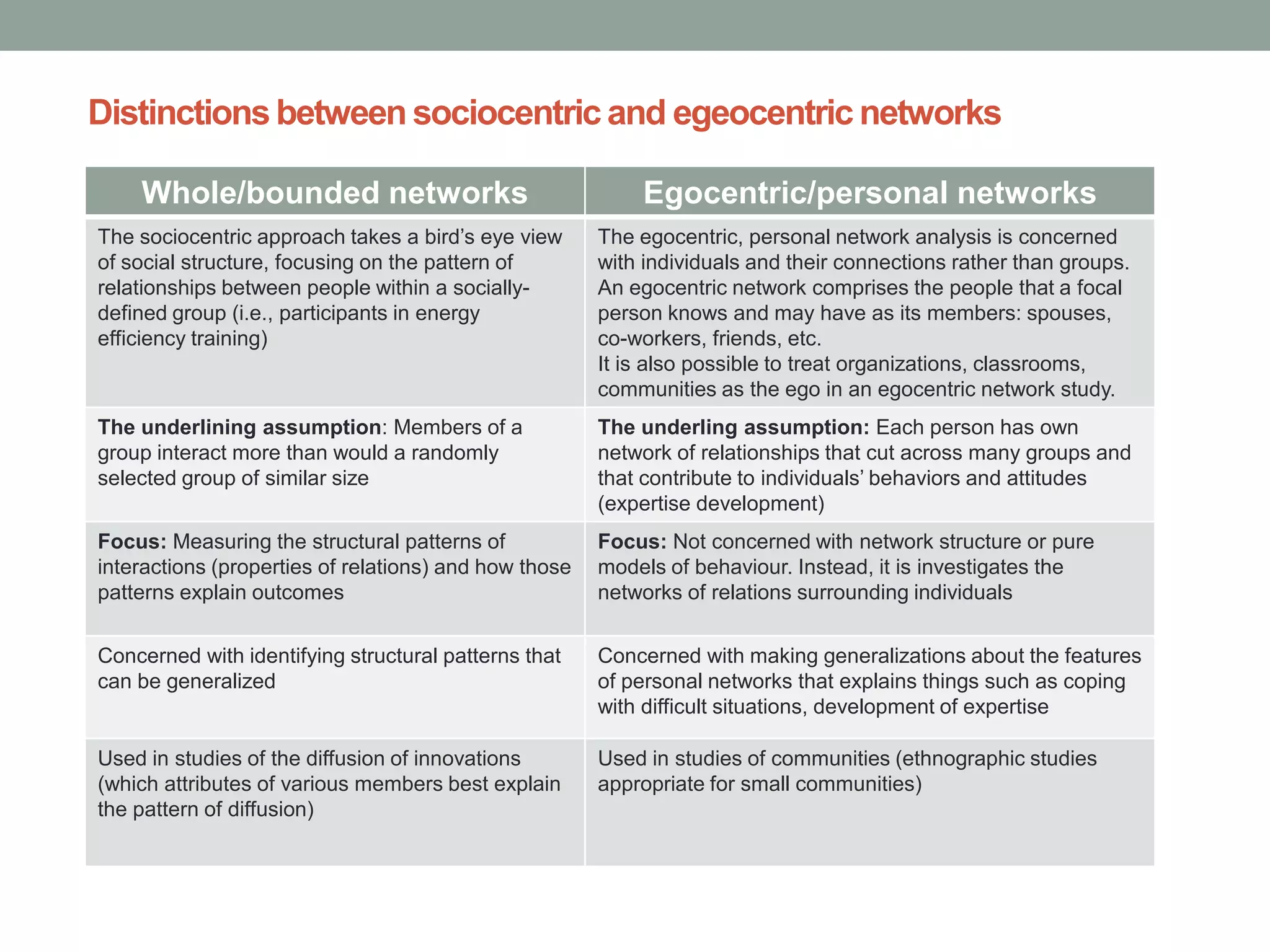
Distinctionsbetween sociocentric and egeocentric networks
Whole/bounded networks Egocentric/personal networks
The sociocentric approach takes a bird’s eye view
of social structure, focusing on the pattern of
relationships between people within a socially-
defined group (i.e., participants in energy
efficiency training)
The egocentric, personal network analysis is concerned
with individuals and their connections rather than groups.
An egocentric network comprises the people that a focal
person knows and may have as its members: spouses,
co-workers, friends, etc.
It is also possible to treat organizations, classrooms,
communities as the ego in an egocentric network study.
The underlining assumption: Members of a
group interact more than would a randomly
selected group of similar size
The underling assumption: Each person has own
network of relationships that cut across many groups and
that contribute to individuals’ behaviors and attitudes
(expertise development)
Focus: Measuring the structural patterns of
interactions (properties of relations) and how those
patterns explain outcomes
Focus: Not concerned with network structure or pure
models of behaviour. Instead, it is investigates the
networks of relations surrounding individuals
Concerned with identifying structural patterns that
can be generalized
Concerned with making generalizations about the features
of personal networks that explains things such as coping
with difficult situations, development of expertise
Used in studies of the diffusion of innovations
(which attributes of various members best explain
the pattern of diffusion)
Used in studies of communities (ethnographic studies
appropriate for small communities)
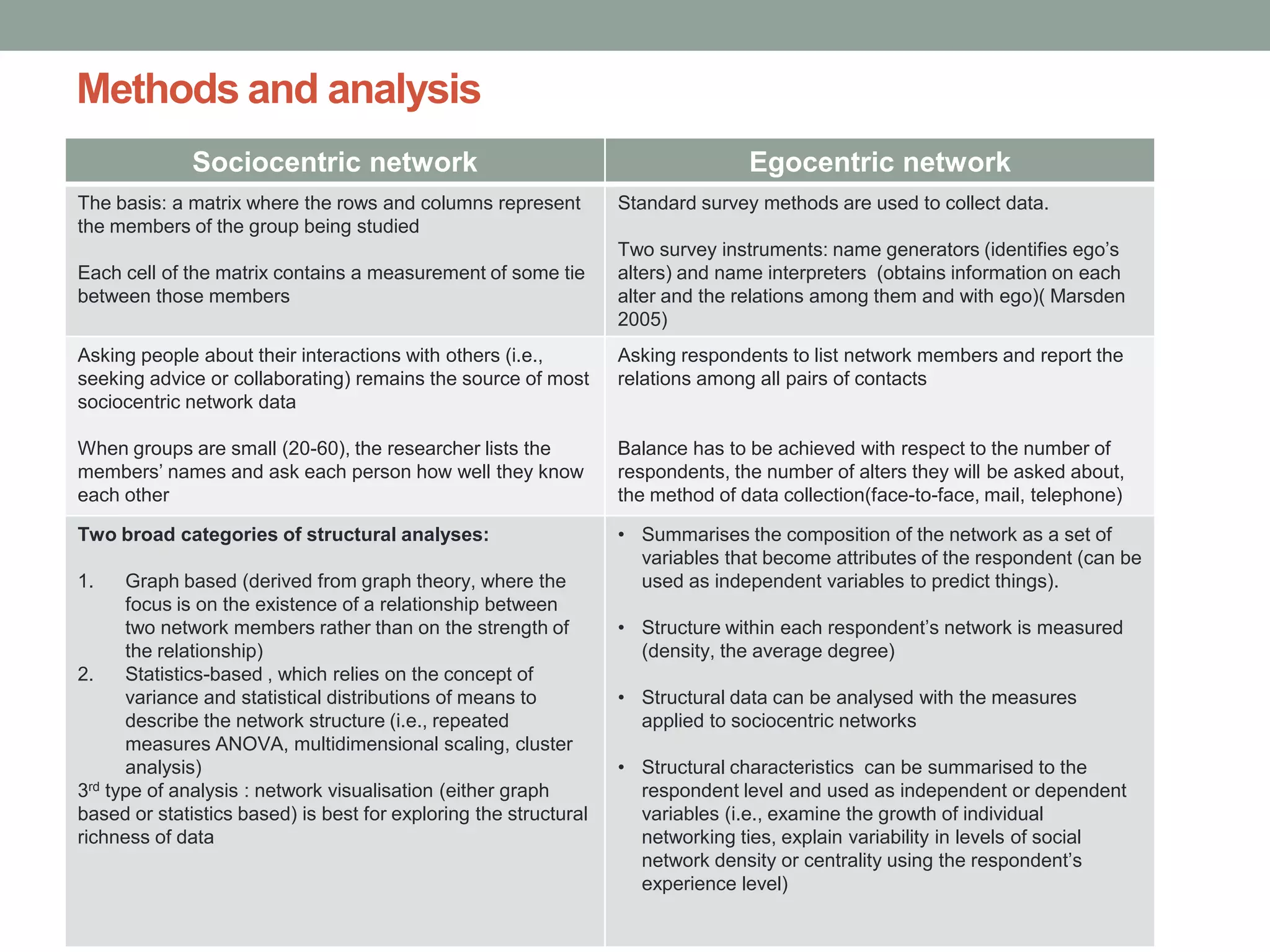
Methods and analysis
Sociocentric network Egocentric network
The basis: a matrix where the rows and columns represent
the members of the group being studied
Each cell of the matrix contains a measurement of some tie
between those members
Standard survey methods are used to collect data.
Two survey instruments: name generators (identifies ego’s
alters) and name interpreters (obtains information on each
alter and the relations among them and with ego)( Marsden
2005)
Asking people about their interactions with others (i.e.,
seeking advice or collaborating) remains the source of most
sociocentric network data
When groups are small (20-60), the researcher lists the
members’ names and ask each person how well they know
each other
Asking respondents to list network members and report the
relations among all pairs of contacts
Balance has to be achieved with respect to the number of
respondents, the number of alters they will be asked about,
the method of data collection(face-to-face, mail, telephone)
Two broad categories of structural analyses:
1. Graph based (derived from graph theory, where the
focus is on the existence of a relationship between
two network members rather than on the strength of
the relationship)
2. Statistics-based , which relies on the concept of
variance and statistical distributions of means to
describe the network structure (i.e., repeated
measures ANOVA, multidimensional scaling, cluster
analysis)
3rd type of analysis : network visualisation (either graph
based or statistics based) is best for exploring the structural
richness of data
• Summarises the composition of the network as a set of
variables that become attributes of the respondent (can be
used as independent variables to predict things).
• Structure within each respondent’s network is measured
(density, the average degree)
• Structural data can be analysed with the measures
applied to sociocentric networks
• Structural characteristics can be summarised to the
respondent level and used as independent or dependent
variables (i.e., examine the growth of individual
networking ties, explain variability in levels of social
network density or centrality using the respondent’s
experience level)
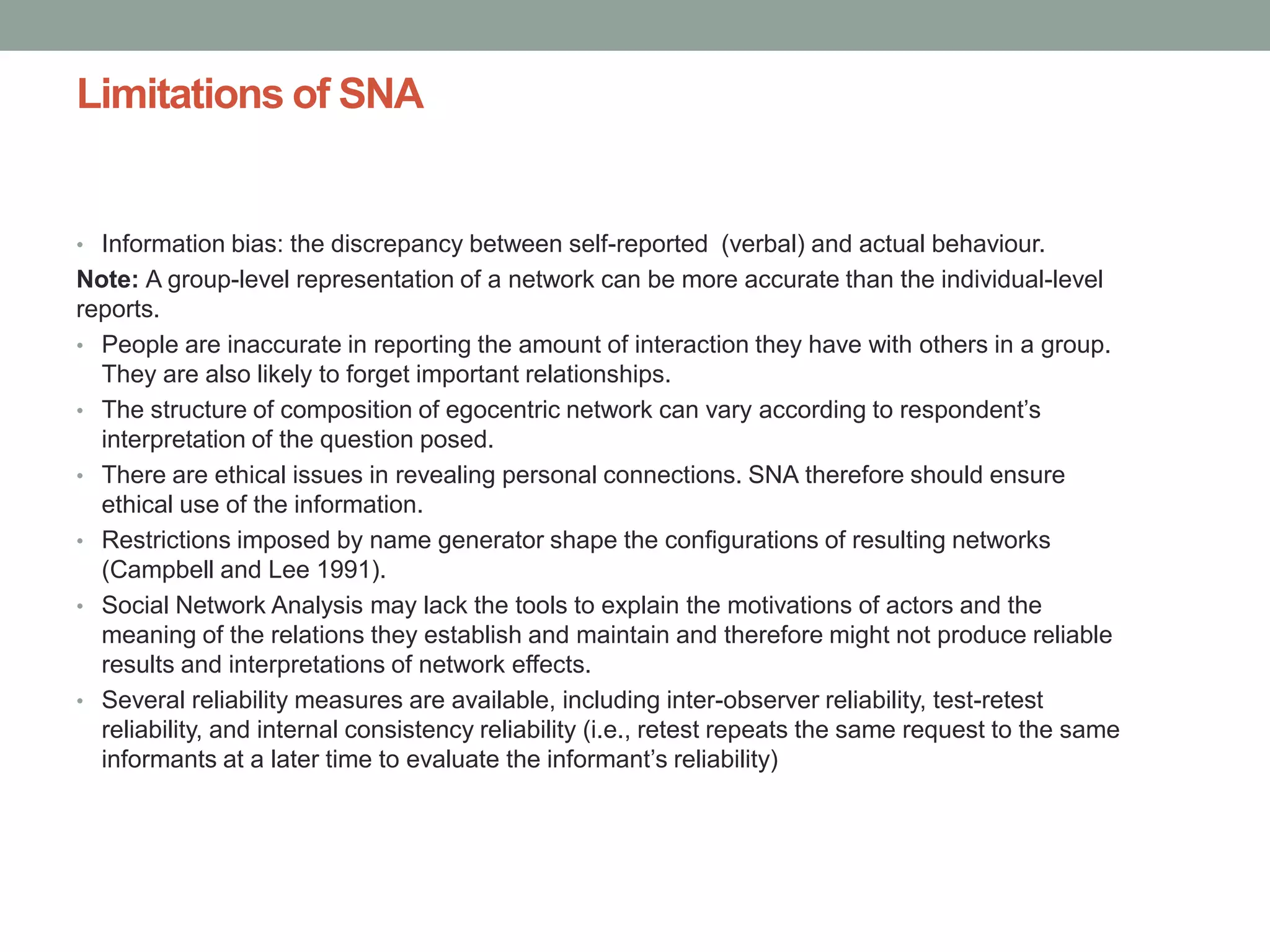
Limitations of SNA
• Information bias: the discrepancy between self-reported (verbal) and actual behaviour.
Note: A group-level representation of a network can be more accurate than the individual-level
reports.
• People are inaccurate in reporting the amount of interaction they have with others in a group.
They are also likely to forget important relationships.
• The structure of composition of egocentric network can vary according to respondent’s
interpretation of the question posed.
• There are ethical issues in revealing personal connections. SNA therefore should ensure
ethical use of the information.
• Restrictions imposed by name generator shape the configurations of resulting networks
(Campbell and Lee 1991).
• Social Network Analysis may lack the tools to explain the motivations of actors and the
meaning of the relations they establish and maintain and therefore might not produce reliable
results and interpretations of network effects.
• Several reliability measures are available, including inter-observer reliability, test-retest
reliability, and internal consistency reliability (i.e., retest repeats the same request to the same
informants at a later time to evaluate the informant’s reliability)
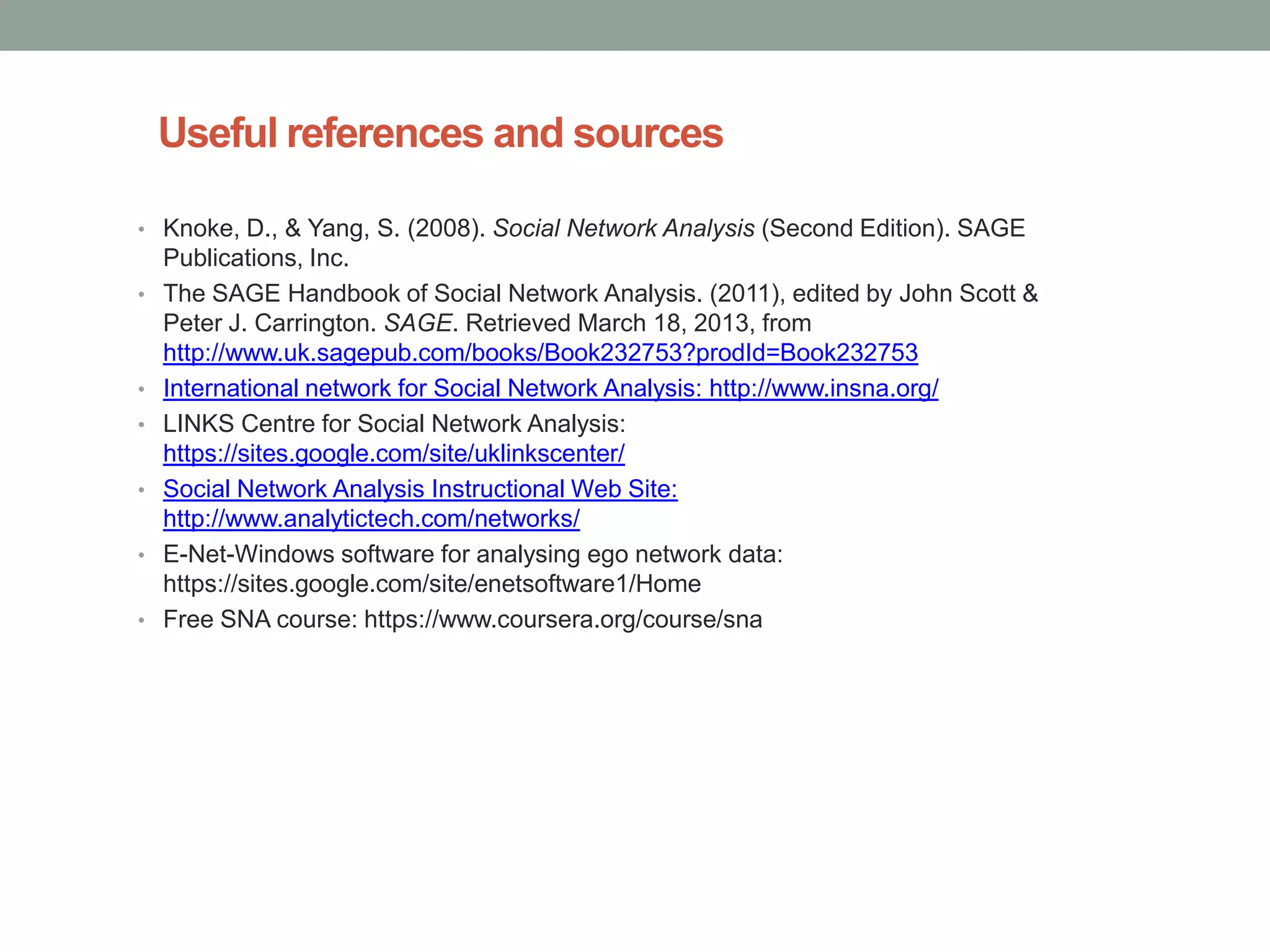
Useful references and sources
• Knoke, D., & Yang, S. (2008). Social Network Analysis (Second Edition). SAGE
Publications, Inc.
• The SAGE Handbook of Social Network Analysis. (2011), edited by John Scott &
Peter J. Carrington. SAGE. Retrieved March 18, 2013, from
http://www.uk.sagepub.com/books/Book232753?prodId=Book232753
• International network for Social Network Analysis: http://www.insna.org/
• LINKS Centre for Social Network Analysis:
https://sites.google.com/site/uklinkscenter/
• Social Network Analysis Instructional Web Site:
http://www.analytictech.com/networks/
• E-Net-Windows software for analysing ego network data:
https://sites.google.com/site/enetsoftware1/Home
• Free SNA course: https://www.coursera.org/course/sna

Tepl webinar 20032013

  • 1.
    TEPL WEBINAR “LEARNINGTHROUGH NETWORKS” Nina Pataraia, PhD Candidate Caledonian Academy, GCU March 20, 2013
  • 2.
    A general overviewof SNA • The roots of social network analysis are found in the work of German sociologists at the turn of the 20th century. • Aim: construct a theory to explain how social phenomena (i.e., war, economics) came about. SNA is an integrated set of theoretical concepts and analytic methods used across different disciplines, such as psychology, anthropology, sociology, education (only recently), etc. • In terms of theory, SNA extends and complements traditional social science by focusing on the causes and consequences of relations between people and among sets of people rather than on the features of individuals • In terms of methods, SNA is centered on the representation and measurement of relationships between people Two distinct approaches to SNA arose from two historical traditions: • The sociocentric (whole) network approach comes from sociology and is influenced by the work of Georg Simmel • The egocentric (personal) network approach arose from anthropology and traces its roots to A. R. Radcliffe-Brown
  • 3.
    Distinctionsbetween sociocentric andegeocentric networks Whole/bounded networks Egocentric/personal networks The sociocentric approach takes a bird’s eye view of social structure, focusing on the pattern of relationships between people within a socially- defined group (i.e., participants in energy efficiency training) The egocentric, personal network analysis is concerned with individuals and their connections rather than groups. An egocentric network comprises the people that a focal person knows and may have as its members: spouses, co-workers, friends, etc. It is also possible to treat organizations, classrooms, communities as the ego in an egocentric network study. The underlining assumption: Members of a group interact more than would a randomly selected group of similar size The underling assumption: Each person has own network of relationships that cut across many groups and that contribute to individuals’ behaviors and attitudes (expertise development) Focus: Measuring the structural patterns of interactions (properties of relations) and how those patterns explain outcomes Focus: Not concerned with network structure or pure models of behaviour. Instead, it is investigates the networks of relations surrounding individuals Concerned with identifying structural patterns that can be generalized Concerned with making generalizations about the features of personal networks that explains things such as coping with difficult situations, development of expertise Used in studies of the diffusion of innovations (which attributes of various members best explain the pattern of diffusion) Used in studies of communities (ethnographic studies appropriate for small communities)
  • 4.
    Methods and analysis Sociocentricnetwork Egocentric network The basis: a matrix where the rows and columns represent the members of the group being studied Each cell of the matrix contains a measurement of some tie between those members Standard survey methods are used to collect data. Two survey instruments: name generators (identifies ego’s alters) and name interpreters (obtains information on each alter and the relations among them and with ego)( Marsden 2005) Asking people about their interactions with others (i.e., seeking advice or collaborating) remains the source of most sociocentric network data When groups are small (20-60), the researcher lists the members’ names and ask each person how well they know each other Asking respondents to list network members and report the relations among all pairs of contacts Balance has to be achieved with respect to the number of respondents, the number of alters they will be asked about, the method of data collection(face-to-face, mail, telephone) Two broad categories of structural analyses: 1. Graph based (derived from graph theory, where the focus is on the existence of a relationship between two network members rather than on the strength of the relationship) 2. Statistics-based , which relies on the concept of variance and statistical distributions of means to describe the network structure (i.e., repeated measures ANOVA, multidimensional scaling, cluster analysis) 3rd type of analysis : network visualisation (either graph based or statistics based) is best for exploring the structural richness of data • Summarises the composition of the network as a set of variables that become attributes of the respondent (can be used as independent variables to predict things). • Structure within each respondent’s network is measured (density, the average degree) • Structural data can be analysed with the measures applied to sociocentric networks • Structural characteristics can be summarised to the respondent level and used as independent or dependent variables (i.e., examine the growth of individual networking ties, explain variability in levels of social network density or centrality using the respondent’s experience level)
  • 5.
    Limitations of SNA •Information bias: the discrepancy between self-reported (verbal) and actual behaviour. Note: A group-level representation of a network can be more accurate than the individual-level reports. • People are inaccurate in reporting the amount of interaction they have with others in a group. They are also likely to forget important relationships. • The structure of composition of egocentric network can vary according to respondent’s interpretation of the question posed. • There are ethical issues in revealing personal connections. SNA therefore should ensure ethical use of the information. • Restrictions imposed by name generator shape the configurations of resulting networks (Campbell and Lee 1991). • Social Network Analysis may lack the tools to explain the motivations of actors and the meaning of the relations they establish and maintain and therefore might not produce reliable results and interpretations of network effects. • Several reliability measures are available, including inter-observer reliability, test-retest reliability, and internal consistency reliability (i.e., retest repeats the same request to the same informants at a later time to evaluate the informant’s reliability)
  • 6.
    Useful references andsources • Knoke, D., & Yang, S. (2008). Social Network Analysis (Second Edition). SAGE Publications, Inc. • The SAGE Handbook of Social Network Analysis. (2011), edited by John Scott & Peter J. Carrington. SAGE. Retrieved March 18, 2013, from http://www.uk.sagepub.com/books/Book232753?prodId=Book232753 • International network for Social Network Analysis: http://www.insna.org/ • LINKS Centre for Social Network Analysis: https://sites.google.com/site/uklinkscenter/ • Social Network Analysis Instructional Web Site: http://www.analytictech.com/networks/ • E-Net-Windows software for analysing ego network data: https://sites.google.com/site/enetsoftware1/Home • Free SNA course: https://www.coursera.org/course/sna