CONSTRAINTS ON RELEVANCE
AND RELIABILITY OF ACCOUNTING
INFORMATION
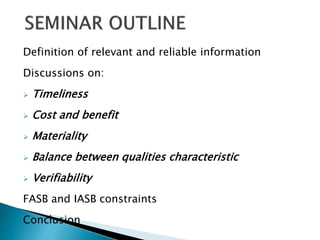
Definition of relevant and reliable information
Discussions on:
 Timeliness
 Cost and benefit
 Materiality
 Balance between qualities characteristic
 Verifiability
FASB and IASB constraints
Conclusion
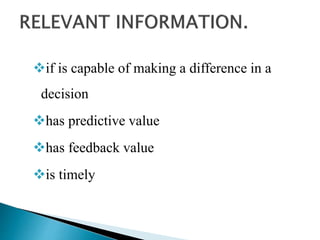
if is capable of making a difference in a
decision
has predictive value
has feedback value
is timely
 The degree of correspondence between what that
information conveys to users and the underlying
transactions
 Is verifiable; independent users can arrive at the same
conclusion
 Is a faithful representation of what actually happened
 Is neutral; free from bias
 having information available to decision
makers before it loses its capacity
 Lose its relevance if there is undue delay in it
being reported
 weigh the relative merits of timely reporting
and the provision of relevant and reliable
financial information
 how much will it cost to uphold the qualities of relevant and
reliability , what benefit will they get.
 The cost of providing information should not outweigh the
benefit derived
 Costs and benefits are not always obvious or quantifiable
 Different point of incidence of benefit and cost
 Sound judgement must be used in providing information
 E.g. hiring of external auditor, valuation of asset
 Information that can influence the decisions that
users make on the basis of an entity’s financial
information.
 it is not possible to specify a uniform quantitative
threshold
 cross road over qualitative and quantitative
materiality concept
 misstatements will result in information that is
incomplete, biased or not free from error
 appropriate balance among the
characteristics in order to meet the objective
of financial statements
 Information may be relevant but so unreliable
in nature or representation
 User specific constraint
 implies a consensus among different measurer
 impossible for every user to verify the
information provided
 Consider how a shareholder can verified the all
figures in income statement with its underlying
transaction.
 This limits external users’ reliability on financial
information.
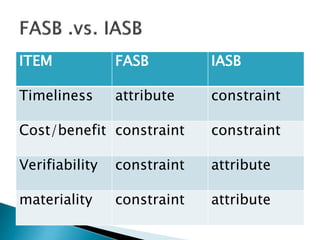
ITEM FASB IASB
Timeliness attribute constraint
Cost/benefit constraint constraint
Verifiability constraint attribute
materiality constraint attribute
As accounting theory is like cloud seen
differently by everyone so as its constituents
thus, these constraints can also be classified
as attributes depending on its application.
 Eldon S. Hendriksen, Accounting Theory
 Ahrmed Riahi-Belkaoui Accounting Theory
 Jawahar Lal, Accounting Theory and Practice,
Himalaya Publishing House, 2008
 Institute of Chartered Accountants, Australia
Qualitative Characteristic of Financial
Information I (SAC 3).
 Financial Accounting Standard Board Qualitative
Characteristic of Accounting Information I (CON 2
2008).
 International Accounting Standard Board
Qualitative Characteristic of Financial
Information I (Issue paper 2009).

constraints on relevant and reliable information

  • 1.
    CONSTRAINTS ON RELEVANCE ANDRELIABILITY OF ACCOUNTING INFORMATION
  • 2.
    Definition of relevantand reliable information Discussions on:  Timeliness  Cost and benefit  Materiality  Balance between qualities characteristic  Verifiability FASB and IASB constraints Conclusion
  • 3.
    if is capableof making a difference in a decision has predictive value has feedback value is timely
  • 4.
     The degreeof correspondence between what that information conveys to users and the underlying transactions  Is verifiable; independent users can arrive at the same conclusion  Is a faithful representation of what actually happened  Is neutral; free from bias
  • 5.
     having informationavailable to decision makers before it loses its capacity  Lose its relevance if there is undue delay in it being reported  weigh the relative merits of timely reporting and the provision of relevant and reliable financial information
  • 6.
     how muchwill it cost to uphold the qualities of relevant and reliability , what benefit will they get.  The cost of providing information should not outweigh the benefit derived  Costs and benefits are not always obvious or quantifiable  Different point of incidence of benefit and cost  Sound judgement must be used in providing information  E.g. hiring of external auditor, valuation of asset
  • 7.
     Information thatcan influence the decisions that users make on the basis of an entity’s financial information.  it is not possible to specify a uniform quantitative threshold  cross road over qualitative and quantitative materiality concept  misstatements will result in information that is incomplete, biased or not free from error
  • 8.
     appropriate balanceamong the characteristics in order to meet the objective of financial statements  Information may be relevant but so unreliable in nature or representation
  • 9.
     User specificconstraint  implies a consensus among different measurer  impossible for every user to verify the information provided  Consider how a shareholder can verified the all figures in income statement with its underlying transaction.  This limits external users’ reliability on financial information.
  • 10.
    ITEM FASB IASB Timelinessattribute constraint Cost/benefit constraint constraint Verifiability constraint attribute materiality constraint attribute
  • 11.
    As accounting theoryis like cloud seen differently by everyone so as its constituents thus, these constraints can also be classified as attributes depending on its application.
  • 12.
     Eldon S.Hendriksen, Accounting Theory  Ahrmed Riahi-Belkaoui Accounting Theory  Jawahar Lal, Accounting Theory and Practice, Himalaya Publishing House, 2008  Institute of Chartered Accountants, Australia Qualitative Characteristic of Financial Information I (SAC 3).  Financial Accounting Standard Board Qualitative Characteristic of Accounting Information I (CON 2 2008).  International Accounting Standard Board Qualitative Characteristic of Financial Information I (Issue paper 2009).