Chapter
2-1
Chapter
2-2
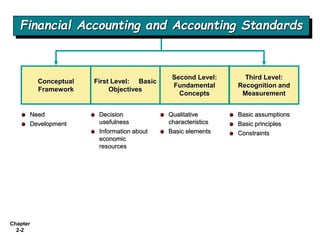
Decision
usefulness
Information about
economic
resources
Conceptual
Framework
First Level: Basic
Objectives
Second Level:
Fundamental
Concepts
Third Level:
Recognition and
Measurement
Need
Development
Qualitative
characteristics
Basic elements
Basic assumptions
Basic principles
Constraints
Financial Accounting and Accounting Standards
Chapter
2-3
Conceptual Framework
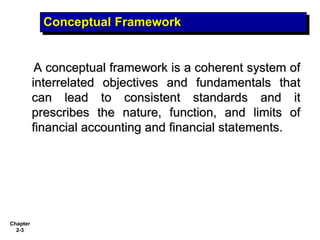
A conceptual framework is a coherent system of
interrelated objectives and fundamentals that
can lead to consistent standards and it
prescribes the nature, function, and limits of
financial accounting and financial statements.
Chapter
2-4
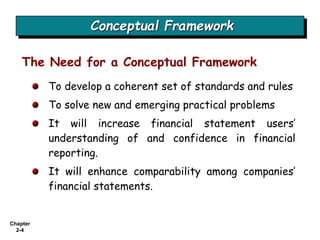
The Need for a Conceptual Framework
To develop a coherent set of standards and rules
To solve new and emerging practical problems
It will increase financial statement users’
understanding of and confidence in financial
reporting.
It will enhance comparability among companies’
financial statements.
Conceptual Framework
Chapter
2-5 Objective 2
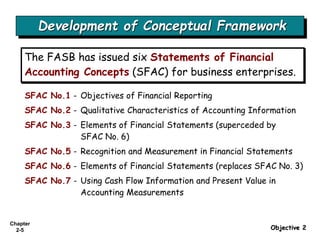
The FASB has issued six Statements of Financial
Accounting Concepts (SFAC) for business enterprises.
Development of Conceptual Framework
SFAC No.1 - Objectives of Financial Reporting
SFAC No.2 - Qualitative Characteristics of Accounting Information
SFAC No.3 - Elements of Financial Statements (superceded by
SFAC No. 6)
SFAC No.5 - Recognition and Measurement in Financial Statements
SFAC No.6 - Elements of Financial Statements (replaces SFAC No. 3)
SFAC No.7 - Using Cash Flow Information and Present Value in
Accounting Measurements
Chapter
2-6
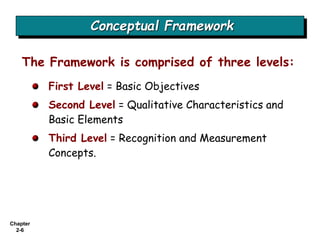
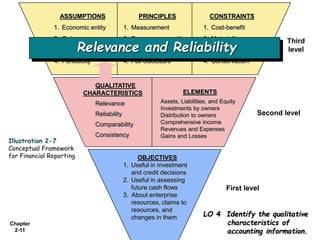
The Framework is comprised of three levels:
First Level = Basic Objectives
Second Level = Qualitative Characteristics and
Basic Elements
Third Level = Recognition and Measurement
Concepts.
Conceptual Framework
Chapter
2-7
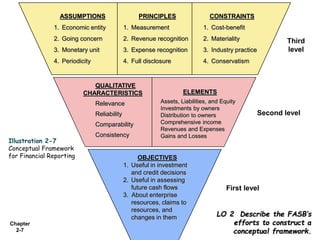
ASSUMPTIONS
1. Economic entity
2. Going concern
3. Monetary unit
4. Periodicity
PRINCIPLES
1. Measurement
2. Revenue recognition
3. Expense recognition
4. Full disclosure
CONSTRAINTS
1. Cost-benefit
2. Materiality
3. Industry practice
4. Conservatism
OBJECTIVES
1. Useful in investment
and credit decisions
2. Useful in assessing
future cash flows
3. About enterprise
resources, claims to
resources, and
changes in them
ELEMENTS
Assets, Liabilities, and Equity
Investments by owners
Distribution to owners
Comprehensive income
Revenues and Expenses
Gains and Losses
Illustration 2-7
Conceptual Framework
for Financial Reporting
First level
Second level
Third
level
LO 2 Describe the FASB’s
efforts to construct a
conceptual framework.
QUALITATIVE
CHARACTERISTICS
Relevance
Reliability
Comparability
Consistency
Chapter
2-8
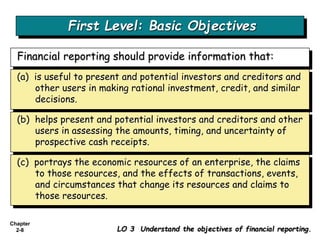
Financial reporting should provide information that:
(a) is useful to present and potential investors and creditors and
other users in making rational investment, credit, and similar
decisions.
(b) helps present and potential investors and creditors and other
users in assessing the amounts, timing, and uncertainty of
prospective cash receipts.
(c) portrays the economic resources of an enterprise, the claims
to those resources, and the effects of transactions, events,
and circumstances that change its resources and claims to
those resources.
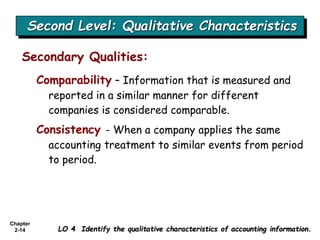
First Level: Basic Objectives
LO 3 Understand the objectives of financial reporting.
Chapter
2-9
Qualitative Characteristics
“The FASB identified the Qualitative Characteristics
of accounting information that distinguish better
(more useful) information from inferior (less useful)
information for decision-making purposes.”
Second Level: Fundamental Concepts
LO 4 Identify the qualitative characteristics of accounting information.
Chapter
2-10
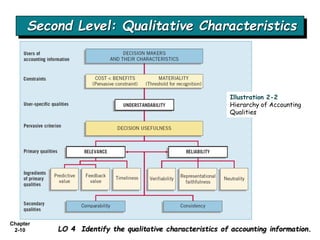
Second Level: Qualitative Characteristics
LO 4 Identify the qualitative characteristics of accounting information.
Illustration 2-2
Hierarchy of Accounting
Qualities
Chapter
2-11
ASSUMPTIONS
1. Economic entity
2. Going concern
3. Monetary unit
4. Periodicity
CONSTRAINTS
1. Cost-benefit
2. Materiality
3. Industry practice
4. Conservatism
OBJECTIVES
1. Useful in investment
and credit decisions
2. Useful in assessing
future cash flows
3. About enterprise
resources, claims to
resources, and
changes in them
QUALITATIVE
CHARACTERISTICS
Relevance
Reliability
Comparability
Consistency
ELEMENTS
Assets, Liabilities, and Equity
Investments by owners
Distribution to owners
Comprehensive income
Revenues and Expenses
Gains and Losses
Illustration 2-7
Conceptual Framework
for Financial Reporting
First level
Second level
Third
level
LO 4 Identify the qualitative
characteristics of
accounting information.
PRINCIPLES
1. Measurement
2. Revenue recognition
3. Expense recognition
4. Full disclosure
Relevance and Reliability
Chapter
2-12 LO 4
Second Level: Qualitative Characteristics
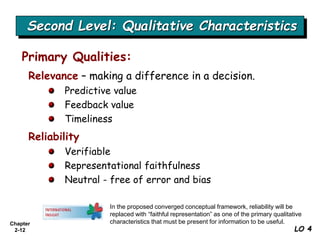
Primary Qualities:
Relevance – making a difference in a decision.
Predictive value
Feedback value
Timeliness
Reliability
Verifiable
Representational faithfulness
Neutral - free of error and bias
In the proposed converged conceptual framework, reliability will be
replaced with “faithful representation” as one of the primary qualitative
characteristics that must be present for information to be useful.
Chapter
2-13
ASSUMPTIONS
1. Economic entity
2. Going concern
3. Monetary unit
4. Periodicity
CONSTRAINTS
1. Cost-benefit
2. Materiality
3. Industry practice
4. Conservatism
OBJECTIVES
1. Useful in investment
and credit decisions
2. Useful in assessing
future cash flows
3. About enterprise
resources, claims to
resources, and
changes in them
QUALITATIVE
CHARACTERISTICS
Relevance
Reliability
Comparability
Consistency
ELEMENTS
Assets, Liabilities, and Equity
Investments by owners
Distribution to owners
Comprehensive income
Revenues and Expenses
Gains and Losses
First level
Second level
Third
level
LO 4 Identify the qualitative
characteristics of
accounting information.
Illustration 2-7
Conceptual Framework
for Financial Reporting
PRINCIPLES
1. Measurement
2. Revenue recognition
3. Expense recognition
4. Full disclosure
Comparability and Consistency
Chapter
2-14 LO 4 Identify the qualitative characteristics of accounting information.
Second Level: Qualitative Characteristics
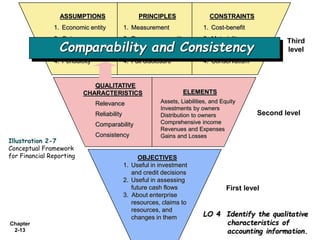
Secondary Qualities:
Comparability – Information that is measured and
reported in a similar manner for different
companies is considered comparable.
Consistency - When a company applies the same
accounting treatment to similar events from period
to period.
Chapter
2-15
ASSUMPTIONS
1. Economic entity
2. Going concern
3. Monetary unit
4. Periodicity
CONSTRAINTS
1. Cost-benefit
2. Materiality
3. Industry practice
4. Conservatism
OBJECTIVES
1. Useful in investment
and credit decisions
2. Useful in assessing
future cash flows
3. About enterprise
resources, claims to
resources, and
changes in them
QUALITATIVE
CHARACTERISTICS
Relevance
Reliability
Comparability
Consistency
ELEMENTS
Assets, Liabilities, and Equity
Investments by owners
Distribution to owners
Comprehensive income
Revenues and Expenses
Gains and Losses
First level
Second level
Third
level
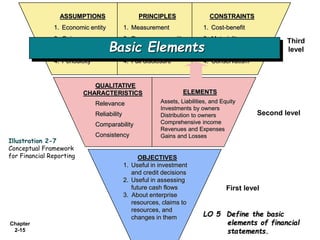
LO 5 Define the basic
elements of financial
statements.
Illustration 2-7
Conceptual Framework
for Financial Reporting
PRINCIPLES
1. Measurement
2. Revenue recognition
3. Expense recognition
4. Full disclosure
Basic Elements
Chapter
2-16
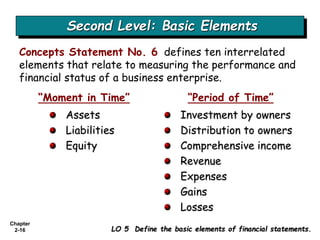
Investment by owners
Distribution to owners
Comprehensive income
Revenue
Expenses
Gains
Losses
Second Level: Basic Elements
Concepts Statement No. 6 defines ten interrelated
elements that relate to measuring the performance and
financial status of a business enterprise.
Assets
Liabilities
Equity
“Moment in Time” “Period of Time”
LO 5 Define the basic elements of financial statements.
Chapter
2-17
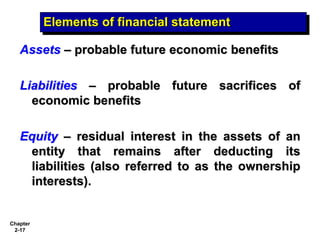
Elements of financial statement
Assets – probable future economic benefits
Liabilities – probable future sacrifices of
economic benefits
Equity – residual interest in the assets of an
entity that remains after deducting its
liabilities (also referred to as the ownership
interests).
Chapter
2-18
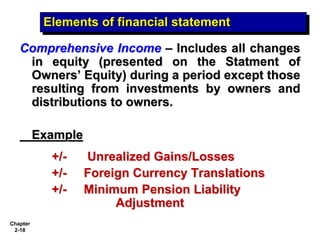
Elements of financial statement
Comprehensive Income – Includes all changes
in equity (presented on the Statment of
Owners’ Equity) during a period except those
resulting from investments by owners and
distributions to owners.
Example
+/- Unrealized Gains/Losses
+/- Foreign Currency Translations
+/- Minimum Pension Liability
Adjustment
Chapter
2-19
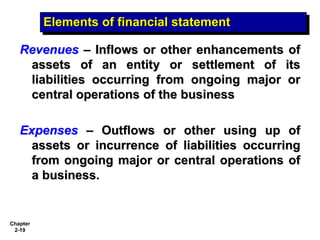
Elements of financial statement
Revenues – Inflows or other enhancements of
assets of an entity or settlement of its
liabilities occurring from ongoing major or
central operations of the business
Expenses – Outflows or other using up of
assets or incurrence of liabilities occurring
from ongoing major or central operations of
a business.
Chapter
2-20
Elements of financial statement
Gains – Increases in equity (net assets) from
peripheral or incidental transactions of an
entity.
Losses – Decreases in equity (net assets) from
peripheral or incidental transactions of an
entity.
(ex. Gains/Losses from sale of an operational
asset, or gains/losses from settlement of a
lawsuit)
Chapter
2-21
Elements of financial statement
Investment by owners: increase in net assets
of a particular enterprise resulting from
transfers to it from other entities of
something of value to obtain or increase
ownership interests in it.
Distributions to owners: decrease in net assets
of a particular enterprise resulting from
transferring assets, rendering services, or
incurring liabilities by the enterprise to
owners.
Chapter
2-22
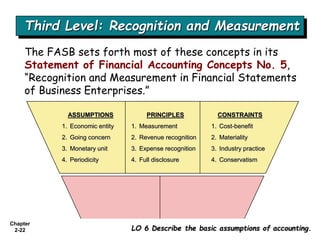
Third Level: Recognition and Measurement
The FASB sets forth most of these concepts in its
Statement of Financial Accounting Concepts No. 5,
“Recognition and Measurement in Financial Statements
of Business Enterprises.”
ASSUMPTIONS
1. Economic entity
2. Going concern
3. Monetary unit
4. Periodicity
PRINCIPLES
1. Measurement
2. Revenue recognition
3. Expense recognition
4. Full disclosure
CONSTRAINTS
1. Cost-benefit
2. Materiality
3. Industry practice
4. Conservatism
LO 6 Describe the basic assumptions of accounting.
Chapter
2-23
Economic Entity – company keeps its activity
separate from its owners and other businesses.
Going Concern - company to last long enough to fulfill
objectives and commitments.
Monetary Unit - money is the common denominator.
Periodicity - company can divide its economic
activities into time periods.
Third Level: Assumptions
LO 6 Describe the basic assumptions of accounting.
Chapter
2-24
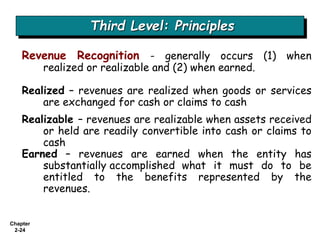
Revenue Recognition - generally occurs (1) when
realized or realizable and (2) when earned.
Realized – revenues are realized when goods or services
are exchanged for cash or claims to cash
Realizable – revenues are realizable when assets received
or held are readily convertible into cash or claims to
cash
Earned – revenues are earned when the entity has
substantially accomplished what it must do to be
entitled to the benefits represented by the
revenues.
Third Level: Principles
Chapter
2-25
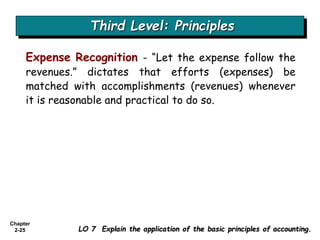
Expense Recognition - “Let the expense follow the
revenues.” dictates that efforts (expenses) be
matched with accomplishments (revenues) whenever
it is reasonable and practical to do so.
Third Level: Principles
LO 7 Explain the application of the basic principles of accounting.
Chapter
2-26
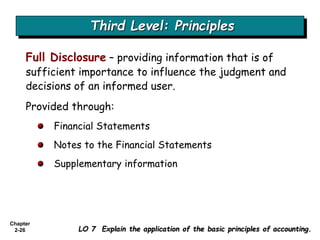
Full Disclosure – providing information that is of
sufficient importance to influence the judgment and
decisions of an informed user.
Provided through:
Financial Statements
Notes to the Financial Statements
Supplementary information
Third Level: Principles
LO 7 Explain the application of the basic principles of accounting.
Chapter
2-27
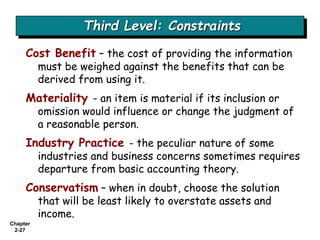
Cost Benefit – the cost of providing the information
must be weighed against the benefits that can be
derived from using it.
Materiality - an item is material if its inclusion or
omission would influence or change the judgment of
a reasonable person.
Industry Practice - the peculiar nature of some
industries and business concerns sometimes requires
departure from basic accounting theory.
Conservatism – when in doubt, choose the solution
that will be least likely to overstate assets and
income.
Third Level: Constraints

conceptual framework.ppt

  • 1.
  • 2.
    Chapter 2-2 Decision usefulness Information about economic resources Conceptual Framework First Level:Basic Objectives Second Level: Fundamental Concepts Third Level: Recognition and Measurement Need Development Qualitative characteristics Basic elements Basic assumptions Basic principles Constraints Financial Accounting and Accounting Standards
  • 3.
    Chapter 2-3 Conceptual Framework A conceptualframework is a coherent system of interrelated objectives and fundamentals that can lead to consistent standards and it prescribes the nature, function, and limits of financial accounting and financial statements.
  • 4.
    Chapter 2-4 The Need fora Conceptual Framework To develop a coherent set of standards and rules To solve new and emerging practical problems It will increase financial statement users’ understanding of and confidence in financial reporting. It will enhance comparability among companies’ financial statements. Conceptual Framework
  • 5.
    Chapter 2-5 Objective 2 TheFASB has issued six Statements of Financial Accounting Concepts (SFAC) for business enterprises. Development of Conceptual Framework SFAC No.1 - Objectives of Financial Reporting SFAC No.2 - Qualitative Characteristics of Accounting Information SFAC No.3 - Elements of Financial Statements (superceded by SFAC No. 6) SFAC No.5 - Recognition and Measurement in Financial Statements SFAC No.6 - Elements of Financial Statements (replaces SFAC No. 3) SFAC No.7 - Using Cash Flow Information and Present Value in Accounting Measurements
  • 6.
    Chapter 2-6 The Framework iscomprised of three levels: First Level = Basic Objectives Second Level = Qualitative Characteristics and Basic Elements Third Level = Recognition and Measurement Concepts. Conceptual Framework
  • 7.
    Chapter 2-7 ASSUMPTIONS 1. Economic entity 2.Going concern 3. Monetary unit 4. Periodicity PRINCIPLES 1. Measurement 2. Revenue recognition 3. Expense recognition 4. Full disclosure CONSTRAINTS 1. Cost-benefit 2. Materiality 3. Industry practice 4. Conservatism OBJECTIVES 1. Useful in investment and credit decisions 2. Useful in assessing future cash flows 3. About enterprise resources, claims to resources, and changes in them ELEMENTS Assets, Liabilities, and Equity Investments by owners Distribution to owners Comprehensive income Revenues and Expenses Gains and Losses Illustration 2-7 Conceptual Framework for Financial Reporting First level Second level Third level LO 2 Describe the FASB’s efforts to construct a conceptual framework. QUALITATIVE CHARACTERISTICS Relevance Reliability Comparability Consistency
  • 8.
    Chapter 2-8 Financial reporting shouldprovide information that: (a) is useful to present and potential investors and creditors and other users in making rational investment, credit, and similar decisions. (b) helps present and potential investors and creditors and other users in assessing the amounts, timing, and uncertainty of prospective cash receipts. (c) portrays the economic resources of an enterprise, the claims to those resources, and the effects of transactions, events, and circumstances that change its resources and claims to those resources. First Level: Basic Objectives LO 3 Understand the objectives of financial reporting.
  • 9.
    Chapter 2-9 Qualitative Characteristics “The FASBidentified the Qualitative Characteristics of accounting information that distinguish better (more useful) information from inferior (less useful) information for decision-making purposes.” Second Level: Fundamental Concepts LO 4 Identify the qualitative characteristics of accounting information.
  • 10.
    Chapter 2-10 Second Level: QualitativeCharacteristics LO 4 Identify the qualitative characteristics of accounting information. Illustration 2-2 Hierarchy of Accounting Qualities
  • 11.
    Chapter 2-11 ASSUMPTIONS 1. Economic entity 2.Going concern 3. Monetary unit 4. Periodicity CONSTRAINTS 1. Cost-benefit 2. Materiality 3. Industry practice 4. Conservatism OBJECTIVES 1. Useful in investment and credit decisions 2. Useful in assessing future cash flows 3. About enterprise resources, claims to resources, and changes in them QUALITATIVE CHARACTERISTICS Relevance Reliability Comparability Consistency ELEMENTS Assets, Liabilities, and Equity Investments by owners Distribution to owners Comprehensive income Revenues and Expenses Gains and Losses Illustration 2-7 Conceptual Framework for Financial Reporting First level Second level Third level LO 4 Identify the qualitative characteristics of accounting information. PRINCIPLES 1. Measurement 2. Revenue recognition 3. Expense recognition 4. Full disclosure Relevance and Reliability
  • 12.
    Chapter 2-12 LO 4 SecondLevel: Qualitative Characteristics Primary Qualities: Relevance – making a difference in a decision. Predictive value Feedback value Timeliness Reliability Verifiable Representational faithfulness Neutral - free of error and bias In the proposed converged conceptual framework, reliability will be replaced with “faithful representation” as one of the primary qualitative characteristics that must be present for information to be useful.
  • 13.
    Chapter 2-13 ASSUMPTIONS 1. Economic entity 2.Going concern 3. Monetary unit 4. Periodicity CONSTRAINTS 1. Cost-benefit 2. Materiality 3. Industry practice 4. Conservatism OBJECTIVES 1. Useful in investment and credit decisions 2. Useful in assessing future cash flows 3. About enterprise resources, claims to resources, and changes in them QUALITATIVE CHARACTERISTICS Relevance Reliability Comparability Consistency ELEMENTS Assets, Liabilities, and Equity Investments by owners Distribution to owners Comprehensive income Revenues and Expenses Gains and Losses First level Second level Third level LO 4 Identify the qualitative characteristics of accounting information. Illustration 2-7 Conceptual Framework for Financial Reporting PRINCIPLES 1. Measurement 2. Revenue recognition 3. Expense recognition 4. Full disclosure Comparability and Consistency
  • 14.
    Chapter 2-14 LO 4Identify the qualitative characteristics of accounting information. Second Level: Qualitative Characteristics Secondary Qualities: Comparability – Information that is measured and reported in a similar manner for different companies is considered comparable. Consistency - When a company applies the same accounting treatment to similar events from period to period.
  • 15.
    Chapter 2-15 ASSUMPTIONS 1. Economic entity 2.Going concern 3. Monetary unit 4. Periodicity CONSTRAINTS 1. Cost-benefit 2. Materiality 3. Industry practice 4. Conservatism OBJECTIVES 1. Useful in investment and credit decisions 2. Useful in assessing future cash flows 3. About enterprise resources, claims to resources, and changes in them QUALITATIVE CHARACTERISTICS Relevance Reliability Comparability Consistency ELEMENTS Assets, Liabilities, and Equity Investments by owners Distribution to owners Comprehensive income Revenues and Expenses Gains and Losses First level Second level Third level LO 5 Define the basic elements of financial statements. Illustration 2-7 Conceptual Framework for Financial Reporting PRINCIPLES 1. Measurement 2. Revenue recognition 3. Expense recognition 4. Full disclosure Basic Elements
  • 16.
    Chapter 2-16 Investment by owners Distributionto owners Comprehensive income Revenue Expenses Gains Losses Second Level: Basic Elements Concepts Statement No. 6 defines ten interrelated elements that relate to measuring the performance and financial status of a business enterprise. Assets Liabilities Equity “Moment in Time” “Period of Time” LO 5 Define the basic elements of financial statements.
  • 17.
    Chapter 2-17 Elements of financialstatement Assets – probable future economic benefits Liabilities – probable future sacrifices of economic benefits Equity – residual interest in the assets of an entity that remains after deducting its liabilities (also referred to as the ownership interests).
  • 18.
    Chapter 2-18 Elements of financialstatement Comprehensive Income – Includes all changes in equity (presented on the Statment of Owners’ Equity) during a period except those resulting from investments by owners and distributions to owners. Example +/- Unrealized Gains/Losses +/- Foreign Currency Translations +/- Minimum Pension Liability Adjustment
  • 19.
    Chapter 2-19 Elements of financialstatement Revenues – Inflows or other enhancements of assets of an entity or settlement of its liabilities occurring from ongoing major or central operations of the business Expenses – Outflows or other using up of assets or incurrence of liabilities occurring from ongoing major or central operations of a business.
  • 20.
    Chapter 2-20 Elements of financialstatement Gains – Increases in equity (net assets) from peripheral or incidental transactions of an entity. Losses – Decreases in equity (net assets) from peripheral or incidental transactions of an entity. (ex. Gains/Losses from sale of an operational asset, or gains/losses from settlement of a lawsuit)
  • 21.
    Chapter 2-21 Elements of financialstatement Investment by owners: increase in net assets of a particular enterprise resulting from transfers to it from other entities of something of value to obtain or increase ownership interests in it. Distributions to owners: decrease in net assets of a particular enterprise resulting from transferring assets, rendering services, or incurring liabilities by the enterprise to owners.
  • 22.
    Chapter 2-22 Third Level: Recognitionand Measurement The FASB sets forth most of these concepts in its Statement of Financial Accounting Concepts No. 5, “Recognition and Measurement in Financial Statements of Business Enterprises.” ASSUMPTIONS 1. Economic entity 2. Going concern 3. Monetary unit 4. Periodicity PRINCIPLES 1. Measurement 2. Revenue recognition 3. Expense recognition 4. Full disclosure CONSTRAINTS 1. Cost-benefit 2. Materiality 3. Industry practice 4. Conservatism LO 6 Describe the basic assumptions of accounting.
  • 23.
    Chapter 2-23 Economic Entity –company keeps its activity separate from its owners and other businesses. Going Concern - company to last long enough to fulfill objectives and commitments. Monetary Unit - money is the common denominator. Periodicity - company can divide its economic activities into time periods. Third Level: Assumptions LO 6 Describe the basic assumptions of accounting.
  • 24.
    Chapter 2-24 Revenue Recognition -generally occurs (1) when realized or realizable and (2) when earned. Realized – revenues are realized when goods or services are exchanged for cash or claims to cash Realizable – revenues are realizable when assets received or held are readily convertible into cash or claims to cash Earned – revenues are earned when the entity has substantially accomplished what it must do to be entitled to the benefits represented by the revenues. Third Level: Principles
  • 25.
    Chapter 2-25 Expense Recognition -“Let the expense follow the revenues.” dictates that efforts (expenses) be matched with accomplishments (revenues) whenever it is reasonable and practical to do so. Third Level: Principles LO 7 Explain the application of the basic principles of accounting.
  • 26.
    Chapter 2-26 Full Disclosure –providing information that is of sufficient importance to influence the judgment and decisions of an informed user. Provided through: Financial Statements Notes to the Financial Statements Supplementary information Third Level: Principles LO 7 Explain the application of the basic principles of accounting.
  • 27.
    Chapter 2-27 Cost Benefit –the cost of providing the information must be weighed against the benefits that can be derived from using it. Materiality - an item is material if its inclusion or omission would influence or change the judgment of a reasonable person. Industry Practice - the peculiar nature of some industries and business concerns sometimes requires departure from basic accounting theory. Conservatism – when in doubt, choose the solution that will be least likely to overstate assets and income. Third Level: Constraints

Editor's Notes

  • #3 Service Cost - Actuaries compute service cost as the present value of the new benefits earned by employees during the year. Future salary levels considered in calculation. Interest on Liability - Interest accrues each year on the PBO just as it does on any discounted debt. Actual Return on Plan Assets - Increase in pension funds from interest, dividends, and realized and unrealized changes in the fair market value of the plan assets. Amortization of Unrecognized Prior Service Cost - The cost of providing retroactive benefits is allocated to pension expense in the future, specifically to the remaining service-years of the affected employees. Gain or Loss - Volatility in pension expense can be caused by sudden and large changes in the market value of plan assets and by changes in the projected benefit obligation. Two items comprise the gain or loss: difference between the actual return and the expected return on plan assets and, amortization of the unrecognized net gain or loss from previous periods