1
Topic :
Conceptual Framework
Presented by
Name ID
Apurbo Gosh M23040201557
Mohammad Mohsin M23040201531
Pratap Saha Anik M23040201553
Opu Raihan M23040201502
Group - G
Conceptual Framework
• A conceptual framework in accounting is a set of
principles and guidelines that establishes the
objectives and fundamental concepts for financial
reporting. It serves as a foundation for creating
consistent and logical accounting standards and
practices.
• The framework helps to ensure that financial
information is relevant, reliable, and comparable,
which enhances its usefulness to investors, creditors,
and other stakeholders in making economic
decisions
3
The role of a conceptual framework
A structured theory of accounting.
States the scope and objective of financial
reporting.
Identifies and defines qualitative
characteristics of financial information and the
basic elements of accounting.
Deals with principles and rules of recognition
and measurement, and report disclosures.
4
Objectives of conceptual frameworks
 Financial reporting should provide
information that is useful to present and
potential investors and creditors and other
users in making rational investment, credit
and similar decisions.
 Both the IASB and FASB frameworks consider
the main objective of financial reporting is to
communicate financial information to users.
5
Objectives of conceptual frameworks
• For that reason, the information should be:
Useful in making economic decisions.
Useful in assessing cash flow prospects.
About enterprise resources, claims to those
resources and changes in them.
6
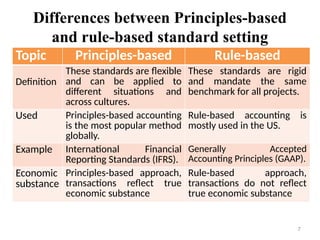
Differences between Principles-based
and rule-based standard setting
Topic Principles-based Rule-based
Definition
These standards are flexible
and can be applied to
different situations and
across cultures.
These standards are rigid
and mandate the same
benchmark for all projects.
Used Principles-based accounting
is the most popular method
globally.
Rule-based accounting is
mostly used in the US.
Example International Financial
Reporting Standards (IFRS).
Generally Accepted
Accounting Principles (GAAP).
Economic
substance
Principles-based approach,
transactions reflect true
economic substance
Rule-based approach,
transactions do not reflect
true economic substance
7
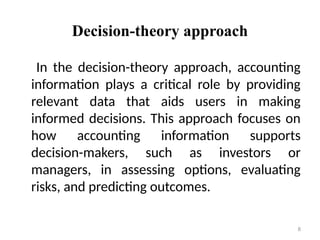
Decision-theory approach
In the decision-theory approach, accounting
information plays a critical role by providing
relevant data that aids users in making
informed decisions. This approach focuses on
how accounting information supports
decision-makers, such as investors or
managers, in assessing options, evaluating
risks, and predicting outcomes.
8
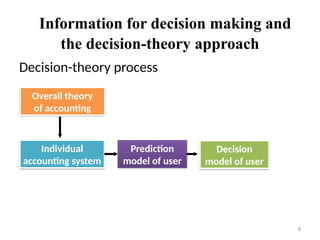
Information for decision making and
the decision-theory approach
Decision-theory process
9
Overall theory
of accounting
Individual
accounting system
Prediction
model of user
Decision
model of user
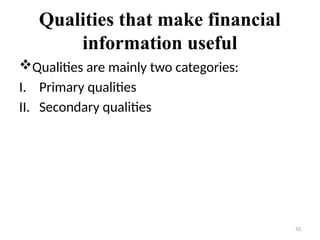
Qualities that make financial
information useful
Qualities are mainly two categories:
I. Primary qualities
II. Secondary qualities
10
Primary Qualities
Primary qualities are the fundamental qualities
those must be present on the financial
information.
 Relevance: Financial information is relevant if it can
influence decision-making by helping users predict future
outcomes (predictive value) or confirm past evaluations
(confirmatory value). Relevant information is closely
related to the specific needs of users.
 Faithful Representation: Information should be a true
and fair representation of what it aims to show. This
means it must be complete, neutral (unbiased), and free
from errors, allowing users to rely on its accuracy.
11
Secondary Qualities
Secondary qualities are the enhancing qualities
those must be present on the financial
information.
 Comparability: Users should be able to compare financial
information across different periods or with other companies
to identify similarities and differences. Standardized reporting
formats and consistent policies enhance comparability.
 Verifiability: Information is verifiable when different
knowledgeable users can reach a consensus that it accurately
represents the underlying transactions. Verification can be
direct or indirect.
12
Secondary Qualities
 Timeliness: Information must be provided in a
timely manner to be relevant for decision- making. If
delayed, the value of information in influencing
decisions may diminish.
 Understandability: Information should be presented
clearly and concisely so that users with reasonable
financial knowledge can understand it. Complex
information should be simplified without sacrificing
essential details.
13
Scientific critique of conceptual
framework projects
Scientific criticisms:
Prescriptive
Unspecified rules and conventions
Do not resolve contemporary disclosure issues
Do not address measurement issues
Risk of mechanical decision making
Framework may become an end in itself
Overreliance on definitions
14
Circularity of reasoning
Circular reasoning occurs when a concept is defined
in a way that relies on itself, making it difficult to
clearly understand or apply the concept.
For example, a framework might define "relevant
information" as information that is useful for
decision-making but then define "useful information"
as information that is relevant. This creates a loop
that doesn't clarify what makes information
specifically useful or relevant.
15
Financial reports should provide
information
 Financial Position: Information on assets, liabilities, and
equity, which helps assess the company‘s.
 Financial Performance: This shows how well the company
generates revenue and controls costs, which is crucial for
evaluating operational efficiency and profitability.
 Cash Flows: This helps users understand how well the
company generates cash and meets liquidity needs.
• .
16
Financial reports should provide
information
 Changes in Financial Position: This gives insights into
shareholder value and retained earnings' contribution to
growth.
 Risk and Uncertainty: Notes on contingent liabilities, market
risks, and other uncertainties affecting future performance.
 Comparability and Trends: Historical data that allows for
period-to-period comparisons and trend analysis, enabling
users to forecast future performance based on past trends.
17
18

ACC_Th_Presentation_(_Board)(00905.11).pptx

  • 1.
  • 2.
    Topic : Conceptual Framework Presentedby Name ID Apurbo Gosh M23040201557 Mohammad Mohsin M23040201531 Pratap Saha Anik M23040201553 Opu Raihan M23040201502 Group - G
  • 3.
    Conceptual Framework • Aconceptual framework in accounting is a set of principles and guidelines that establishes the objectives and fundamental concepts for financial reporting. It serves as a foundation for creating consistent and logical accounting standards and practices. • The framework helps to ensure that financial information is relevant, reliable, and comparable, which enhances its usefulness to investors, creditors, and other stakeholders in making economic decisions 3
  • 4.
    The role ofa conceptual framework A structured theory of accounting. States the scope and objective of financial reporting. Identifies and defines qualitative characteristics of financial information and the basic elements of accounting. Deals with principles and rules of recognition and measurement, and report disclosures. 4
  • 5.
    Objectives of conceptualframeworks  Financial reporting should provide information that is useful to present and potential investors and creditors and other users in making rational investment, credit and similar decisions.  Both the IASB and FASB frameworks consider the main objective of financial reporting is to communicate financial information to users. 5
  • 6.
    Objectives of conceptualframeworks • For that reason, the information should be: Useful in making economic decisions. Useful in assessing cash flow prospects. About enterprise resources, claims to those resources and changes in them. 6
  • 7.
    Differences between Principles-based andrule-based standard setting Topic Principles-based Rule-based Definition These standards are flexible and can be applied to different situations and across cultures. These standards are rigid and mandate the same benchmark for all projects. Used Principles-based accounting is the most popular method globally. Rule-based accounting is mostly used in the US. Example International Financial Reporting Standards (IFRS). Generally Accepted Accounting Principles (GAAP). Economic substance Principles-based approach, transactions reflect true economic substance Rule-based approach, transactions do not reflect true economic substance 7
  • 8.
    Decision-theory approach In thedecision-theory approach, accounting information plays a critical role by providing relevant data that aids users in making informed decisions. This approach focuses on how accounting information supports decision-makers, such as investors or managers, in assessing options, evaluating risks, and predicting outcomes. 8
  • 9.
    Information for decisionmaking and the decision-theory approach Decision-theory process 9 Overall theory of accounting Individual accounting system Prediction model of user Decision model of user
  • 10.
    Qualities that makefinancial information useful Qualities are mainly two categories: I. Primary qualities II. Secondary qualities 10
  • 11.
    Primary Qualities Primary qualitiesare the fundamental qualities those must be present on the financial information.  Relevance: Financial information is relevant if it can influence decision-making by helping users predict future outcomes (predictive value) or confirm past evaluations (confirmatory value). Relevant information is closely related to the specific needs of users.  Faithful Representation: Information should be a true and fair representation of what it aims to show. This means it must be complete, neutral (unbiased), and free from errors, allowing users to rely on its accuracy. 11
  • 12.
    Secondary Qualities Secondary qualitiesare the enhancing qualities those must be present on the financial information.  Comparability: Users should be able to compare financial information across different periods or with other companies to identify similarities and differences. Standardized reporting formats and consistent policies enhance comparability.  Verifiability: Information is verifiable when different knowledgeable users can reach a consensus that it accurately represents the underlying transactions. Verification can be direct or indirect. 12
  • 13.
    Secondary Qualities  Timeliness:Information must be provided in a timely manner to be relevant for decision- making. If delayed, the value of information in influencing decisions may diminish.  Understandability: Information should be presented clearly and concisely so that users with reasonable financial knowledge can understand it. Complex information should be simplified without sacrificing essential details. 13
  • 14.
    Scientific critique ofconceptual framework projects Scientific criticisms: Prescriptive Unspecified rules and conventions Do not resolve contemporary disclosure issues Do not address measurement issues Risk of mechanical decision making Framework may become an end in itself Overreliance on definitions 14
  • 15.
    Circularity of reasoning Circularreasoning occurs when a concept is defined in a way that relies on itself, making it difficult to clearly understand or apply the concept. For example, a framework might define "relevant information" as information that is useful for decision-making but then define "useful information" as information that is relevant. This creates a loop that doesn't clarify what makes information specifically useful or relevant. 15
  • 16.
    Financial reports shouldprovide information  Financial Position: Information on assets, liabilities, and equity, which helps assess the company‘s.  Financial Performance: This shows how well the company generates revenue and controls costs, which is crucial for evaluating operational efficiency and profitability.  Cash Flows: This helps users understand how well the company generates cash and meets liquidity needs. • . 16
  • 17.
    Financial reports shouldprovide information  Changes in Financial Position: This gives insights into shareholder value and retained earnings' contribution to growth.  Risk and Uncertainty: Notes on contingent liabilities, market risks, and other uncertainties affecting future performance.  Comparability and Trends: Historical data that allows for period-to-period comparisons and trend analysis, enabling users to forecast future performance based on past trends. 17
  • 18.