Semi-Supervised
Learning
Ahmed Taha
Feb 2014

S
Content

S Concept Introduction
S Graph cut and Least Square solution
S Eigen vector and Eigen Functions

S Application
Concept Introduction

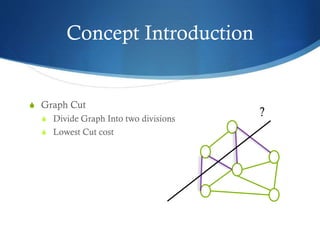
S Graph Cut
S Divide Graph Into two divisions
S Lowest Cut cost

?
Concept Introduction

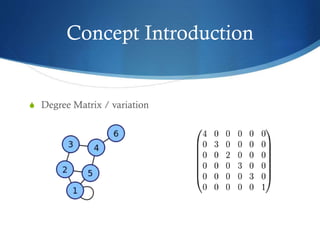
S Degree Matrix / variation
Concept Introduction

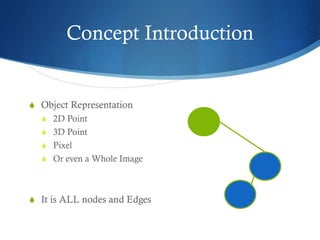
S Object Representation
S 2D Point
S 3D Point
S Pixel
S Or even a Whole Image

S It is ALL nodes and Edges
Concept Introduction
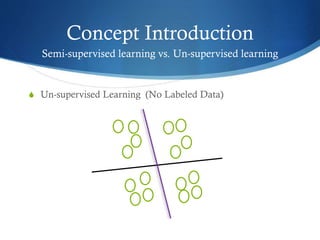
Semi-supervised learning vs. Un-supervised learning

S Un-supervised Learning (No Labeled Data)
Concept Introduction
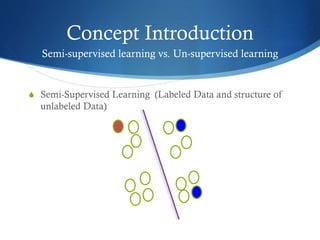
Semi-supervised learning vs. Un-supervised learning

S Semi-Supervised Learning (Labeled Data and structure of

unlabeled Data)
Graph Cut
Least square Solution
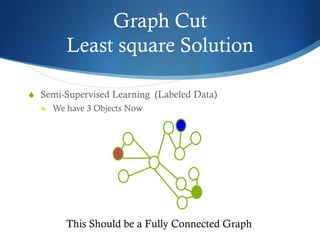
S Semi-Supervised Learning (Labeled Data)
S We have 3 Objects Now

This Should be a Fully Connected Graph
Graph Cut
Least square Solution
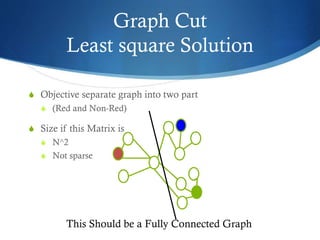
S Objective separate graph into two part
S (Red and Non-Red)

S Size if this Matrix is
S N^2
S Not sparse

This Should be a Fully Connected Graph
Graph Cut
Least square Solution
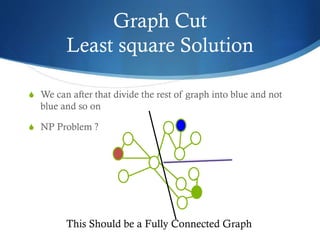
S We can after that divide the rest of graph into blue and not

blue and so on
S NP Problem ?

This Should be a Fully Connected Graph
Graph Cut
Least square Solution
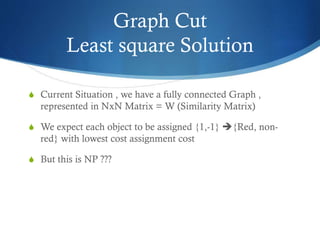
S Current Situation , we have a fully connected Graph ,

represented in NxN Matrix = W (Similarity Matrix)
S We expect each object to be assigned {1,-1} {Red, non-

red} with lowest cost assignment cost
S But this is NP ???
Label Propagation
Least square Solution
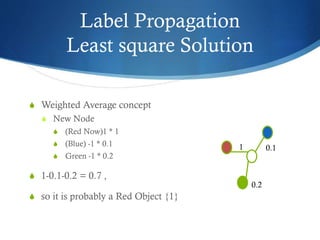
S Weighted Average concept
S New Node
S

(Red Now)1 * 1

S

(Blue) -1 * 0.1

S

Green -1 * 0.2

S 1-0.1-0.2 = 0.7 ,
S so it is probably a Red Object {1}

1

0.1

0.2
Label Propagation
Least square Solution
S Here comes the first Equation , Lets define
S Matrix W (NxN) , Similarity Between Objects
S Matrix D (NxN), degree of each Object
S Matrix L (Laplacian Matrix) = D – W

S Label vector F (Nx1), assignment of each object [-1,1] and

not {-1,1}
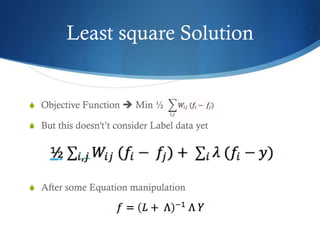
S Objective Function  Min ½
Least square Solution

S Objective Function  Min ½
S But this doesn't’t consider Label data yet

S After some Equation manipulation
Least square Solution

S We need to solve NxN
S NxN matrix Inverse
S NxN matrix multiplication

S Need to reduce dimensions by using Eigenvectors of Graph

Laplacian
EigenVector

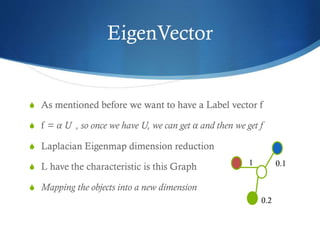
S As mentioned before we want to have a Label vector f
S f = α U , so once we have U, we can get α and then we get f
S Laplacian Eigenmap dimension reduction

S L have the characteristic is this Graph

1

0.1

S Mapping the objects into a new dimension
0.2
EigenVector

S

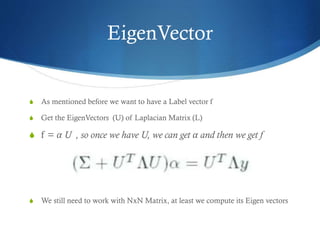
As mentioned before we want to have a Label vector f

S

Get the EigenVectors (U) of Laplacian Matrix (L)

S f = α U , so once we have U, we can get α and then we get f

S

We still need to work with NxN Matrix, at least we compute its Eigen vectors
Eigen Function

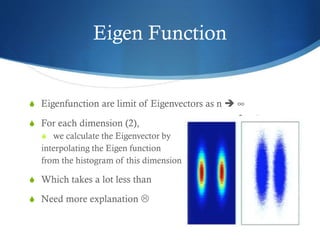
S Eigenfunction are limit of Eigenvectors as n  ∞
S For each dimension (2),
S we calculate the Eigenvector by
interpolating the Eigen function
from the histogram of this dimension
S Which takes a lot less than
S Need more explanation 
Eigen Function

S Eigenfunction are limit of Eigenvectors as n  ∞
S Notice solution of Eigenfunction is based on the number of

Dimensions, while Eigenfunction is based on number of
Objects
S Images Pixels as Object
S Images with local features as dimension
Application

S Object Classification
S Interactive Image segmentation
S Image Segmentation
Application
Object Classification
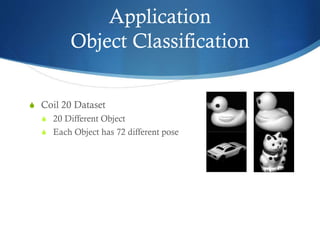
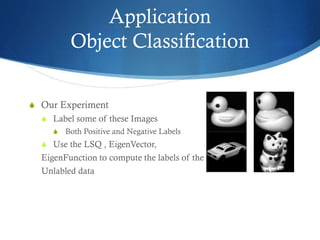
S Coil 20 Dataset
S 20 Different Object
S Each Object has 72 different pose
Application
Object Classification
S Our Experiment
S Label some of these Images
S

Both Positive and Negative Labels

S Use the LSQ , EigenVector,

EigenFunction to compute the labels of the
Unlabled data
Application
Object Classification
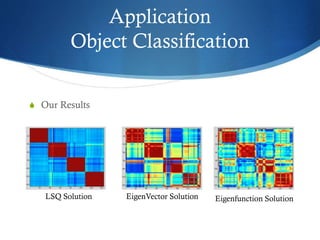
S Our Results

LSQ Solution

EigenVector Solution

Eigenfunction Solution
Application
Object Classification
S Results Analysis
S LSQ solution is almost perfect since it is almost exact Solution
S EigenVector generate approximate solution but in less time,

which makes more sense it is just solving one NxN Matrix to
get Eigen Vectors
S Eigen Function method also generated an approximate
solution but its time was worse
Application
Object Classification
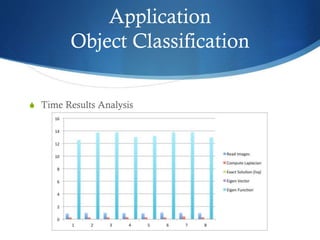
S Time Results Analysis
Application
Object Classification
S Results Explanation
S We have 4 (Object) * 36 (pose per object) so total of 144 Object

so Matrix laplaican is of size 144
S Each Image has 128*128 (gray scale) pixel so total of 16384 ,
so each object have 16384 dimension
S 144 Object vs 16384 dimension
Application
Object Classification
S Results Explanation
S 144 Object vs 16384 dimension
S So it is expected that LSQ , EigenVector method to finish

faster since Matrix L is not that big
S While Eigen-function will take a long time to compute the

Eigen-function for each dimension 16384
Application
Interactive Image Segmentation
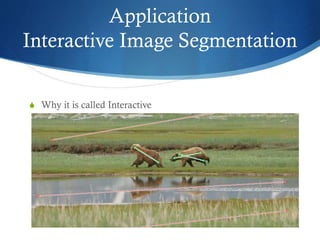
S Why it is called Interactive
Application
Interactive Image Segmentation
S We now have 500x320 = 160000 Object
S But each object have like 5 dimension (R,G,B,X,Y).
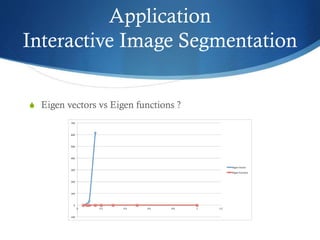
S Eigen vectors vs Eigen functions ?
Application
Interactive Image Segmentation
S Eigen vectors vs Eigen functions ?
Application
Interactive Image Segmentation
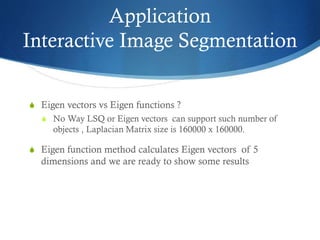
S Eigen vectors vs Eigen functions ?
S No Way LSQ or Eigen vectors can support such number of

objects , Laplacian Matrix size is 160000 x 160000.
S Eigen function method calculates Eigen vectors of 5

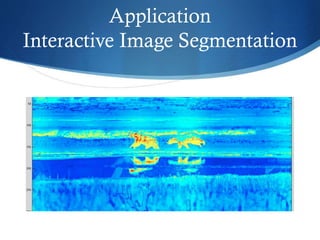
dimensions and we are ready to show some results
Application
Interactive Image Segmentation
Application
Interactive Image Segmentation
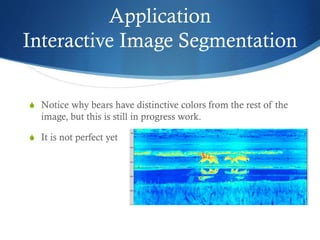
S Notice why bears have distinctive colors from the rest of the

image, but this is still in progress work.
S It is not perfect yet
Application
S Non-Interactive segmentation
S Fore-ground background segmentation
S Co-segmentation
S System held user to know where to add annotation
Conclusion
S It is better to use Eigen vectors when you have small set of

objects with high dimension
S It is better to use Eigen functions when you have big set of

objects with small dimension
Thanks 

Semi supervised learning