Algorithms: k Nearest
Neighbours (k-NN)
-Rishav K Sharma
2020/SPD/11
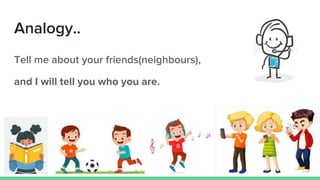
Analogy..
Tell me about your friends(neighbours),
and I will tell you who you are.
Instance-Based
Learning
k-NN Different Names
● K-Nearest Neighbors
● Memory-Based Reasoning
● Example-Based Learning
● Instance-Based Learning
● Lazy Learning
What is k-NN?
● A powerful classification algorithm used in pattern
recognition.
● K- nearest neighbors stores all available cases and
classify new cases based on similarity measure(eg.
Distance function)
● It is one of the top data mining algorithm used today.
● A non-parametric lazy learning algorithm (instance based
learning method)
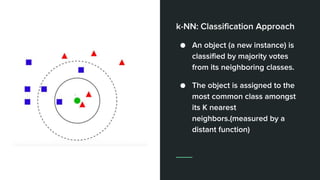
k-NN: Classification Approach
● An object (a new instance) is
classified by majority votes
from its neighboring classes.
● The object is assigned to the
most common class amongst
its K nearest
neighbors.(measured by a
distant function)
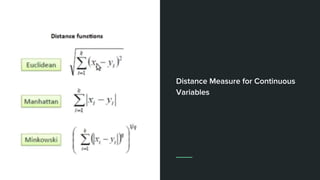
Distance Measure for Continuous
Variables
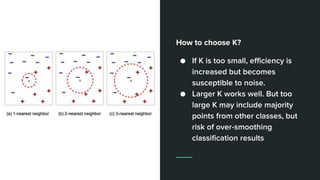
How to choose K?
● If K is too small, efficiency is
increased but becomes
susceptible to noise.
● Larger K works well. But too
large K may include majority
points from other classes, but
risk of over-smoothing
classification results
Strengths of k-NN
● Very simple and intuitive.
● Can be applied to the data from any distribution.
● Good classification if the number of samples is large enough.
Weaknesses of k-NN
● Takes more time to classify a new example.
○ need to calculate and compare distance from new example to all other examples.
● Choosing k may be tricky.
● Need large number of samples for accuracy.
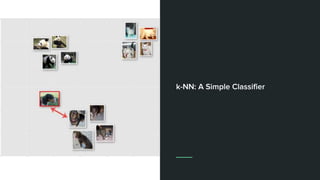
k-NN: A Simple Classifier
Implementing k-NN in Image Classification
● Step 1 – Gather Dataset: Dataset consists of several images(~1000) of each class. Each image is
represented in RGB color space. They are pre-processed by resizing it to 32x32 pixels.Therefore the
resized image with RGB channels has 32x32x3=3072 integers.
● Step 2 – Split the Dataset: Split half of the dataset for training and other half for testing.
● Step 3 – Train the Classifier: k-NN classifier will be trained on the raw pixel intensities of the images in
the training set and feature matrix is formed.(nearly~9Mb)
● Step 4 – Evaluate:Once our k-NN classifier is trained, performance can be evaluated.
Conclusion
k-NN algorithm is simple, easy to understand and gives a
baseline to implement neural networks and convolutional
neural networks.

Knn Algorithm presentation

  • 1.
    Algorithms: k Nearest Neighbours(k-NN) -Rishav K Sharma 2020/SPD/11
  • 2.
    Analogy.. Tell me aboutyour friends(neighbours), and I will tell you who you are.
  • 3.
  • 4.
    k-NN Different Names ●K-Nearest Neighbors ● Memory-Based Reasoning ● Example-Based Learning ● Instance-Based Learning ● Lazy Learning
  • 5.
    What is k-NN? ●A powerful classification algorithm used in pattern recognition. ● K- nearest neighbors stores all available cases and classify new cases based on similarity measure(eg. Distance function) ● It is one of the top data mining algorithm used today. ● A non-parametric lazy learning algorithm (instance based learning method)
  • 6.
    k-NN: Classification Approach ●An object (a new instance) is classified by majority votes from its neighboring classes. ● The object is assigned to the most common class amongst its K nearest neighbors.(measured by a distant function)
  • 7.
    Distance Measure forContinuous Variables
  • 8.
    How to chooseK? ● If K is too small, efficiency is increased but becomes susceptible to noise. ● Larger K works well. But too large K may include majority points from other classes, but risk of over-smoothing classification results
  • 9.
    Strengths of k-NN ●Very simple and intuitive. ● Can be applied to the data from any distribution. ● Good classification if the number of samples is large enough. Weaknesses of k-NN ● Takes more time to classify a new example. ○ need to calculate and compare distance from new example to all other examples. ● Choosing k may be tricky. ● Need large number of samples for accuracy.
  • 10.
    k-NN: A SimpleClassifier
  • 11.
    Implementing k-NN inImage Classification ● Step 1 – Gather Dataset: Dataset consists of several images(~1000) of each class. Each image is represented in RGB color space. They are pre-processed by resizing it to 32x32 pixels.Therefore the resized image with RGB channels has 32x32x3=3072 integers. ● Step 2 – Split the Dataset: Split half of the dataset for training and other half for testing. ● Step 3 – Train the Classifier: k-NN classifier will be trained on the raw pixel intensities of the images in the training set and feature matrix is formed.(nearly~9Mb) ● Step 4 – Evaluate:Once our k-NN classifier is trained, performance can be evaluated.
  • 12.
    Conclusion k-NN algorithm issimple, easy to understand and gives a baseline to implement neural networks and convolutional neural networks.