



Theory and Toolkits
of PCA
2009 5/4 IRLab
Study Group
Presenter : Chin-Hui Chen
Agenda
 Theory :
◦ 1. Scenario
◦ 2. What is PCA?
◦ 3. How to minimize Squared-Error ?
◦ 4. Dimensionality Reduction
 Toolkit :
◦ A list of PCA toolkits
◦ Demo
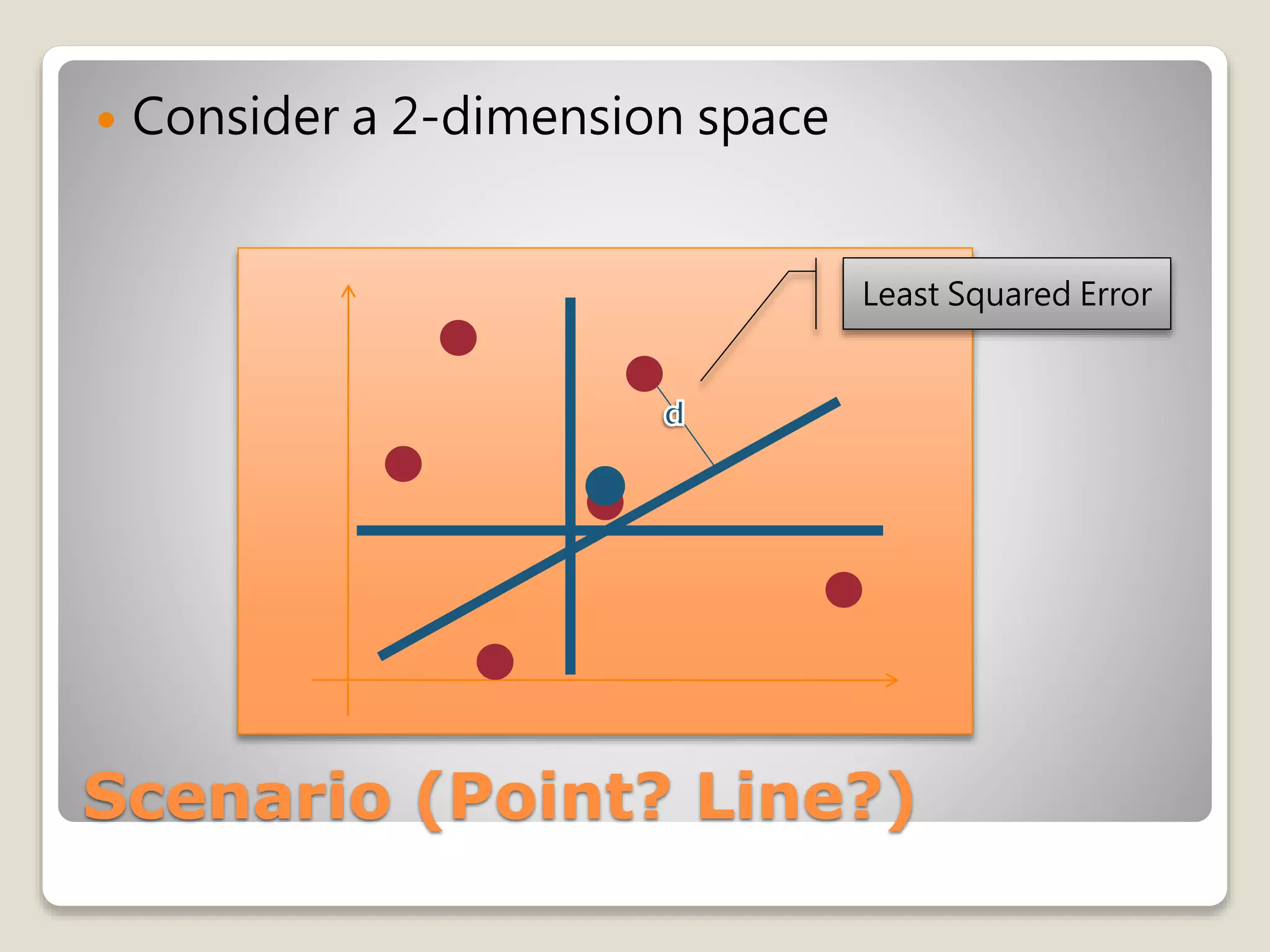
Scenario (Point? Line?)
 Consider a 2-dimension space
Least Squared Error
Agenda
 Theory :
◦ 1. Scenario
◦ 2. What is PCA?
◦ 3. How to minimize Squared-Error ?
◦ 4. Dimensionality Reduction
 Toolkit :
◦ A list of PCA toolkits
◦ Demo
What is PCA ? (1)
 Principal component analysis (PCA)
involves a mathematical procedure that
transforms a number of possibly
correlated variables into a smaller number
of uncorrelated variables called “principal
components”.
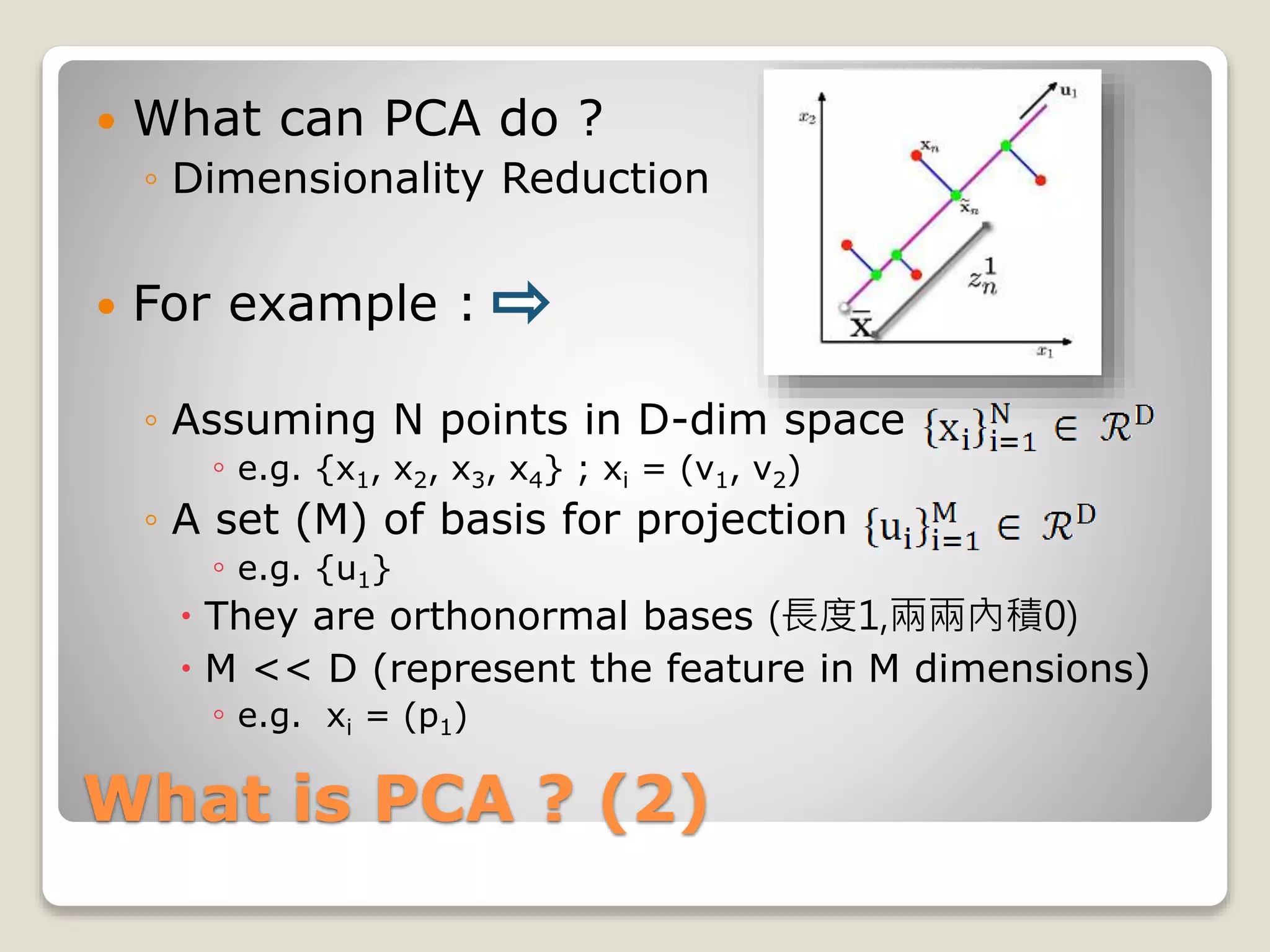
What is PCA ? (2)
 What can PCA do ?
◦ Dimensionality Reduction
 For example :
◦ Assuming N points in D-dim space
◦ e.g. {x1, x2, x3, x4} ; xi = (v1, v2)
◦ A set (M) of basis for projection
◦ e.g. {u1}
 They are orthonormal bases (長度1,兩兩內積0)
 M << D (represent the feature in M dimensions)
◦ e.g. xi = (p1)
Agenda
 Theory :
◦ 1. Scenario
◦ 2. What is PCA?
◦ 3. How to minimize Squared-Error ?
◦ 4. Dimensionality Reduction
 Toolkit :
◦ A list of PCA toolkits
◦ Demo
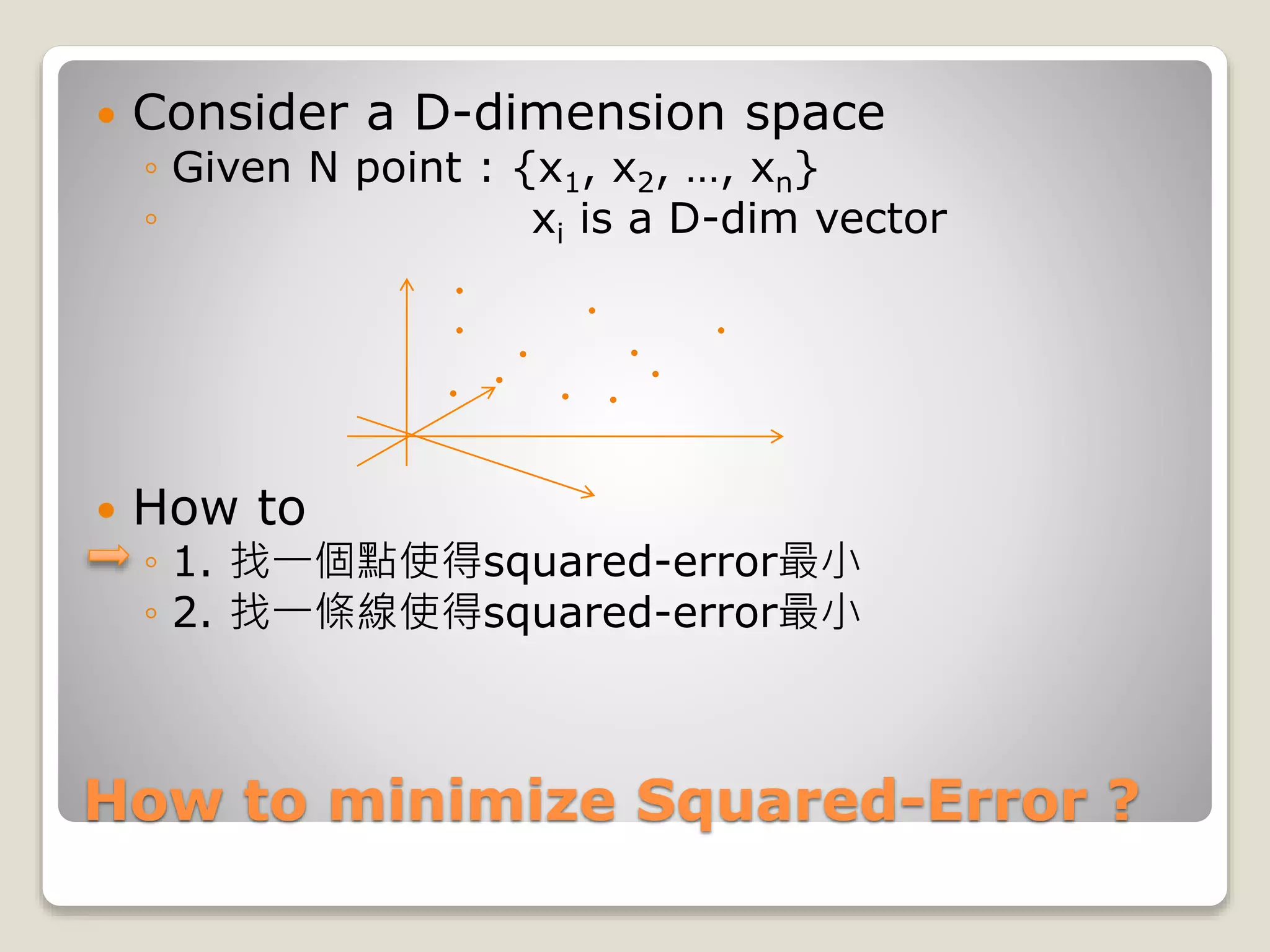
How to minimize Squared-Error ?
 Consider a D-dimension space
◦ Given N point : {x1, x2, …, xn}
◦ xi is a D-dim vector
 How to
◦ 1. 找一個點使得squared-error最小
◦ 2. 找一條線使得squared-error最小
How to ? - Point
◦ Goal : Find x0 s.t. min.
◦
◦ Let .
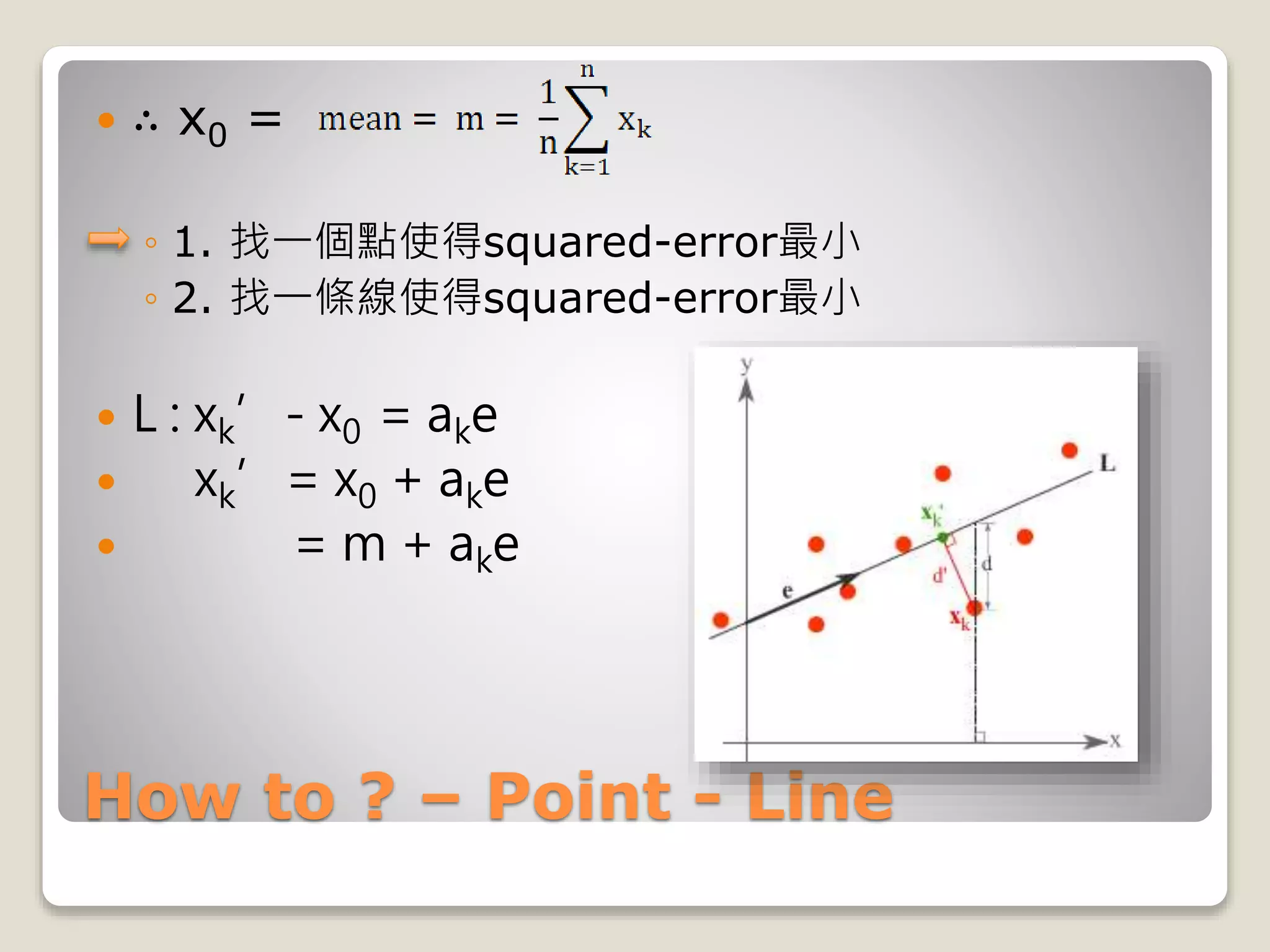
How to ? – Point - Line
 ∴ x0 =
◦ 1. 找一個點使得squared-error最小
◦ 2. 找一條線使得squared-error最小
 L : xk’- x0 = ake
 xk’= x0 + ake
 = m + ake
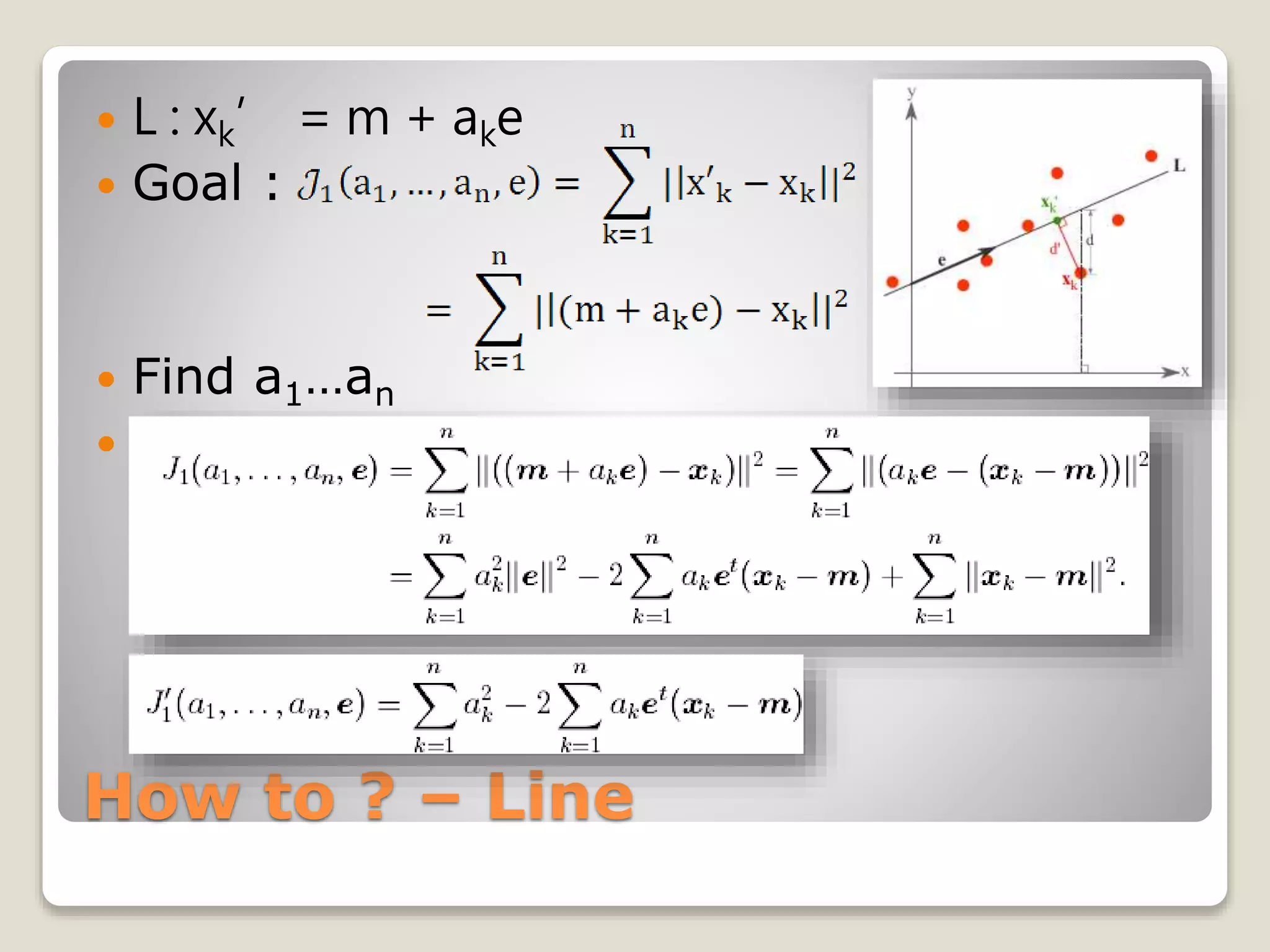
How to ? – Line
 L : xk’ = m + ake
 Goal :
 Find a1…an

How to ? – Line
 每個部份微分後 [2ak – 2et(xk-m)]

 What does it mean ?
xk’ = m + ake
How to ? – Line
 Then, how about e ?
How to ? – Line
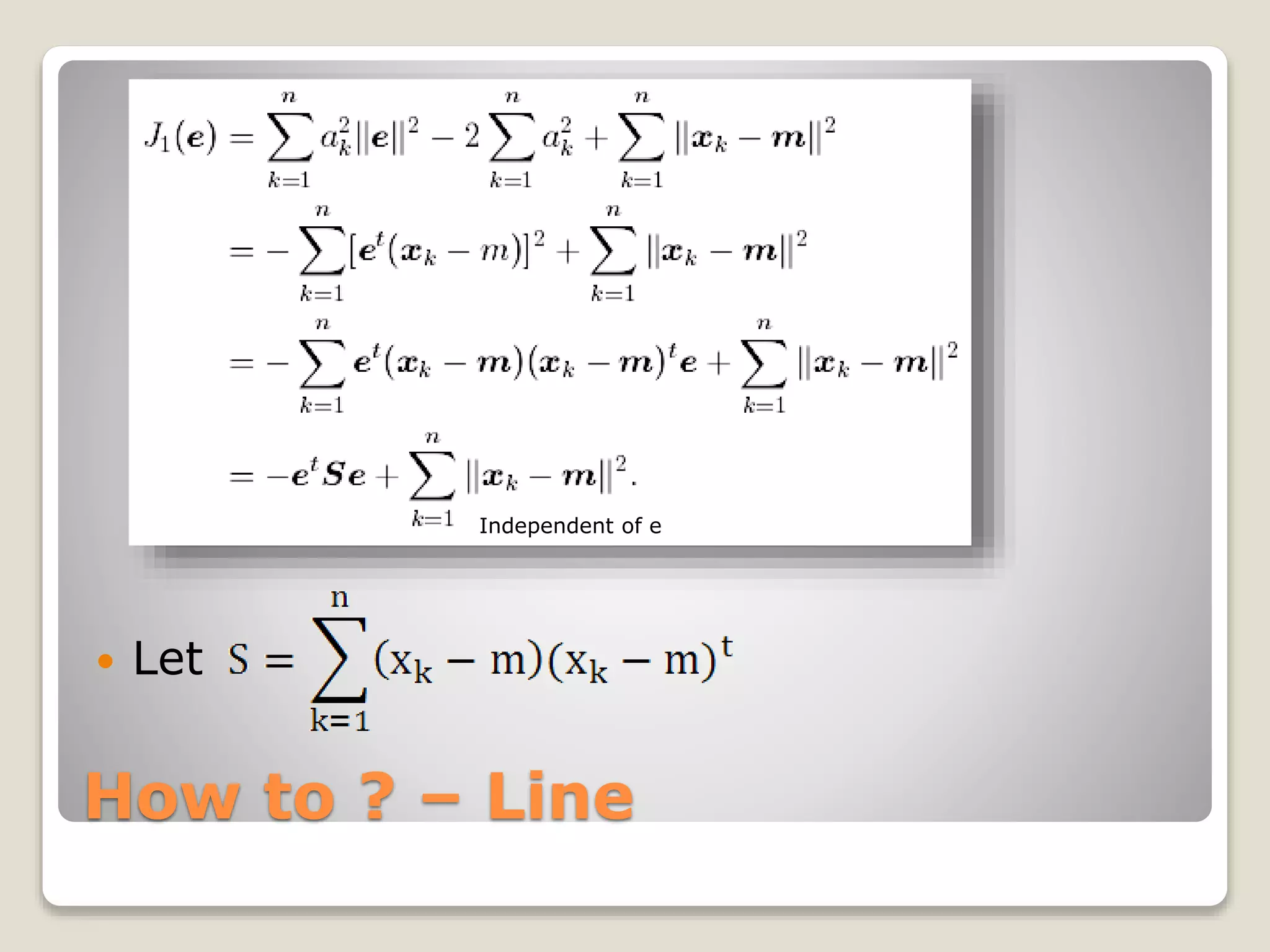
 Let
Independent of e
How to ? – Line
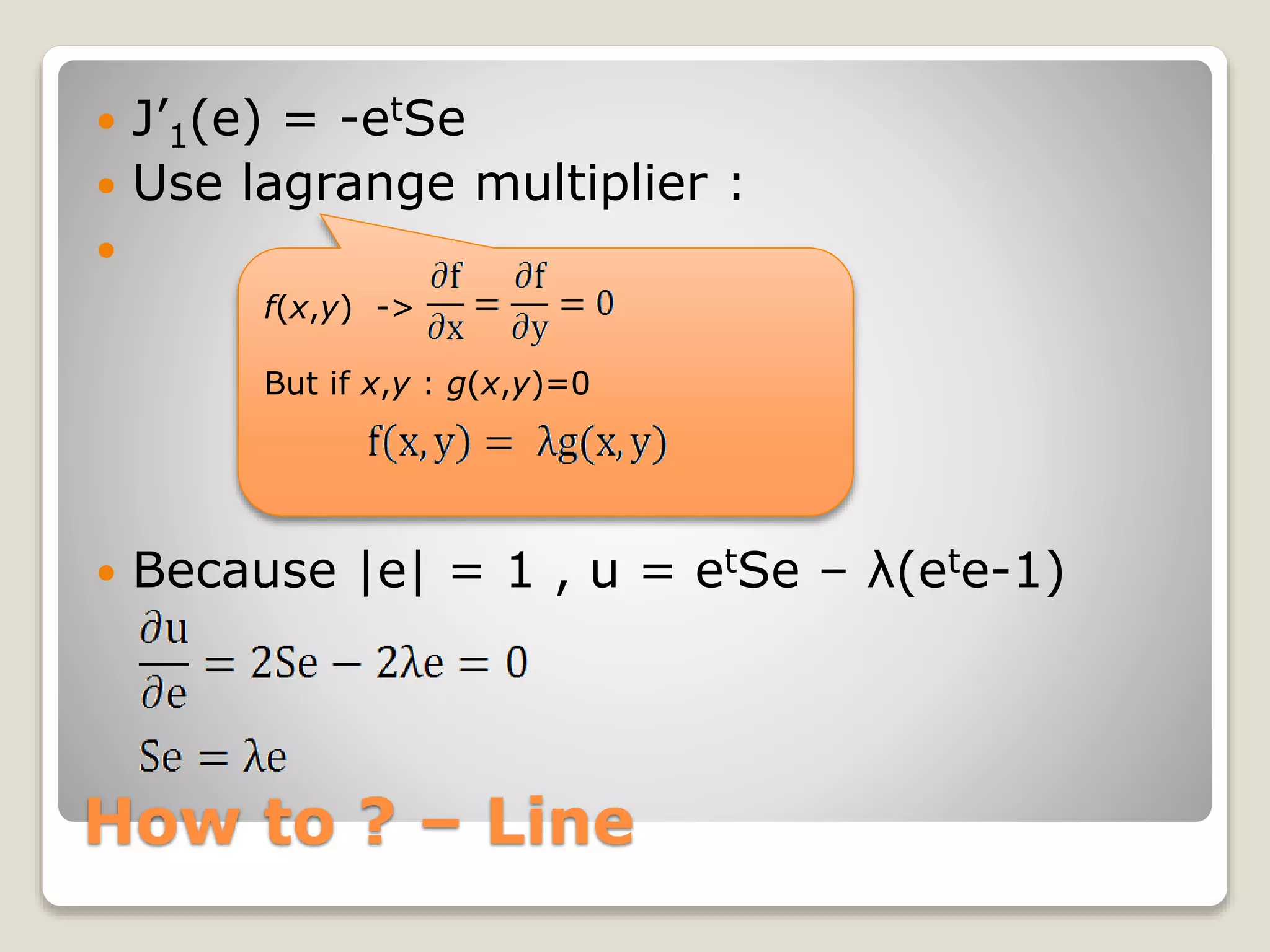
f(x,y) ->
But if x,y : g(x,y)=0
 J’1(e) = -etSe
 Use lagrange multiplier :

 Because |e| = 1 , u = etSe – λ(ete-1)
How to ? – Line

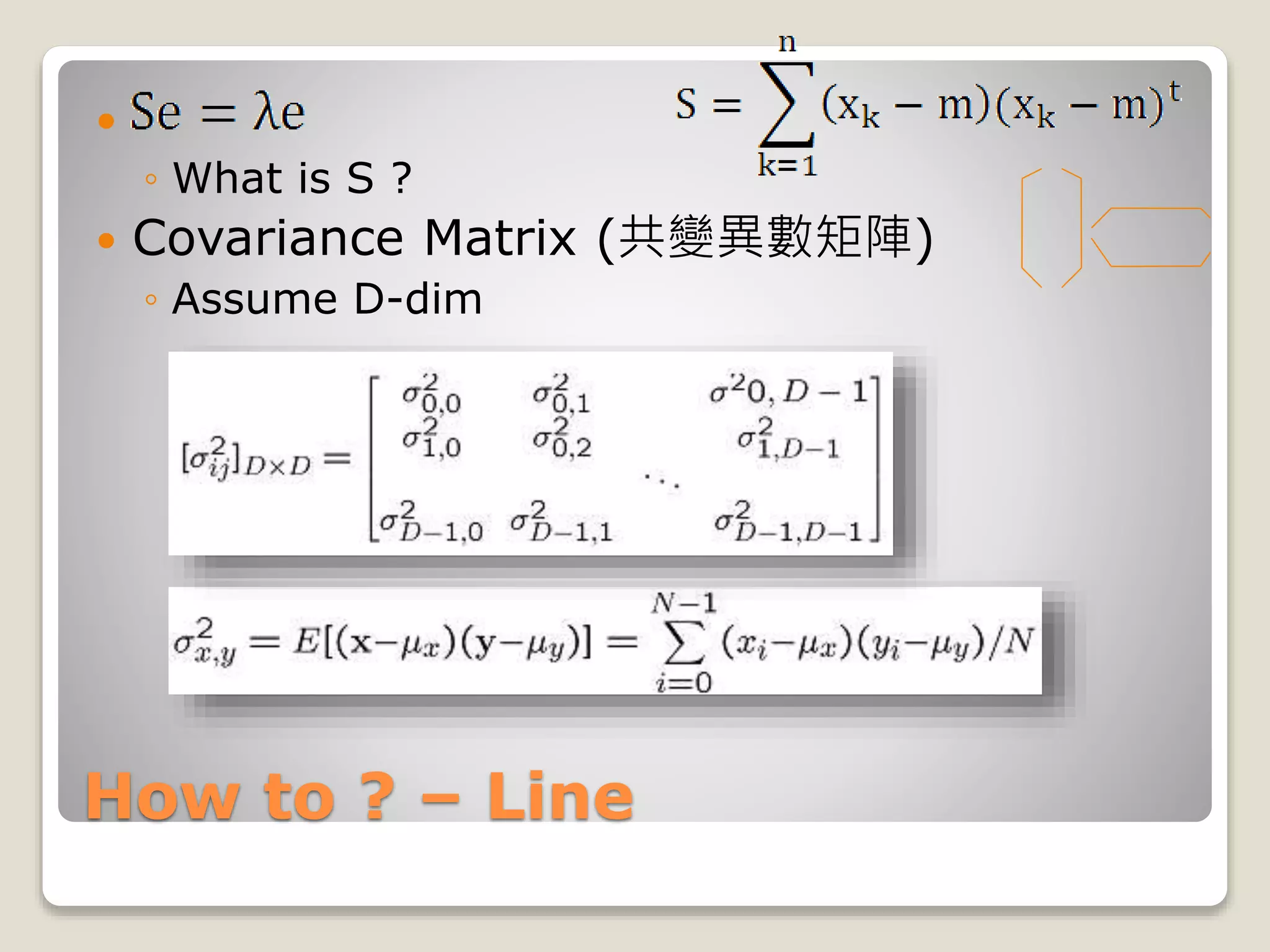
◦ What is S ?
 Covariance Matrix (共變異數矩陣)
◦ Assume D-dim
How to ? – Line
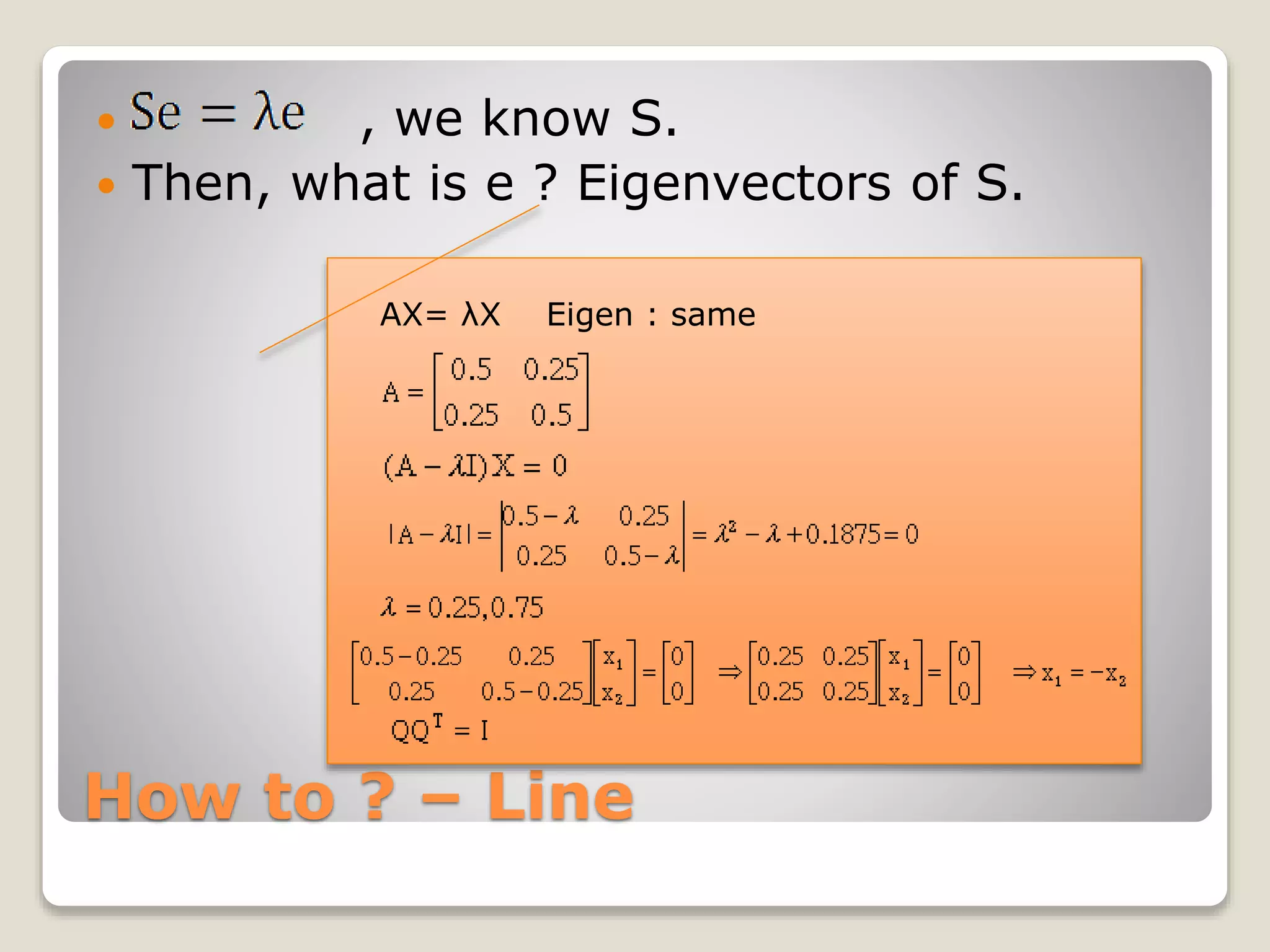
 , we know S.
 Then, what is e ? Eigenvectors of S.
AX= λX Eigen : same
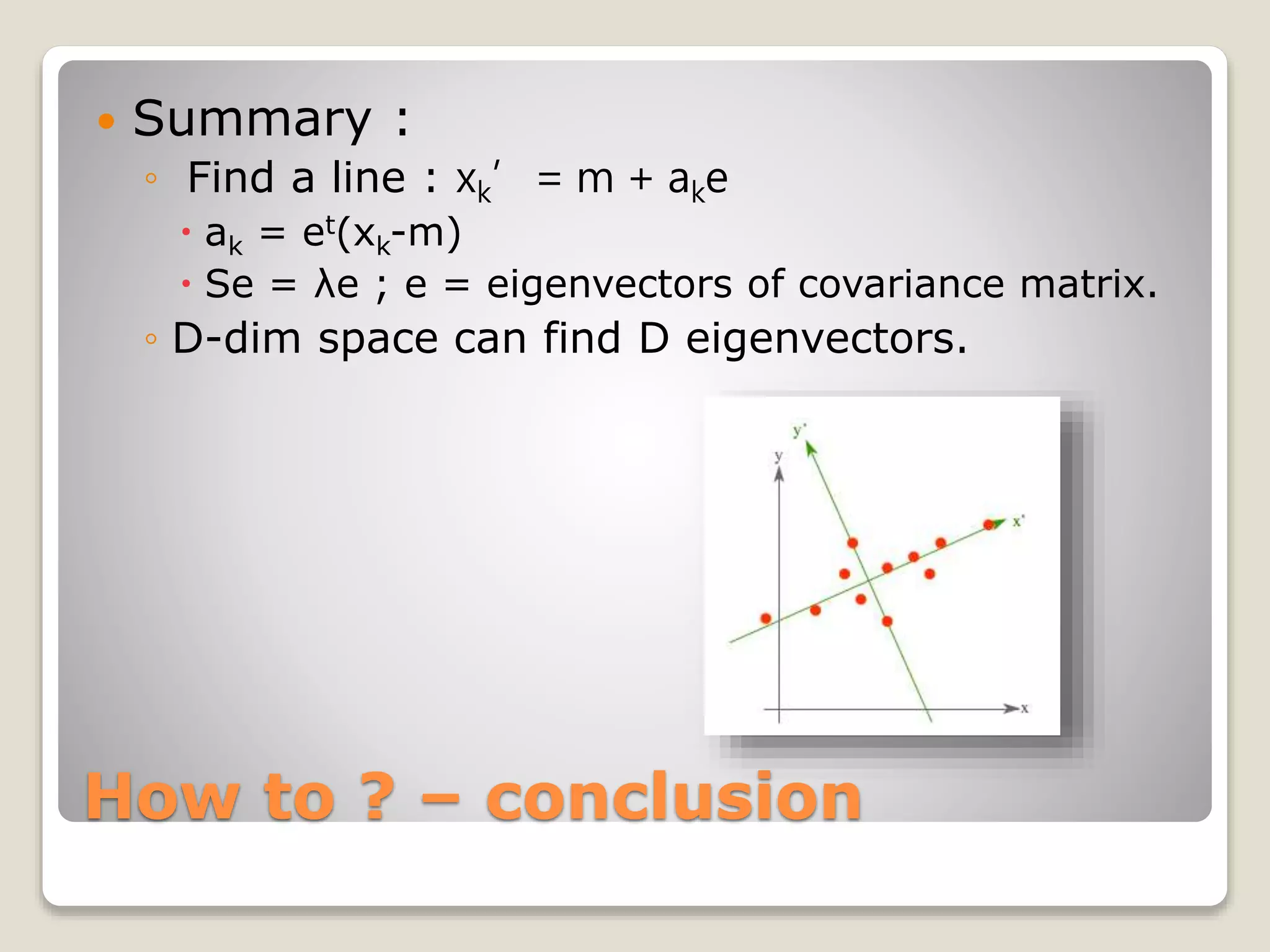
How to ? – conclusion
 Summary :
◦ Find a line : xk’= m + ake
 ak = et(xk-m)
 Se = λe ; e = eigenvectors of covariance matrix.
◦ D-dim space can find D eigenvectors.
Agenda
 Theory :
◦ 1. Scenario
◦ 2. What is PCA?
◦ 3. How to minimize Squared-Error ?
◦ 4. Dimensionality Reduction
 Toolkit :
◦ A list of PCA toolkits
◦ Demo
Dimensionality
Reduction
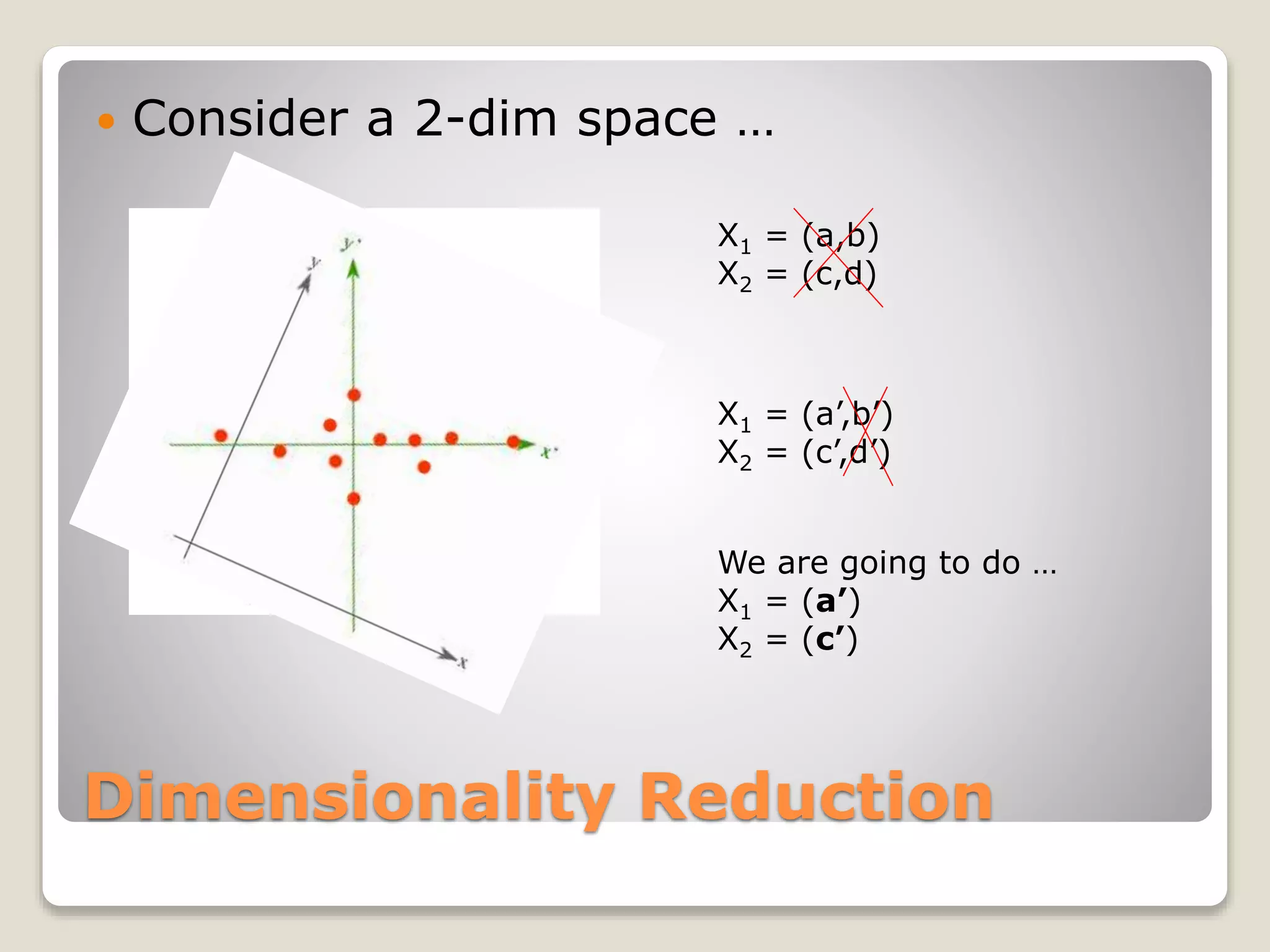
Dimensionality Reduction
 Consider a 2-dim space …
X1 = (a,b)
X2 = (c,d)
X1 = (a’,b’)
X2 = (c’,d’)
We are going to do …
X1 = (a’)
X2 = (c’)
Dimensionality Reduction
 We want to proof :
◦ Axes of the data are independent.
 Consider N m-dim vectors
◦ {x1, x2, … ,xn}
◦ Let X=[x1-m x2-m … xn-m]T m = mean
◦ Let E = [e1 e2 … em]
Se = λe
eigen decomposition Eigen vector {e1,…,em}
Eigen value {λ1,…, λm}
Dimensionality Reduction
 SE = [Se1 Se2 … Sem]
 = [λe1 λe2 … λem]

 =
 = ED
 S = EDE-1
E = [e1 e2 … em]
Dimensionality Reduction
 We want to know new Covariance Matrix
of projected vectors.
 Let Y = [y1 y2 … yn]T
 E = [e1 e2 … em]
 Y = ETX
 SY
Dimensionality Reduction
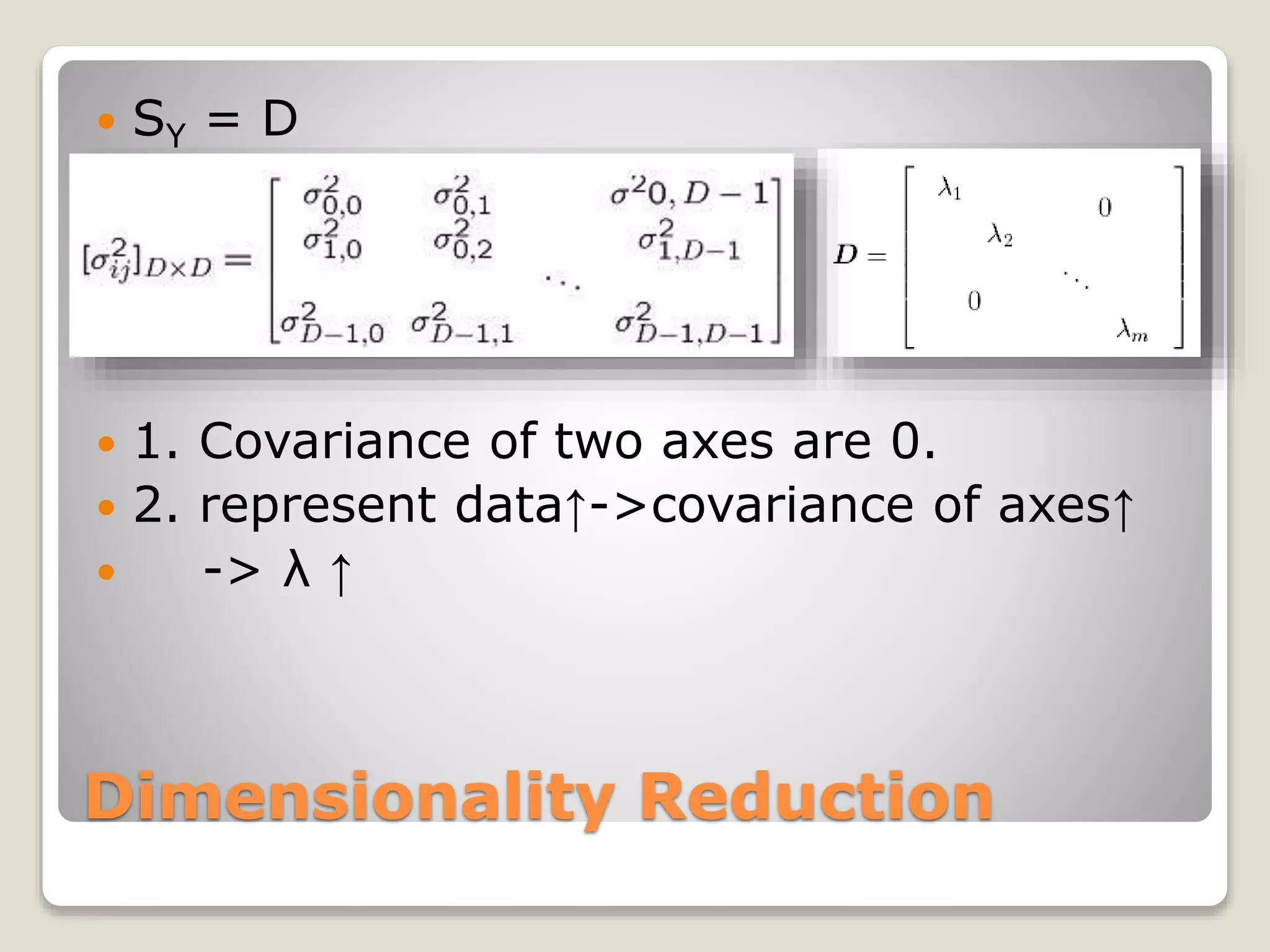
 SY = D
 1. Covariance of two axes are 0.
 2. represent data↑->covariance of axes↑
 -> λ ↑
Dimensionality Reduction
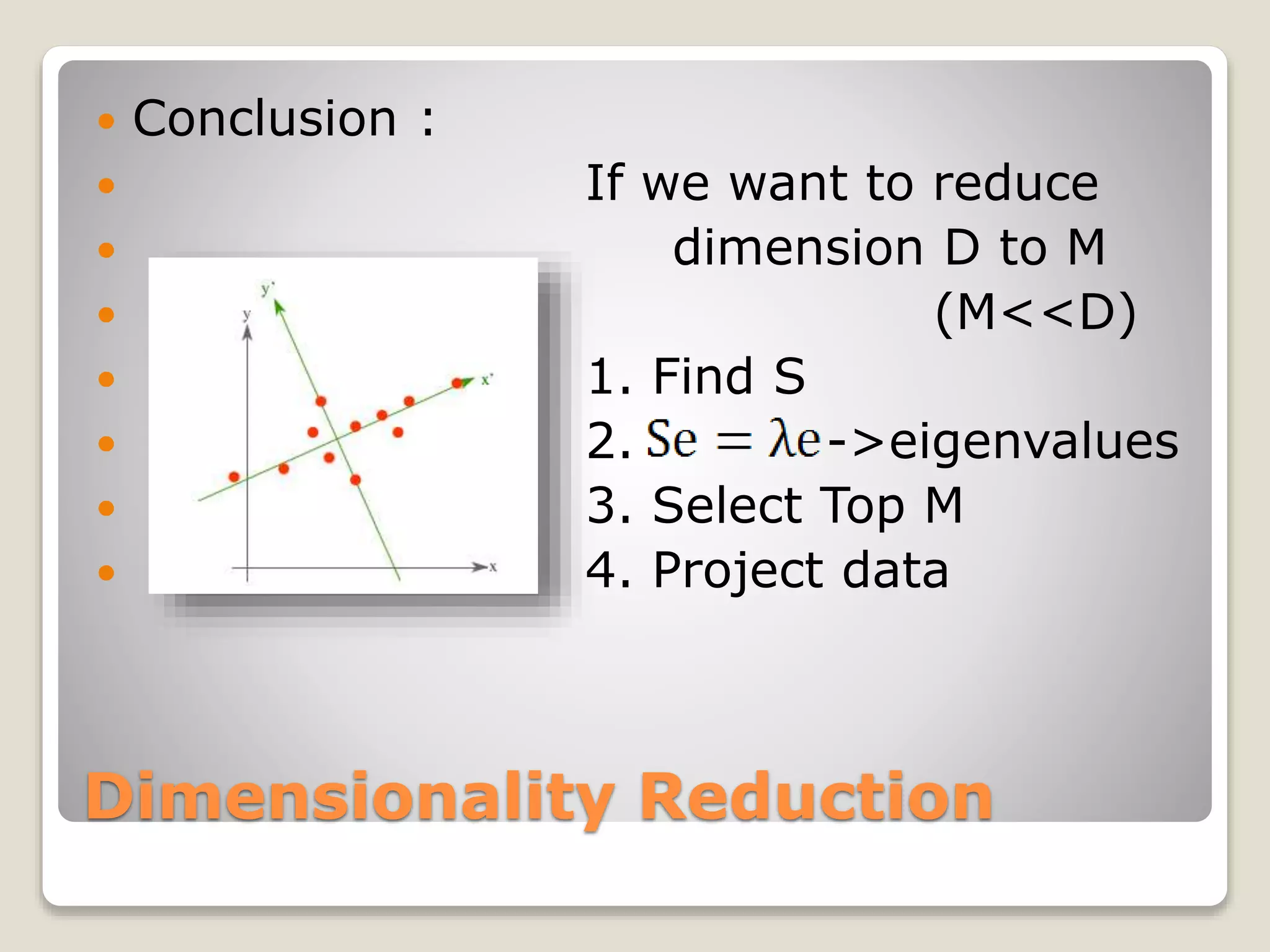
 Conclusion :
 If we want to reduce
 dimension D to M
 (M<<D)
 1. Find S
 2. ->eigenvalues
 3. Select Top M
 4. Project data
Agenda
 Theory :
◦ 1. Scenario
◦ 2. What is PCA?
◦ 3. How to minimize Squared-Error ?
◦ 4. Dimensionality Reduction
 Toolkit :
◦ A list of PCA toolkits
◦ Demo
Toolkits
A List of PCA Toolkits
 C & Java
◦ Fionn Murtagh's Multivariate Data Analysis Software and Resources
◦ http://astro.u-strasbg.fr/~fmurtagh/mda-sw/
 Perl
◦ PDL::PCA
 Matlab
◦ Statistics Toolbox™ : princomp
 Weka
◦ weka.attributeSelection.PrincipalComponents
(http://www.laps.ufpa.br/aldebaro/weka/feature_selection.html )
A List of PCA Toolkits
 C & Java
◦ Fionn Murtagh's Multivariate Data Analysis Software and Resources
◦ http://astro.u-strasbg.fr/~fmurtagh/mda-sw/
C :
Download: pca.c
Compile: cc pca.c -lm -o pcac
Run: ./pcac spectr.dat 36 8 R > pcaout.c.txt
Java :
Download: JAMA, PCAcorr.java
Compile: javac –classpath Jama-1.0.2.jar PCAcorr.java
Run: java PCAcorr iris.dat > pcaout.java.txt
PCA (Principal component analysis) Theory and Toolkits

PCA (Principal component analysis) Theory and Toolkits

  • 1.
    Theory and Toolkits ofPCA 2009 5/4 IRLab Study Group Presenter : Chin-Hui Chen
  • 2.
    Agenda  Theory : ◦1. Scenario ◦ 2. What is PCA? ◦ 3. How to minimize Squared-Error ? ◦ 4. Dimensionality Reduction  Toolkit : ◦ A list of PCA toolkits ◦ Demo
  • 3.
    Scenario (Point? Line?) Consider a 2-dimension space Least Squared Error
  • 4.
    Agenda  Theory : ◦1. Scenario ◦ 2. What is PCA? ◦ 3. How to minimize Squared-Error ? ◦ 4. Dimensionality Reduction  Toolkit : ◦ A list of PCA toolkits ◦ Demo
  • 5.
    What is PCA? (1)  Principal component analysis (PCA) involves a mathematical procedure that transforms a number of possibly correlated variables into a smaller number of uncorrelated variables called “principal components”.
  • 6.
    What is PCA? (2)  What can PCA do ? ◦ Dimensionality Reduction  For example : ◦ Assuming N points in D-dim space ◦ e.g. {x1, x2, x3, x4} ; xi = (v1, v2) ◦ A set (M) of basis for projection ◦ e.g. {u1}  They are orthonormal bases (長度1,兩兩內積0)  M << D (represent the feature in M dimensions) ◦ e.g. xi = (p1)
  • 7.
    Agenda  Theory : ◦1. Scenario ◦ 2. What is PCA? ◦ 3. How to minimize Squared-Error ? ◦ 4. Dimensionality Reduction  Toolkit : ◦ A list of PCA toolkits ◦ Demo
  • 8.
    How to minimizeSquared-Error ?  Consider a D-dimension space ◦ Given N point : {x1, x2, …, xn} ◦ xi is a D-dim vector  How to ◦ 1. 找一個點使得squared-error最小 ◦ 2. 找一條線使得squared-error最小
  • 9.
    How to ?- Point ◦ Goal : Find x0 s.t. min. ◦ ◦ Let .
  • 10.
    How to ?– Point - Line  ∴ x0 = ◦ 1. 找一個點使得squared-error最小 ◦ 2. 找一條線使得squared-error最小  L : xk’- x0 = ake  xk’= x0 + ake  = m + ake
  • 11.
    How to ?– Line  L : xk’ = m + ake  Goal :  Find a1…an 
  • 12.
    How to ?– Line  每個部份微分後 [2ak – 2et(xk-m)]   What does it mean ? xk’ = m + ake
  • 13.
    How to ?– Line  Then, how about e ?
  • 14.
    How to ?– Line  Let Independent of e
  • 15.
    How to ?– Line f(x,y) -> But if x,y : g(x,y)=0  J’1(e) = -etSe  Use lagrange multiplier :   Because |e| = 1 , u = etSe – λ(ete-1)
  • 16.
    How to ?– Line  ◦ What is S ?  Covariance Matrix (共變異數矩陣) ◦ Assume D-dim
  • 17.
    How to ?– Line  , we know S.  Then, what is e ? Eigenvectors of S. AX= λX Eigen : same
  • 18.
    How to ?– conclusion  Summary : ◦ Find a line : xk’= m + ake  ak = et(xk-m)  Se = λe ; e = eigenvectors of covariance matrix. ◦ D-dim space can find D eigenvectors.
  • 19.
    Agenda  Theory : ◦1. Scenario ◦ 2. What is PCA? ◦ 3. How to minimize Squared-Error ? ◦ 4. Dimensionality Reduction  Toolkit : ◦ A list of PCA toolkits ◦ Demo
  • 20.
  • 21.
    Dimensionality Reduction  Considera 2-dim space … X1 = (a,b) X2 = (c,d) X1 = (a’,b’) X2 = (c’,d’) We are going to do … X1 = (a’) X2 = (c’)
  • 22.
    Dimensionality Reduction  Wewant to proof : ◦ Axes of the data are independent.  Consider N m-dim vectors ◦ {x1, x2, … ,xn} ◦ Let X=[x1-m x2-m … xn-m]T m = mean ◦ Let E = [e1 e2 … em] Se = λe eigen decomposition Eigen vector {e1,…,em} Eigen value {λ1,…, λm}
  • 23.
    Dimensionality Reduction  SE= [Se1 Se2 … Sem]  = [λe1 λe2 … λem]   =  = ED  S = EDE-1 E = [e1 e2 … em]
  • 24.
    Dimensionality Reduction  Wewant to know new Covariance Matrix of projected vectors.  Let Y = [y1 y2 … yn]T  E = [e1 e2 … em]  Y = ETX  SY
  • 25.
    Dimensionality Reduction  SY= D  1. Covariance of two axes are 0.  2. represent data↑->covariance of axes↑  -> λ ↑
  • 26.
    Dimensionality Reduction  Conclusion:  If we want to reduce  dimension D to M  (M<<D)  1. Find S  2. ->eigenvalues  3. Select Top M  4. Project data
  • 27.
    Agenda  Theory : ◦1. Scenario ◦ 2. What is PCA? ◦ 3. How to minimize Squared-Error ? ◦ 4. Dimensionality Reduction  Toolkit : ◦ A list of PCA toolkits ◦ Demo
  • 28.
  • 29.
    A List ofPCA Toolkits  C & Java ◦ Fionn Murtagh's Multivariate Data Analysis Software and Resources ◦ http://astro.u-strasbg.fr/~fmurtagh/mda-sw/  Perl ◦ PDL::PCA  Matlab ◦ Statistics Toolbox™ : princomp  Weka ◦ weka.attributeSelection.PrincipalComponents (http://www.laps.ufpa.br/aldebaro/weka/feature_selection.html )
  • 30.
    A List ofPCA Toolkits  C & Java ◦ Fionn Murtagh's Multivariate Data Analysis Software and Resources ◦ http://astro.u-strasbg.fr/~fmurtagh/mda-sw/ C : Download: pca.c Compile: cc pca.c -lm -o pcac Run: ./pcac spectr.dat 36 8 R > pcaout.c.txt Java : Download: JAMA, PCAcorr.java Compile: javac –classpath Jama-1.0.2.jar PCAcorr.java Run: java PCAcorr iris.dat > pcaout.java.txt

Editor's Notes

  • #13 因為這代表如果你已經知道 e , 將空間中任一點xk投射到t直線 L 上, 只需要將原座標為移後與 e 做內積, 就可以得到空間轉換後的新座標