RETAIL THEATRE: BRINGING THE BRAND TO LIFE
NIKE: WHO ARE WE?
WHO ARE WE?:
Started in 1962 with $500 Based on a handshake between two men Aim to make running shoes suitable for runners
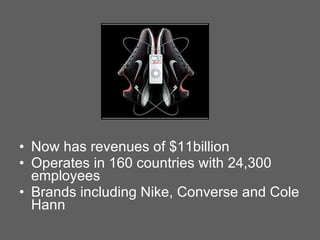
Now has revenues of $11billion Operates in 160 countries with 24,300 employees Brands including Nike, Converse and Cole Hann
” If You Have a Body You Are An Athlete” n
NIKETOWN LONDON: WHAT DO WE DO?
Opened 1999 by Michael Jordan Approx 3million visitors per year 68,000sqft over four floors
Running club – 200 per week attend 160,000 units of stock 260 staff 1 in 5 through the door leave with a purchase
Our mission statement:  Deliver premium consumer experiences at every touch point
NIKETOWN LONDON: WHY DO  WE CREATE THEATRE?
WHY DO WE CREATE THEATRE?: Create a destination – drive footfall Tell the Brand story Better understanding of the Brand Encourage loyalty Encourage performance
RETAIL THEATRE: HOW DO WE DO IT?
HOW DO WE DO IT?: In store-communication
 
HOW DO WE DO IT?: Use athletes as ‘heroes’
 
HOW DO WE DO IT?: Attract & engage through visuals
 
HOW DO WE DO IT?: Make the Store an interactive experience


HOW DO WE DO IT?: Make the Store ‘live’ through events


HOW DO WE DO IT?: Remember the mission
 
RETAIL THEATRE: IS THAT ENOUGH?
HOW DO WE DO IT?: Our people are true to the brand
 
 
BRINGING THE BRAND TO LIFE: WHAT  WOULD WE DO?
WHAT WOULD WE DO? : Know our ‘market’
WHAT WOULD WE DO? : Know our ‘market’ Understand their needs
WHAT WOULD WE DO? : Know our ‘market’ Understand their needs Know the competition
 
WHAT WOULD WE DO? : Know our ‘market’ Understand their needs Know the competition Understand your point of difference
by  Colin  Trask , contributor  *  • 03 Jan 2006                                                         Although the number is dwindling, there are those who recall the days of milkmen, gas station attendants and bank tellers. Now, we take care of most of those jobs ourselves, and seem happy to do it. There are few areas of our economy that haven’t been touched by the growing self-service industry. And, it’s not something that’s being forced on the customer by budget cuts and lower overhead. More and more people just prefer to do it themselves. What has transformed the shopper’s mindset from a desire to be waited on to a desire to serve himself? Peter Honebein has made it his business to find out. As a learning psychologist and instructional designer, he has accumulated 10 years experience designing software products and training programs for customers and employees. Along with Roy Cammarano, he has written "Creating Do-It-Yourself Customers: How Great Customer Experiences Build Great Companies." Honebein sees the self-service industry drawing on five types of do-it-yourself customers. The first is the  transactional customer  who is willing to carry out the transaction role of doing business. The next is the  traditional customer ; this is the classic DIY kind of guy: he fixes it, builds it and renovates it himself. Third is the  conventional customer . This customer is the co-creator of product value, where all products are viewed as services and — through use of the product — the customer becomes a co-creator of its applications. Fourth is the  intentional customer  who wants to be in on the design phase. This customer shops Build-A-Bear stores, designs his own basketball shoes at NikeID.com or builds her own Barbie online. Lastly, there’s the  radical customer . This type discovers new ways to use a product; ways that weren’t even intended when it was designed. iPOD is one example; it was intended for music but those radical customers wanted more, so now we have pod casting. According to Honebein, the trick for businesses is determining what type — or combination of types its customers are and to design a system that satisfies them. Look at your business through the eyes of your customer type and address operations to that type. Betting on self-service Looking at business through the customer’s eyes was the challenge facing Tim Yeltin, director of new development for Charlson Broadcast Technologies (CBT), a Northern Kentucky that has been bringing IT innovations to the horse racing industry since 1985.    The psychology of self-service
WHAT WOULD WE DO? : Know our mission statement
WHAT WOULD WE DO? : Know our mission statement Make sure our people know it  and believe in it
 
 
WHAT WOULD WE DO? : Know our mission statement Make sure our people know it  and believe in it Don’t ‘fake’ it
WHAT WOULD WE DO? : Know our mission statement Make sure our people know it  and believe in it Don’t ‘fake’ it Diversify and enhance but don’t  lose sight of your core purpose
WHAT WOULD WE DO? : Create ‘heroes’
 
WHAT WOULD WE DO? : Create ‘heroes’ Become relevant to our ‘market’
WHAT WOULD WE DO? : Create ‘heroes’ Become relevant to our ‘market’ Create a marketing calendar
WHAT WOULD WE DO? : Create the right environment


WHAT WOULD WE DO? : Create the right environment Embrace technology
WHAT WOULD WE DO? : Create the right environment Embrace technology Make it interactive
WHAT WOULD WE DO? : Create the right environment Embrace technology Make it interactive Break the barriers – encourage talk!
Man Vs Machine – What are the implications of a cyborg society? The psychology of speed dating‚ the origin of magical beliefs and London’s first media-arts festival launches
WHAT WOULD WE DO? : Focus on features and benefits
WHAT WOULD WE DO? : Focus on features and benefits Communicate them clearly
WHAT WOULD WE DO? : Focus on features and benefits Communicate them clearly Ensure relevant content
WHAT WOULD WE DO? : Focus on features and benefits Communicate them clearly Ensure relevant content ‘ Right product, right place, right time’
WHAT WOULD WE DO? : Know the mission statement
WHAT WOULD WE DO? : Know the mission statement And make sure it informs all you do
RETAIL THEATRE: BRINGING THE BRAND TO LIFE

Nike

  • 1.
    RETAIL THEATRE: BRINGINGTHE BRAND TO LIFE
  • 2.
  • 3.
  • 4.
    Started in 1962with $500 Based on a handshake between two men Aim to make running shoes suitable for runners
  • 5.
    Now has revenuesof $11billion Operates in 160 countries with 24,300 employees Brands including Nike, Converse and Cole Hann
  • 6.
    ” If YouHave a Body You Are An Athlete” n
  • 7.
  • 8.
    Opened 1999 byMichael Jordan Approx 3million visitors per year 68,000sqft over four floors
  • 9.
    Running club –200 per week attend 160,000 units of stock 260 staff 1 in 5 through the door leave with a purchase
  • 10.
    Our mission statement: Deliver premium consumer experiences at every touch point
  • 11.
    NIKETOWN LONDON: WHYDO WE CREATE THEATRE?
  • 12.
    WHY DO WECREATE THEATRE?: Create a destination – drive footfall Tell the Brand story Better understanding of the Brand Encourage loyalty Encourage performance
  • 13.
    RETAIL THEATRE: HOWDO WE DO IT?
  • 14.
    HOW DO WEDO IT?: In store-communication
  • 15.
  • 16.
    HOW DO WEDO IT?: Use athletes as ‘heroes’
  • 17.
  • 18.
    HOW DO WEDO IT?: Attract & engage through visuals
  • 19.
  • 20.
    HOW DO WEDO IT?: Make the Store an interactive experience
  • 21.
  • 22.
  • 23.
  • 24.
    HOW DO WEDO IT?: Make the Store ‘live’ through events
  • 25.
  • 26.
  • 27.
  • 28.
  • 29.
    HOW DO WEDO IT?: Remember the mission
  • 30.
  • 31.
    RETAIL THEATRE: ISTHAT ENOUGH?
  • 32.
    HOW DO WEDO IT?: Our people are true to the brand
  • 33.
  • 34.
  • 35.
    BRINGING THE BRANDTO LIFE: WHAT WOULD WE DO?
  • 36.
    WHAT WOULD WEDO? : Know our ‘market’
  • 37.
    WHAT WOULD WEDO? : Know our ‘market’ Understand their needs
  • 38.
    WHAT WOULD WEDO? : Know our ‘market’ Understand their needs Know the competition
  • 39.
  • 40.
    WHAT WOULD WEDO? : Know our ‘market’ Understand their needs Know the competition Understand your point of difference
  • 41.
    by Colin Trask , contributor * • 03 Jan 2006                                                       Although the number is dwindling, there are those who recall the days of milkmen, gas station attendants and bank tellers. Now, we take care of most of those jobs ourselves, and seem happy to do it. There are few areas of our economy that haven’t been touched by the growing self-service industry. And, it’s not something that’s being forced on the customer by budget cuts and lower overhead. More and more people just prefer to do it themselves. What has transformed the shopper’s mindset from a desire to be waited on to a desire to serve himself? Peter Honebein has made it his business to find out. As a learning psychologist and instructional designer, he has accumulated 10 years experience designing software products and training programs for customers and employees. Along with Roy Cammarano, he has written "Creating Do-It-Yourself Customers: How Great Customer Experiences Build Great Companies." Honebein sees the self-service industry drawing on five types of do-it-yourself customers. The first is the transactional customer who is willing to carry out the transaction role of doing business. The next is the traditional customer ; this is the classic DIY kind of guy: he fixes it, builds it and renovates it himself. Third is the conventional customer . This customer is the co-creator of product value, where all products are viewed as services and — through use of the product — the customer becomes a co-creator of its applications. Fourth is the intentional customer who wants to be in on the design phase. This customer shops Build-A-Bear stores, designs his own basketball shoes at NikeID.com or builds her own Barbie online. Lastly, there’s the radical customer . This type discovers new ways to use a product; ways that weren’t even intended when it was designed. iPOD is one example; it was intended for music but those radical customers wanted more, so now we have pod casting. According to Honebein, the trick for businesses is determining what type — or combination of types its customers are and to design a system that satisfies them. Look at your business through the eyes of your customer type and address operations to that type. Betting on self-service Looking at business through the customer’s eyes was the challenge facing Tim Yeltin, director of new development for Charlson Broadcast Technologies (CBT), a Northern Kentucky that has been bringing IT innovations to the horse racing industry since 1985.   The psychology of self-service
  • 42.
    WHAT WOULD WEDO? : Know our mission statement
  • 43.
    WHAT WOULD WEDO? : Know our mission statement Make sure our people know it and believe in it
  • 44.
  • 45.
  • 46.
    WHAT WOULD WEDO? : Know our mission statement Make sure our people know it and believe in it Don’t ‘fake’ it
  • 47.
    WHAT WOULD WEDO? : Know our mission statement Make sure our people know it and believe in it Don’t ‘fake’ it Diversify and enhance but don’t lose sight of your core purpose
  • 48.
    WHAT WOULD WEDO? : Create ‘heroes’
  • 49.
  • 50.
    WHAT WOULD WEDO? : Create ‘heroes’ Become relevant to our ‘market’
  • 51.
    WHAT WOULD WEDO? : Create ‘heroes’ Become relevant to our ‘market’ Create a marketing calendar
  • 52.
    WHAT WOULD WEDO? : Create the right environment
  • 53.
  • 54.
  • 55.
  • 56.
    WHAT WOULD WEDO? : Create the right environment Embrace technology
  • 57.
    WHAT WOULD WEDO? : Create the right environment Embrace technology Make it interactive
  • 58.
    WHAT WOULD WEDO? : Create the right environment Embrace technology Make it interactive Break the barriers – encourage talk!
  • 59.
    Man Vs Machine– What are the implications of a cyborg society? The psychology of speed dating‚ the origin of magical beliefs and London’s first media-arts festival launches
  • 60.
    WHAT WOULD WEDO? : Focus on features and benefits
  • 61.
    WHAT WOULD WEDO? : Focus on features and benefits Communicate them clearly
  • 62.
    WHAT WOULD WEDO? : Focus on features and benefits Communicate them clearly Ensure relevant content
  • 63.
    WHAT WOULD WEDO? : Focus on features and benefits Communicate them clearly Ensure relevant content ‘ Right product, right place, right time’
  • 64.
    WHAT WOULD WEDO? : Know the mission statement
  • 65.
    WHAT WOULD WEDO? : Know the mission statement And make sure it informs all you do
  • 66.
    RETAIL THEATRE: BRINGINGTHE BRAND TO LIFE