Presented by: 1. Dini Budiwati
2. Dini Kartini
Class: 6B
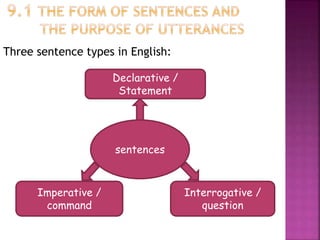
Three sentence types in English:
sentences
Declarative /
Statement
Imperative /
command
Interrogative /
question
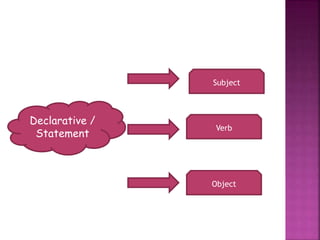
Declarative /
Statement
Subject
Verb
Object
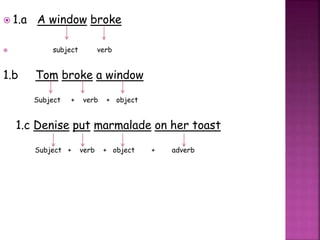
 1.a A window broke
 subject verb
1.b Tom broke a window
Subject + verb + object
1.c Denise put marmalade on her toast
Subject + verb + object + adverb
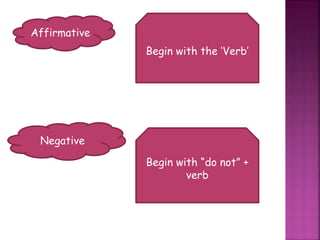
Affirmative
Begin with the ‘Verb’
Negative
Begin with “do not” +
verb
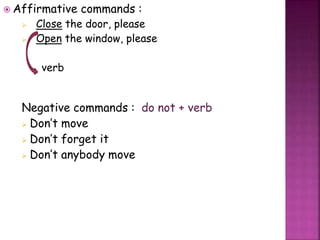
 Affirmative commands :
 Close the door, please
 Open the window, please
verb
Negative commands : do not + verb
 Don’t move
 Don’t forget it
 Don’t anybody move
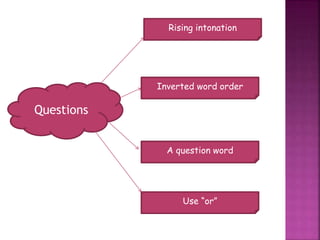
Questions
Rising intonation
Inverted word order
A question word
Use “or”
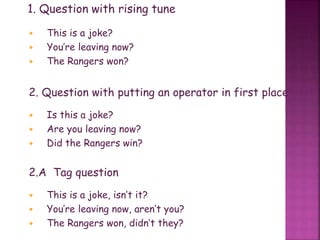
1. Question with rising tune
 This is a joke?
 You’re leaving now?
 The Rangers won?
2. Question with putting an operator in first place
 Is this a joke?
 Are you leaving now?
 Did the Rangers win?
2.A Tag question
 This is a joke, isn’t it?
 You’re leaving now, aren’t you?
 The Rangers won, didn’t they?
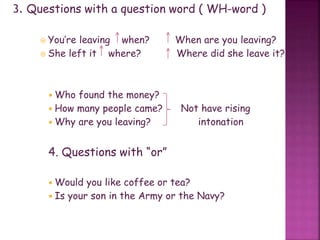
3. Questions with a question word ( WH-word )
 You’re leaving when? When are you leaving?
 She left it where? Where did she leave it?
 Who found the money?
 How many people came? Not have rising
 Why are you leaving? intonation
4. Questions with “or”
 Would you like coffee or tea?
 Is your son in the Army or the Navy?
Truth conditional semantics takes statements as the
basic kind of sentence and thus considers that the
principal use of language is to state facts, to
describe how things are in the world, to present
information which, generally, is either true or false.
In every speech act we can distinguish three things,
following Austin (1962). What is said, the utterance,
can be called the locution. What the speaker
intends to communicate to the addressee is the
illocution. The message that the addressee gets, his
interpretation of what the speaker says, is the
perlocution. If communication is successful, the
illocution and the perlocution are alike or nearly
alike.
9.3.1 Assertive utterances
9.3.2 Performative
utterances
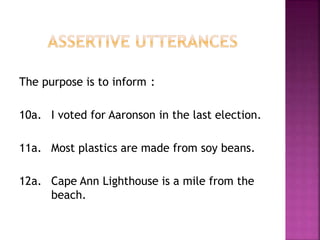
The purpose is to inform :
10a. I voted for Aaronson in the last election.
11a. Most plastics are made from soy beans.
12a. Cape Ann Lighthouse is a mile from the
beach.
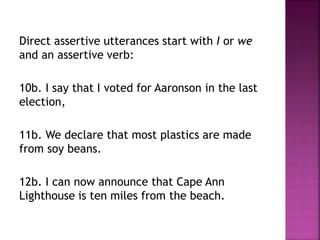
Direct assertive utterances start with I or we
and an assertive verb:
10b. I say that I voted for Aaronson in the last
election,
11b. We declare that most plastics are made
from soy beans.
12b. I can now announce that Cape Ann
Lighthouse is ten miles from the beach.
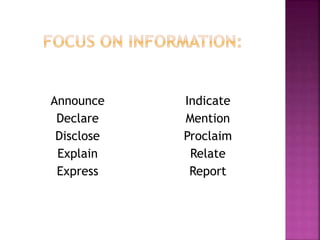
Announce
Declare
Disclose
Explain
Express
Indicate
Mention
Proclaim
Relate
Report
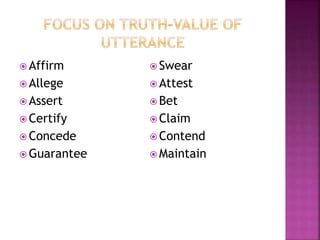
 Affirm
 Allege
 Assert
 Certify
 Concede
 Guarantee
 Swear
 Attest
 Bet
 Claim
 Contend
 Maintain
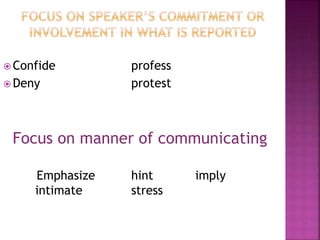
 Confide profess
 Deny protest
Focus on manner of communicating
Emphasize hint imply
intimate stress
 Focus on the nature of the message:
Dictate [a spoken message, written by
another person]
Narrate recount [the utterance is a unified
series of events]
Preach [the utterance has moral or ethical
content]
 Focus on aspect:
Predict [the utterance is about possible
future events]
Recall [the utterance is about previous
events]
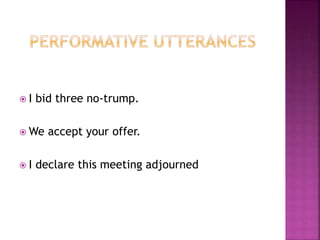
 I bid three no-trump.
 We accept your offer.
 I declare this meeting adjourned

Semantics "Speech Act"

  • 1.
    Presented by: 1.Dini Budiwati 2. Dini Kartini Class: 6B
  • 2.
    Three sentence typesin English: sentences Declarative / Statement Imperative / command Interrogative / question
  • 3.
  • 4.
     1.a Awindow broke  subject verb 1.b Tom broke a window Subject + verb + object 1.c Denise put marmalade on her toast Subject + verb + object + adverb
  • 5.
    Affirmative Begin with the‘Verb’ Negative Begin with “do not” + verb
  • 6.
     Affirmative commands:  Close the door, please  Open the window, please verb Negative commands : do not + verb  Don’t move  Don’t forget it  Don’t anybody move
  • 7.
    Questions Rising intonation Inverted wordorder A question word Use “or”
  • 8.
    1. Question withrising tune  This is a joke?  You’re leaving now?  The Rangers won? 2. Question with putting an operator in first place  Is this a joke?  Are you leaving now?  Did the Rangers win? 2.A Tag question  This is a joke, isn’t it?  You’re leaving now, aren’t you?  The Rangers won, didn’t they?
  • 9.
    3. Questions witha question word ( WH-word )  You’re leaving when? When are you leaving?  She left it where? Where did she leave it?  Who found the money?  How many people came? Not have rising  Why are you leaving? intonation 4. Questions with “or”  Would you like coffee or tea?  Is your son in the Army or the Navy?
  • 10.
    Truth conditional semanticstakes statements as the basic kind of sentence and thus considers that the principal use of language is to state facts, to describe how things are in the world, to present information which, generally, is either true or false. In every speech act we can distinguish three things, following Austin (1962). What is said, the utterance, can be called the locution. What the speaker intends to communicate to the addressee is the illocution. The message that the addressee gets, his interpretation of what the speaker says, is the perlocution. If communication is successful, the illocution and the perlocution are alike or nearly alike.
  • 11.
    9.3.1 Assertive utterances 9.3.2Performative utterances
  • 12.
    The purpose isto inform : 10a. I voted for Aaronson in the last election. 11a. Most plastics are made from soy beans. 12a. Cape Ann Lighthouse is a mile from the beach.
  • 13.
    Direct assertive utterancesstart with I or we and an assertive verb: 10b. I say that I voted for Aaronson in the last election, 11b. We declare that most plastics are made from soy beans. 12b. I can now announce that Cape Ann Lighthouse is ten miles from the beach.
  • 14.
  • 15.
     Affirm  Allege Assert  Certify  Concede  Guarantee  Swear  Attest  Bet  Claim  Contend  Maintain
  • 16.
     Confide profess Deny protest Focus on manner of communicating Emphasize hint imply intimate stress
  • 17.
     Focus onthe nature of the message: Dictate [a spoken message, written by another person] Narrate recount [the utterance is a unified series of events] Preach [the utterance has moral or ethical content]  Focus on aspect: Predict [the utterance is about possible future events] Recall [the utterance is about previous events]
  • 18.
     I bidthree no-trump.  We accept your offer.  I declare this meeting adjourned