SEMANTICS: LANGUAGE AND
MEANING
Part I: Sense and Reference
SEMANTICS is the study of how language acquires
meaning. It is a complex field, but our overview will
break semantics into four essential parts:
1.Sense and Reference
2.What Definitions Offer
3.Relationships between Words
4.Propositions and Presuppositions
SENSE AND REFERENCE
Think of SENSES as impressions or associations
you have when you hear a word.What comes to
mind when you read the following nouns?
Cat, Bird, Furniture, School
Think of REFERENCE as the specific entity of
a sense. Maybe more clearly, think of senses
as categories and references as specific
entities belonging to those categories. If
“School” is a sense, then possible references
are:“The University of Idaho,Washington
State University, and Boise State University.”
You might have noticed all that the
references: UI,WSU, and BSU are all
colleges/universities.We could count your
high school as a school, but we cannot
count it as a college/university. Similarly,
we can count Spokane Falls Community
College (SFCC) and North Idaho College
(NIC) as community colleges, but we
cannot count University of Idaho in that
category.
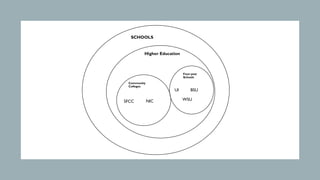
Next slide gives a diagram of this
breakdown of SENSE and REFERENCE

SCHOOLS
Higher Education
Community
Colleges
Four-year
Schools
SFCC NIC
UI BSU
WSU
‱ In other words, UI,WSU, and BSU belong to the set of schools which are also
institutes of higher education and are also four-year schools.
‱ They do NOT however, belong to the set of schools which are institutes of higher
education and are also community colleges.
‱ “SFCC” and “NIC” are REFERENCES of the set of all things that are Community
Colleges.
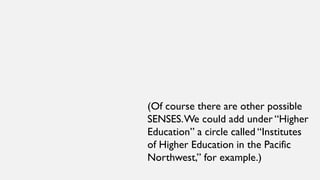
(Of course there are other possible
SENSES.We could add under “Higher
Education” a circle called “Institutes
of Higher Education in the Pacific
Northwest,” for example.)
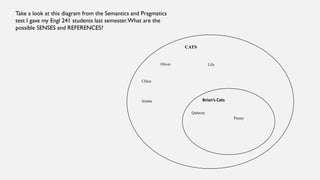
Take a look at this diagram from the Semantics and Pragmatics
test I gave my Engl 241 students last semester.What are the
possible SENSES and REFERENCES?
CATS
Brian’s Cats
Oliver
Quincey
Lily
Simba
Chloe
Penny
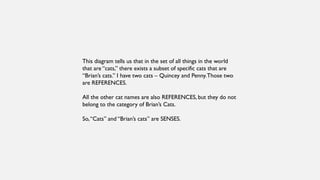
This diagram tells us that in the set of all things in the world
that are “cats,” there exists a subset of specific cats that are
“Brian’s cats.” I have two cats – Quincey and Penny.Those two
are REFERENCES.
All the other cat names are also REFERENCES, but they do not
belong to the category of Brian’s Cats.
So,“Cats” and “Brian’s cats” are SENSES.
Why does it matter?
Well, imagine we did not have the ability to
categorize, or that we did not have the ability
to recognize specific entities.We need both
senses and references to understand specific
entities in relationship to other specific entities
in the world.
Why does it matter?
Well, imagine we did not have the ability to
categorize, or that we did not have the ability
to recognize specific entities.We need both
senses and references to understand specific
entities in relationship to other specific entities
in the world.
Distinguishing senses helps us understand that “airplane” and
“spaceship” are different senses that belong to a larger sense
that we might call “Flying machines.”
Our ability to distinguish senses also helps us understand
intuitively why “strawberry” and “spaceship” mean different
things.
Why does it matter?
Well, imagine we did not have the ability to
categorize, or that we did not have the ability
to recognize specific entities.We need both
senses and references to understand specific
entities in relationship to other specific entities
in the world.
Distinguishing senses helps us understand that “airplane” and
“spaceship” are different senses that belong to a larger sense
that we might call “Flying machines.”
Our ability to distinguish senses also helps us understand
intuitively why “strawberry” and “spaceship” mean different
things.
Distinguishing references helps us understand that “Quincey” and
“Penny” are distinct entities.We need both sense and reference
to understand that the two are connected because they belong
to the same set of entities,“Brian’s cats.”
One quick complication on the notion of references

It’s important to note that proper nouns are both a sense and a
reference.Take my name for example. Brian Malone.Whatever
associations you have with me prove that I am a sense.The fact
that I am a specific physical entity in the world makes me a
reference, too.
Imagine the precision that using language requires in certain
spheres of public life.You can say,“A linguistics professor at UI”
and have (I think) maybe six possible references.As soon as you
say,“My linguistics professor at UI,” there is only one possible
reference. Me.This is precisely what allows us to use implicature
in language.
Teachers say things like,“One of my students
” all the time.
This allows us to capitalize on the SENSE of “students” while
protecting the privacy of individual REFERENCES.This sort of
careful application of senses allows us (we, humans) to straddle
the line between vagueness and clarity when it suits our
purposes.
CHALLENGE:
Think of a general noun that can serve as a sense.Think of as
many associated senses as possible, and then think of specific
references.
This can be tricky. Some nouns, like car you might think of
naming a specific model/year – but if more than one of that
kind of car has been made you have not arrived at a reference
yet!
For example, you might say politician. Other senses can include
“Dead politicians,” “Living politicians,” “US politicians,” “South
African politicians,” “World leaders,” etc.
“JFK” counts as a reference. So what other senses are there?
“Deceased,” “former US president,” “Catholic,” “Assassinated,”
“politician,” etc. Notice each of these senses contains LOTS of
other references, too.
We are all a product of many, many senses.
Now you try to come up with your own!
END
‱ PPT 1 of 4 written for the Semantics unit.
‱ Engl 241-01, 02, Spring 2020 at University of Idaho.
‱ Professor Brian Malone

Semantics i sense and reference

  • 1.
  • 2.
    SEMANTICS is thestudy of how language acquires meaning. It is a complex field, but our overview will break semantics into four essential parts: 1.Sense and Reference 2.What Definitions Offer 3.Relationships between Words 4.Propositions and Presuppositions
  • 3.
  • 4.
    Think of SENSESas impressions or associations you have when you hear a word.What comes to mind when you read the following nouns? Cat, Bird, Furniture, School
  • 5.
    Think of REFERENCEas the specific entity of a sense. Maybe more clearly, think of senses as categories and references as specific entities belonging to those categories. If “School” is a sense, then possible references are:“The University of Idaho,Washington State University, and Boise State University.”
  • 6.
    You might havenoticed all that the references: UI,WSU, and BSU are all colleges/universities.We could count your high school as a school, but we cannot count it as a college/university. Similarly, we can count Spokane Falls Community College (SFCC) and North Idaho College (NIC) as community colleges, but we cannot count University of Idaho in that category. Next slide gives a diagram of this breakdown of SENSE and REFERENCE

  • 7.
  • 8.
    ‱ In otherwords, UI,WSU, and BSU belong to the set of schools which are also institutes of higher education and are also four-year schools. ‱ They do NOT however, belong to the set of schools which are institutes of higher education and are also community colleges. ‱ “SFCC” and “NIC” are REFERENCES of the set of all things that are Community Colleges.
  • 9.
    (Of course thereare other possible SENSES.We could add under “Higher Education” a circle called “Institutes of Higher Education in the Pacific Northwest,” for example.)
  • 10.
    Take a lookat this diagram from the Semantics and Pragmatics test I gave my Engl 241 students last semester.What are the possible SENSES and REFERENCES? CATS Brian’s Cats Oliver Quincey Lily Simba Chloe Penny
  • 11.
    This diagram tellsus that in the set of all things in the world that are “cats,” there exists a subset of specific cats that are “Brian’s cats.” I have two cats – Quincey and Penny.Those two are REFERENCES. All the other cat names are also REFERENCES, but they do not belong to the category of Brian’s Cats. So,“Cats” and “Brian’s cats” are SENSES.
  • 12.
    Why does itmatter? Well, imagine we did not have the ability to categorize, or that we did not have the ability to recognize specific entities.We need both senses and references to understand specific entities in relationship to other specific entities in the world.
  • 13.
    Why does itmatter? Well, imagine we did not have the ability to categorize, or that we did not have the ability to recognize specific entities.We need both senses and references to understand specific entities in relationship to other specific entities in the world. Distinguishing senses helps us understand that “airplane” and “spaceship” are different senses that belong to a larger sense that we might call “Flying machines.” Our ability to distinguish senses also helps us understand intuitively why “strawberry” and “spaceship” mean different things.
  • 14.
    Why does itmatter? Well, imagine we did not have the ability to categorize, or that we did not have the ability to recognize specific entities.We need both senses and references to understand specific entities in relationship to other specific entities in the world. Distinguishing senses helps us understand that “airplane” and “spaceship” are different senses that belong to a larger sense that we might call “Flying machines.” Our ability to distinguish senses also helps us understand intuitively why “strawberry” and “spaceship” mean different things. Distinguishing references helps us understand that “Quincey” and “Penny” are distinct entities.We need both sense and reference to understand that the two are connected because they belong to the same set of entities,“Brian’s cats.”
  • 15.
    One quick complicationon the notion of references
 It’s important to note that proper nouns are both a sense and a reference.Take my name for example. Brian Malone.Whatever associations you have with me prove that I am a sense.The fact that I am a specific physical entity in the world makes me a reference, too. Imagine the precision that using language requires in certain spheres of public life.You can say,“A linguistics professor at UI” and have (I think) maybe six possible references.As soon as you say,“My linguistics professor at UI,” there is only one possible reference. Me.This is precisely what allows us to use implicature in language. Teachers say things like,“One of my students
” all the time. This allows us to capitalize on the SENSE of “students” while protecting the privacy of individual REFERENCES.This sort of careful application of senses allows us (we, humans) to straddle the line between vagueness and clarity when it suits our purposes.
  • 16.
    CHALLENGE: Think of ageneral noun that can serve as a sense.Think of as many associated senses as possible, and then think of specific references. This can be tricky. Some nouns, like car you might think of naming a specific model/year – but if more than one of that kind of car has been made you have not arrived at a reference yet! For example, you might say politician. Other senses can include “Dead politicians,” “Living politicians,” “US politicians,” “South African politicians,” “World leaders,” etc. “JFK” counts as a reference. So what other senses are there? “Deceased,” “former US president,” “Catholic,” “Assassinated,” “politician,” etc. Notice each of these senses contains LOTS of other references, too. We are all a product of many, many senses. Now you try to come up with your own!
  • 17.
    END ‱ PPT 1of 4 written for the Semantics unit. ‱ Engl 241-01, 02, Spring 2020 at University of Idaho. ‱ Professor Brian Malone