Body Paragraphs
Prof Brian Malone
Writ 1301
UHCL; Fall ‘20
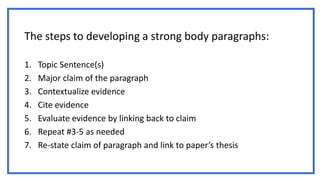
1. Topic Sentence(s)
2. Major claim of the paragraph
3. Contextualize evidence
4. Cite evidence
5. Evaluate evidence by linking back to claim
6. Repeat #3-5 as needed
7. Re-state claim of paragraph and link to paper’s thesis
The steps to developing a strong body paragraphs:
Topic Sentence(s)
At the start of each body paragraph, writing 1-2 sentences stating what this
paragraph will be about usually helps the reader prepare to hear your
argument.
You might include signposting statements that signal to your reader what
you have already discussed and what you still need to discuss. These
statements may include some form of the following template: “While we
have established the importance of [Y], the discussion of [topic] is not
complete without [X].”
You might also include some general historical context. Without necessarily
arguing, you might say, for example, “The first time [topic] occurred was in
[year] when [story].”
Major Claim of the Paragraph
While this varies depending on the context you are writing in, for argumentative essays like
the rhetorical analysis, each body paragraph should typically be making a point. Here, think
about purpose. If you were writing an encyclopedia entry, maybe your paragraph would be
informational. For a rhetorical analysis, however, each paragraph should make claim.
You should think about your claim as a subset of the larger thesis of your paper. For
example, this paragraph will prove that [author] primarily uses appeals to emotion, which
impact the audience by…
So, what is the point of each of your paragraphs? What does each paragraph accomplish as
part of the larger thesis/argument of your essay? Having clear answers to these questions
will ensure that your paragraphs are cohesive and unified. You want to write paragraphs
where one sentence seems to connect logically to the previous one, and you want your
paragraphs to remain focused around the topic and claim without accidentally veering too
much into some unrelated claim that might be better off as its own paragraph.
Contextualize Evidence
Before integrating a citation from either your primary source or a secondary
source, it is always a good idea to include a tag of some sort to indicate:
• You are borrowing from someone else’s work
• This other work is relevant and valuable to the larger point you are making
• This evidence relates to other parts of your essay by supporting what someone else has claimed
or offering a different perspective on the topic.
A tag is a strong way to demonstrate that you are separating your work from
another sources. Think of phrases like, “[Author] also discusses [topic] in their
article, stating…” or “[Author] has a very different opinion from [other source],
writing…”
For more practice with these tags, see pages 97 of IG.
Cite Evidence
When citing evidence, you include information from your outside resources
into your own work. However, you must be very careful to clarify which
words are yours and which you have borrowed. The easiest way to do this is
by quoting the other source directly, but sometimes quotes can be too long.
You may also choose to summarize or paraphrase evidence. No matter how
you do it, those tags from the previous slide help you indicate to your reader
that you have borrowed from another source.
For an overview of the correct ways to quote, summarize, and paraphrase,
revisit pages 94-98 from IG.
Evaluate Evidence
Unfortunately, you’re not done once you’ve inserted the outside
evidence. Remember, you are using this source for your own rhetorical
purpose, so you still have to connect the evidence to the larger claim in
your paragraph. You might use a sentence about how the evidence
proves your point, counters your point, agrees/disagrees with other
evidence, etc.
Here, recall your topic sentence and claim for the paragraph. What did
you promise this paragraph would be about? Has your evidence proved
that claim? These evaluative sentences should definitively make your
claim by reiterating how your evidence proves it.
Re-State Claim of Paragraph and Link to
Thesis
So far, you have learned to write a cohesive, unified paragraph. But
what about making that paragraph cohesive with the larger essay? This
is a move that some writers overlook, but it is crucial that your final
product feels like an essay – and not a compilation of great paragraphs
that sort of relate to each other.
So how do you do that? Once you have evaluated your evidence and
proven the claim of your paragraph, your last couple sentences should
connect that paragraph’s claim to the larger thesis of your paper. Why
was this paragraph one that you had to include in this essay? What
makes it fit? Why does it matter?

Body paragraphs

  • 1.
    Body Paragraphs Prof BrianMalone Writ 1301 UHCL; Fall ‘20
  • 2.
    1. Topic Sentence(s) 2.Major claim of the paragraph 3. Contextualize evidence 4. Cite evidence 5. Evaluate evidence by linking back to claim 6. Repeat #3-5 as needed 7. Re-state claim of paragraph and link to paper’s thesis The steps to developing a strong body paragraphs:
  • 3.
    Topic Sentence(s) At thestart of each body paragraph, writing 1-2 sentences stating what this paragraph will be about usually helps the reader prepare to hear your argument. You might include signposting statements that signal to your reader what you have already discussed and what you still need to discuss. These statements may include some form of the following template: “While we have established the importance of [Y], the discussion of [topic] is not complete without [X].” You might also include some general historical context. Without necessarily arguing, you might say, for example, “The first time [topic] occurred was in [year] when [story].”
  • 4.
    Major Claim ofthe Paragraph While this varies depending on the context you are writing in, for argumentative essays like the rhetorical analysis, each body paragraph should typically be making a point. Here, think about purpose. If you were writing an encyclopedia entry, maybe your paragraph would be informational. For a rhetorical analysis, however, each paragraph should make claim. You should think about your claim as a subset of the larger thesis of your paper. For example, this paragraph will prove that [author] primarily uses appeals to emotion, which impact the audience by… So, what is the point of each of your paragraphs? What does each paragraph accomplish as part of the larger thesis/argument of your essay? Having clear answers to these questions will ensure that your paragraphs are cohesive and unified. You want to write paragraphs where one sentence seems to connect logically to the previous one, and you want your paragraphs to remain focused around the topic and claim without accidentally veering too much into some unrelated claim that might be better off as its own paragraph.
  • 5.
    Contextualize Evidence Before integratinga citation from either your primary source or a secondary source, it is always a good idea to include a tag of some sort to indicate: • You are borrowing from someone else’s work • This other work is relevant and valuable to the larger point you are making • This evidence relates to other parts of your essay by supporting what someone else has claimed or offering a different perspective on the topic. A tag is a strong way to demonstrate that you are separating your work from another sources. Think of phrases like, “[Author] also discusses [topic] in their article, stating…” or “[Author] has a very different opinion from [other source], writing…” For more practice with these tags, see pages 97 of IG.
  • 6.
    Cite Evidence When citingevidence, you include information from your outside resources into your own work. However, you must be very careful to clarify which words are yours and which you have borrowed. The easiest way to do this is by quoting the other source directly, but sometimes quotes can be too long. You may also choose to summarize or paraphrase evidence. No matter how you do it, those tags from the previous slide help you indicate to your reader that you have borrowed from another source. For an overview of the correct ways to quote, summarize, and paraphrase, revisit pages 94-98 from IG.
  • 7.
    Evaluate Evidence Unfortunately, you’renot done once you’ve inserted the outside evidence. Remember, you are using this source for your own rhetorical purpose, so you still have to connect the evidence to the larger claim in your paragraph. You might use a sentence about how the evidence proves your point, counters your point, agrees/disagrees with other evidence, etc. Here, recall your topic sentence and claim for the paragraph. What did you promise this paragraph would be about? Has your evidence proved that claim? These evaluative sentences should definitively make your claim by reiterating how your evidence proves it.
  • 8.
    Re-State Claim ofParagraph and Link to Thesis So far, you have learned to write a cohesive, unified paragraph. But what about making that paragraph cohesive with the larger essay? This is a move that some writers overlook, but it is crucial that your final product feels like an essay – and not a compilation of great paragraphs that sort of relate to each other. So how do you do that? Once you have evaluated your evidence and proven the claim of your paragraph, your last couple sentences should connect that paragraph’s claim to the larger thesis of your paper. Why was this paragraph one that you had to include in this essay? What makes it fit? Why does it matter?