Speech Acts and Indirect
Speech
Imagine a situation…
Two friends see each other
while shopping. The first
says, “Oh, I like your shirt.”
The friend responds,
“Thanks, it’s really old.”
Nothing about the first speaker’s statement suggested that they wanted to know
how old the shirt was, but the second speaker’s response represents something
fundamental to the study of Pragmatics. Namely:
Appropriate language use is dependent on context!
Pragmatics vs.
Semantics
• Last chapter, we saw that Semantics
helps us understand how language
acquires meaning, but we don’t always
say exactly what we mean.
• Pragmatics helps us understand how
situational/cultural context also
determines how we should interpret
language use.
Speech Acts
In our initial example, the first speaker
presumably wanted to compliment their
friend. There is a category of social
functions that language allows us to
accomplish called speech acts.
Besides compliments, common speech
acts include things like: questioning,
begging, commanding, requesting,
promising, apologizing, and many more.
Performative Speech Acts
Sometimes, it is only through language that an action is
accomplished. Or, the words perform the action.
Take a look at the next slide…
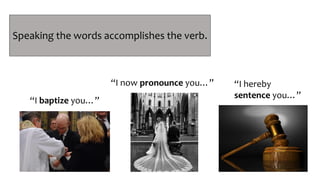
PERFORMATIVE
Speech Acts
“I baptize you…”
“I now pronounce you…” “I hereby
sentence you…”
Speaking the words accomplishes the verb.
Direct Speech
• It is impossible to pass a sentence, baptize someone, make a marriage official,
etc. without the preset, recognized language.
• Such performative speech acts are always examples of direct speech. That is,
language that makes the speaker’s intentions explicit.
• What are the verbs that make the following examples direct speech acts?
Direct Speech Acts (Examples)
• “I’m asking you to stay.”
• “I wager $60.”
• “I promise I’ll pay the rent today.”
Indirect Speech
• SOOOO often, though, our intentions are veiled through indirect speech, or,
language where context helps speakers understand what is being implied.
• Consider these examples:
• A guest in someone’s home is sweating. “It’s hot in here,” they tell the host.
• A teacher tells a student, “Your assignment is late.”
• A customer says, “When you have a chance, could you bring more napkins?”
• A partner at a law firm meets with a client in open-toed shoes and swim trunks.
Afterwards, the other partner says, “Nice outfit.”
Indirect Speech (Cont.)
• In all these examples, the speaker wants to accomplish something through
language, but for any range of reasons, is not using explicit language.
• Let’s take a closer look…
• A guest in someone’s home is sweating. “It’s hot in here,” they tell the host. The guest wants the
host to open a window or turn on AC.
• A teacher tells a student, “Your assignment is late.” The teacher wants the student to turn in their
work or explain themselves.
• A customer says to a server, “When you have a chance, could you bring more napkins?” The
customer wants the server to bring napkins.
• A partner at a law firm meets with a client in open-toed shoes and swim trunks. Afterwards, the
other partner says, “Nice outfit.” The speaker wants to insult/shame the partner for their lack of
professionalism.
Indirect Speech (Cont.)
• We use indirect speech overwhelmingly in our interactions. We do so for many
reasons, but mostly it comes down to this:
• Politeness
• Plausible Deniability
• Offering the interlocuters (others involved in the communication) a “way out.”
• Let’s revisit…
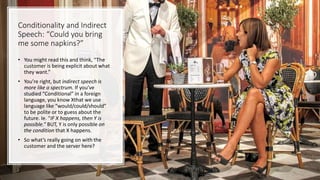
Conditionality and Indirect
Speech: “Could you bring
me some napkins?”
• You might read this and think, “The
customer is being explicit about what
they want.”
• You’re right, but indirect speech is
more like a spectrum. If you’ve
studied “Conditional” in a foreign
language, you know Xthat we use
language like “would/could/should”
to be polite or to guess about the
future. Ie. “IF X happens, then Y is
possible.” BUT, Y is only possible on
the condition that X happens.
• So what’s really going on with the
customer and the server here?
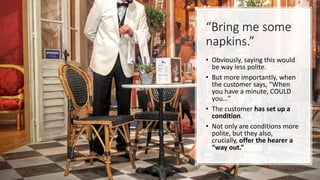
“Bring me some
napkins.”
• Obviously, saying this would
be way less polite.
• But more importantly, when
the customer says, “When
you have a minute, COULD
you…”
• The customer has set up a
condition.
• Not only are conditions more
polite, but they also,
crucially, offer the hearer a
“way out.”
What if the server forgets the
napkins?
• Well, the customer has – maybe not consciously –
offered the server an easy disguise.
• The customer may safely assume that the server
became very busy and never “had a minute”
according to the customer’s initial condition.
• Now, of course, maybe the customer is still angry
and not going to leave a good tip (jerk!), but the
initial request hopefully alleviates some
awkwardness, hostility, or confrontation.
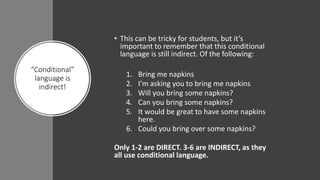
“Conditional”
language is
indirect!
• This can be tricky for students, but it’s
important to remember that this conditional
language is still indirect. Of the following:
1. Bring me napkins
2. I’m asking you to bring me napkins
3. Will you bring some napkins?
4. Can you bring some napkins?
5. It would be great to have some napkins
here.
6. Could you bring over some napkins?
Only 1-2 are DIRECT. 3-6 are INDIRECT, as they
all use conditional language.
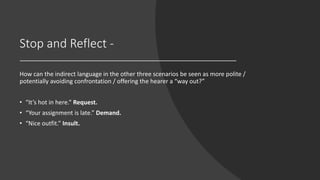
Stop and Reflect -
How can the indirect language in the other three scenarios be seen as more polite /
potentially avoiding confrontation / offering the hearer a “way out?”
• “It’s hot in here.” Request.
• “Your assignment is late.” Demand.
• “Nice outfit.” Insult.
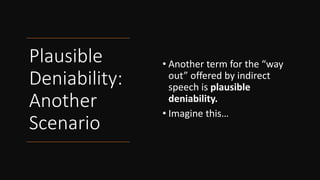
Plausible
Deniability:
Another
Scenario
• Another term for the “way
out” offered by indirect
speech is plausible
deniability.
• Imagine this…
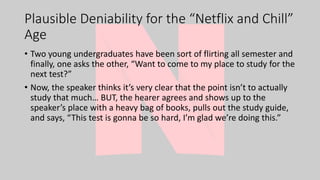
Plausible Deniability for the “Netflix and Chill”
Age
• Two young undergraduates have been sort of flirting all semester and
finally, one asks the other, “Want to come to my place to study for the
next test?”
• Now, the speaker thinks it’s very clear that the point isn’t to actually
study that much… BUT, the hearer agrees and shows up to the
speaker’s place with a heavy bag of books, pulls out the study guide,
and says, “This test is gonna be so hard, I’m glad we’re doing this.”
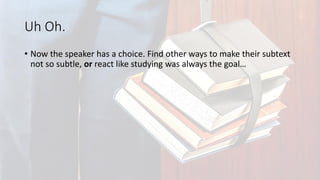
Uh Oh.
• Now the speaker has a choice. Find other ways to make their subtext
not so subtle, or react like studying was always the goal…
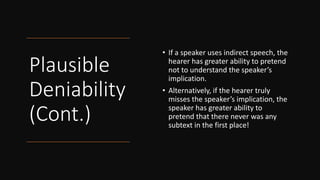
Plausible
Deniability
(Cont.)
• If a speaker uses indirect speech, the
hearer has greater ability to pretend
not to understand the speaker’s
implication.
• Alternatively, if the hearer truly
misses the speaker’s implication, the
speaker has greater ability to
pretend that there never was any
subtext in the first place!
A Challenge for You!
• Start paying attention to the way people interact with you (or how characters
interact in books / media). How essential is plausible deniability to building polite
relationships?
Image References
• https://www.wallpaperflare.com/public-speaking-mic-microphone-stage-speech-
speaker-sing-wallpaper-artjx
• https://pixabay.com/photos/books-student-study-education-1012088/
• https://commons.wikimedia.org/wiki/File:Netflix-new-icon.png
• https://www.wallpaperflare.com/shopping-stores-fun-factor-group-of-people-shopping-
mall-wallpaper-aborp
• https://www.pickpik.com/waitress-waiter-restaurant-cafe-the-waiter-coffee-62849
• https://www.peakpx.com/552854/gray-table-napkin-and-silver-fork
END
Pragmatics Lecture ONE of TWO
Engl 241 Spring ’20; Professor Brian Malone

Pragmatics i

  • 1.
    Speech Acts andIndirect Speech
  • 2.
  • 3.
    Two friends seeeach other while shopping. The first says, “Oh, I like your shirt.” The friend responds, “Thanks, it’s really old.”
  • 4.
    Nothing about thefirst speaker’s statement suggested that they wanted to know how old the shirt was, but the second speaker’s response represents something fundamental to the study of Pragmatics. Namely: Appropriate language use is dependent on context!
  • 5.
    Pragmatics vs. Semantics • Lastchapter, we saw that Semantics helps us understand how language acquires meaning, but we don’t always say exactly what we mean. • Pragmatics helps us understand how situational/cultural context also determines how we should interpret language use.
  • 6.
    Speech Acts In ourinitial example, the first speaker presumably wanted to compliment their friend. There is a category of social functions that language allows us to accomplish called speech acts. Besides compliments, common speech acts include things like: questioning, begging, commanding, requesting, promising, apologizing, and many more.
  • 7.
    Performative Speech Acts Sometimes,it is only through language that an action is accomplished. Or, the words perform the action. Take a look at the next slide…
  • 8.
    PERFORMATIVE Speech Acts “I baptizeyou…” “I now pronounce you…” “I hereby sentence you…” Speaking the words accomplishes the verb.
  • 9.
    Direct Speech • Itis impossible to pass a sentence, baptize someone, make a marriage official, etc. without the preset, recognized language. • Such performative speech acts are always examples of direct speech. That is, language that makes the speaker’s intentions explicit. • What are the verbs that make the following examples direct speech acts?
  • 10.
    Direct Speech Acts(Examples) • “I’m asking you to stay.” • “I wager $60.” • “I promise I’ll pay the rent today.”
  • 11.
    Indirect Speech • SOOOOoften, though, our intentions are veiled through indirect speech, or, language where context helps speakers understand what is being implied. • Consider these examples:
  • 12.
    • A guestin someone’s home is sweating. “It’s hot in here,” they tell the host. • A teacher tells a student, “Your assignment is late.” • A customer says, “When you have a chance, could you bring more napkins?” • A partner at a law firm meets with a client in open-toed shoes and swim trunks. Afterwards, the other partner says, “Nice outfit.”
  • 13.
    Indirect Speech (Cont.) •In all these examples, the speaker wants to accomplish something through language, but for any range of reasons, is not using explicit language. • Let’s take a closer look…
  • 14.
    • A guestin someone’s home is sweating. “It’s hot in here,” they tell the host. The guest wants the host to open a window or turn on AC. • A teacher tells a student, “Your assignment is late.” The teacher wants the student to turn in their work or explain themselves. • A customer says to a server, “When you have a chance, could you bring more napkins?” The customer wants the server to bring napkins. • A partner at a law firm meets with a client in open-toed shoes and swim trunks. Afterwards, the other partner says, “Nice outfit.” The speaker wants to insult/shame the partner for their lack of professionalism.
  • 15.
    Indirect Speech (Cont.) •We use indirect speech overwhelmingly in our interactions. We do so for many reasons, but mostly it comes down to this: • Politeness • Plausible Deniability • Offering the interlocuters (others involved in the communication) a “way out.” • Let’s revisit…
  • 16.
    Conditionality and Indirect Speech:“Could you bring me some napkins?” • You might read this and think, “The customer is being explicit about what they want.” • You’re right, but indirect speech is more like a spectrum. If you’ve studied “Conditional” in a foreign language, you know Xthat we use language like “would/could/should” to be polite or to guess about the future. Ie. “IF X happens, then Y is possible.” BUT, Y is only possible on the condition that X happens. • So what’s really going on with the customer and the server here?
  • 17.
    “Bring me some napkins.” •Obviously, saying this would be way less polite. • But more importantly, when the customer says, “When you have a minute, COULD you…” • The customer has set up a condition. • Not only are conditions more polite, but they also, crucially, offer the hearer a “way out.”
  • 18.
    What if theserver forgets the napkins? • Well, the customer has – maybe not consciously – offered the server an easy disguise. • The customer may safely assume that the server became very busy and never “had a minute” according to the customer’s initial condition. • Now, of course, maybe the customer is still angry and not going to leave a good tip (jerk!), but the initial request hopefully alleviates some awkwardness, hostility, or confrontation.
  • 19.
    “Conditional” language is indirect! • Thiscan be tricky for students, but it’s important to remember that this conditional language is still indirect. Of the following: 1. Bring me napkins 2. I’m asking you to bring me napkins 3. Will you bring some napkins? 4. Can you bring some napkins? 5. It would be great to have some napkins here. 6. Could you bring over some napkins? Only 1-2 are DIRECT. 3-6 are INDIRECT, as they all use conditional language.
  • 20.
    Stop and Reflect- How can the indirect language in the other three scenarios be seen as more polite / potentially avoiding confrontation / offering the hearer a “way out?” • “It’s hot in here.” Request. • “Your assignment is late.” Demand. • “Nice outfit.” Insult.
  • 21.
    Plausible Deniability: Another Scenario • Another termfor the “way out” offered by indirect speech is plausible deniability. • Imagine this…
  • 22.
    Plausible Deniability forthe “Netflix and Chill” Age • Two young undergraduates have been sort of flirting all semester and finally, one asks the other, “Want to come to my place to study for the next test?” • Now, the speaker thinks it’s very clear that the point isn’t to actually study that much… BUT, the hearer agrees and shows up to the speaker’s place with a heavy bag of books, pulls out the study guide, and says, “This test is gonna be so hard, I’m glad we’re doing this.”
  • 23.
    Uh Oh. • Nowthe speaker has a choice. Find other ways to make their subtext not so subtle, or react like studying was always the goal…
  • 24.
    Plausible Deniability (Cont.) • If aspeaker uses indirect speech, the hearer has greater ability to pretend not to understand the speaker’s implication. • Alternatively, if the hearer truly misses the speaker’s implication, the speaker has greater ability to pretend that there never was any subtext in the first place!
  • 25.
    A Challenge forYou! • Start paying attention to the way people interact with you (or how characters interact in books / media). How essential is plausible deniability to building polite relationships?
  • 26.
    Image References • https://www.wallpaperflare.com/public-speaking-mic-microphone-stage-speech- speaker-sing-wallpaper-artjx •https://pixabay.com/photos/books-student-study-education-1012088/ • https://commons.wikimedia.org/wiki/File:Netflix-new-icon.png • https://www.wallpaperflare.com/shopping-stores-fun-factor-group-of-people-shopping- mall-wallpaper-aborp • https://www.pickpik.com/waitress-waiter-restaurant-cafe-the-waiter-coffee-62849 • https://www.peakpx.com/552854/gray-table-napkin-and-silver-fork
  • 27.
    END Pragmatics Lecture ONEof TWO Engl 241 Spring ’20; Professor Brian Malone