“LANGUAGE WITHOUT MEANING IS MEANINGLESS”… (ROMAN
JAKOBSON)
Semantics:
• is the technical term used to refer to the study
of meaning, and, since meaning is a part of
language, semantics is a part of linguistics.
What is semantics?
• Semantics is the study of meaning in
language. It is a wide subject within the
general study of language.
• An understanding of semantics is
essential to the study of language
acquisition (how language users acquire a
sense of meaning, as speakers and writers,
listeners and readers).
• It is also essential to the study of language
change (how meanings alter over time).
• It is important for understanding language
in social contexts, as these are likely to
affect meaning, and for understanding
varieties of English and effects of style.
• It is thus one of the most fundamental
concepts in linguistics.
• The study of semantics includes the study
of how meaning is constructed,
interpreted, clarified, obscured, illustrated,
simplified, negotiated, contradicted, and
paraphrased.
Some important areas of semantic theory or
related subjects include these:
• Symbol and referent
• Conceptions of meaning
• Words and lexemes
• Denotation, connotation, implication
• Pragmatics
• Ambiguity
• Metaphor, simile and symbol
• Semantic fields
• Synonym, antonym and hyponym
• Collocation, fixed expression and idiom
• Semantic change and etymology
• Polysemy
• Homonymy, homophones and
homographs
• Lexicology and lexicography
• Thesauruses, libraries and Web portals
• Epistemology
• Colour
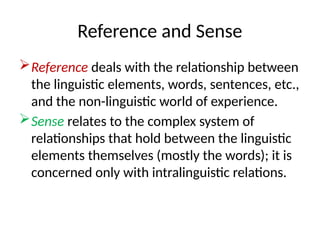
Reference and Sense
Reference deals with the relationship between
the linguistic elements, words, sentences, etc.,
and the non-linguistic world of experience.
Sense relates to the complex system of
relationships that hold between the linguistic
elements themselves (mostly the words); it is
concerned only with intralinguistic relations.
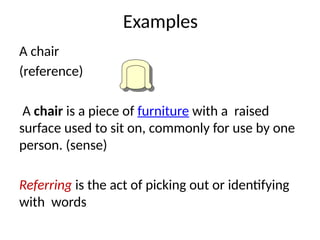
Examples
A chair
(reference)
A chair is a piece of furniture with a raised
surface used to sit on, commonly for use by one
person. (sense)
Referring is the act of picking out or identifying
with words
Basic notions related to Reference
Referring expressions are any linguistic
expression which is used to identify an entity.
eg. Mary, The book
Non-referring expression is any linguistic
elements which can never be used to refer.
Eg. So, very, may be, of, etc
Cont’…….
Constant Versus Variable Reference
(1) Any expressions which have the same
referent across range of utterances are
constant reference. Eg. The Eiffle Tower,
Pacific Ocean
(2) Any expressions which have their reference
totally dependent on context are variable
reference .Eg. I wrote to you.
Referent and Extension
The term referent is used for the thing picked
out by uttering the expression in a particular
context.Eg. The referent of Indonesian
President in 1997 is Suharto, the referent of a
toad in
The term extension is used for the set of
things which could be the referent of the
expression
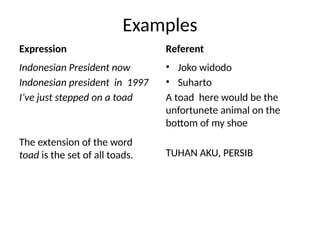
Examples
Expression
Indonesian President now
Indonesian president in 1997
I’ve just stepped on a toad
The extension of the word
toad is the set of all toads.
Referent
• Joko widodo
• Suharto
A toad here would be the
unfortunete animal on the
bottom of my shoe
TUHAN AKU, PERSIB
Referents and Referring expressions
• A referring expression is not a referent
Eg. Howard is your cousin, isn’t it?
Howard is your cousin’s name, isn’t it?
• There is no natural connection between
referring expression and referent
• The existance of a referring expression does
not guarantee the existence of a referent in
the physical social-social world that we inhabit
• Eg. The present emperor of texas,
Cont’
• Two or more referring expression may have
the same referent, but they do not
necessaraly have the same meaning, eg
 Ani Yudoyono
 Susilo bambang Yudoyono’s wife
Ibas’ mother
Different kinds of referents
a. Unique and non unique referents
A referring expression has fixed reference when
the referent is unique entity or unique set of
entities, such as Lake Toba, Japan, Boris Yeltsin
Eg. We swam in Lake Toba
We swam in a lake
A referring expression has variable reference if
its referent may be different every time.
Eg. That dog, my uncle, a lake, etc
b. Concrete and abstract referent
Concrete referents are objects that can be
seen or touched. Door, leaf, stone
Abstract referents mean they can not be
perceived directly through the senses.
reason, knowledge, etc
What about this….?
• The key to the front door
The key to success
• A bright light
a bright future
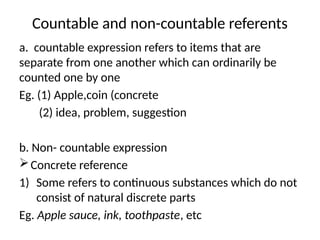
Countable and non-countable referents
a. countable expression refers to items that are
separate from one another which can ordinarily be
counted one by one
Eg. (1) Apple,coin (concrete
(2) idea, problem, suggestion
b. Non- countable expression
Concrete reference
1) Some refers to continuous substances which do not
consist of natural discrete parts
Eg. Apple sauce, ink, toothpaste, etc
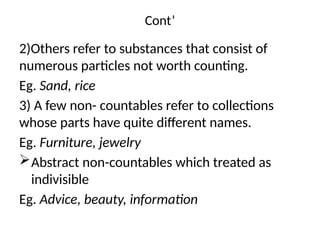
Cont’
2)Others refer to substances that consist of
numerous particles not worth counting.
Eg. Sand, rice
3) A few non- countables refer to collections
whose parts have quite different names.
Eg. Furniture, jewelry
Abstract non-countables which treated as
indivisible
Eg. Advice, beauty, information
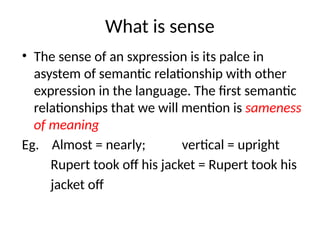
What is sense
• The sense of an sxpression is its palce in
asystem of semantic relationship with other
expression in the language. The first semantic
relationships that we will mention is sameness
of meaning
Eg. Almost = nearly; vertical = upright
Rupert took off his jacket = Rupert took his
jacket off
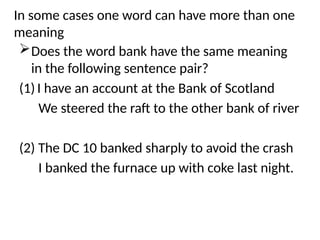
In some cases one word can have more than one
meaning
Does the word bank have the same meaning
in the following sentence pair?
(1) I have an account at the Bank of Scotland
We steered the raft to the other bank of river
(2) The DC 10 banked sharply to avoid the crash
I banked the furnace up with coke last night.
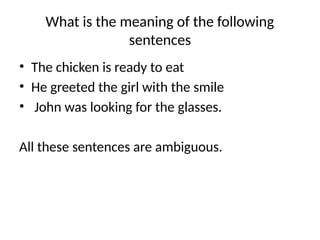
What is the meaning of the following
sentences
• The chicken is ready to eat
• He greeted the girl with the smile
• John was looking for the glasses.
All these sentences are ambiguous.
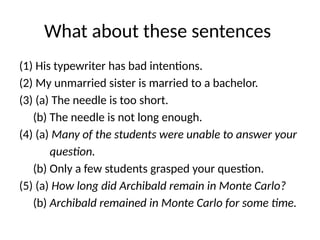
What about these sentences
(1) His typewriter has bad intentions.
(2) My unmarried sister is married to a bachelor.
(3) (a) The needle is too short.
(b) The needle is not long enough.
(4) (a) Many of the students were unable to answer your
question.
(b) Only a few students grasped your question.
(5) (a) How long did Archibald remain in Monte Carlo?
(b) Archibald remained in Monte Carlo for some time.
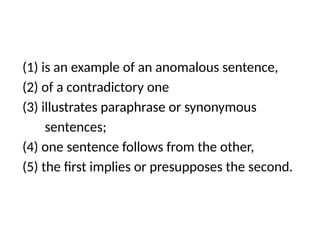
(1) is an example of an anomalous sentence,
(2) of a contradictory one
(3) illustrates paraphrase or synonymous
sentences;
(4) one sentence follows from the other,
(5) the first implies or presupposes the second.
Ccq
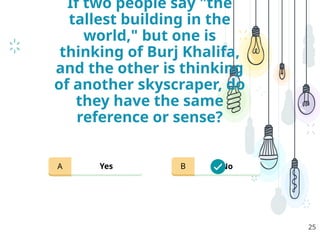
If two people say "the
tallest building in the
world," but one is
thinking of Burj Khalifa,
and the other is thinking
of another skyscraper, do
they have the same
reference or sense?
25
Yes No
A B
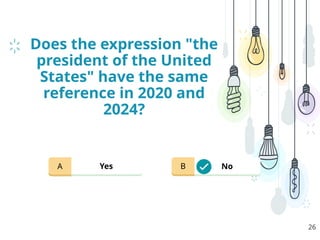
Does the expression "the
president of the United
States" have the same
reference in 2020 and
2024?
26
Yes No
A B
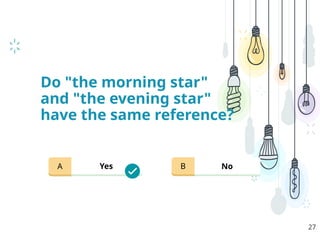
Do "the morning star"
and "the evening star"
have the same reference?
27
Yes No
A B
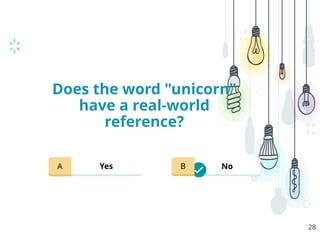
Does the word "unicorn"
have a real-world
reference?
28
Yes No
A B
Task
Analyze
30
1. "The proclaimer of Indonesia's independence is Soekarno.
Is "the proclaimer of Indonesia's independence" a sense or a reference? Explain
why?
2. "The current President of Indonesia" and "Joko Widodo" refer to the same
person (as of 2024).
Do "the current President of Indonesia" and "Joko Widodo" have the same sense?
Explain your reasoning.
3. Garuda is a mythological creature.“
Why does "Garuda" have only a sense and not a reference? How does this affect
its meaning in communication?
4. Consider the phrases "the largest island in Indonesia" and "Kalimantan.“
Do these phrases have the same reference? How might their senses differ in specific contexts?
5. "The Governor of Jakarta" will refer to different people over time
How can the sense of "The Governor of Jakarta" remain constant while the
reference changes? What does this tell us about the flexibility of language?

MEEETING 2-------REFERENCE AND SENSE.pptx

  • 1.
    “LANGUAGE WITHOUT MEANINGIS MEANINGLESS”… (ROMAN JAKOBSON) Semantics: • is the technical term used to refer to the study of meaning, and, since meaning is a part of language, semantics is a part of linguistics.
  • 2.
    What is semantics? •Semantics is the study of meaning in language. It is a wide subject within the general study of language. • An understanding of semantics is essential to the study of language acquisition (how language users acquire a sense of meaning, as speakers and writers, listeners and readers). • It is also essential to the study of language change (how meanings alter over time).
  • 3.
    • It isimportant for understanding language in social contexts, as these are likely to affect meaning, and for understanding varieties of English and effects of style. • It is thus one of the most fundamental concepts in linguistics. • The study of semantics includes the study of how meaning is constructed, interpreted, clarified, obscured, illustrated, simplified, negotiated, contradicted, and paraphrased.
  • 4.
    Some important areasof semantic theory or related subjects include these: • Symbol and referent • Conceptions of meaning • Words and lexemes • Denotation, connotation, implication • Pragmatics • Ambiguity • Metaphor, simile and symbol • Semantic fields
  • 5.
    • Synonym, antonymand hyponym • Collocation, fixed expression and idiom • Semantic change and etymology • Polysemy • Homonymy, homophones and homographs • Lexicology and lexicography • Thesauruses, libraries and Web portals • Epistemology • Colour
  • 6.
    Reference and Sense Referencedeals with the relationship between the linguistic elements, words, sentences, etc., and the non-linguistic world of experience. Sense relates to the complex system of relationships that hold between the linguistic elements themselves (mostly the words); it is concerned only with intralinguistic relations.
  • 7.
    Examples A chair (reference) A chairis a piece of furniture with a raised surface used to sit on, commonly for use by one person. (sense) Referring is the act of picking out or identifying with words
  • 8.
    Basic notions relatedto Reference Referring expressions are any linguistic expression which is used to identify an entity. eg. Mary, The book Non-referring expression is any linguistic elements which can never be used to refer. Eg. So, very, may be, of, etc
  • 9.
    Cont’……. Constant Versus VariableReference (1) Any expressions which have the same referent across range of utterances are constant reference. Eg. The Eiffle Tower, Pacific Ocean (2) Any expressions which have their reference totally dependent on context are variable reference .Eg. I wrote to you.
  • 10.
    Referent and Extension Theterm referent is used for the thing picked out by uttering the expression in a particular context.Eg. The referent of Indonesian President in 1997 is Suharto, the referent of a toad in The term extension is used for the set of things which could be the referent of the expression
  • 11.
    Examples Expression Indonesian President now Indonesianpresident in 1997 I’ve just stepped on a toad The extension of the word toad is the set of all toads. Referent • Joko widodo • Suharto A toad here would be the unfortunete animal on the bottom of my shoe TUHAN AKU, PERSIB
  • 12.
    Referents and Referringexpressions • A referring expression is not a referent Eg. Howard is your cousin, isn’t it? Howard is your cousin’s name, isn’t it? • There is no natural connection between referring expression and referent • The existance of a referring expression does not guarantee the existence of a referent in the physical social-social world that we inhabit • Eg. The present emperor of texas,
  • 13.
    Cont’ • Two ormore referring expression may have the same referent, but they do not necessaraly have the same meaning, eg  Ani Yudoyono  Susilo bambang Yudoyono’s wife Ibas’ mother
  • 14.
    Different kinds ofreferents a. Unique and non unique referents A referring expression has fixed reference when the referent is unique entity or unique set of entities, such as Lake Toba, Japan, Boris Yeltsin Eg. We swam in Lake Toba We swam in a lake A referring expression has variable reference if its referent may be different every time. Eg. That dog, my uncle, a lake, etc
  • 15.
    b. Concrete andabstract referent Concrete referents are objects that can be seen or touched. Door, leaf, stone Abstract referents mean they can not be perceived directly through the senses. reason, knowledge, etc
  • 16.
    What about this….? •The key to the front door The key to success • A bright light a bright future
  • 17.
    Countable and non-countablereferents a. countable expression refers to items that are separate from one another which can ordinarily be counted one by one Eg. (1) Apple,coin (concrete (2) idea, problem, suggestion b. Non- countable expression Concrete reference 1) Some refers to continuous substances which do not consist of natural discrete parts Eg. Apple sauce, ink, toothpaste, etc
  • 18.
    Cont’ 2)Others refer tosubstances that consist of numerous particles not worth counting. Eg. Sand, rice 3) A few non- countables refer to collections whose parts have quite different names. Eg. Furniture, jewelry Abstract non-countables which treated as indivisible Eg. Advice, beauty, information
  • 19.
    What is sense •The sense of an sxpression is its palce in asystem of semantic relationship with other expression in the language. The first semantic relationships that we will mention is sameness of meaning Eg. Almost = nearly; vertical = upright Rupert took off his jacket = Rupert took his jacket off
  • 20.
    In some casesone word can have more than one meaning Does the word bank have the same meaning in the following sentence pair? (1) I have an account at the Bank of Scotland We steered the raft to the other bank of river (2) The DC 10 banked sharply to avoid the crash I banked the furnace up with coke last night.
  • 21.
    What is themeaning of the following sentences • The chicken is ready to eat • He greeted the girl with the smile • John was looking for the glasses. All these sentences are ambiguous.
  • 22.
    What about thesesentences (1) His typewriter has bad intentions. (2) My unmarried sister is married to a bachelor. (3) (a) The needle is too short. (b) The needle is not long enough. (4) (a) Many of the students were unable to answer your question. (b) Only a few students grasped your question. (5) (a) How long did Archibald remain in Monte Carlo? (b) Archibald remained in Monte Carlo for some time.
  • 23.
    (1) is anexample of an anomalous sentence, (2) of a contradictory one (3) illustrates paraphrase or synonymous sentences; (4) one sentence follows from the other, (5) the first implies or presupposes the second.
  • 24.
  • 25.
    If two peoplesay "the tallest building in the world," but one is thinking of Burj Khalifa, and the other is thinking of another skyscraper, do they have the same reference or sense? 25 Yes No A B
  • 26.
    Does the expression"the president of the United States" have the same reference in 2020 and 2024? 26 Yes No A B
  • 27.
    Do "the morningstar" and "the evening star" have the same reference? 27 Yes No A B
  • 28.
    Does the word"unicorn" have a real-world reference? 28 Yes No A B
  • 29.
  • 30.
    Analyze 30 1. "The proclaimerof Indonesia's independence is Soekarno. Is "the proclaimer of Indonesia's independence" a sense or a reference? Explain why? 2. "The current President of Indonesia" and "Joko Widodo" refer to the same person (as of 2024). Do "the current President of Indonesia" and "Joko Widodo" have the same sense? Explain your reasoning. 3. Garuda is a mythological creature.“ Why does "Garuda" have only a sense and not a reference? How does this affect its meaning in communication? 4. Consider the phrases "the largest island in Indonesia" and "Kalimantan.“ Do these phrases have the same reference? How might their senses differ in specific contexts? 5. "The Governor of Jakarta" will refer to different people over time How can the sense of "The Governor of Jakarta" remain constant while the reference changes? What does this tell us about the flexibility of language?